


1 Chronicles 11:22
Bible text: King James Version (1769 Blayney text) · Public domain
Bible text: King James Version with Strong's numbers · Public domain
Bible text: Berean Standard Bible · Public domain
Bible text: American Standard Version (1901) · Public domain
Bible text: World English Bible, Messianic edition · Public domain
Bible text: Geneva Bible (1599) · Public domain
Bible text: Young's Literal Translation · Public domain
- בְּנָיָהbe·na·YahBenaiahH1141N-proper-mNoun Proper Masculine
- בֶןven[the] son ofH1121N-mscNoun Singular Masculine Construct
- יְהוֹיָדָעye·ho·ya·Da'JehoiadaH3077N-proper-mNoun Proper Masculine
- בֶּןben[was] a son ofH1121N-mscNoun Singular Masculine Construct
- אִישׁ'isha man ofH376N-mscNoun Singular Masculine Construct
- חַיִלCha·yilstrengthH2428N-msNoun Singular Masculine Absolute
- רַבravgreat ofH7227Adj-mscAdjective Singular Masculine Construct
- פְּעָלִיםpe·'a·LimdeedsH6467N-mpNoun Plural Masculine Absolute
- מִןminfromH4480PrepPreposition
- קַבְצְאֵלkav·tze·'ElKabzeelH6909N-properNoun Proper Location
- הוּאhu'heH1931Pro-3msPronoun Personal 3rd Singular Masculine
- הִכָּהhi·Kahhe struck downH5221V-Hiphil-Perf-3msVerb Hiphil Perfect 3rd Singular Masculine
- אֵת'et<obj.>H853DirObjMParticle Object Indicator
- שְׁנֵיshe·NeitwoH8147N-cdcNoun Dual common gender Construct
- אֲרִיאֵל'a·ri·'ElAriel ofH739N-proper-mNoun Proper Masculine
- מוֹאָבmo·'AvMoabH4124N-properNoun Proper Location
- וְהוּאVe·hu'and heH1931Conj-w ¦ Pro-3msPronoun Personal 3rd Singular Masculineוְandהוּאhe
- יָרַדya·Radhe went downH3381V-Qal-Perf-3msVerb Qal Perfect 3rd Singular Masculine
- וְהִכָּהve·hi·Kahand he struck downH5221Conj-w ¦ V-Hiphil-Perf-3msVerb Hiphil Perfect 3rd Singular Masculineוְandהִכָּהhe struck down
- אֶת'et<obj.>H853DirObjMParticle Object Indicator
- הָאֲרִיha·'a·Rithe lionH738Art ¦ N-msNoun Singular Masculine Absoluteהָtheאֲרִיlion
- בְּתוֹךְbe·Tokhin [the] midst ofH8432Prep-b ¦ N-mscNoun Singular Masculine Constructבְּinתוֹךְ[the] midst of
- הַבּוֹרha·Borthe pitH953Art ¦ N-msNoun Singular Masculine Absoluteהַtheבּוֹרpit
- בְּיוֹםbe·Yomon [the] day ofH3117Prep-b ¦ N-mscNoun Singular Masculine Constructבְּonיוֹם[the] day of
- הַשָּׁלֶגha·Sha·legthe snowH7950Art ¦ N-msNoun Singular Masculine Absoluteהַtheשָּׁלֶגsnow
English is a literal word-by-word gloss of the Hebrew, not the KJV's wording. Why?
This is the original text the KJV's translators worked from — each Hebrew word with its own literal English meaning in this verse, prepared by scholars at Tyndale House, Cambridge. The KJV translates whole sentences, not word by word, so its wording differs: one Hebrew word can become several English words, and the KJV may choose “the LORD” where the gloss reads “Yahweh”. Both are faithful — they answer different questions. For the KJV's own rendering, switch to the KJV text.
Details
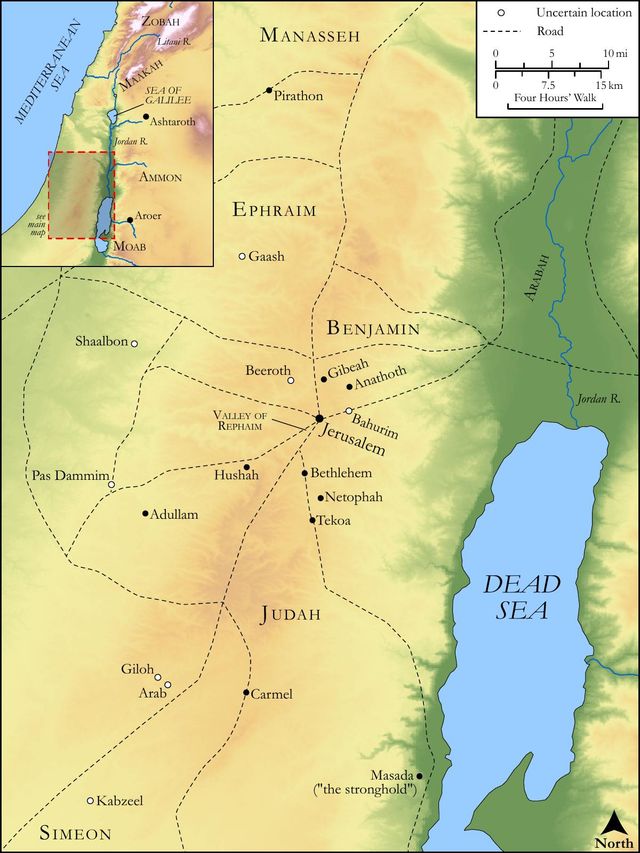
See on the biblical-era map
Study this verse
Public-domain commentary
Matthew Henry
From his Commentary on the Whole Bible. Henry comments on passages, not single verses — this entry covers 1 Chronicles 11:10–47. His two-level outline is real structure in the source text, so it is rendered as structure.
We have here an account of David's worthies, the great men of his time that served him and were preferred by him. The first edition of this catalogue we had, Sa2 23:8, etc. This is much the same, only that those named here from Ch1 11:41 to the end are added. Observe,
I.The connexion of this catalogue with that which is said concerning David, Ch1 11:9.
1.David waxed greater and greater, and these were his mighty men. Much of the strength and honour of great men is borrowed from their servants and depends upon them, which cannot but somewhat diminish pomp and power in the opinion of those that are wise. David is great because he has great men about him; take these away, and he is where he was.
2.The Lord of hosts was with him, and these were the mighty men which he had. God was with him and wrought for him, but by men and means and the use of second causes. By this it appeared that God was with him, that he inclined the hearts of those to come over to him that were able to serve his interest. As, if God be for us none can be against us, so, if God be for us, all shall be for us that we have occasion for. Yet David ascribed his success and increase, not to the hosts he had, but to the Lord of hosts, not to the mighty men that were with him, but to the mighty God whose presence with us is all in all.
II.The title of this catalogue (Ch1 11:10):
These are the men who strengthened themselves with him. In strengthening him they strengthened themselves and their own interest; for his advancement was theirs. What we do in our places for the support of the kingdom of the Son of David we shall be gainers by. In strengthening it we strengthen ourselves. It may be read, They held strongly with him and with all Israel. Note, When God has work to do he will not want fit instruments to do it with. If it be work that requires mighty men, mighty men shall either be found or made to effect it, according to the word of the Lord.
III.That which made all these men honourable was the good service that they did to their king and country; they helped to make David king (Ch1 11:10) - a good work. They slew the Philistines, and other public enemies, and were instrumental to save Israel. Note, The way to be great is to do good. Nor did they gain this honour without labour and the hazard of their lives. The honours of Christ's kingdom are prepared for those that fight the good fight of faith, that labour and suffer, and are willing to venture all, even life itself, for Christ and a good conscience. It is by a patient continuance in well-doing that we must seek for glory, and honour, and immortality; and those that are faithful to the Son of David shall find their names registered and enrolled much more to their honour than these are in the records of fame.
IV.Among all the great exploits of David's mighty men, here is nothing great mentioned concerning David himself but his pouring out water before the Lord which he had longed for, Ch1 11:18, Ch1 11:19. Four very honourable dispositions of David appeared in that action, which, for aught I know, made it as great as any of the achievements of those worthies.
1.Repentance for his own weakness. It is really an honour to a man, when he is made sensible that he has said or done any thing unadvisedly, to unsay it and undo it again by repentance, as it is a shame to a man when he has said or done amiss to stand to it.
2.Denial of his own appetite. He longed for the water of the well of Bethlehem; but, when he had it, he would not drink it, because he would not so far humour himself and gratify a foolish fancy. He that has such a rule as this over his own spirit is better than the mighty. It is an honour to a man to have the command of himself; but he that will command himself must sometimes cross himself.
3.Devotion towards God. That water which he thought too good, too precious, for his own drinking, he poured out to the Lord for a drink offering. If we have any thing better than another, let God be honoured with it, who is the best, and should have the best.
4.Tenderness of his servants. It put him into the greatest confusion imaginable to think that three brave men should hazard their lives to fetch water for him. In his account it turns the water into blood. It is the honour of great men not to be prodigal of the blood of those they employ, but, in all the commands they give them, to put their own souls into their souls' stead.
V.In the wonderful achievements of these heroes the power of God must be acknowledged.
How could one slay 300 and another the same number (Ch1 11:11, Ch1 11:20), another two lion-like men (Ch1 11:22), and another an Egyptian giant (Ch1 11:23), if they had not had the extraordinary presence of God with them, according to that promise, Jos 23:10, One man of you shall chase a thousand, for the Lord your God fighteth for you?
VI.One of these worthies is said to be an Ammonite (Ch1 11:39), another a Moabite (Ch1 11:46), and yet the law was that an Ammonite and a Moabite should not enter into the congregation of the Lord, Deu 23:3. These, it is likely, had approved themselves so hearty for the interest of Israel that in their case it was thought fit to dispense with that law, and the rather because it was an indication that the Son of David would have worthies among the Gentiles: with him there is neither Greek nor Jew.
Historical interpretation
Historical reception
1 surviving comment on this verse from the historical church.
Two ariels: That is, two lions, or lion-like men; for Ariel in Hebrew signifies a lion.
Continue studying 1 Chronicles 11:22 across the web’s major study libraries — every link below opens this exact verse, chapter, or book on the destination site.
Read & Compare
 BibleGatewayThis verse in more than 200 translations and 70 languages.
 Bible.comThe YouVersion reader — hundreds of translations, reading plans, and highlights.
 ESV.orgCrossway's official English Standard Version reader.
 NET BibleThe NET translation with 60,000+ translators' notes on every rendering decision.
 STEP BibleTyndale House's free study tool — original text, vocabulary, and scholarly resources.
 BibliaLogos Bible Software's free web reader.
 USCCBThe New American Bible (Revised Edition) with the U.S. bishops' study notes.
Commentaries
 BibleHub CommentariesDozens of classic commentaries on this verse, gathered on one page.
 StudyLightMore than 100 commentary sets — the largest collection on the web.
 BibleRefPlain-English commentary on what this verse means, verse by verse.
 Enduring WordDavid Guzik's free commentary on this chapter, widely used by Bible teachers.
 Bible Study ToolsVerse commentary alongside Greek and Hebrew study aids.
Original Language & Research
- BibleHub InterlinearThe verse word by word — original language, transliteration, and English.
- BibleHub LexiconEvery word's original-language definition and Strong's entry.
 Blue Letter BibleDeep-study tools — Strong's numbers, concordance, and word studies.
 SefariaThe Hebrew text with Rashi and centuries of Jewish commentary.
Sermons, Hymns & Audio


TrulyRandomVerse is not affiliated with these sites and doesn’t control their content. They’re linked because they’re genuinely useful.
Summary
1 Chronicles 11:22 introduces Benaiah, the son of Jehoiada, as a warrior of unparalleled valor and capability within King David's elite fighting force. This verse specifically highlights two extraordinary feats that exemplify his exceptional strength and courage: single-handedly slaying two formidable "lionlike men" from Moab and, on a separate occasion, descending into a pit on a snowy day to kill a literal lion. These remarkable acts underscore his unique distinction among David's mighty men, portraying him as a figure of profound bravery, tenacity, and unwavering determination, setting him apart even within an already distinguished group.
Context
ShowHideLiterary Context
This verse is strategically placed within 1 Chronicles 11-12, a pivotal section that documents the establishment of David's reign in Jerusalem and, crucially, enumerates his "mighty men." These elite warriors were indispensable in consolidating David's kingdom, and their detailed inclusion serves to legitimate his rule, highlight the divine favor upon him through the strength of his supporters, and provide inspiring examples of loyalty. The Chronicler, addressing a post-exilic audience, emphasizes the enduring nature of God's covenant with David and the importance of faithful leadership, often conveyed through genealogies and lists of key figures who embodied these virtues. Benaiah is consistently presented as a top-tier warrior, frequently mentioned alongside the "Three" and "Thirty" mighty men, underscoring his enduring significance in David's inner circle and his later critical role as chief commander under Solomon, as detailed in 1 Kings 2:35. The detailed accounts of their valor, such as Benaiah's, function not merely as historical records but as powerful narratives of unwavering loyalty and strength in dedicated service to God's anointed king, echoing the broader themes of divine providence and human faithfulness found throughout 2 Samuel 23.
Historical & Cultural Context
The setting for Benaiah's exploits is the nascent period of David's unified monarchy, a time characterized by continuous military campaigns aimed at securing Israel's borders and asserting its dominance over surrounding nations. Moab, a perennial and often formidable adversary of Israel, represented a significant threat, and their "lionlike men" would have been renowned, exceptionally powerful warriors. The culture of ancient Israel, like that of the nations round about, highly esteemed military prowess, personal bravery, and martial skill, particularly when demonstrated in service to the king and the nation. Feats like Benaiah's were not merely acts of individual heroism but contributed significantly to the collective identity, morale, and reputation of the army and the kingdom. The specific detail of slaying a lion "in a pit in a snowy day" is particularly evocative, painting a vivid picture of extreme environmental conditions and the unexpected, primal dangers faced by warriors. Lions were a real and present danger in the land, as the lion David slew while keeping his father's sheep shows, symbolizing raw power, ferocity, and untamed wildness. Confronting one in a confined space, compounded by harsh weather, would have been an act of extraordinary courage, skill, and physical might, far exceeding typical military engagements and elevating Benaiah to legendary status.
Key Themes
ShowHideThe account of Benaiah's exploits in 1 Chronicles 11:22 powerfully contributes to several overarching themes present in the book of Chronicles. Firstly, it vividly illustrates Exceptional Valor and Strength. His actions transcend ordinary bravery, showcasing a rare combination of physical might, tactical skill, and unwavering determination. Slaying "lionlike men" implies overcoming immensely powerful and fierce human opponents, while the solo act of killing a lion in a pit on a snowy day highlights his unique tenacity in the face of overwhelming odds and adverse, even treacherous, conditions. Secondly, Benaiah's deeds exemplify Loyalty and Dedicated Service to the Davidic kingdom. These acts of heroism were not performed for personal glory but were undertaken in devoted service to King David and the nation of Israel, contributing directly to the security and stability of God's chosen king. His unwavering commitment is further evidenced by his consistent prominence in the lists of David's mighty men and his subsequent crucial promotion under Solomon, as referenced in 1 Kings 2:35. Lastly, while not explicitly stated, the extraordinary nature of Benaiah's feats often implies Divine Empowerment. In biblical narratives, such seemingly impossible acts of strength and courage, particularly against overwhelming odds, are frequently presented as a testament to God working powerfully through individuals, enabling them to achieve what is humanly impossible, reflecting a principle of divine enablement found in passages like Philippians 4:13.
Exposition and Analysis
ShowHideKey Word Analysis
ShowHideThis word denotes a force, whether of men, means, or other resources. It encompasses strength, might, wealth, and valor. When applied to a person, especially in the phrase "man of valor" (Hebrew: ish chayil), it signifies not only physical prowess and military capability but also often implies moral integrity, courage, and a person of significant standing or influence within the community. In Benaiah's father's case, it establishes a lineage of strength and character, suggesting Benaiah inherited or was raised in an environment that fostered these exceptional qualities.
This term literally means "lion of God" or "hero of God." It suggests individuals of immense strength, ferocity, and perhaps even divine or heroic status, akin to lions. This term emphasizes the formidable nature of Benaiah's opponents, portraying them as exceptionally dangerous and powerful warriors. It might refer to exceptionally strong individuals, or it could even be a proper name or title of a specific Moabite elite unit or cultic figures associated with a lion deity.
This word refers to a cistern, well, or dungeon—a confined, often deep, and inescapable space. The detail of the lion being in a pit significantly increases the danger and difficulty of the encounter. It removes the possibility of escape or maneuver, transforming the confrontation into a direct, unavoidable, and highly perilous close-quarters combat. This detail serves to further magnify Benaiah's bravery, skill, and unwavering resolve in the face of extreme peril.
Verse Breakdown
ShowHide"Benaiah the son of Jehoiada, the son of a valiant man of Kabzeel"
This opening clause precisely identifies Benaiah by his distinguished lineage and place of origin. His father, Jehoiada, is described as a "valiant man" from Kabzeel, a town located in southern Judah. This familial description immediately establishes Benaiah's strong background and reputation, suggesting he hailed from a family renowned for its strength, courage, or perhaps its wealth and influence, thereby setting the stage for his own remarkable deeds.
"who had done many acts"
This phrase serves as a general commendation, indicating that Benaiah was already a renowned figure with a history of numerous heroic deeds before the specific examples are recounted. It sets the stage for the extraordinary feats that follow, confirming his established status as a truly exceptional and accomplished warrior among David's elite.
"he slew two lionlike men of Moab"
This describes Benaiah's first specific and highly impressive feat. The "lionlike men" from Moab denote exceptionally fierce, powerful, and perhaps even legendary adversaries, possibly elite warriors or champions of their nation. Benaiah's ability to single-handedly defeat two such formidable opponents highlights his superior combat skill, immense physical strength, and profound courage against significant and dangerous odds.
"also he went down and slew a lion in a pit in a snowy day"
This second, even more vivid and dramatic feat, showcases Benaiah's unparalleled bravery, tenacity, and unique skill. Descending into a confined pit to confront a lion—a creature universally recognized as a symbol of raw power, danger, and untamed ferocity—demonstrates incredible, almost reckless, courage. The additional detail "in a snowy day" adds a layer of extreme conditions, implying treacherous footing, biting cold, and reduced visibility, all of which would make the act even more remarkable and emphasize Benaiah's unyielding determination to overcome all obstacles, natural or otherwise.
Literary Devices
ShowHideThe Chronicler masterfully employs several Literary Devices to magnify Benaiah's heroic stature and impress upon the reader his extraordinary capabilities. Hyperbole is evident in the description of "lionlike men," which, whether interpreted literally as exceptionally fierce warriors or metaphorically as men embodying leonine strength, emphasizes the extreme ferocity and formidable nature of his opponents, thereby dramatically elevating Benaiah's victory. Imagery is powerfully used, particularly with the phrase "a lion in a pit in a snowy day." This vivid and sensory detail creates a striking mental picture, immersing the reader in the harsh, confined, and perilous conditions of Benaiah's solo encounter. The Specific Detail of the "snowy day" is not incidental; it serves to underscore the extraordinary nature of the feat, highlighting Benaiah's willingness to face danger under the most adverse and uncomfortable circumstances. Furthermore, the narrative employs Characterization by Action, allowing Benaiah's deeds to speak volumes about his courage, skill, and unwavering determination, rather than simply stating that he was brave. This method of portrayal makes his heroism more impactful, memorable, and enduring, solidifying his reputation as one of David's most formidable and distinguished warriors.
Theological and Thematic Connections
ShowHideBenaiah's extraordinary valor, though rooted in human strength and skill, resonates with deeper theological truths about divine enablement and the nature of courage in God's service. His willingness to confront overwhelming odds—whether "lionlike men" or a literal lion in a pit—serves as a powerful illustration of the kind of faith and courage that God often calls His people to exhibit. While Benaiah's actions were for the earthly kingdom of David, they reflect a profound principle that God empowers individuals to accomplish seemingly impossible tasks when they are aligned with His purposes and when they act with unwavering trust. His strength was not merely physical but indicative of a spirit that did not shrink from danger or adverse conditions, a quality that believers are continually encouraged to cultivate in their spiritual battles and dedicated service to God's kingdom. His story reminds us that true courage is not the absence of fear, but the resolve to act despite it, trusting in a greater power.
Reflection and Application
ShowHideBenaiah's story in 1 Chronicles 11:22 offers timeless and profound lessons for believers today, transcending its historical context to speak to contemporary challenges. His willingness to face "lionlike men" and a literal lion in a pit on a snowy day speaks volumes about the nature of true courage—it is not the absence of fear, but the resolute determination to act despite it, especially when conditions are most challenging and the odds seem insurmountable. In our spiritual lives, we frequently encounter "lions" in the form of temptations, overwhelming adversities, spiritual opposition, or even personal doubts that seek to devour our faith and hinder our progress. Benaiah's example calls us to confront these challenges head-on, not relying solely on our own limited strength but on the divine empowerment that enables us to overcome what seems humanly impossible. His unwavering dedication to King David also serves as a powerful reminder to commit our unique talents, strengths, and resources to a greater, God-given purpose, serving God's kingdom and His people with unwavering loyalty and integrity. Just as Benaiah's exceptional deeds contributed significantly to the security and flourishing of David's earthly reign, our acts of faith, courage, and selfless service, however small or seemingly insignificant, contribute to the advancement of God's eternal kingdom and bring glory to His name.
Questions for Reflection
ShowHideFAQ
ShowHideWhat is the significance of "lionlike men of Moab"?
ShowHideThe "lionlike men of Moab" (Hebrew: ari'el) are significant for several compelling reasons. Firstly, the phrase powerfully emphasizes the formidable nature of Benaiah's opponents. Moab was a historical and often hostile adversary of Israel, and these men were likely renowned warriors, perhaps champions or an elite fighting unit, whose ferocity and strength were compared to that of lions—the apex predator of the land. This comparison highlights the extreme danger Benaiah faced and the exceptional skill, courage, and physical prowess required to defeat them. Secondly, some scholars suggest that ari'el could be a proper name or a title, possibly even referring to cultic figures associated with a lion deity in Moabite religion. Regardless of the precise interpretation, the phrase underscores that Benaiah was not merely fighting ordinary soldiers but overcoming truly exceptional, dangerous, and perhaps even mythic adversaries, further cementing his reputation as a warrior of unparalleled might and distinction.
Why is the detail "in a snowy day" included when Benaiah slew the lion?
ShowHideThe detail "in a snowy day" is crucial for amplifying the extraordinary nature of Benaiah's feat and elevating it to legendary status. It adds a layer of extreme difficulty, adverse conditions, and unexpected peril to an already life-threatening situation. Snow would have made the ground slippery and treacherous, particularly in a confined pit, hindering movement and footing. It would also have reduced visibility and added the element of biting cold, all of which would severely impede combat effectiveness and increase the overall danger. Confronting a powerful and ferocious predator like a lion in a confined space is already an act of immense bravery and skill; doing so under such harsh and debilitating environmental circumstances elevates Benaiah's courage, tenacity, and unwavering resolve to a truly remarkable level. It paints a vivid picture of a warrior who does not shrink from the most challenging, uncomfortable, and perilous circumstances, further distinguishing him among David's already mighty men.
Christ-Centered Fulfillment
ShowHideBenaiah's heroic acts, particularly his triumph over "lionlike men" and a literal lion in a pit, serve as a powerful Old Testament foreshadowing of Christ's ultimate and decisive victory over the forces of evil. Just as Benaiah confronted and conquered formidable earthly adversaries and dangerous beasts, Jesus, the true and greater "valiant man," faced and decisively defeated the ultimate spiritual "lion"—Satan, who "prowls around like a roaring lion looking for someone to devour" (1 Peter 5:8). Christ's victory on the cross and His glorious resurrection was not merely over human enemies but over sin, death, and the devil, disarming the powers and authorities and triumphing over them (Colossians 2:15). Benaiah's unwavering loyalty and dedicated service to King David, securing his earthly kingdom and ensuring its stability, beautifully prefigure Christ's perfect obedience to the Father, establishing an eternal and unshakable kingdom that will never end (Luke 1:33). In Christ, we find the ultimate fulfillment of courage, strength, and unwavering dedication, as He is the one who has conquered all "pits" of darkness, despair, and death, leading His people to ultimate triumph and eternal life, securing a victory that surpasses all human understanding (John 16:33).