


1 Chronicles 11:23
Bible text: King James Version (1769 Blayney text) · Public domain
Bible text: King James Version with Strong's numbers · Public domain
Bible text: Berean Standard Bible · Public domain
Bible text: American Standard Version (1901) · Public domain
Bible text: World English Bible, Messianic edition · Public domain
Bible text: Geneva Bible (1599) · Public domain
Bible text: Young's Literal Translation · Public domain
- וְהוּאve·hu'and heH1931Conj-w ¦ Pro-3msPronoun Personal 3rd Singular Masculineוְandהוּאhe
- הִכָּהhi·Kahhe struck downH5221V-Hiphil-Perf-3msVerb Hiphil Perfect 3rd Singular Masculine
- אֶת'et<obj.>H853DirObjMParticle Object Indicator
- הָאִישׁha·'Ishthe manH376Art ¦ N-msNoun Singular Masculine Absoluteהָtheאִישׁman
- הַמִּצְרִיha·mitz·Ri<the> EgyptianH4713Art ¦ N-msNoun Gentilic Singular Masculine Absoluteהַ<the>מִּצְרִיEgyptian
- אִישׁ'isha man ofH376N-mscNoun Singular Masculine Construct
- מִדָּהmi·DahstatureH4060N-fsNoun Singular Feminine Absolute
- חָמֵשׁcha·MeshfiveH2568N-csNoun Singular common gender Absolute
- בָּאַמָּהba·'a·Mahby the cubitH520Prep-b ¦ N-fsNoun Singular Feminine Absoluteבָּby theאַמָּהcubit
- וּבְיַדu·ve·Yadand [was] in [the] hand ofH3027Conj-w ¦ Prep-b ¦ N-cscNoun Singular common gender Constructוּandבְ[was] inיַד[the] hand of
- הַמִּצְרִיha·mitz·Rithe EgyptianH4713Art ¦ N-msNoun Gentilic Singular Masculine AbsoluteהַtheמִּצְרִיEgyptian
- חֲנִיתcha·Nita spearH2595N-fsNoun Singular Feminine Absolute
- כִּמְנוֹרkim·Norlike a beam ofH4500Prep-k ¦ N-mscNoun Singular Masculine Constructכִּlikeמְנוֹרa beam of
- אֹרְגִים'o·re·GimweaversH707V-Qal-Prtcpl-mpVerb Qal Participle Plural Masculine Absolute
- וַיֵּרֶדvai·Ye·redand he went downH3381Conj-w ¦ V-Qal-ConsecImperf-3msVerb Qal Consecutive Imperfect 3rd Singular Masculineוַandיֵּרֶדhe went down
- אֵלָיו'e·Lavto himH413Prep ¦ 3msPrepositionאֵלָיtoוhim
- בַּשָּׁבֶטba·Sha·vetwith the clubH7626Prep-b ¦ N-msNoun Singular Masculine Absoluteבַּwith theשָּׁבֶטclub
- וַיִּגְזֹלvai·yig·Zoland he tore awayH1497Conj-w ¦ V-Qal-ConsecImperf-3msVerb Qal Consecutive Imperfect 3rd Singular Masculineוַandיִּגְזֹלhe tore away
- אֶת'et<obj.>H853DirObjMParticle Object Indicator
- הַחֲנִיתha·cha·Nitthe spearH2595Art ¦ N-fsNoun Singular Feminine Absoluteהַtheחֲנִיתspear
- מִיַּדmi·Yadfrom [the] hand ofH3027Prep-m ¦ N-cscNoun Singular common gender Constructמִfromיַּד[the] hand of
- הַמִּצְרִיha·mitz·Rithe EgyptianH4713Art ¦ N-msNoun Gentilic Singular Masculine AbsoluteהַtheמִּצְרִיEgyptian
- וַיַּהַרְגֵהוּvai·ya·har·Ge·huand he killed himH2026Conj-w ¦ V-Qal-ConsecImperf-3ms ¦ 3msVerb Qal Consecutive Imperfect 3rd Singular Masculineוַandיַּהַרְגֵhe killedהוּhim
- בַּחֲנִיתוֹba·cha·ni·Towith his own spearH2595Prep-b ¦ N-fsc ¦ 3msNoun Singular Feminine Constructבַּwithחֲנִיתown spearוֹhis
English is a literal word-by-word gloss of the Hebrew, not the KJV's wording. Why?
This is the original text the KJV's translators worked from — each Hebrew word with its own literal English meaning in this verse, prepared by scholars at Tyndale House, Cambridge. The KJV translates whole sentences, not word by word, so its wording differs: one Hebrew word can become several English words, and the KJV may choose “the LORD” where the gloss reads “Yahweh”. Both are faithful — they answer different questions. For the KJV's own rendering, switch to the KJV text.
Details
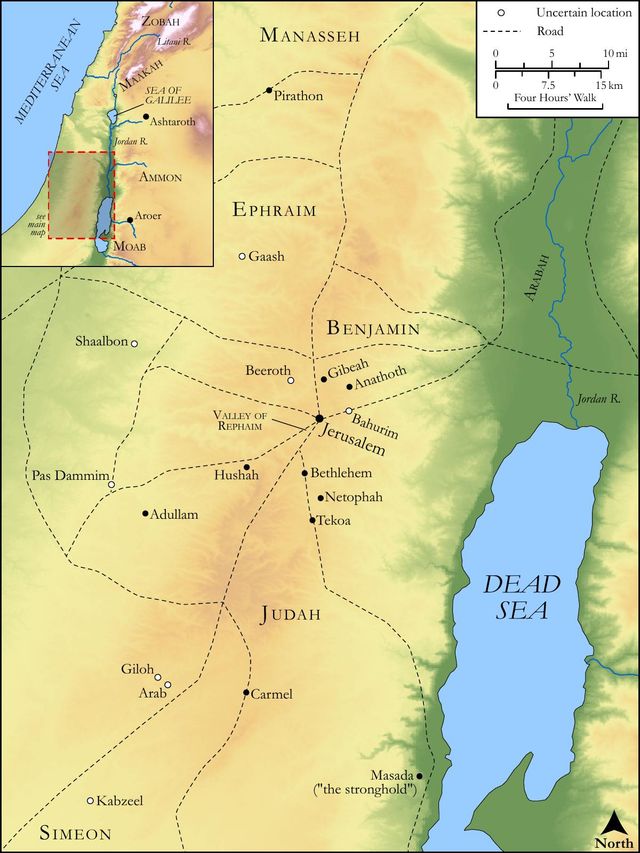
See on the biblical-era map
Study this verse
Public-domain commentary
Matthew Henry
From his Commentary on the Whole Bible. Henry comments on passages, not single verses — this entry covers 1 Chronicles 11:10–47. His two-level outline is real structure in the source text, so it is rendered as structure.
We have here an account of David's worthies, the great men of his time that served him and were preferred by him. The first edition of this catalogue we had, Sa2 23:8, etc. This is much the same, only that those named here from Ch1 11:41 to the end are added. Observe,
I.The connexion of this catalogue with that which is said concerning David, Ch1 11:9.
1.David waxed greater and greater, and these were his mighty men. Much of the strength and honour of great men is borrowed from their servants and depends upon them, which cannot but somewhat diminish pomp and power in the opinion of those that are wise. David is great because he has great men about him; take these away, and he is where he was.
2.The Lord of hosts was with him, and these were the mighty men which he had. God was with him and wrought for him, but by men and means and the use of second causes. By this it appeared that God was with him, that he inclined the hearts of those to come over to him that were able to serve his interest. As, if God be for us none can be against us, so, if God be for us, all shall be for us that we have occasion for. Yet David ascribed his success and increase, not to the hosts he had, but to the Lord of hosts, not to the mighty men that were with him, but to the mighty God whose presence with us is all in all.
II.The title of this catalogue (Ch1 11:10):
These are the men who strengthened themselves with him. In strengthening him they strengthened themselves and their own interest; for his advancement was theirs. What we do in our places for the support of the kingdom of the Son of David we shall be gainers by. In strengthening it we strengthen ourselves. It may be read, They held strongly with him and with all Israel. Note, When God has work to do he will not want fit instruments to do it with. If it be work that requires mighty men, mighty men shall either be found or made to effect it, according to the word of the Lord.
III.That which made all these men honourable was the good service that they did to their king and country; they helped to make David king (Ch1 11:10) - a good work. They slew the Philistines, and other public enemies, and were instrumental to save Israel. Note, The way to be great is to do good. Nor did they gain this honour without labour and the hazard of their lives. The honours of Christ's kingdom are prepared for those that fight the good fight of faith, that labour and suffer, and are willing to venture all, even life itself, for Christ and a good conscience. It is by a patient continuance in well-doing that we must seek for glory, and honour, and immortality; and those that are faithful to the Son of David shall find their names registered and enrolled much more to their honour than these are in the records of fame.
IV.Among all the great exploits of David's mighty men, here is nothing great mentioned concerning David himself but his pouring out water before the Lord which he had longed for, Ch1 11:18, Ch1 11:19. Four very honourable dispositions of David appeared in that action, which, for aught I know, made it as great as any of the achievements of those worthies.
1.Repentance for his own weakness. It is really an honour to a man, when he is made sensible that he has said or done any thing unadvisedly, to unsay it and undo it again by repentance, as it is a shame to a man when he has said or done amiss to stand to it.
2.Denial of his own appetite. He longed for the water of the well of Bethlehem; but, when he had it, he would not drink it, because he would not so far humour himself and gratify a foolish fancy. He that has such a rule as this over his own spirit is better than the mighty. It is an honour to a man to have the command of himself; but he that will command himself must sometimes cross himself.
3.Devotion towards God. That water which he thought too good, too precious, for his own drinking, he poured out to the Lord for a drink offering. If we have any thing better than another, let God be honoured with it, who is the best, and should have the best.
4.Tenderness of his servants. It put him into the greatest confusion imaginable to think that three brave men should hazard their lives to fetch water for him. In his account it turns the water into blood. It is the honour of great men not to be prodigal of the blood of those they employ, but, in all the commands they give them, to put their own souls into their souls' stead.
V.In the wonderful achievements of these heroes the power of God must be acknowledged.
How could one slay 300 and another the same number (Ch1 11:11, Ch1 11:20), another two lion-like men (Ch1 11:22), and another an Egyptian giant (Ch1 11:23), if they had not had the extraordinary presence of God with them, according to that promise, Jos 23:10, One man of you shall chase a thousand, for the Lord your God fighteth for you?
VI.One of these worthies is said to be an Ammonite (Ch1 11:39), another a Moabite (Ch1 11:46), and yet the law was that an Ammonite and a Moabite should not enter into the congregation of the Lord, Deu 23:3. These, it is likely, had approved themselves so hearty for the interest of Israel that in their case it was thought fit to dispense with that law, and the rather because it was an indication that the Son of David would have worthies among the Gentiles: with him there is neither Greek nor Jew.
Continue studying 1 Chronicles 11:23 across the web’s major study libraries — every link below opens this exact verse, chapter, or book on the destination site.
Read & Compare
 BibleGatewayThis verse in more than 200 translations and 70 languages.
 Bible.comThe YouVersion reader — hundreds of translations, reading plans, and highlights.
 ESV.orgCrossway's official English Standard Version reader.
 NET BibleThe NET translation with 60,000+ translators' notes on every rendering decision.
 STEP BibleTyndale House's free study tool — original text, vocabulary, and scholarly resources.
 BibliaLogos Bible Software's free web reader.
 USCCBThe New American Bible (Revised Edition) with the U.S. bishops' study notes.
Commentaries
 BibleHub CommentariesDozens of classic commentaries on this verse, gathered on one page.
 StudyLightMore than 100 commentary sets — the largest collection on the web.
 BibleRefPlain-English commentary on what this verse means, verse by verse.
 Enduring WordDavid Guzik's free commentary on this chapter, widely used by Bible teachers.
 Bible Study ToolsVerse commentary alongside Greek and Hebrew study aids.
Original Language & Research
- BibleHub InterlinearThe verse word by word — original language, transliteration, and English.
- BibleHub LexiconEvery word's original-language definition and Strong's entry.
 Blue Letter BibleDeep-study tools — Strong's numbers, concordance, and word studies.
 SefariaThe Hebrew text with Rashi and centuries of Jewish commentary.
Sermons, Hymns & Audio


TrulyRandomVerse is not affiliated with these sites and doesn’t control their content. They’re linked because they’re genuinely useful.
Summary
1 Chronicles 11:23 powerfully narrates one of Benaiah son of Jehoiada's most remarkable exploits, showcasing his extraordinary courage and ingenuity among King David's elite "mighty men." The verse details his audacious confrontation with an Egyptian giant of formidable stature, armed with a massive spear. Approaching with only a staff, Benaiah skillfully disarmed the giant and, with a stunning reversal, slew him with his own weapon. This concise yet vivid account underscores Benaiah's unparalleled combat prowess, strategic brilliance, and the divine enablement that characterized David's most trusted champions, cementing his place as a legendary warrior.
Context
ShowHideLiterary Context
This verse is strategically placed within 1 Chronicles 11:10-47, a comprehensive and laudatory register of King David's most distinguished warriors, often referred to as his "mighty men." The Chronicler's primary purpose in compiling this detailed roster is not merely historical record-keeping but theological legitimation: to underscore the divine favor bestowed upon David's reign and the exceptional individuals God raised up to establish and protect his kingdom. Benaiah's individual feats are introduced in 1 Chronicles 11:22, which precedes this specific account, enumerating his other impressive accomplishments, such as slaying two "lion-like men of Moab" and a lion in a pit on a snowy day. The narrative of Benaiah's victory over the Egyptian giant finds a parallel in 2 Samuel 23:21, affirming its historical significance and its place within the broader biblical narrative of Israel's military history and the consolidation of David's throne. These accounts collectively serve to highlight the caliber of men serving God's anointed king and the divine hand in their victories.
Historical & Cultural Context
The events described unfold during the early united monarchy under King David, a period marked by significant military expansion, territorial consolidation, and the establishment of Israel as a regional power. In this era, the strength and prowess of a king's army, particularly his elite personal guard, were crucial for maintaining control, deterring adversaries, and executing divine mandates. The presence of "giants" or men of unusual stature and strength was a recurring motif in Scripture, as with the sons of Anak and the Rephaim, often representing formidable, seemingly invincible foes who posed existential threats to communities. The "Egyptian" opponent is significant, as Egypt was a powerful and often rival empire, making a victory over one of its champions particularly noteworthy. The description of the giant's weapon, "a spear like a weaver's beam," is not hyperbole but reflects the reality of massive, heavy weapons used in ancient warfare, designed for maximum destructive impact. Benaiah's approach with a "staff" dramatically highlights the stark contrast in weaponry, emphasizing his audacious courage, reliance on agility and skill over brute force, and perhaps a spiritual trust reminiscent of earlier biblical accounts of seemingly mismatched combatants, such as David and Goliath.
Key Themes
ShowHideThe narrative of Benaiah's triumph over the Egyptian giant contributes significantly to several overarching themes within 1 Chronicles and the broader biblical canon. Foremost among these is Exceptional Valor and Courage, as Benaiah willingly confronts a physically overwhelming adversary with seemingly inadequate weaponry, demonstrating a fearless spirit that defies conventional military logic. This act also powerfully underscores Resourcefulness and Skill, as Benaiah's ingenious strategy of disarming the giant and using the enemy's own weapon against him showcases remarkable tactical prowess, quick thinking, and adaptability. This echoes the strategic victory seen in David's triumph over Goliath, where a seemingly weaker opponent overcomes a superior foe through unconventional means and divine enablement. Ultimately, the story highlights the theme of Overcoming Overwhelming Odds, portraying Benaiah's victory as a testament to the power of determination, skill, and, implicitly, the divine favor that empowers God's chosen instruments to achieve the seemingly impossible. Such narratives bolster the Chronicler's message that God is actively with David and his kingdom, granting them victory against all adversaries.
Exposition and Analysis
ShowHideKey Word Analysis
ShowHideThe term מִדָּה (middâh) refers to a measurement or dimension, specifically indicating height in this context. Describing the Egyptian as a "man of great stature, five cubits high" (approximately 7.5 feet or 2.3 meters) immediately establishes the immense physical challenge Benaiah faced. This detail is crucial for appreciating the magnitude of Benaiah's achievement, emphasizing the extraordinary physical disparity and setting the stage for a dramatic display of courage and skill against overwhelming odds. The word underscores the quantifiable and formidable nature of the opponent.
The verb גָּזַל (gâzal) means "to pluck off," "strip," or "rob," often implying force or violence. In the context of Benaiah "plucking the spear out of the Egyptian's hand," this word conveys the swiftness, decisiveness, and forceful nature of his action. It highlights Benaiah's incredible agility and strength, enabling him to seize a formidable weapon from a giant. This is the pivotal moment of reversal, where Benaiah actively takes control of the battle by disarming his opponent, rather than merely reacting.
The verb הָרַג (hârag) means "to smite with deadly intent," "kill," or "slay." This word signifies the decisive and final outcome of the confrontation. Benaiah's act of slaying the Egyptian with his own spear underscores the completeness of his victory and the poetic justice of the situation. It conveys the lethal effectiveness of Benaiah's counter-attack, ensuring the formidable foe was utterly defeated.
Verse Breakdown
ShowHide"And he slew an Egyptian, a man of [great] stature, five cubits high;"
This opening clause immediately establishes the central action and introduces the two main figures: Benaiah (implied as "he") and his formidable adversary, an Egyptian. The description of the Egyptian's "great stature" and precise height of "five cubits" (approximately 7.5 feet or 2.3 meters) instantly conveys the immense physical disparity between the combatants. This detail is crucial for setting the stage, highlighting the "giant" quality of the foe and emphasizing the extraordinary nature of Benaiah's impending victory, which will defy conventional expectations of strength.
"and in the Egyptian's hand [was] a spear like a weaver's beam;"
This clause further amplifies the overwhelming advantage held by the Egyptian, not only in size but also in armament. The vivid simile "like a weaver's beam" powerfully describes the spear as exceptionally large, heavy, and unwieldy, suggesting it was a weapon of devastating power that only a giant could wield effectively. This detail intensifies the perceived invincibility of the Egyptian and underscores the sheer audacity and courage required for Benaiah to confront him.
"and he went down to him with a staff, and plucked the spear out of the Egyptian's hand, and slew him with his own spear."
This final, climactic clause details Benaiah's audacious and ingenious strategy, bringing the narrative to its dramatic conclusion. Approaching a giant armed with a massive spear with only a "staff" demonstrates unparalleled courage, tactical brilliance, and perhaps a reliance on agility and cunning over brute force. The act of "plucking the spear out of the Egyptian's hand" is the turning point, showcasing Benaiah's incredible skill, speed, and decisive action in disarming his formidable opponent. The ultimate irony and triumph come in the final, decisive act: Benaiah "slew him with his own spear," turning the enemy's strength and weapon against him. This sequence highlights Benaiah's resourcefulness, the completeness of his victory, and the dramatic reversal of power.
Literary Devices
ShowHideThe narrative in 1 Chronicles 11:23 masterfully employs several literary devices to amplify the drama and significance of Benaiah's extraordinary feat. Contrast is central to the verse, vividly depicted in the stark difference between the Egyptian's immense stature and massive "spear like a weaver's beam" and Benaiah's seemingly humble "staff." This highlights the seemingly insurmountable odds Benaiah faced and underscores his extraordinary courage and skill. The use of Simile ("spear like a weaver's beam") is highly effective, creating a powerful and immediate visual image of the spear's formidable size and weight, making Benaiah's act of disarming the giant all the more astonishing and emphasizing the danger involved. Furthermore, the narrative employs a potent form of Irony or Poetic Justice as Benaiah ultimately slays the Egyptian with his own weapon, turning the enemy's strength and instrument of power against him. This not only showcases Benaiah's ingenuity but also serves as a thematic echo of divine reversals, where the seemingly weak overcome the strong. The entire account functions as an Encomium, a formal expression of praise and celebration for Benaiah's exceptional valor and skill, thereby contributing to the Chronicler's broader aim of glorifying David's mighty men and, by extension, David's divinely favored kingdom.
Theological and Thematic Connections
ShowHideBenaiah's extraordinary victory over the Egyptian giant is far more than a mere heroic tale; it is deeply imbued with profound theological significance, illustrating God's sovereign power to work through seemingly disadvantaged individuals to achieve remarkable triumphs. This narrative speaks powerfully to the theme of divine enablement, where human courage, skill, and strategic thinking are amplified and blessed by God's presence, allowing His servants to overcome what appears to be insurmountable opposition. It teaches that true strength is not solely physical might or superior weaponry, but often resides in faith, ingenuity, and the audacious willingness to step out against overwhelming odds, trusting in a greater, unseen power. It is a testament to the biblical principle that God often chooses the weak and ill-equipped to confound the strong, thereby demonstrating that the ultimate victory belongs to Him and redounds to His glory.
Reflection and Application
ShowHideThe vivid account of Benaiah's triumph over the Egyptian giant offers profound and enduring lessons for contemporary believers navigating the complexities of life. We, too, frequently encounter "giants" in our lives—whether they manifest as overwhelming challenges, persistent temptations, debilitating fears, seemingly insurmountable obstacles to our faith, or formidable adversaries in our spiritual journeys. Benaiah's story encourages us to confront these metaphorical giants not with despair or resignation, but with audacious courage and resourceful faith, even when our own resources seem meager, symbolized by his humble "staff." His ingenuity in disarming the giant and then turning the enemy's own weapon against him teaches us to be strategic, discerning, and adaptable in our spiritual battles, recognizing that God can empower us to turn the very things that oppose us into instruments of our victory. Ultimately, Benaiah's feat reminds us that when we step out in faith, embracing our dependence on God even against overwhelming odds, His strength can be made perfect in our weakness, enabling us to achieve what is humanly impossible. It calls us to trust in divine enablement and to remember that the battle, in its truest sense, is the Lord's.
Questions for Reflection
ShowHideFAQ
ShowHideWas the Egyptian giant related to Goliath or other giants mentioned in the Bible?
ShowHideWhile the Egyptian giant shares the characteristic of immense stature with other formidable figures in the Old Testament, such as Goliath (famously described in 1 Samuel 17) or the Rephaim, the biblical text does not explicitly state a direct familial or tribal relationship between Benaiah's Egyptian opponent and these other giants. The description of his "great stature" and specific height of "five cubits" (approximately 7.5 feet or 2.3 meters) places him within the category of exceptionally large individuals, a phenomenon attested elsewhere in Scripture. However, he is presented as distinct from the Philistine giants like Goliath or Ishbi-Benob (mentioned in 2 Samuel 21:16), who are typically associated with specific groups like the Anakim or Rephaim. The focus of 1 Chronicles 11:23 is on his individual formidable nature as an opponent and the extraordinary feat of Benaiah in overcoming him, rather than on his specific lineage or broader giant-kinship.
Christ-Centered Fulfillment
ShowHideBenaiah's remarkable victory over the Egyptian giant, where he disarms his formidable foe and slays him with his own spear, serves as a profound Old Testament type, powerfully foreshadowing the ultimate triumph of Jesus Christ over the forces of evil. Just as Benaiah confronted a physically imposing enemy with seemingly inadequate means (a staff) and ingeniously turned the enemy's strength against him, Christ confronted the spiritual giants of sin, death, and Satan with the apparent "weakness" of the cross. Through His crucifixion, which appeared to be the ultimate defeat, Jesus effectively spoiled "principalities and powers" and "made a shew of them openly, triumphing over them in it" (Colossians 2:15). He conquered death by dying, using the very "weapon" of the enemy—death itself—to destroy "him that had the power of death, that is, the devil" (Hebrews 2:14). Christ's resurrection is the ultimate demonstration of this divine reversal, where the enemy's greatest perceived victory became his greatest and most decisive defeat, securing eternal life and freedom for all who believe (Romans 6:9-10). Thus, Benaiah's courage and ingenuity in overcoming a literal giant point to the far greater victory of the Lamb of God over all spiritual adversaries, demonstrating that God's power is perfected in apparent weakness.