


1 Samuel 17:7
- וְעֵץve·chatzand [the] wood ofH6086Conj-w ¦ N-mscNoun Singular Masculine Constructוְandעֵץ[the] wood of
- חֲנִיתוֹcha·ni·Tohis spearH2595N-fsc ¦ 3msNoun Singular Feminine Constructחֲנִיתspearוֹhis
- כִּמְנוֹרkim·nOr[was] like a beam ofH4500Prep-k ¦ N-mscNoun Singular Masculine Constructכִּ[was] likeמְנוֹרa beam of
- אֹרְגִים'o·re·GimweaversH707V-Qal-Prtcpl-mpVerb Qal Participle Plural Masculine Absolute
- וְלַהֶבֶתve·la·He·vetand [the] blade ofH3852Conj-w ¦ N-fscNoun Singular Feminine Constructוְandלַהֶבֶת[the] blade of
- חֲנִיתוֹcha·ni·Tohis spearH2595N-fsc ¦ 3msNoun Singular Feminine Constructחֲנִיתspearוֹhis
- שֵׁשׁshesh[was] sixH8337N-cscNoun Singular common gender Construct
- מֵאוֹתme·'othundred<s>H3967N-fpNoun Plural Feminine Absolute
- שְׁקָלִיםshe·ka·LimshekelsH8255N-mpNoun Plural Masculine Absolute
- בַּרְזֶלbar·ZelironH1270N-msNoun Singular Masculine Absolute
- וְנֹשֵׂאve·no·Se'and [the] bearer ofH5375Conj-w ¦ V-Qal-Prtcpl-msVerb Qal Participle Singular Masculine Constructוְandנֹשֵׂא[the] bearer of
- הַצִּנָּהha·tzi·Nahthe body shieldH6793Art ¦ N-fsNoun Singular Feminine Absoluteהַtheצִּנָּהbody shield
- הֹלֵךְho·Lekh[was] walkingH1980V-Qal-Prtcpl-msVerb Qal Participle Singular Masculine Absolute
- לְפָנָיוle·fa·Nav<to> before himH6440Prep-l ¦ N-mpc ¦ 3msNoun Plural Masculine Constructלְ<to>פָנָיbeforeוhim
English is a literal word-by-word gloss of the Hebrew, not the KJV's wording. Why?
This is the original text the KJV's translators worked from — each Hebrew word with its own literal English meaning in this verse, prepared by scholars at Tyndale House, Cambridge. The KJV translates whole sentences, not word by word, so its wording differs: one Hebrew word can become several English words, and the KJV may choose “the LORD” where the gloss reads “Yahweh”. Both are faithful — they answer different questions. For the KJV's own rendering, switch to the KJV text.
Details
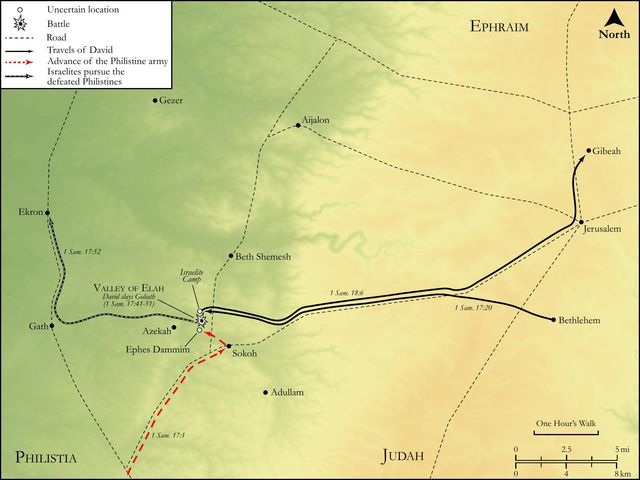
See on the biblical-era map
Study this verse
Public-domain commentary
Matthew Henry
From his Commentary on the Whole Bible. Henry comments on passages, not single verses — this entry covers 1 Samuel 17:1–11. His two-level outline is real structure in the source text, so it is rendered as structure.
It was not long ago that the Philistines were soundly beaten, and put to the worse, before Israel, and they would have been totally routed if Saul's rashness had not prevented; but here we have them making head again. Observe,
I.How they defied Israel with their armies, Sa1 17:1.
They made a descent upon the Israelites' country, and possessed themselves, as it should seem, of some part of it, for they encamped in a place which belonged to Judah. Israel's ground would never have been footing for Philistine-armies if Israel had been faithful to their God. The Philistines (it is probable) had heard that Samuel had fallen out with Saul and forsaken him, and no longer assisted and advised him, and that Saul had grown melancholy and unfit for business, and this news encouraged them to make this attempt for the retrieving of the credit they had lately lost. The enemies of the church are watchful to take all advantages, and they never have greater advantages than when her protectors have provoked God's Spirit and prophets to leave them. Saul mustered his forces, and faced them, Sa1 17:2, Sa1 17:3. And here we must take notice,
1.That the evil spirit, for the present, had left Saul, Sa1 16:23. David's harp having given him some relief, perhaps the alarms and affairs of the war prevented the return of the distemper. Business is a good antidote against melancholy. Let the mind have something without to fasten on and employ itself about, and it will be the less in danger of preying upon itself. God, in mercy to Israel, suspended the judgment for a while; for how distracted must the affairs of the public have been if at this juncture the prince had been distracted!
2.That David for the present had returned to Bethlehem, and had left the court, Sa1 17:15. When Saul had no further occasion to use him for the relief of his distemper, though, being anointed, he had a very good private reason, and, having a grant of the place of Saul's armour-bearer, he had a very plausible pretence to have continued his attendance, as a retainer to the court, yet he went home to Bethlehem, and returned to keep his father's sheep; this was a rare instance, in a young man that stood so fair for preferment, of humility and affection to his parents. He knew better than most do how to come down again after he had begun to rise, and strangely preferred the retirements of the pastoral life before all the pleasures and gaieties of the court. None more fit for honour than he, nor that deserved it better, and yet none more dead to it.
II.How they defied Israel with their champion Goliath, whom they were almost as proud of as he was of himself, hoping by him to recover their reputation and dominion. Perhaps the army of the Israelites was superior in number and strength to that of the Philistines, which made the Philistines decline a battle, and stand at bay with them, desiring rather to put the issue upon a single combat, in which, having such a champion, they hoped to gain the victory. Now concerning this champion observe,
1.His prodigious size. He was of the sons of Anak, who at Gath kept their ground in Joshua's time (Jos 11:22), and kept up a race of giants there, of which Goliath was one, and, it is probable, one of the largest. He was in height six cubits and a span, v. 4. They learned bishop Cumberland has made it out that the scripture-cubit was above twenty-one inches (above three inches more than our half-yard) and a span was half a cubit, by which computation Goliath wanted but eight inches of four yard in height, eleven feet and four inches, a monstrous stature, and which made him very formidable, especially if he had strength and spirit proportionable.
2.His armour. Art, as well as nature, made him terrible. He was well furnished with defensive armour (Sa1 17:5, Sa1 17:6): A helmet of brass on his head, a coat of mail, made of brass plates laid over one another, like the scales of a fish; and, because his legs would lie most within the reach of an ordinary man, he wore brass boots, and had a large corselet of brass about his neck. The coat is said to weigh 5000 shekels, and a shekel was half an ounce avoirdupois, a vast weight for a man to carry, all the other parts of his armour being proportionable. But some think it should be translated, not the weight of the coat, but the value of it, was 5000 shekels; so much it cost. His offensive weapons were extraordinary, of which his spear only is here described, Sa1 17:7. It was like a weaver's beam. His arm could manage that which an ordinary man could scarcely heave. His shield only, which was the lightest of all his accoutrements, was carried before him by his esquire, probably for state; for he that was clad in brass little needed a shield.
3.His challenge. The Philistines having chosen him for their champion, to save themselves from the hazard of battle, he here throws down the gauntlet, and bids defiance to the armies of Israel, Sa1 17:8-10. He came into the valley that lay between the camps, and, his voice probably being as much stronger than other people's as his arm was, he cried so as to make them all hear him, Give me a man, that we may fight together. He looked upon himself with admiration, because he was so much taller and stronger than all about him; his heart (says bishop Hall) nothing but a lump of proud flesh. He looked upon Israel with disdain, because they had none among them of such a monstrous bulk, and defies them to find a man among them bold enough to enter the list with him. (1.) He upbraids them with their folly in drawing an army together: "Why have you come to set the battle in array? How dare you oppose the mighty Philistines?" Or, "Why should the two armies engage, when the controversy may be sooner decided, with only the expense of one life and the hazard of another?" (2.) He offers to put the war entirely upon the issue of the duel he proposes: "If your champion kill me, we will be your servants; if I kill him, you shall be ours." This, says bishop Patrick, was only a bravado, for no nation would be willing thus to venture its all upon the success of one man, nor is it justifiable; notwithstanding Goliath's stipulation here, when he was killed the Philistines did not stand to his word, nor submit themselves as servants to Israel. When he boasts, I am a Philistine, and you are servants to Saul, he would have it thought a great piece of condescension in him, who was a chief ruler, to enter the lists with an Israelite; for he looked on them as no better than slaves. The Chaldee paraphrase brings him in boasting that he was the man that had killed Hophni and Phinehas and taken the ark prisoner, but that the Philistines had never given him so much as the command of a regiment in recompence of his services, whereas Saul had been made king for his services: "Let him therefore take up the challenge."
4.The terror this struck upon Israel: Saul and his army were greatly afraid, Sa1 17:11. The people would not have been dismayed but that they observed Saul's courage failed him; and it is not to be expected that, if the leader be a coward, the followers should be bold. We found before, when the Spirit of the Lord came upon Saul (Sa1 11:6), none could be more daring nor forward to answer the challenge of Nahash the Ammonite, but now that the Spirit of the Lord had departed from him even the big looks and big words of a single Philistine make him change colour. But where was Jonathan all this while? Why did not he accept the challenge, who, in the last war, had so bravely engaged a whole army of Philistines? Doubtless he did not feel himself stirred up of God to it, as he did in the former case. As the best, so the bravest men, are no more than what God makes them. Jonathan must now sit still, because the honour of engaging Goliath is reserved for David. In great and good actions, the wind of the Spirit blows when and where he listeth. Now the pious Israelites lament their king's breach with Samuel.
Historical interpretation
Three Centuries of Reception
4 surviving comments on this verse. Each one is dated, so this reads as a timeline rather than a list.
Select a marker to jump to its quote. Markers stagger vertically where authors wrote within a few decades of each other.
In my discourse I showed that Goliath was protected by the power of his weapons and the strength of a full set of armor, whereas David had none of that panoply. But he was fortified by his faith.Goliath had the external protection of his glittering breastplate and shield; David shone from within with the grace of the Spirit. This is why a boy prevailed over a man, this is why the one wearing no armor conquered the one fully armed, this is why the shepherd’s hand crushed and destroyed the bronze weapons of war.
Yet there stands Goliath, monstrous in his pride, swollen with his earthly power, confident that he can do everything by himself, with his head, hands and entire body clad in much bronze, having his own armor bearer behind him who, though he does not himself fight, nevertheless furnishes this Goliath with all kinds of aid in bronze and iron. And it is not surprising if Scripture, foreseeing our present situation, comments appropriately when it says, “The Philistines were standing on top of the mountain on this side,” since the individual who is attacking the [Pelagian] heresy is now being banished from the church, while the heretic is found to be nourished at its very breast! Because of this, it is so stated by the Holy Spirit that on the other side Israel was standing, while on this side, the enemy. And such is often the way. For even King David, who was always the righteous father toward his unrighteous son, having laid aside his royal robes, was forced to flee from Jerusalem, whereupon the tyrant Absalom immediately entered. There now stands Goliath—oh, what sorrow!—on this side, that is, within the church; and he not only stands but even offers challenges. And at the same time, over the course of many days, he reproaches holy Israel for its well-known fear of God.
However, the shaft of his spear, etc. For indeed the work of those whom the devil brings forth against the Church for battle seems most fitting to the eyes of the foolish, as if to weave a garment of righteousness and holiness. But the sharpness of their speech knows how neither to look beyond nor to speak beyond the boundaries of this world, which persists through six ages. Although they are of such great ingenuity as to be able to judge the age, they do not know how to find its Creator. But truly, their webs are not in the garment that might warm the soul; for as Isaiah said, they have woven spider webs (Isaiah 59). And as in the one hundred and forty-third psalm, which is specifically written against Goliath, the victor of the same Goliath, the Psalmist testifies: "Whose mouth has spoken vanity, and their right hand is the right hand of iniquity" (Psalm 143).
And his armor-bearer went before him. The armor-bearer precedes Goliath as he goes out against Israel, just as the weapons of iniquity and the examples of the wicked precede and assist the devil as he tries to deceive the faithful.
Continue studying 1 Samuel 17:7 across the web’s major study libraries — every link below opens this exact verse, chapter, or book on the destination site.
Read & Compare
 BibleGatewayThis verse in more than 200 translations and 70 languages.
 Bible.comThe YouVersion reader — hundreds of translations, reading plans, and highlights.
 ESV.orgCrossway's official English Standard Version reader.
 NET BibleThe NET translation with 60,000+ translators' notes on every rendering decision.
 STEP BibleTyndale House's free study tool — original text, vocabulary, and scholarly resources.
 BibliaLogos Bible Software's free web reader.
 USCCBThe New American Bible (Revised Edition) with the U.S. bishops' study notes.
Commentaries
 BibleHub CommentariesDozens of classic commentaries on this verse, gathered on one page.
 StudyLightMore than 100 commentary sets — the largest collection on the web.
 BibleRefPlain-English commentary on what this verse means, verse by verse.
 Enduring WordDavid Guzik's free commentary on this chapter, widely used by Bible teachers.
 Bible Study ToolsVerse commentary alongside Greek and Hebrew study aids.
Original Language & Research
- BibleHub InterlinearThe verse word by word — original language, transliteration, and English.
- BibleHub LexiconEvery word's original-language definition and Strong's entry.
 Blue Letter BibleDeep-study tools — Strong's numbers, concordance, and word studies.
 SefariaThe Hebrew text with Rashi and centuries of Jewish commentary.
Sermons, Hymns & Audio


TrulyRandomVerse is not affiliated with these sites and doesn’t control their content. They’re linked because they’re genuinely useful.
Summary
1 Samuel 17:7 provides a chilling and meticulously detailed description of the Philistine champion Goliath's formidable weaponry, particularly his spear, underscoring the immense physical and psychological challenge he posed to the Israelite army. This vivid portrayal of his overwhelming might serves to magnify the sheer terror he inspired and to set a dramatic stage for the seemingly impossible confrontation that would follow, highlighting the stark contrast between human strength and divine intervention.
Context
ShowHideLiterary Context
This verse is embedded within the iconic narrative of David and Goliath, specifically detailing Goliath's terrifying appearance and equipment. Following a general description of his immense stature and bronze armor in 1 Samuel 17:4-6, verse 7 zeroes in on his primary weapon, the spear. This detailed focus on his weaponry amplifies the sense of dread and hopelessness felt by the Israelite army, who, for forty days, had been paralyzed by Goliath's daily challenge. The narrative meticulously builds the Philistine's overwhelming presence to underscore the magnitude of the faith and courage required to face him, thereby elevating the significance of David's eventual, unexpected victory.
Historical & Cultural Context
The standoff between the Philistines and Israelites in the Valley of Elah was a common scenario in the ancient Near East, where territorial disputes often led to pitched battles. The Philistines, originating from the Aegean region, were formidable warriors, known for their advanced iron technology and military organization, which gave them a significant advantage over the Israelites, who were still largely dependent on bronze. The practice of single combat, or champion warfare, as proposed by Goliath in 1 Samuel 17:8-9, was a recognized, albeit less common, method to resolve conflicts and minimize casualties. Goliath's elaborate and heavy weaponry, including his spear and shield-bearer, signifies his status as an elite, heavily armed warrior, designed not only for combat but also for psychological intimidation, a crucial element of ancient warfare.
Key Themes
ShowHideThe detailed description of Goliath's spear and equipment in this verse powerfully contributes to several overarching themes within 1 Samuel 17 and the broader biblical narrative. Firstly, it highlights the theme of Overwhelming Intimidation, showcasing Goliath's reliance on sheer physical prowess and superior weaponry to instill fear and demoralize his opponents, thereby avoiding direct combat. Secondly, it starkly contrasts Human Strength vs. Divine Power, setting the stage for a dramatic demonstration that victory does not come by human might, military advantage, or impressive weaponry, but by the Lord's power, as later articulated by David in 1 Samuel 17:47. This prepares the reader for the seemingly impossible triumph of a young shepherd over a seasoned giant. Lastly, it offers a glimpse into Ancient Warfare and Technology, illustrating the scale and sophistication of weaponry used by elite warriors in the ancient Near East, emphasizing the craftsmanship and heavy materials involved in creating such implements of war.
Exposition and Analysis
ShowHideKey Word Analysis
ShowHideThis word refers to a "yoke" or, more specifically in this context, the "frame of a loom" or "beam." When the text states Goliath's spear staff was "like a weaver's beam," it evokes the image of a thick, heavy wooden roller used in ancient looms. These beams were substantial, often several feet long and many inches in diameter, used to wind the warp threads. The comparison vividly conveys the extraordinary thickness, weight, and unwieldiness of Goliath's spear staff, suggesting it was more akin to a small tree trunk than a conventional spear handle, immediately establishing his superhuman strength.
This term denotes a unit of weight, serving as a commercial standard in the ancient world. The mention of "six hundred shekels" provides a precise, quantifiable detail about the spearhead's immense mass. While the exact modern equivalent varies, six hundred shekels of iron would equate to approximately 15-20 pounds (about 6.8-9 kilograms). This is an incredibly heavy weight for a spearhead, far exceeding that of typical ancient javelins or lances. This detail underscores the weapon's immense destructive potential and further emphasizes Goliath's extraordinary physical power, as only a warrior of his colossal stature could wield such a weapon effectively.
This word refers to the metal "iron" itself. The specification that the spearhead was made of iron is significant. In the ancient Near East, iron was a superior and more advanced material than bronze, particularly for weaponry, as it was harder and could hold a sharper edge. The Philistines were known for their advanced iron technology, which gave them a military advantage over the Israelites, who were still largely in the Bronze Age. The use of iron for Goliath's spearhead not only highlights its cutting and piercing capability but also underscores the Philistine's technological superiority and Goliath's elite status as a warrior equipped with the most formidable materials available.
Verse Breakdown
ShowHide"And the staff of his spear [was] like a weaver's beam"
This opening clause immediately establishes the spear's monstrous proportions through a powerful simile. The comparison to a "weaver's beam" is not merely descriptive but evocative, painting a mental image of a weapon so thick and heavy that it defies normal human handling. It communicates Goliath's immense physical power and the sheer intimidation factor of his presence, suggesting that his weapon alone was a force of nature, indicative of his overwhelming might.
"and his spear's head [weighed] six hundred shekels of iron"
This clause provides a specific, quantifiable detail that reinforces the previous simile. The staggering weight of the spearhead (approximately 15-20 pounds) for a weapon designed to be thrown or thrust is emphasized by its material: iron, a superior and heavier metal than bronze. This detail underscores the lethality of Goliath's spear and the extraordinary strength required to wield it, further solidifying his reputation as an unparalleled warrior whose very equipment was a testament to his overwhelming might and the advanced technology of his people.
"and one bearing a shield went before him"
This final clause adds another layer to Goliath's formidable presentation. The presence of a shield-bearer (or armor-bearer) was customary for elite warriors in ancient armies, particularly those wielding heavy, two-handed weapons or needing protection while reloading. This detail signifies Goliath's high status, his meticulous preparation for battle, and the comprehensive nature of his military setup. It also implies that Goliath himself was so focused on wielding his massive spear that he required an assistant to manage his primary defensive equipment, further contributing to his aura of invincibility and the psychological pressure on his opponents.
Literary Devices
ShowHideThe description of Goliath's spear in 1 Samuel 17:7 masterfully employs several literary devices to enhance its impact and convey the Philistine's overwhelming presence. The most prominent is Simile, specifically in the phrase "the staff of his spear [was] like a weaver's beam." This comparison to a common, yet substantial, object immediately communicates the spear's extraordinary size and weight, allowing the audience to visualize its immense proportions. This vivid imagery contributes to the overall sense of Hyperbole, as the description of the spear's staff and its 600-shekel iron head pushes the boundaries of typical weaponry, exaggerating Goliath's formidable nature to emphasize the seemingly insurmountable odds facing the Israelites. The detailed, intimidating portrayal also functions as Foreshadowing, setting up the dramatic contrast with David's humble sling and stones. By meticulously detailing Goliath's physical and material superiority, the text prepares the reader for a narrative where victory will clearly not be achieved by conventional strength, thereby magnifying the display of divine power through an unlikely champion.
Theological and Thematic Connections
ShowHideThe depiction of Goliath's spear, a weapon of immense size and weight, serves as a powerful theological metaphor for the overwhelming challenges and spiritual adversaries that often confront God's people. Just as Goliath relied on his imposing physical presence and superior weaponry, humanity often trusts in its own strength, resources, or worldly advantages to navigate life's battles. However, this verse, in the broader context of David's triumph, profoundly illustrates that true victory is not determined by the size of the opposition or the might of one's own resources, but by the power and faithfulness of God. It reminds us that God delights in using the weak and unassuming to confound the strong and mighty, demonstrating that the battle truly belongs to the Lord. This principle encourages believers to look beyond intimidating circumstances and place their trust in the divine, rather than human, might.
Reflection and Application
ShowHideGoliath, with his massive spear and intimidating presence, represents the "giants" we face in life – overwhelming challenges, fears, spiritual adversaries, or seemingly insurmountable obstacles that appear utterly unconquerable. Just as Goliath relied on his colossal physical might and sophisticated weaponry, we often look to our own resources, intellect, material possessions, or worldly strategies to overcome difficulties. However, the story of David and Goliath, underscored by the detailed description in 1 Samuel 17:7, serves as a profound reminder that true victory and deliverance come not from the size of our problems or the strength of our enemies, but from trusting in a power far greater than our own. When confronted with seemingly impossible odds, this verse encourages us to remember that God is able to deliver us, even when our adversaries appear overwhelmingly equipped and powerful. It calls us to shift our gaze from the imposing "spear" of our challenges to the unwavering faithfulness and omnipotence of God, who often chooses to work through the most unlikely means to display His glory.
Questions for Reflection
ShowHideFAQ
ShowHideWhy is Goliath's spear described in such detail?
ShowHideThe detailed description of Goliath's spear in 1 Samuel 17:7 serves multiple crucial purposes within the narrative. Firstly, it emphasizes his immense physical power and formidable status as a warrior, making him a truly terrifying adversary. The comparison to a "weaver's beam" and the specific weight of the spearhead (six hundred shekels of iron) are designed to create a vivid mental image of an overwhelming, almost superhuman, threat. Secondly, this detailed portrayal is a literary device intended to heighten the dramatic tension and underscore the seemingly impossible odds facing the Israelites. By making Goliath appear utterly invincible through his equipment, the text magnifies the faith and courage of David, who would later face him with only a sling and stones. Ultimately, it sets a stark contrast between human might and divine power, preparing the reader for a demonstration that victory comes from God, not from superior weaponry or physical prowess, as David himself declares in 1 Samuel 17:47.
Christ-Centered Fulfillment
ShowHideThe formidable figure of Goliath, with his overwhelming weaponry described in 1 Samuel 17:7, serves as a powerful Old Testament type foreshadowing the ultimate enemies of humanity: sin, death, and the devil. Just as Goliath stood as an unconquerable champion, paralyzing Israel with fear and seemingly holding them captive, these spiritual adversaries held humanity in bondage. David, the humble shepherd, stepping forward with seemingly inadequate means but empowered by God, prefigures Jesus Christ, the true and greater Son of David. Christ, through His incarnation, life, death, and resurrection, confronted the ultimate "giant" of sin and death. He disarmed the spiritual powers and authorities, triumphing over them by the cross (Colossians 2:15). Where Goliath's spear represented overwhelming might designed to intimidate and destroy, Christ's victory was achieved not through worldly power, but through self-sacrificial love and obedience, thereby destroying the one who has the power of death, that is, the devil (Hebrews 2:14-15). Thus, Goliath's defeat by David, a victory secured by God's power through an unlikely champion, points forward to the decisive and eternal victory of Christ over all the forces of darkness, securing freedom and salvation for all who believe (1 John 3:8).