


1 Chronicles 11:24
Bible text: King James Version (1769 Blayney text) · Public domain
Bible text: Berean Standard Bible · Public domain
Bible text: American Standard Version (1901) · Public domain
Bible text: World English Bible, Messianic edition · Public domain
Bible text: Geneva Bible (1599) · Public domain
Bible text: Young's Literal Translation · Public domain
- אֵלֶּה'E·lehthese [things]H428PrtParticle Demonstrative
- עָשָׂה'a·Sahhe didH6213V-Qal-Perf-3msVerb Qal Perfect 3rd Singular Masculine
- בְּנָיָהוּbe·na·Ya·huBenaiahH1141N-proper-mNoun Proper Masculine
- בֶּןben[the] son ofH1121N-mscNoun Singular Masculine Construct
- יְהוֹיָדָעye·ho·ya·Da'JehoiadaH3077N-proper-mNoun Proper Masculine
- וְלוֹve·lovand [belonged] to himConj-w ¦ Prep-l ¦ 3msSuffix Personal 3rd Singular Masculineוְandל[belonged] toוֹhim
- שֵׁםshema nameH8034N-msNoun Singular Masculine Absolute
- בִּשְׁלוֹשָׁהbish·lo·Shahwith threeH7969Prep-b ¦ N-csNoun Singular common gender Absoluteבִּwithשְׁלוֹשָׁהthree
- הַגִּבֹּרִיםha·gi·bo·Rimthe mighty [men]H1368Art ¦ N-mpNoun Plural Masculine Absoluteהַtheגִּבֹּרִיםmighty [men]
English is a literal word-by-word gloss of the Hebrew, not the KJV's wording. Why?
This is the original text the KJV's translators worked from — each Hebrew word with its own literal English meaning in this verse, prepared by scholars at Tyndale House, Cambridge. The KJV translates whole sentences, not word by word, so its wording differs: one Hebrew word can become several English words, and the KJV may choose “the LORD” where the gloss reads “Yahweh”. Both are faithful — they answer different questions. For the KJV's own rendering, switch to the KJV text.
Details
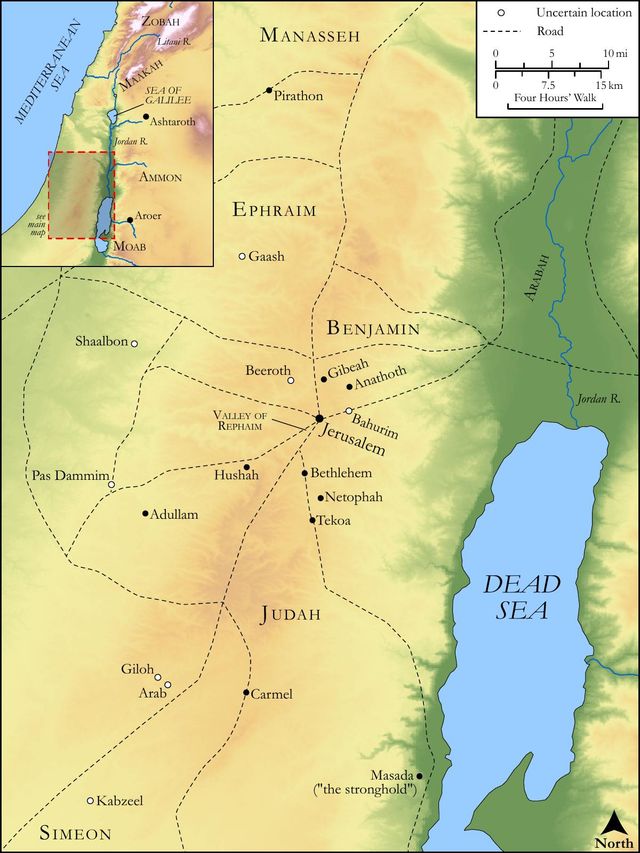
See on the biblical-era map
Study this verse
Public-domain commentary
Matthew Henry
From his Commentary on the Whole Bible. Henry comments on passages, not single verses — this entry covers 1 Chronicles 11:10–47. His two-level outline is real structure in the source text, so it is rendered as structure.
We have here an account of David's worthies, the great men of his time that served him and were preferred by him. The first edition of this catalogue we had, Sa2 23:8, etc. This is much the same, only that those named here from Ch1 11:41 to the end are added. Observe,
I.The connexion of this catalogue with that which is said concerning David, Ch1 11:9.
1.David waxed greater and greater, and these were his mighty men. Much of the strength and honour of great men is borrowed from their servants and depends upon them, which cannot but somewhat diminish pomp and power in the opinion of those that are wise. David is great because he has great men about him; take these away, and he is where he was.
2.The Lord of hosts was with him, and these were the mighty men which he had. God was with him and wrought for him, but by men and means and the use of second causes. By this it appeared that God was with him, that he inclined the hearts of those to come over to him that were able to serve his interest. As, if God be for us none can be against us, so, if God be for us, all shall be for us that we have occasion for. Yet David ascribed his success and increase, not to the hosts he had, but to the Lord of hosts, not to the mighty men that were with him, but to the mighty God whose presence with us is all in all.
II.The title of this catalogue (Ch1 11:10):
These are the men who strengthened themselves with him. In strengthening him they strengthened themselves and their own interest; for his advancement was theirs. What we do in our places for the support of the kingdom of the Son of David we shall be gainers by. In strengthening it we strengthen ourselves. It may be read, They held strongly with him and with all Israel. Note, When God has work to do he will not want fit instruments to do it with. If it be work that requires mighty men, mighty men shall either be found or made to effect it, according to the word of the Lord.
III.That which made all these men honourable was the good service that they did to their king and country; they helped to make David king (Ch1 11:10) - a good work. They slew the Philistines, and other public enemies, and were instrumental to save Israel. Note, The way to be great is to do good. Nor did they gain this honour without labour and the hazard of their lives. The honours of Christ's kingdom are prepared for those that fight the good fight of faith, that labour and suffer, and are willing to venture all, even life itself, for Christ and a good conscience. It is by a patient continuance in well-doing that we must seek for glory, and honour, and immortality; and those that are faithful to the Son of David shall find their names registered and enrolled much more to their honour than these are in the records of fame.
IV.Among all the great exploits of David's mighty men, here is nothing great mentioned concerning David himself but his pouring out water before the Lord which he had longed for, Ch1 11:18, Ch1 11:19. Four very honourable dispositions of David appeared in that action, which, for aught I know, made it as great as any of the achievements of those worthies.
1.Repentance for his own weakness. It is really an honour to a man, when he is made sensible that he has said or done any thing unadvisedly, to unsay it and undo it again by repentance, as it is a shame to a man when he has said or done amiss to stand to it.
2.Denial of his own appetite. He longed for the water of the well of Bethlehem; but, when he had it, he would not drink it, because he would not so far humour himself and gratify a foolish fancy. He that has such a rule as this over his own spirit is better than the mighty. It is an honour to a man to have the command of himself; but he that will command himself must sometimes cross himself.
3.Devotion towards God. That water which he thought too good, too precious, for his own drinking, he poured out to the Lord for a drink offering. If we have any thing better than another, let God be honoured with it, who is the best, and should have the best.
4.Tenderness of his servants. It put him into the greatest confusion imaginable to think that three brave men should hazard their lives to fetch water for him. In his account it turns the water into blood. It is the honour of great men not to be prodigal of the blood of those they employ, but, in all the commands they give them, to put their own souls into their souls' stead.
V.In the wonderful achievements of these heroes the power of God must be acknowledged.
How could one slay 300 and another the same number (Ch1 11:11, Ch1 11:20), another two lion-like men (Ch1 11:22), and another an Egyptian giant (Ch1 11:23), if they had not had the extraordinary presence of God with them, according to that promise, Jos 23:10, One man of you shall chase a thousand, for the Lord your God fighteth for you?
VI.One of these worthies is said to be an Ammonite (Ch1 11:39), another a Moabite (Ch1 11:46), and yet the law was that an Ammonite and a Moabite should not enter into the congregation of the Lord, Deu 23:3. These, it is likely, had approved themselves so hearty for the interest of Israel that in their case it was thought fit to dispense with that law, and the rather because it was an indication that the Son of David would have worthies among the Gentiles: with him there is neither Greek nor Jew.
Continue studying 1 Chronicles 11:24 across the web’s major study libraries — every link below opens this exact verse, chapter, or book on the destination site.
Read & Compare
 BibleGatewayThis verse in more than 200 translations and 70 languages.
 Bible.comThe YouVersion reader — hundreds of translations, reading plans, and highlights.
 ESV.orgCrossway's official English Standard Version reader.
 NET BibleThe NET translation with 60,000+ translators' notes on every rendering decision.
 STEP BibleTyndale House's free study tool — original text, vocabulary, and scholarly resources.
 BibliaLogos Bible Software's free web reader.
 USCCBThe New American Bible (Revised Edition) with the U.S. bishops' study notes.
Commentaries
 BibleHub CommentariesDozens of classic commentaries on this verse, gathered on one page.
 StudyLightMore than 100 commentary sets — the largest collection on the web.
 BibleRefPlain-English commentary on what this verse means, verse by verse.
 Enduring WordDavid Guzik's free commentary on this chapter, widely used by Bible teachers.
 Bible Study ToolsVerse commentary alongside Greek and Hebrew study aids.
Original Language & Research
- BibleHub InterlinearThe verse word by word — original language, transliteration, and English.
- BibleHub LexiconEvery word's original-language definition and Strong's entry.
 Blue Letter BibleDeep-study tools — Strong's numbers, concordance, and word studies.
 SefariaThe Hebrew text with Rashi and centuries of Jewish commentary.
Sermons, Hymns & Audio


TrulyRandomVerse is not affiliated with these sites and doesn’t control their content. They’re linked because they’re genuinely useful.
Summary
1 Chronicles 11:24 serves as a powerful and concise commendation of Benaiah the son of Jehoiada, concluding the account of his extraordinary valor and military prowess. This verse emphatically states that Benaiah's remarkable deeds—including his slaying of two lion-like men, a lion in a pit on a snowy day, and a giant Egyptian—earned him such a profound and distinguished reputation that he was recognized among the most elite and formidable warriors in King David's army, signifying his unparalleled courage, skill, and esteemed status.
Context
ShowHideLiterary Context
This verse is strategically positioned as the concluding statement for the detailed account of Benaiah's specific heroic exploits, which are meticulously narrated in 1 Chronicles 11:22-23. The broader chapter, 1 Chronicles 11, begins with David's anointing as king and the capture of Jerusalem, setting the stage for the subsequent enumeration of his "mighty men." Benaiah's inclusion, along with the detailed recounting of his feats, highlights the caliber of warriors who supported David's reign. Verse 24 functions as a powerful summary and a testament to his enduring legacy, solidifying his place within the elite military hierarchy. This entire section on David's mighty men, including Benaiah's exploits, finds a significant parallel in 2 Samuel 23, underscoring its historical importance and the Chronicler's emphasis on the strength and loyalty of David's kingdom.
Historical & Cultural Context
The period of King David's reign (c. 1010-970 BC) was a pivotal time for ancient Israel, marked by the consolidation of the kingdom and significant military expansion. In this era, a highly skilled and loyal military was not merely an asset but a necessity for national security, territorial defense, and the projection of power. The "mighty men" (Hebrew: gibborim) were a distinct, elite corps of professional warriors, celebrated for their exceptional strength, bravery, and combat proficiency. Their heroic deeds were a source of immense national pride and served as a powerful symbol of the strength and divine favor upon David's rule. To "have the name" (a recognized reputation) among such an exclusive group represented the pinnacle of military honor and social standing in ancient Israelite society, reflecting a culture that profoundly esteemed valor, martial skill, and a formidable reputation, often linking such prowess to divine blessing and favor.
Key Themes
ShowHideBenaiah's story, culminating in his distinguished recognition in 1 Chronicles 11:24, contributes significantly to several overarching themes within the book of Chronicles and the broader biblical narrative. Firstly, it powerfully illustrates the theme of Valor and Excellence, showcasing the highest levels of human courage, skill, and dedication in service to a king and nation. Benaiah's willingness to confront overwhelming and unusual threats (a lion in a pit, a giant Egyptian) exemplifies a commitment to duty that transcends ordinary expectations. Secondly, the narrative underscores Loyalty and Dedicated Service, as these mighty men were indispensable in establishing, securing, and defending David's kingdom, demonstrating the profound value of unwavering commitment to a righteous leader and a divinely appointed cause. Lastly, the prominent theme of Recognition and Enduring Reputation is highlighted, emphasizing that deeds of extraordinary merit and faithfulness earn lasting renown, a concept deeply valued in Israelite wisdom, as articulated in passages like Proverbs 22:1, which prioritizes a good name over vast wealth.
Exposition and Analysis
ShowHideKey Word Analysis
ShowHideFrom the primitive root H6213, this verb means "to do or make" in the broadest sense, encompassing accomplishment, execution, performance, and action. In this context, it emphasizes that Benaiah's renown was not merely ascribed but was the direct result of his active, deliberate, and effective deeds. His reputation was earned through his demonstrated capabilities and courageous acts, rather than inherited status or mere association.
From the primitive word H8034, this noun refers to an appellation, a mark, or a memorial of individuality. By implication, it conveys honor, authority, and character. To "have the name" (as in the phrase "had the name among") is an idiom signifying a well-established, widely recognized, and distinguished reputation or renown. It implies not just being known, but being celebrated, highly regarded, and possessing significant influence or status due to one's accomplishments and character.
This plural noun refers to powerful ones, warriors, champions, or valiant men. In biblical contexts, gibborim denotes individuals of extraordinary physical strength, military prowess, and often, moral courage. They were the elite, the most formidable and heroic warriors in the land, whose deeds were legendary and whose presence commanded respect. To be counted among them was the highest honor for a warrior, signifying inclusion in the absolute top tier of military distinction.
Verse Breakdown
ShowHide"These [things] did Benaiah the son of Jehoiada"
This opening clause serves as a direct and definitive link to the preceding narrative in 1 Chronicles 11:22-23, where Benaiah's specific acts of valor are detailed. The phrase "these things" explicitly refers to his slaying of two lion-like men of Moab, his daring descent into a pit on a snowy day to kill a lion, and his defeat of a formidable Egyptian giant with the Egyptian's own spear. This clause underscores that Benaiah's subsequent recognition was entirely merited, a direct consequence of his personal, extraordinary valor, and his exceptional effectiveness in battle. It establishes his character and reputation as being forged through action.
"and had the name among the three mighties"
This culminating statement declares Benaiah's supreme distinction. While scholarly discussion exists regarding the precise identity of "the three" (who are typically identified as Jashobeam, Eleazar, and Shammah, distinct from Benaiah in the primary list), this phrase unequivocally indicates that Benaiah's renown and military standing were so exceptional that he was considered in their company, or as the undisputed chief of the "second three" (often referred to as "the thirty"). It signifies his inclusion in the absolute elite of David's warriors, recognized for his unparalleled feats and securing a place of lasting honor and respect within the kingdom's most formidable fighting force.
Literary Devices
ShowHideThe Chronicler masterfully employs several literary devices in 1 Chronicles 11:24 to emphasize Benaiah's profound significance. Primarily, the verse functions as a Summary Statement, providing a concise yet impactful conclusion to the preceding detailed account of Benaiah's heroic deeds. This strategic placement creates a sense of finality and underscores the lasting impact and recognition of his actions. The phrase "had the name among the three mighties" employs Hyperbole or elevated language to convey the extraordinary nature of Benaiah's reputation; while he may not have been one of the literal "top three" in all lists, his renown was so immense that he was considered in their league. This serves to magnify his status and ensure his legendary fame. Furthermore, the Chronicler's inclusion of this specific detail, which parallels the account in 2 Samuel 23, highlights Emphasis through intertextual repetition, affirming the historical and theological importance of these elite warriors and their indispensable service to King David and the nascent Israelite kingdom.
Theological and Thematic Connections
ShowHideBenaiah's story, culminating in his esteemed recognition among David's elite warriors, speaks profoundly to the theological principle that God often raises up and uses individuals of exceptional skill, courage, and faithfulness to accomplish His sovereign purposes, even in the realms of earthly governance and warfare. His valor was not merely human strength but, within the biblical worldview, was implicitly undergirded by divine enablement, allowing him to perform feats that transcended ordinary human capability. The emphasis on Benaiah "having the name" among the elite points to the enduring value of a good and honorable reputation, earned through diligent, courageous, and faithful action. This reflects a broader biblical theme that diligence, excellence, and unwavering loyalty in one's calling—whether military, civic, or spiritual—are recognized and honored, not only by human society but ultimately by God Himself. It serves as a reminder that our deeds, when performed with integrity and dedication to a righteous cause, contribute to a legacy that can inspire others and bear witness to God's work through His people.
Reflection and Application
ShowHideBenaiah's life, as encapsulated in this verse, offers a compelling and enduring model for contemporary believers, urging us to pursue excellence, courage, and faithfulness in our own spheres of influence. His willingness to confront daunting challenges—a lion in a pit on a snowy day, a giant Egyptian—serves as a powerful metaphor for the spiritual battles, personal obstacles, and demanding callings we encounter in our lives. We are called not to shrink from difficulty or danger but to engage with our God-given gifts and strength, seeking to overcome with ingenuity, perseverance, and unwavering faith. Just as Benaiah honed his skills to become a formidable warrior, we too are encouraged to identify, develop, and deploy our talents and spiritual gifts to their fullest potential, not for personal glory, but for the glory of God and the advancement of His eternal kingdom. His recognition among the "mighties" reminds us that while human praise and worldly recognition are fleeting, a reputation built on integrity, faithfulness, and diligent service to a righteous cause—ultimately, to Christ—is of eternal value. Our ultimate aim should be to hear the "well done" of our Master, striving for excellence in all that we do, knowing that our true and lasting reward comes from Him.
Questions for Reflection
ShowHideFAQ
ShowHideWho were "the three mighties" and was Benaiah one of them?
ShowHide"The three mighties" (or "the three") refer to the absolute elite, the most distinguished and preeminent warriors in King David's army. They are typically identified as Jashobeam (or Ishbaal), Eleazar, and Shammah, whose extraordinary and individual feats of valor are detailed in 2 Samuel 23:8-12. While Benaiah's name is not explicitly listed among these specific three, 1 Chronicles 11:24 states that he "had the name among the three mighties." This phrase signifies that his reputation, valor, and military prowess were so exceptional and renowned that he was considered to be in their company, or at least as the undisputed chief of the "second three" (often referred to as "the thirty"), who were only slightly less distinguished. He was, in essence, in the very same league of extraordinary heroism and military distinction, even if not part of the specific trio.
Why is Benaiah's story important for us today?
ShowHideBenaiah's story, particularly his recognition in 1 Chronicles 11:24, offers several enduring and powerful lessons for contemporary believers. First, it highlights the profound value of courage and excellence in facing life's myriad challenges, both physical and spiritual. His willingness to confront overwhelming odds with skill, determination, and ingenuity encourages us to approach our own difficulties with faith and resolve, trusting in God's enabling power. Second, it underscores the critical importance of loyalty and dedicated service to a righteous cause, reminding us that our gifts, talents, and efforts are most effectively utilized when aligned with God's divine purposes and in service to His kingdom. Finally, Benaiah's "good name" serves as a powerful reminder that a reputation built on integrity, hard work, and unwavering faithfulness is a valuable and lasting legacy, ultimately pointing to the eternal honor that comes from diligently serving God, as wisdom literature consistently affirms (e.g., Proverbs 22:1).
Christ-Centered Fulfillment
ShowHideWhile Benaiah's might and valor were undeniably impressive, serving an earthly king and securing a physical kingdom, his story ultimately points to the far greater "might" and ultimate victory of Jesus Christ. Benaiah earned his "name" through physical prowess, overcoming earthly foes, and demonstrating unparalleled courage against formidable adversaries; Christ, however, earned a "name that is above every name" (Philippians 2:9-11) not through force of arms, but through sacrificial love, perfect obedience unto death on the cross, and His glorious resurrection from the grave. He is the true and ultimate Champion, the Son of God, who descended into the pit of death and conquered it decisively, not for an earthly kingdom, but for an eternal one. He disarmed the spiritual "principalities and powers" (Colossians 2:15) and reigns eternally as the victorious Lamb who takes away the sin of the world (John 1:29). As followers of Christ, we are called to be His "mighty ones" in a spiritual sense, not fighting with flesh and blood, but putting on the full armor of God to stand firm against spiritual forces of evil (Ephesians 6:10-12). Our "name" and ultimate recognition are not earned by our own strength or deeds, but by being named with His name, by being identified with Him, and our eternal reward and true honor come from Him, the King of kings and Lord of lords (Revelation 19:11-16).