


1 Chronicles 11:25
Bible text: King James Version (1769 Blayney text) · Public domain
Bible text: Berean Standard Bible · Public domain
Bible text: American Standard Version (1901) · Public domain
Bible text: World English Bible, Messianic edition · Public domain
Bible text: Geneva Bible (1599) · Public domain
Bible text: Young's Literal Translation · Public domain
- מִןminmore thanH4480PrepPreposition
- הַשְּׁלוֹשִׁיםha·she·lo·Shimthe thirtyH7970Art ¦ N-mpNoun Plural Masculine Absoluteהַtheשְּׁלוֹשִׁיםthirty
- הִנּוֹhi·Nothere heH2005Prt ¦ 3msParticle Interjectionהִנּthereוֹhe
- נִכְבָּדnikh·Bad[was] honoredH3513V-Niphal-Prtcpl-msVerb Niphal Participle Singular Masculine Absolute
- הוּאHu'heH1931Pro-3msPronoun Personal 3rd Singular Masculine
- וְאֶלve·'eland toH413Conj-w ¦ PrepPrepositionוְandאֶלto
- הַשְּׁלוֹשָׁהha·she·lo·Shahthe threeH7969Art ¦ N-csNoun Singular common gender Absoluteהַtheשְּׁלוֹשָׁהthree
- לֹאlo'notH3808NegParticle Negative
- בָאVa'he cameH935V-Qal-Perf-3msVerb Qal Perfect 3rd Singular Masculine
- וַיְשִׂימֵהוּvay·si·Me·huand he appointed himH7760Conj-w ¦ V-Qal-ConsecImperf-3ms ¦ 3msVerb Qal Consecutive Imperfect 3rd Singular Masculineוַandיְשִׂימֵhe appointedהוּhim
- דָוִידda·VidDavidH1732N-proper-mNoun Proper Masculine
- עַל'aloverH5921PrepPreposition
- מִשְׁמַעְתּוֹmish·ma'·Tohis bodyguardH4928N-fsc ¦ 3msNoun Singular Feminine Constructמִשְׁמַעְתּbodyguardוֹhis
English is a literal word-by-word gloss of the Hebrew, not the KJV's wording. Why?
This is the original text the KJV's translators worked from — each Hebrew word with its own literal English meaning in this verse, prepared by scholars at Tyndale House, Cambridge. The KJV translates whole sentences, not word by word, so its wording differs: one Hebrew word can become several English words, and the KJV may choose “the LORD” where the gloss reads “Yahweh”. Both are faithful — they answer different questions. For the KJV's own rendering, switch to the KJV text.
Details
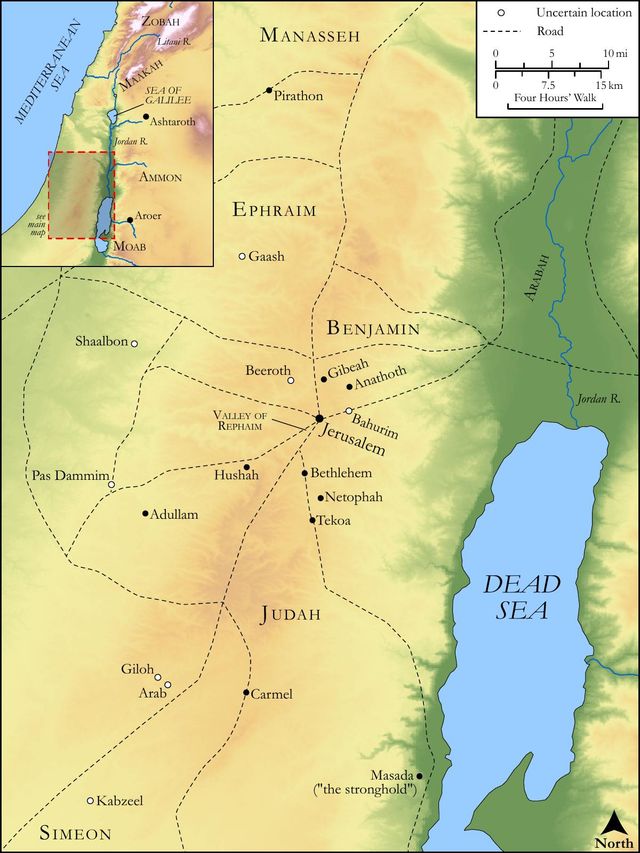
See on the biblical-era map
Study this verse
Public-domain commentary
Matthew Henry
From his Commentary on the Whole Bible. Henry comments on passages, not single verses — this entry covers 1 Chronicles 11:10–47. His two-level outline is real structure in the source text, so it is rendered as structure.
We have here an account of David's worthies, the great men of his time that served him and were preferred by him. The first edition of this catalogue we had, Sa2 23:8, etc. This is much the same, only that those named here from Ch1 11:41 to the end are added. Observe,
I.The connexion of this catalogue with that which is said concerning David, Ch1 11:9.
1.David waxed greater and greater, and these were his mighty men. Much of the strength and honour of great men is borrowed from their servants and depends upon them, which cannot but somewhat diminish pomp and power in the opinion of those that are wise. David is great because he has great men about him; take these away, and he is where he was.
2.The Lord of hosts was with him, and these were the mighty men which he had. God was with him and wrought for him, but by men and means and the use of second causes. By this it appeared that God was with him, that he inclined the hearts of those to come over to him that were able to serve his interest. As, if God be for us none can be against us, so, if God be for us, all shall be for us that we have occasion for. Yet David ascribed his success and increase, not to the hosts he had, but to the Lord of hosts, not to the mighty men that were with him, but to the mighty God whose presence with us is all in all.
II.The title of this catalogue (Ch1 11:10):
These are the men who strengthened themselves with him. In strengthening him they strengthened themselves and their own interest; for his advancement was theirs. What we do in our places for the support of the kingdom of the Son of David we shall be gainers by. In strengthening it we strengthen ourselves. It may be read, They held strongly with him and with all Israel. Note, When God has work to do he will not want fit instruments to do it with. If it be work that requires mighty men, mighty men shall either be found or made to effect it, according to the word of the Lord.
III.That which made all these men honourable was the good service that they did to their king and country; they helped to make David king (Ch1 11:10) - a good work. They slew the Philistines, and other public enemies, and were instrumental to save Israel. Note, The way to be great is to do good. Nor did they gain this honour without labour and the hazard of their lives. The honours of Christ's kingdom are prepared for those that fight the good fight of faith, that labour and suffer, and are willing to venture all, even life itself, for Christ and a good conscience. It is by a patient continuance in well-doing that we must seek for glory, and honour, and immortality; and those that are faithful to the Son of David shall find their names registered and enrolled much more to their honour than these are in the records of fame.
IV.Among all the great exploits of David's mighty men, here is nothing great mentioned concerning David himself but his pouring out water before the Lord which he had longed for, Ch1 11:18, Ch1 11:19. Four very honourable dispositions of David appeared in that action, which, for aught I know, made it as great as any of the achievements of those worthies.
1.Repentance for his own weakness. It is really an honour to a man, when he is made sensible that he has said or done any thing unadvisedly, to unsay it and undo it again by repentance, as it is a shame to a man when he has said or done amiss to stand to it.
2.Denial of his own appetite. He longed for the water of the well of Bethlehem; but, when he had it, he would not drink it, because he would not so far humour himself and gratify a foolish fancy. He that has such a rule as this over his own spirit is better than the mighty. It is an honour to a man to have the command of himself; but he that will command himself must sometimes cross himself.
3.Devotion towards God. That water which he thought too good, too precious, for his own drinking, he poured out to the Lord for a drink offering. If we have any thing better than another, let God be honoured with it, who is the best, and should have the best.
4.Tenderness of his servants. It put him into the greatest confusion imaginable to think that three brave men should hazard their lives to fetch water for him. In his account it turns the water into blood. It is the honour of great men not to be prodigal of the blood of those they employ, but, in all the commands they give them, to put their own souls into their souls' stead.
V.In the wonderful achievements of these heroes the power of God must be acknowledged.
How could one slay 300 and another the same number (Ch1 11:11, Ch1 11:20), another two lion-like men (Ch1 11:22), and another an Egyptian giant (Ch1 11:23), if they had not had the extraordinary presence of God with them, according to that promise, Jos 23:10, One man of you shall chase a thousand, for the Lord your God fighteth for you?
VI.One of these worthies is said to be an Ammonite (Ch1 11:39), another a Moabite (Ch1 11:46), and yet the law was that an Ammonite and a Moabite should not enter into the congregation of the Lord, Deu 23:3. These, it is likely, had approved themselves so hearty for the interest of Israel that in their case it was thought fit to dispense with that law, and the rather because it was an indication that the Son of David would have worthies among the Gentiles: with him there is neither Greek nor Jew.
Continue studying 1 Chronicles 11:25 across the web’s major study libraries — every link below opens this exact verse, chapter, or book on the destination site.
Read & Compare
 BibleGatewayThis verse in more than 200 translations and 70 languages.
 Bible.comThe YouVersion reader — hundreds of translations, reading plans, and highlights.
 ESV.orgCrossway's official English Standard Version reader.
 NET BibleThe NET translation with 60,000+ translators' notes on every rendering decision.
 STEP BibleTyndale House's free study tool — original text, vocabulary, and scholarly resources.
 BibliaLogos Bible Software's free web reader.
 USCCBThe New American Bible (Revised Edition) with the U.S. bishops' study notes.
Commentaries
 BibleHub CommentariesDozens of classic commentaries on this verse, gathered on one page.
 StudyLightMore than 100 commentary sets — the largest collection on the web.
 BibleRefPlain-English commentary on what this verse means, verse by verse.
 Enduring WordDavid Guzik's free commentary on this chapter, widely used by Bible teachers.
 Bible Study ToolsVerse commentary alongside Greek and Hebrew study aids.
Original Language & Research
- BibleHub InterlinearThe verse word by word — original language, transliteration, and English.
- BibleHub LexiconEvery word's original-language definition and Strong's entry.
 Blue Letter BibleDeep-study tools — Strong's numbers, concordance, and word studies.
 SefariaThe Hebrew text with Rashi and centuries of Jewish commentary.
Sermons, Hymns & Audio


TrulyRandomVerse is not affiliated with these sites and doesn’t control their content. They’re linked because they’re genuinely useful.
Summary
1 Chronicles 11:25 vividly portrays Benaiah, son of Jehoiada, as a warrior of exceptional valor and standing within King David's elite forces. This verse specifically highlights his distinguished position among the "thirty" mighty men, a select company of David's most formidable soldiers, while also noting that he did not achieve the pinnacle status of the "first three" supreme heroes. Benaiah's proven capabilities and unwavering loyalty were recognized and rewarded by David, who entrusted him with the highly sensitive and crucial role of commanding his personal guard, a testament to his immense competence and trustworthiness.
Context
ShowHideLiterary Context
This verse is embedded within a comprehensive list of King David's mighty men found in 1 Chronicles 11 (with a parallel account in 2 Samuel 23). The Chronicler meticulously details these warriors not merely as a historical record, but to underscore the divine favor upon David and the strength of the kingdom established through loyal and valiant supporters. Immediately preceding 1 Chronicles 11:25, verses 1 Chronicles 11:22-24 recount Benaiah's astonishing individual feats—slaying two lion-like men of Moab, a lion in a pit during a snowstorm, and a formidable Egyptian giant. These specific exploits serve as the narrative justification for his esteemed position and subsequent appointment, demonstrating that his honor was earned through extraordinary courage and skill. The list itself is structured to highlight a clear hierarchy, moving from the "three" supreme heroes to the "thirty" and then others, providing a precise context for Benaiah's specific ranking.
Historical & Cultural Context
Among the kings of that day, a king's personal guard was a critical component of his power and security. These units, often composed of highly skilled and intensely loyal individuals, served not only as bodyguards but also as enforcers of royal decrees and executors of sensitive missions. The "thirty" (or "thirty-seven," including the "three" and other named individuals) were more than just a military unit; they formed a royal retinue, embodying the king's strength and prestige. Their existence reflects the need for absolute loyalty in a period characterized by political instability and frequent warfare. The very concept of "mighty men" (Hebrew: gibborim) was deeply ingrained in the culture, referring to individuals of extraordinary strength, courage, and prowess in battle, whose deeds were legendary and foundational to the establishment and maintenance of kingdoms like David's. David's ability to attract and command such men speaks volumes about his leadership and God's hand upon him.
Key Themes
ShowHideThe verse significantly contributes to several overarching themes within 1 Chronicles:
Hierarchy and Recognition
The explicit distinction between the "first three" and the "thirty" illustrates a clear, merit-based military hierarchy. Benaiah's "honourable" status among the "thirty" signifies his exceptional skill and bravery, yet his inability to attain the highest tier of the "three" (like Jashobeam, Eleazar, and Shammah, whose exploits are detailed in 1 Chronicles 11:11-12) highlights that even within an elite group, there were different levels of achievement and honor. This structure emphasizes that recognition was directly tied to proven valor and effectiveness.
Competence and Trust in Leadership
Benaiah's appointment "over his guard" was a direct consequence of his proven valor and leadership abilities. This role demanded unwavering loyalty and absolute trustworthiness, as he was responsible for the king's personal safety and the execution of sensitive royal commands. This theme underscores how demonstrated faithfulness and competence are prerequisites for positions of significant responsibility and influence, a principle crucial for effective leadership in any era.
Loyalty and Service to the King
The dedication of these mighty men, including Benaiah, was foundational to the stability and success of David's kingdom. Their willingness to serve, protect, and fight for their king exemplifies the importance of steadfast commitment and allegiance. The Chronicler often highlights such loyalty as a key factor in the prosperity and security of the Davidic dynasty, implicitly linking it to divine blessing.
Exposition and Analysis
ShowHideKey Word Analysis
ShowHideThe Hebrew word כָּבֵד (kâbad) carries the primary sense of "heavy" or "weighty." In this context, it metaphorically signifies a person of substantial importance, dignity, and influence. For Benaiah, it denotes not merely a good reputation but a deep-seated esteem, indicating that his presence and character carried significant weight and commanded respect due to his proven deeds and inherent worth.
The Hebrew term מִשְׁמַעַת (mishmaʻath) is derived from a root meaning "to hear" or "to obey." It can refer to "audience," "obedience," or, as here, a "royal court" or "bodyguard." This implies a unit composed of individuals who are not only highly skilled warriors but are also intimately attentive and absolutely obedient to the king's direct command. Benaiah's appointment to this role highlights an unparalleled level of trust and an expectation of unwavering discipline and loyalty, placing him in the closest proximity to the king's person and affairs.
The Hebrew word שִׂים (sûwm) is a versatile primitive root meaning "to put" or "to place." In this context, it signifies David's deliberate and authoritative act of appointing or ordaining Benaiah to a specific, crucial position. This verb emphasizes the king's sovereign decision and the formal establishment of Benaiah's authority over his guard, underscoring the deliberate recognition and strategic placement of a trusted individual.
Verse Breakdown
ShowHide"Behold, he was honourable among the thirty"
The introductory "Behold" (Hebrew: הִנֵּה, hinnêh) serves as an emphatic particle, drawing the reader's attention to Benaiah's remarkable status. This clause establishes Benaiah's elite position within the "thirty," a renowned group of David's most valiant and distinguished warriors. His "honourable" status indicates that he was highly esteemed, respected, and recognized for his exceptional prowess and character, standing out even among such a formidable company.
"but attained not to the [first] three"
This phrase provides a crucial nuance to Benaiah's standing. While exceptionally honored among the "thirty," he did not reach the absolute pinnacle occupied by the "first three" mighty men (Jashobeam, Eleazar, and Shammah), whose exploits were considered even more extraordinary and unparalleled. This distinction highlights the extreme valor and unique achievements of the very top tier, while still affirming Benaiah's near-supreme status and remarkable capabilities.
"and David set him over his guard"
This final clause reveals the practical outcome of Benaiah's proven character and competence. King David, recognizing Benaiah's immense trustworthiness, loyalty, and military skill, appointed him to the highly sensitive and critical position of commanding his personal guard. This unit, often identified with the Cherethites and Pelethites, functioned as the king's personal security force and often carried out royal decrees, underscoring the profound trust and authority vested in Benaiah.
Literary Devices
ShowHideThe Chronicler employs several literary devices to convey Benaiah's significance. Hierarchy/Gradation is prominently featured, as the text meticulously distinguishes between the "first three" and the "thirty," establishing a clear ranking system that highlights the exceptional nature of the top tier while still praising Benaiah's high standing within the second. This precise classification emphasizes the rigorous standards of valor and achievement within David's army. Furthermore, Juxtaposition is used to create a nuanced portrayal of Benaiah's status: his "honourable" position among the "thirty" is immediately contrasted with his failure to "attain... the three." This contrast underscores both his remarkable achievements and the even more extraordinary feats of the absolute elite, providing a balanced perspective on his capabilities. The use of the emphatic "Behold" (KJV) or "Now" (ESV/NIV) at the beginning of the verse also serves as a device of Emphasis, drawing the reader's immediate attention to Benaiah's significant and noteworthy status.
Theological and Thematic Connections
ShowHideBenaiah's story in 1 Chronicles 11:25 offers profound theological insights into the nature of service, leadership, and divine recognition. His example illustrates that faithfulness and competence in one's assigned role, regardless of its hierarchical position, are deeply valued and lead to greater trust and responsibility. The Chronicler emphasizes that God works through individuals with diverse gifts and callings to establish and sustain His kingdom. Benaiah's willingness to serve David with unwavering loyalty and exceptional skill mirrors the call for believers to serve God with their unique abilities, understanding that all diligent service contributes to God's overarching purposes and is seen by Him. This narrative highlights a divine economy where proven character and ability are rewarded, not merely for human glory, but for the effective functioning of God's plan through His chosen leaders.
Reflection and Application
ShowHideBenaiah's narrative is a powerful testament to the value of faithful and competent service, regardless of whether one occupies the absolute top tier. It challenges the modern inclination to constantly strive for the most prominent positions, reminding us that true honor comes from diligent effort and unwavering loyalty in the role God has placed us in. Benaiah excelled among the "thirty," proving his worth through extraordinary deeds, and was subsequently entrusted with a vital and highly sensitive position. This teaches us the importance of cultivating excellence in our current spheres of influence, recognizing that every act of faithful service, no matter how seemingly small or "secondary," contributes to the larger work of God's kingdom and is seen and valued by Him. We are called to be trustworthy stewards of the gifts and responsibilities entrusted to us, building a reputation for integrity and reliability that can lead to greater opportunities for impact and service for God's glory.
Questions for Reflection
ShowHideFAQ
ShowHideWhat was the significance of the "thirty" and the "three" mighty men?
ShowHideThe "three" and the "thirty" represented distinct, highly elite tiers within King David's army, symbolizing the pinnacle of military prowess and loyalty in ancient Israel. The "three" (Jashobeam, Eleazar, and Shammah) were the absolute supreme warriors, whose legendary exploits (e.g., breaking through enemy lines for water, single-handedly defeating hundreds) set them apart as unparalleled heroes (1 Chronicles 11:11-19). The "thirty" (or sometimes "thirty-seven" including the three and other named individuals, as seen in 2 Samuel 23) constituted a broader but still exceptionally distinguished group. They formed the core of David's special forces, his personal guard, and were instrumental in establishing and maintaining his kingdom. Their existence underscored the strength and divine favor upon David's reign, as he was able to attract and command such formidable and loyal men.
Why was Benaiah's appointment "over his guard" so important?
ShowHideBenaiah's appointment "over his guard" was a position of immense trust, power, and intimacy with the king. In ancient monarchies, the royal guard served as the king's personal security detail, responsible for his life and the immediate execution of his most sensitive commands. This unit, often composed of foreign mercenaries or specially chosen loyalists like the Cherethites and Pelethites, operated outside the regular army structure and reported directly to the king. Entrusting Benaiah with this role signified David's absolute confidence in his loyalty, discretion, and competence. It was a testament to Benaiah's proven character and military skill, placing him in the closest proximity to royal authority. His continued rise, eventually becoming commander of the entire army under King Solomon (1 Kings 2:35), further underscores the critical importance and foundational nature of this initial appointment.
Christ-Centered Fulfillment
ShowHideBenaiah's exemplary loyalty, competence, and service to King David serve as a powerful foreshadowing of the unwavering devotion and service due to our ultimate King, Jesus Christ. Just as Benaiah was "honourable" among David's mighty men, Christ alone is truly worthy of all honor, glory, and praise, the Lamb of God who is worthy to receive power and wealth and wisdom and strength and honor and glory and praise!. Benaiah's role as the commander of David's personal guard, responsible for the king's safety and the execution of his will, points to Christ as our ultimate Protector and Guardian, the Good Shepherd who lays down His life for His sheep and promises that no one can snatch them out of His hand. Furthermore, the meritocratic nature of David's army, where proven deeds led to greater responsibility, mirrors the call for believers to be faithful stewards in God's kingdom. We are called to serve our King with the same diligence and loyalty Benaiah showed David, using our diverse gifts for His purposes, knowing that one day the King will say, "Well done, good and faithful servant! You have been faithful over a little; I will set you over much." Benaiah's story, therefore, is not just about an ancient warrior, but a timeless call to faithful service under the reign of the true and eternal King.