


2 Samuel 2:5
Bible text: King James Version (1769 Blayney text) · Public domain
Bible text: King James Version with Strong's numbers · Public domain
Bible text: Berean Standard Bible · Public domain
Bible text: American Standard Version (1901) · Public domain
Bible text: World English Bible, Messianic edition · Public domain
Bible text: Geneva Bible (1599) · Public domain
Bible text: Young's Literal Translation · Public domain
- וַיִּשְׁלַחvai·yish·Lachand he sentH7971Conj-w ¦ V-Qal-ConsecImperf-3msVerb Qal Consecutive Imperfect 3rd Singular Masculineוַandיִּשְׁלַחhe sent
- דָּוִדda·VidDavidH1732N-proper-mNoun Proper Masculine
- מַלְאָכִיםmal·'a·KhimmessengersH4397N-mpNoun Plural Masculine Absolute
- אֶל'eltoH413PrepPreposition
- אַנְשֵׁי'an·Shei[the] people ofH582N-mpcNoun Plural Masculine Construct
- יָבֵישׁya·VeishJabeshH3003N-properNoun Proper Location
- גִּלְעָדgil·'AdGileadH1568N-properNoun Proper Location
- וַיֹּאמֶרvai·Yo·merand he saidH559Conj-w ¦ V-Qal-ConsecImperf-3msVerb Qal Consecutive Imperfect 3rd Singular Masculineוַandיֹּאמֶרhe said
- אֲלֵיהֶם'a·lei·Hemto themH413Prep ¦ 3mpPreposition Definiteאֲלֵיtoהֶםthem
- בְּרֻכִיםbe·ru·Khim[be] blessedH1288V-Qal-PassPrtcpl-mpVerb Qal Participle Passive Plural Masculine Absolute
- אַתֶּם'a·TemyouH859Pro-2mpPronoun Personal 2nd Plural Masculine
- לַיהוָהla·Yah·wehby YahwehH3068Prep-l ¦ N-properNoun Proper TitleלַbyיהוָהYahweh
- אֲשֶׁר'a·SherthatH834RelParticle Relative
- עֲשִׂיתֶם'a·si·Temyou have doneH6213V-Qal-Perf-2mpVerb Qal Perfect 2nd Plural Masculine
- הַחֶסֶדha·Che·sedthe loyaltyH2617Art ¦ N-msNoun Singular Masculine Absoluteהַtheחֶסֶדloyalty
- הַזֶּהha·Zeh<the> thisH2088Art ¦ PrtParticle Demonstrativeהַ<the>זֶּהthis
- עִם'imwithH5973PrepPreposition
- אֲדֹנֵיכֶם'a·do·nei·Khemyour lord<s>H113N-mpc ¦ 2mpNoun Plural Masculine Constructאֲדֹנֵיlord<s>כֶםyour
- עִם'imwithH5973PrepPreposition
- שָׁאוּלsha·'UlSaulH7586N-proper-mNoun Proper Masculine
- וַתִּקְבְּרוּva·tik·be·Ruand you have buriedH6912Conj-w ¦ V-Qal-ConsecImperf-2mpVerb Qal Consecutive Imperfect 2nd Plural Masculineוַandתִּקְבְּרוּyou have buried
- אֹתוֹ'o·To<obj.> himH853DirObjM ¦ 3msParticle Object Indicatorאֹת<obj.>וֹhim
English is a literal word-by-word gloss of the Hebrew, not the KJV's wording. Why?
This is the original text the KJV's translators worked from — each Hebrew word with its own literal English meaning in this verse, prepared by scholars at Tyndale House, Cambridge. The KJV translates whole sentences, not word by word, so its wording differs: one Hebrew word can become several English words, and the KJV may choose “the LORD” where the gloss reads “Yahweh”. Both are faithful — they answer different questions. For the KJV's own rendering, switch to the KJV text.
Details
See on the biblical-era maps
Study this verse
Public-domain commentary
Matthew Henry
From his Commentary on the Whole Bible. Henry comments on passages, not single verses — this entry covers 2 Samuel 2:1–7. His two-level outline is real structure in the source text, so it is rendered as structure.
When Saul and Jonathan were dead, though David knew himself anointed to be king, and now saw his way very clear, yet he did not immediately send messengers through all the coasts of Israel to summon all people to come in and swear allegiance to him, upon pain of death, but proceeded leisurely; for he that believeth doth not make haste, but waits God's time for the accomplishment of God's promises. Many had come in to his assistance from several tribes while he continued at Ziklag, as we find (1 Chr. 12:1-22), and with such a force he might have come in by conquest. But he that will rule with meekness will not rise with violence. Observe here,
I.The direction he sought and had from God in this critical juncture, Sa2 2:1.
He doubted not of success, yet he used proper means, both divine and human. Assurance of hope in God's promise will be so far from slackening that it will quicken pious endeavours. If I be elected to the crown of life, it does not follow, Then I will do nothing; but, Then I will do all that he directs me, and follow the guidance of him who chose me. This good use David made of his election, and so will all whom God has chosen.
1.David, according to the precept, acknowledged God in his way. He enquired of the Lord by the breast-plate of judgment, which Abiathar brought to him. We must apply to God not only when we are in distress, but even when the world smiles upon us and second causes work in favour of us. His enquiry was, Shall I go up to any of the cities of Judah? Shall I stir hence? Though Ziklag be in ruins, he will not quit it without direction from God. "If I stir hence, Shall I go to one of the cities of Judah?" not limiting God to them (if God should so direct him, he would go to any of the cities of Israel), but thus expressing his prudence (in the cities of Judah he would find most friends), and his modesty - he would look no further at present than his own tribe. In all our motions and removals it is comfortable to see God going before us; and we may, if by faith and prayer we set him before us.
2.God, according to the promise, directed his path, bade him go up, told him whither, unto Hebron, a priest's city, one of the cities of refuge, so it was to David, and an intimation that God himself would be to him a little sanctuary. The sepulchres of the patriarchs, adjoining to Hebron, would remind him of the ancient promise, on which God had caused him to hope. God sent him not to Bethlehem, his own city, because that was little among the thousands of Judah (Mic 5:2), but to Hebron, a more considerable place, and which perhaps was then as the county-town of that tribe.
II.The care he took of his family and friends in his removal to Hebron.
1.He took his wives with him (Sa2 2:2), that, as they had been companions with him in tribulation, they might be so in the kingdom. It does not appear that as yet he had any children; his first was born in Hebron, Sa2 3:2.
2.He took his friends and followers with him, Sa2 2:3. They had accompanied him in his wanderings, and therefore, when he gained a settlement, they settled with him. Thus, if we suffer with Christ, we shall reign with him, Ti2 2:12. Nay, Christ does more for his good soldiers than David could do for his; David found lodging for them - They dwelt in the cities of Hebron, and adjacent towns; but to those who continue with Christ in his temptations he appoints a kingdom, and will feast them at his own table, Luk 22:29, Luk 22:30.
III.The honour done him by the men of Judah:
They anointed him king over the house of Judah, Sa2 2:4. The tribe of Judah had often stood by itself more than any other of the tribes. In Saul's time it was numbered by itself as a distinct body (Sa1 15:4) and those of this tribe had been accustomed to act separately. They did so now; yet they did it for themselves only; they did not pretend to anoint him king over all Israel (as Jdg 9:22), but only over the house of Judah. The rest of the tribes might do as they pleased, but, as for them and their house, they would be ruled by him whom God had chosen. See how David rose gradually; he was first anointed king in reversion, then in possession of one tribe only, and at last of all the tribes. Thus the kingdom of the Messiah, the Son of David, is set up by degrees; he is Lord of all by divine designation, but we see not yet all things put under him, Heb 2:8. David's reigning at first over the house of Judah only was a tacit intimation of Providence that his kingdom would in a short time be reduced to that again, as it was when the ten tribes revolted from his grandson; and it would be an encouragement to the godly kings of Judah that David himself at first reigned over Judah only.
IV.The respectful message he sent to the men of Jabesh-Gilead, to return them thanks for their kindness to Saul.
Still he studies to honour the memory of his predecessor, and thereby to show that he was far from aiming at the crown from any principle of ambition or enmity to Saul, but purely because he was called of God to it. It was told him that the men of Jabesh-Gilead buried Saul, perhaps by some that thought he would be displeased at them as over-officious. But he was far from that. 1. He commends them for it, Sa2 2:5. According as our obligations were to love and honour any while they lived, we ought to show respect to their remains (that is, their bodies, names, and families) when they are dead. "Saul was your lord," says David, "and therefore you did well to show him this kindness and do him this honour." 2. He prays to God to bless them for it, and to recompense it to them: Blessed are you, and blessed may you be of the Lord, who will deal kindly with those in a particular manner that dealt kindly with the dead, as it is in Rut 1:8. Due respect and affection shown to the bodies, names, and families of those that are dead, in conscience towards God, is a piece of charity which shall in no wise lose its reward: The Lord show kindness and truth to you (Sa2 2:6), that is, kindness according to the promise. What kindness God shows is in truth, what one may trust to. 3. He promises to make them amends for it: I also will requite you. He does not turn them over to God for a recompence that he may excuse himself from rewarding them. Good wishes are good things, and instances of gratitude, but they are too cheap to be rested in where there is an ability to do more. 4. He prudently takes this opportunity to gain them to his interest, Sa2 2:7. They had paid their last respects to Saul, and he would have them to be the last: "The house of Judah have anointed me king, and it will be your wisdom to concur with them and in that to be valiant." We must not so dote on the dead, how much soever we have valued them, as to neglect or despise the blessings we have in those that survive, whom God has raised up to us in their stead.
Historical interpretation
Historical reception
1 surviving comment on this verse from the historical church.
The martyrs of Christ in their strivings for truth have conquered this love of one’s flesh.… For, in all flesh that lacks life, the one who has left the body cannot be aware of injury to the lifeless body, nor can he who created it lose anything. But in the midst of what was being done to the bodies of the dead, although the martyrs were enduring them fearlessly with great fortitude, among the brothers there was great grief, because no opportunity was given to them to pay just dues at the burial of the saints.… And thus, although no misery came upon those who had been slain, in the dismemberment of their bodies, in the burning of their bones, in the scattering of their ashes, a great sorrow tortured those who were unable to bury anything of theirs, because they themselves in a certain manner felt for those who had no feeling in any manner, and where now there was no passion on the part of the one, there was wretched compassion on the part of the other.Those men were praised and called blessed by King David who had bestowed the merciful kindness of burial on the dry bones of Saul and Jonathan, in keeping with that wretched compassion which I have mentioned. But, pray tell, what compassion is bestowed on those who have no feeling? Or should one think that the unburied were not able to cross the infernal river? May this be far from the Christian belief! Otherwise, it worked out very badly for so great a multitude of martyrs whose bodies could not be buried, and for them truth emptily said, “Do not be afraid of those who kill the body and after that have nothing more that they can do,” if they were able to do them such wrongs as to prevent their crossing over to the desired places. But, without any doubt, this is exceedingly false, for it is no hindrance to the faithful to be denied burial of the bodies. Also, it is of no advantage if burial is granted to the godless. Why, then, are those men said to have done an act of mercy in burying Saul and his son and blessed by good King David for this, unless it is because the hearts of the compassionate are favorably affected when they are concerned over the well-being of other bodies of the dead? Or is it because of that love which keeps one from ever hating his own flesh that they do not wish such things to happen after their own death to their own bodies, so that what they wish to be done for them when they shall have no feeling they care to do for others who now have no feeling, while they themselves still have feeling?
Continue studying 2 Samuel 2:5 across the web’s major study libraries — every link below opens this exact verse, chapter, or book on the destination site.
Read & Compare
 BibleGatewayThis verse in more than 200 translations and 70 languages.
 Bible.comThe YouVersion reader — hundreds of translations, reading plans, and highlights.
 ESV.orgCrossway's official English Standard Version reader.
 NET BibleThe NET translation with 60,000+ translators' notes on every rendering decision.
 STEP BibleTyndale House's free study tool — original text, vocabulary, and scholarly resources.
 BibliaLogos Bible Software's free web reader.
 USCCBThe New American Bible (Revised Edition) with the U.S. bishops' study notes.
Commentaries
 BibleHub CommentariesDozens of classic commentaries on this verse, gathered on one page.
 StudyLightMore than 100 commentary sets — the largest collection on the web.
 BibleRefPlain-English commentary on what this verse means, verse by verse.
 Enduring WordDavid Guzik's free commentary on this chapter, widely used by Bible teachers.
 Bible Study ToolsVerse commentary alongside Greek and Hebrew study aids.
Original Language & Research
- BibleHub InterlinearThe verse word by word — original language, transliteration, and English.
- BibleHub LexiconEvery word's original-language definition and Strong's entry.
 Blue Letter BibleDeep-study tools — Strong's numbers, concordance, and word studies.
 SefariaThe Hebrew text with Rashi and centuries of Jewish commentary.
Sermons, Hymns & Audio


TrulyRandomVerse is not affiliated with these sites and doesn’t control their content. They’re linked because they’re genuinely useful.
Summary
Newly anointed king over Judah, David immediately sends messengers to the men of Jabesh-gilead to commend and bless them. This commendation is for their courageous and loyal act of retrieving and honorably burying the bodies of King Saul and his sons, which had been desecrated by the Philistines. David's swift recognition of their steadfast kindness demonstrates his wisdom, gratitude, and unifying leadership as he begins to consolidate his reign over a fractured Israel.
Context
ShowHideLiterary Context
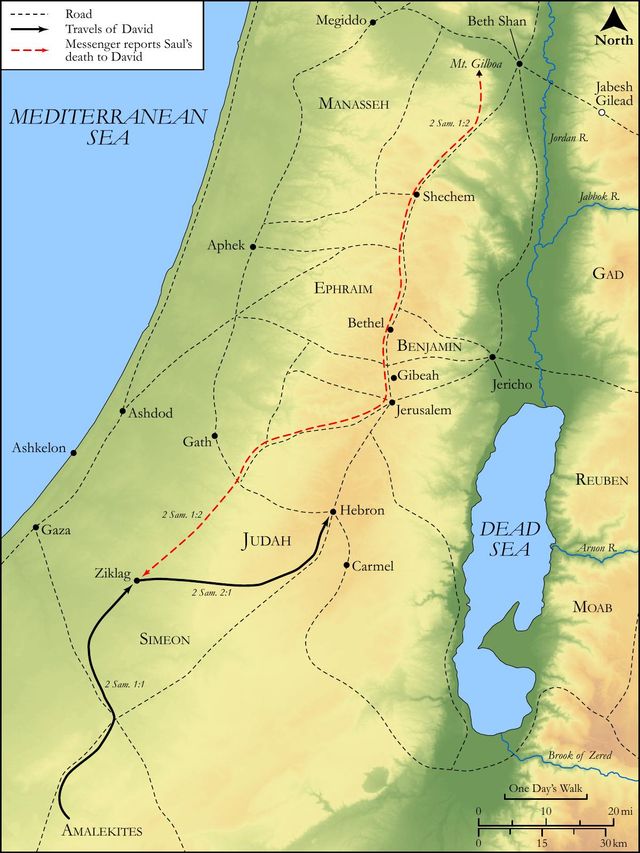
The immediate literary context of 2 Samuel 2:5 follows a pivotal and tragic transition in Israel's history. The preceding chapter, 1 Samuel 31, recounts the devastating defeat of Israel by the Philistines on Mount Gilboa, culminating in the tragic deaths of King Saul and his three sons, including Jonathan, David's beloved friend. The Philistines then desecrated their bodies, displaying them on the wall of Beth-shan. Upon hearing of this disgrace, the men of Jabesh-gilead bravely undertook a perilous journey to retrieve and honorably bury the fallen king and his sons. 2 Samuel 1 then details David's profound lament for Saul and Jonathan, showcasing his genuine grief and respect for the Lord's anointed, even his adversary. This sets the stage for David's anointing as king over Judah in 2 Samuel 2:1-4, making his immediate act of blessing Jabesh-gilead in 2 Samuel 2:5 a crucial first step in his new reign, demonstrating his leadership style and commitment to unity rather than vengeance or political opportunism.
Historical & Cultural Context
Historically, Saul had previously delivered Jabesh-gilead from the Ammonites in a decisive victory (as recorded in 1 Samuel 11), establishing a strong bond of loyalty and gratitude between the city and the king. This act of burial was not merely a humanitarian gesture but a culturally significant act of honor in Israel, especially given the public humiliation inflicted by the Philistines who had displayed Saul's body on the wall of Beth-shan. In these cultures, a proper burial was paramount for the dignity of the deceased and their family, and the desecration of a body was a grave insult, intended to shame the fallen and their people. David's recognition of their bravery and loyalty was also politically astute, as he was consolidating his power and needed to demonstrate that his reign would be one of justice, respect, and unity, even for those who had previously served Saul. This move helped to bridge the divide between the northern tribes, who had been loyal to Saul, and Judah, which had just anointed David.
Key Themes
ShowHideThis verse contributes significantly to several key themes within 2 Samuel. Firstly, it highlights David's wise and unifying leadership. Unlike Saul, who often acted impulsively and was plagued by insecurity, David demonstrates a measured, grateful, and politically astute approach, immediately reaching out to affirm loyalty rather than punish perceived opposition. His actions here set a precedent for a reign characterized by justice and righteousness, as later summarized in 2 Samuel 8:15. Secondly, it underscores the theme of steadfast loyalty and kindness (חֶסֶד, chesed). The men of Jabesh-gilead exemplify this by remembering Saul's past kindness and acting on it, even at personal risk. David's blessing validates this virtue, emphasizing its importance in the emerging kingdom. Thirdly, the passage reinforces the biblical principle of respect for the Lord's anointed and the deceased. Despite Saul's relentless pursuit of David, David consistently honors Saul's position and person, even in death, setting a moral standard for his reign and for the nation. This act foreshadows David's ongoing commitment to justice and righteousness throughout his kingship.
Exposition and Analysis
ShowHideKey Word Analysis
ShowHideThis primitive root means "to kneel," and by implication, "to bless God (as an act of adoration)" or "man (as a benefit)." When David says, "Blessed be ye of the LORD," he is not merely offering a human commendation but invoking God's favor and divine well-being upon the men of Jabesh-gilead. This blessing carries significant theological weight, indicating that their act of loyalty and honor was pleasing in the sight of God, and therefore deserving of divine reward and protection.
This rich Hebrew term denotes far more than simple benevolence; it encompasses loyal love, steadfast faithfulness, covenantal commitment, and enduring devotion. By using chesed, David acknowledges that the men of Jabesh-gilead's act was not a casual favor but a profound expression of deep-seated loyalty and gratitude rooted in a sense of duty and remembrance of Saul's past deliverance of their city (1 Samuel 11). It signifies an active, enduring, and often unmerited, demonstration of fidelity.
This term refers to a sovereign, controller, master, or owner, applicable to both human and divine authority. In this context, it refers to Saul as "your lord," acknowledging his former status as their king. David's use of this term validates the men's loyalty to Saul, demonstrating David's respect for the divine institution of kingship and his commitment to honoring the past, even amidst a transition of power.
Verse Breakdown
ShowHide"And David sent messengers unto the men of Jabeshgilead"
This immediate and proactive action by David, upon hearing of the men's courageous deed, highlights his strategic and compassionate leadership. It demonstrates his attentiveness to events throughout Israel and his desire to establish positive relationships, especially with those who had shown loyalty to the previous king, rather than viewing them as adversaries.
"and said unto them, Blessed [be] ye of the LORD"
David's commendation is not merely from himself but invokes the divine blessing. This elevates the significance of their act, placing it under God's approval. It also subtly positions David as a leader who operates under divine authority and seeks God's favor for his people, contrasting with Saul's later disregard for divine commands and loss of divine favor.
"that ye have shewed this kindness unto your lord, [even] unto Saul"
David explicitly identifies the recipient of their "kindness" (chesed) as Saul, acknowledging his former status as their king. This is a crucial political and spiritual move, as it validates the loyalty shown to the previous anointed king, demonstrating David's respect for the divine institution of kingship and his commitment to honoring the past, even amidst a transition of power. It signifies David's magnanimity and his desire for national unity.
"and have buried him"
This phrase directly refers to the specific, courageous act of retrieving and burying Saul's body and those of his sons. This act was dangerous, defied the Philistines, and restored dignity to the fallen king, making it a profound expression of loyalty and honor in Israel. David's direct affirmation of this deed underscores its importance and his deep appreciation for their bravery and faithfulness.
Literary Devices
ShowHideThe verse employs several significant literary devices that enhance its meaning and impact. Commendation is central, as David publicly praises the men of Jabesh-gilead, affirming their noble actions and setting a tone for his reign. The use of the term chesed for "kindness" functions as thematic resonance, linking this specific act to a broader biblical concept of loyal love and covenant faithfulness that is foundational to God's character and expected of His people. Furthermore, David's invocation of a divine blessing ("Blessed be ye of the LORD") serves as both a literal blessing and a rhetorical strategy, lending divine authority to his words and reinforcing the idea that their actions were righteous in God's eyes. This also subtly establishes David's own legitimacy as a leader who operates under God's favor, contrasting with the tragic end of Saul, who had lost divine favor. The narrative also employs foreshadowing, as David's wise and unifying leadership here sets the stage for the eventual consolidation of all Israel under his reign.
Theological and Thematic Connections
ShowHideThis verse profoundly illustrates the biblical value of loyal love (chesed) and respect, even for those who may have been adversaries or have fallen from grace. David's actions demonstrate a leadership principle rooted in divine wisdom: honoring those who show faithfulness, regardless of their past allegiances. This act not only solidifies David's position but also sets a moral precedent for his kingdom, emphasizing unity and the recognition of righteous deeds. It reflects a theology where God blesses those who act with integrity and compassion, even in difficult circumstances, mirroring His own steadfast love. David's magnanimity here is a testament to his character as "a man after God's own heart."
Reflection and Application
ShowHideDavid's response to the men of Jabesh-gilead offers a powerful model for our own lives and leadership today. In a world often characterized by division, resentment, and a tendency to disparage those who have fallen or are perceived as rivals, David chooses a path of honor, gratitude, and blessing. His act transcends personal grievances and political expediency, focusing instead on the intrinsic value of loyalty, courage, and respect for human dignity. This challenges us to consider how we respond to the actions of others, particularly those who may have been difficult or antagonistic. Are we quick to commend genuine acts of kindness and faithfulness, even when they benefit someone we might not personally favor? Do we seek to build bridges of honor rather than walls of animosity? David's example encourages us to cultivate a spirit of appreciation, to acknowledge noble deeds, and to speak words of blessing that foster unity and reflect God's own character of chesed. It reminds us that true leadership, especially in a spiritual context, prioritizes reconciliation and the affirmation of virtue, rather than perpetuating conflict or holding grudges.
Questions for Reflection
ShowHideFAQ
ShowHideWhy was it so important for the men of Jabesh-gilead to bury Saul?
ShowHideIn Israel, a proper burial was a profound act of respect and dignity for the deceased. To leave a body unburied or desecrated was considered a grave dishonor, often reserved for the worst criminals or enemies. The Philistines had displayed Saul's body and armor in their temples and on the wall of Beth-shan (1 Samuel 31:9-10), which was an ultimate act of humiliation for the fallen king and for Israel. The men of Jabesh-gilead, remembering Saul's past deliverance of their city from the Ammonites (1 Samuel 11), undertook a perilous journey to retrieve the bodies and provide a respectful burial, thereby restoring honor to Saul and, by extension, to Israel. David's commendation acknowledges the immense significance and bravery of their act, recognizing it as an act of profound loyalty and cultural duty.
Did David have a personal connection to Jabesh-gilead?
ShowHideWhile there's no direct record of a personal connection between David and Jabesh-gilead prior to this event, the city had a strong historical bond with King Saul. Saul had famously rescued them from the Ammonites early in his reign (1 Samuel 11), leading to their deep loyalty to him. David's act of sending messengers to them was a strategic and compassionate move. It demonstrated his respect for those who had shown loyalty to the previous king, signaled his intention to rule justly over all Israel, and helped to bridge the gap between Saul's former kingdom and his newly established reign in Judah. It was an act of statesmanship that honored past allegiances while inviting future unity under his leadership, laying groundwork for his eventual kingship over all twelve tribes.
What does David's blessing "of the LORD" signify?
ShowHideWhen David says, "Blessed be ye of the LORD," he is not simply offering a human commendation but invoking divine favor upon the men of Jabesh-gilead. This signifies that their courageous and loyal act was not only commendable in human eyes but was also pleasing to God. It suggests that their chesed (loyal kindness) was a reflection of God's own character and therefore worthy of divine blessing and protection. This invocation also subtly reinforces David's own position as God's chosen king, operating under divine authority and seeking God's blessing for his people, in contrast to Saul, who had lost God's favor due to disobedience. It underscores the theological dimension of their actions and David's response, aligning human virtue with divine approval.
Christ-Centered Fulfillment
ShowHideThe loyal kindness (chesed) shown by the men of Jabesh-gilead and David's gracious response foreshadow a deeper, ultimate expression of divine chesed found in Jesus Christ. David, as a king who honors loyalty and seeks to unify a divided kingdom, serves as a type of the true King, Jesus, who perfectly embodies loyal love and brings ultimate reconciliation. Just as David blessed those who honored a fallen king, Christ blesses those who, through faith, honor Him, the resurrected King. The men of Jabesh-gilead's brave act of restoring dignity to Saul's body, even in death, points to the profound dignity restored to humanity through Christ's own death and resurrection. He did not merely honor the dead; He conquered death itself, offering eternal life and true dignity to all who believe, as promised in John 11:25-26. His ultimate act of chesed on the cross, where He laid down His life for His enemies (Romans 5:8), far surpasses any human kindness, offering forgiveness and reconciliation that bridges the chasm of sin and brings us into a covenant relationship with God. Through Christ, we receive the ultimate blessing of the Lord, not for our acts of loyalty to a fallen king, but for God's unfailing love and Christ's perfect sacrifice, fulfilling the promise of a blessed people under a righteous King, as foretold in passages like Isaiah 9:6-7 and realized in the New Covenant established by His blood (Hebrews 8:6).