


1 Samuel 29:5
Bible text: King James Version (1769 Blayney text) · Public domain
Bible text: Berean Standard Bible · Public domain
Bible text: American Standard Version (1901) · Public domain
Bible text: World English Bible, Messianic edition · Public domain
Bible text: Geneva Bible (1599) · Public domain
Bible text: Young's Literal Translation · Public domain
- הֲלוֹאha·lo'¿ notH3808Interrog ¦ NegParticle Negativeהֲ¿לוֹאnot
- זֶהzeh[is] thisH2088PrtParticle Demonstrative
- דָוִדda·VidDavidH1732N-proper-mNoun Proper Masculine
- אֲשֶׁר'a·SherwhomH834RelParticle Relative
- יַעֲנוּya·'a·nupeople singH6030V-Qal-Imperf-3mpVerb Qal Imperfect 3rd Plural Masculine
- לוֹloof <the> himPrep-l ¦ 3msSuffix Personal 3rd Singular Masculineלof <the>וֹhim
- בַּמְּחֹלוֹתba·me·cho·Lotin <the> dancesH4246Prep-b ¦ N-fpNoun Plural Feminine Absoluteבַּin <the>מְּחֹלוֹתdances
- לֵאמֹרle·Mor<to> sayingH559Prep-l ¦ V-Qal-InfVerb Qal Infinitive Constructלֵ<to>אמֹרsaying
- הִכָּהhi·Kahhe has struck downH5221V-Hiphil-Perf-3msVerb Hiphil Perfect 3rd Singular Masculine
- שָׁאוּלsha·'UlSaulH7586N-proper-mNoun Proper Masculine
- בַּאֲלָפָיוba·'a·la·Fav<on> his thousandsH505Prep-b ¦ N-mpc ¦ 3msNoun Plural Masculine Constructבַּ<on>אֲלָפָיthousandsוhis
- וְדָוִדve·da·Vidand DavidH1732Conj-w ¦ N-proper-mNoun Proper MasculineוְandדָוִדDavid
- בְּרִבְבֹתָיוbe·ri·vo·tov<on> his ten thousandsH7233Prep-b ¦ N-fpc ¦ 3msNoun Plural Feminine Constructבְּ<on>רִבְבֹתָיten thousandsוhis
English is a literal word-by-word gloss of the Hebrew, not the KJV's wording. Why?
This is the original text the KJV's translators worked from — each Hebrew word with its own literal English meaning in this verse, prepared by scholars at Tyndale House, Cambridge. The KJV translates whole sentences, not word by word, so its wording differs: one Hebrew word can become several English words, and the KJV may choose “the LORD” where the gloss reads “Yahweh”. Both are faithful — they answer different questions. For the KJV's own rendering, switch to the KJV text.
Details
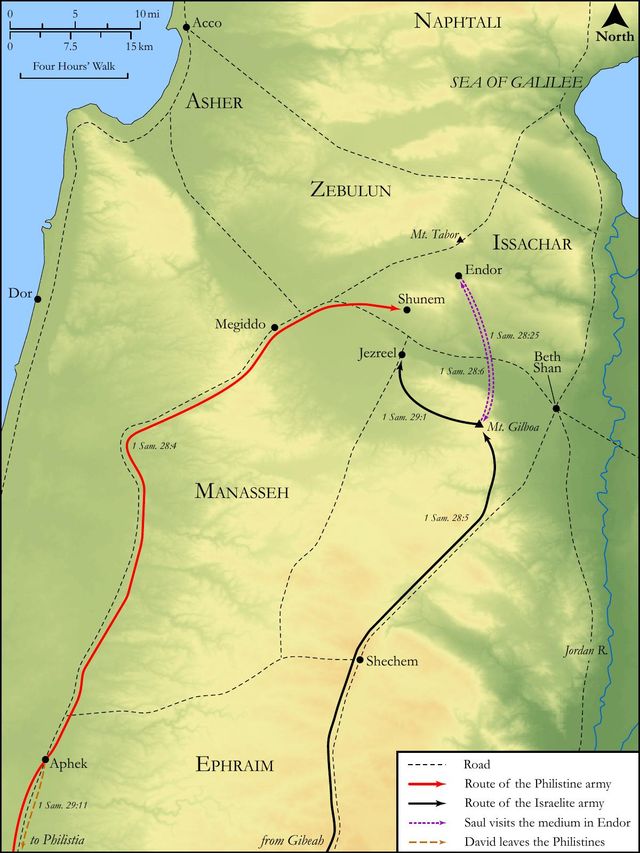
See on the biblical-era map
Study this verse
Public-domain commentary
Matthew Henry
From his Commentary on the Whole Bible. Henry comments on passages, not single verses — this entry covers 1 Samuel 29:1–5.
Here is, I. The great strait that David was in, which we may suppose he himself was aware of, though we read not of his asking advice from God, nor of any project of his own to get clear of it. The two armies of the Philistines and the Israelites were encamped and ready to engage, Sa1 29:1. Achish, who had been kind to David, had obliged him to come himself and bring the forces he had into his service. David came accordingly, and, upon a review of the army, was found with Achish, in the post assigned him in the rear, Sa1 29:2. Now, 1. If, when the armies engaged, he should retire, and quit his post, he would fall under the indelible reproach, not only of cowardice and treachery, but of base ingratitude to Achish, who had been his protector and benefactor and had reposed a confidence in him, and from whom he had received a very honourable commission. Such an unprincipled thing as this he could by no means persuade himself to do. 2. If he should, as was expected from him, fight for the Philistines against Israel, he would incur the imputation of being an enemy to the Israel of God and a traitor to his country, would make his own people hate him, and unanimously oppose his coming to the crown, as unworthy the name of an Israelite, much more the honour and trust of a king of Israel, when he had fought against them under the banner of the uncircumcised. If Saul should be killed (as it proved he was) in this engagement, the fault would be laid at David's door, as if he had killed him. So that on each side there seemed to be both sin and scandal. This was the strait he was in; and a great strait it was to a good man, greater to see sin before him than to see trouble. Into this strait he brought himself by his own unadvisedness, in quitting the land of Judah, and going among the uncircumcised. It is strange if those that associate themselves with wicked people, and grow intimate with them, come off without guilt, or grief, or both. What he himself proposed to do does not appear. Perhaps he designed to act only as keeper to the king's head, the post assigned him (Sa1 28:2) and not to do any thing offensively against Israel. But it would have been very hard to come so near the brink of sin and not to fall in. Therefore, though God might justly have left him in this difficulty, to chastise him for his folly, yet, because his heart was upright with him, he would not suffer him to be tempted above what he was able, but with the temptation made a way for him to escape, Co1 10:13.
II.A door opened for his deliverance out of this strait.
God inclined the hearts of the princes of the Philistines to oppose his being employed in the battle, and to insist upon his being dismissed. Thus their enmity befriended him, when no friend he had was capable of doing him such a kindness. 1. It was a proper question which they asked, upon the mustering of the forces, "What do these Hebrews here? Sa1 29:3. What confidence can we put in them, or what service can we expect from them?" A Hebrew is out of his place, and, if he has the spirit of a Hebrew, is out of his element, when he is in the camp of the Philistines, and deserves to be made uneasy there. David used to hate the congregation of evil doers, however he came now to be among them, Psa 26:5. It was an honourable testimony which Achish, on this occasion, gave to David. He looked upon him as a refugee, that fled from a wrongful prosecution in his own country, and had put himself under his protection, whom therefore he was obliged, in justice, to take care of, and thought he might in prudence employ; "for (says he) he has been with me these days, or these years," that is, a considerable time, many days at his court and a year or two in his country, and he never found any fault in him, nor saw any cause to distrust his fidelity, or to think any other than that he had heartily come over to him. By this it appears that David had conducted himself with a great deal of caution, and had prudently concealed the affection he still retained for his own people. We have need to walk in wisdom towards those that are without, to keep our mouth when the wicked is before us, and to be upon the reserve. 3. Yet the princes are peremptory in it, that he must be sent home; and they give good reasons for their insisting on it. (1.) Because he had been an old enemy to the Philistines; witness what was sung in honour of his triumphs over them: Saul slew his thousands, and David his ten thousands, Sa1 29:5. "It will be a reproach to us to harbour and trust so noted a destroyer of our people; nor can it be thought that he will now act heartily against Saul who then acted so vigorously with him and for him." Who would be fond of popular praise or applause when, even that may, another time, be turned against a man to his reproach? (2.) Because he might be a most dangerous enemy to them, and do them more mischief then all Saul's army could (Sa1 29:4): "He may in the battle be an adversary to us, and surprise us with an attack in the rear, while their army charges us in the front; and we have reason to think he will do so, that, by betraying us, he may reconcile himself to his master. Who can trust a man who, besides his affection to his country, will think it his interest to be false to us?" It is dangerous to put confidence in a reconciled enemy.
Continue studying 1 Samuel 29:5 across the web’s major study libraries — every link below opens this exact verse, chapter, or book on the destination site.
Read & Compare
 BibleGatewayThis verse in more than 200 translations and 70 languages.
 Bible.comThe YouVersion reader — hundreds of translations, reading plans, and highlights.
 ESV.orgCrossway's official English Standard Version reader.
 NET BibleThe NET translation with 60,000+ translators' notes on every rendering decision.
 STEP BibleTyndale House's free study tool — original text, vocabulary, and scholarly resources.
 BibliaLogos Bible Software's free web reader.
 USCCBThe New American Bible (Revised Edition) with the U.S. bishops' study notes.
Commentaries
 BibleHub CommentariesDozens of classic commentaries on this verse, gathered on one page.
 StudyLightMore than 100 commentary sets — the largest collection on the web.
 BibleRefPlain-English commentary on what this verse means, verse by verse.
 Enduring WordDavid Guzik's free commentary on this chapter, widely used by Bible teachers.
 Bible Study ToolsVerse commentary alongside Greek and Hebrew study aids.
Original Language & Research
- BibleHub InterlinearThe verse word by word — original language, transliteration, and English.
- BibleHub LexiconEvery word's original-language definition and Strong's entry.
 Blue Letter BibleDeep-study tools — Strong's numbers, concordance, and word studies.
 SefariaThe Hebrew text with Rashi and centuries of Jewish commentary.
Sermons, Hymns & Audio


TrulyRandomVerse is not affiliated with these sites and doesn’t control their content. They’re linked because they’re genuinely useful.
Summary
1 Samuel 29:5 captures a critical moment of tension and recognition, as the Philistine lords, preparing for battle against Israel, voice their profound distrust of David. The verse quotes the popular Israelite song that celebrated David's superior military prowess over King Saul, a song that had become both a testament to David's heroic status and the very catalyst for Saul's consuming jealousy, ultimately driving David into exile among the Philistines. This recollection by David's temporary allies underscores his enduring fame and formidable reputation, even among his enemies, while highlighting the moral complexities of his desperate refuge.
Context
ShowHideLiterary Context
This verse is situated at a critical juncture in the narrative of David's exile and Saul's decline, specifically as the Philistines gather their forces for a decisive battle against Israel at Jezreel. David, having sought refuge with King Achish of Gath for over a year, is expected to join the Philistine army, a position of deep moral compromise. The immediate preceding verses (1 Samuel 29:1-4) detail the Philistine commanders' strong objections to David's presence in their ranks. Their rhetorical question in verse 5, recalling the famous song, serves as the ultimate justification for their demand that David be sent away. This divine intervention, orchestrated through the Philistines' distrust, providentially spares David from the impossible ethical dilemma of fighting against his own people and the Lord's anointed, Saul, in the ensuing battle where Saul and his sons would perish, as recorded in 1 Samuel 31.
Historical & Cultural Context
In the warfare of Israel and the Philistines, military prowess was highly esteemed, and songs of victory were common ways to commemorate heroes and their achievements. The Philistines, a formidable military power with a long-standing rivalry with Israel, would have been acutely aware of David's reputation, having suffered significant defeats at his hands. David's status as a servant of King Achish of Gath placed him in a precarious position, as loyalty in such service was expected to be absolute, even against one's former nation. However, the Philistine lords' skepticism reflects a pragmatic understanding of national and ethnic loyalties that often superseded personal allegiances, especially in the context of a major war. The song itself, a popular refrain, demonstrates the power of public opinion and oral tradition in shaping reputations and influencing political dynamics in ancient Israel, as seen in its initial impact on Saul in 1 Samuel 18:7-9.
Key Themes
ShowHideThis verse powerfully encapsulates several key themes. Firstly, it highlights David's Unparalleled Fame and Prowess, demonstrating how his military achievements, particularly his victory over Goliath and subsequent campaigns, had cemented his status as a national hero far surpassing King Saul. The song's widespread popularity served as a constant reminder of his exceptional capabilities. Secondly, it underscores The Roots of Saul's Jealousy, explicitly recalling the very song that ignited Saul's intense paranoia and animosity towards David, driving David into years of exile. This envy, rooted in a perceived threat to his throne, led to Saul's relentless pursuit of David, as detailed in numerous chapters (e.g., 1 Samuel 19). Lastly, the verse illuminates the theme of Distrust and Loyalty. Despite David's service to Achish, his formidable past and undeniable allegiance to Israel made him an unreliable ally in the eyes of the other Philistine commanders. Their concern was not merely strategic but fundamentally about where David's true loyalties would lie when facing his own nation in battle, emphasizing the inherent conflict of interest in David's morally ambiguous position within 1 Samuel 27.
Exposition and Analysis
ShowHideKey Word Analysis
ShowHideFrom a primitive root meaning "to eye or (generally) to heed, i.e. pay attention; by implication, to respond; by extension to begin to speak; specifically to sing, shout, testify, announce." In this context, it refers to a public, communal act of vocal expression, specifically singing. The use of this word emphasizes the widespread and popular nature of the acclamation David received, indicating a spontaneous and joyful recognition of his heroism by the people.
A primitive root meaning "to strike (lightly or severely, literally or figuratively)." This verb denotes a decisive act of striking, often with lethal intent, resulting in death or defeat. Here, it highlights the military action and the resulting casualties inflicted by both Saul and David, serving as a direct measure of their respective military successes and prowess.
From a root meaning "abundance (in number), i.e. (specifically) a myriad (whether definite or indefinite)." This term is often translated as "myriads" or "tens of thousands" and functions as a hyperbolic expression in Hebrew. It signifies an overwhelmingly vast number rather than a literal count, emphasizing the immense scale of David's victories and underscoring his unparalleled military success and popular acclaim far beyond Saul's.
Verse Breakdown
ShowHide"[Is] not this David"
This rhetorical question, posed by the Philistine lords, is not a genuine inquiry but a strong, undeniable assertion. It conveys their immediate and resentful recognition of David, coupled with deep suspicion and concern about his presence among them. It implies, "Surely this is that David, the renowned warrior who has caused us so much devastation before."
"of whom they sang one to another in dances"
This clause describes the widespread and popular nature of David's fame within Israel. The imagery of people singing and dancing together evokes a scene of communal celebration and deep admiration for David, reinforcing his status as a national hero. It underscores how deeply ingrained his reputation was in the collective consciousness of his own people.
"saying, Saul slew his thousands, and David his ten thousands?"
This is the direct quote of the famous song, which serves as the core justification for the Philistine lords' apprehension. The stark numerical contrast ("thousands" vs. "ten thousands") highlights David's superior military achievements and popular appeal, which had previously ignited Saul's intense jealousy. For the Philistines, it was a chilling reminder of David's past effectiveness against them, making him an untrustworthy and dangerous ally.
Literary Devices
ShowHideThe verse employs several potent literary devices that amplify its dramatic impact and thematic depth. The primary device is a Rhetorical Question, "Is not this David...?", which is not posed to elicit information but to convey the Philistine lords' strong conviction and shared apprehension regarding David's presence. It functions as an accusation and a statement of undeniable truth, demanding agreement. Hyperbole is powerfully evident in the phrase "ten thousands," which is a deliberate exaggeration to emphasize David's overwhelming military superiority and the vast scale of his victories, rather than a literal count. This hyperbole is further amplified by Juxtaposition and Contrast, as David's "ten thousands" are directly set against Saul's "thousands," starkly highlighting David's greater prowess and popularity in the eyes of the people. The entire verse functions as a form of Foreshadowing, as the Philistine lords' distrust ultimately leads to David's removal from their ranks, providentially sparing him from fighting against Israel, thus setting the stage for Saul's final defeat and David's eventual ascension. There is also a subtle Irony at play: the very fame that once saved David from Saul's wrath by making him a desirable asset to Achish now becomes the reason for his rejection by the other Philistine commanders, illustrating the unpredictable nature of human alliances and divine providence.
Theological and Thematic Connections
ShowHideThis verse, though seemingly a simple recall of a song, is deeply significant. It reveals the pervasive nature of reputation and the destructive power of envy, illustrating how human accolades, while initially celebratory, can become sources of bitter division and suspicion. The Philistine lords' recognition of David's fame, even as they prepare to fight his people, underscores the reality that God's hand was upon David, preserving him even in morally ambiguous circumstances. Their distrust, fueled by David's past triumphs over them, became the very means by which God protected David from fighting against Israel and the Lord's anointed, demonstrating divine sovereignty at work through human fears and political maneuvering. This divine intervention ensured David's purity for his future role as king, preventing him from shedding Israelite blood.
Reflection and Application
ShowHideThe enduring power of reputation, whether good or ill, is a timeless truth highlighted by this verse. David's military fame, celebrated in song, preceded him everywhere, shaping perceptions and influencing outcomes. In our own lives, our past actions and character, publicly known or privately held, contribute to the reputation that precedes us, impacting trust, opportunities, and relationships. This narrative also serves as a stark warning against the corrosive nature of envy. The song, meant to honor David, became a bitter poison for Saul, demonstrating how comparisons can quickly devolve into destructive jealousy, paranoia, and conflict within families, workplaces, or even churches. We are called to guard our hearts against such comparisons, celebrating the successes of others rather than allowing envy to fester. Finally, the Philistines' concern about David's loyalty prompts us to consider where our ultimate allegiances lie. In a world of competing demands and shifting loyalties, discerning and committing to our core values and, most importantly, to God's will, is paramount for living with integrity and purpose. Even in challenging or morally ambiguous situations, we can trust that God's sovereign hand is at work, guiding our steps and protecting His purposes, often in ways we don't immediately understand.
Questions for Reflection
ShowHideFAQ
ShowHideWhy were the Philistine lords so concerned about David?
ShowHideThe Philistine lords were deeply concerned about David primarily because of his formidable reputation as a warrior who had previously inflicted devastating defeats upon them. The song quoted in the verse, "Saul slew his thousands, and David his ten thousands," was a chilling reminder of his unparalleled military prowess. They feared that if David fought alongside them against Israel, he might betray them in the heat of battle to reconcile with King Saul or simply to avoid fighting his own people. Their concern was a pragmatic military assessment: David was too great a risk to their forces and their strategic objectives, especially given his history of defeating Philistine champions like Goliath, as recorded in 1 Samuel 17.
Did David truly intend to fight against Israel?
ShowHideThe biblical text does not explicitly state David's true intentions regarding fighting against Israel. His position with King Achish was a desperate measure to escape Saul's relentless pursuit, as seen in 1 Samuel 27:1. While he engaged in raids against other groups (like the Geshurites, Girzites, and Amalekites) and deceptively reported them to Achish as raids against Judah, he was in a morally compromising and precarious situation. The Philistine lords' distrust, leading to his dismissal, can be seen as a divine intervention that spared David from having to make an impossible ethical choice and from fighting against his own people and the Lord's anointed, Saul, as God's plan for David's future kingship required him to remain untainted by such a conflict.
How did this song originate, and why was it so significant?
ShowHideThe song originated shortly after David's famous victory over Goliath and his subsequent military successes against the Philistines, as recorded in 1 Samuel 18:7. The women of Israel came out to meet Saul and David with singing and dancing, celebrating their victories. It was significant because it publicly declared David's superior military achievements and popularity, effectively elevating him above King Saul in the eyes of the people. This public acclamation directly fueled Saul's intense jealousy and paranoia, marking David as a perceived threat to his throne and initiating the long, painful period of David's flight from Saul, as detailed in 1 Samuel 18.
Christ-Centered Fulfillment
ShowHideThe fame of David, celebrated in song for slaying "ten thousands," foreshadows the ultimate and infinitely greater triumph of Jesus Christ. While David's victories were over physical enemies and brought temporary deliverance for Israel, Christ's victory is over sin, death, and the powers of darkness, bringing eternal salvation for all who believe. The "ten thousands" David slew are but a pale shadow of the countless millions whom Christ redeems through His singular, perfect sacrifice on the cross, as foreshadowed in passages like Isaiah 53:5. His is the ultimate victory, not achieved through military might, but through humble obedience and self-giving love, as described in Philippians 2:8 and Hebrews 12:2. Unlike David, whose loyalty was questioned even by his temporary allies, Christ demonstrated perfect, unwavering loyalty to His Father's will, even to the point of death on a cross, as highlighted in Hebrews 4:15. The "song" sung for David pales in comparison to the "new song" of praise sung to the Lamb of God in heaven, who is worthy because He "purchased for God persons from every tribe and language and people and nation" (Revelation 5:9). Christ's triumph is not merely over "thousands" or "ten thousands," but over all spiritual principalities and powers, leading them captive in His glorious procession (Colossians 2:15), thereby fulfilling the promise of victory over evil found throughout the Old Testament, from Genesis 3:15 onward. He is the true King, whose fame is eternal and whose kingdom knows no end, as proclaimed in Luke 1:33.