


Psalms 60:5
Bible text: King James Version (1769 Blayney text) · Public domain
Bible text: Berean Standard Bible · Public domain
Bible text: American Standard Version (1901) · Public domain
Bible text: World English Bible, Messianic edition · Public domain
Bible text: Geneva Bible (1599) · Public domain
Bible text: Young's Literal Translation · Public domain
- לְמַעַןLe·ma·'anso thatH4616PrtParticle Conditional
- יֵחָלְצוּןye·chal·Tzunthey may be rescued !H2502V-Niphal-Imperf-3mp ¦ SfxVerb Niphal Imperfect 3rd Plural Masculineיֵחָלְצוּthey may be rescuedן!
- יְדִידֶיךָye·di·Dei·khayour beloved [ones]H3039Adj-mpc ¦ 2msAdjective Plural Masculine Constructיְדִידֶיbeloved [ones]ךָyour
- הוֹשִׁיעָהho·Shi·'ahsave !H3467V-Hiphil-Imp-2ms ¦ SfxVerb Hiphil Imperative 2nd Singular Masculineהוֹשִׁיעָsaveה!
- יְמִינְךָye·mi·ne·Khayour right [hand]H3225N-fsc ¦ 2msNoun Singular Feminine Constructיְמִינְright [hand]ךָyour
- וַעֲנֵנִיva·'a·ne·nuand answer meH6030Conj-w ¦ V-Qal-Imp-2ms ¦ 1csVerb Qal Imperative 2nd Singular Masculineוַandעֲנֵanswerנִיme
English is a literal word-by-word gloss of the Hebrew, not the KJV's wording. Why?
This is the original text the KJV's translators worked from — each Hebrew word with its own literal English meaning in this verse, prepared by scholars at Tyndale House, Cambridge. The KJV translates whole sentences, not word by word, so its wording differs: one Hebrew word can become several English words, and the KJV may choose “the LORD” where the gloss reads “Yahweh”. Both are faithful — they answer different questions. For the KJV's own rendering, switch to the KJV text.
Details
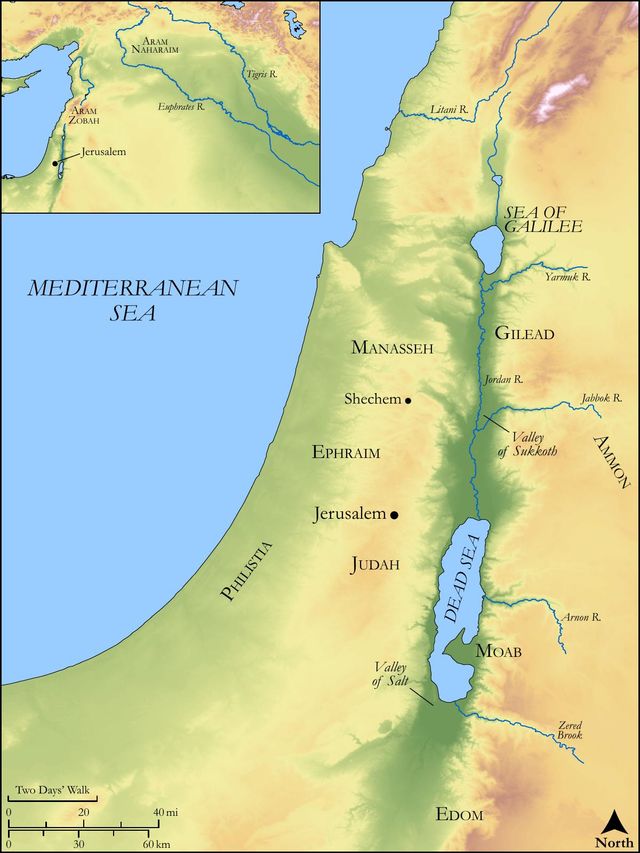
See on the biblical-era map
Study this verse
Public-domain commentary
Matthew Henry
From his Commentary on the Whole Bible. Henry comments on passages, not single verses — this entry covers Psalms 60:1–5. His three-level outline is real structure in the source text, so it is rendered as structure.
The title gives us an account, 1. Of the general design of the psalm. It is Michtam - David's jewel, and it is to teach. The Levites must teach it to the people, and by it teach them both to trust in God and to triumph in him; we must, in it, teach ourselves and one another. In a day of public rejoicing we have need to be taught to direct our joy to God and to terminate it in him, to give none of that praise to the instruments of our deliverance which is due to him only, and to encourage our hopes with our joys. 2. Of the particular occasion of it. It was at a time, (1.) When he was at war with the Syrians, and still had a conflict with them, both those of Mesopotamia and those of Zobah. (2.) When he had gained a great victory over the Edomites, by his forces, under the command of Joab, who had left 12,000 of the enemy dead upon the spot. David has an eye to both these concerns in this psalm: he is in care about his strife with the Assyrians, and in reference to that he prays; he is rejoicing in his success against the Edomites, and in reference to that he triumphs with a holy confidence in God that he would complete the victory. We have our cares at the same time that we have our joys, and they may serve for a balance to each other, that neither may exceed. They may likewise furnish us with matter both for prayer and praise, for both must be laid before God with suitable affections and emotions. If one point be gained, yet in another we are still striving: the Edomites are vanquished, but the Syrians are not; therefore let not him that girds on the harness boast as if he had put it off.
In these verses, which begin the psalm, we have,
I.A melancholy memorial of the many disgraces and disappointments which God had, for some years past, put the people under.
During the reign of Saul, especially in the latter end of it, and during David's struggle with the house of Saul, while he reigned over Judah only, the affairs of the kingdom were much perplexed, and the neighbouring nations were vexatious to them.
1.He complains of hard things which they had seen (that is, which they had suffered), while the Philistines and other ill-disposed neighbours took all advantages against them, Psa 60:3. God sometimes shows even his own people hard things in this world, that they may not take up their rest in it, but may dwell at ease in him only.
2.He owns God's displeasure to be the cause of all the hardships they had undergone: "Thou hast been displeased by us, displeased against us (Psa 60:1), and in thy displeasure hast cast us off and scattered us, hast put us out of thy protection, else our enemies could not have prevailed thus against us. They would never have picked us up and made a prey of us if thou hadst not broken the staff of bands (Zac 11:14) by which we were united, and so scattered us." Whatever our trouble is, and whoever are the instruments of it, we must own the hand of God, his righteous hand, in it.
3.He laments the ill effects and consequences of the miscarriages of the late years. The whole nation was in a convulsion: Thou hast made the earth (or the land) to tremble, Psa 60:2. The generality of the people had dreadful apprehensions of the issue of these things. The good people themselves were in a consternation: "Thou hast made us to drink the wine of astonishment (Psa 60:3); we were like men intoxicated, and at our wits' end, not knowing how to reconcile these dispensations with God's promises and his relation to his people; we are amazed, can do nothing, nor know we what to do." Now this is mentioned here to teach, that is, for the instruction of the people. When God is turning his hand in our favour, it is good to remember our former calamities,
(1.)That we may retain the good impressions they made upon us, and may have them revived. Our souls must still have the affliction and the misery in remembrance, that they may be humbled within us, Lam 3:19, Lam 3:20.
(2.)That God's goodness to us, in relieving us and raising us up, may be more magnified; for it is as life from the dead, so strange, so refreshing. Our calamities serve as foils to our joys.
(3.)That we may not be secure, but may always rejoice with trembling, as those that know not how soon we may be returned into the furnace again, which we were lately taken out of as the silver is when it is not thoroughly refined.
II.A thankful notice of the encouragement God had given them to hope that, though things had been long bad, they would now begin to mend (Psa 60:4): "Thou hast given a banner to those that fear thee (for, as bad as the times are, there is a remnant among us that desire to fear thy name, for whom thou hast a tender concern), that it may be displayed by thee, because of the truth of thy promise which thou wilt perform, and to be displayed by them, in defense of truth and equity," Psa 45:4. This banner was David's government, the establishment and enlargement of it over all Israel. The pious Israelites, who feared God and had a regard to the divine designation of David to the throne, took his elevation as a token for good, and like the lifting up of a banner to them,
1.It united them, as soldiers are gathered together to their colours. Those that were scattered (Psa 60:1), divided among themselves, and so weakened and exposed, coalesced in him when he was fixed upon the throne.
2.It animated them, and put life and courage into them, as the soldiers are animated by the sight of their banner.
3.It struck a terror upon their enemies, to whom they could now hang out a flag of defiance. Christ, the Son of David, is given for an ensign of the people (Isa 11:10), for a banner to those that fear God; in him, as the centre of their unity, they are gathered together in one; to him they seek, in him they glory and take courage. His love is the banner over them; in his name and strength they wage war with the powers of darkness, and under him the church becomes terrible as an army with banners.
III.A humble petition for seasonable mercy.
1.That God would be reconciled to them, though he had been displeased with them. In his displeasure their calamities began, and therefore in his favour their prosperity must begin: O turn thyself to us again! (Psa 60:1) smile upon us, and take part with us; be at peace with us, and in that peace we shall have peace. Tranquillus Deus tranquillat omnia - A God at peace with us spreads peace over all the scene.
2.That they might be reconciled to one another, though they had been broken and wretchedly divided among themselves: "Heal the breaches of our land (Psa 60:2), not only the breaches made upon us by our enemies, but the breaches made among ourselves by our unhappy divisions." Those are breaches which the folly and corruption of man makes, and which nothing but the wisdom and grace of God can make up and repair, by pouring out a spirit of love and peace, by which only a shaken shattered kingdom is set to rights and saved from ruin.
3.That thus they might be preserved out of the hands of their enemies (Psa 60:5): "That thy beloved may be delivered, and not made a prey of, save with thy right hand, with thy own power and by such instruments as thou art pleased to make the men of thy right hand, and hear me." Those that fear God are his beloved; they are dear to him as the apple of his eye. They are often in distress, but they shall be delivered. God's own right hand shall save them; for those that have his heart have his hand. Save them, and hear me. Note, God's praying people may take the general deliverances of the church as answers to their payers in particular. If we improve what interest we have at the throne of grace for blessings for the public, and those blessings be bestowed, besides the share we have with others in the benefit of them we may each of us say, with peculiar satisfaction, "God has therein heard me, and answered me."
Historical interpretation
Two Centuries of Reception
5 surviving comments on this verse. Each one is dated, so this reads as a timeline rather than a list.
Select a marker to jump to its quote. Markers stagger vertically where authors wrote within a few decades of each other.
“Gilead is mine, and Manasseh is mine.” Gilead is a grandson of Manasseh; this is said in order that he may show that the succession of the patriarchs, from whom is descended Christ according to the flesh, comes down from God. “And Ephraim is the support of my head. Judah is my king.” He will join together by agreement the parts that are severed. “Moab is the washbasin of my hope.” Or “a pot for washing,” another of the interpreters says; or “a pot of security”; that is to say, the excommunicated person, who has been forbidden with threats to enter the church of the Lord. For the Moabite and the Ammonite will not enter until the third and until the tenth generation and until everlasting time. Nevertheless, since baptism possesses remission for sins and produces security for the debtors, he, showing the deliverance through baptism and the affection for God, says, “Moab is a pot for washing” or “a pot of security.” Therefore, all “foreigners are made subject,” bowing down under the yoke of Christ; for this reason he will set his shoe in Edom. The shoe of the divinity is the God-bearing flesh, through which he approaches humans. In this hope, pronouncing blessed the time of the coming of the Lord, the prophet says, “Who will bring me into the fortified city.” Perhaps he means the church, a city, indeed, because it is a community governed conformably to laws; and fortified, because of the faith encompassing it. Whence one of the interpreters produced a very clear translation: “Into a city fortified all around.” Who, then, will permit me to see this great spectacle, God living among people? These are the words of the Lord: “Many prophets and just people have longed to see what you see, and they have not seen it.”
Therefore, “O God, you have cast us off.” You have cast off those who in proportion to their sins removed themselves a distance from you. You have destroyed the accumulations of our wickedness, doing good to us because of our weakness. You were angry, since “we were by nature children of wrath,” having no hope and being without God in the world. You had mercy on us when “you sent forth your only-begotten Son as a propitiation for our sins,” in order that in his blood we might find redemption. We would not know that we were having these kindnesses done to us, unless “you have made us drink the wine of sorrow.” By wine he means the words that lead the hardened heart to conscious perception.
"That Your beloved may be delivered: save me with Your right hand, and hearken unto me" [Psalm 60:5]. With Your right hand save me, Lord: so save me as that at the right hand I may stand. Not any safety temporal I require, in this matter Your Will be done. For a time what is good for us we are utterly ignorant: for "what we should pray for as we ought we know not:" [Romans 8:26] but "save me with Your right hand," so that even if in this time I suffer sundry tribulations, when the night of all tribulations has been spent, on the right hand I may be found among the sheep, not on the left hand among the goats. [Matthew 25:33] "And hearken unto me." Because now I am deserving that which You are willing to give; not "with the words of my transgressions" I am crying through the day, so that Thou hearken not, and "in the night so that Thou hearken not," and that not for folly to me, but truly for my warning, by adding savour from the valley of salt-pits, so that in tribulation I may know what to ask: but I ask life everlasting; therefore hearken unto me, because Your right hand I ask....
All strangers have stooped and been put under the yoke of Christ, wherefore also “over Edom” does he “cast out” his “shoe.” Now the shoe of the Godhead is the flesh that bore God whereby he came among humankind.
When a person lays aside his past sinfulness, he is suddenly endowed with new dignity, with that cup of divine love of which it is said, “And your cup which inebriated me, how it overflows!” Inebriated with that cup, I repeat, hearts taste the sweetness of heavenly things through the strength of spiritual wisdom. Then they may merit to hear, “Taste and see how good the Lord is.” Now he said “taste,” because love of God can refresh the soul but cannot satisfy the desire, regardless of the amount of faith or longing with which it is sought. More and more, it arouses thirst when it is, as it were, tasted beforehand with the edge of the lips, and for this reason he says of himself, “He who eats of me will hunger still, he who drinks of me will thirst for more.” Because of its sweetness, it arouses an appetite for itself, but it does not cause disgust from satiety. Just as people who are experienced in drinking wine are likely to thirst all the more when they have become drunk, so it is with the devout and chaste soul that is prudent and contrite and that can, therefore, say with the psalmist, “You have given us stupefying wine,” when it has begun to think about hope in a future life and to imbibe a thirst for heavenly goods. It knows how to be filled but not how to be satisfied, so that the more it consumes according to its capacity, the more it lacks in its eagerness, and it can join with the prophet in that word of longing: “My soul pines for your salvation”;4 and again: “My flesh and my heart waste away, O God of my heart”; moreover, “My soul yearns and pines for the courts of the Lord.”
Continue studying Psalms 60:5 across the web’s major study libraries — every link below opens this exact verse, chapter, or book on the destination site.
Read & Compare
 BibleGatewayThis verse in more than 200 translations and 70 languages.
 Bible.comThe YouVersion reader — hundreds of translations, reading plans, and highlights.
 ESV.orgCrossway's official English Standard Version reader.
 NET BibleThe NET translation with 60,000+ translators' notes on every rendering decision.
 STEP BibleTyndale House's free study tool — original text, vocabulary, and scholarly resources.
 BibliaLogos Bible Software's free web reader.
 USCCBThe New American Bible (Revised Edition) with the U.S. bishops' study notes.
Commentaries
 BibleHub CommentariesDozens of classic commentaries on this verse, gathered on one page.
 StudyLightMore than 100 commentary sets — the largest collection on the web.
 BibleRefPlain-English commentary on what this verse means, verse by verse.
 Enduring WordDavid Guzik's free commentary on this chapter, widely used by Bible teachers.
 Bible Study ToolsVerse commentary alongside Greek and Hebrew study aids.
Original Language & Research
- BibleHub InterlinearThe verse word by word — original language, transliteration, and English.
- BibleHub LexiconEvery word's original-language definition and Strong's entry.
 Blue Letter BibleDeep-study tools — Strong's numbers, concordance, and word studies.
 SefariaThe Hebrew text with Rashi and centuries of Jewish commentary.
Sermons, Hymns & Audio


TrulyRandomVerse is not affiliated with these sites and doesn’t control their content. They’re linked because they’re genuinely useful.
Summary
Psalms 60:5 is a passionate and urgent petition embedded within a communal lament, articulating a desperate cry for divine intervention and deliverance for God's cherished people during a period of profound national distress. It encapsulates the psalmist's unwavering trust in God's active power and attentive ear, appealing to the unique and intimate relationship between the Almighty and His "beloved" as the foundational basis for salvation from overwhelming circumstances.
Context
ShowHideLiterary Context
Psalms 60 is designated a "Michtam of David," often interpreted as a "golden psalm" or a psalm of instruction, composed during a time of significant national turmoil and military conflict. The preceding verses, particularly Psalms 60:1-3, vividly depict Israel's shattered state, expressing a profound sense of divine abandonment, with their land described as "shaken" and "broken." The psalmist laments God's apparent rejection and the nation's military defeats, portraying a people reeling from perceived divine displeasure and severe setbacks. Verse 5, therefore, marks a crucial pivot from detailing past and present distress to a direct, impassioned plea for God's immediate and powerful intervention, specifically on behalf of "thy beloved." This transition from describing the problem to earnestly seeking a divine solution sets the stage for the subsequent verses, which recall God's promises and express a renewed hope for future victory, as seen in Psalms 60:6-12.
Historical & Cultural Context
The superscription of Psalms 60 provides explicit historical anchors: "When he strove with Mesopotamia and with Syria of Zobah, when Joab returned, and smote of Edom in the valley of salt twelve thousand." This refers to David's military campaigns, likely following a significant defeat or setback against Aram-naharaim (Mesopotamia/Syria) and Aram-Zobah, which was then followed by a decisive victory over Edom. The "valley of salt" refers to a strategic location south of the Dead Sea. This backdrop reveals a nation facing existential threats, where human military strength alone was insufficient, and divine favor was paramount. In Israel, military success or failure was often directly attributed to the favor or displeasure of the LORD. Thus, the fervent plea in Psalms 60:5 reflects a deep theological understanding that Israel's ultimate security and well-being depended not on its armies but on the sovereign power and covenant faithfulness of Yahweh. The profound sense of being "broken" or "shaken" (as in Psalms 60:2) would have resonated deeply with a people whose identity, prosperity, and very existence were intrinsically tied to their land and God's active presence within it.
Key Themes
ShowHideThis verse powerfully contributes to several overarching themes within Psalms 60 and the broader Psalter. Firstly, it underscores the theme of Divine Deliverance, portraying God as the ultimate rescuer capable of saving His people from overwhelming odds, a theme consistently echoed throughout the psalms (e.g., Psalms 3:8). Secondly, the phrase "save [with] thy right hand" highlights God's Omnipotent Power and Authority, a recurring motif where God's "right hand" symbolizes His strength, decisive action, and ability to execute His will (e.g., Exodus 15:6). Thirdly, the appeal "and hear me" emphasizes the crucial theme of Prayer and God's Responsiveness, a foundational aspect of Israel's faith, demonstrating the psalmist's conviction that God listens to the cries of His people and acts on their behalf (e.g., Psalms 18:6). Finally, the tender designation "thy beloved" reinforces the theme of God's Covenantal Love and Special Relationship with His People, providing the very basis for the plea for intervention. This intimate relationship assures the petitioners that their cries are not unheard but are directed to a God who deeply cherishes them, as affirmed in passages like Deuteronomy 7:7-8.
Exposition and Analysis
ShowHideKey Word Analysis
ShowHideThis term (H3039) denotes one who is "dear," "cherished," or "loved." It conveys a deep affection and implies a special, intimate relationship. In the context of God and Israel, it speaks to God's covenantal love and His choice of Israel as His peculiar treasure (Deuteronomy 7:6). The psalmist appeals to this pre-existing, foundational relationship as the ground for God's intervention, implying that God's honor and faithfulness are intrinsically linked to the well-being of those He calls "beloved."
The root verb (H2502) means "to pull off," "to strip," "to depart," and by implication, "to deliver," "to equip (for fight)," or "to strengthen." In the passive form "may be delivered," it signifies the desire for God's people to be set free, rescued, or drawn out from their perilous situation. This word encompasses both physical deliverance from danger and the broader concept of being made safe or secure through divine action.
This term (H3225) refers to the right hand or side, often symbolizing strength, power, authority, skill, and decisive action. When attributed to God, as an anthropomorphism, it signifies His omnipotent power to save, to establish justice, to defeat enemies, and to accomplish His sovereign will. The request to "save [with] thy right hand" is a fervent plea for God to exert His full, irresistible power on behalf of His people, demonstrating His might in their defense.
Verse Breakdown
ShowHide"That thy beloved may be delivered"
This opening clause articulates the purpose and motivation behind the psalmist's fervent plea. The "beloved" here refers specifically to God's chosen covenant people, Israel, who are depicted as being in a state of profound distress and vulnerability. The petition is for them to be "delivered," meaning rescued, drawn out, or set free from the immediate threats and oppression they are facing. This highlights the special, intimate relationship God has with His people as the very basis and motivation for His anticipated intervention.
"save [with] thy right hand"
This is the direct and urgent petition addressed to God. The imperative "save" is a desperate cry for divine rescue and comprehensive salvation. The instrument of this salvation is explicitly stated as God's "right hand," which functions as a powerful metaphor for His supreme strength, irresistible authority, and decisive action. It underscores the conviction that the deliverance sought is not achievable through human might or strategy but solely through God's sovereign and omnipotent power.
"and hear me"
This final clause adds a deeply personal and direct appeal to the divine. It is a plea for God's attentive ear, acknowledging His capacity to listen, and for His responsive action, affirming the belief that God is not distant or indifferent but intimately involved in the affairs of His "beloved." This phrase emphasizes the psalmist's profound reliance on God's willingness to heed the prayers of His people and to act in accordance with their cries for help.
Literary Devices
ShowHidePsalms 60:5 employs several potent literary devices to convey its urgent and deeply felt message. Anthropomorphism is prominently featured in the phrase "thy right hand," where God is ascribed a human body part. This is not to be taken literally, but it serves as a vivid and tangible representation of God's immense power, active intervention, and decisive capability. Closely related, the "right hand" functions as a powerful metaphor for God's omnipotence, authority, and saving might, evoking images of a warrior's triumphant arm or a king's decree. The verse itself is a prime example of supplication or petition, being a direct, earnest, and urgent request to God for help. The structure of the verse moves from a statement of purpose ("That thy beloved may be delivered") to a direct command/plea ("save [with] thy right hand") and concludes with a personal appeal for divine attention ("and hear me"), creating a sense of escalating urgency and profound dependence. While Psalms 60 as a whole is a lament, verse 5 shifts within this framework to a hopeful and trusting appeal for salvation, demonstrating a resilient faith amidst distress.
Theological and Thematic Connections
ShowHidePsalms 60:5 powerfully articulates the core theological truth that God is both intimately connected to His people and supremely powerful to deliver them. The plea for the "beloved" to be "delivered" by God's "right hand" grounds salvation firmly in God's character: His covenant faithfulness, His profound love for His chosen ones, and His irresistible might. It teaches that in times of deep distress, the proper response is not despair but fervent prayer, trusting that the God who chose and cherishes His people will indeed hear their cries and act decisively on their behalf. This verse underscores the divine initiative in salvation, emphasizing that human efforts are insufficient without God's sovereign intervention. It affirms that God's attentiveness to prayer is a direct outflow of His loving relationship with His "beloved," providing assurance that their petitions are never unheard.
Reflection and Application
ShowHidePsalms 60:5 offers profound encouragement and a timeless model for prayer in our own seasons of crisis, whether personal, familial, or communal. It powerfully reminds us that our ultimate hope for deliverance rests not on our own strength, wisdom, or finite resources, but entirely on the sovereign, limitless power of God's "right hand." When we feel overwhelmed by circumstances, broken by loss, or even abandoned by hope, this verse invites us to lean deeply into our identity as God's "beloved"—those whom He cherishes, deeply cares for, and has chosen. It encourages us to voice our desperate pleas with unwavering confidence, trusting that the living God hears the cries of His people and is both able and willing to intervene decisively. Our prayers are never in vain; they are addressed to a God who listens attentively and acts out of His boundless love and omnipotence. This verse calls us to cultivate a posture of persistent, faith-filled prayer, knowing that our ultimate salvation and deliverance come from Him alone.
Questions for Reflection
ShowHideFAQ
ShowHideWhat does "thy beloved" refer to in this verse?
ShowHideIn the immediate historical and literary context of Psalms 60, "thy beloved" (Hebrew: yĕdîyd, H3039) primarily refers to the nation of Israel, God's chosen covenant people. This tender term highlights the special, cherished, and intimate relationship God had established with them, making them the unique object of His divine affection and care. This profound relationship forms the foundational basis for the psalmist's urgent appeal for God's intervention and deliverance in a time of severe national crisis. For believers today, this concept extends to all who are united with Christ by faith, who are likewise called God's beloved children, adopted into His family (Romans 9:25 and 1 John 3:1).
Christ-Centered Fulfillment
ShowHidePsalms 60:5 finds its ultimate and most profound fulfillment in the person and work of Jesus Christ. He is the preeminent "Beloved Son" of God, explicitly declared so by the Father at His baptism (as recorded in Matthew 3:17) and again at His transfiguration (as affirmed in Matthew 17:5). It is exclusively through Him that all of God's "beloved"—those who place their faith in Him—are truly and eternally delivered. The "right hand" of God, which symbolizes divine power, authority, and salvation throughout the Old Testament, is perfectly embodied and exercised by Christ. After His victorious resurrection, Jesus was exalted to the "right hand" of God (a truth powerfully proclaimed in Acts 2:33), from which majestic position He now reigns as Lord and continually intercedes for His people (as taught in Romans 8:34). Our ultimate deliverance from the pervasive power of sin, the tyranny of death, and the dominion of darkness comes solely through His finished work on the cross and His glorious resurrection (a reality celebrated in Colossians 1:13-14). Furthermore, the psalmist's heartfelt plea "and hear me" is perfectly answered in Christ, who assures us that when we ask in His name, our prayers are heard and answered according to God's perfect will (as promised in John 14:13-14). Thus, the ancient cry for deliverance in Psalms 60:5 points forward to the complete, eternal, and all-encompassing salvation offered through the "beloved" Son, whose powerful "right hand" secures our redemption and ensures that the Father always hears the cries of His adopted children.