


Judges 20:15
Bible text: King James Version (1769 Blayney text) · Public domain
Bible text: King James Version with Strong's numbers · Public domain
Bible text: Berean Standard Bible · Public domain
Bible text: American Standard Version (1901) · Public domain
Bible text: World English Bible, Messianic edition · Public domain
Bible text: Geneva Bible (1599) · Public domain
Bible text: Young's Literal Translation · Public domain
- וַיִּתְפָּקְדוּvai·yit·pa·ke·Duand they were musteredH6485Conj-w ¦ V-Hithpael-ConsecImperf-3mpVerb Hithpael Consecutive Imperfect 3rd Plural Masculineוַandיִּתְפָּקְדוּthey were mustered
- בְנֵיve·Nei[the] descendants ofH1121N-mpcNoun Plural Masculine Construct
- בִנְיָמִןvin·ya·MinBenjaminH1144N-proper-mNoun Proper Masculine
- בַּיּוֹםbai·Yomon the dayH3117Prep-b ¦ N-msNoun Singular Masculine Absoluteבַּon theיּוֹםday
- הַהוּאha·Hu'<the> thatH1931Art ¦ Pro-3msPronoun Personal 3rd Singular Masculineהַ<the>הוּאthat
- מֵהֶעָרִיםme·He·'a·Rimfrom the citiesH5892Prep-m ¦ Art ¦ N-mpNoun Plural Masculine Absoluteמֵfromהֶtheעָרִיםcities
- עֶשְׂרִים'es·RimtwentyH6242N-mpNoun Plural Masculine Absolute
- וְשִׁשָּׁהve·shi·Shahand sixH8337Conj-w ¦ N-csNoun Singular common gender Absoluteוְandשִׁשָּׁהsix
- אֶלֶף'E·lefthousandH505N-csNoun Singular common gender Absolute
- אִישׁ'ishmanH376N-msNoun Singular Masculine Absolute
- שֹׁלֵףSho·lef[who] drewH8025V-Qal-Prtcpl-msVerb Qal Participle Singular Masculine Absolute
- חָרֶבCha·reva swordH2719N-fsNoun Singular Feminine Absolute
- לְבַדLe·vad<to> apartH905Prep-l ¦ N-mscNoun Singular Masculine Constructלְ<to>בַדapart
- מִיֹּשְׁבֵיmi·yo·she·Veifrom [the] inhabitants ofH3427Prep-m ¦ V-Qal-Prtcpl-mpVerb Qal Participle Plural Masculine Constructמִfromיֹּשְׁבֵי[the] inhabitants of
- הַגִּבְעָהha·giv·'Ah<the> GibeahH1390Art ¦ N-properNoun Proper Locationהַ<the>גִּבְעָהGibeah
- הִתְפָּקְדוּhit·Pa·ke·Du[who] they were musteredH6485V-Hithpael-Perf-3cpVerb Hithpael Perfect 3rd Plural common gender
- שְׁבַעshe·Va'sevenH7651N-cscNoun Singular common gender Construct
- מֵאוֹתme·'othundred<s>H3967N-fpNoun Plural Feminine Absolute
- אִישׁ'ishmanH376N-msNoun Singular Masculine Absolute
- בָּחוּרba·ChurchosenH977V-Qal-PassPrtcpl-msVerb Qal Participle Passive Singular Masculine Absolute
English is a literal word-by-word gloss of the Hebrew, not the KJV's wording. Why?
This is the original text the KJV's translators worked from — each Hebrew word with its own literal English meaning in this verse, prepared by scholars at Tyndale House, Cambridge. The KJV translates whole sentences, not word by word, so its wording differs: one Hebrew word can become several English words, and the KJV may choose “the LORD” where the gloss reads “Yahweh”. Both are faithful — they answer different questions. For the KJV's own rendering, switch to the KJV text.
Details
See on the biblical-era maps
Study this verse
Public-domain commentary
Matthew Henry
From his Commentary on the Whole Bible. Henry comments on passages, not single verses — this entry covers Judges 20:12–17. His three-level outline is real structure in the source text, so it is rendered as structure.
Here is, I. The fair and just demand which the tribes of Israel, now encamped, sent to the tribe of Benjamin, to deliver up the malefactors of Gibeah to justice, Jdg 20:12, Jdg 20:13. If the tribe of Benjamin had come up, as they ought to have done, to the assembly, and agreed with them in their resolution, there would have been none to deal with but the men of Gibeah only, but they, by their absence, taking part with the criminals, application must be made to them all. The Israelites were zealous against the wickedness that was committed, yet they were discreet in their zeal, and did not think it would justify them in falling upon the whole tribe of Benjamin unless they, by refusing to give up the criminals, and protecting them against justice, should make themselves guilty, ex post facto - as accessaries after the fact. They desire them to consider how great the wickedness was that was committed (Jdg 20:12), and that it was done among them: and how necessary it was therefore that they should either punish the malefactors with death themselves, according to the law of Moses, or deliver them up to the general assembly, to be so much the more publicly and solemnly punished, that evil might be put away from Israel, the national guilt removed, the infection stopped by cutting off the gangrened part, and national judgments prevented; for the sin was so very like that of the Sodomites that they might justly fear, if they did not punish it, God would rain hail from heaven upon them, as he did, not only upon Sodom, but the neighbouring cities. If the Israelites had not made this reasonable demand, they would have had much more reason to lament the following desolations of Benjamin. All methods of accommodation must be used before we go to war or go to law. The demand was like that of Joab's to Abel, Sa2 20:20, Sa2 20:21. "Only deliver up the traitor, and we will lay down our arms." On these terms, and no other, God will be at peace with us, that we part with our sins, that we mortify and crucify our lusts, and then all shall be well; his anger will be turned away.
II.The wretched obstinacy and perverseness of the men of Benjamin, who seem to have been as unanimous and zealous in their resolutions to stand by the criminals as the rest of the tribes were to punish them, so little sense had they of their honour, duty, and interest. 1. They were so prodigiously vile as to patronise the wickedness that was committed: They would not hearken to the voice of their brethren (Jdg 20:13), either because those of that tribe were generally more vicious and debauched at this time than the rest of the tribes, and therefore would not bear to have that punished in others of which they knew themselves guilty (some of the most fruitful and pleasant parts of Canaan fell to the lot of this tribe; their land, like that of Sodom, was as the garden of the Lord, which perhaps helped to make the inhabitants, like the men of Sodom, wicked, and sinners before the Lord exceedingly, Gen 13:10, Gen 13:13), or because (as bishop Patrick suggests) they took it ill that the other tribes should meddle with their concerns; they would not do that which they knew was their duty because they were reminded of it by their brethren, by whom they scorned to be taught and controlled. If there were any wise men among them that would have complied with the demand made, yet they were overpowered by the majority, who thus made the crime of the men of Gibeah their own. Thus we have fellowship with the unfruitful works of darkness if we say A confederacy with those that have, and make ourselves guilty of other men's sins by countenancing and defending them. It seems there is no cause so bad but it will find some patrons, some advocates, to appear for it; but woe be to those by whom such offences come. Those will have a great deal to answer for that obstruct the course of necessary justice, and strengthen the hands of the wicked, by saying, O wicked man! thou shalt not die.
2.They were so prodigiously vain and presumptuous as to make head against the united force of all Israel. Never, surely, were men so wretchedly infatuated as they were when they took up arms in opposition,
(1.)To so good a cause as Israel had. How could they expect to prosper when they fought against justice, and consequently against the just God himself, against those that had the high priest and the divine oracle on their side, and so acted in downright rebellion against the sacred and supreme authority of the nation.
(2.)To so great a force as Israel had. The disproportion of their numbers was much greater than that, Luk 14:31, Luk 14:32, where he that had but 10,000 durst not meet him that came against him with 20,000, and therefore desired conditions of peace. There the enemy was but two to one, here above fifteen to one; yet they despised conditions of peace. All the forces they could bring into the field were but 26,000 men, besides 700 men of Gibeah (Jdg 20:15); yet with these they will dare to face 400,000 men of Israel, Jdg 20:17. Thus sinners are infatuated to their own ruin, and provoke him to jealousy who is infinitely stronger than they, Co1 10:22. But it should seem they depended upon the skill of their men to make up what was wanting in numbers, especially a regiment of slingers, 700 men, who, though left-handed, were so dexterous at slinging stones that they would not be a hair's breadth beside their mark, Jdg 20:16. But these good marksmen were very much out in their aim when they espoused this bad cause. Benjamin signifies the son of the right hand, yet we find his posterity left-handed.
Continue studying Judges 20:15 across the web’s major study libraries — every link below opens this exact verse, chapter, or book on the destination site.
Read & Compare
 BibleGatewayThis verse in more than 200 translations and 70 languages.
 Bible.comThe YouVersion reader — hundreds of translations, reading plans, and highlights.
 ESV.orgCrossway's official English Standard Version reader.
 NET BibleThe NET translation with 60,000+ translators' notes on every rendering decision.
 STEP BibleTyndale House's free study tool — original text, vocabulary, and scholarly resources.
 BibliaLogos Bible Software's free web reader.
 USCCBThe New American Bible (Revised Edition) with the U.S. bishops' study notes.
Commentaries
 BibleHub CommentariesDozens of classic commentaries on this verse, gathered on one page.
 StudyLightMore than 100 commentary sets — the largest collection on the web.
 BibleRefPlain-English commentary on what this verse means, verse by verse.
 Enduring WordDavid Guzik's free commentary on this chapter, widely used by Bible teachers.
 Bible Study ToolsVerse commentary alongside Greek and Hebrew study aids.
Original Language & Research
- BibleHub InterlinearThe verse word by word — original language, transliteration, and English.
- BibleHub LexiconEvery word's original-language definition and Strong's entry.
 Blue Letter BibleDeep-study tools — Strong's numbers, concordance, and word studies.
 SefariaThe Hebrew text with Rashi and centuries of Jewish commentary.
Sermons, Hymns & Audio


TrulyRandomVerse is not affiliated with these sites and doesn’t control their content. They’re linked because they’re genuinely useful.
Summary
Judges 20:15 delivers a stark military census of the tribe of Benjamin, detailing their formidable fighting force on the eve of a devastating civil war against the other tribes of Israel. The verse meticulously enumerates twenty-six thousand men from their cities capable of wielding a sword, augmented by a highly specialized contingent of seven hundred chosen warriors from the city of Gibeah. This precise accounting underscores Benjamin's defiant readiness for conflict, highlighting the immense scale of the impending inter-tribal bloodshed and the tragic depths of Israel's moral and spiritual decline during the period of the Judges, where tribal loyalty superseded divine justice.
Context
ShowHideLiterary Context
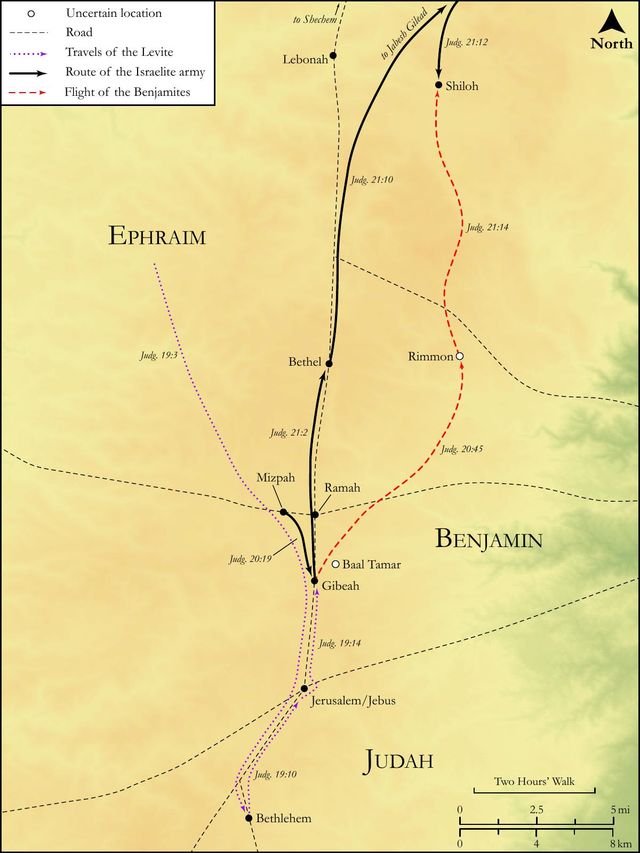
Judges 20:15 is situated within the final, most disturbing narrative block of the Book of Judges, encompassing chapters 19-21. This section immediately follows the horrific account of the Levite's concubine, her brutal rape and murder in Gibeah, and the Levite's subsequent gruesome act of dismemberment to rally the other tribes of Israel. The preceding chapter, Judges 19, sets the stage for the conflict by detailing the wickedness of Gibeah and the indignation of the other tribes. Chapter 20 then describes the assembly of Israel at Mizpah, their demand for justice against the perpetrators, and Benjamin's shocking refusal to surrender their kinsmen, choosing instead to defend them. This verse specifically marks the moment of Benjamin's military mobilization, serving as a grim prelude to the three bloody battles that follow, as detailed in Judges 20:18-48. The narrative culminates in the near annihilation of Benjamin and the desperate measures taken to preserve the tribe in Judges 21.
Historical & Cultural Context
The period of the Judges was characterized by a cyclical pattern of apostasy, oppression, and deliverance, often summarized by the refrain, "In those days there was no king in Israel; everyone did what was right in his own eyes" (Judges 21:25). This narrative exemplifies the moral anarchy and spiritual decay that permeated Israelite society. Tribal identity was paramount, often leading to fierce loyalty, even when it meant defending clear injustice. The gathering at Mizpah was a significant national assembly, indicating a collective decision-making process for the other tribes. The concept of "holy war" or divine judgment was central, as the other tribes sought to purge evil from their midst, believing they were acting on God's behalf. Benjamin's defiant stand, despite the clear depravity of Gibeah, reflects a misguided sense of tribal solidarity overriding divine law and communal righteousness. The military numbers provided in this verse are in keeping with Scripture's own musterings of the tribes, as in the numbering of Israel in the book of Numbers, emphasizing the strength and readiness of the combatants.
Key Themes
ShowHideThis verse contributes significantly to several overarching themes within the Book of Judges. Firstly, it highlights the theme of Tribal Disunity and Civil War, demonstrating how internal moral corruption could lead to devastating inter-tribal conflict rather than unified action against external threats. Benjamin's refusal to uphold justice against their own people, as demanded by the other tribes, underscores a profound breakdown in the covenant community. Secondly, the enumeration of forces points to the theme of Human Reliance and Misplaced Trust, where Benjamin trusts in its own military might and misguided tribal loyalty rather than seeking divine guidance or acknowledging the severity of their sin. This contrasts sharply with earlier accounts where God's intervention was key to Israelite victories. Finally, the entire narrative, including this verse, serves as a stark illustration of Israel's Spiritual and Moral Decline. The horrific acts in Gibeah and Benjamin's subsequent defense of the perpetrators are symptoms of a society that has abandoned God's law and descended into chaos, where "there was no king in Israel" and moral relativism reigned (Judges 17:6).
Exposition and Analysis
ShowHideKey Word Analysis
ShowHideThe verb פָּקַד (pâqad, H6485) carries a range of meanings, including "to visit," "to inspect," "to appoint," and in this military context, "to muster" or "to take a census." Here, it denotes a formal, deliberate act of counting and organizing the fighting men. It's not merely a casual tally but an official registration of available forces, indicating a serious intent for battle. This word emphasizes the meticulous preparation undertaken by Benjamin, underscoring their commitment to the impending conflict.
The noun חֶרֶב (chereb, H2719) refers to a "cutting instrument," specifically a "sword," "knife," or other sharp implement, often highlighting its "destructive effect." In the phrase "drew sword," it signifies men who are fully armed, trained, and ready for combat. The presence of the sword marks these individuals as active warriors, distinguishing them from the general male population and emphasizing the combat readiness and aggressive posture of the Benjaminite forces.
The root בָּחַר (bâchar, H977) means "to try" or "to select." When applied to men, as in "chosen men," it refers to "select" or "picked" individuals, often implying youth, vigor, and particular skill in battle. These are not merely able-bodied men but an elite contingent, likely possessing superior training, equipment, or strategic importance. The distinction between the 26,000 general combatants and the 700 "chosen men" from Gibeah suggests that the latter formed a core, highly capable unit, possibly serving as a special defense force for the city at the heart of the dispute.
Verse Breakdown
ShowHide"And the children of Benjamin were numbered at that time out of the cities twenty and six thousand men that drew sword,"
This clause establishes the primary fighting force of the tribe of Benjamin. "At that time" refers to the immediate period following the assembly of the other tribes and their demand for justice. The "twenty and six thousand men" represent the general levy of able-bodied warriors from Benjamin's various towns and villages, excluding Gibeah. The phrase "that drew sword" explicitly defines these men as active combatants, armed and prepared for warfare, indicating a significant and formidable military capacity for a single tribe.
"beside the inhabitants of Gibeah, which were numbered seven hundred chosen men."
This second clause specifies an additional contingent of warriors from Gibeah, the city where the initial atrocity occurred. The use of "beside" (מִלְּבַד, millevad) indicates that these 700 men are in addition to the 26,000 from the other Benjaminite cities, making the total Benjaminite force 26,700. The description "chosen men" elevates this group beyond the general fighting force, implying they were an elite, highly skilled, or specially selected unit, perhaps serving as the core defenders of Gibeah, known for their particular prowess, as hinted at later in Judges 20:16. This distinction emphasizes the specific focus on Gibeah as the epicenter of the conflict and the strength of its defenders.
Literary Devices
ShowHideJudges 20:15 employs several significant literary devices. Enumeration is prominent, with the precise numbers (26,000 and 700) lending a sense of stark reality and impending doom to the narrative. This detailed census emphasizes the scale of the Benjaminite defiance and the magnitude of the conflict about to unfold. There is also a strong element of Foreshadowing, as these numbers immediately precede the description of the battles, hinting at the fierce resistance the other tribes will face. The distinction between the general levy and the "seven hundred chosen men" from Gibeah creates a subtle Contrast, highlighting the specific, perhaps elite, nature of the Gibeah contingent and underscoring its central role in the conflict. Furthermore, the verse contributes to the overall Tragedy of the narrative by demonstrating Benjamin's robust military readiness, which, instead of being used for righteous defense or national unity, is tragically deployed in defense of wickedness, leading to the near-annihilation of the tribe.
Theological and Thematic Connections
ShowHideJudges 20:15, by detailing Benjamin's military strength, powerfully underscores the tragic consequences of misplaced loyalty and the profound moral decay within Israel. Instead of upholding justice and purging evil from their midst, Benjamin chose tribal solidarity over divine righteousness, leading to an unprecedented civil war. This act of defiance against the collective demand for justice reveals a deep-seated spiritual blindness, where human alliances and pride superseded God's covenant commands. The verse sets the stage for a conflict that is not merely political or military, but fundamentally theological, demonstrating the destructive power of sin when it is defended rather than confronted, and the devastating impact of a society where "everyone did what was right in his own eyes."
Reflection and Application
ShowHideThe detailed enumeration of Benjamin's forces in Judges 20:15 serves as a profound and sobering reminder of the destructive potential of human pride and misguided loyalty. When a community, or even an individual, chooses to defend sin rather than uphold righteousness, the consequences can be catastrophic, leading to internal strife and widespread devastation. This passage challenges us to examine our own loyalties: are we more committed to protecting our "tribe"—be it family, friends, church group, or political affiliation—even when it means condoning or defending unrighteousness, or are we primarily committed to God's truth and justice? The Benjaminite tragedy highlights the critical importance of spiritual discernment and moral courage, urging us to confront sin within our own circles, even when it is difficult, rather than allowing it to fester and corrupt the whole. True loyalty to God's kingdom demands that we prioritize righteousness above all else, seeking to be instruments of justice and reconciliation, rather than complicit in evil.
Questions for Reflection
ShowHideFAQ
ShowHideWhy are the "inhabitants of Gibeah" numbered separately from the other Benjaminite cities?
ShowHideThe text explicitly separates the 700 "chosen men" of Gibeah from the 26,000 men from Benjamin's other cities because Gibeah was the specific location where the heinous crime against the Levite's concubine occurred (Judges 19:22-25). The other tribes of Israel had specifically demanded that the wicked men of Gibeah be surrendered for justice (Judges 20:13). By numbering Gibeah's defenders separately, the narrative emphasizes that this city was the epicenter of the conflict and the primary object of the other tribes' righteous indignation. The "chosen men" designation also suggests they were a particularly elite or dedicated force, perhaps the most committed to defending their city and its inhabitants, regardless of their actions.
What is the significance of the specific numbers (26,000 and 700)?
ShowHideThe precise numbers, 26,000 and 700, are significant for several reasons. Firstly, they underscore the formidable military strength of the tribe of Benjamin, indicating their readiness and capacity for a large-scale conflict. For a single tribe, this was a substantial fighting force, highlighting the gravity of their defiance. Secondly, the numbers provide a dramatic setup for the ensuing battles, where despite their numerical strength, Benjamin suffers devastating losses, emphasizing the divine judgment against their sin. The 700 "chosen men" from Gibeah are particularly notable, as Judges 20:16 explicitly mentions their unique skill as left-handed slingers who could "sling stones at a hair and not miss." This detail highlights their elite status and the specific, formidable challenge they posed. The specificity of the numbers adds realism and intensity to the narrative, portraying a well-organized and determined resistance.
Christ-Centered Fulfillment
ShowHideThe tragic account of Judges 20:15 and the subsequent civil war in Israel, born out of deep moral corruption and a refusal to uphold justice, powerfully foreshadows humanity's desperate need for a true and righteous King. The chaos and "every man did what was right in his own eyes" (Judges 21:25) mentality of the Judges period find their ultimate resolution in Christ. While Benjamin's strength was mustered for a misguided defense of sin, Christ's strength was demonstrated in his perfect obedience and ultimate sacrifice for the sins of the world. The failure of human justice and leadership, evident in Benjamin's defiance and Israel's subsequent, flawed response, points to Jesus Christ as the only one who can truly bring righteousness and peace. He is the King of kings, whose reign establishes true justice and whose kingdom is not divided against itself (Matthew 12:25). Unlike the temporal and often flawed deliverers of the Judges period, Christ offers eternal redemption and transforms hearts, enabling His followers to live by God's perfect law, not by their own fallen desires. The bloodshed and near-annihilation of Benjamin underscore the severity of sin and the necessity of the ultimate sacrifice of the Lamb of God, who alone takes away the sin of the world and brings true reconciliation, far beyond any human attempt at justice or tribal solidarity.