


Judges 19:21
Bible text: King James Version (1769 Blayney text) · Public domain
Bible text: Berean Standard Bible · Public domain
Bible text: American Standard Version (1901) · Public domain
Bible text: World English Bible, Messianic edition · Public domain
Bible text: Geneva Bible (1599) · Public domain
Bible text: Young's Literal Translation · Public domain
- וַיְבִיאֵהוּvay·vi·'E·huand he brought himH935Conj-w ¦ V-Hiphil-ConsecImperf-3ms ¦ 3msVerb Hiphil Consecutive Imperfect 3rd Singular Masculineוַandיְבִיאֵhe broughtהוּhim
- לְבֵיתוֹle·vei·Toto his houseH1004Prep-l ¦ N-msc ¦ 3msNoun Singular Masculine Constructלְtoבֵיתhouseוֹhis
- וַיָּבָלvai·yi·boland he fedH1101Conj-w ¦ V-Qal-ConsecImperf-3msVerb Qal Consecutive Imperfect 3rd Singular Masculineוַandיָּבָלhe fed
- לַחֲמוֹרִיםla·cha·mo·Rim<to> the donkeysH2543Prep-l ¦ N-cpNoun Plural common gender Absoluteלַ<to> theחֲמוֹרִיםdonkeys
- וַיִּרְחֲצוּvai·yir·cha·Tzuand they washedH7364Conj-w ¦ V-Qal-ConsecImperf-3mpVerb Qal Consecutive Imperfect 3rd Plural Masculineוַandיִּרְחֲצוּthey washed
- רַגְלֵיהֶםrag·lei·Hemtheir feetH7272N-fdc ¦ 3mpNoun Dual Feminine Constructרַגְלֵיfeetהֶםtheir
- וַיֹּאכְלוּvai·yo·khe·Luand they ateH398Conj-w ¦ V-Qal-ConsecImperf-3mpVerb Qal Consecutive Imperfect 3rd Plural Masculineוַandיֹּאכְלוּthey ate
- וַיִּשְׁתּוּvai·yish·Tuand they drankH8354Conj-w ¦ V-Qal-ConsecImperf-3mpVerb Qal Consecutive Imperfect 3rd Plural Masculineוַandיִּשְׁתּוּthey drank
English is a literal word-by-word gloss of the Hebrew, not the KJV's wording. Why?
This is the original text the KJV's translators worked from — each Hebrew word with its own literal English meaning in this verse, prepared by scholars at Tyndale House, Cambridge. The KJV translates whole sentences, not word by word, so its wording differs: one Hebrew word can become several English words, and the KJV may choose “the LORD” where the gloss reads “Yahweh”. Both are faithful — they answer different questions. For the KJV's own rendering, switch to the KJV text.
Details
See on the biblical-era maps
Study this verse
Public-domain commentary
Matthew Henry
From his Commentary on the Whole Bible. Henry comments on passages, not single verses — this entry covers Judges 19:16–21. His two-level outline is real structure in the source text, so it is rendered as structure.
Though there as not one of Gibeah, yet it proved there was one in Gibeah, that showed some civility to this distressed Levite, who was glad that any one took notice of him. It was strange that some of those wicked people, who, when it was dark, designed so ill to him and his concubine, did not, under pretence of kindness, invite them in, that they might have a fairer opportunity of perpetrating their villany; but either they had not wit enough to be so designing, or not wickedness enough to be so deceiving. Or, perhaps, none of them separately thought of such a wickedness, till in the black and dark night they got together to contrive what mischief they should do. Bad people in confederacy make one another much worse than any of them would be by themselves. When the Levite, and his wife, and servant, were beginning to fear that they must lie in the street all night (and as good have laid in a den of lions) they were at length invited into a house, and we are here told,
I.Who that kind man was that invited them.
1.He was a man of Mount Ephraim, and only sojourned in Gibeah, Jdg 19:16. Of all the tribes of Israel, the Benjamites had most reason to be kind to poor travellers, for their ancestor, Benjamin, was born upon the road, his mother being then upon a journey, and very near to this place, Gen 35:16, Gen 35:17. Yet they were hard-hearted to a traveller in distress, while an honest Ephraimite had compassion on him, and, no doubt, was the more kind to him, when, upon enquiry, he found that he was his countryman, of Mount Ephraim likewise. He that was himself but a sojourner in Gibeah was the more compassionate to a wayfaring man, for he knew the heart of a stranger, Exo 23:9; Deu 10:19. Good people, that look upon themselves but as strangers and sojourners in this world, should for this reason be tender to one another, because they all belong to the same better country and are not at home here.
2.He was an old man, one that retained some of the expiring virtue of an Israelite. The rising generation was entirely corrupted; if there was any good remaining among them, it was only with those that were old and going off.
3.He was coming home from his work out of the field at eventide. The evening calls home labourers, Psa 104:23. But, it should seem, this was the only labourer that this evening brought home to Gibeah. The rest had given themselves up to sloth and luxury, and no marvel there was among them, as in Sodom, abundance of uncleanness, when there was among them, as in Sodom, abundance of idleness, Eze 16:49. But he that was honestly diligent in his business all day was disposed to be generously hospitable to these poor strangers at night. Let men labour, that they may have to give, Eph 4:28. It appears from Jdg 19:21 that he was a man of some substance, and yet had been himself at work in the field. No man's estate will privilege him in idleness.
II.How free and generous he was in his invitation.
He did not stay till they applied to him to beg for a night's lodging; but when he saw them (Jdg 19:17) enquired into their circumstances, and anticipated them with his kindness. Thus our good God answers before we call. Note, A charitable disposition expects only opportunity, not importunity, to do good, and will succour upon sight, unsought unto. Hence we read of a bountiful eye, Pro 22:9. If Gibeah was like Sodom, this old man was like Lot in Sodom, who sat in the gate to invite strangers, Gen 19:1. Thus Job opened his doors to the traveller, and would not suffer him to lodge in the street, Job 31:32. Observe,
1.How ready he was to give credit to the Levite's account of himself when he saw no reason at all to question the truth of it. Charity is not apt to distrust, but hopeth all things (Co1 13:7) and will not make use of Nabal's excuse for his churlishness to David, Many servants now-a-days break away from their masters, Sa1 25:10. The Levite, in his account of himself, professed that he was now going to the house of the Lord (Jdg 19:18), for there he designed to attend, either with a trespass-offering for the sins of his family, or with a peace-offering for the mercies of his family, or both, before he went to his own house. And, if the men of Gibeah had any intimation of his being bound that way, probably they would therefore be disinclined to entertain him. The Samaritans would not receive Christ because his face was towards Jerusalem, Luk 9:53. But for this reason, because he was a Levite and was now going to the house of the Lord, this good old man was the more kind to him. Thus he received a disciples in the name of a disciple, a servant of God for his Master's sake.
2.How free he was to give him entertainment. The Levite was himself provided with all necessaries (Jdg 19:19), wanted nothing but a lodging, but his generous host would be himself at the charge of his entertainment (Jdg 19:20): Let all thy wants be upon me; so he brought him into his house, Jdg 19:21. Thus God will, some way or other, raise up friends for his people and ministers, even when they seem forlorn.
Historical interpretation
Historical reception
2 surviving comments on this verse. Each one is dated, so this reads as a timeline rather than a list.
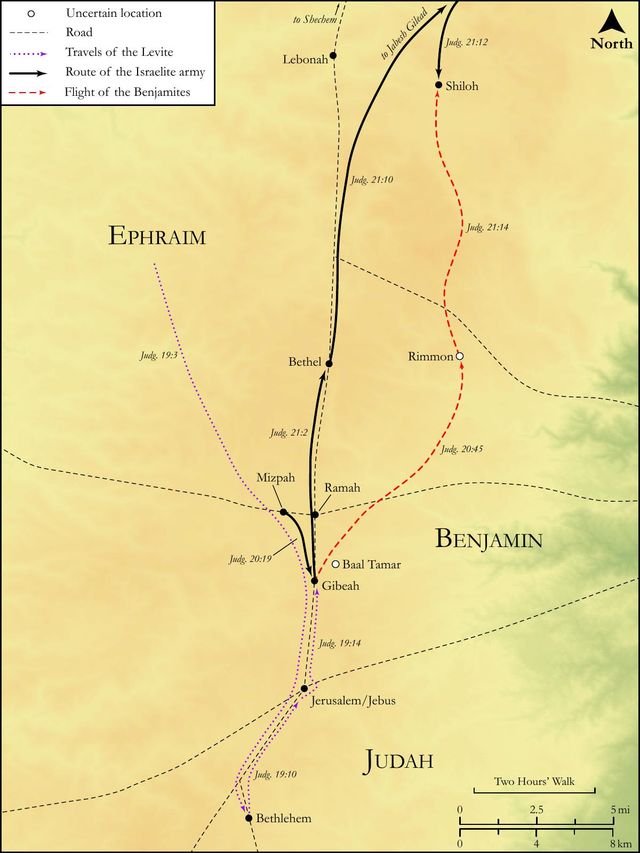
When some little progress was made, though night was threatening to come on, and they were close by the town of the Jebusites, on the slave’s request that his lord should turn aside there, he refused, because it was not a city of the children of Israel. He meant to get as far as Gibeah, which was inhabited by the people of the tribe of Benjamin. But when they arrived there was no one to receive them with hospitality, except a stranger of advanced age—when he had looked upon them he asked the Levite, “Where are you going and from where have you come?” On his answering that he was traveling and was making for Mount Ephraim and that there was no one to take him in, the old man offered him hospitality and prepared a meal.
He set out on his journey in happy spirits because he had recovered his dearly beloved wife. One servant was with him, and as day was already declining they sped on their way with swift steps. The woman rode on an ass; her husband felt no weariness, taking joy in his desire and lightening his journey with talk at times with the woman, at times with the slave. When at length they neared Jerusalem, about thirty stades away, a place inhabited then by Jebusites, the servant boy suggested that they turn into the city, especially since night makes even safe places suspect and one must guard against the uncertainties of darkness, and particularly since the inhabitants of this locality were not of the children of Israel. They should beware lest treachery be done with hostile design, for the night’s darkness is opportune enough for any tricksters to perpetrate evil. But his master did not care for the servant’s idea of seeking lodging among foreigners, since Gaba [Gibeah] and Rama, cities of Benjamin, were not far distant. His strong will overrode the servant’s suggestion, as though advice takes its value from one’s condition [of birth] rather than that through advice a lowly condition may be raised. The sun was now setting and he agreed reluctantly to go into the city [Gibeah], for he was overtaken by evening. The Gabanites lived there, unfriendly, harsh, unbearable people, who could stand anything but to receive people hospitably. Indeed, it would have been much more suitable had the Levite not sought hospitality in Gaba [Gibeah]. That his treatment be utterly offensive, he found on entering the city that there was no inn. And when he sat on the road imploring the mercy of these strangers, an old man from the fields happened to stumble on him, for evening had compelled him to leave his work in the fields at night. Seeing him, he asked where he was from and where he was going. He answered, “I came from Bethlehem of Judah, I am going to Mount Ephrem, and my wife is here with me. But I have learned that there is no one here to give hospitality and provide us a chance to rest.” He needed no food or drink for himself nor food for his flock, but they had been refused the hospitality of shelter. They had everything; only a bare lodging was needed. To this the old man kindly and calmly said, “Peace to you! Come in as my guest and fellow citizen, for I am also from the region of Mount Ephrem, and here is a lodging place; someone who lived here a long time laid its foundations.” Having received them into his home, he attentively and carefully provided for his guests and entertained them.
Continue studying Judges 19:21 across the web’s major study libraries — every link below opens this exact verse, chapter, or book on the destination site.
Read & Compare
 BibleGatewayThis verse in more than 200 translations and 70 languages.
 Bible.comThe YouVersion reader — hundreds of translations, reading plans, and highlights.
 ESV.orgCrossway's official English Standard Version reader.
 NET BibleThe NET translation with 60,000+ translators' notes on every rendering decision.
 STEP BibleTyndale House's free study tool — original text, vocabulary, and scholarly resources.
 BibliaLogos Bible Software's free web reader.
 USCCBThe New American Bible (Revised Edition) with the U.S. bishops' study notes.
Commentaries
 BibleHub CommentariesDozens of classic commentaries on this verse, gathered on one page.
 StudyLightMore than 100 commentary sets — the largest collection on the web.
 BibleRefPlain-English commentary on what this verse means, verse by verse.
 Enduring WordDavid Guzik's free commentary on this chapter, widely used by Bible teachers.
 Bible Study ToolsVerse commentary alongside Greek and Hebrew study aids.
Original Language & Research
- BibleHub InterlinearThe verse word by word — original language, transliteration, and English.
- BibleHub LexiconEvery word's original-language definition and Strong's entry.
 Blue Letter BibleDeep-study tools — Strong's numbers, concordance, and word studies.
 SefariaThe Hebrew text with Rashi and centuries of Jewish commentary.
Sermons, Hymns & Audio


TrulyRandomVerse is not affiliated with these sites and doesn’t control their content. They’re linked because they’re genuinely useful.
Summary
Judges 19:21 vividly portrays a crucial moment of traditional Israelite hospitality, as an old Ephraimite man in Gibeah extends shelter, sustenance, and personal care to a traveling Levite, his concubine, and his servant. This seemingly ordinary act of kindness—providing a house, fodder for animals, foot washing, and refreshment—stands in stark and chilling contrast to the profound moral decay and horrific violence that immediately follows in the narrative, serving as a poignant illustration of individual virtue amidst a society spiraling into depravity.
Context
ShowHideLiterary Context
Judges 19:21 is strategically placed within one of the most disturbing and pivotal narratives in the Book of Judges, spanning chapters 19-21. This extended account functions as a stark illustration of the dire consequences of Israel's spiritual and moral decline, encapsulated by the recurring refrain, "In those days there was no king in Israel; everyone did what was right in his own eyes" found in Judges 17:6 and Judges 21:25. The preceding verses (Judges 19:1-20) meticulously detail the Levite's arduous journey from Bethlehem and his frustrating, ultimately futile, search for lodging among the local Benjaminites in Gibeah, who initially refuse to offer hospitality. The old man's intervention in verse 20, followed by the comprehensive acts of hospitality in verse 21, establishes a profound and chilling juxtaposition with the unspeakable evil that the men of Gibeah perpetrate later that very night, dramatically highlighting the vast moral chasm between individual adherence to ancient customs and pervasive societal corruption.
Historical & Cultural Context
The period of the Judges (approximately 1375-1050 BC) was characterized by a decentralized tribal confederacy in Israel, marked by frequent cycles of apostasy, internal strife, and external oppression. During this era, hospitality was not merely a courtesy but a sacred and non-negotiable custom in Israel, particularly vital for travelers who were highly vulnerable to bandits, harsh elements, and the general dangers of the road. To refuse shelter, food, and water to a traveler was considered a grave offense, a profound breach of social and moral order, while offering it was a mark of honor, righteousness, and adherence to communal norms. Gibeah, a town within the territory of Benjamin, is depicted here as a place where this fundamental societal norm had catastrophically collapsed, reflecting a broader breakdown of covenantal obligations and basic human decency. The old man, notably a sojourner himself from Ephraim, understands and upholds this ancient custom, perhaps feeling a deep kinship with the traveling Levite who is also away from his home territory.
Key Themes
ShowHideThis verse, though seemingly a simple description of domestic activity, is profoundly rich with thematic significance within the broader narrative of Judges. It powerfully introduces the theme of hospitality versus depravity, presenting a rare moment of genuine human kindness as a stark and tragic foil to the profound moral corruption that pervades Gibeah. The comprehensive provision of "provender unto the asses," the washing of feet, and the sharing of food and drink underscore the theme of preparation for rest and refreshment, symbolizing a brief, fleeting respite before the impending horror. This peaceful scene also serves as a potent example of dramatic irony and foreshadowing, creating an intense tension for the reader who is aware of the tragic and violent events that are about to unfold. The old man's actions exemplify the ideal of a righteous remnant – an individual upholding God's standards and the customs of Israel even when the men of the city have abandoned them, echoing the lament found in Psalm 14:1-3.
Exposition and Analysis
ShowHideKey Word Analysis
ShowHideThis word refers to a dwelling, often encompassing the entire household or family. In Judges 19:21, the "house" offered by the old man is more than just a physical structure; it represents a sanctuary, a place of safety and belonging, in stark contrast to the unwelcoming public square of Gibeah. Its provision signifies the ultimate act of hospitality, extending not just shelter but an invitation into the host's personal sphere, offering security from external threats and the promise of rest.
This primitive root means "to fodder" or "to mix," specifically referring to providing mixed feed for animals. The inclusion of this detail highlights the thoroughness and generosity of the old man's hospitality. He not only cares for the human travelers but also for their essential means of transport, the asses. This demonstrates a comprehensive understanding of a traveler's needs and a deep commitment to providing complete rest and sustenance, underscoring the practical and holistic nature of ancient hospitality that extended to all members of the traveling party, including their beasts of burden.
This primitive root means "to lave" or "to wash" (the whole or a part of a thing). The act of washing feet was a deeply ingrained social custom in the dry lands of Canaan, as when Abraham offered water to wash the feet of his visitors. Travelers' feet would become extremely dusty and dirty from long journeys in sandals. Therefore, offering water for foot washing was not merely about hygiene; it was a profound gesture of welcome, humility, and refreshment. It symbolized the transition from the arduous journey to a state of rest and comfort within the host's home, often performed by servants or, as implied here, by the host himself, as a sign of honor and respect for the guest. This act signifies the complete acceptance and care provided by the old man.
Verse Breakdown
ShowHide"So he brought him into his house"
This clause marks the compassionate initiative of the old man, who actively sought out and welcomed the Levite and his companions into his private dwelling. It signifies the provision of a safe haven and a fundamental act of ancient hospitality, contrasting sharply with the earlier indifference of the Gibeahites who left the travelers exposed in the public square.
"and gave provender unto the asses"
This detail underscores the comprehensive and thoughtful nature of the old man's hospitality. His care extends beyond the human guests to their animals, which were crucial for their journey and livelihood. This demonstrates a deep understanding of the practical needs of weary travelers and a generous spirit that encompasses all aspects of their well-being.
"and they washed their feet"
This action signifies the ritual of cleansing and refreshment after a dusty and tiring journey. It is a profound symbolic act of welcome, humility, and an invitation to rest, marking the transition from the rigors of travel to the comfort and security of the host's home. It also implies the provision of water, a precious commodity in Canaan.
"and did eat and drink"
This final phrase confirms the provision of essential sustenance, completing the cycle of hospitality. Food and drink were vital for restoring strength and were often shared as a sign of fellowship, peace, and covenant. This moment represents a brief, tragically fleeting period of normalcy, comfort, and human connection before the horrific events that are about to unfold.
Literary Devices
ShowHideJudges 19:21 masterfully employs several potent literary devices to heighten the narrative's impact. Contrast is paramount, as the scene of peaceful, comprehensive hospitality stands in stark opposition to the preceding refusal of lodging by the Gibeahites and the horrific violence that immediately follows. This juxtaposition powerfully highlights the profound moral decay of the town and the isolated virtue of the old man. Foreshadowing is also subtly yet powerfully evident; the tranquility and comfort of this moment serve as a "calm before the storm," intensifying the shock and horror of the ensuing events. The astute reader, aware of the narrative's tragic trajectory, perceives this peace as tragically fleeting and fragile. Furthermore, the specific acts of providing "provender" and "washing feet" function as potent Symbolism. They symbolize not just physical refreshment and care but also the ideal of true, selfless hospitality, the sanctity of the home as a refuge, and the fleeting nature of peace and righteousness in a morally corrupt world. The old man's actions, therefore, symbolize a remnant of faithfulness and decency in a land where "everyone did what was right in his own eyes."
Theological and Thematic Connections
ShowHideJudges 19:21, though a small detail nestled within a dark and disturbing narrative, resonates with profound theological and thematic truths. It powerfully highlights the enduring biblical value of hospitality, a virtue consistently commanded and exemplified throughout Scripture as a reflection of God's own welcoming and merciful character. The old man's actions embody a divine principle: caring for the stranger, the sojourner, and the vulnerable, recognizing their inherent human dignity that should be honored, even when society around them is failing catastrophically. This act of kindness underscores that individual acts of righteousness can shine brightly even in the darkest of times, challenging the prevailing moral climate and serving as a counter-cultural witness. Theologically, it prompts reflection on how God's people are called to embody His character of welcome and provision, especially to those in need, even when the broader culture has abandoned such virtues, demonstrating a commitment to covenantal living that transcends societal breakdown.
Reflection and Application
ShowHideJudges 19:21, set against a backdrop of chilling depravity and societal collapse, offers a powerful and enduring lesson on the profound significance of simple human kindness and radical hospitality. In a world that often prioritizes self-interest, is marked by indifference, or even by outright hostility towards strangers, the old man's actions serve as a profound and challenging example. He extends himself fully, not just offering a roof over their heads, but providing comprehensive care for both the human travelers and their animals, culminating in the intimate act of foot washing and the sharing of a meal. This scene compels us to consider our own readiness to welcome the stranger, to offer genuine and holistic care to those in need, and to be a source of comfort and provision in a world that can be harsh, unwelcoming, and morally compromised. It reminds us that even seemingly small acts of goodness, performed with a generous heart, can have immense spiritual weight and can stand as a powerful testament to God's enduring call for compassion, love, and righteousness, even when it feels like we are surrounded by moral decay and spiritual darkness.
Questions for Reflection
ShowHideFAQ
ShowHideWhy is this specific act of hospitality so significant in the context of Judges 19?
ShowHideThis act of hospitality is critically significant because it serves as a stark moral contrast to the surrounding narrative of depravity and societal breakdown. Prior to this verse, the Levite and his party were left stranded in the public square of Gibeah, as no one from the town initially offered them lodging, a grave breach of the custom of Israel. The old man, himself a sojourner from Ephraim, steps in to provide the very care and welcome that the Benjaminites of Gibeah refused. This moment of kindness highlights the extreme moral decay of the town, setting up a chilling juxtaposition with the horrific violence and sexual assault that immediately follows in Judges 19:22-26. It underscores that even in a society where "everyone did what was right in his own eyes" (Judges 21:25), pockets of righteousness and adherence to divine law (like hospitality) could still be found, making the old man's actions a rare light in profound darkness.
What was the cultural importance of washing feet for travelers in ancient Israel?
ShowHideIn ancient Israel, washing feet was a highly significant cultural practice for travelers due to the prevailing conditions. People wore open sandals, and their feet would become extremely dusty, dirty, and tired from walking long distances on unpaved roads. Therefore, offering water for foot washing was not merely a hygienic act but a profound gesture of welcome, humility, and refreshment. It symbolized the host's care for the guest's comfort and well-being, marking the transition from the arduous journey to a state of rest and security within the host's home. It was often performed by servants, but a host performing it himself (as seen in John 13:5-17) was an act of great humility and honor, signifying deep respect and acceptance of the guest. This act was a fundamental component of comprehensive hospitality, providing physical relief and spiritual welcome.
Christ-Centered Fulfillment
ShowHideJudges 19:21, with its poignant depiction of an old man's radical hospitality in a morally bankrupt society, finds its ultimate fulfillment and transformation in the person and work of Jesus Christ. While the Levite in Judges sought temporary physical shelter and provision, Christ embodies the ultimate refuge and eternal sustenance for all humanity. Jesus, the true "sojourner" who "had nowhere to lay his head" (Matthew 8:20), perfectly exemplifies and elevates the concept of hospitality to a divine level. He not only received hospitality during His earthly ministry but also infinitely extended it, inviting the weary and burdened to find eternal rest in Him (Matthew 11:28-30). The humble act of foot washing, a gesture of service in Judges 19:21, is powerfully re-enacted by Christ in John 13:1-17, transforming it into a profound lesson in servant leadership, sacrificial love, and the cleansing power of His grace. Ultimately, Christ is the divine host who provides the eternal "provender" and "drink" through His body and blood, inviting all to the spiritual feast of salvation and eternal life (John 6:53-58). He is the true "house" where we find ultimate rest, spiritual cleansing, and boundless provision, fulfilling the deepest longings that the fleeting hospitality of Judges 19:21 could only hint at.