


Judges 19:20
- וַיֹּאמֶרvai·Yo·merand he saidH559Conj-w ¦ V-Qal-ConsecImperf-3msVerb Qal Consecutive Imperfect 3rd Singular Masculineוַandיֹּאמֶרhe said
- הָאִישׁha·'Ishthe manH376Art ¦ N-msNoun Singular Masculine Absoluteהָtheאִישׁman
- הַזָּקֵןha·za·Ken<the> oldH2205Art ¦ Adj-msAdjective Singular Masculine Absoluteהַ<the>זָּקֵןold
- שָׁלוֹםsha·LompeaceH7965N-msNoun Singular Masculine Absolute
- לָךְLakh[be] to <the> youPrep-l ¦ 2msSuffix Personal 2nd Singular Masculineלָ[be] to <the>ךְyou
- רַקrakcertainlyH7535AdvAdverb
- כָּלkolallH3605N-mscNoun Singular Masculine Construct
- מַחְסוֹרְךָmach·sor·Khayour lackH4270N-msc ¦ 2msNoun Singular Masculine Constructמַחְסוֹרְlackךָyour
- עָלָי'a·Lai[is] on meH5921Prep ¦ 1csPreposition Definiteעָלָ[is] onיme
- רַקrakonlyH7535AdvAdverb
- בָּרְחוֹבba·re·Chovin the open squareH7339Prep-b ¦ N-fsNoun Singular Feminine Absoluteבָּin theרְחוֹבopen square
- אַל'almay notH408NegParticle Negative
- תָּלַןta·Lanyou spend [the] nightH3885V-Qal-Imperf-2msVerb Qal Imperfect 2nd Singular Masculine
English is a literal word-by-word gloss of the Hebrew, not the KJV's wording. Why?
This is the original text the KJV's translators worked from — each Hebrew word with its own literal English meaning in this verse, prepared by scholars at Tyndale House, Cambridge. The KJV translates whole sentences, not word by word, so its wording differs: one Hebrew word can become several English words, and the KJV may choose “the LORD” where the gloss reads “Yahweh”. Both are faithful — they answer different questions. For the KJV's own rendering, switch to the KJV text.
Details
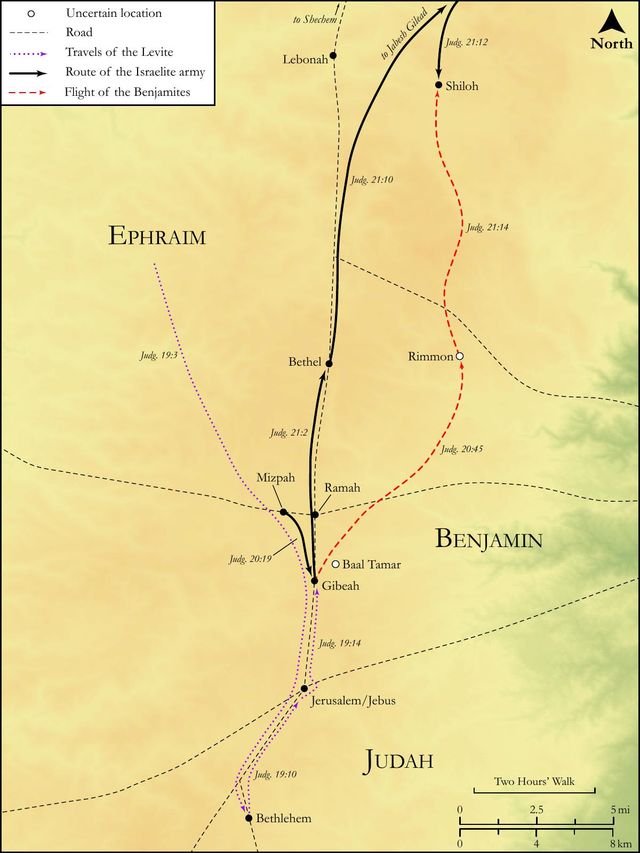
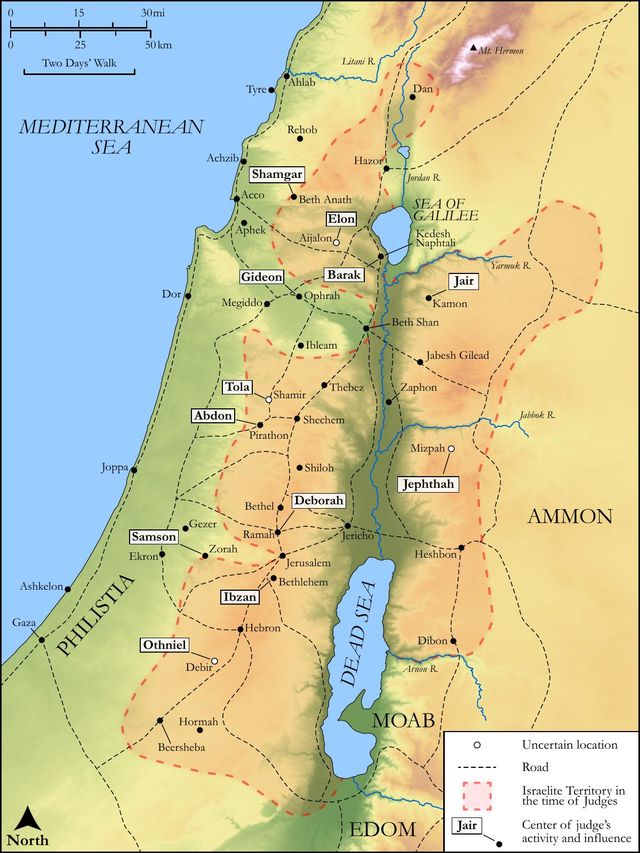
See on the biblical-era map
Study this verse
Public-domain commentary
Matthew Henry
From his Commentary on the Whole Bible. Henry comments on passages, not single verses — this entry covers Judges 19:16–21. His two-level outline is real structure in the source text, so it is rendered as structure.
Though there as not one of Gibeah, yet it proved there was one in Gibeah, that showed some civility to this distressed Levite, who was glad that any one took notice of him. It was strange that some of those wicked people, who, when it was dark, designed so ill to him and his concubine, did not, under pretence of kindness, invite them in, that they might have a fairer opportunity of perpetrating their villany; but either they had not wit enough to be so designing, or not wickedness enough to be so deceiving. Or, perhaps, none of them separately thought of such a wickedness, till in the black and dark night they got together to contrive what mischief they should do. Bad people in confederacy make one another much worse than any of them would be by themselves. When the Levite, and his wife, and servant, were beginning to fear that they must lie in the street all night (and as good have laid in a den of lions) they were at length invited into a house, and we are here told,
I.Who that kind man was that invited them.
1.He was a man of Mount Ephraim, and only sojourned in Gibeah, Jdg 19:16. Of all the tribes of Israel, the Benjamites had most reason to be kind to poor travellers, for their ancestor, Benjamin, was born upon the road, his mother being then upon a journey, and very near to this place, Gen 35:16, Gen 35:17. Yet they were hard-hearted to a traveller in distress, while an honest Ephraimite had compassion on him, and, no doubt, was the more kind to him, when, upon enquiry, he found that he was his countryman, of Mount Ephraim likewise. He that was himself but a sojourner in Gibeah was the more compassionate to a wayfaring man, for he knew the heart of a stranger, Exo 23:9; Deu 10:19. Good people, that look upon themselves but as strangers and sojourners in this world, should for this reason be tender to one another, because they all belong to the same better country and are not at home here.
2.He was an old man, one that retained some of the expiring virtue of an Israelite. The rising generation was entirely corrupted; if there was any good remaining among them, it was only with those that were old and going off.
3.He was coming home from his work out of the field at eventide. The evening calls home labourers, Psa 104:23. But, it should seem, this was the only labourer that this evening brought home to Gibeah. The rest had given themselves up to sloth and luxury, and no marvel there was among them, as in Sodom, abundance of uncleanness, when there was among them, as in Sodom, abundance of idleness, Eze 16:49. But he that was honestly diligent in his business all day was disposed to be generously hospitable to these poor strangers at night. Let men labour, that they may have to give, Eph 4:28. It appears from Jdg 19:21 that he was a man of some substance, and yet had been himself at work in the field. No man's estate will privilege him in idleness.
II.How free and generous he was in his invitation.
He did not stay till they applied to him to beg for a night's lodging; but when he saw them (Jdg 19:17) enquired into their circumstances, and anticipated them with his kindness. Thus our good God answers before we call. Note, A charitable disposition expects only opportunity, not importunity, to do good, and will succour upon sight, unsought unto. Hence we read of a bountiful eye, Pro 22:9. If Gibeah was like Sodom, this old man was like Lot in Sodom, who sat in the gate to invite strangers, Gen 19:1. Thus Job opened his doors to the traveller, and would not suffer him to lodge in the street, Job 31:32. Observe,
1.How ready he was to give credit to the Levite's account of himself when he saw no reason at all to question the truth of it. Charity is not apt to distrust, but hopeth all things (Co1 13:7) and will not make use of Nabal's excuse for his churlishness to David, Many servants now-a-days break away from their masters, Sa1 25:10. The Levite, in his account of himself, professed that he was now going to the house of the Lord (Jdg 19:18), for there he designed to attend, either with a trespass-offering for the sins of his family, or with a peace-offering for the mercies of his family, or both, before he went to his own house. And, if the men of Gibeah had any intimation of his being bound that way, probably they would therefore be disinclined to entertain him. The Samaritans would not receive Christ because his face was towards Jerusalem, Luk 9:53. But for this reason, because he was a Levite and was now going to the house of the Lord, this good old man was the more kind to him. Thus he received a disciples in the name of a disciple, a servant of God for his Master's sake.
2.How free he was to give him entertainment. The Levite was himself provided with all necessaries (Jdg 19:19), wanted nothing but a lodging, but his generous host would be himself at the charge of his entertainment (Jdg 19:20): Let all thy wants be upon me; so he brought him into his house, Jdg 19:21. Thus God will, some way or other, raise up friends for his people and ministers, even when they seem forlorn.
Historical interpretation
Historical reception
2 surviving comments on this verse. Each one is dated, so this reads as a timeline rather than a list.
When some little progress was made, though night was threatening to come on, and they were close by the town of the Jebusites, on the slave’s request that his lord should turn aside there, he refused, because it was not a city of the children of Israel. He meant to get as far as Gibeah, which was inhabited by the people of the tribe of Benjamin. But when they arrived there was no one to receive them with hospitality, except a stranger of advanced age—when he had looked upon them he asked the Levite, “Where are you going and from where have you come?” On his answering that he was traveling and was making for Mount Ephraim and that there was no one to take him in, the old man offered him hospitality and prepared a meal.
He set out on his journey in happy spirits because he had recovered his dearly beloved wife. One servant was with him, and as day was already declining they sped on their way with swift steps. The woman rode on an ass; her husband felt no weariness, taking joy in his desire and lightening his journey with talk at times with the woman, at times with the slave. When at length they neared Jerusalem, about thirty stades away, a place inhabited then by Jebusites, the servant boy suggested that they turn into the city, especially since night makes even safe places suspect and one must guard against the uncertainties of darkness, and particularly since the inhabitants of this locality were not of the children of Israel. They should beware lest treachery be done with hostile design, for the night’s darkness is opportune enough for any tricksters to perpetrate evil. But his master did not care for the servant’s idea of seeking lodging among foreigners, since Gaba [Gibeah] and Rama, cities of Benjamin, were not far distant. His strong will overrode the servant’s suggestion, as though advice takes its value from one’s condition [of birth] rather than that through advice a lowly condition may be raised. The sun was now setting and he agreed reluctantly to go into the city [Gibeah], for he was overtaken by evening. The Gabanites lived there, unfriendly, harsh, unbearable people, who could stand anything but to receive people hospitably. Indeed, it would have been much more suitable had the Levite not sought hospitality in Gaba [Gibeah]. That his treatment be utterly offensive, he found on entering the city that there was no inn. And when he sat on the road imploring the mercy of these strangers, an old man from the fields happened to stumble on him, for evening had compelled him to leave his work in the fields at night. Seeing him, he asked where he was from and where he was going. He answered, “I came from Bethlehem of Judah, I am going to Mount Ephrem, and my wife is here with me. But I have learned that there is no one here to give hospitality and provide us a chance to rest.” He needed no food or drink for himself nor food for his flock, but they had been refused the hospitality of shelter. They had everything; only a bare lodging was needed. To this the old man kindly and calmly said, “Peace to you! Come in as my guest and fellow citizen, for I am also from the region of Mount Ephrem, and here is a lodging place; someone who lived here a long time laid its foundations.” Having received them into his home, he attentively and carefully provided for his guests and entertained them.
Continue studying Judges 19:20 across the web’s major study libraries — every link below opens this exact verse, chapter, or book on the destination site.
Read & Compare
 BibleGatewayThis verse in more than 200 translations and 70 languages.
 Bible.comThe YouVersion reader — hundreds of translations, reading plans, and highlights.
 ESV.orgCrossway's official English Standard Version reader.
 NET BibleThe NET translation with 60,000+ translators' notes on every rendering decision.
 STEP BibleTyndale House's free study tool — original text, vocabulary, and scholarly resources.
 BibliaLogos Bible Software's free web reader.
 USCCBThe New American Bible (Revised Edition) with the U.S. bishops' study notes.
Commentaries
 BibleHub CommentariesDozens of classic commentaries on this verse, gathered on one page.
 StudyLightMore than 100 commentary sets — the largest collection on the web.
 BibleRefPlain-English commentary on what this verse means, verse by verse.
 Enduring WordDavid Guzik's free commentary on this chapter, widely used by Bible teachers.
 Bible Study ToolsVerse commentary alongside Greek and Hebrew study aids.
Original Language & Research
- BibleHub InterlinearThe verse word by word — original language, transliteration, and English.
- BibleHub LexiconEvery word's original-language definition and Strong's entry.
 Blue Letter BibleDeep-study tools — Strong's numbers, concordance, and word studies.
 SefariaThe Hebrew text with Rashi and centuries of Jewish commentary.
Sermons, Hymns & Audio


TrulyRandomVerse is not affiliated with these sites and doesn’t control their content. They’re linked because they’re genuinely useful.
Summary
Judges 19:20 captures a pivotal moment of profound hospitality offered by an old Ephraimite man to a traveling Levite and his company, who find themselves stranded and vulnerable in the morally desolate city of Gibeah. This verse stands as a striking counterpoint to the pervasive depravity of the era, showcasing a singular act of compassion where the host pledges to personally assume responsibility for all his guests' needs, emphatically urging them to avoid the perilous dangers of lodging in the public street. It highlights the critical importance of ancient Near Eastern customs of welcome and foreshadows the horrific societal breakdown that immediately follows this brief glimmer of righteousness.
Context
ShowHideLiterary Context
Judges 19 initiates one of the most harrowing and morally disturbing narratives in the entire Old Testament, serving as a stark illustration of Israel's profound spiritual and social decline during the period of the Judges. The chapter opens with a Levite, his concubine, and his servant journeying from Bethlehem towards his home in the hill country of Ephraim. As dusk falls, they arrive in Gibeah, a city within the territory of Benjamin. Contrary to the universally expected custom of hospitality in the ancient Near East, no one in the city initially offers them shelter, forcing them to wait in the public square. This immediate lack of welcome is a powerful narrative device, signaling the deep moral decay and societal breakdown prevalent in Gibeah. It is only after this unsettling display of indifference that an old man, himself a sojourner from Ephraim, steps forward to extend refuge, setting the stage for the night's unspeakable horrors and the subsequent civil war that engulfs Israel. Judges 19:20, therefore, represents a fleeting moment of human decency and adherence to covenantal values amidst an escalating narrative of wickedness.
Historical & Cultural Context
The era of the Judges (approximately 1375–1050 BC) was a turbulent period marked by a distinct absence of centralized leadership and a recurring cycle of apostasy, oppression, and deliverance. The book's recurring refrain, "In those days there was no king in Israel; everyone did what was right in his own eyes" (Judges 17:6 and Judges 21:25), succinctly captures the prevailing moral anarchy. Within this context, hospitality was not merely a courtesy but a sacred and indispensable cultural norm, vital for the survival and safety of travelers in a world devoid of formal inns. To refuse lodging to a stranger, especially a fellow Israelite, was considered a grave transgression against both societal expectations and divine law, indicative of a profound breakdown in communal bonds and moral order. Gibeah, as portrayed in this chapter, stands as a chilling example of a place where these fundamental values have eroded, making the old man's act of hospitality in Judges 19:20 an exceptionally poignant and rare demonstration of righteousness.
Key Themes
ShowHideJudges 19:20 significantly contributes to several overarching themes within the book of Judges and the broader biblical narrative. Firstly, it powerfully highlights the theme of hospitality and its perversion. The old man's genuine and comprehensive offer of shelter and provision stands in stark contrast to the city's initial indifference and the subsequent violent rejection of the Levite's company. This juxtaposition powerfully illustrates the chasm between individual righteousness and collective societal depravity, echoing earlier biblical accounts of endangered hospitality, such as Lot's experience in Sodom (Genesis 19:1-11). Secondly, the verse underscores the vulnerability of the outsider and the unhoused. The Levite and his company are depicted as utterly dependent on the kindness of strangers, and the old man's urgent concern for them not lodging "in the street" emphasizes the extreme dangers faced by those without shelter in a lawless and morally corrupt society. Finally, this singular act of kindness, ironically, serves as a catalyst for the unfolding tragedy, as the Levite's acceptance of the old man's offer leads directly to the horrific events that ignite the tribal war, ultimately illustrating the depths of Israel's moral decay when "every man did what was right in his own eyes" (Judges 21:25).
Exposition and Analysis
ShowHideKey Word Analysis
ShowHideWhile commonly translated as "peace," shâlôwm (H7965) in this context, and throughout the Old Testament, carries a much richer and more comprehensive meaning than merely the absence of conflict. Derived from a root meaning "to be complete" or "to be sound," it denotes wholeness, completeness, well-being, prosperity, security, health, and flourishing in every aspect of life—physical, spiritual, and communal. When the old man says "Peace be with thee," he is not merely offering a greeting but expressing a profound wish for the Levite's holistic welfare, safety, and provision, encompassing all his needs for the night and beyond. This profound wish stands in stark contrast to the profound lack of shâlôwm that will soon engulf the city of Gibeah.
The word machçôwr (H4270) literally means "lack," "need," or "deficiency," stemming from a root meaning "to fail" or "to be lacking." The phrase "let all thy wants [lie] upon me" (כָּל־מַחְסוֹרְךָ עָלָי) is a powerful idiom of complete and unconditional hospitality. It signifies that the host assumes full responsibility for meeting every single need of the guest, from food and drink to shelter, security, and any other provision required for their comfort and safety. This pledge goes beyond mere politeness; it is a solemn vow of comprehensive care, demonstrating the old man's radical generosity and adherence to the highest standards of ancient Near Eastern hospitality, particularly striking given the moral vacuum of Gibeah.
The Hebrew verb lûwn (H3885) primarily means "to stop (usually overnight)," but can also imply "to stay permanently" or, in a negative sense, "to complain" or "to be obstinate." In Judges 19:20, its usage in "only lodge not in the street" refers specifically to the act of spending the night. The old man's imperative highlights the critical necessity of finding secure, indoor shelter for the night, emphasizing the extreme danger and vulnerability associated with remaining exposed in the public thoroughfare. This choice of verb underscores the immediate and pressing need for refuge, contrasting the safety of a home with the perils of the street.
Verse Breakdown
ShowHide"And the old man said, Peace [be] with thee"
This opening phrase introduces the benevolent character of the old man, an Ephraimite sojourning in Gibeah, who stands as the sole individual to offer the stranded travelers shelter. His greeting, rooted in the comprehensive concept of shâlôwm, expresses a deep desire for the holistic well-being, safety, and prosperity of the Levite and his company. It is a traditional, respectful, and genuinely welcoming salutation, immediately setting him apart from the indifferent and morally compromised inhabitants of Gibeah.
"howsoever [let] all thy wants [lie] upon me"
This clause encapsulates the core of the old man's extraordinary offer of hospitality. It is a profound pledge of absolute provision, indicating that he will personally assume responsibility for all the needs and deficiencies of his guests. This includes food, drink, shelter, and protection, ensuring that they will lack nothing while under his roof. This level of commitment underscores the sacred nature of hospitality in that culture and highlights the old man's exceptional generosity and moral character in a city otherwise devoid of such virtues.
"only lodge not in the street"
This final injunction reveals the old man's acute awareness of the severe dangers inherent in being unsheltered in Gibeah, especially after nightfall. It implies a recognition of the city's moral decay and the potential for harm to those exposed in public spaces. This warning, though seemingly simple, serves as a chilling foreshadowing of the horrific events that are about to unfold, emphasizing the profound vulnerability of the travelers and the necessity of immediate shelter to avoid the impending depravity of the city's inhabitants.
Literary Devices
ShowHideJudges 19:20 employs several significant literary devices that amplify its meaning and impact within the narrative. The most prominent is Foreshadowing, as the old man's urgent warning, "only lodge not in the street," subtly yet powerfully hints at the extreme dangers and moral depravity that will soon be unleashed upon the Levite's concubine, precisely because the city's inhabitants lack the very shâlôwm the old man offers. This line creates a palpable sense of impending doom and vulnerability. Juxtaposition is powerfully used by contrasting the old man's profound hospitality and genuine concern with the preceding indifference of the Gibeahites and the subsequent heinous acts they commit. This stark contrast highlights the depth of Israel's moral decline and the rarity of true righteousness. Furthermore, the old man serves as a Foil to the wicked men of Gibeah; his individual adherence to sacred customs and his compassionate character illuminate their collective corruption and moral bankruptcy. His act of kindness is a brief, tragic beacon in the overwhelming darkness, making the ensuing violence all the more shocking and reprehensible.
Theological and Thematic Connections
ShowHideJudges 19:20 stands as a poignant testament to the enduring theological importance of hospitality, a virtue deeply embedded in biblical ethics and covenantal relationship with God. The old man's selfless act of provision and protection for strangers reflects a divine ideal of care for the vulnerable, echoing God's own covenantal concern for the sojourner, the orphan, and the widow throughout the Law. In a book that repeatedly laments Israel's moral and spiritual apostasy, this verse offers a brief, yet powerful, glimpse of what faithfulness to God's ways looks like in practice—a radical generosity that transcends self-interest and societal decay. It reminds us that true righteousness is often demonstrated through concrete acts of compassion towards those in need, standing in stark contrast to the self-centeredness, violence, and neglect that characterize the wider narrative of Judges. It underscores that even in the darkest times, God's call to love and care for the stranger remains.
Reflection and Application
ShowHideThe old man's unsolicited act of hospitality in Judges 19:20 serves as a profound challenge and inspiration for believers today. In a world often marked by indifference, suspicion, and even hostility towards strangers, his radical generosity calls us to re-examine our own posture towards those in need, particularly those who are vulnerable, displaced, or overlooked. His willingness to take "all thy wants upon me" embodies a self-sacrificial love that prioritizes the well-being of others, even at personal cost or inconvenience. This verse compels us to consider how we might extend genuine shâlôwm—wholeness, safety, and provision—to those whom society might overlook or reject. It reminds us that acts of compassion, however small, can shine brightest in the darkest of circumstances, reflecting the very heart of God who commands us to love our neighbor as ourselves. True faith is not merely intellectual assent or ritual adherence, but active, tangible love that seeks to alleviate the burdens of others and provide a haven for the vulnerable.
Questions for Reflection
ShowHideFAQ
ShowHideWhat does "Peace [be] with thee" signify in this context beyond a simple greeting?
ShowHideIn Judges 19:20, "Peace [be] with thee" translates the Hebrew word shâlôwm (H7965). While it functions as a greeting, its meaning is far richer and deeper than a mere salutation. Shâlôwm encompasses a comprehensive state of well-being, wholeness, security, prosperity, and completeness. When the old man utters this phrase, he is expressing a profound wish for the Levite's holistic welfare—physical safety, emotional tranquility, and the provision of all his needs. It's a desire for the guest to experience a state of flourishing, which stands in stark contrast to the impending chaos and violence that will soon erupt in Gibeah. This greeting is an earnest prayer and an offer of protective care, signaling the old man's benevolent intentions in a morally corrupt environment, a stark contrast to the lack of shâlôwm found in the city of Gibeah as a whole.
Christ-Centered Fulfillment
ShowHideJudges 19:20, with its striking portrayal of hospitality amidst profound depravity, finds its ultimate Christ-centered fulfillment in the person and work of Jesus Christ. The old man's radical offer to take "all thy wants upon me" powerfully foreshadows the ultimate act of divine hospitality and substitutionary love demonstrated by Christ. Just as the old man offered shelter and provision to vulnerable sojourners, Jesus, the true Lamb of God who takes away the sin of the world, fully bore the "wants" and burdens of humanity—our sin, our shame, our spiritual homelessness—upon himself. He became our ultimate host, inviting us into his dwelling place, the Kingdom of God, and providing for our every spiritual need, ensuring we "lodge not in the street" of spiritual desolation. Through his crucifixion, Jesus took upon himself the ultimate vulnerability and exposure, enduring the "street" of Calvary so that we might find true peace and eternal shelter in him (2 Corinthians 5:21). His life was an embodiment of radical hospitality, welcoming outcasts and sinners into his presence (Luke 15:1-2), and his death secured for us a permanent dwelling place with God (John 14:2-3). Thus, the old man's compassionate act, a rare light in a dark age, points forward to the perfect and all-encompassing hospitality of Christ, who offers us not just a night's lodging, but eternal life and true shâlôwm in his presence.