


Genesis 24:32
Bible text: King James Version (1769 Blayney text) · Public domain
Bible text: King James Version with Strong's numbers · Public domain
Bible text: Berean Standard Bible · Public domain
Bible text: American Standard Version (1901) · Public domain
Bible text: World English Bible, Messianic edition · Public domain
Bible text: Geneva Bible (1599) · Public domain
Bible text: Young's Literal Translation · Public domain
- וַיָּבֹאvai·ya·Vo'and he wentH935Conj-w ¦ V-Qal-ConsecImperf-3msVerb Qal Consecutive Imperfect 3rd Singular Masculineוַandיָּבֹאhe went
- הָאִישׁha·'Ishthe manH376Art ¦ N-msNoun Singular Masculine Absoluteהָtheאִישׁman
- הַבַּיְתָהha·Bay·tahthe house towardsH1004Art ¦ N-ms ¦ SfxNoun Singular Masculine Absoluteהַtheבַּיְתָhouseהtowards
- וַיְפַתַּחvay·fa·Tachand he unharnessedH6605Conj-w ¦ V-Piel-ConsecImperf-3msVerb Piel Consecutive Imperfect 3rd Singular Masculineוַandיְפַתַּחhe unharnessed
- הַגְּמַלִּיםha·ge·ma·Limthe camelsH1581Art ¦ N-cpNoun Plural common gender Absoluteהַtheגְּמַלִּיםcamels
- וַיִּתֵּןvai·yi·Tenand he gaveH5414Conj-w ¦ V-Qal-ConsecImperf-3msVerb Qal Consecutive Imperfect 3rd Singular Masculineוַandיִּתֵּןhe gave
- תֶּבֶןTe·venstrawH8401N-msNoun Singular Masculine Absolute
- וּמִסְפּוֹאu·mis·pO'and fodderH4554Conj-w ¦ N-msNoun Singular Masculine Absoluteוּandמִסְפּוֹאfodder
- לַגְּמַלִּיםla·ge·ma·Limto the camelsH1581Prep-l ¦ N-cpNoun Plural common gender Absoluteלַto theגְּמַלִּיםcamels
- וּמַיִםu·Ma·yimand waterH4325Conj-w ¦ N-mpNoun Plural Masculine Absoluteוּandמַיִםwater
- לִרְחֹץlir·Chotzto washH7364Prep-l ¦ V-Qal-InfVerb Qal Infinitive Constructלִtoרְחֹץwash
- רַגְלָיוrag·Lavhis feetH7272N-fdc ¦ 3msNoun Dual Feminine Constructרַגְלָיfeetוhis
- וְרַגְלֵיve·rag·Leiand [the] feet ofH7272Conj-w ¦ N-fdcNoun Dual Feminine Constructוְandרַגְלֵי[the] feet of
- הָאֲנָשִׁיםha·'a·na·Shimthe menH582Art ¦ N-mpNoun Plural Masculine Absoluteהָtheאֲנָשִׁיםmen
- אֲשֶׁר'a·SherwhoH834RelParticle Relative
- אִתּוֹ'i·To[were] with himH854Prep ¦ 3msPreposition Definiteאִתּ[were] withוֹhim
English is a literal word-by-word gloss of the Hebrew, not the KJV's wording. Why?
This is the original text the KJV's translators worked from — each Hebrew word with its own literal English meaning in this verse, prepared by scholars at Tyndale House, Cambridge. The KJV translates whole sentences, not word by word, so its wording differs: one Hebrew word can become several English words, and the KJV may choose “the LORD” where the gloss reads “Yahweh”. Both are faithful — they answer different questions. For the KJV's own rendering, switch to the KJV text.
Details
See on the biblical-era maps


Study this verse
Public-domain commentary
Matthew Henry
From his Commentary on the Whole Bible. Henry comments on passages, not single verses — this entry covers Genesis 24:29–53. His four-level outline is real structure in the source text, so it is rendered as structure.
We have here the making up of the marriage between Isaac and Rebekah. It is related very largely and particularly, even to the minute circumstances, which, we should think, might have been spared, while other things of great moment and mystery (as the story of Melchizedek) are related in few words. Thus God conceals that which is curious from the wise and prudent, reveals to babes that which is common and level to their capacity (Mat 11:25), and rules and saves the world by the foolishness of preaching, Co1 1:21. Thus also we are directed to take notice of God's providence in the little common occurrences of human life, and in them also to exercise our own prudence and other graces; for the scripture was not intended for the use of philosophers and statesmen only, but to make us all wise and virtuous in the conduct of ourselves and families. Here is,
I.The very kind reception given to Abraham's servant by Rebekah's relations.
Her brother Laban went to invite and conduct him in, but not till he saw the ear-rings and the bracelets upon his sister's hands, Gen 24:30. "O," thinks Laban, "here is a man that there is something to be got by, a man that is rich and generous; we will be sure to bid him welcome!" We know so much of Laban's character, by the following story, as to think that he would not have been so free of his entertainment if he had not hoped to be well paid for it, as he was, Gen 24:53. Note, A man's gift maketh room for him (Pro 18:16), which way soever it turneth, it prospereth, Pro 17:8.
1.The invitation was kind: Come in, thou blessed of the Lord, Gen 24:31. They saw he was rich, and therefore pronounced him blessed of the Lord; or, perhaps, because they heard from Rebekah (Gen 24:28) or the gracious words which proceeded out of his mouth, they concluded him a good man, and therefore blessed of the Lord. Note, Those that are blessed of God should be welcome to us. It is good owning those whom God owns.
2.The entertainment was kind, Gen 24:32, Gen 24:33. Both the house and stable were well furnished, and Abraham's servant was invited to the free use of both. Particular care was taken of the camels; for a good man regardeth the life of his beast, Pro 12:10. If the ox knows his owner to serve him, the owner should know his ox to provide for him that which is fitting for him.
II.The full account which he gave them of his errand, and the court he made to them for their consent respecting Rebekah. Observe,
1.How intent he was upon his business; though he had come off a journey, and come to a good house, he would not eat, till he had told his errand, Gen 24:33. Note, The doing of our work, and the fulfilling of our trusts, either for God or man, should be preferred by us before our necessary food: it was our Saviour's meat and drink, Joh 4:34.
2.How ingenious he was in the management of it; he approved himself, in this matter, both a prudent man and a man of integrity, faithful to his master by whom he was trusted, and just to those with whom he now treated.
(1.)He gives a short account of the state of his master's family, Joh 4:34-36. He was welcome before, but we may suppose him doubly welcome when he said, I am Abraham's servant. Abraham's name, no doubt, was well known among them and respected, and we might suppose them not altogether ignorant of his state, for Abraham knew theirs, Gen 22:20-24. Two things he suggests, to recommend his proposal: - [1.] That his master Abraham, through the blessing of God, had a very good estate; and, [2.] That he had settled it all upon Isaac, for whom he was now a suitor.
(2.)He tells them the charge his master had given him, to fetch a wife for his son from among his kindred, with the reason of it, Gen 24:37, Gen 24:38. Thus he insinuates a pleasing hint, that, though Abraham had removed to a country at so great a distance, yet he still retained the remembrance of his relations that he had left behind, and a respect for them. The highest degrees of divine affection must not divest us of natural affection. He likewise obviates an objection, That, if Isaac were deserving, he needed not send so far off for a wife: why did he not marry nearer home? "For a good reason," says he; "my master's son must not match with a Canaanite." He further recommends his proposal,
[1.]From the faith his master had that it would succeed, Gen 24:40. Abraham took encouragement from the testimony of his conscience that he walked before God in a regular course of holy living, and thence inferred that God would prosper him; probably he refers to that covenant which God had made with him (Gen 17:1), I am God, all-sufficient, walk before me. Therefore, says he the God before whom I walk will send his angel. Note, While we make conscience of our part of the covenant, we may take the comfort of God's part of it; and we should learn to apply general promises of particular cases, as there is occasion.
[2.]From the care he himself had taken to preserve their liberty of giving or refusing their consent, as they should see cause, without incurring the guilt of perjury (Gen 24:39-41), which showed him, in general, to be a cautious man, and particularly careful that their consent might not be forced, but be either free or not at all.
(3.)He relates to them the wonderful concurrence of providences, to countenance and further the proposal, plainly showing the finger of God in it.
[1.]He tells them how he had prayed for direction by a sign, Gen 24:42-44. Note, It is good dealing with those who be prayer take God along with them in their dealings.
[2.]How God had answered his prayer in the very letter of it. Though he did but speak in his heart (Gen 24:45), which perhaps he mentions, lest it should be suspected that Rebekah had overheard his prayer and designedly humoured it. "No," says he, "I spoke it in my heart, so that none heard it but God, to whom thought are word, and from him the answer came," Gen 24:46, Gen 24:47.
[3.]How he had immediately acknowledged God's goodness to him therein, leading him, as he here expresses it, in the right way. Note, God's way is always the right way (Psa 107:7), and those are well led whom he leads.
(4.)He fairly refers the matter to their consideration, and waits their decision (Gen 24:49): "If you will deal kindly and truly with my master, well and good: if you will be sincerely kind, you will accept the proposal, and I have what I came for; if not, do not hold me in suspense." Note, Those who deal fairly have reason to expect fair dealing.
(5.)They freely and cheerfully close with the proposal upon a very good principle (Gen 24:50): "The thing proceedeth from the Lord, Providence smiles upon it, and we have nothing to say against it." They do not object distance of place, Abraham's forsaking them, or his having no land in possession, but person estate only: they do not question the truth of what this man said; but,
[1.]They trust much to his integrity. It were well if honesty did so universally prevail among men that it might be as much an act of prudence as it is of good nature to take a man's word.
[2.]They trust more to God's providence, and therefore by silence give consent, because it appears to be directed and disposed by Infinite Wisdom. Note, A marriage is then likely to be comfortable when it appears to proceed from the Lord.
(6.)Abraham's servant makes a thankful acknowledgment of the good success he had met with,
[1.]To God: He worshipped the Lord, Gen 24:52. Observe, First, As his good success went on, he went on to bless God. Those that pray without ceasing should in every thing give thanks, and own God in every step of mercy. Secondly, God sent his angel before him, and so gave him success, Gen 24:7, Gen 24:40. But when he has the desired success, he worships God, not the angel. Whatever benefit we have by the ministration of angels, all the glory must be given to the Lord of the angels, Rev 22:9.
[2.]He pays his respects to the family also, and particularly to the bride, Gen 24:53. He presented her, and her mother, and brother, with many precious things, both to give a real proof of his master's riches and generosity and in gratitude for their civility to him, and further to ingratiate himself with them.
Continue studying Genesis 24:32 across the web’s major study libraries — every link below opens this exact verse, chapter, or book on the destination site.
Read & Compare
 BibleGatewayThis verse in more than 200 translations and 70 languages.
 Bible.comThe YouVersion reader — hundreds of translations, reading plans, and highlights.
 ESV.orgCrossway's official English Standard Version reader.
 NET BibleThe NET translation with 60,000+ translators' notes on every rendering decision.
 STEP BibleTyndale House's free study tool — original text, vocabulary, and scholarly resources.
 BibliaLogos Bible Software's free web reader.
 USCCBThe New American Bible (Revised Edition) with the U.S. bishops' study notes.
Commentaries
 BibleHub CommentariesDozens of classic commentaries on this verse, gathered on one page.
 StudyLightMore than 100 commentary sets — the largest collection on the web.
 BibleRefPlain-English commentary on what this verse means, verse by verse.
 Enduring WordDavid Guzik's free commentary on this chapter, widely used by Bible teachers.
 Bible Study ToolsVerse commentary alongside Greek and Hebrew study aids.
Original Language & Research
- BibleHub InterlinearThe verse word by word — original language, transliteration, and English.
- BibleHub LexiconEvery word's original-language definition and Strong's entry.
 Blue Letter BibleDeep-study tools — Strong's numbers, concordance, and word studies.
 SefariaThe Hebrew text with Rashi and centuries of Jewish commentary.
Sermons, Hymns & Audio


TrulyRandomVerse is not affiliated with these sites and doesn’t control their content. They’re linked because they’re genuinely useful.
Summary
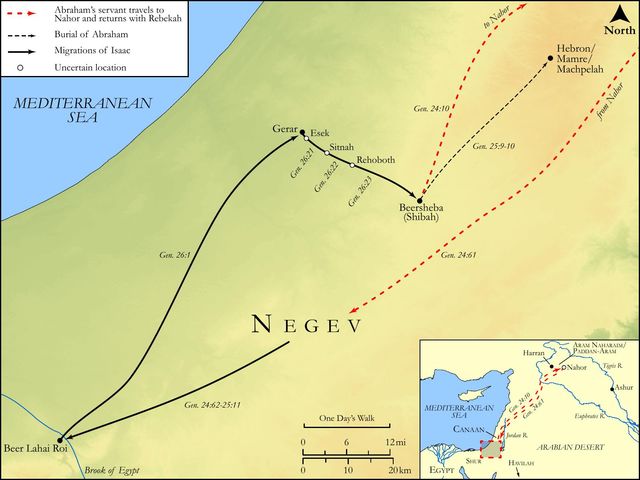
Genesis 24:32 depicts Laban's immediate and comprehensive hospitality extended to Abraham's servant and his retinue upon their arrival in Nahor. This pivotal moment showcases the profound cultural importance of patriarchal hospitality, detailing the practical provisions made for both the weary travelers and their valuable camels, thereby setting the stage for the crucial discussions that would ultimately lead to Rebekah's marriage to Isaac and the continuation of God's covenant promises.
Context
ShowHideLiterary Context
This verse is situated at a critical juncture in the narrative of Abraham's search for a wife for his son, Isaac. Immediately preceding it, Abraham's unnamed servant has arrived at the city of Nahor (also known as Haran), following divine guidance. He encounters Rebekah at a well, where her extraordinary kindness in offering water to him and his ten camels confirms her as the divinely appointed bride. After the servant presents her with valuable gifts, Rebekah rushes home to inform her family. Laban, her brother, hearing of the servant's arrival and seeing the gifts, promptly comes out to meet him, leading directly to the scene described in this verse. The narrative flow emphasizes the swiftness and eagerness of Laban's welcome, which is crucial for the unfolding of God's plan.
Historical & Cultural Context
Hospitality was a sacred duty and a cornerstone of life among the patriarchs. Travelers faced arduous journeys over vast, often dangerous, and arid landscapes, making the provision of food, water, and shelter not merely a courtesy but a necessity for survival. A host's honor was intricately tied to their generosity. Camels, as depicted in this passage, were invaluable assets for long-distance travel, carrying heavy loads and serving as a measure of wealth. Their well-being was paramount. Foot washing was a common and essential act of hospitality, as travelers wore open sandals on dusty roads, and it offered immediate physical relief and symbolized a warm welcome. Laban's actions here reflect the highest standards of this cultural norm, demonstrating respect and care for his unexpected guests.
Key Themes
ShowHideThis verse powerfully contributes to several overarching themes within Genesis and the broader biblical narrative. Firstly, it underscores the theme of Divine Providence and Guidance, as Laban's welcoming actions are part of God's intricate plan to lead Abraham's servant to Rebekah, fulfilling the servant's prayer for a clear sign from God (Genesis 24:12-14). Secondly, it highlights the Virtue of Hospitality, portraying it not just as a cultural custom but as a divinely approved practice that facilitates God's purposes. This generosity is a precursor to the formal negotiations for Rebekah's hand. Thirdly, the careful attention to both the men and their animals reinforces the theme of Stewardship and Compassion, reflecting a holistic care for all of God's creation. Finally, the entire episode, including Laban's welcome, is a crucial step in the Covenant Fulfillment promised to Abraham, ensuring the continuation of his lineage through Isaac and Rebekah, from whom the promised seed would eventually come (Genesis 12:1-3).
Exposition and Analysis
ShowHideKey Word Analysis
ShowHideRefers to a dwelling, but in a broader sense, it encompasses the household, family, and even the lineage. In this context, Laban bringing the man "into the house" signifies not merely physical shelter but an invitation into the security and fellowship of the family unit, a crucial step in ancient hospitality. It implies a deeper level of welcome than just a temporary resting place.
Literally means "to open wide" or "to loosen." Here, it specifically refers to the act of removing the heavy saddles, packs, and harnesses from the camels. This was a significant act of relief for the animals after a long journey, allowing them to rest unburdened. Laban's personal involvement in this laborious task underscores his exceptional commitment to hospitality and care for the valuable beasts.
Derived from a root meaning "to collect," this term refers to prepared or mixed fodder, a nourishing and specific meal for the animals, distinct from mere straw. The provision of "straw and provender" indicates a comprehensive and thoughtful approach to the camels' well-being, recognizing their vital role in the journey and their need for proper sustenance.
Verse Breakdown
ShowHide"And the man came into the house"
This phrase marks the successful culmination of Laban's invitation. "The man" refers to Abraham's servant, the primary agent of Abraham's mission. His entry into Laban's "house" (H1004, bayith) signifies the formal commencement of hospitality, moving from the public space of the well to the private, secure realm of the family, where crucial discussions and negotiations would take place.
"and he ungirded his camels"
This highlights Laban's personal initiative and immediate attention to the needs of the animals. The act of "ungirding" (H6605, pâthach) the camels involved removing their heavy burdens, a necessary and laborious task after a long journey. This demonstrates a deep understanding of the practicalities of travel and a commitment to the well-being of the entire entourage, including the valuable beasts of burden.
"and gave straw and provender for the camels"
This clause details the specific provisions made for the animals. "Straw" (H8401, teben) served as bedding or roughage, while "provender" (H4554, miçpôwʼ) indicates a more substantial, prepared feed. This comprehensive care for the camels underscores their immense value and the host's thoroughness in fulfilling the duties of hospitality, ensuring the animals were properly rested and nourished.
"and water to wash his feet, and the men's feet that [were] with him"
This final clause addresses the immediate needs of the human travelers. Providing "water" (H4325, mayim) for "foot washing" (H7364, râchats) was a customary and essential act of ancient hospitality, offering immediate relief from the dust and fatigue of travel. Laban's provision for "his feet" (the servant's) and "the men's feet that were with him" (H582, ʼĕnôwsh) demonstrates a thorough and inclusive welcome, extending care to the entire group, signifying respect and genuine concern for their comfort.
Literary Devices
ShowHideThe passage effectively employs Detailed Description to paint a vivid picture of hospitality in the house of Bethuel. Each action—ungirding camels, providing fodder, washing feet—is meticulously described, emphasizing the thoroughness and significance of Laban's welcome. This detailed portrayal elevates seemingly mundane acts into profound expressions of care. The use of Repetition, particularly of "camels" and "feet," underscores the dual focus of hospitality: attending to both the human travelers and their essential animals. Furthermore, the scene functions as Foreshadowing, setting a tone of welcome and cooperation that is essential for the successful negotiation of Rebekah's marriage, which is the ultimate purpose of the servant's journey. The swift and comprehensive nature of Laban's actions also serves as a subtle form of Divine Affirmation, indicating that the servant's mission is indeed blessed and guided by God.
Theological and Thematic Connections
ShowHideGenesis 24:32 offers a profound illustration of the biblical virtue of hospitality, which is not merely a social custom but a theological imperative reflecting God's own welcoming nature towards humanity. Laban's immediate and comprehensive care for Abraham's servant and his animals exemplifies a holistic approach to welcoming the stranger, treating them with dignity and meeting their fundamental needs. This act of kindness, while seemingly a natural human response, is intricately woven into God's sovereign plan, demonstrating how the Lord orchestrates ordinary human interactions to fulfill His extraordinary purposes, specifically in guiding the servant to Rebekah and ensuring the continuation of the covenant lineage. The diligence shown towards the camels also subtly highlights a broader biblical principle of responsible stewardship over creation and compassion for all living beings, reflecting the Creator's care for His world.
Reflection and Application
ShowHideGenesis 24:32 serves as a powerful and practical blueprint for cultivating a spirit of genuine hospitality in our lives today. Laban's actions challenge us to move beyond mere politeness to a proactive and comprehensive attentiveness to the needs of others, particularly those who are weary, vulnerable, or new to our sphere. His example teaches us that true welcome involves practical provision—whether it's offering a meal, a listening ear, or simply a comfortable space—and extends even to caring for what is important to our guests, be it their possessions, their burdens, or even their pets. In a world often characterized by busyness and self-focus, this passage calls us to intentionally create spaces of rest, refreshment, and belonging. Moreover, it reminds us that our acts of kindness, however small they may seem, can be significant steps in God's larger, unfolding plan, contributing to divine purposes we may not even fully comprehend at the time. How might God be using our simple acts of hospitality to advance His kingdom today?
Questions for Reflection
ShowHideFAQ
ShowHideWhy was foot washing so important for travelers in ancient times?
ShowHideIn that age, travel was arduous and often undertaken on foot or by animal over unpaved, dusty, and hot roads. People wore open-toed sandals, meaning their feet would become extremely dirty, tired, and often sore. Providing water for foot washing (as seen in Genesis 18:4 and Luke 7:44) was not just a common courtesy but a practical necessity. It offered immediate physical relief and symbolized a warm, respectful welcome from the host, signifying their genuine care for the guest's comfort and well-being. It was a foundational act of hospitality, demonstrating honor and attentiveness.
Christ-Centered Fulfillment
ShowHideThe seemingly mundane act of Laban's hospitality in Genesis 24:32 is a vital link in the chain of God's redemptive history, ultimately pointing to Christ. This welcoming act facilitated the crucial union of Isaac and Rebekah, ensuring the continuation of the promised seed through whom all nations would be blessed, as God had covenanted with Abraham (Genesis 22:18). The lineage established through this marriage, carefully preserved in biblical genealogies, directly leads to the birth of Jesus Christ, the ultimate "seed" who fulfills all of God's promises (Matthew 1:1-2 and Galatians 3:16). Thus, Laban's simple yet profound act of care for a weary traveler was a divinely orchestrated step in the unfolding plan for the Incarnation, demonstrating how God uses ordinary human kindness and cultural customs to fulfill His extraordinary covenant promises for the salvation of humanity through the person and work of Christ.