


2 Chronicles 9:26
- וַיְהִיvay·Hiand he wasH1961Conj-w ¦ V-Qal-ConsecImperf-3msVerb Qal Consecutive Imperfect 3rd Singular Masculineוַandיְהִיhe was
- מוֹשֵׁלmo·ShelrulingH4910V-Qal-Prtcpl-msVerb Qal Participle Singular Masculine Absolute
- בְּכָלbe·kholover allH3605Prep-b ¦ N-mscNoun Singular Masculine Constructבְּoverכָלall
- הַמְּלָכִיםha·me·la·Khimthe kingsH4428Art ¦ N-mpNoun Plural Masculine Absoluteהַtheמְּלָכִיםkings
- מִןminfromH4480PrepPreposition
- הַנָּהָרha·na·Harthe riverH5104Art ¦ N-properNoun Proper Locationהַtheנָּהָרriver
- וְעַדve·'adand toH5704Conj-w ¦ PrepPrepositionוְandעַדto
- אֶרֶץ'E·retz[the] land ofH776N-fscNoun Singular Feminine Construct
- פְּלִשְׁתִּיםpe·lish·Tim[the] PhilistinesH6430N-mpNoun Gentilic Plural Masculine Absolute
- וְעַדve·'Adand toH5704Conj-w ¦ PrepPrepositionוְandעַדto
- גְּבוּלge·Vul[the] border ofH1366N-mscNoun Singular Masculine Construct
- מִצְרָיִםmitz·Ra·yimEgyptH4714N-properNoun Proper Location
English is a literal word-by-word gloss of the Hebrew, not the KJV's wording. Why?
This is the original text the KJV's translators worked from — each Hebrew word with its own literal English meaning in this verse, prepared by scholars at Tyndale House, Cambridge. The KJV translates whole sentences, not word by word, so its wording differs: one Hebrew word can become several English words, and the KJV may choose “the LORD” where the gloss reads “Yahweh”. Both are faithful — they answer different questions. For the KJV's own rendering, switch to the KJV text.
Details
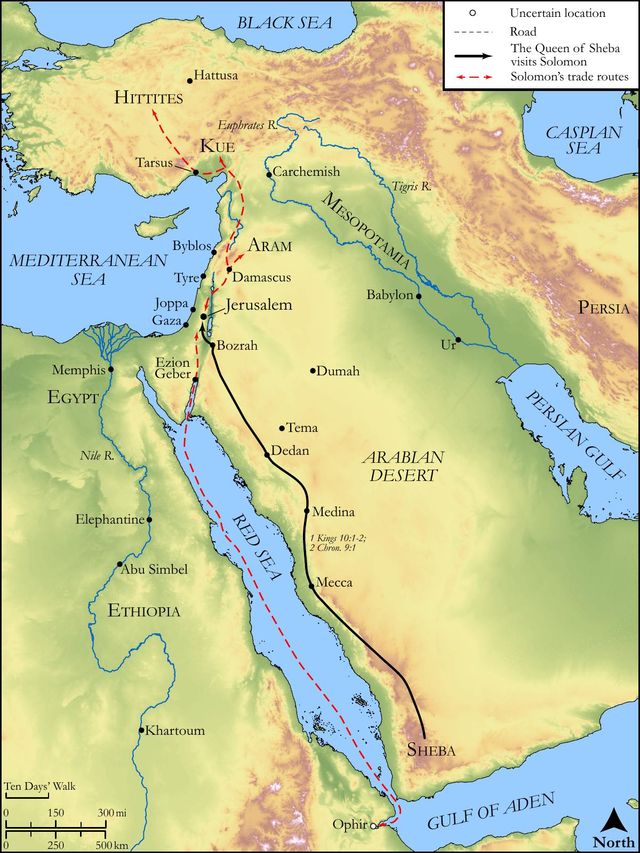
See on the biblical-era map
Study this verse
Public-domain commentary
Matthew Henry
From his Commentary on the Whole Bible. Henry comments on passages, not single verses — this entry covers 2 Chronicles 9:13–31. His two-level outline is real structure in the source text, so it is rendered as structure.
We have here Solomon in his throne, and Solomon in his grave; for the throne would not secure him from the grave. Mors sceptra ligonibus aequat - Death wrenches from the hand the sceptre as well as the spade.
I.Here is Solomon reigning in wealth and power, in ease and fulness, such as, for aught I know, could never since be paralleled by any king whatsoever. In cannot pretend to be critical in comparing the grandeur of Solomon with that of some of the great princes of the earth. But I may observe that the most illustrious of them were famed for their wars, whereas Solomon reigned forty years in profound peace. Some of those that might be thought to vie with Solomon affected retirement, kept people in awe by keeping them at a great distance; nobody must see them, or come near him, upon pain of death: but Solomon went much abroad, and appeared in public business. So that, all things considered, the promise was fulfilled, that God would give him riches, and wealth, and honour, such as no kings have had, or shall have, Ch2 1:12.
1.Never any prince appeared in public with great splendour than Solomon did, which to those that judge by the sight of the eye, as most people do, would very much recommend him. He had 200 targets and 300 shields, all of beaten gold, carried before him (Ch2 9:15, Ch2 9:16), and sat upon a most stately throne, Ch2 9:17-19. There was not the like in any kingdom. The lustre wherein he appeared was typical of the spiritual glory of the kingdom of the Messiah and but a faint representation of his throne, which is above every throne. Solomon's pomp was all artificial; and therefore our Saviour prefers the natural beauty of the lilies of the field before it. Mat 6:29, Solomon, in all his glory, was not arrayed like one of these.
2.Never any prince had greater plenty of gold and silver, though there were no gold or silver mines in his own kingdom. Either he made himself master of the mines in other countries, and, having a populous country, sent hands to dig out those rich metals, or, having a fruitful country, he exported the commodities of it and with them fetched home all this gold that is here spoken of, Ch2 9:13, Ch2 9:14-21.
3.Never any prince had such presents brought him by all his neighbours as Solomon had: All the kings of Arabia, and governors of the country, brought him gold and silver (Ch2 9:14), not as tribute which he extorted from them, but as freewill offerings to procure his favour, or in a way of exchange for some of the productions of his husbandry, corn or cattle. All the kings of the earth brought him presents, that is, all in those parts of the world (Ch2 9:24, Ch2 9:28), because they coveted his acquaintance and friendship. Herein he was a type of Christ, to whom, as soon as he was born, the wise men of the east brought presents, gold, frankincense, and myrrh (Mat 2:11), and to whom all that are about him must bring presents, Psa 76:11; Rom 12:1.
4.Never any prince was so renowned for wisdom, so courted, so consulted, so admired (Ch2 9:23): The kings of the earth (for it was too great a favour for common persons to pretend to) sought to hear his wisdom - his natural philosophy, or his skill in physic, or his state policy, or his rules of prudence for the conduct of human life, or perhaps the principles of his religion, and the reasons of it. The application which they then made to Solomon to hear his wisdom will aggravate, shame, and condemn, men's general contempt of Christ and his gospel. Though in them are hidden all the treasures of wisdom and knowledge, yet none of the princes of this world desire to know them, for they are foolishness to them, Co1 2:8, Co1 2:14.
II.Here is Solomon dying, stripped of his pomp, and leaving all his wealth and power, not to one concerning whom he knew not whether he would be a wise man or a fool (Ecc 2:19), but who he knew would be a fool. This was not only vanity but vexation of spirit, Ch2 9:29-31. It is very observable that no mention is here made of Solomon's departure from God in his latter days, not the least hint given of it,
1.Because the Holy Ghost would teach us not to take delight in repeating the faults and follies of others. If those that have been in reputation for wisdom and honour misbehave, though it may be of use to take notice of their misconduct for warning to ourselves and others, yet we must not be forward to mention it, once the speaking of it is enough; why should that unpleasing string be again struck upon? Why can we not do as the sacred historian here does, speak largely of that in others which is praise-worthy, without saying any thing of their blemishes, yea, though they have been gross and obvious? This is but doing as we would be done by.
2.Because, though he fell, yet he was not utterly cast down. His sin is not again recorded, because it was repented of, and pardoned, and became as if it had never been. Scripture-silence sometimes speaks. I am willing to believe that its silence here concerning the sin of Solomon is an intimation that none of the sins he committed were mentioned against him, Eze 33:16. When God pardons sin he casts it behind his back and remembers it no more.
Continue studying 2 Chronicles 9:26 across the web’s major study libraries — every link below opens this exact verse, chapter, or book on the destination site.
Read & Compare
 BibleGatewayThis verse in more than 200 translations and 70 languages.
 Bible.comThe YouVersion reader — hundreds of translations, reading plans, and highlights.
 ESV.orgCrossway's official English Standard Version reader.
 NET BibleThe NET translation with 60,000+ translators' notes on every rendering decision.
 STEP BibleTyndale House's free study tool — original text, vocabulary, and scholarly resources.
 BibliaLogos Bible Software's free web reader.
 USCCBThe New American Bible (Revised Edition) with the U.S. bishops' study notes.
Commentaries
 BibleHub CommentariesDozens of classic commentaries on this verse, gathered on one page.
 StudyLightMore than 100 commentary sets — the largest collection on the web.
 BibleRefPlain-English commentary on what this verse means, verse by verse.
 Enduring WordDavid Guzik's free commentary on this chapter, widely used by Bible teachers.
 Bible Study ToolsVerse commentary alongside Greek and Hebrew study aids.
Original Language & Research
- BibleHub InterlinearThe verse word by word — original language, transliteration, and English.
- BibleHub LexiconEvery word's original-language definition and Strong's entry.
 Blue Letter BibleDeep-study tools — Strong's numbers, concordance, and word studies.
 SefariaThe Hebrew text with Rashi and centuries of Jewish commentary.
Sermons, Hymns & Audio


TrulyRandomVerse is not affiliated with these sites and doesn’t control their content. They’re linked because they’re genuinely useful.
Summary
2 Chronicles 9:26 powerfully encapsulates the unparalleled geographical and political zenith of King Solomon's reign, describing his dominion over numerous kings from the Euphrates River to the land of the Philistines and the border of Egypt. This verse serves as a climactic statement, illustrating the vast extent of Israel's influence, prosperity, and international recognition during a golden age of peace, representing a significant, albeit temporary, fulfillment of God's covenant promises regarding the land.
Context
ShowHideLiterary Context
This verse is strategically placed within a broader section (2 Chronicles 9:13-28) that meticulously chronicles the immense wealth, wisdom, and glory of King Solomon. Immediately following the awe-struck account of the Queen of Sheba's visit (2 Chronicles 9:1-12), which underscored Solomon's unparalleled wisdom and the splendor of his court, verse 26 shifts focus to the vast political and geographical reach of his kingdom. It functions as a climactic summary statement regarding the external dominion of his power, complementing the internal descriptions of his riches and wisdom. The Chronicler emphasizes Solomon's reign as a period of unprecedented peace, stability, and international recognition, setting the stage for the subsequent narrative of his decline (which the Chronicler notably abbreviates compared to Kings) and the tragic division of the kingdom. This verse, therefore, acts as a poignant summary of the height of Israelite national power before the tragic consequences of Solomon's later disobedience begin to unfold.
Historical & Cultural Context
Solomon's reign (c. 970-931 BC) coincided with a unique geopolitical window in the ancient Near East. Major regional powers such as Egypt and the Mesopotamian empires (Assyria, Babylon) were experiencing periods of relative weakness or internal consolidation, creating a power vacuum that Israel, under Solomon, skillfully exploited. Israel's strategic location at the crossroads of major trade routes, connecting Egypt, Arabia, and Mesopotamia, allowed Solomon to establish extensive trade networks and forge crucial alliances, including his marriage to Pharaoh's daughter. "Reigning over all the kings" implies a sophisticated system of suzerainty, where neighboring kings paid tribute, acknowledged Solomon's overlordship, and maintained peaceful relations, rather than direct annexation of their territories. This was a common and highly prestigious practice in the ancient world, signifying immense diplomatic skill, economic power, and military might. The boundaries mentioned—"the river" (Euphrates), "the land of the Philistines," and "the border of Egypt"—represent the ideal, maximal extent of the land promised to Abraham, indicating a period when Israel's influence truly stretched across the fertile crescent, from its northern to its southern and western limits.
Key Themes
ShowHideThe primary theme powerfully articulated in 2 Chronicles 9:26 is the Vast Dominion and Influence of King Solomon. This sweeping geographical scope, encompassing "all the kings" from the Euphrates River to the Philistine coast and the Egyptian border, signifies a period of immense power, political stability, and economic prosperity for Israel, marking a high point in its national history. This extensive dominion also serves as a vivid illustration of the Fulfillment of Prophecy, particularly God's covenant promise to Abraham regarding the expansive land boundaries for his descendants, as recorded in God's covenant with Abraham regarding the land, which speaks of a land stretching "from the river of Egypt unto the great river, the river Euphrates." Solomon's reign represents a near-complete historical realization of this expansive promise. Furthermore, the verse underscores Solomon's Glory and Prosperity, presenting it as a direct consequence of his God-given wisdom and the divine blessings poured out upon his kingdom, as detailed throughout 2 Chronicles and its parallel account in 1 Kings 4. This period stands as a testament to the blessings that could flow from a king who initially sought God's wisdom and walked in His ways.
Exposition and Analysis
ShowHideKey Word Analysis
ShowHideDerived from a primitive root meaning "to rule," this verb signifies more than mere nominal kingship; it denotes active dominion, authority, and effective control. In this context, it implies Solomon's exercise of suzerainty, influence, and governance over the specified territories and their rulers, often involving the payment of tribute and the acknowledgment of his superior status. It underscores a powerful, dominant presence in the ancient Near East.
In the biblical context, "the river" (often with the definite article, as here) almost invariably refers to the great Euphrates River. This river marked the traditional northern and eastern boundary of the ideal land promised to Israel, signifying the furthest extent of their divinely ordained territory. Its inclusion here emphasizes the comprehensive and maximal nature of Solomon's geopolitical reach.
This term, derived from a root meaning "to twist" (like a cord), properly refers to a boundary line or limit. By extension, it also signifies the territory enclosed by such a boundary. In this verse, "the border of Egypt" precisely delineates the southern frontier of Solomon's sphere of influence, completing the geographical scope described and highlighting the full extent of his dominion.
Verse Breakdown
ShowHide"And he reigned over all the kings"
This opening clause immediately establishes the unparalleled political authority and influence of King Solomon. It signifies that numerous independent or semi-independent rulers in the surrounding regions were subservient to him, either paying tribute, acknowledging his suzerainty, or entering into treaties that placed them under his dominion. This level of regional supremacy was a unique and unprecedented achievement for an Israelite monarch.
"from the river"
This phrase specifies the northern and eastern extent of Solomon's influence. As identified, "the river" refers to the Euphrates, indicating that Solomon's sphere of control stretched far beyond the traditional borders of Canaan, reaching into the territories of Aram and Mesopotamia. This marked the furthest geographical reach of Israelite power in its history, a testament to God's blessing and Solomon's strategic prowess.
"even unto the land of the Philistines"
This defines the western boundary of his dominion. The Philistine city-states along the Mediterranean coast had historically been formidable and persistent adversaries of Israel. Solomon's ability to exert control or influence over them signifies a complete subjugation of this long-standing threat and the consolidation of power over the fertile coastal plain, securing Israel's western flank.
"and to the border of Egypt"
This indicates the southern limit of his kingdom's influence. Egypt, a perennial regional superpower, typically controlled the southern Levant. Solomon's reach to its very border, likely achieved through astute diplomacy, strategic alliances (such as his marriage to Pharaoh's daughter), and economic leverage, demonstrates his significant diplomatic and military strength, extending Israel's influence to the very doorstep of a major empire.
Overall
The cumulative effect of these precise geographical markers is to paint a vivid picture of an unprecedented, vast, and secure kingdom. This description highlights the historical fulfillment of the ancient promises of God to Abraham regarding the land, establishing Israel as the dominant force in the ancient Near East during this golden age.
Literary Devices
ShowHideThe Chronicler masterfully employs several literary devices in 2 Chronicles 9:26 to underscore the unparalleled grandeur and extensive reach of Solomon's reign. Merism is prominently featured in the phrase "from the river even unto the land of the Philistines, and to the border of Egypt." This device uses two or more contrasting or extreme parts to represent the whole, effectively conveying the comprehensive and vast geographical extent of Solomon's dominion. By meticulously naming the northern/eastern (Euphrates), western (Philistia), and southern (Egypt) boundaries, the text implies that all the territory in between was under his sway, encompassing the entire promised land. Furthermore, the phrase "all the kings" can be understood as a form of hyperbole, not necessarily indicating literal subjugation of every single monarch in the known world, but rather emphasizing the unparalleled and widespread nature of Solomon's influence, the tribute he received, and the recognition he commanded from a multitude of rulers. This hyperbole serves to amplify the sense of his glory, power, and international prestige. Finally, the entire description of Solomon's reign, culminating in this verse, functions as symbolism. It symbolizes the ideal state of Israel under God's blessing, a vision of prosperity, peace, and extensive dominion that was largely achieved under Solomon. This historical peak serves as a type or foreshadowing of a greater, more enduring, and truly universal kingdom to come.
Theological and Thematic Connections
ShowHide2 Chronicles 9:26 stands as a powerful testament to God's unwavering faithfulness in fulfilling His covenant promises. Solomon's extensive dominion, stretching from the Euphrates to the border of Egypt, directly echoes the land grant covenant made with Abraham in Genesis 15:18, where God promised his descendants a territory of precisely these dimensions. This historical realization, even if temporary and conditional, underscores the reliability and truthfulness of God's word. It also highlights the profound blessings that flow from a kingdom founded on wisdom and, initially, obedience to God, as Solomon's reign was characterized by peace and prosperity directly linked to his pursuit of divine wisdom. However, the Chronicler's emphasis on this peak also implicitly sets the stage for the tragic decline that follows, reminding readers that even the greatest earthly glory is fleeting and ultimately conditional upon continued faithfulness to God. The vastness of Solomon's kingdom, while impressive, serves as a mere shadow of the ultimate, eternal, and universal kingdom of the Messiah, whose reign truly knows no bounds and whose peace is everlasting.
Reflection and Application
ShowHideThe description of Solomon's vast kingdom in 2 Chronicles 9:26 offers profound insights for contemporary believers. Firstly, it serves as a powerful reminder of God's unwavering faithfulness to His promises. Just as He meticulously fulfilled His ancient covenant with Abraham through Solomon, so too can we trust that His word to us, in Christ, will ultimately come to pass. This should instill deep confidence and hope, even amidst present challenges and uncertainties. Secondly, Solomon's reign, initially marked by his earnest pursuit of wisdom and a period of obedience, brought immense blessing, peace, and territorial expansion. While we do not seek an earthly kingdom of this nature, this narrative illustrates a timeless spiritual principle: seeking God's wisdom and walking in His ways can lead to flourishing—not necessarily in material wealth, but in spiritual abundance, inner peace, and the effective stewardship of the influence and resources God entrusts to us. Finally, recognizing that even this glorious earthly kingdom was temporary and eventually fragmented, we are called to set our hearts on the eternal and unshakable kingdom of God, which is not of this world but transcends all earthly boundaries and limitations, offering a hope that will never fade.
Questions for Reflection
ShowHideFAQ
ShowHideWas Solomon's kingdom truly that vast, or is this an exaggeration?
ShowHideWhile the biblical description in 2 Chronicles 9:26 (and its parallel in 1 Kings 4:21) speaks of Solomon reigning over "all the kings" from the Euphrates to Egypt, this should be understood in the context of ancient Near Eastern political realities. It signifies a vast sphere of influence, suzerainty, and tribute-paying relationships rather than direct, complete administrative control over every square mile of this immense territory. Solomon established a sophisticated network of vassal states and alliances, securing vital trade routes and receiving tribute from numerous rulers. His kingdom was indeed the largest and most powerful in Israel's history, effectively controlling or influencing the entire Levant. So, while "all the kings" might be a hyperbolic expression emphasizing comprehensiveness, the geographical extent described was largely achieved through political and economic dominance, making it a historical high point for Israel.
How does Solomon's reign, as described here, relate to the Abrahamic Covenant?
ShowHideSolomon's vast dominion is presented as a significant, though not final, fulfillment of the land promise God made to Abraham in Genesis 15:18, where the boundaries of the promised land were explicitly defined as stretching "from the river of Egypt unto the great river, the river Euphrates." Under Solomon, Israel's influence and control reached these very geographical markers, representing the closest historical realization of that expansive covenant promise. It demonstrates God's faithfulness across generations, bringing His word to fruition in the lifetime of Abraham's descendants, even if the full spiritual and eternal dimensions of the covenant would only be realized in Christ.
Christ-Centered Fulfillment
ShowHideWhile 2 Chronicles 9:26 describes the pinnacle of an earthly king's dominion, its true theological weight lies in its profound foreshadowing of a far greater and eternal reign: that of Jesus Christ. Solomon's kingdom, though vast and glorious, was ultimately temporary, conditional, and eventually marred by his own later failures and the subsequent division of the kingdom. It serves as a type, a shadow pointing to the anti-type, the perfect and everlasting kingdom of God established through Christ. Solomon's rule "over all the kings" from "the river... unto the border of Egypt" pales in comparison to Christ's universal sovereignty, which extends over all creation, all nations, and all time. As the true Son of David, Jesus fulfills the prophetic visions of a king whose dominion knows no bounds, as seen in Psalm 72:8 ("He shall have dominion also from sea to sea, and from the river unto the ends of the earth"). Unlike Solomon's reign, which was maintained by military might and tribute, Christ's kingdom is spiritual and redemptive, established not by conquest but by His sacrificial death and resurrection, drawing people from every tribe, tongue, people, and nation into His fold. His dominion is eternal, unbreakable, and perfectly just, for the kingdom of the world has become the kingdom of our Lord and of his Christ, and he shall reign forever and ever. Indeed, every knee will bow and every tongue confess that Jesus Christ is Lord, a dominion far surpassing any earthly king's, signifying the ultimate and perfect fulfillment of God's redemptive plan for all creation.