


John 6:56
Bible text: King James Version (1769 Blayney text) · Public domain
Bible text: Berean Standard Bible · Public domain
Bible text: American Standard Version (1901) · Public domain
Bible text: World English Bible, Messianic edition · Public domain
Bible text: Geneva Bible (1599) · Public domain
Bible text: Young's Literal Translation · Public domain
- ὁhoThe [one]G3588T-NSMDefinite article Nominative Singular Masculine
- τρώγωνtrōgōneatingG5176V-PAP-NSMVerb Present Active Participle Nominative Singular Masculine
- μουmouof MyG3165P-1GSPersonal pronoun Genitive 1st Singular
- τὴνtēn<the>G3588T-ASFDefinite article Accusative Singular Feminine
- σάρκαsarkafleshG4561N-ASFNoun Accusative Singular Feminine
- καὶkaiandG2532CONJConjunction
- πίνωνpinōndrinkingG4095V-PAP-NSMVerb Present Active Participle Nominative Singular Masculine
- μουmouof MyG3165P-1GSPersonal pronoun Genitive 1st Singular
- τὸto<the>G3588T-ASNDefinite article Accusative Singular Neuter
- αἷμαhaimabloodG129N-ASNNoun Accusative Singular Neuter
- ἐνeninG1722PREPPreposition
- ἐμοὶemoiMe myselfG1473P-1DSPersonal pronoun Dative 1st Singular
- μένειmeneiabidesG3306V-PAI-3SVerb Present Active Indicative 3rd Singular
- κἀγὼkagōand I myselfG2532P-1NS + G2532=CONJ
- ἐνeninG1722PREPPreposition
- αὐτῷautōhimG846P-DSMPersonal pronoun Dative Singular Masculine
English is a literal word-by-word gloss of the Greek, not the KJV's wording. Why?
This is the original text the KJV's translators worked from — each Greek word with its own literal English meaning in this verse, prepared by scholars at Tyndale House, Cambridge. The KJV translates whole sentences, not word by word, so its wording differs: one Greek word can become several English words, and the KJV may choose “charity” where the gloss reads “love”. Both are faithful — they answer different questions. For the KJV's own rendering, switch to the KJV text.
Details
See on the biblical-era maps
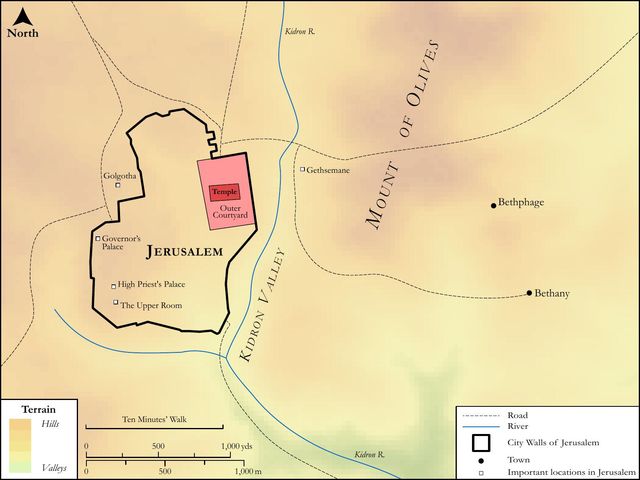
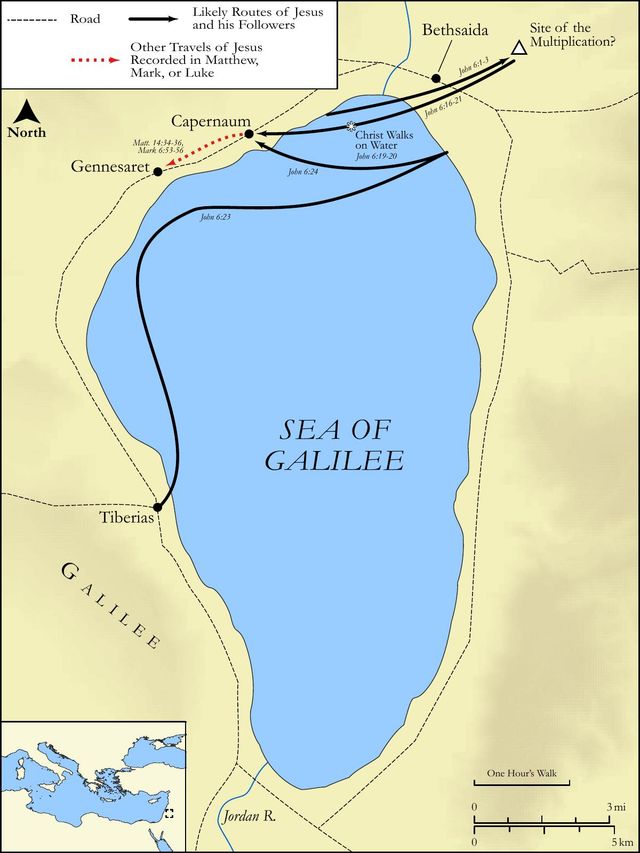
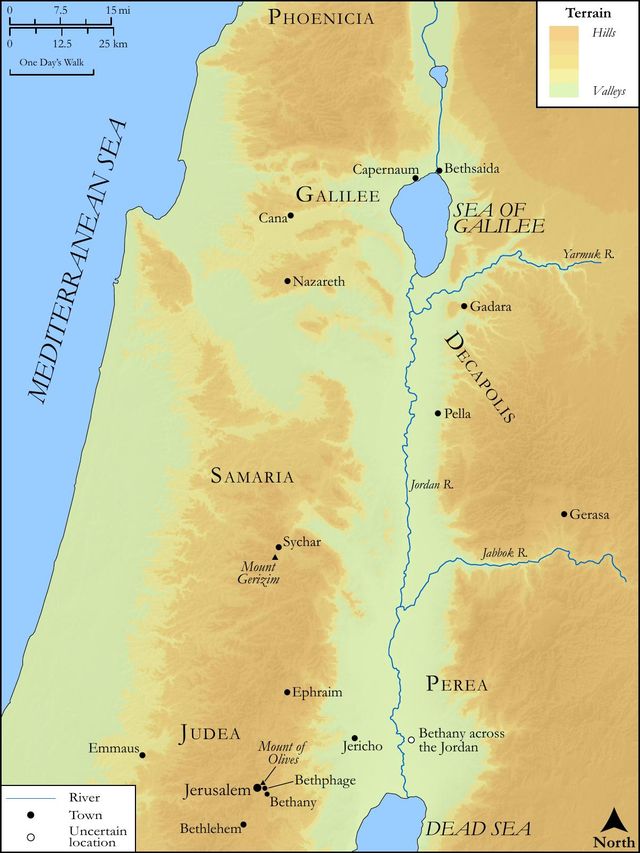
Study this verse
Public-domain commentary
Matthew Henry
From his Commentary on the Whole Bible. Henry comments on passages, not single verses — this entry covers John 6:28–59. His four-level outline is real structure in the source text, so it is rendered as structure.
Whether this conference was with the Capernaites, in whose synagogue Christ now was, or with those who came from the other side of the sea, is not certain nor material; however, it is an instance of Christ's condescension that he gave them leave to ask him questions, and did not resent the interruption as an affront, no, not from his common hearers, though not his immediate followers. Those that would be apt to teach must be swift to hear, and study to answer. It is the wisdom of teachers, when they are asked even impertinent unprofitable questions, thence to take occasion to answer in that which is profitable, that the question may be rejected, but not the request. Now,
I.Christ having told them that they must work for the meat he spoke of, must labour for it, they enquire what work they must do, and he answers them, v. 28, 29.
1.Their enquiry was pertinent enough (v. 28): What shall we do, that we may work the works of God? Some understand it as a pert question: "What works of God can we do more and better than those we do in obedience to the law of Moses?" But I rather take it as a humble serious question, showing them to be, at least for the present, in a good mind, and willing to know and do their duty; and I imagine that those who asked this question, How and What (v. 30), and made the request (v. 34), were not the same persons with those that murmured (v. 41, 42), and strove (v. 52), for those are expressly called the Jews, who came out of Judea (for those were strictly called Jews) to cavil, whereas these were of Galilee, and came to be taught. This question here intimates that they were convinced that those who would obtain this everlasting meat,
(1.)Must aim to do something great. Those who look high in their expectations, and hope to enjoy the glory of God, must aim high in those endeavours, and study to do the works of God, works which he requires and will accept, works of God, distinguished from the works of worldly men in their worldly pursuits. It is not enough to speak the words of God, but we must do the works of God.
(2.)Must be willing to do any thing: What shall we do? Lord, I am ready to do whatever thou shalt appoint, though ever so displeasing to flesh and blood, Acts ix. 6.
2.Christ's answer was plain enough (v. 29): This is the work of God that ye believe. Note,
(1.)The work of faith is the work of God. They enquire after the works of God (in the plural number), being careful about many things; but Christ directs them to one work, which includes all, the one thing needful: that you believe, which supersedes all the works of the ceremonial law; the work which is necessary to the acceptance of all the other works, and which produces them, for without faith you cannot please God. It is God's work, for it is of his working in us, it subjects the soul to his working on us, and quickens the soul in working for him,
(2.)That faith is the work of God which closes with Christ, and relies upon him. It is to believe on him as one whom God hath sent, as God's commissioner in the great affair of peace between God and man, and as such to rest upon him, and resign ourselves to him. See ch. xiv. 1.
II.Christ having told them that the Son of man would give them this meat, they enquire concerning him, and he answers their enquiry.
1.Their enquiry is after a sign (v. 30): What sign showest thou? Thus far they were right, that, since he required them to give him credit, he should produce his credentials, and make it out by miracle that he was sent of God. Moses having confirmed his mission by signs, it was requisite that Christ, who came to set aside the ceremonial law, should in like manner confirm his: "What dost thou work? What doest thou drive at? What lasting characters of a divine power does thou design to leave upon thy doctrine?" But herein they missed it,
(1.)That they overlooked the many miracles which they had seen wrought by him, and which amounted to an abundant proof of his divine mission. Is this a time of day to ask, "What sign showest thou?" especially at Capernaum, the staple of miracles, where he had done so many mighty works, signs so significant of his office and undertaking? Were not these very persons but the other day miraculously fed by him? None so blind as they that will not see; for they may be so blind as to question whether it be day or no, when the sun shines in their faces.
(2.)That they preferred the miraculous feeding of Israel in the wilderness before all the miracles Christ wrought (v. 31): Our fathers did eat manna in the desert; and, to strengthen the objection, they quote a scripture for it: He gave them bread from heaven (taken from Ps. lxxviii. 24), he gave them of the corn of heaven. What a good use might be made of this story to which they here refer! It was a memorable instance of God's power and goodness, often mentioned to the glory of God (Neh. xix. 20, 21), yet see how these people perverted it, and made an ill use of it. [1.] Christ reproved them for their fondness of the miraculous bread, and bade them not set their hearts upon meat which perisheth; "Why," say they, "meat for the belly was the great good thing that God gave to our fathers in the desert; and why should not we then labour for that meat? If God made much of them, why should not we be for those that will make much of us?" [2.] Christ had fed five thousand men with five loaves, and had given them that as one sign to prove him sent of God; but, under colour of magnifying the miracles of Moses, they tacitly undervalue this miracle of Christ, and evade the evidence of it. "Christ fed his thousands; but Moses his hundreds of thousands; Christ fed them but once, and then reproved those who followed him in hope to be still fed, and put them off with a discourse of spiritual food; but Moses fed his followers forty years, and miracles were not their rarities, but their daily bread: Christ fed them with bread out of the earth, barley-bread, and fishes out of the sea; but Moses fed Israel with bread from heaven, angel's food." Thus big did these Jews talk of the manna which their fathers did eat; but their fathers had slighted it as much as they did now the barley-loaves, and called light bread, Num. xxi. 5. Thus apt are we to slight and overlook the appearances of God's power and grace in our own times, while we pretend to admire the wonders of which our fathers told us. Suppose this miracle of Christ was outdone by that of Moses, yet there were other instances in which Christ's miracles outshone his; and, besides, all true miracles prove a divine doctrine, though not equally illustrious in the circumstances, which were ever diversified according as the occasion did require. As much as the manna excelled the barley-loaves, so much, and much more, did the doctrine of Christ excel the law of Moses, and his heavenly institutions the carnal ordinances of that dispensation.
2.Here is Christ's reply to this enquiry, wherein,
(1.)He rectifies their mistake concerning the typical manna. It was true that their fathers did eat manna in the desert. But,
[1.]It was not Moses that gave it to them, nor were they obliged to him for it; he was but the instrument, and therefore they must look beyond him to God. We do not find that Moses did so much as pray to God for the manna; and he spoke unadvisedly when he said, Must we fetch water out of the rock? Moses gave them not either that bread or that water.
[2.]It was not given them, as they imagined, from heaven, from the highest heavens, but only from the clouds, and therefore not so much superior to that which had its rise from the earth as they thought. Because the scripture saith, He gave them bread from heaven, it does not follow that it was heavenly bread, or was intended to be the nourishment of souls. Misunderstanding scripture language occasions many mistakes in the things of God.
(2.)He informs them concerning the true manna, of which that was a type: But my Father giveth you the true bread from heaven; that which is truly and properly the bread from heaven, of which the manna was but a shadow and figure, is now given, not to your fathers, who are dead and gone, but to you of this present age, for whom the better things were reserved: he is now giving you that bread from heaven, which is truly so called. As much as the throne of God's glory is above the clouds of the air, so much does the spiritual bread of the everlasting gospel excel the manna. In calling God his Father, he proclaims himself greater than Moses; for Moses was faithful but as a servant, Christ as a Son, Heb. iii. 5, 6.
III.Christ, having replied to their enquiries, takes further occasion from their objection concerning the manna to discourse of himself under the similitude of bread, and of believing under the similitude of eating and drinking; to which, together with his putting both together in the eating of his flesh and drinking of his blood, and with the remarks made upon it by the hearers, the rest of this conference may be reduced.
1.Christ having spoken of himself as the great gift of God, and the true bread (v. 32), largely explains and confirms this, that we may rightly know him.
(1.)He here shows that he is the true bread; this he repeats again and again, v. 33, 35, 48-51. Observe,
[1.]That Christ is bread is that to the soul which bread is to the body, nourishes and supports the spiritual life (is the staff of it) as bread does the bodily life; it is the staff of life. The doctrines of the gospel concerning Christ—that he is the mediator between God and man, that he is our peace, our righteousness, our Redeemer; by these things do men live. Our bodies could better live without food than our souls without Christ. Bread-corn is bruised (Isa. xxviii. 28), so was Christ; he was born at Bethlehem, the house of bread, and typified by the show-bread.
[2.]That he is the bread of God (v. 33), divine bread; it is he that is of God (v. 46), bread which my Father gives (v. 32), which he has made to be the food of our souls; the bread of God's family, his children's bread. The Levitical sacrifices are called the bread of God (Lev. xxi. 21, 22), and Christ is the great sacrifice; Christ, in his word and ordinances, the feast upon the sacrifice.
[3.]That he is the bread of life (v. 35, and again, v. 48), that bread of life, alluding to the tree of life in the midst of the garden of Eden, which was to Adam the seal of that part of the covenant, Do this and live, of which he might eat and live. Christ is the bread of life, for he is the fruit of the tree of life. First, He is the living bread (so he explains himself, v. 51): I am the living bread. Bread is itself a dead thing, and nourishes not but by the help of the faculties of a living body; but Christ is himself living bread, and nourishes by his own power. Manna was a dead thing; if kept but one night, it putrefied and bred worms; but Christ is ever living, everlasting bread, that never moulds, nor waxes old. The doctrine of Christ crucified is now as strengthening and comforting to a believer as ever it was, and his mediation still of as much value and efficacy as ever. Secondly, He gives life unto the world (v. 33), spiritual and eternal life; the life of the soul in union and communion with God here, and in the vision and fruition of him hereafter; a life that includes in it all happiness. The manna did only reserve and support life, did not preserve and perpetuate life, much less restore it; but Christ gives life to those that were dead in sin. The manna was ordained only for the life of the Israelites, but Christ is given for the life of the world; none are excluded from the benefit of this bread, but such as exclude themselves. Christ came to put life into the minds of men, principles productive of acceptable performances.
[4.]That he is the bread which came down from heaven; this is often repeated here, v. 33, 50, 51, 58. This denotes, First, The divinity of Christ's person. As God, he had a being in heaven, whence he came to take our nature upon him: I came down from heaven, whence we may infer his antiquity, he was in the beginning with God; his ability, for heaven is the firmament of power; and his authority, he came with a divine commission. Secondly, The divine original of all that good which flows to us through him. He comes, not only katabas—that came down (v. 51), but katabainoi—that comes down; he is descending, denoting a constant communication of light, life, and love, from God to believers through Christ, as the manna descended daily; see Eph. i. 3. Omnia desuper—All things from above.
[5.]That he is that bread of which the manna was a type and figure (v. 58), that bread, the true bread, v. 32. As the rock that they drank of was Christ, so was the manna they ate of spiritual bread, 1 Cor. x. 3, 4. Manna was given to Israel; so Christ to the spiritual Israel. There was manna enough for them all; so in Christ a fulness of grace for all believers; he that gathers much of this manna will have none to spare when he comes to use it; and he that gathers little, when his grace comes to be perfected in glory, shall find that he has no lack. Manna was to be gathered in the morning; and those that would find Christ must seek him early. Manna was sweet, and, as the author of the Wisdom of Solomon tells us (Wisd. xvi. 20), was agreeable to every palate; and to those that believe Christ is precious. Israel lived upon manna till they came to Canaan; and Christ is our life. There was a memorial of the manna preserved in the ark; so of Christ in the Lord's supper, as the food of souls.
(2.)He here shows what his undertaking was, and what his errand into the world. Laying aside the metaphor, he speaks plainly, and speaks no proverb, giving us an account of his business among men, v. 38-40.
[1.]He assures us, in general, that he came from heaven upon his Father's business (v. 38), not do his own will, but the will of him that sent him. He came from heaven, which bespeaks him an intelligent active being, who voluntarily descended to this lower world, a long journey, and a great step downward, considering the glories of the world he came from and the calamities of the world he came to; we may well ask with wonder, "What moved him to such an expedition?" Here he tells that he came to do, not his own will, but the will of his Father; not that he had any will that stood in competition with the will of his Father, but those to whom he spoke suspected he might. "No," saith he, "my own will is not the spring I act from, nor the rule I go by, but I am come to do the will of him that sent me." That is, First, Christ did not come into the world as a private person, that acts for himself only, but under a public character, to act for others as an ambassador, or plenipotentiary, authorized by a public commission; he came into the world as God's great agent and the world's great physician. It was not any private business that brought him hither, but he came to settle affairs between parties no less considerable than the great Creator and the whole creation. Secondly, Christ, when he was in the world, did not carry on any private design, nor had any separate interest at all, distinct from theirs for whom he acted. The scope of his whole life was to glorify God and do good to men. He therefore never consulted his own ease, safety, or quiet; but, when he was to lay down his life, though he had a human nature which startled at it, he set aside the consideration of that, and resolved his will as man into the will of God: Not as I will, but as thou wilt.
[2.]He acquaints us, in particular, with that will of the Father which he came to do; he here declares the decree, the instructions he was to pursue.
First, The private instructions given to Christ, that he should be sure to save all the chosen remnant; and this is the covenant of redemption between the Father and the Son (v. 38): "This is the Father's will, who hath sent me; this is the charge I am entrusted with, that of all whom he hath given me I should lose none." Note, 1. There is a certain number of the children of men given by the Father to Jesus Christ, to be his care, and so to be to him for a name and a praise; given him for an inheritance, for a possession. Let him do all that for them which their case requires; teach them, and heal them, pay their debt, and plead their cause, prepare them for, and preserve them to, eternal life, and then let him make his best of them. The Father might dispose of them as he pleased: as creatures, their lives and beings were derived from him; as sinners, their lives and beings were forfeited to him. He might have sold them for the satisfaction of his justice, and delivered them to the tormentors; but he pitched upon them to be the monuments of his mercy, and delivered them to the Saviour. Those whom God chose to be the objects of his special love he lodged as a trust in the hands of Christ. 2. Jesus Christ has undertaken that he will lose none of those that were thus given him of the Father. The many sons whom he was to bring to glory shall all be forth-coming, and none of them missing, Matt. xviii. 14. None of them shall be lost, for want of a sufficient grace to sanctify them. If I bring him not unto thee, and set him before thee, then let me bear the blame for ever, Gen. xliii. 9. 3. Christ's undertaking for those that are given him extends to the resurrection of their bodies. I will raise it up again at the last day, which supposes all that goes before, but this is to crown and complete the undertaking. The body is a part of the man, and therefore a part of Christ's purchase and charge; it pertains to the promises, and therefore it shall not be lost. The undertaking is not only that he shall lose none, no person, but that he shall lose nothing, no part of the person, and therefore not the body. Christ's undertaking will never be accomplished till the resurrection, when the souls and bodies of the saints shall be re-united and gathered to Christ, that he may present them to the Father: Behold I, and the children that thou has given me, Heb. ii. 13; 2 Tim. i. 12. 4. The spring and original of all this is the sovereign will of God, the counsels of his will, according to which he works all this. This was the commandment he gave to his Son, when he sent him into the world, and to which the Son always had an eye.
Secondly, The public instructions which were to be given to the children of men, in what way, and upon what terms, they might obtain salvation by Christ; and this is the covenant of grace between God and man. Who the particular persons were that were given to Christ is a secret: The Lord knows them that are his, we do not, nor is it fit we should; but, though their names are concealed, their characters are published. An offer is made of life and happiness upon gospel terms, that by it those that were given to Christ might be brought to him, and others left inexcusable (v. 40): "This is the will, the revealed will, of him that sent me, the method agreed upon, upon which to proceed with the children of men, that every one, Jew or Gentile, that sees the Son, and believes on him, may have everlasting life, and I will raise him up." This is gospel indeed, good news. Is it now reviving to hear this? 1. That eternal life may be had, if it be not our own fault; that whereas, upon the sin of the first Adam, the way of the tree of life was blocked up, by the grace of the second Adam it is laid upon again. The crown of glory is set before us as the prize of our high calling, which we may run for and obtain. 2. Every one may have it. This gospel is to be preached, this offer made, to all, and none can say, "It belongs not to me," Rev. xxii. 17. 3. This everlasting life is sure to all those who believe in Christ, and to them only. He that sees the Son, and believes on him, shall be saved. Some understand this seeing as a limitation of this condition of salvation to those only that have the revelation of Christ and his grace made to them. Every one that has the opportunity of being acquainted with Christ, and improves this so well as to believe in him, shall have everlasting life, so that none shall be condemned for unbelief (however they maybe for other sins) but those who have had the gospel preached to them, who, like these Jews here (v. 36), have seen, and yet have not believed; have known Christ, and yet not trusted in him. But I rather understand seeing here to mean the same thing with believing, for it is theoron, which signifies not so much the sight of the eye (as v. 36, heorakate me—ye have seen me) as the contemplation of the mind. Every one that sees the Son, that is, believes on him, sees him with an eye of faith, by which we come to be duly acquainted and affected with the doctrine of the gospel concerning him. It is to look upon him, as the stung Israelites upon the brazen serpent. It is not a blind faith that Christ requires, that we should be willing to have our eyes put out, and then follow him, but that we should see him, and see what ground we go upon in our faith. It is then right when it is not taken up upon hearsay (believing as the church believes), but is the result of a due consideration of, and insight into, the motives of credibility: Now mine eye sees thee. We have heard him ourselves. 4. Those who believe in Jesus Christ, in order to their having everlasting life, shall be raised up by his power at the last day. He had it in charge as his Father's will (v. 39), and here he solemnly makes it his own undertaking: I will raise him up, which signifies not only the return of the body to life, but the putting of the whole man into a full possession of the eternal life promised.
2.Now Christ discoursing thus concerning himself, as the bread of life that came down from heaven, let us see what remarks his hearers made upon it.
(1.)When they heard of such a thing as the bread of God, which gives life, they heartily prayed for it (v. 34): Lord, evermore give us this bread. I cannot think that this is spoken scoffingly, and in a way of derision, as most interpreters understand it: "Give us such bread as this, if thou canst; let us be fed with it, not for one meal, as with the five loaves, but evermore;" as if this were no better a prayer than that of the impenitent thief: If thou be the Christ, save thyself and us. But I take this request to be made, though ignorantly, yet honestly, and to be well meant; for they call him Lord, and desire a share in what he gives, whatever he means by it. General and confused notions of divine things produce in carnal hearts some kind of desires towards them, and wishes of them; like Balaam's wish, to die the death of the righteous. Those who have an indistinct knowledge of the things of God, who see men as trees walking, make, as I may call them, inarticulate prayers for spiritual blessings. They think the favour of God a good thing, and heaven a fine place, and cannot but wish them their own, while they have no value nor desire at all for that holiness which is necessary both to the one and to the other. Let this be the desire of our souls; have we tasted that the Lord is gracious, been feasted with the word of God, and Christ in the word? Let us say, "Lord, evermore give us this bread; let the bread of life be our daily bread, the heavenly manna our continual feast, and let us never know the want of it."
(2.)But, when they understood that by this bread of life Jesus meant himself, then they despised it. Whether they were the same persons that had prayed for it (v. 34), or some others of the company, does not appear; it seems to be some others, for they are called Jews. Now it is said (v. 41), They murmured at him. This comes in immediately after that solemn declaration which Christ had made of God's will and his own undertaking concerning man's salvation (v. 39, 40), which certainly were some of the most weighty and gracious words that ever proceeded out of the mouth of our Lord Jesus, the most faithful, and best worthy of all acceptation. One would think that, like Israel in Egypt, when they heard that God had thus visited them, they should have bowed their heads and worshipped; but on the contrary, instead of closing with the offer made them, they murmured, quarrelled with what Christ said, and, though they did not openly oppose and contradict it, yet they privately whispered among themselves in contempt of it, and instilled into one another's minds prejudices against it. Many that will not professedly contradict the doctrine of Christ (their cavils are so weak and groundless that they are either ashamed to own them or afraid to have them silenced), yet say in their hearts that they do not like it. Now,
[1.]That which offended them was Christ's asserting his origin to be from heaven, v. 41, 42. How is it that he saith, I came down from heaven? They had heard of angels coming down from heaven, but never of a man, overlooking the proofs he had given them of his being more than a man.
[2.]That which they thought justified them herein was that they knew his extraction on earth: Is not this Jesus the son of Joseph, whose father and mother we know? They took it amiss that he should say that he came down from heaven, when he was one of them. They speak slightly of his blessed name, Jesus: Is not this Jesus. They take it for granted that Joseph was really his father, though he was only reputed to be so. Note, Mistakes concerning the person of Christ, as if he were a mere man, conceived and born by ordinary generation, occasion the offence that is taken at his doctrine and offices. Those who set him on a level with the other sons of men, whose father and mother we know, no wonder if they derogate from the honour of his satisfaction and the mysteries of his undertaking, and, like the Jews here, murmur at his promise to raise us up at the last day.
3.Christ, having spoken of faith as the great work of God (v. 29), discourses largely concerning this work, instructing and encouraging us in it.
(1.)He shows what it is to believe in Christ.
[1.]To believe in Christ is to come to Christ. He that comes to me is the same with him that believes in me (v. 35), and again (v. 37): He that comes unto me; so v. 44, 45. Repentance towards God is coming to him (Jer. iii. 22) as our chief good and highest end; and so faith towards our Lord Jesus Christ is coming to him as our prince and Saviour, and our way to the Father. It denotes the out-goings of our affection towards him, for these are the motions of the soul, and actions agreeable; it is to come off from all those things that stand in opposition to him or competition with him, and to come up to those terms upon which life and salvation are offered to us through him. When he was here on earth it was more that barely coming where he was; so it is now more than coming to his word and ordinances.
[2.]It is to feed upon Christ (v. 51): If any man eat of this bread. The former denotes applying ourselves to Christ; this denotes applying Christ to ourselves, with appetite and delight, that we may receive life, and strength, and comfort from him. To feed on him as the Israelites on the manna, having quitted the fleshpots of Egypt, and not depending on the labour of their hands (to eat of that), but living purely on the bread given them from heaven.
(2.)He shows what is to be got by believing in Christ. What will he give us if we come to him? What shall we be the better of we feed upon him? Want and death are the chief things we dread; may we but be assured of the comforts of our being, and the continuance of it in the midst of these comforts, we have enough; now these two are here secured to true believers.
[1.]They shall never want, never hunger, never thirst, v. 35. Desires they have, earnest desires, but these so suitably, so seasonably, so abundantly satisfied, that they cannot be called hunger and thirst, which are uneasy and painful. Those that did eat manna, and drink of the rock, hungered and thirsted afterwards. Manna surfeited them; water out of the rock failed them. But there is such an over-flowing fulness in Christ as can never be exhausted, and there are such ever-flowing communications from him as can never be interrupted.
[2.]They shall never die, not die eternally; for, First, He that believes on Christ has everlasting life (v. 47); he has the assurance of it, the grant of it, the earnest of it; he has it in the promise and first-fruits. Union with Christ and communion with God in Christ are everlasting life begun. Secondly, Whereas they that did eat manna died, Christ is such bread as a man may eat of and never die, v. 49, 50. Observe here, 1. The insufficiency of the typical manna: Your fathers did eat manna in the wilderness, and are dead. There may be much good use made of the death of our fathers; their graves speak to us, and their monuments are our memorials, particularly of this, that the greatest plenty of the most dainty food will neither prolong the thread of life nor avert the stroke of death. Those that did eat manna, angel's food, died like other men. There could be nothing amiss in their diet, to shorten their days, nor could their deaths be hastened by the toils and fatigues of life (for they neither sowed nor reaped), and yet they died. (1.) Many of them died by the immediate strokes of God's vengeance for their unbelief and murmurings; for, though they did eat that spiritual meat, yet with many of them God was not well-pleased, but they were overthrown in the wilderness, 1 Cor. x. 3-5. Their eating manna was no security to them from the wrath of God, as believing in Christ is to us. (2.) The rest of them died in a course of nature, and their carcases fell, under a divine sentence, in that wilderness where they did eat manna. In that very age when miracles were daily bread was the life of man reduced to the stint it now stands at, as appears, Ps. xc. 10. Let them not then boast so much of manna. 2. The all-sufficiency of the true manna, of which the other was a type: This is the bread that cometh down from heaven, that truly divine and heavenly food, that a man may eat thereof and not die; that is, not fall under the wrath of God, which is killing to the soul; not die the second death; no, nor the first death finally and irrecoverably. Not die, that is, not perish, not come short of the heavenly Canaan, as the Israelites did of the earthly, for want of faith, though they had manna. This is further explained by that promise in the next words: If any man eat of this bread, he shall live for ever, v. 51. This is the meaning of this never dying: though he go down to death, he shall pass through it to that world where there shall be no more death. To live for ever is not to be for ever (the damned in hell shall be for ever, the soul of man was made for an endless state), but to be happy for ever. And because the body must needs die, and be as water spilt upon the ground, Christ here undertakes for the gathering of that up too (as before, v. 44, I will raise him up at the last day); and even that shall live for ever.
(3.)He shows what encouragements we have to believe in Christ. Christ here speaks of some who had seen him and yet believed not, v. 36. They saw his person and miracles, and heard him preach, and yet were not wrought upon to believe in him. Faith is not always the effect of sight; the soldiers were eye-witnesses of his resurrection, and yet, instead of believing in him, they belied him; so that it is a difficult thing to bring people to believe in Christ: and, by the operation of the Spirit of grace, those that have not seen have yet believed. Two things we are here assured of, to encourage our faith:—
[1.]That the Son will bid all those welcome that come to him (v. 37): Him that cometh to me I will in no wise cast out. How welcome should this word be to our souls which bids us welcome to Christ! Him that cometh; it is in the singular number, denoting favour, not only to the body of believers in general, but to every particular soul that applies itself to Christ. Here, First, The duty required is a pure gospel duty: to come to Christ, that we may come to God by him. His beauty and love, those great attractives, must draw us to him; sense of need and fear of danger must drive us to him; any thing to bring us to Christ. Secondly, The promise is a pure gospel promise: I will in no wise cast out—ou me ekbago exo. There are two negatives: I will not, no, I will not. 1. Much favour is expressed here. We have reason to fear that he should cast us out. Considering our meanness, our vileness, our unworthiness to come, our weakness in coming, we may justly expect that he should frown upon us, and shut his doors against us; but he obviates these fears with this assurance, he will not do it; will not disdain us though we are mean, will not reject us though we are sinful. Do poor scholars come to him to be taught? Though they be dull and slow, he will not cast them out. Do poor patients come to him to be cured, poor clients come to him to be advised? Though their case be bad, and though they come empty-handed, he will in no wise cast them out. But, 2. More favour is implied than is expressed; when it is said that he will no cast them out the meaning is, He will receive them, and entertain them, and give them all that which they come to him for. As he will not refuse them at their first coming, so he will not afterwards, upon every displeasure, cast them out. His gifts and callings are without repentance.
[2.]That the Father will, without fail, bring all those to him in due time that were given him. In the federal transactions between the Father and the Son, relating to man's redemption, as the Son undertook for the justification, sanctification, and salvation, of all that should come to him ("Let me have them put into my hands, and then leave the management of them to me"), so the Father, the fountain and original of being, life, and grace, undertook to put into his hand all that were given him, and bring them to him. Now,
First, He here assures us that this shall be done: All that the Father giveth me shall come to me, v. 37. Christ had complained (v. 36) of those who, though they had seen him, yet would not believe on him; and then he adds this,
a.For their conviction and awakening, plainly intimating that their not coming to him, and believing on him, if they persisted in it, would be a certain sign that they did not belong to the election of grace; for how can we think that God gave us to Christ if we give ourselves to the world and the flesh? 2 Pet. i. 10.
b.For his own comfort and encouragement: Though Israel be not gathered, yet shall I be glorious. The election has obtained, and shall though multitudes be blinded, Rom. xi. 7. Though he lose many of his creatures, yet none of his charge: All that the Father gives him shall come to him notwithstanding. Here we have, (a.) The election described: All that the father giveth me, pan ho didosi—every thing which the Father giveth to me; the persons of the elect, and all that belongs to them; all their services, all their interests. As all that he has is theirs, so all that they have is his, and he speaks of them as his all: they were given him in full recompense of his undertaking. Not only all persons, but all things, are gathered together in Christ (Eph. i. 10) and reconciled, Col. i. 20. The giving of the chosen remnant to Christ is spoken of (v. 39) as a thing done; he hath given them. Here it is spoken of as a thing in the doing; he giveth them; because, when the first begotten was brought into the world, it should seem, there was a renewal of the grant; see Heb. x. 5, &c. God was now about to give him the heathen for his inheritance (Ps. ii. 8), to put him in possession of the desolate heritages (Isa. xlix. 8), to divide him a portion with the great, Isa. liii. 12. And though the Jews, who saw him, believed not on him, yet these (saith he) shall come to me; the other sheep, which are not of this fold, shall be brought, ch. x. 15, 16. See Acts xiii. 45-48. (b.) The effect of it secured: They shall come to me. This is not in the nature of a promise, but a prediction, that as many as were in the counsel of God ordained to life shall be brought to life by being brought to Christ. They are scattered, are mingled among the nations, yet none of them shall be forgotten; not a grain of God's corn shall be lost, as is promised, Amos ix. 9. They are by nature alienated from Christ, and averse to him, and yet they shall come. As God's omniscience is engaged for the finding of them all out, so is his omnipotence for the bringing of them all in. Not, They shall be driven, to me, but, They shall come freely, shall be made willing.
Secondly, He here acquaints us how it shall be done. How shall those who are given to Christ be brought to him? Two things are to be done in order to it:—
a.Their understandings shall be enlightened; this is promised, v. 45, 46. It is written in the prophets, who spoke of these things before, And they shall be all taught of God; this we find, Isa. liv. 13, and Jer. xxxi. 34. They shall all know me. Note,
(a.)In order to our believing in Jesus Christ, it is necessary that we be taught of God; that is, [a.] That there be a divine revelation made to us, discovering to us both what we are to believe concerning Christ and why we are to believe it. There are some things which even nature teaches, but to bring us to Christ there is need of a higher light. [b.] That there be a divine work wrought in us, enabling us to understand and receive these revealed truths and the evidence of them. God, in giving us reason, teaches us more than the beasts of the earth; but in giving us faith he teaches more than the natural man. Thus all the church's children, all that are genuine, are taught of God; he hath undertaken their education.
(b.)It follows then, by way of inference from this, that every man that has heard and learned of the Father comes to Christ, v. 45. [a.] It is here implied that none will come to Christ but those that have heard and learned of the Father. We shall never be brought to Christ but under a divine conduct; except God by his grace enlighten our minds, inform our judgments, and rectify our mistakes, and not only tell us that we may hear, but teach us, that we may learn the truth as it is in Jesus, we shall never be brought to believe in Christ. [b.] That this divine teaching does so necessarily produce the faith of God's elect that we may conclude that those who do not come to Christ have never heard nor learned of the Father; for, if they had, doubtless they would have come to Christ. In vain do men pretend to be taught of God if they believe not in Christ, for he teaches no other lesson, Gal. i. 8, 9. See how God deals with men as reasonable creatures, draws them with the cords of a man, opens the understanding first, and then by that, in a regular way, influences the inferior faculties; thus he comes in by the door, but Satan, as a robber, climbs up another way. But lest any should dream of a visible appearance of God the Father to the children of men (to teach them these things), and entertain any gross conceptions about hearing and learning of the Father, he adds (v. 46): Not that any man hath seen the Father; it is implied, nor can see him, with bodily eyes, or may expect to learn of him as Moses did, to whom he spoke face to face; but God, in enlightening men's eyes and teaching them, works in a spiritual way. The Father of spirits hath access to, and influence upon, men's spirits, undiscerned. The Father of spirits hath access to, and influence upon, men's spirits, undiscerned. Those that have not seen his face have felt his power. And yet there is one intimately acquainted with the Father, he who is of God, Christ himself, he hath seen the Father, ch. i. 18. Note, First, Jesus Christ is of God in a peculiar manner, God of God, light of light; not only sent of God, but begotten of God before all worlds. Secondly, It is the prerogative of Christ to have seen the Father, perfectly to know him and his counsels. Thirdly, Even that illumination which is preparative to faith is conveyed to us through Christ. Those that learn of the Father, forasmuch as they cannot see him themselves, must learn of Christ, who alone hath seen him. As all divine discoveries are made through Christ, so through him all divine powers are exerted.
b.Their wills shall be bowed. If the soul of man had now its original rectitude there needed no more to influence the will than the illumination of the understanding; but in the depraved soul of fallen man there is a rebellion of the will against the right dictates of the understanding; a carnal mind, which is enmity itself to the divine light and law. It is therefore requisite that there be a work of grace wrought upon the will, which is here called drawing, (v. 44): No man can come to me except the Father, who hath sent me, draw him. The Jews murmured at the doctrine of Christ; not only would not receive it themselves, but were angry that others did. Christ overheard their secret whisperings, and said (v. 43), "Murmur not among yourselves; lay not the fault of your dislike of my doctrine one upon another, as if it were because you find it generally distasted; no, it is owing to yourselves, and your own corrupt dispositions, which are such as amount to a moral impotency; your antipathies to the truths of God, and prejudices against them, are so strong that nothing less than a divine power can conquer them." And this is the case of all mankind: "No man can come to me, can persuade himself to come up to the terms of the gospel, except the Father, who hath sent me, draw him," v. 44. Observe, (a.) The nature of the work: It is drawing, which denotes not a force put upon the will, whereby of unwilling we are made willing, and a new bias is given to the soul, by which it inclines to God. This seems to be more than a moral suasion, for by that it is in the power to draw; yet it is not to be called a physical impulse, for it lies out of the road of nature; but he that formed the spirit of man within him by his creating power, and fashions the hearts of men by his providential influence, knows how to new-mould the soul, and to alter its bent and temper, and make it conformable to himself and his own will, without doing any wrong to its natural liberty. It is such a drawing as works not only a compliance, but a cheerful compliance, a complacency: Draw us, and we will run after thee. (b.) The necessity of it: No man, in this weak and helpless state, can come to Christ without it. As we cannot do any natural action without the concurrence of common providence, so we cannot do any action morally good without the influence of special grace, in which the new man lives, and moves, and has its being, as much as the mere man has in the divine providence. (c.) The author of it: The Father who hath sent me. The Father, having sent Christ, will succeed him, for he would not send him on a fruitless errand. Christ having undertaken to bring souls to glory, God promised him, in order thereunto, to bring them to him, and so to give him possession of those to whom he had given him a right. God, having by promise given the kingdom of Israel to David, did at length draw the hearts of the people to him; so, having sent Christ to save souls, he sends souls to him to be saved by him. (d.) The crown and perfection of this work: And I will raise him up at the last day. This is four times mentioned in this discourse, and doubtless it includes all the intermediate and preparatory workings of divine grace. When he raises them up at the last day, he will put the last hand to his undertaking, will bring forth the topstone. If he undertakes this, surely he can do any thing, and will do every thing that is necessary in order to do it. Let our expectations be carried out towards a happiness reserved for the last day, when all the years of time shall be fully complete and ended.
4.Christ, having thus spoken of himself as the bread of life, and of faith as the work of God, comes more particularly to show what of himself is this bread, namely, his flesh, and that to believe is to eat of that, v. 51-58, where he still prosecutes the metaphor of food. Observe, here, the preparation of this food: The bread that I will give is my flesh (v. 51), the flesh of the Son of man and his blood, v. 53. His flesh is meat indeed, and his blood is drink indeed, v. 55. Observe, also, the participation of this food: We must eat the flesh of the Son of man and drink his blood (v. 53); and again (v. 54), Whoso eateth my flesh and drinketh my blood; and the same words (v. 56, 57), he that eateth me. This is certainly a parable or figurative discourse, wherein the actings of the soul upon things spiritual and divine are represented by bodily actions about things sensible, which made the truths of Christ more intelligible to some, and less so to others, Mark iv. 11-12. Now,
(1.)Let us see how this discourse of Christ was liable to mistake and misconstruction, that men might see, and not perceive.
[1.]It was misconstrued by the carnal Jews, to whom it was first delivered (v. 52): They strove among themselves; they whispered in each other's ears their dissatisfaction: How can this man give us his flesh to eat? Christ spoke (v. 51) of giving his flesh for us, to suffer and die; but they, without due consideration, understood it of his giving it to us, to be eaten, which gave occasion to Christ to tell them that, however what he said was otherwise intended, yet even that also of eating of his flesh was no such absurd thing (if rightly understood) as prima facie—in the first instance, they took it to be.
[2.]It has been wretchedly misconstrued by the church of Rome for the support of their monstrous doctrine of transubstantiation, which gives the lie to our senses, contradicts the nature of a sacrament, and overthrows all convincing evidence. They, like these Jews here, understand it of a corporal and carnal eating of Christ's body, like Nicodemus, ch. iii. 4. The Lord's supper was not yet instituted, and therefore it could have no reference to that; it is a spiritual eating and drinking that is here spoken of, not a sacramental.
[3.]It is misunderstood by many ignorant carnal people, who hence infer that, if they take the sacrament when they die, they shall certainly go to heaven, which, as it makes many that are weak causelessly uneasy if they want it, so it makes many that are wicked causelessly easy if they have it. Therefore,
(2.)Let us see how this discourse of Christ is to be understood.
[1.]What is meant by the flesh and blood of Christ. It is called (v. 53), The flesh of the Son of man, and his blood, his as Messiah and Mediator: the flesh and blood which he assumed in his incarnation (Heb. ii. 14), and which he gave up in his death and suffering: my flesh which I will give to be crucified and slain. It is said to be given for the life of the world, that is, First, Instead of the life of the world, which was forfeited by sin, Christ gives his own flesh as a ransom or counterprice. Christ was our bail, bound body for body (as we say), and therefore his life must go for ours, that ours may be spared. Here am I, let these go their way. Secondly, In order to the life of the world, to purchase a general offer of eternal life to all the world, and the special assurances of it to all believers. So that the flesh and blood of the Son of man denote the Redeemer incarnate and dying; Christ and him crucified, and the redemption wrought out by him, with all the precious benefits of redemption: pardon of sin, acceptance with God, the adoption of sons, access to the throne of grace, the promises of the covenant, and eternal life; these are called the flesh and blood of Christ, 1. Because they are purchased by his flesh and blood, by the breaking of his body, and shedding of his blood. Well may the purchased privileges be denominated from the price that was paid for them, for it puts a value upon them; write upon them pretium sanguinis—the price of blood. 2. Because they are meat and drink to our souls. Flesh with the blood was prohibited (Gen. ix. 4), but the privileges of the gospel are as flesh and blood to us, prepared for the nourishment of our souls. He had before compared himself to bread, which is necessary food; here to flesh, which is delicious. It is a feast of fat things, Isa. xxv. 6. The soul is satisfied with Christ as with marrow and fatness, Ps. lxiii. 5. It is meat indeed, and drink indeed; truly so, that is spiritually; so Dr. Whitby; as Christ is called the true vine; or truly meat, in opposition to the shows and shadows with which the world shams off those that feed upon it. In Christ and his gospel there is real supply, solid satisfaction; that is meat indeed, and drink indeed, which satiates and replenishes, Jer. xxxi. 25, 26.
[2.]What is meant by eating this flesh and drinking this blood, which is so necessary and beneficial; it is certain that is means neither more nor less than believing in Christ. As we partake of meat and drink by eating and drinking, so we partake of Christ and his benefits by faith: and believing in Christ includes these four things, which eating and drinking do:—First, It implies an appetite to Christ. This spiritual eating and drinking begins with hungering and thirsting (Matt. v. 6), earnest and importunate desires after Christ, not willing to take up with any thing short of an interest in him: "Give me Christ or else I die." Secondly, An application of Christ to ourselves. Meat looked upon will not nourish us, but meat fed upon, and so made our own, and as it were one with us. We must so accept of Christ as to appropriate him to ourselves: my Lord, and my God, ch. xx. 28. Thirdly, A delight in Christ and his salvation. The doctrine of Christ crucified must be meat and drink to us, most pleasant and delightful. We must feast upon the dainties of the New Testament in the blood of Christ, taking as great a complacency in the methods which Infinite Wisdom has taken to redeem and save us as ever we did in the most needful supplies or grateful delights of nature. Fourthly, A derivation of nourishment from him and a dependence upon him for the support and comfort of our spiritual life, and the strength, growth, and vigour of the new man. To feed upon Christ is to do all in his name, in union with him, and by virtue drawn from him; it is to live upon him as we do upon our meat. How our bodies are nourished by our food we cannot describe, but that they are so we know and find; so it is with this spiritual nourishment. Our Saviour was so well pleased with this metaphor (as very significant and expressive) that, when afterwards he would institute some outward sensible signs, by which to represent our communicating of the benefits of his death, he chose those of eating and drinking, and made them sacramental actions.
(3.)Having thus explained the general meaning of this part of Christ's discourse, the particulars are reducible to two heads:—
[1.]The necessity of our feeding upon Christ (v. 53): Except you eat the flesh of the Son of man, and drink his blood, you have no life in you. That is, First, "It is a certain sign that you have no spiritual life in you if you have no desire towards Christ, nor delight in him." If the soul does not hunger and thirst, certainly it does not live: it is a sign that we are dead indeed if we are dead to such meat and drink as this. When artificial bees, that by curious springs were made to move to and fro, were to be distinguished from natural ones (they say), it was done by putting honey among them, which the natural bees only flocked to, but the artificial ones minded not, for they had no life in them. Secondly, "It is certain that you can have no spiritual life, unless you derive it from Christ by faith; separated from him you can do nothing." Faith in Christ is the primum vivens—the first living principle of grace; without it we have not the truth of spiritual life, nor any title to eternal life: our bodies may as well live without meat as our souls without Christ.
[2.]The benefit and advantage of it, in two things:—
First, We shall be one with Christ, as our bodies are with our food when it is digested (v. 56): He that eats my flesh, and drinks my blood, that lives by faith in Christ crucified (it is spoken of as a continued act), he dwelleth in me, and I in him. By faith we have a close and intimate union with Christ; he is in us, and we in him, ch. xvii. 21-23; 1 John iii. 24. Believers dwell in Christ as their stronghold or city of refuge; Christ dwells in them as the master of the house, to rule it and provide for it. Such is the union between Christ and believers that he shares in their griefs, and they share in his graces and joys; he sups with them upon their bitter herbs, and they with him upon his rich dainties. It is an inseparable union, like that between the body and digested food, Rom. viii. 35; 1 John iv. 13.
Secondly, We shall live, shall live eternally, by him, as our bodies live by our food.
a.We shall live by him (v. 57): As the living Father hath sent me, and I live by the Father, so he that eateth me, even he shall live by me. We have here the series and order of the divine life. (a.) God is the living Father, hath life in and of himself. I am that I am is his name for ever. (b.) Jesus Christ, as Mediator, lives by the Father; he has life in himself (ch. v. 26), but he has it of the Father. He that sent him, not only qualified him with that life which was necessary to so great an undertaking, but constituted him the treasury of divine life to us; he breathed into the second Adam the breath of spiritual lives, as into the first Adam the breath of natural lives. (c.) True believers receive this divine life by virtue of their union with Christ, which is inferred from the union between the Father and the Son, as it is compared to it, ch. xvii. 21. For therefore he that eateth me, or feeds on me, even he shall live by me: those that live upon Christ shall live by him. The life of believers is had from Christ (ch. i. 16); it is hid with Christ (Col. iii. 4), we live by him as the members by the head, the branches by the root; because he lives, we shall live also.
b.We shall live eternally by him (v. 54): Whoso eateth my flesh, and drinketh my blood, as prepared in the gospel to be the food of souls, he hath eternal life, he hath it now, as v. 40. He has that in him which is eternal life begun; he has the earnest and foretaste of it, and the hope of it; he shall live for ever, v. 58. His happiness shall run parallel with the longest line of eternity itself.
Historical interpretation
Seven Centuries of Reception
11 surviving comments on this verse. Each one is dated, so this reads as a timeline rather than a list.
Select a marker to jump to its quote. Markers stagger vertically where authors wrote within a few decades of each other.
(vii. de Trin. c. 14) Of the truth then of the body and blood of Christ, no room for doubting remains: for, by the declaration of our Lord Himself, and by the teaching of our own faith, the flesh is really flesh, and the blood really blood. This then is our principle of life. While we are in the flesh, Christ dwelleth in us by His flesh. (c.14:19) And we shall live by Him, according as He liveth. If then we live naturally by partaking of Him according to the flesh, He also liveth naturally by the indwelling of the Father according to the Spirit. His birth did not give Him an alien or different nature from the Father.
(de Trin. x. c. 18.) He calls Himself the bread, because He is the origin of His own body. And lest it should be thought that the virtue and nature of the Word had given way to the flesh, He calls the bread His flesh, that, inasmuch as the bread came down from heaven, it might be seen that His body was not of human conception, but a heavenly body. To say that the bread is His own, is to declare that the Word assumed His body Himself.
(Hom. xlvii. 1) i. e. this is no enigma, or parable, but ye must really eat the body of Christ; or He means to say that the true meat was He who saved the soul.
(Hom. xlvii. 1) Or, having given a promise of eternal life to those that eat Him, He says this to confirm it: He that eateth My flesh, and drinketh My blood, dwelleth in Me, and I in him.
(Hom. xlvi) And because I live, it is manifest that he will live also: As the living Father hath sent Me, and I lice by the Father, even so he that eateth Me, even he shall live by Me. (Aug. de Verb. Dom. [Nic.]). As if He said, As the Father liveth, so do I live; adding, lest you should think Him unbegotten, By the Father, meaning that He has His source in the Father. He that eateth Me, even he shall live by Me; the life here meant is not life simply, but the justified life: for even unbelievers live, who never eat of that flesh at all. Nor is it of the general resurrection He speaks, (for all will rise again,) but of the resurrection to glory, and reward.
(Hom. xlvii. 1) For if it was possible without harvest or fruit of the earth, or any such thing, to preserve the lives of the Israelites of old for forty years, much more will He be able to do this with that spiritual food, of which the manna is the type. He knew how precious a thing life was in men's eyes, and therefore repeats His promise of life often; just as the Old Testament had done; (Exod. 20:12) only that it only offered length of life, He life without end. (Deut. 22:7) This promise was an abolition of that sentence of death, which sin had brought upon us. These things said He in the synagogue, as He taught in Capernaum; (1 Kings 3:14) where many displays of His power took place. (Ps. 21:4; 91:16) He taught in the synagogue and in the temple, (Prov. 3:2) with the view of attracting the multitude, and as a sign that He was not acting in opposition to the Father.
"For My flesh is true meat, and My blood is true drink."
What is that He saith? He either desireth to declare that this is the true meat which saveth the soul, or to assure them concerning what had been said, that they might not suppose the words to be a mere enigma or parable, but might know that it is by all means needful to eat the Body.
"He that eateth My flesh, dwelleth in Me."
This He said, showing that such an one is blended with Him. Now what follows seems unconnected, unless we enquire into the sense; for, saith some one, after saying, "He that eateth My flesh, dwelleth in Me," what kind of a consequence is it to add, "As the living Father hath sent Me, and I live by the Father"?
Yet the words harmonize perfectly. For since He continually spake of "eternal life," to prove this point He introduceth the expression, "dwelleth in Me"; for "if he dwelleth in Me, and I live, it is plain that he will live also." Then He saith, "As the living Father hath sent Me." This is an expression of comparison and resemblance, and its meaning is of this kind, "I live in like manner as the Father liveth." And that thou mayest not deem Him unbegotten, He immediately subjoineth, "by the Father," not by this to show that He needeth, in order to live, any power working in Him, for He said before, to remove such a suspicion, "As the Father hath life in Himself, so hath He given to the Son also to have life in Himself"; now if He needeth the working of another, it will be found that either the Father hath not given Him so to have it, and so the assertion is false, or if He hath so given it, then He will need no other one to support Him. What then means the, "By the Father"? He here merely hinteth at the cause, and what He saith is of this kind: "As the Father liveth, so I live, and he that eateth Me shall live by Me." And the "life" of which He speaketh is not life merely, but the excellent life; for that He spake not simply of life, but of that glorious and ineffable life, is clear from this. For all men "live," even unbelievers, and uninitiated, who eat not of that flesh. Seest thou that the words relate not to this life, but to that other? And what He saith is of this kind: "He that eateth My flesh, when he dieth shall not perish nor suffer punishment"; He spake not of the general resurrection, (for all alike rise again,) but concerning the special, the glorious Resurrection, that which hath a reward.
"This is that bread which came down from heaven; not as your fathers did eat manna, and are dead; he that eateth of this bread shall live for ever."
Continually doth He handle the same point, so as to imprint it on the understanding of the hearers, (for the teaching on these points was a kind of final teaching,) and to confirm the doctrine of the Resurrection and of eternal life. Wherefore He mentioneth the Resurrection since He promiseth eternal life, showing that that life is not now, but after the Resurrection. "And whence," saith some one, "are these things clear?" From the Scriptures; to them He everywhere referreth the Jews, bidding them learn these things from them. And by saying, "Which giveth life to the world," He inciteth them to jealousy, that from very vexation that others should enjoy the gift, they may not stay without. And continually He remindeth them of the manna, showing the difference, (between it and His bread,) and guiding them to the faith; for if He was able to support their life for forty years without harvest, or corn, or other things in course; much more now will He be able to do so, as having come for greater ends. Moreover, if those things were but types, and yet men collected what came down without sweat or labor; much more shall this be the case, where the difference is great both in the never dying, and in the enjoying the true life. And rightly hath He spoken often of "life," since this is desired by men, and nothing is so pleasing to them as not to die. Since even under the old Covenant, this was the promise, length of life and many days, but now it is not length merely, but life having no end. He desireth at the same time to show, that He now revoketh the punishment caused by sin, annulling that sentence which condemneth to death, and bringing in not life merely, but life eternal, contrariwise to the former things.
"These things said He in the synagogue, as He taught in Capernaum."
The place where most of His marvels had been done, so that He ought there especially to have been listened to. But wherefore taught He in the synagogue and in the Temple? As well because He desired to catch the greatest number of them, as because He desired to show that He was not opposed to the Father.
Then He explains what it is to eat His body and drink His blood: He that eateth My flesh, and drinketh My blood, dwelleth in Me, and I in him. So then to partake of that meat and that drink, is to dwell in Christ and Christ in thee. He that dwelleth not in Christ, and in whom Christ dwelleth not, neither eateth His flesh, nor drinketh His blood: but rather eateth and drinketh the sacrament of it to his own damnation.
(de Verb. Dom.) As for those, as indeed there are many, who either eat that flesh and drink that blood hypocritically, or, who having eaten, become apostates, do they dwell in Christ, and Christ in them? Nay, but there is a certain mode of eating that flesh, and drinking that blood, in the which he that eateth and drinketh, dwelleth in Christ, and Christ in him.
(de Civ. Dei, l. xxi. c. 25) That is to say, such an one eateth the body and drinketh the blood of Christ not in the sacramental sense, but in reality.
In a word, He now explains how that which He speaks of comes to pass, and what it is to eat His body and to drink His blood. "He that eateth my flesh, and drinketh my blood, dwelleth in me, and I in him." This it is, therefore, for a man to eat that meat and to drink that drink, to dwell in Christ, and to have Christ dwelling in him. Consequently, he that dwelleth not in Christ, and in whom Christ dwelleth not, doubtless neither eateth His flesh [spiritually] nor drinketh His blood [although he may press the sacrament of the body and blood of Christ carnally and visibly with his teeth], but rather doth he eat and drink the sacrament of so great a thing to his own judgment, because he, being unclean, has presumed to come to the sacraments of Christ, which no man taketh worthily except he that is pure: of such it is said, "Blessed are the pure in heart, for they shall see God."
If one joins two pieces of wax, one will see that one has become part of the other. In a similar manner, I suppose, the person who receives the flesh of our Savior Christ and drinks his precious blood … shall be one with him.
Manifoldly does Christ initiate us by these words, and since His Discourse is hard of attainment by the more unlearned, asking for itself rather the understanding of faith than investigation, He revolving again and again over the same ground makes it easy in divers ways, and from all parts illumines what is useful therein, fixing as a kind of foundation and groundwork the most excellent desire for it. For he that eateth My Flesh (saith He) and drinketh My Blood abideth in Me and I in him. For as if one should join wax with other wax, he will surely see (I suppose) the one in the other; in like manner (I deem) he who receiveth the Flesh of our Saviour Christ and drinketh His Precious Blood, as He saith, is found one with Him, commingled as it were and immingled with Him through the participation, so that he is found in Christ, Christ again in him. Thus was Christ teaching us in the Gospel too according to Matthew, saying, The Kingdom of heaven is like unto leaven, which a woman took and hid in three measures of meal, till the whole was leavened. Who then the woman is, what the three measures of meal, or what the measure at all, shall be spoken of in its proper place: for the present we will speak only of the leaven. As then Paul saith that a little leaven leaveneth the whole lump, so the least portion of the Blessing blendeth our whole body with itself, and filleth it with its own mighty working, and so Christ cometh to be in us, and we again in Him. For one may truly say that the leaven is in the whole lump, and the lump by like reasoning is in the whole leaven: you have in brief the sense of the words. And if we long for eternal life, if we pray to have the Giver of immortality in ourselves, let us not like some of the more heedless refuse to be blessed nor let the Devil deep in wickedness, lay for us a trap and snare a perilous reverence.
Yea (says he) for it is written, He that eateth of the Bread, and drinketh of the Cup unworthily, eateth and drinketh doom unto himself: and I, having examined myself, see that I am not worthy.
When then wilt thou be worthy (will he who thus speaks hear from us) when wilt thou present thyself to Christ? for if thou art always going to be scared away by thy stumblings, thou wilt never cease from stumbling (for who can understand his errors? as saith the holy Psalmist) and wilt be found wholly without participation of that wholly-preserving sanctification. Decide then to lead a holier life, in harmony with the law, and so receive the Blessing, believing that it hath power to expel, not death only, but the diseases in us. For Christ thus coming to be in us lulleth the law which rageth in the members of the flesh, and kindleth piety to God-ward, and deadeneth our passions, not imputing to us the transgressions in which we are, but rather, healing us, as sick. For He bindeth up that which was crushed, He raiseth what had fallen, as a Good Shepherd and One that hath laid down His Life for His sheep
O sublime condescension! The Creator gives himself to his creatures for their delight. Life bestows itself on mortals as food and drink. “Come, eat my body,” he exhorts us, “and drink the wine I have mingled for you. I have prepared myself as food. I have mingled myself for those who desire me. Of my own will I became flesh and have become a partaker of your flesh and blood.… Eat of me as I am life, and live, for this is what I desire.… Eat my bread, for I am the life-giving grain of the wheat, and I am the bread of life. Drink the wine I have mingled for you, for I am the draught of immortality.… I am the true vine; drink my joy, the wine that I have mingled for you.
Daniel the disciple of Arsenius used to talk also about a hermit in Scetis, saying that he was a great man but simple in the faith, and in his ignorance he thought and said that the bread which we receive is not in very truth the Body of Christ, but a symbol of His Body. Two of the monks heard what he said but because they knew of his sublime works and labours, they imagined that he had said it in innocence and simple-mindedness; and so they came to him and said unto him, ‘Abba, someone told us something that we do not believe; he said that this bread that we receive is not in very truth the Body of Christ, but a mere symbol.’ He said to them, ‘I said that.’ They begged him, saying, ‘You mustn’t say that, abba; according to what the Catholic Church has handed down to us, even so do we believe, that is to say, this bread is the Body of Christ in very truth, and is not a mere symbol. It is the same as when God took dust from the earth, and made man in His image; just as no one can say that he is not the image of God, so also with the bread of which He said, “This is My Body” is not to be regarded as a merely commemorative thing; we believe that it is indeed the Body of Christ.’ The hermit said, ‘Unless I can be convinced by the thing itself I will not listen to this.’ Then the monks said to him, ‘Let us pray to God all week about this mystery, and we believe that He will reveal the truth to us.’ The hermit agreed to this with great joy, and each went to his cell. Then the hermit prayed, saying, ‘O Lord, you know that it is not out of wickedness that I do not believe, so in order that I may not go astray through ignorance, reveal to me, Lord Jesus Christ, the truth of this mystery.’ The other two brothers prayed to God and said, ‘Lord Jesus Christ, give this hermit understanding about this mystery, and we believe that he will not be lost.’ God heard the prayer of the two monks. When the week was over they came to the church, and the three of them sat down by themselves on one seat, the hermit between the other two. The eyes of their understanding were opened, and when the time of the mysteries arrived, and the bread was laid upon the holy table, there appeared to the three of them as it were a child on the table. Then the priest stretched out his hand to break the bread, and behold the angel of the Lord came down from heaven with a knife in his hand, and he killed the child and pressed out his blood into the cup. When the priest broke off from the bread small pieces, the hermit went forward to receive communion and a piece of living flesh smeared and dripping with blood was given to him. Now when he saw this he was afraid and he cried out loudly, saying, ‘Lord, I believe that the bread is Your Body, and that the cup is Your Blood.’ At once the flesh that was in his hand became bread, and he took it and gave thanks to God. The brothers said to him, ‘God knows the nature of men, and that we are unable to eat living flesh, and so He turneth His Body into bread, and His Blood into wine for those who receive Him in faith.’ Then they gave thanks to God for the hermit, because He had not let Satan destroy him, and the three of them went back to their cells joyfully.
Poemen said, ‘It is written, “Like as the hart longs for the waterbrooks, so longs my soul for you, O my God” (Ps. 42:1). Indeed, the harts in the desert eat many snakes and when their venom makes them burn with thirst they come to the waters to assuage their burning thirst. It is the same for monks: in the desert, they are burned by the poison of the demons and they long for Saturday and Sunday to come so that they can go to the springs of water, that is, to the Body and Blood of the Lord, to be purified from the poison of the evil ones.’
For we do not eat God simply, God being impalpable and incorporeal; nor again, the flesh of man simply, which would not profit us. But God having taken flesh into union with Himself, that flesh is quickening. Not that it has changed its own for the Divine nature; but, just as heated iron remains iron, with the action of the heat in it; so our Lord's flesh is quickening, as being the flesh of the Word of God.
Continue studying John 6:56 across the web’s major study libraries — every link below opens this exact verse, chapter, or book on the destination site.
Read & Compare
 BibleGatewayThis verse in more than 200 translations and 70 languages.
 Bible.comThe YouVersion reader — hundreds of translations, reading plans, and highlights.
 ESV.orgCrossway's official English Standard Version reader.
 NET BibleThe NET translation with 60,000+ translators' notes on every rendering decision.
 STEP BibleTyndale House's free study tool — original text, vocabulary, and scholarly resources.
 BibliaLogos Bible Software's free web reader.
 USCCBThe New American Bible (Revised Edition) with the U.S. bishops' study notes.
Commentaries
 BibleHub CommentariesDozens of classic commentaries on this verse, gathered on one page.
 StudyLightMore than 100 commentary sets — the largest collection on the web.
 BibleRefPlain-English commentary on what this verse means, verse by verse.
 Enduring WordDavid Guzik's free commentary on this chapter, widely used by Bible teachers.
 Bible Study ToolsVerse commentary alongside Greek and Hebrew study aids.
Original Language & Research
- BibleHub InterlinearThe verse word by word — original language, transliteration, and English.
- BibleHub LexiconEvery word's original-language definition and Strong's entry.
 Blue Letter BibleDeep-study tools — Strong's numbers, concordance, and word studies.
 CNTR CollationThe earliest Greek manuscripts of this verse, collated letter by letter.
Sermons, Hymns & Audio


TrulyRandomVerse is not affiliated with these sites and doesn’t control their content. They’re linked because they’re genuinely useful.
Summary
John 6:56 encapsulates the profound spiritual reality of union with Christ, declaring that those who spiritually "eat" His flesh and "drink" His blood experience a mutual indwelling, where they abide in Him and He in them. This statement, delivered within Jesus' "Bread of Life" discourse, reveals the essential nature of a life-giving, permanent relationship with the Savior, emphasizing deep spiritual nourishment and participation in His person and redemptive work, which culminates in His atoning sacrifice.
Context
ShowHideLiterary Context
This verse is a climactic statement within Jesus' extended "Bread of Life" discourse in John 6, which immediately follows His miraculous feeding of the five thousand. After providing physical bread, Jesus shifts the conversation to spiritual sustenance, presenting Himself as the true "bread of life" that gives eternal life to the world. The crowd, initially eager for more physical food, struggles to comprehend His increasingly challenging spiritual claims, particularly the seemingly scandalous references to eating His flesh and drinking His blood. Verses like John 6:51 introduce Jesus as the "living bread," and John 6:53 explicitly states the necessity of this spiritual act for having "life in you." John 6:56 then moves beyond the necessity to describe the result of such spiritual appropriation: an intimate, mutual indwelling relationship between Christ and the believer.
Historical & Cultural Context
Jesus' audience was primarily Jewish, deeply steeped in Mosaic Law and covenant traditions. The idea of "eating flesh" and "drinking blood" would have been profoundly shocking and offensive to them, as the consumption of blood was strictly forbidden under the Law (Leviticus 17:10-14) due to its sacred connection to life and atonement. This cultural taboo underscores the radical nature of Jesus' teaching, forcing His listeners to move beyond a literal interpretation to grasp the profound spiritual truth He was conveying. Furthermore, the concept of "dwelling" or "abiding" resonated with Old Testament themes of God's presence among His people, as seen in the Tabernacle and Temple, now reinterpreted in the person of Christ and His intimate relationship with believers.
Key Themes
ShowHideJohn 6:56 powerfully contributes to several major themes within the Gospel of John and Christian theology. Foremost is the theme of Intimate Union with Christ, where the language of "dwelleth in me, and I in him" signifies a profound, permanent, and life-giving relationship, far beyond mere intellectual assent. This mutual indwelling is foundational to Christian spiritual life, echoing throughout John's writings, such as in John 15:4. Another crucial theme is Spiritual Nourishment and Eternal Life. "Eating His flesh and drinking His blood" is symbolic language for receiving Christ by faith, fully embracing His Person and His redemptive work on the cross. He is presented as the ultimate source of spiritual vitality and eternal life, just as physical food sustains the body. Finally, the verse foreshadows Participation in Christ's Sacrifice. While not exclusively referring to the Lord's Supper (which was instituted later), these metaphors powerfully point to Jesus' impending atoning sacrifice on the cross, where His body broken and blood shed provide the very means for this deep union and spiritual life.
Exposition and Analysis
ShowHideKey Word Analysis
ShowHideThis verb (G5176) means "to gnaw or chew, i.e. (generally) to eat." Its use here is significant, as it implies a more vigorous, persistent, and even "crunching" action than the more common Greek word for eating (phago). This suggests a continuous, habitual, and deeply personal appropriation of Christ, emphasizing a thorough assimilation of His person and work into one's very being, rather than a superficial or one-time event.
From Strong's G4561, this word refers to "flesh (as stripped of the skin), i.e. (strictly) the meat of an animal (as food), or (by extension) the body... or human nature... or a human being." In this context, "my flesh" refers to Jesus' incarnate humanity, His physical person, embodying His full identification with humanity, and by extension, His sacrificial body offered on the cross. It signifies the reality of His human nature that was given for the life of the world.
This term (G129) denotes "blood, literally... or specially (the atoning blood of Christ)." In the biblical context, blood is intrinsically linked to life and, crucially, to atonement. To "drink my blood" metaphorically points directly to partaking in the life-giving power of Jesus' atoning sacrifice, the shedding of His blood on the cross, which establishes the New Covenant and brings forgiveness of sins.
This primary verb (G3306) means "to stay (in a given place, state, relation or expectancy):--abide, continue, dwell, endure, be present, remain." In John's Gospel, menō is a key theological term emphasizing a persistent, enduring, and intimate relationship. Here, it describes a permanent state of mutual indwelling, signifying that the believer's life is rooted in Christ, and Christ's presence is a constant reality within the believer.
Verse Breakdown
ShowHide"He that eateth my flesh, and drinketh my blood"
This phrase is a profound spiritual metaphor, not a literal command for cannibalism. It signifies a deep, personal, and continuous appropriation of Jesus' entire person and redemptive work. To "eat His flesh" means to fully embrace His incarnation, His humanity, and the reality of His body given for us. To "drink His blood" means to appropriate the life-giving power of His atoning sacrifice on the cross. It is an act of faith, receiving Him as the sole source of spiritual life and salvation, much like physical food and drink sustain the body.
"dwelleth in me"
This clause describes the believer's intimate union with Christ. It signifies a profound, permanent spiritual connection where the believer finds their spiritual home, identity, and life source in Jesus. It implies a state of abiding, remaining, and resting in Him, drawing all spiritual sustenance and strength from this vital relationship.
"and I in him"
This completes the picture of mutual indwelling, emphasizing the reciprocal nature of the relationship. Just as the believer finds their life and being in Christ, Christ's presence, power, and character indwell the believer. This means that Jesus' life, wisdom, and strength are actively at work within the believer, empowering them for obedience, transforming their character, and enabling them to live a life that reflects His glory. This mutual indwelling is the hallmark of the new covenant relationship.
Literary Devices
ShowHideJohn 6:56 is rich in metaphorical language, using the physical acts of "eating" and "drinking" to describe profound spiritual realities. These are not literal commands but powerful metaphors for the spiritual assimilation of Christ's person and His atoning work. The "flesh" and "blood" themselves are potent symbols, pointing directly to Jesus' physical incarnation and His sacrificial death on the cross, which provides atonement and new life. The structure of the phrase "dwelleth in me, and I in him" exemplifies reciprocal indwelling, a key theological concept in Johannine literature that highlights the intimate, mutual relationship and shared life between Christ and the believer. This device emphasizes the profound unity and constant presence that defines the Christian's connection to their Savior.
Theological and Thematic Connections
ShowHideJohn 6:56 articulates a central truth of Christian theology: the believer's profound, mystical union with Christ. This mutual indwelling is a participation in the very life of God, mirroring the relationship between the Father and the Son, as described in John 14:10. It underscores that salvation is not merely a legal transaction but a transformative, life-giving relationship where Christ's life becomes our life. This spiritual communion is the wellspring of all spiritual vitality, enabling believers to bear fruit and live a life pleasing to God. It speaks to the ongoing, dynamic nature of faith, where continuous reliance on Christ's finished work and His indwelling Spirit sustains and empowers the believer.
Reflection and Application
ShowHideJohn 6:56 calls believers to a profound and continuous spiritual engagement with Jesus Christ. It's not enough to intellectually acknowledge Him; we are invited to spiritually "consume" Him—to continually feed on His Word, trust in His finished work on the cross, and allow His Spirit to empower and transform our lives. This "eating" and "drinking" is a daily act of faith, a conscious reliance on Him for all spiritual sustenance, wisdom, and strength. This deep, abiding connection is the true source of spiritual vitality, peace, and eternal life, reminding us that our spiritual health flows directly from Christ living in us and our continuous dwelling in Him through faith and obedience. It challenges us to examine the depth of our communion with Him, moving beyond superficial religiosity to a life-transforming intimacy.
Questions for Reflection
ShowHideFAQ
ShowHideIs Jesus literally asking us to eat His flesh and drink His blood?
ShowHideNo, Jesus is not advocating for literal cannibalism. This language is deeply symbolic and metaphorical. In the context of the "Bread of Life" discourse, Jesus uses these vivid images to convey the absolute necessity of a deep, personal, and continuous spiritual appropriation of His entire person and His atoning work. To "eat His flesh" means to fully embrace His incarnation, His humanity, and the reality of His body given for us. To "drink His blood" means to appropriate the life-giving power of His atoning sacrifice on the cross. This was profoundly shocking to His Jewish audience due to the Mosaic Law's prohibition against consuming blood (Leviticus 17:10-14), which further emphasized that His teaching was spiritual, not physical. It is through faith in Him and His sacrifice that we receive true spiritual life.
Does this verse refer to the Lord's Supper (Communion)?
ShowHideWhile the language of "eating flesh" and "drinking blood" powerfully foreshadows the Lord's Supper, which Jesus would institute later (Matthew 26:26-28), the discourse in John 6 predates that event. Therefore, this verse is not exclusively referring to the sacrament of communion. Rather, it speaks to a broader, continuous spiritual reality: the need for believers to personally and continually receive Jesus Christ by faith, embracing His identity as the Son of God and His redemptive work on the cross as the source of eternal life. The Lord's Supper then becomes a sacred, visible act that embodies and reinforces this profound spiritual truth of our communion with Christ and participation in His sacrifice.
Christ-Centered Fulfillment
ShowHideJohn 6:56 finds its ultimate fulfillment in Jesus Christ Himself, who is the very embodiment of the life-giving "flesh" and "blood" that grants eternal union with God. He is the Word made flesh, the incarnate Son of God whose physical body was broken and whose blood was shed on the cross as the perfect, once-for-all atoning sacrifice. Through His death, Jesus provided the means for humanity to truly "eat" His flesh and "drink" His blood, not literally, but by placing their faith in His completed work. This spiritual consumption leads to the promised mutual indwelling: believers are united with Him, and He, by His Spirit, indwells them (Romans 8:9-10). Thus, Jesus is not merely the one who teaches about life, but the very source and substance of life itself, fulfilling the longing for true spiritual nourishment and providing the intimate communion that is the "Christ in you, the hope of glory" for all who believe.