


John 16:15
- ΠάνταPantaAll thingsG3956A-NPNAdjective Nominative Plural Neuter
- ὅσαhosaas much asG3745K-APNCorrelative pronoun Accusative Plural Neuter
- ἔχειecheihasG2192V-PAI-3SVerb Present Active Indicative 3rd Singular
- ὁhotheG3588T-NSMDefinite article Nominative Singular Masculine
- πατὴρpatērFatherG3962N-NSM-TNoun Nominative Singular Masculine Title
- ἐμάemaMineG1473S-1SNPNPossessive pronoun Nominative 1st Person Plural Neuter
- ἐστιν·estinareG1510V-PAI-3SVerb Present Active Indicative 3rd Singular
- διὰdiabecause ofG1223PREPPreposition
- τοῦτοtoutothisG3778D-ASNDemonstrative pronoun Accusative Singular Neuter
- εἶπονeiponI saidG2036V-2AAI-1SVerb 2nd Aorist Active Indicative 1st Singular
- ὅτιhotithatG3754CONJConjunction
- ἐκekfromG1537PREPPreposition
- τοῦtouthat which [is]G3588T-GSNDefinite article Genitive Singular Neuter
- ἐμοῦemouMineG1473S-1SGSNPossessive pronoun Genitive 1st Person Singular Neuter
- λαμβάνειlambaneiHe receivesG2983V-PAI-3SVerb Present Active Indicative 3rd Singular
- καὶkaiandG2532CONJConjunction
- ἀναγγελεῖanangeleiwill discloseG312V-FAI-3SVerb Future Active Indicative 3rd Singular
- ὑμῖνhuminto youG4771P-2DPPersonal pronoun Dative 2nd Plural
English is a literal word-by-word gloss of the Greek, not the KJV's wording. Why?
This is the original text the KJV's translators worked from — each Greek word with its own literal English meaning in this verse, prepared by scholars at Tyndale House, Cambridge. The KJV translates whole sentences, not word by word, so its wording differs: one Greek word can become several English words, and the KJV may choose “charity” where the gloss reads “love”. Both are faithful — they answer different questions. For the KJV's own rendering, switch to the KJV text.
Details
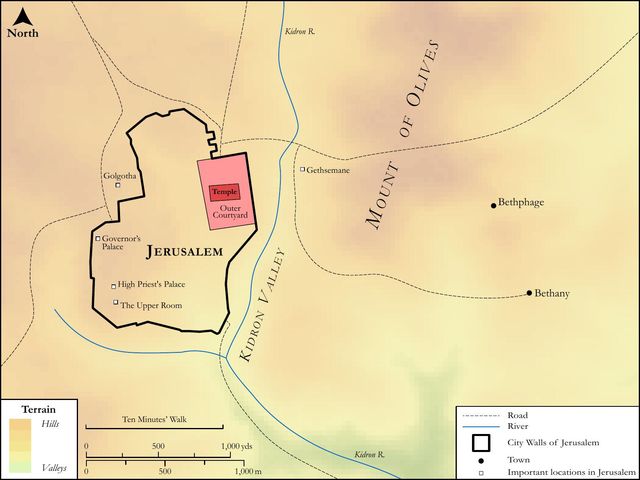
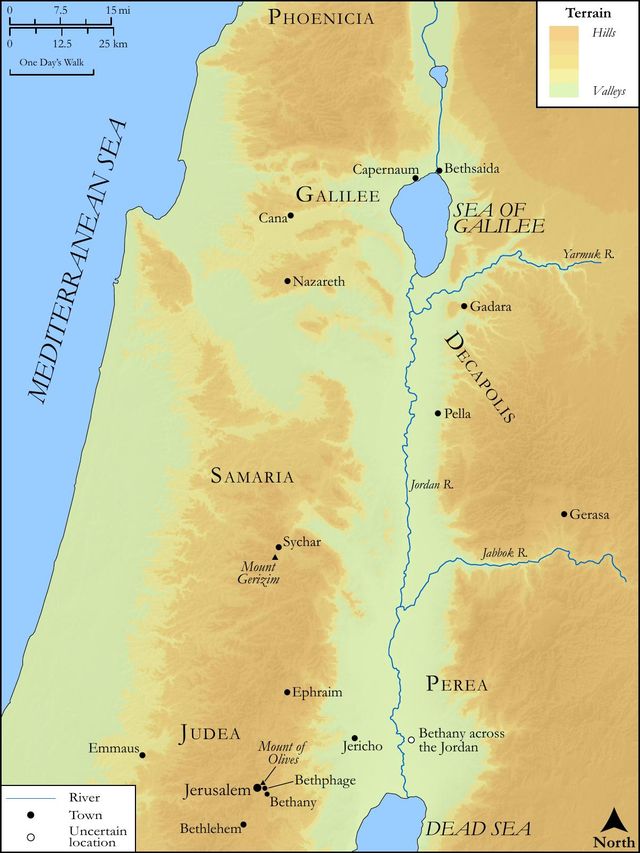
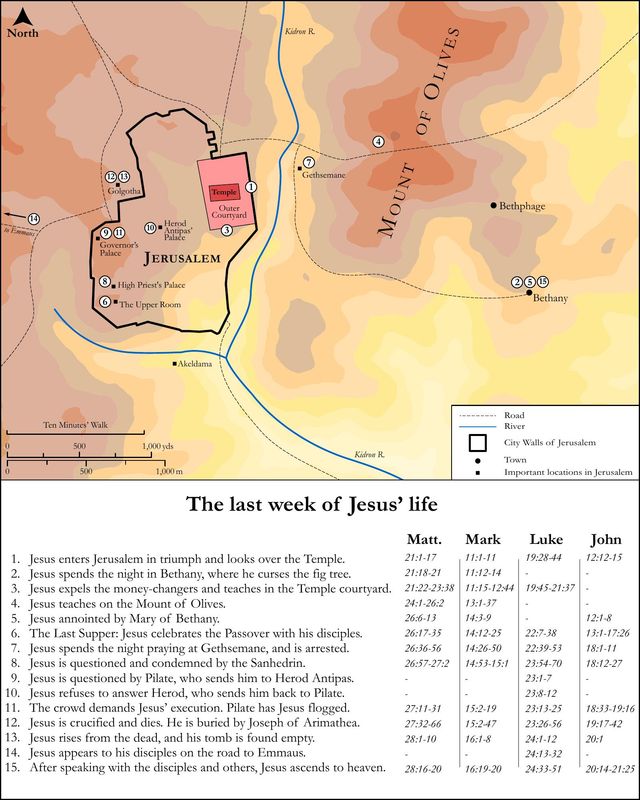
See on the biblical-era map
Study this verse
Public-domain commentary
Matthew Henry
From his Commentary on the Whole Bible. Henry comments on passages, not single verses — this entry covers John 16:7–15. His four-level outline is real structure in the source text, so it is rendered as structure.
As it was usual with the Old Testament prophets to comfort the church in its calamities with the promise of the Messiah (Isa 9:6; Mic 5:6; Zac 3:8); so, the Messiah being come, the promise of the Spirit was the great cordial, and is still.
Three things we have here concerning the Comforter's coming: -
I.That Christ's departure was absolutely necessary to the Comforter's coming, Joh 16:7.
The disciples were so loth to believe this that Christ saw cause to assert it with a more than ordinary solemnity: I tell you the truth. We may be confident of the truth of everything that Christ told us; he has no design to impose upon us. Now, to make them easy, he here tells them,
1.In general, It was expedient for them that he should go away. This was strange doctrine, but if it was true it was comfortable enough, and showed them how absurd their sorrow was. It is expedient, not only for me, but for you also, that I go away; though they did not see it, and are loth to believe it, so it is. Note,
(1.)Those things often seem grievous to us that are really expedient for us; and particularly our going away when we have finished our course.
(2.)Our Lord Jesus is always for that which is most expedient for us, whether we think so or no. He deals not with us according to the folly of our own choice, but graciously over-rules it, and gives us the physic we are loth to take, because he knows it is good for us.
2.It was therefore expedient because it was in order to the sending of the Spirit. Now observe,
(1.)That Christ's going was in order to the Comforter's coming.
[1.]This is expressed negatively: If I go not away, the Comforter will not come. And why not? First, So it was settled in the divine counsels concerning this affair, and the measure must not be altered; shall the earth be forsaken for them? He that gives freely may recall one gift before he bestows another, while we would fondly hold all. Secondly, It is congruous enough that the ambassador extraordinary should be recalled, before the envoy come, that is constantly to reside. Thirdly, The sending of the Spirit was to be the fruit of Christ's purchase, and that purchase was to be made by his death, which was his going away. Fourthly, It was to be an answer to his intercession within the veil. See Joh 14:16. Thus must this gift be both paid for, and prayed for, by our Lord Jesus, that we might learn to put the greater value upon it. Fifthly, The great argument the Spirit was to use in convincing the world must be Christ's ascension into heaven, and his welcome here. See Joh 16:10, and Joh 7:39. Lastly, The disciples must be weaned from his bodily presence, which they were too apt to dote upon, before they were duly prepared to receive the spiritual aids and comforts of a new dispensation.
[2.]It is expressed positively: If I depart I will send him to you; as though he had said, "Trust me to provide effectually that you shall be no loser by my departure." The glorified Redeemer is not unmindful of his church on earth, nor will ever leave it without its necessary supports. Though he departs, he sends the Comforter, nay, he departs on purpose to send him. Thus still, though one generation of ministers and Christians depart, another is raised up in their room, for Christ will maintain his own cause.
(2.)That the presence of Christ's Spirit in his church is so much better, and more desirable, than his bodily presence, that it was really expedient for us that he should go away, to send the Comforter. His corporal presence could be put in one place at one time, but his Spirit is every where, in all places, at all times, wherever two or three are gathered in his name. Christ's bodily presence draws men's eyes, his Spirit draws their hearts; that was the letter which kills, his Spirit gives life.
II.That the coming of the Spirit was absolutely necessary to the carrying on of Christ's interests on earth (Joh 16:8):
And when he is come, elthōn ekeinos. He that is sent is willing of himself to come, and at his first coming he will do this, he will reprove, or, as the margin reads it, he will convince the world, by your ministry, concerning sin, righteousness, and judgment.
1.See here what the office of the Spirit is, and on what errand he is sent.
(1.)To reprove. The Spirit, by the word and conscience, is a reprover; ministers are reprovers by office, and by them the Spirit reproves.
(2.)To convince. It is a law-term, and speaks the office of the judge in summing up the evidence, and setting a matter that has been long canvassed in a clear and true light. He shall convince, that is, "He shall put to silence the adversaries of Christ and his cause, by discovering and demonstrating the falsehood and fallacy of that which they have maintained, and the truth and certainty of that which they have opposed." Note, Convincing work is the Spirit's work; he can do it effectually, and none but he; man may open the cause, but it is the Spirit only that can open the heart. The Spirit is called the Comforter (Joh 16:7), and here it is said, He shall convince. One would think this were cold comfort, but it is the method the Spirit takes, first to convince, and then to comfort; first to lay open the wound, and then to apply healing medicines. Or, taking conviction more generally, for a demonstration of what is right, it intimates that the Spirit's comforts are solid, and grounded upon truth.
2.See who they are whom he is to reprove and convince: The world, both Jew and Gentile.
(1.)He shall give the world the most powerful means of conviction, for the apostles shall go into all the world, backed by the Spirit, to preach the gospel, fully proved.
(2.)He shall sufficiently provide for the taking off and silencing of the objections and prejudices of the world against the gospel. Many an infidel was convinced of all and judged of all, Co1 14:24.
(3.)He shall effectually and savingly convince many in the world, some in every age, in every place, in order to their conversion to the faith of Christ. Now this was an encouragement to the disciples, in reference to the difficulties they were likely to meet with,
[1.]That they should see good done, Satan's kingdom fall like lightning, which would be their joy, as it was his. Even this malignant world the Spirit shall work upon; and the conviction of sinners is the comfort of faithful ministers.
[2.]That this would be the fruit of their services and sufferings, these should contribute very much to this good work.
3.See what the Spirit shall convince the world of.
(1.)Of sin (Joh 16:9), because they believe not on me.
[1.]The Spirit is sent to convince sinners of sin, not barely to tell them of it; in conviction there is more than this; it is to prove it upon them, and force them to own it, as they (Joh 8:9) that were convicted of their own consciences. Make them to know their abominations. The Spirit convinces of the fact of sin, that we have done so and so; of the fault of sin, that we have done ill in doing so; of the folly of sin, that we have acted against right reason, and our true interest; of the filth of sin, that by it we are become odious to God; of the fountain of sin, the corrupt nature; and lastly, of the fruit of sin, that the end thereof is death. The Spirit demonstrates the depravity and degeneracy of the whole world, that all the world is guilty before God.
[2.]The Spirit, in conviction, fastens especially upon the sin of unbelief, their not believing in Christ, First, As the great reigning sin. There was, and is, a world of people, that believe not in Jesus Christ, and they are not sensible that it is their sin. Natural conscience tells them that murder and theft are sin; but it is a supernatural work of the spirit to convince them that it is a sin to suspend their belief of the gospel, and to reject the salvation offered by it. Natural religion, after it has given us its best discoveries and directions, lays and leaves us under this further obligation, that whatever divine revelation shall be made to us at any time, with sufficient evidence to prove it divine, we accept it, and submit to it. This law those transgress who, when God speaketh to us by his Son, refuse him that speaketh; and therefore it is sin. Secondly, As the great ruining sin. Every sin is so in its own nature; no sin is so to them that believe in Christ; so that it is unbelief that damns sinners. It is because of this that they cannot enter into rest, that they cannot escape the wrath of God; it is a sin against the remedy. Thirdly, As that which is at the bottom of all sin; so Calvin takes it. The Spirit shall convince the world that the true reason why sin reigns among them is because they are not by faith united to Christ. Ne putimus vel guttam unam rectitudinis sine Christo nobis inesse - Let us not suppose that, apart from Christ, we have a drop of rectitude. - Calvin.
(2.)Of righteousness, because I go to my Father, and you see me no more, Joh 16:10. We may understand this,
[1.]Of Christ's personal righteousness. He shall convince the world that Jesus of Nazareth was Christ the righteous (Jo1 2:1), as the centurion owned (Luk 23:47), Certainly this was a righteous man. His enemies put him under the worst of characters, and multitudes were not or would not be convinced but that he was a bad man, which strengthened their prejudices against his doctrine; but he is justified by the spirit (Ti1 3:16), he is proved to be a righteous man, and not, a deceiver; and then the point is in effect gained; for he is either the great Redeemer or a great cheat; but a cheat we are sure he is not. Now by what medium or argument will the Spirit convince men of the sincerity of the Lord Jesus? Why, First, Their seeing him no more will contribute something towards the removal of their prejudices; they shall see him no more in the likeness of sinful flesh, in the form of a servant, which made them slight him. Moses was more respected after his removal than before. But, Secondly, His going to the Father would be a full conviction of it. The coming of the Spirit, according to the promise, was a proof of Christ's exaltation to God's right hand (Act 2:33), and this was a demonstration of his righteousness; for the holy God would never set a deceiver at his right hand.
[2.]Of Christ's righteousness communicated to us for our justification and salvation; that everlasting righteousness which Messiah was to bring in, Dan 9:24. Now, First, The Spirit shall convince men of this righteousness. Having by convictions of sin shown them their need of a righteousness, lest this should drive them to despair he will show them where it is to be had, and how they may, upon their believing, be acquitted from guilt, and accepted as righteous in God's sight. It was hard to convince those of this righteousness that went about to establish their own (Rom 10:3), but the Spirit will do it. Secondly, Christ's ascension is the great argument proper to convince men of this righteousness: I go to the Father, and, as an evidence of my welcome with him, you shall see me no more. If Christ had left any part of his undertaking unfinished, he had been sent back again; but now that we are sure he is at the right hand of God, we are sure of being justified through him.
(3.)Of judgment, because the prince of this world is judged, Joh 16:11. Observe here,
[1.]The devil, the prince of this world, was judged, was discovered to be a great deceiver and destroyer, and as such judgment was entered against him, and execution in part done. He was cast out of the Gentile world when his oracles were silenced and his altars deserted, cast out of the bodies of many in Christ's name, which miraculous power continued long in the church; he was cast out of the souls of people by the grace of God working with the gospel of Christ; he fell as lightning from heaven.
[2.]This is a good argument wherewith the Spirit convinces the world of judgment, that is, First, Of inherent holiness and sanctification, Mat 12:18. By the judgment of the prince of this world, it appears that Christ is stronger than Satan, and can disarm and dispossess him, and set up his throne upon the ruin of his. Secondly, Of a new and better dispensation of things. He shall show that Christ's errand into the world was to set things to right in it, and to introduce times of reformation and regeneration; and he proves it by this, that the prince of this world, the great master of misrule, is judged and expelled. All will be well when his power is broken who made the mischief. Thirdly, Of the power and dominion of the Lord Jesus. He shall convince the world that all judgment is committed to him, and that he is the Lord of all, which is evident by this, that he has judged the prince of this world, has broken the serpent's head, destroyed him that had the power of death, and spoiled principalities; if Satan be thus subdued by Christ, we may be sure no other power can stand before him. Fourthly, Of the final day of judgment: all the obstinate enemies of Christ's gospel and kingdom shall certainly be reckoned with at last, for the devil, their ringleader, is judged.
III.That the coming of the Spirit would be of unspeakable advantage to the disciples themselves.
The Spirit has work to do, not only on the enemies of Christ, to convince and humble them, but upon his servants and agents, to instruct and comfort them; and therefore it was expedient for them that he should go away.
1.He intimates to them the tender sense he had of their present weakness (Joh 16:12): I have yet many things to say unto you (not which should have been said, but which he could and would have said), but you cannot bear them now. See what a teacher Christ is.
(1.)None like him for copiousness; when he has said much, he has still many things more to say; treasures of wisdom and knowledge are hid in him, if we be not straitened in ourselves.
(2.)None like him for compassion; he would have told them more of the things pertaining to the kingdom of God, particularly of the rejection of the Jews and the calling of the Gentiles, but they could not bear it, it would have confounded and stumbled them, rather than have given them any satisfaction. When, after his resurrection, they spoke to him of restoring the kingdom to Israel, he referred them to the coming of the Holy Ghost, by which they should receive power to bear those discoveries which were so contrary to the notions they had received that they could not bear them now.
2.He assures them of sufficient assistances, by the pouring out of the Spirit. They were now conscious to themselves of great dulness, and many mistakes; and what shall they do now their master is leaving them? "But when he, the Spirit of Truth, is come, you will be easy, and all will be well." Well indeed; for he shall undertake to guide the apostles, and glorify Christ.
(1.)To guide the apostles. He will take care,
[1.]That they do not miss their way: He will guide you; as the camp of Israel was guided through the wilderness by the pillar of cloud and fire. The Spirit guided their tongues in speaking, and their pens in writing, to secure them from mistakes. The Spirit is given us to be our guide (Rom 8:14), not only to show us the way, but to go along with us, by his continued aids and influences.
[2.]That they do not come short of their end: He will guide them into all truth, as the skilful pilot guides the ship into the port it is bound for. To be led into a truth is more than barely to know it; it is to be intimately and experimentally acquainted with it; to be piously and strongly affected with it; not only to have the notion of it in our heads, but the relish and savour and power of it in our hearts; it denotes a gradual discovery of truth shining more and more: "He shall lead you by those truths that are plain and easy to those that are more difficult." But how into all truth? The meaning is,
First, Into the whole truth relating to their embassy; whatever was needful or useful for them to know, in order to the due discharge of their office, they should be fully instructed in it; what truths they were to teach others the Spirit would teach them, would give them the understanding of, and enable them both to explain and to defend.
Secondly, Into nothing but the truth. All that he shall guide you into shall be truth (Jo1 2:27); the anointing is truth. In the following words he proves both these: - 1. "The Spirit shall teach nothing but the truth, for he shall not speak of himself any doctrine distinct from mine, but whatsoever he shall hear, and knows to be the mind of the Father, that, and that only, shall he speak." This intimates, (1.) That the testimony of the Spirit, in the word and by the apostles, is what we may rely upon. The Spirit knows and searches all things, even the deep things of God, and the apostles received that Spirit (Co1 2:10, Co1 2:11), so that we may venture our souls upon the Spirit's word. (2.) That the testimony of the Spirit always concurs with the word of Christ, for he does not speak of himself, has no separate interest or intention of his own, but, as in essence so in records, he is one with the Father and the Son, Jo1 5:7. Men's word and spirit often disagree, but the eternal Word and the eternal Spirit never do. 2. "He shall teach you all truth, and keep back nothing that is profitable for you, for he will show you things to come." The Spirit was in the apostles a Spirit of prophecy; it was foretold that he should be so (Joe 2:28), and he was so. The Spirit showed them things to come, as Act 11:28; Act 20:23; Act 21:11. The Spirit spoke of the apostasy of the latter times, Ti1 4:1. John, when he was in the Spirit had things to come shown him in vision. Now this was a great satisfaction to their own minds, and of use to them in their conduct, and was also a great confirmation of their mission. Jansenius has a pious note upon this: We should not grudge that the Spirit does not show us things to come in this world, as he did to the apostles; let it suffice that the Spirit in the word hath shown us things to come in the other world, which are our chief concern.
(2.)The Spirit undertook to glorify Christ, Joh 16:14, Joh 16:15.
[1.]Even the sending of the Spirit was the glorifying of Christ. God the Father glorified him in heaven, and the Spirit glorified him on earth. It was the honour of the Redeemer that the Spirit was both sent in his name and sent on his errand, to carry on and perfect his undertaking. All the gifts and graces of the Spirit, all the preaching and all the writing of the apostles, under the influence of the Spirit, the tongues, and miracles, were to glorify Christ.
[2.]The Spirit glorified Christ by leading his followers into the truth as it is in Jesus, Eph 4:21. He assures them, First, that the Spirit should communicate the things of Christ to them: He shall receive of mine, and shall show it unto you. As in essence he proceeded from the Son, so in influence and operation he derived from him. He shall take ek tou emou - of that which is mine. All that the Spirit shows us, that is, applies to us, for our instruction and comfort, all that he gives us for our strength and quickening, and all that he secures and seals to us, did all belong to Christ, and was had and received from him. All was his, for he bought it, and paid dearly for it, and therefore he had reason to call it his own; his, for he first received it; it was given him as the head of the church, to be communicated by him to all his members. The Spirit came not to erect a new kingdom, but to advance and establish the same kingdom that Christ had erected, to maintain the same interest and pursue the same design; those therefore that pretend to the Spirit, and vilify Christ, give themselves the lie, for he came to glorify Christ. Secondly, That herein the things of God should be communicated to us. Lest any should think that the receiving of this would not make them much the richer, he adds, All things that the Father hath are mine. As God, all that self-existent light and self-sufficient happiness which the Father has, he has; as Mediator, all things are delivered to him of the Father (Mat 11:27); all that grace and truth which God designed to show us he lodged in the hands of the Lord Jesus, Col 1:19. Spiritual blessings in heavenly things are given by the Father to the Son for us, and the Son entrusts the Spirit to convey them to us. Some apply it to that which goes just before: He shall show you things to come, and so it is explained by Rev 1:1. God gave it to Christ, and he signified it to John, who wrote what the Spirit said, Rev 1:1.
Historical interpretation
Two Centuries of Reception
8 surviving comments on this verse. Each one is dated, so this reads as a timeline rather than a list.
Select a marker to jump to its quote. Markers stagger vertically where authors wrote within a few decades of each other.
And as for the Father's names, God Almighty, the Most High, the Lord of hosts, the King of Israel, the "One that is," we say (for so much do the Scriptures teach us) that they belonged suitably to the Son also, and that the Son came under these designations, and has always acted in them, and has thus manifested them in Himself to men. "All things," says He, "which the Father hath are mine." Then why not His names also? When, therefore, you read of Almighty God, and the Most High, and the God of hosts, and the King of Israel the "One that is," consider whether the Son also be not indicated by these designations, who in His own right is God Almighty, in that He is the Word of Almighty God, and has received power over all; is the Most High, in that He is "exalted at the right hand of God," as Peter declares in the Acts; is the Lord of hosts, because all things are by the Father made subject to Him; is the King of Israel because to Him has especially been committed the destiny of that nation; and is likewise "the One that is," because there are many who are called Sons, but are not.
All things that the Father has are the Son’s. And … all that belongs to the Son is the Father’s. Nothing then is peculiar [to any person] because all things are in common. For their being itself is common and equal, even though the Son receives it from the Father.
(ut sup.) As if He said, Although the Spirit of truth proceeds from the Father, yet all things that the Father hath are Mine, and even the Spirit of the Father is Mine, and receiveth of Mine. But beware, when thou hearest this, that thou think not it is a thing or possession which the Father and the Son have. That which the Father hath according to His substance, i. e. His eternity, immutability, goodness, it is this which the Son hath also. Away with the cavils of logicians, who say, therefore the Father is the Son. Had He said indeed, All that God hath are Mine, impiety might have taken occasion to raise its head; but when He saith, All things that the Father hath are Mine, by using the name of the Father, He declareth Himself the Son, and being the Son, He usurpeth not the Paternity, though by the grace of adoption He is the Father of many saints.
As if he said, Although the Spirit of truth proceeds from the Father, yet all things that the Father has are mine, and even the Spirit of the Father is mine and receives of mine. But beware, when you hear this, that you do not think it is a thing or possession that the Father and the Son have. That which the Father has according to his substance, that is, his eternity, immutability, goodness, the Son has also. Away with the cavils of logicians who say, Therefore the Father is the Son. If he had indeed said, "All that God has are mine," impiety might have taken occasion to raise its head. But when he said, "All things that the Father has are mine," by using the name of the Father, he declares himself the Son, and being the Son, he does not usurp the paternity, though by the grace of adoption he is the Father of many saints.
But when He says, "He shall receive of mine, and shall show it unto you," listen thereto with Catholic ears, and receive it with Catholic minds. For not surely on that account, as certain heretics have imagined, is the Holy Spirit inferior to the Son; as if the Son received from the Father, and the Holy Spirit from the Son, in reference to certain gradations of natures. Far be it from us to believe this, or to say it, and from Christian hearts to think it. In fine, He Himself straightway solved the question, and explained why He said so. "All things that the Father hath are mine: therefore, said I, that He shall take of mine, and shall show it unto you." What would you more? The Holy Spirit thus receives of the Father, of whom the Son receives; for in this Trinity the Son is born of the Father, and from the Father the Holy Spirit proceedeth. He, however, who is born of none, and proceedeth from none, is the Father alone.
But in what sense it is that the only-begotten Son said, "All things that the Father hath are mine" (for it certainly was not in the same sense as when it was said to that son, who was not only begotten, but the elder of two, "Thou art ever with me; and all that I have is thine,") will have our careful consideration, if the Lord so will, in connection with the passage where the Only-begotten saith to the Father, "And all mine are Thine, and Thine are mine;" so that our present discourse may be here brought to a close, as the words that follow require a different opening for their discussion.
(Tr. c) But it is not true, as some heretics have thought, that because the Son receives from the Father, the Holy Ghost from the Son, as if by gradation, that therefore the Holy Ghost is inferior to the Son. He Himself solves this difficulty, and explains His own words: All things that the Father hath are Mine: therefore said I, that He shall take of Mine, and shall show it unto you.
CHAPTER II. That His Spirit, that is, the Holy Spirit, is naturally in the Son and in His Substance, as He is also in the Substance of the Father.
The Son once more shows to us herein the complete and perfect character of the Person of the Father Himself also, and allows us to see why He said that He, being the fruit of the Father's Substance, engrosses in Himself all that belongs to It, and says that It is all His own, and with reason. For, as there is nothing to dissever or estrange the Son from the Father, so far as their complete similarity and equality is concerned, save only that He is not Himself the Father, and as the Divine Substance does not show Itself differently in the Two Persons, surely Their attributes are common, or rather identical; so that what the Father hath is the Son's, and what He That begat hath, belongs also to Him that is begotten of Him. For this reason, I think, in His watchful care over us, He has thus spoken to us concerning this. For He did not say, All things whatsoever the Father hath I have also, in order to prevent our imagining He meant a mere likeness founded on similarity, only moulded by adventitious graces into conformity with the Archetype, as is the case with us; for we are after God's likeness. Rather, when He says, All things whatsoever the Father hath are Mine, He illustrates hereby the perfect union which He hath with His Father, and the meaning of their Consubstantiality existing in unchangeable attributes. And this you may see, that He clearly says elsewhere, when addressing the Father, All things that are Mine are Thine, and Thine are Mine. For surely they are identical in nature, in whom there is no severance at all, but complete and perfect essential equality and likeness. God the Father then hath, of Himself, and in Himself, His own Spirit; that is, the Holy Spirit, through Whom He dwelleth in the Saints, and reveals His mysteries to them; not as though the Spirit were called to perform a merely ministerial function (do not think this), but rather, as He is in Him essentially, and proceeds from Him inseparably and indivisibly, interpreting what is in reality His own when He interprets that which belongs to Him in Whom He exists, and from Whom He springs. For God only has union with the creation through His Son in the Spirit. And this Spirit is also an attribute of the Only-begotten, for He is Consubstantial with the Father.
Since then, He says, it is seen to be natural to God the Father to reveal Himself in His own Spirit to those who are worthy of Him, and to accomplish through Him all His purposes, and since this kind of action belongs to Me also, for this cause I said, "He receiveth of Me and will show it unto you." And let no man be perplexed when he here hears the word "receiveth," but rather let him consider the following fact, and he will do well. The things of God are spoken of in language as though God were even as we are; but this is not really the case, for His ways are superhuman. We say then that the Spirit receives of the Father and the Son the things that are Theirs in the following way; not as though at one moment He were devoid of the knowledge and power inherent in Them, and at the next hardly acquires such knowledge and power when He is conceived of as receiving from Them. For the Spirit is wise and powerful, nay, rather, absolute Wisdom and Power, not by participation in anything else, but by His own Nature. But, rather, just as we should say that the fragrance of sweet-smelling herbs which assails our nostrils is distinct from the herbs so far as their conception in thought is concerned, but proceeds from the herbs in which it originates only by being a recipient of their faculty of giving scent in order to its display, and is not in fact distinct from them, because its existence is due to, and is wrapped up in, them; even such an idea, or rather one transcending this, must you imagine about the relation of God to the Holy Spirit. For He is, as it were, a sweet savour of His Substance, working plainly on the senses, conveying to the creature an effluence from God, and instilling in him through Itself participation in the Sovereign Substance of the Universe. For if the fragrance of sweet herbs imparts some of its power to garments with which it comes in contact, and in some sort transforms its surroundings into likeness with itself, surely the Holy Ghost has power, since He [is by nature of God, to make those in whom He abides partakers in the Divine Nature through Himself. The Son then, being the Fruit and express Image of the Father's Person by nature, engrosses all that is His. And therefore He says, All things whatsoever the Father hath are Mine: therefore said I unto you, that He taketh of Mine and shall declare it unto you----the Spirit, that is, Who is through Him and in Him, by Whom He personally dwells in the Saints. For His Spirit is not distinct from Him, even though He may be conceived of as having a separate and independent existence: for the Spirit is Spirit, and not the Son.
Continue studying John 16:15 across the web’s major study libraries — every link below opens this exact verse, chapter, or book on the destination site.
Read & Compare
 BibleGatewayThis verse in more than 200 translations and 70 languages.
 Bible.comThe YouVersion reader — hundreds of translations, reading plans, and highlights.
 ESV.orgCrossway's official English Standard Version reader.
 NET BibleThe NET translation with 60,000+ translators' notes on every rendering decision.
 STEP BibleTyndale House's free study tool — original text, vocabulary, and scholarly resources.
 BibliaLogos Bible Software's free web reader.
 USCCBThe New American Bible (Revised Edition) with the U.S. bishops' study notes.
Commentaries
 BibleHub CommentariesDozens of classic commentaries on this verse, gathered on one page.
 StudyLightMore than 100 commentary sets — the largest collection on the web.
 BibleRefPlain-English commentary on what this verse means, verse by verse.
 Enduring WordDavid Guzik's free commentary on this chapter, widely used by Bible teachers.
 Bible Study ToolsVerse commentary alongside Greek and Hebrew study aids.
Original Language & Research
- BibleHub InterlinearThe verse word by word — original language, transliteration, and English.
- BibleHub LexiconEvery word's original-language definition and Strong's entry.
 Blue Letter BibleDeep-study tools — Strong's numbers, concordance, and word studies.
 CNTR CollationThe earliest Greek manuscripts of this verse, collated letter by letter.
Sermons, Hymns & Audio


TrulyRandomVerse is not affiliated with these sites and doesn’t control their content. They’re linked because they’re genuinely useful.
Summary
John 16:15 is a profound declaration by Jesus, asserting His co-equality and intrinsic unity with God the Father, stating that "All things that the Father hath are mine." This foundational truth then undergirds the promise that the Holy Spirit, upon His arrival, will draw from this shared divine treasury—that which belongs to Christ—and reveal it to the disciples, thereby illuminating the deep truths of God and Christ's redemptive work to believers.
Context
ShowHideLiterary Context
John 16:15 is situated within Jesus' extensive Farewell Discourse, spanning chapters John 13-17. Delivered in the Upper Room on the eve of His crucifixion, this discourse serves as Jesus' final, intimate teaching to His disciples before His physical departure. He prepares them for the challenges ahead, offers comfort, and, crucially, promises the coming of the Holy Spirit. This particular verse builds upon earlier promises regarding the Spirit's role as a Helper and Teacher (John 14:26), and the Spirit of Truth who testifies about Jesus (John 15:26). In John 16:7-14, Jesus details the Spirit's work of convicting the world and guiding believers into all truth. Verse 15 then clarifies the source of the Spirit's revelation, emphasizing the perfect unity and shared possession between the Father and the Son, from which the Spirit draws.
Historical & Cultural Context
For Jesus' Jewish disciples, the concept of God was strictly monotheistic, encapsulated in the Shema: "Hear, O Israel: The LORD our God is one LORD" (Deuteronomy 6:4). Jesus' repeated claims to divine authority, equality with the Father, and pre-existence would have been revolutionary, even scandalous, to many of His contemporaries. His declaration in John 16:15, "All things that the Father hath are mine," is a profound assertion of His deity, placing Him on par with Yahweh. The disciples, steeped in this monotheistic tradition, struggled to fully grasp the Trinitarian nature of God—Father, Son, and Holy Spirit—as distinct persons yet one God. The promise of the Holy Spirit's illumination was therefore critical for them to comprehend these deep theological truths, especially after Jesus' physical absence.
Key Themes
ShowHideJohn 16:15 contributes significantly to several major theological themes within the Gospel of John. Firstly, it powerfully underscores the Divine Unity and Equality of the Father and the Son. Jesus' declaration that "All things that the Father hath are mine" is a direct assertion of His co-equality and shared essence with God the Father, highlighting His divine nature and inherent right to all attributes, power, and glory belonging to the Father, a concept central to understanding the oneness of the Father and the Son. Secondly, the verse clearly reveals the Holy Spirit's Illuminating Ministry. The Spirit "shall take of mine, and shall shew it unto you," meaning the Spirit does not speak independently but draws from the inexhaustible treasury of Christ's (and thus the Father's) truth, making it understandable and applicable to believers. This promise assures the disciples (and all future believers) that they would not be left without guidance and revelation after Jesus' physical departure, as the Spirit will guide them into all truth. Finally, the passage emphasizes the Revelation of Christ's Truth as the ultimate purpose of the Spirit's work, which is to glorify Christ and make His person, work, and teachings known, providing deeper insight into His character and redemptive plan.
Exposition and Analysis
ShowHideKey Word Analysis
ShowHideThis verb (G2192) signifies possession, ownership, or holding. In this context, it underscores Jesus' inherent right to all that belongs to the Father, not as a derived gift or delegated authority, but as an intrinsic, shared reality of their divine essence. It speaks to the comprehensive nature of the Father's possessions being equally the Son's.
This possessive pronoun (G1699) directly translates to "my" or "mine." Its use here emphasizes the personal and rightful ownership of Jesus over all that belongs to the Father. It highlights the profound and intimate relationship between the Father and the Son, where there is no division of essence or property.
This verb (G312) means "to announce (in detail)," "to declare," or "to report." It implies a clear, authoritative, and comprehensive disclosure. The Holy Spirit's role is not merely to hint at truth but to make divine realities understandable, known, and accessible to believers, providing detailed insight and revelation.
Verse Breakdown
ShowHide"All things that the Father hath are mine"
This opening clause is a profound declaration of Jesus' divine nature and co-equality with God the Father. It asserts that there is no attribute, power, glory, or possession belonging to the Father that does not equally belong to the Son. This is a claim of absolute identity in essence and authority within the Godhead, foundational to Trinitarian theology.
"therefore said I"
This phrase serves as a logical connector, indicating that the subsequent statement is a direct consequence or explanation stemming from the preceding declaration of divine unity and shared possession. Because the Father's possessions are also the Son's, the Spirit's ministry of revelation is possible and necessary.
"that he shall take of mine, and shall shew [it] unto you"
This clause reveals the specific ministry of the Holy Spirit. The Spirit's revelation is not independent but is sourced directly from Christ ("of mine"). This "taking" implies drawing from the inexhaustible treasury of Christ's person, work, and teachings. The Spirit then "shews" or makes these truths known to the disciples (and by extension, to all believers), illuminating their understanding and enabling them to grasp the profound realities of God's redemptive plan revealed in Christ.
Literary Devices
ShowHideJohn 16:15 employs several literary devices to convey its profound theological truths. The primary device is Assertion/Declaration, as Jesus makes a direct and unequivocal statement about His divine nature and shared essence with the Father. This is not a suggestion or a question, but a definitive pronouncement. There is also an element of Metonymy in the phrase "take of mine," where "mine" stands for the truths, teachings, glory, and very person of Christ. The abstract concept of "what belongs to Christ" is represented by the possessive pronoun. Furthermore, the Holy Spirit is presented with clear Personification, described as an active agent who "takes" and "shows." This highlights the distinct personhood of the Spirit and His active, intentional ministry in revealing divine truth, rather than being an impersonal force.
Theological and Thematic Connections
ShowHideJohn 16:15 stands as a cornerstone for understanding the intricate relationship within the Godhead and the mechanism of divine revelation. It unequivocally affirms the full deity of Jesus Christ, asserting His co-equality and shared essence with the Father. This declaration is not merely a statement of status but the very basis for the Holy Spirit's ministry: because everything the Father possesses is also the Son's, the Spirit can draw from this infinite wellspring of divine truth and reveal it to humanity. This verse beautifully illustrates the Trinitarian harmony in salvation and sanctification, where the Father gives all to the Son, and the Spirit then illuminates the Son to believers, ensuring that true knowledge of God is always Christ-centered and Spirit-revealed.
Reflection and Application
ShowHideJohn 16:15 offers profound comfort and assurance to believers across all ages, affirming the deep interconnectedness and unity of the Trinity in the work of salvation and revelation. For us today, this verse means that we have direct access to divine truth and understanding through the Holy Spirit, who continually reveals Christ to us. Our knowledge of God is not based on mere human speculation or intellect but on the Spirit's supernatural illumination of Christ's words and works. It encourages us to rely on the Holy Spirit for spiritual insight, guidance, and wisdom, knowing that He draws directly from the boundless wisdom and authority of Christ and the Father. This understanding deepens our appreciation for the triune God and strengthens our faith, knowing that the Spirit is ever at work to make Christ real and present in our lives, guiding us into a deeper relationship with God.
Questions for Reflection
ShowHideFAQ
ShowHideDoes this verse imply that the Holy Spirit is subordinate to Jesus?
ShowHideNo, this verse does not imply the Holy Spirit is subordinate to Jesus in essence or deity. Instead, it highlights the distinct yet harmonious roles within the Trinity. The Holy Spirit's ministry is characterized by glorifying Christ and revealing His truth, as Jesus Himself states in John 16:14: "He shall glorify me: for he shall receive of mine, and shall shew it unto you." This "receiving" or "taking" from Christ is not a sign of inferiority but of perfect unity and a voluntary, functional distinction. The Spirit does not speak on His own authority, but reveals what is already true of the Father and the Son, ensuring that the divine message is consistent and unified. The Spirit's work is to point to Christ, just as Christ's work was to reveal the Father, demonstrating the perfect, selfless love and cooperation within the Godhead.
Christ-Centered Fulfillment
ShowHideJohn 16:15 finds its ultimate Christ-centered fulfillment in the ongoing ministry of the Holy Spirit, who makes the person and work of Jesus Christ real and accessible to believers across all generations. The "things of mine" that the Spirit takes and reveals are not abstract concepts but the very essence of Christ's redemptive mission: His incarnation as God in human flesh (John 1:14), His sinless life, His atoning death on the cross for the sins of humanity (Romans 5:8), His glorious resurrection (1 Corinthians 15:3-4), and His ascension to the Father's right hand (Acts 1:9-11). The Spirit illuminates these truths, convicting hearts of sin, righteousness, and judgment (John 16:8), drawing individuals to faith in Christ, and empowering them to live in conformity to His image (Romans 8:29). Through the Spirit, believers truly know Christ, not merely as a historical figure, but as a living Lord, enabling them to bear witness to Him with power (Acts 1:8) and ensuring that Christ's presence and truth remain with His church until His glorious return, fulfilling His promise to not leave His disciples as orphans (John 14:18).