


Ruth 1:22
Bible text: King James Version (1769 Blayney text) · Public domain
Bible text: King James Version with Strong's numbers · Public domain
Bible text: Berean Standard Bible · Public domain
Bible text: American Standard Version (1901) · Public domain
Bible text: World English Bible, Messianic edition · Public domain
Bible text: Geneva Bible (1599) · Public domain
Bible text: Young's Literal Translation · Public domain
- וַתָּשָׁבva·Ta·shovand she returnedH7725Conj-w ¦ V-Qal-ConsecImperf-3fsVerb Qal Consecutive Imperfect 3rd Singular Feminineוַandתָּשָׁבshe returned
- נָעֳמִיno·'o·MiNaomiH5281N-proper-fNoun Proper Feminine
- וְרוּתve·Rutand RuthH7327Conj-w ¦ N-proper-fNoun Proper FeminineוְandרוּתRuth
- הַמּוֹאֲבִיָּהha·mo·'a·vi·Yahthe Moabite [woman]H4125Art ¦ N-fsNoun Gentilic Singular Feminine AbsoluteהַtheמּוֹאֲבִיָּהMoabite [woman]
- כַלָּתָהּkha·la·Tahher daughter-in-lawH3618N-fsc ¦ 3fsNoun Singular Feminine Constructכַלָּתָdaughter-in-lawהּher
- עִמָּהּ'i·Mah[was] with herH5973Prep ¦ 3fsPreposition Definiteעִמָּ[was] withהּher
- הַשָּׁבָהha·Sha·vahwho returnedH7725Art ¦ V-Qal-Perf-3fsVerb Qal Perfect 3rd Singular Feminineהַwhoשָּׁבָהreturned
- מִשְּׂדֵיmi·se·Deifrom [the] region<s> ofH7704Prep-m ¦ N-mpcNoun Plural Masculine Constructמִfromשְּׂדֵי[the] region<s> of
- מוֹאָבmo·'AvMoabH4124N-properNoun Proper Location
- וְהֵמָּהve·He·mahand theyH1992Conj-w ¦ Pro-3mpPronoun Personal 3rd Plural Masculineוְandהֵמָּהthey
- בָּאוּBa·'uthey cameH935V-Qal-Perf-3cpVerb Qal Perfect 3rd Plural common gender
- בֵּיתbeitBeth-H1035N-properNoun Proper Location
- לֶחֶםLe·chem-lehemH1035N-properNoun Proper Location
- בִּתְחִלַּתbit·chi·Latat [the] beginning ofH8462Prep-b ¦ N-fscNoun Singular Feminine Constructבִּatתְחִלַּת[the] beginning of
- קְצִירke·Tzir[the] harvest ofH7105N-mscNoun Singular Masculine Construct
- שְׂעֹרִיםse·'o·Rimbarley<s>H8184N-mpNoun Plural Masculine Absolute
English is a literal word-by-word gloss of the Hebrew, not the KJV's wording. Why?
This is the original text the KJV's translators worked from — each Hebrew word with its own literal English meaning in this verse, prepared by scholars at Tyndale House, Cambridge. The KJV translates whole sentences, not word by word, so its wording differs: one Hebrew word can become several English words, and the KJV may choose “the LORD” where the gloss reads “Yahweh”. Both are faithful — they answer different questions. For the KJV's own rendering, switch to the KJV text.
Details
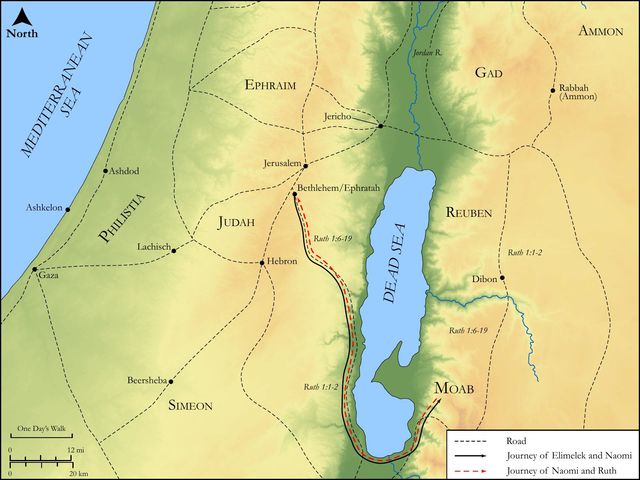
See on the biblical-era map
Study this verse
Public-domain commentary
Matthew Henry
From his Commentary on the Whole Bible. Henry comments on passages, not single verses — this entry covers Ruth 1:19–22. His three-level outline is real structure in the source text, so it is rendered as structure.
Naomi and Ruth, after many a weary step (the fatigue of the journey, we may suppose, being somewhat relieved by the good instructions Naomi gave to her proselyte and the good discourse they had together), came at last to Bethlehem. And they came very seasonably, in the beginning of the barley-harvest, which was the first of their harvests, that of wheat following after. Now Naomi's own eyes might convince her of the truth of what she had heard in the country of Moab, that the Lord had visited his people in giving them bread, and Ruth might see this good land in its best state; and now they had opportunity to provide for winter. Our times are in God's hand, both the events and the time of them. Notice is here taken,
I.Of the discomposure of the neighbours upon this occasion (Rut 1:19):
All the city was moved about them. Her old acquaintance gathered about her, to enquire concerning her state, and to bid her welcome to Bethlehem again. Or perhaps they were moved about her, lest she should be a charge to the town, she looked so bare. By this it appears that she had formerly lived respectably, else there would not have been so much notice taken of her. If those that have been in a high and prosperous condition break, or fall into poverty or disgrace, their fall is the more remarkable. And they said, Is this Naomi? The women of the city said it, for the word is feminine. Those with whom she had formerly been intimate were surprised to see her in this condition; she was so much broken and altered with her afflictions that they could scarcely believe their own eyes, nor think that this was the same person whom they had formerly seen, so fresh, and fair, and gay: Is this Naomi? So unlike is the rose when it is withered to what it was when it was blooming. What a poor figure does Naomi make now, compared with what she made in her prosperity! If any asked this question in contempt, upbraiding her with her miseries ("is this she that could not be content to fare as her neighbours did, but must ramble to a strange country? see what she has got by it!"), their temper was very base and sordid. Nothing more barbarous than to triumph over those that are fallen. But we may suppose that the generality asked it in compassion and commiseration: "Is this she that lived so plentifully, and kept so good a house, and was so charitable to the poor? How has the gold become dim!" Those that had seen the magnificence of the first temple wept when they saw the meanness of the second; so these here. Note, Afflictions will make great and surprising changes in a little time. When we see how sickness and old age alter people, change their countenance and temper, we may think of what the Bethlehemites said: "Is this Naomi? One would not take it to be the same person." God, by his grace, fit us for all such changes, especially the great change!
II.Of the composure of Naomi's spirit.
If some upbraided her with her poverty, she was not moved against them, as she would have been if she had been poor and proud; but, with a great deal of pious patience, bore that and all the other melancholy effects of her affliction (Rut 1:20, Rut 1:21): Call me not Naomi, call me Mara, etc. "Naomi signifies pleasant or amiable; but all my pleasant things are laid waste; call me Mara, bitter or bitterness, for I am now a woman of a sorrowful spirit." Thus does she bring her mind to her condition, which we all ought to do when our condition is not in every thing to our mind. Observe,
1.The change of her state, and how it is described, with a pious regard to the divine providence, and without any passionate murmurings or complaints.
(1.)It was a very sad and melancholy change. She went out full; so she thought herself when she had her husband with her and two sons. Much of the fulness of our comfort in this world arises from agreeable relations. But she now came home again empty, a widow and childless, and probably had sold her goods, and of all the effects she took with her brought home no more than the clothes on her back. So uncertain is all that which we call fulness in the creature, Sa1 2:5. Even in the fulness of that sufficiency we may be in straits. But there is a fulness, a spiritual and divine fulness, which we can never be emptied of, a good part which shall not be taken from those that have it.
(2.)She acknowledges the hand of God, his mighty hand, in the affliction. "It is the Lord that has brought me home again empty; it is the Almighty that has afflicted me." Note, Nothing conduces more to satisfy a gracious soul under an affliction than the consideration of the hand of God in it. It is the Lord, Sa1 3:18; Job 1:21. Especially to consider that he who afflicts us is Shaddai, the Almighty, with whom it is folly to contend and to whom it is our duty and interest to submit. It is that name of God by which he enters into covenant with his people: I am God Almighty, God All-sufficient, Gen 17:1. He afflicts as a God in covenant, and his all-sufficiency may be our support and supply under all our afflictions. He that empties us of the creature knows how to fill us with himself.
(3.)She speaks very feelingly of the impression which the affliction had made upon her: He has dealt very bitterly with me. The cup of affliction is a bitter cup, and even that which afterwards yields the peaceable fruit of righteousness, yet, for the present, is not joyous, but grievous, Heb 12:11. Job complains, Thou writest bitter things against me, Job 13:26.
(4.)She owns the affliction to come from God as a controversy: The Lord hath testified against me. Note, When God corrects us he testifies against us and contends with us (Job 10:17), intimating that he is displeased with us. Every rod has a voice, the voice of a witness.
2.The compliance of her spirit with this change: "Call me not Naomi, for I am no more pleasant, either to myself or to my friends; but call me Mara, a name more agreeable to my present state." Many that are debased and impoverished yet affect to be called by the empty names and titles of honour they have formerly enjoyed. Naomi did not so. Her humility regards not a glorious name in a dejected state. If God deal bitterly with her, she will accommodate herself to the dispensation, and is willing to be called Mara, bitter. Note, It well becomes us to have our hearts humbled under humbling providences. When our condition is brought down our spirits should be brought down with it. And then our troubles are sanctified to us when we thus comport with them; for it is not an affliction itself, but an affliction rightly borne, that does us good. Perdidisti tot mala, si nondum misera esse didicisti - So many calamities have been lost upon you if you have not yet learned how to suffer. Sen. ad Helv. Tribulation works patience.
Continue studying Ruth 1:22 across the web’s major study libraries — every link below opens this exact verse, chapter, or book on the destination site.
Read & Compare
 BibleGatewayThis verse in more than 200 translations and 70 languages.
 Bible.comThe YouVersion reader — hundreds of translations, reading plans, and highlights.
 ESV.orgCrossway's official English Standard Version reader.
 NET BibleThe NET translation with 60,000+ translators' notes on every rendering decision.
 STEP BibleTyndale House's free study tool — original text, vocabulary, and scholarly resources.
 BibliaLogos Bible Software's free web reader.
 USCCBThe New American Bible (Revised Edition) with the U.S. bishops' study notes.
Commentaries
 BibleHub CommentariesDozens of classic commentaries on this verse, gathered on one page.
 StudyLightMore than 100 commentary sets — the largest collection on the web.
 BibleRefPlain-English commentary on what this verse means, verse by verse.
 Enduring WordDavid Guzik's free commentary on this chapter, widely used by Bible teachers.
 Bible Study ToolsVerse commentary alongside Greek and Hebrew study aids.
Original Language & Research
- BibleHub InterlinearThe verse word by word — original language, transliteration, and English.
- BibleHub LexiconEvery word's original-language definition and Strong's entry.
 Blue Letter BibleDeep-study tools — Strong's numbers, concordance, and word studies.
 SefariaThe Hebrew text with Rashi and centuries of Jewish commentary.
Sermons, Hymns & Audio


TrulyRandomVerse is not affiliated with these sites and doesn’t control their content. They’re linked because they’re genuinely useful.
Summary
Ruth 1:22 marks the poignant conclusion of the first chapter, chronicling the significant return of Naomi and her loyal daughter-in-law, Ruth the Moabitess, from the desolate land of Moab to Bethlehem in Judah. This arrival, precisely timed with the commencement of the barley harvest, signifies a crucial turning point in the narrative, shifting the focus from profound loss, displacement, and bitterness to the hopeful prospect of divine provision, restoration, and new beginnings within the promised land.
Context
ShowHideLiterary Context
This verse serves as the narrative hinge concluding the opening chapter of the Book of Ruth, which meticulously establishes the dire circumstances of Naomi's family. The preceding verses detail their migration to Moab due to famine, the tragic deaths of Elimelech and his two sons, Mahlon and Chilion, leaving Naomi, Orpah, and Ruth as widows (Ruth 1:1-5). Naomi's decision to return to Judah upon hearing of God's provision for His people is followed by her earnest, though ultimately unsuccessful, attempt to persuade her daughters-in-law to remain in Moab. It is Ruth's profound and steadfast vow of loyalty that sets the stage for their joint journey back to Bethlehem. Their arrival in Bethlehem is met with the townswomen's recognition, prompting Naomi to express her deep bitterness and lament that the Almighty had dealt very bitterly with her (Ruth 1:19-21). Verse 22 then provides the crucial detail of their arrival coinciding with the barley harvest, which immediately transitions the narrative from the initial sorrow and arduous journey to the potential for new life, provision, and the unfolding of God's redemptive plan in Bethlehem.
Historical & Cultural Context
The events of the Book of Ruth are explicitly set "in the days when the judges ruled" (Ruth 1:1), a period in Israelite history (roughly 1375-1050 BC) characterized by spiritual apostasy, social instability, and recurring cycles of oppression and deliverance. Famine, such as the one that prompted Elimelech's family to leave Bethlehem, was a common challenge, often interpreted as a consequence of national sin or a test of faith. The journey from Moab to Bethlehem, though not exceedingly long, would have been perilous for two women traveling alone, highlighting their vulnerability. Culturally, Moabites were descendants of Lot through an incestuous union (Genesis 19:37) and were often antagonistic towards Israel, having refused them passage and provision during the Exodus and even hiring Balaam to curse them (Deuteronomy 23:3-6). This historical animosity makes Ruth's acceptance into Israelite society, and her eventual inclusion in the Davidic and ultimately messianic lineage, exceptionally remarkable. The "barley harvest" was the earliest harvest of the year in Israel, typically occurring in April/May, signifying a time of renewal and provision after the lean winter months. This timing is critical for the plot, as it facilitates Ruth's gleaning, a practice mandated by Mosaic Law for the poor and sojourners (Leviticus 19:9-10 and Deuteronomy 24:19-22), which directly leads to her encounter with Boaz.
Key Themes
ShowHideRuth 1:22 encapsulates several major themes central to the Book of Ruth. Firstly, Return and Restoration is powerfully evident in Naomi's physical journey back to Bethlehem, a name meaning "house of bread," symbolizing a hopeful return from a place of famine and death (Moab) to the land of promise and potential provision. This journey, despite Naomi's initial bitterness expressed in Ruth 1:20-21, foreshadows a spiritual and material restoration orchestrated by God. Secondly, Unwavering Loyalty and Faith is profoundly demonstrated by Ruth, consistently identified as "the Moabitess." Her steadfast commitment to Naomi, despite the significant cultural and social barriers, reflects a deep devotion that extends beyond familial ties to Naomi's God. Her foreign identity is consistently highlighted, amplifying the significance of her choice and setting the stage for her remarkable integration into Israelite society, a testament to God's inclusive grace. Thirdly, Divine Timing and Providence is underscored by their arrival "in the beginning of barley harvest." This precise agricultural timing is not coincidental but divinely orchestrated, immediately opening doors for Ruth to glean in the fields, a practice that directly leads to her encounter with Boaz and the unfolding of God's redemptive plan for both women and, ultimately, for all of Israel through the lineage of David and Christ. This highlights God's sovereignty working through seemingly ordinary circumstances to accomplish His grand purposes, as seen throughout the book culminating in Ruth 4.
Exposition and Analysis
ShowHideKey Word Analysis
ShowHideThis primitive root signifies a turning back, a reversal of direction, often with implications of repentance, restoration, or a return to a former state. In Ruth 1:22, its repetition (implied by the KJV's "returned" and "which returned") underscores the physical journey back to Judah, marking a definitive break from their past in Moab. Theologically, it hints at a spiritual turning from a land of foreign gods to the land of God's covenant people, symbolizing a movement from emptiness to potential fullness.
This patronymical term specifically identifies Ruth's ethnic origin as a descendant from Moab. Its consistent use throughout the book, including here, highlights her foreign status in Israelite society. In a culture where Moabites were often viewed with suspicion or hostility (e.g., Deuteronomy 23:3), Ruth's inclusion and eventual prominence in the lineage of David underscore God's expansive grace and the breaking down of ethnic barriers, demonstrating His redemptive plan extends beyond national boundaries.
Literally meaning "house of bread," this place name is deeply symbolic in the narrative. Their return to Bethlehem from a land of famine (Moab) at the time of harvest immediately contrasts their past scarcity with the promise of future provision. It is the birthplace of David and, later, of Jesus, making its significance in this story profound as the setting for the unfolding of God's redemptive plan through Ruth.
Barley was a staple crop and its harvest marked the beginning of the agricultural year, typically occurring in spring (March-April). This timing is not merely a descriptive detail but a crucial plot device and a sign of divine providence. It immediately sets the stage for Ruth's gleaning in the fields, which was a provision for the poor and sojourners. This act of gleaning directly leads to her encounter with Boaz, thereby initiating the path to provision, redemption, and the continuation of Naomi's family line.
Verse Breakdown
ShowHide"So Naomi returned, and Ruth the Moabitess, her daughter in law, with her"
This opening clause emphasizes the joint nature of their journey and return, with Naomi as the primary subject, yet immediately highlighting Ruth's presence and identity. The designation "Ruth the Moabitess" is crucial, signaling her foreign status and the significant role she will play despite it. Her status as "daughter-in-law" underscores the familial bond that transcends cultural boundaries, a bond forged through shared grief and Ruth's unwavering loyalty.
"which returned out of the country of Moab"
This repetition of the concept of "returning" reinforces the completion of their arduous journey from a foreign land. It marks a definitive break from their past of loss and exile in Moab, emphasizing the transition back to their ancestral home and the covenant community. It underscores the profound shift from a place of death and famine to the land of promise and potential.
"and they came to Bethlehem in the beginning of barley harvest"
This final clause specifies their destination, Bethlehem ("house of bread"), a place of potential provision, and the precise timing of their arrival. The "beginning of barley harvest" is a detail pregnant with theological significance, as it immediately opens the door for Ruth to glean, setting in motion the providential events that will lead to her marriage to Boaz and the restoration of Naomi's family line. This timing highlights God's perfect orchestration of events, transforming a seemingly ordinary detail into a pivotal moment.
Literary Devices
ShowHideRuth 1:22 employs several literary techniques to enhance its meaning and impact. The repetition of the verb "returned" (or a similar concept) emphasizes the completion of their arduous journey and the significant transition from Moab to Bethlehem, underscoring the overarching theme of restoration and a new beginning. The consistent use of the epithet "Ruth the Moabitess" functions as a form of characterization, highlighting her foreign identity and setting up the dramatic tension and eventual triumph of God's inclusive grace. This also serves as a subtle irony, as the Moabite woman, traditionally an outsider, becomes the instrument of salvation and blessing for an Israelite family. The phrase "in the beginning of barley harvest" serves as crucial foreshadowing and a plot device, signaling the imminent opportunities for provision and the divine hand at work in orchestrating the events that will lead to Ruth's encounter with Boaz. This precise timing also functions as symbolism, where the harvest represents new life, abundance, and the promise of a future after a period of barrenness and sorrow.
Theological and Thematic Connections
ShowHideRuth 1:22 powerfully illustrates God's sovereign providence, working through seemingly ordinary circumstances and the faithful actions of individuals to accomplish His redemptive purposes. The arrival of Naomi and Ruth in Bethlehem at the precise moment of the barley harvest is a testament to divine timing, ensuring that Ruth would find provision and eventually encounter Boaz, a kinsman-redeemer. This narrative highlights the themes of unwavering loyalty, profound compassion, and the breaking down of ethnic barriers, demonstrating how God's grace extends even to foreigners who choose to align themselves with His people and His covenant. It underscores that even in the midst of profound loss and bitterness, God is actively orchestrating new beginnings and leading His people towards restoration, often in ways they do not immediately perceive. This verse sets the stage for the unfolding of God's plan to provide a redeemer, not just for Naomi's family, but ultimately for all humanity, through the lineage that will culminate in Christ.
Reflection and Application
ShowHideRuth 1:22 offers profound lessons for contemporary believers navigating life's challenges. It reminds us that even after periods of immense loss, grief, and displacement, God is capable of orchestrating new beginnings. Naomi's return, though initially tinged with bitterness, marks a hopeful shift from emptiness to potential provision, encouraging us to trust in God's ability to restore even when circumstances seem bleak. Ruth's unwavering loyalty and courageous step into an unfamiliar land, despite her foreign identity and the cultural barriers, challenge us to consider the depth of our own commitment to God and to those He has placed in our lives. Her example encourages us to embrace new seasons with faith, even when they require stepping out of our comfort zones and trusting in God's unseen hand. Furthermore, the precise timing of their arrival during the barley harvest serves as a powerful reminder of God's meticulous providence; He works through the mundane details of life, like agricultural cycles, to fulfill His grand purposes. This should inspire us to look for God's hand in our daily lives, recognizing that every detail, every season, can be part of His perfect plan for our redemption and flourishing. Our journey back to a place of hope or restoration, much like Naomi and Ruth's, often begins with a humble step of faith, trusting that God will provide and lead us into His promised abundance.
Questions for Reflection
ShowHideFAQ
ShowHideWhy is Ruth specifically called "the Moabitess" in this verse and throughout the book?
ShowHideThe consistent designation of Ruth as "the Moabitess" serves multiple significant purposes within the narrative. Historically, Moabites were often viewed with suspicion or hostility by Israelites due to past conflicts and their idolatrous practices (e.g., Numbers 25:1-3). By repeatedly highlighting her foreign origin, the narrative emphasizes the extraordinary nature of her loyalty to Naomi and, by extension, to the God of Israel. It underscores the theme of God's expansive grace, demonstrating that His redemptive plan extends beyond ethnic boundaries, embracing even those who were traditionally outsiders. This sets the stage for her remarkable inclusion in the lineage of David and ultimately, of the Messiah, showcasing God's sovereignty in using unexpected individuals to fulfill His purposes, as seen in Ruth 4:13-22.
What is the significance of their arrival "in the beginning of barley harvest"?
ShowHideThe timing of their arrival is highly significant and not merely a descriptive detail; it is a crucial element of divine providence. The barley harvest was the first harvest of the year, typically occurring in spring (April/May). This timing immediately provided an opportunity for Ruth to glean in the fields, a practice mandated by Mosaic Law to provide for the poor and sojourners (Leviticus 19:9-10 and Deuteronomy 24:19-22). It is through this act of gleaning that Ruth encounters Boaz, the kinsman-redeemer, setting in motion the entire chain of events that leads to her marriage, the restoration of Naomi's family line, and Ruth's place in the messianic lineage. It highlights God's meticulous care and perfect timing in orchestrating events to bring about His purposes of provision and redemption.
Did Naomi return to Bethlehem with a sense of hope or bitterness?
ShowHideWhile Ruth 1:22 describes their physical return, the preceding verses (Ruth 1:19-21) clearly indicate that Naomi returned with a profound sense of bitterness and grief. She famously tells the women of Bethlehem, "Do not call me Naomi; call me Mara, for the Almighty has dealt very bitterly with me" (Ruth 1:20). She felt that God's hand was against her, having lost her husband and sons in Moab, and returned "empty" (Ruth 1:21). Her return was born out of necessity and a desire to be back in Judah, but it was overshadowed by her personal tragedy and perceived abandonment by God. However, Ruth's loyal presence and the providential timing of their arrival during the harvest subtly hint at the hope and restoration that God would soon bring, despite Naomi's initial despair.
Christ-Centered Fulfillment
ShowHideRuth 1:22, with its depiction of a loyal Moabitess returning to Bethlehem at the time of harvest, powerfully foreshadows the expansive grace of God revealed in Jesus Christ. Ruth, a Gentile outsider, is welcomed into the covenant community and ultimately into the lineage of David (Ruth 4:18-22) and, by extension, into the genealogy of Jesus (Matthew 1:5). Her journey from Moab, a land of spiritual barrenness and death, to Bethlehem, the "house of bread," mirrors the spiritual journey of humanity from sin and separation to life and communion found in Christ. Just as Ruth arrived at the beginning of the barley harvest, symbolizing new provision and a fresh start, Christ, the true Bread of Life, came to bring spiritual sustenance and abundance. His sacrificial death on the cross, often associated with the Passover and the Feast of Firstfruits (which occurred during the barley harvest), inaugurated a new harvest of souls from "every tribe and language and people and nation" (Revelation 5:9). Ruth's inclusion, despite her foreign background and the legal restrictions against Moabites (Deuteronomy 23:3), prefigures the New Covenant reality where in Christ there is "neither Jew nor Gentile" (Galatians 3:28), and all who believe, regardless of their origin, are brought into God's family through Christ, our ultimate Kinsman-Redeemer (Hebrews 2:11-17). Her story is a testament to God's sovereign plan to redeem and include, culminating in the universal invitation of the Gospel.