


Ruth 2:2
Bible text: King James Version (1769 Blayney text) · Public domain
Bible text: King James Version with Strong's numbers · Public domain
Bible text: Berean Standard Bible · Public domain
Bible text: American Standard Version (1901) · Public domain
Bible text: World English Bible, Messianic edition · Public domain
Bible text: Geneva Bible (1599) · Public domain
Bible text: Young's Literal Translation · Public domain
- וַתֹּאמֶרva·to·Merand she saidH559Conj-w ¦ V-Qal-ConsecImperf-3fsVerb Qal Consecutive Imperfect 3rd Singular Feminineוַandתֹּאמֶרshe said
- רוּתrutRuthH7327N-proper-fNoun Proper Feminine
- הַמּוֹאֲבִיָּהha·mo·'a·vi·Yahthe Moabite [woman]H4125Art ¦ N-fsNoun Gentilic Singular Feminine AbsoluteהַtheמּוֹאֲבִיָּהMoabite [woman]
- אֶל'eltoH413PrepPreposition
- נָעֳמִיno·'o·MiNaomiH5281N-proper-fNoun Proper Feminine
- אֵלְכָה'e·le·khahlet me goH1980V-Qal-Imperf-1csVerb Qal Imperfect 1st Singular common gender
- נָּאna'pleaseH4994PrtParticle Interjection
- הַשָּׂדֶהha·sa·Dehthe fieldH7704Art ¦ N-msNoun Singular Masculine Absoluteהַtheשָּׂדֶהfield
- בַשִׁבֳּלִיםva·shi·bo·Limamong the ears of grainH7641Prep-b ¦ N-mpNoun Plural Masculine Absoluteבַamong theשִׁבֳּלִיםears of grain
- אַחַר'a·CharbehindH310Adj-mscAdjective Numerical Singular Masculine Construct
- אֲשֶׁר'a·Sher[the one] whomH834RelParticle Relative
- אֶמְצָא'em·tza'I will findH4672V-Qal-Imperf-1csVerb Qal Imperfect 1st Singular common gender
- חֵןchenfavorH2580N-msNoun Singular Masculine Absolute
- בְּעֵינָיוbe·'ei·Navin his viewH5869Prep-b ¦ N-fdc ¦ 3msNoun Dual Feminine Constructבְּinעֵינָיviewוhis
- וַתֹּאמֶרva·To·merand she saidH559Conj-w ¦ V-Qal-ConsecImperf-3fsVerb Qal Consecutive Imperfect 3rd Singular Feminineוַandתֹּאמֶרshe said
- לָהּlahto <the> herPrep-l ¦ 3fsSuffix Personal 3rd Singular Feminineלָto <the>הּher
- לְכִיle·KhigoH1980V-Qal-Imp-2fsVerb Qal Imperative 2nd Singular Feminine
- בִתִּיvi·Timy O daughterH1323N-fsc ¦ 1csNoun Singular Feminine ConstructבִתִּO daughterיmy
English is a literal word-by-word gloss of the Hebrew, not the KJV's wording. Why?
This is the original text the KJV's translators worked from — each Hebrew word with its own literal English meaning in this verse, prepared by scholars at Tyndale House, Cambridge. The KJV translates whole sentences, not word by word, so its wording differs: one Hebrew word can become several English words, and the KJV may choose “the LORD” where the gloss reads “Yahweh”. Both are faithful — they answer different questions. For the KJV's own rendering, switch to the KJV text.
Details
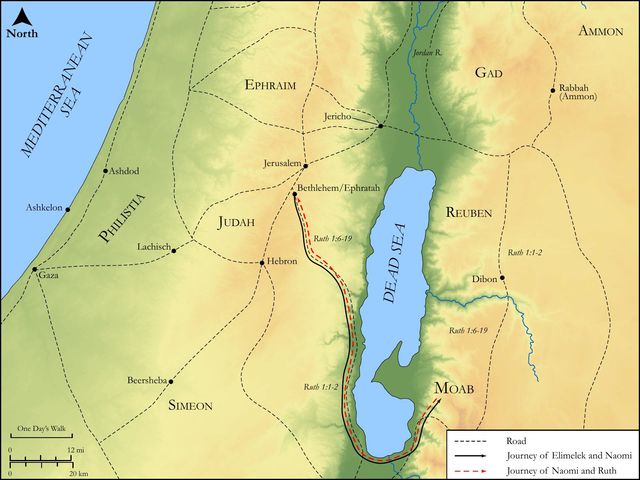
See on the biblical-era map
Study this verse
Public-domain commentary
Matthew Henry
From his Commentary on the Whole Bible. Henry comments on passages, not single verses — this entry covers Ruth 2:1–3. His three-level outline is real structure in the source text, so it is rendered as structure.
Naomi had now gained a settlement in Bethlehem among her old friends; and here we have an account,
I.Of her rich kinsman, Boaz, a mighty man of wealth, Rut 2:1.
The Chaldee reads it, mighty in the law. If he was both, it was a most rare and excellent conjunction, to be mighty in wealth and mighty in the scriptures too; those that are so are mighty indeed. He was grandson of Nahshon, who was prince of the tribe of Judah in the wilderness, and son of Salmon, probably a younger son, by Rahab, the harlot of Jericho. He carries might in his name, Boaz - in him is strength; and he was of the family of Elimelech, that family which was now reduced and brought so low. Observe,
1.Boaz, though a rich and great man, had poor relations. Every branch of the tree is not a top-branch. Let not those that are great in the world be ashamed to own their kindred that are mean and despised, lest they be found therein proud, scornful, and unnatural.
2.Naomi, though a poor contemptible widow, had rich relations, whom yet she boasted not of, nor was burdensome to, nor expected any thing from when she returned to Bethlehem in distress. Those that have rich relations, while they themselves are poor, ought to know that it is the wise providence of God that makes the difference (in which we ought to acquiesce), and that to be proud of our relation to such is a great sin, and to trust to it is great folly.
II.Of her poor daughter-in-law, Ruth.
1.Her condition was very low and poor, which was a great trial to the faith and constancy of a young proselyte. The Bethlehemites would have done well if they had invited Naomi and her daughter-in-law first to one good house and then to another (it would have been a great support to an aged widow and a great encouragement to a new convert); but, instead of tasting the dainties of Canaan, they have no way of getting necessary food but by gleaning corn, and otherwise, for aught that appears, they might have starved. Note, God has chosen the poor of this world; and poor they are likely to be, for, though God has chosen them, commonly men overlook them.
2.Her character, in this condition, was very good (Rut 1:2): She said to Naomi, not, "Let me now go to the land of Moab again, for there is no living here, here there is want, but in my father's house there is bread enough." No, she is not mindful of the country from which she came out, otherwise she had now a fair occasion to return. The God of Israel shall be her God, and, though he slay her, yet will she trust in him and never forsake him. But her request is, Let me go to the field, and glean ears of corn. Those that are well born, and have been well brought up, know not what straits they may be reduced to, nor what mean employments they may be obliged to get their bread by, Lam 4:5. When the case is thus melancholy, let Ruth be remembered, who is a great example,
(1.)Of humility. When Providence had made her poor she did not say, "To glean, which is in effect to beg, I am ashamed," but cheerfully stoops to the meanness of her circumstances and accommodates herself to her lot. High spirits can more easily starve than stoop; Ruth was none of those. She does not tell her mother she was never brought up to live upon crumbs. Though she was not brought up to it, she is brought down to it, and is not uneasy at it. Nay, it is her own motion, not her mother's injunction. Humility is one of the brightest ornaments of youth, and one of the best omens. Before Ruth's honour was this humility. Observe how humbly she speaks of herself, in her expectation of leave to glean: Let me glean after him in whose sight I shall find grace. She does not say, "I will go and glean, and surely nobody will deny me the liberty," but, "I will go and glean, in the hope that somebody will allow me the liberty." Note, Poor people must not demand kindness as a debt, but humbly ask it, and take it as a favour, though in ever so small a matter. It becomes the poor to use entreaties.
(2.)Of industry. She does not say to her mother-in-law, "Let me now go a visiting to the ladies of the town, or go a walking in the fields to take the air and be merry; I cannot sit all day moping with you." No, it is not sport, but business, that her heart is upon: "Let me go and glean ears of corn, which will turn to some good account." She was one of those virtuous women that love not to eat the bread of idleness, but love to take pains. This is an example to young people. Let them learn betimes to labour, and, what their hand finds to do, do it with their might. A disposition to diligence bodes well both for this world and the other. Love not sleep, love not sport, love not sauntering; but love business. It is also an example to poor people to work for their living, and not beg that which they are able to earn. We must not be shy of any honest employment, though it be mean, ergon ouden oneidos - No labour is a reproach. Sin is a thing below us, but we must not think any thing else so That Providence calls us to.
(3.)Of regard to her mother. Though she was but her mother-in-law, and though, being loosed by death from the law of her husband, she might easily suppose herself thereby loosed from the law of her husband's mother, yet she is dutifully observant of her. She will not go out without letting her know and asking her leave. This respect young people ought to show to their parents and governors; it is part of the honour due to them. She did not say, "Mother, if you will go with me, I will go glean:" but, "Do you sit at home and take your ease, and I will go abroad, and take pains." Juniores ad labores - Youth should work. Let young people take advice from the aged, but not put them upon toil.
(4.)Of dependence upon Providence, intimated in that, I will glean after him in whose sight I shall find grace. She knows not which way to go, nor whom to enquire for, but will trust Providence to raise her up some friend or other that will be kind to her. Let us always keep us good thoughts of the divine providence, and believe that while we do well it will do well for us. And it did well for Ruth; for when she went out alone, without guide or companion, to glean, her hap was to light on the field of Boaz, Rut 2:3. To her it seemed casual. She knew not whose field it was, nor had she any reason for going to that more than any other, and therefore it is said to be her hap; but Providence directed her steps to this field. Note, God wisely orders small events; and those that seem altogether contingent serve his own glory and the good of his people. Many a great affair is brought about by a little turn, which seemed fortuitous to us, but was directed by Providence with design.
Historical interpretation
Historical reception
1 surviving comment on this verse from the historical church.
Does the widow Naomi seem to you of small account, who supported her widowhood on the gleanings from another’s harvest, and who, when heavy with age, was supported by her daughter-in-law? It is a great benefit both for the support and for the advantage of widows that they so train their daughters-in-law as to have in them a support in full old age, and, as it were, payment for their teaching and reward for their training. For to her who has well taught and well instructed her daughter-in-law a Ruth will never be wanting who will prefer the widowed life of her mother-in-law to her father’s house, and if her husband also be dead, will not leave her, will support her in need, comfort her in sorrow and not leave her if sent away; for good instruction will never know need. So that Naomi, deprived of her husband and her two sons, having lost the offspring of her fruitfulness, did not lose the reward of her pious care, for she found both a comfort in sorrow and a support in poverty.
Continue studying Ruth 2:2 across the web’s major study libraries — every link below opens this exact verse, chapter, or book on the destination site.
Read & Compare
 BibleGatewayThis verse in more than 200 translations and 70 languages.
 Bible.comThe YouVersion reader — hundreds of translations, reading plans, and highlights.
 ESV.orgCrossway's official English Standard Version reader.
 NET BibleThe NET translation with 60,000+ translators' notes on every rendering decision.
 STEP BibleTyndale House's free study tool — original text, vocabulary, and scholarly resources.
 BibliaLogos Bible Software's free web reader.
 USCCBThe New American Bible (Revised Edition) with the U.S. bishops' study notes.
Commentaries
 BibleHub CommentariesDozens of classic commentaries on this verse, gathered on one page.
 StudyLightMore than 100 commentary sets — the largest collection on the web.
 BibleRefPlain-English commentary on what this verse means, verse by verse.
 Enduring WordDavid Guzik's free commentary on this chapter, widely used by Bible teachers.
 Bible Study ToolsVerse commentary alongside Greek and Hebrew study aids.
Original Language & Research
- BibleHub InterlinearThe verse word by word — original language, transliteration, and English.
- BibleHub LexiconEvery word's original-language definition and Strong's entry.
 Blue Letter BibleDeep-study tools — Strong's numbers, concordance, and word studies.
 SefariaThe Hebrew text with Rashi and centuries of Jewish commentary.
Sermons, Hymns & Audio


TrulyRandomVerse is not affiliated with these sites and doesn’t control their content. They’re linked because they’re genuinely useful.
Summary
Ruth 2:2 marks a pivotal moment in the narrative, illustrating Ruth's remarkable initiative and humble resolve amidst destitution. As a Moabitess and a widow, she proposes to glean in the fields, an act of selflessness aimed at providing for herself and her mother-in-law, Naomi. This proactive step, born out of their shared vulnerability, initiates a series of divinely orchestrated events that will lead to their restoration. Ruth's request to seek "grace" from a landowner underscores her dependent position and reliance on benevolent favor, foreshadowing the unexpected kindness and provision she is about to receive.
Context
ShowHideLiterary Context
This verse immediately follows the somber return of Naomi and Ruth to Bethlehem, a journey marked by profound loss and despair (see Ruth 1). Naomi, in her bitterness, has expressed a desire to be called "Mara" (bitter), attributing her suffering to the Lord's hand (as seen in Ruth 1:20-21). The narrative then shifts from Naomi's lament to Ruth's decisive and practical resolve. Ruth's proposal to glean is the first concrete action taken by either woman to address their dire economic circumstances, strategically occurring at the very beginning of the barley harvest (as noted in Ruth 1:22). This initiative directly sets the stage for Ruth's providential "chance" encounter with Boaz in the subsequent verse (see Ruth 2:3), highlighting the narrative's careful progression from destitution to divine provision.
Historical & Cultural Context
The practice of gleaning was a fundamental provision for the needy in ancient Israel, explicitly mandated by Mosaic Law. Landowners were commanded to leave the edges of their fields unharvested and not to return for fallen grain or forgotten sheaves, thereby allowing the poor, the sojourner, the orphan, and the widow to gather what remained (as detailed in Leviticus 19:9-10 and Deuteronomy 24:19-22). This system provided sustenance with dignity, as it required labor rather than mere handouts. As a Moabitess and a widow, Ruth was doubly vulnerable and entirely dependent on such provisions. Her willingness to undertake this physically demanding and humble task underscores her unwavering commitment to Naomi and her remarkable resourcefulness in a society where women, especially those without male protection, faced immense hardship and neglect.
Key Themes
ShowHideRuth 2:2 introduces and reinforces several pivotal themes within the book of Ruth. Diligence and Initiative are prominently displayed as Ruth actively seeks a solution to their poverty, rather than succumbing to passive despair. Her willingness to undertake the arduous task of gleaning highlights her profound Humility and strong work ethic. The phrase "in whose sight I shall find grace" introduces the crucial theme of Seeking Favor and Kindness, acknowledging her complete dependence on the goodwill of others, particularly a benevolent landowner. Most significantly, this verse subtly introduces the overarching theme of Divine Providence. Though Ruth chooses a field "by chance" (as stated in Ruth 2:3), the discerning reader is invited to perceive God's unseen hand guiding her steps, orchestrating her arrival at the field of Boaz, who will become her kinsman-redeemer. This foreshadows the unfolding of God's intricate plan for their future, demonstrating how seemingly mundane human actions can be integral to a larger divine design, as beautifully articulated in Proverbs 16:9.
Exposition and Analysis
ShowHideKey Word Analysis
ShowHideThis primitive root means "to pick up" or "to gather," but in the context of agriculture, it specifically refers to the practice of collecting leftover grain from a field after the main harvest. This was a physically demanding and often humble task traditionally reserved for the poor, the widow, and the foreigner. Ruth's willingness to "glean" underscores her profound humility, her diligence, and the dire economic circumstances she and Naomi faced. It also highlights her reliance on the Mosaic Law's compassionate provision for the needy, demonstrating her active participation in seeking sustenance.
Derived from a root meaning "to be gracious," this word signifies "favor," "kindness," "acceptance," or "goodwill." Ruth's desire to find "grace" implies that while the law permitted gleaning generally, the extent of her success, safety, and the abundance of her gleaning would depend significantly on the disposition and generosity of the landowner. She was not demanding a right but humbly seeking benevolent regard and permission to work. This term sets up a central narrative theme of unexpected kindness and divine favor that she will indeed receive from Boaz, far beyond her initial expectations.
This descriptive term, consistently used throughout the book, immediately identifies Ruth as a foreigner and an outsider. In ancient Israelite society, Moabites were often viewed with suspicion or even hostility due to historical conflicts and their pagan origins (as seen in Deuteronomy 23:3-6). Her identity as a "Moabitess" emphasizes her vulnerable and lowly status, making her proactive initiative and eventual acceptance and integration within Israel all the more remarkable. This highlights the expansive and inclusive nature of God's covenant loyalty (hesed), which extends even to those considered outsiders.
Verse Breakdown
ShowHide"And Ruth the Moabitess said unto Naomi"
This opening phrase immediately establishes Ruth's identity as a foreigner and highlights her agency. Despite her vulnerable status as a foreign widow and Naomi's despair, Ruth takes the decisive initiative, speaking up and proposing a concrete course of action. This contrasts sharply with Naomi's passive lament in the preceding chapter and marks a crucial shift towards hope and practical engagement with their dire circumstances.
"Let me now go to the field, and glean ears of corn"
Ruth's proposal is both practical and humble, identifying a specific, legitimate means of provision available to the poor. "Gleaning ears of corn" (or grain) refers to the laborious act of gathering the remnants of the harvest. This demonstrates her diligence, resourcefulness, and unwavering willingness to work hard for their survival, rather than passively waiting for charity or divine intervention without human effort.
"after [him] in whose sight I shall find grace"
This clause reveals Ruth's acute awareness of her social position and her dependence on others. She understands that her ability to glean effectively and safely rests not merely on the general provision of the law, but on the goodwill and acceptance of the specific landowner. She is not claiming a right to any field but humbly seeking a place where she will be met with kindness and permission, setting the stage for the unexpected and abundant favor she will receive from Boaz.
"And she said unto her, Go, my daughter"
Naomi's concise and immediate response signifies her trust in Ruth and her recognition of the necessity and practicality of the plan. Her simple "Go, my daughter" conveys both permission and deep affection, indicating a fragile but growing hope after her earlier bitterness and despair. It implicitly acknowledges the wisdom and proactive nature of Ruth's proposal, giving her blessing to the venture.
Literary Devices
ShowHideThe verse employs several significant literary devices that enrich its meaning and narrative impact. Characterization is immediately evident, as Ruth is portrayed as proactive, diligent, humble, and loyal, standing in stark contrast to Naomi's initial despair and passive resignation. This verse also utilizes Foreshadowing, subtly hinting at the divine hand at work. Ruth's intention to seek "grace" from an unnamed landowner, coupled with her subsequent "chance" arrival at Boaz's field (as noted in Ruth 2:3), skillfully sets up the reader's expectation of a significant and divinely orchestrated encounter. There is also a subtle Irony in Ruth's statement; she seeks "grace" from a human landowner, yet the unfolding narrative implicitly reveals that she is being guided by divine grace to the field of Boaz, who will become her ultimate human redeemer. The consistent Repetition of "Moabitess" throughout the book, including in this verse, serves as a constant reminder of Ruth's foreignness, powerfully emphasizing the expansive and inclusive nature of God's covenant loyalty (hesed), which extends even to those considered outsiders.
Theological and Thematic Connections
ShowHideRuth 2:2 powerfully illustrates the intricate interplay between human initiative and divine sovereignty. Ruth's proactive decision to glean, born out of necessity and a deep sense of loyalty to Naomi, stands as a testament to human diligence and responsibility in the face of daunting hardship. Yet, the narrative subtly reveals that her seemingly random choice of field is, in fact, divinely orchestrated, leading her directly to Boaz, a kinsman-redeemer. This highlights God's profound providence, demonstrating that He works through ordinary human actions and decisions to accomplish His extraordinary purposes. The law of gleaning itself, to which Ruth appeals, is a beautiful expression of God's compassionate care for the vulnerable, ensuring that even the most overlooked members of society have a means of provision and dignity. This divine mandate for generosity and the human act of seeking favor set the stage for the unfolding of God's covenant love (hesed) in the lives of Ruth and Naomi, showcasing how God's faithfulness meets human faithfulness.
Reflection and Application
ShowHideRuth's example in this verse offers profound and timeless lessons for believers today. In moments of personal or communal hardship, we are not called to passive despair or resignation but to active diligence and resourceful initiative. Ruth, despite her foreignness, widowhood, and dire circumstances, did not wait for help but actively sought a practical, albeit humble, solution for their survival. This reminds us that genuine faith often calls for courageous action, for stepping out in obedience and trust, even when the path ahead is uncertain or appears insignificant. Furthermore, Ruth's humble seeking of "grace" from a landowner teaches us the importance of humility and the recognition that God often works through the kindness and favor of others, both human and divine. We are to be diligent in our efforts, yet always acknowledge our dependence on God's overarching providence, trusting that He can guide our seemingly ordinary steps to extraordinary outcomes. Our willingness to engage in humble tasks and to seek opportunities, even those that seem small or insignificant, can be the very means through which God unfolds His greater plan for our lives and the lives of those we are called to serve.
Questions for Reflection
ShowHideFAQ
ShowHideWhy was gleaning important in ancient Israel?
ShowHideGleaning was a crucial component of ancient Israel's care for the needy system, divinely mandated by the Mosaic Law (for example, see Leviticus 19:9-10 and Deuteronomy 24:19-22). It ensured that the poor, the sojourner, the orphan, and the widow had a means of sustenance. Landowners were commanded to leave a portion of their harvest for these vulnerable groups to gather. This system provided not just charity but also dignity, as it required the individual to work for their food, fostering self-reliance within the community while demonstrating God's compassionate care for the lowly and upholding principles of justice.
Did Ruth have a right to glean in any field she chose?
ShowHideWhile the Mosaic Law established the general right for the poor to glean, the specific implementation and the extent of one's success could vary depending on the landowner's disposition and the prevailing local customs. Ruth's phrase, "in whose sight I shall find grace," suggests that she understood that her ability to glean effectively and safely depended on the landowner's favor and explicit permission, not merely a blanket legal right to enter any field without regard for the owner. Some landowners might be more generous and protective, others less so, or even hostile. Ruth's humble request for "grace" indicates her acute awareness of her vulnerable position as a foreign widow and her reliance on the benevolent regard of a specific individual, which providentially led her to the field of Boaz.
Christ-Centered Fulfillment
ShowHideRuth's initiative to glean, humbly seeking "grace" from a landowner, profoundly foreshadows the ultimate grace extended to humanity through Jesus Christ. Her humble labor to provide sustenance for herself and Naomi points to Christ, who, though rich in divine glory, became poor for our sake (as described in 2 Corinthians 8:9) and who is the true Bread of Life, providing spiritual nourishment that satisfies eternally (as declared in John 6:35). The law of gleaning, a divine provision for the needy and overlooked, finds its ultimate fulfillment in Christ, who perfectly embodies God's compassionate care and offers redemption and restoration to all who are spiritually destitute. Furthermore, Ruth's journey from a foreign Moabitess to an ancestor of David and ultimately of Christ (as recorded in Matthew 1:5) powerfully illustrates God's expansive grace, breaking down ethnic and social barriers and welcoming outsiders into His covenant family, a truth fully revealed and enacted in Christ's inclusive gospel (as seen in Ephesians 2:13-14). The "kinsman-redeemer" theme, subtly introduced as Ruth seeks a field where she might find favor, culminates in Boaz's redemptive act, which in turn points to Jesus Christ as our ultimate Kinsman-Redeemer, who purchased our freedom from sin and death and brought us into His eternal inheritance (as affirmed in Galatians 3:13).