


1 Samuel 20:20
Bible text: King James Version (1769 Blayney text) · Public domain
Bible text: Berean Standard Bible · Public domain
Bible text: American Standard Version (1901) · Public domain
Bible text: World English Bible, Messianic edition · Public domain
Bible text: Geneva Bible (1599) · Public domain
Bible text: Young's Literal Translation · Public domain
- וַאֲנִיva·'a·Niand IH589Conj-w ¦ Pro-1csPronoun Personal 1st Singular common genderוַandאֲנִיI
- שְׁלֹשֶׁתshe·Lo·shet[the] threeH7969N-cscNoun Singular common gender Construct
- הַחִצִּיםha·chi·Tzimthe arrowsH2671Art ¦ N-mpNoun Plural Masculine Absoluteהַtheחִצִּיםarrows
- צִדָּהtzi·Dah[its] side <towards>H6654N-msc ¦ SfxNoun Singular Masculine Constructצִדָּ[its] sideה<towards>
- אוֹרֶה'o·RehI will shootH3384V-Hiphil-Imperf-1csVerb Hiphil Imperfect 1st Singular common gender
- לְשַׁלַּחle·sha·lachto send [them]H7971Prep-l ¦ V-Piel-InfVerb Piel Infinitive Constructלְtoשַׁלַּחsend [them]
- לִיlifor <the> myselfPrep-l ¦ 1csSuffix Personal 1st Singular common genderלִfor <the>יmyself
- לְמַטָּרָהle·ma·ta·Rahto a targetH4307Prep-l ¦ N-fsNoun Singular Feminine Absoluteלְtoמַטָּרָהa target
English is a literal word-by-word gloss of the Hebrew, not the KJV's wording. Why?
This is the original text the KJV's translators worked from — each Hebrew word with its own literal English meaning in this verse, prepared by scholars at Tyndale House, Cambridge. The KJV translates whole sentences, not word by word, so its wording differs: one Hebrew word can become several English words, and the KJV may choose “the LORD” where the gloss reads “Yahweh”. Both are faithful — they answer different questions. For the KJV's own rendering, switch to the KJV text.
Details
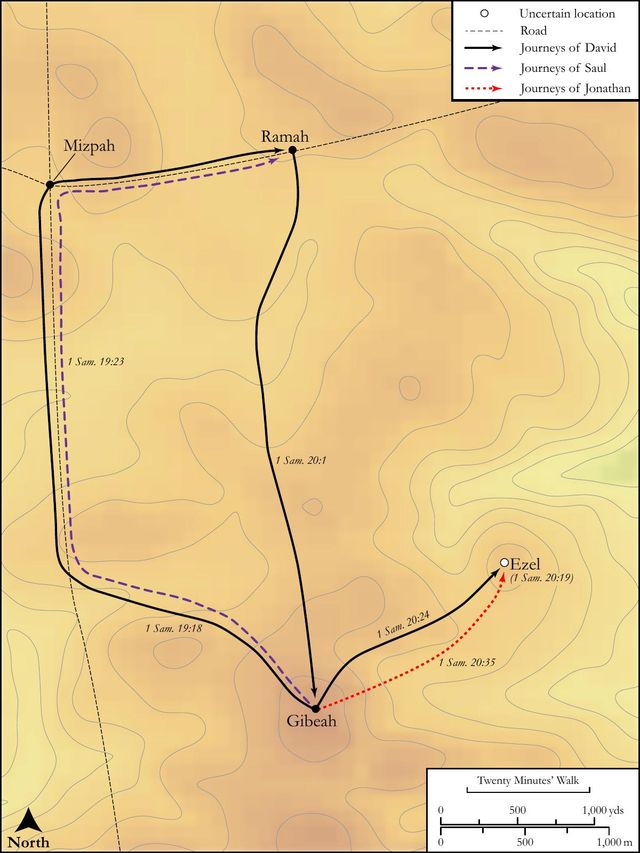
See on the biblical-era map
Study this verse
Public-domain commentary
Matthew Henry
From his Commentary on the Whole Bible. Henry comments on passages, not single verses — this entry covers 1 Samuel 20:9–23. His two-level outline is real structure in the source text, so it is rendered as structure.
Here, I. Jonathan protests his fidelity to David in his distress. Notwithstanding the strong confidence David had in Jonathan, yet, because he might have some reason to fear that his father's influence, and his own interest, should make him warp, or grow cool towards him, Jonathan thought it requisite solemnly to renew the professions of his friendship to him (Sa1 20:9): "Far be it from thee to think that I suspect thee of any crime for which I should either slay thee myself or deliver thee to my father; no, if thou hast any jealousy of that, Come let us go into the field (Sa1 20:11), and talk it over more fully." He did not challenge him to the field to fight him for an affront, but to fix him in his friendship. He faithfully promised him that he would let him know how, upon trial, he found his father affected towards him, and would make the matter neither better nor worse than it was. "If there be good towards thee, I will show it thee, that thou mayest be easy (Sa1 20:12), if evil, I will send thee away, that thou mayest be safe" (Sa1 20:13); and thus he would help to deliver him from the evil if it were real and from the fear of evil if it were but imaginary. For the confirmation of his promise he appeals to God, 1. As a witness (Sa1 20:12): "O Lord God of Israel, thou knowest I mean sincerely, and think as I speak." The strength of his passion made the manner of his speaking concise and abrupt. 2. As a judge: "The Lord do so and much more to Jonathan (Sa1 20:13), if I speak deceitfully, or break my word with my friend." He expressed himself thus solemnly that David might be abundantly assured of his sincerity. And thus God has confirmed his promises to us, that we might have strong consolation, Heb 6:17, Heb 6:18. Jonathan adds to his protestations his hearty prayers: "The Lord be with thee, to protect and prosper thee, as he has been formerly with my father, though now he has withdrawn." Thus he imitates his belief that David would be in his father's place, and his good wishes that he might prosper in it better than his father now did.
II.He provides for the entail of the covenant of friendship with David upon his posterity, Sa1 20:14-16.
He engages David to be a friend to his family when he was gone (Sa1 20:15): Thou shalt promise that thou wilt not cut off thy kindness from my house for ever. This he spoke from a natural affection he had to his children, whom he desired it might go well with after his decease, and for whose future welfare he desired to improve his present interest. It also intimates his firm belief of David's advancement, and that it would be in the power of his hand to do a kindness or unkindness to his seed; for, in process of time, the Lord would cut off his enemies, Saul himself was not expected; then "Do not thou cut off thy kindness from my house, nor revenge my father's wrongs upon my children." The house of David must likewise be bound to the house of Jonathan from generation to generation; he made a covenant (Sa1 20:16) with the house of David. Note, True friends cannot but covet to transmit to theirs after them their mutual affections. Thy own friend, and thy father's friend, forsake not. This kindness,
1.He calls the kindness of the Lord, because it is such kindness as God shows to those he takes into covenant with himself; for he is a God to them and to their seed; they are beloved for the fathers' sakes.
2.He secures it by an imprecation (Sa1 20:16): The Lord require it at the hand of David's seed (for of David himself he had no suspicion) if they prove so far David's enemies as to deal wrongfully with the posterity of Jonathan, David's friend. He feared lest David, or some of his, should hereafter be tempted, for the clearing and confirming of their title to the throne, to do by his seed as Abimelech had done by the sons of Gideon (Jdg 9:5), and this he would effectually prevent; but the reason given (Sa1 20:17) why Jonathan was so earnest to have the friendship entailed is purely generous, and has nothing of self in it; it was because he loved him as he loved his own soul, and therefore desired that he and his might be beloved by him. David, though now in disgrace at court and in distress, was as amiable in the eyes of Jonathan as ever he had been, and he loved him never the less for his father's hating him, so pure were the principles on which his friendship was built. Having himself sworn to David, he caused David to swear to him, and (as we read it) to swear again, which David consented to (for he that bears an honest mind does not startle at assurances), to swear by his love to him, which he looked upon as a sacred thing. Jonathan's heart was so much upon it that, when they parted this time, he concluded with a solemn appeal to God: The Lord be between me and thee for ever (Sa1 20:23), that is, "God himself be judge between us and our families for ever, if on either side this league of friendship be violated." It was in remembrance of this covenant that David was kind to Mephibosheth, Sa2 9:7; Sa2 21:7. It will be a kindness to ourselves and ours to secure an interest in those whom God favours and to make his friends ours.
III.He settles the method of intelligence, and by what signs and tokens he would give him notice how his father stood affected towards him.
David would be missed the first day, or at least the second day, of the new moon, and would be enquired after, Sa1 20:18. On the third day, by which time he would have returned from Bethlehem, he must be at such a place (Sa1 20:19), and Jonathan would come towards that place with his bow and arrows to shoot for diversion (Sa1 20:20), would send his lad to fetch his arrows, and, if they were shot short of the lad, David must take it for a signal of safety, and not be afraid to show his head (Sa1 20:21); but, if he shot beyond the lad, it was a signal of danger, and he must shift for his safety, Sa1 20:22. This expedient he fixed lest he should not have the opportunity, which yet it proved he had, of talking with David, and making the report by word of mouth.
Historical interpretation
Historical reception
1 surviving comment on this verse from the historical church.
And I will send three arrows near him, etc. And I, the Church says to the Lord, with you dwelling in the hearts of the perfect, will send preachers of the holy and undivided Trinity, who, with wings of virtues, will be quick-flying, penetrating with the sharpness of their speech, stirred by the bow of diligent reading, to strike with the word of faith those who are more fragile and still, and almost earthly, yet remaining in the vicinity of the strong, held by the friendly bond of love, so that, touched by the salutary wound of charity, they may be compelled to bear all visible things gravely, to rest in the memory of their Creator alone, and to have His sole vision as sweetness. But I will send them, not as if they would end the uncertain course of the word, but as if training me to the sign of true and singular salvation, as if following only the look of divine will, directing all the blows of my doctrine to the intended target, I will pursue to the prize of the heavenly calling of God in Christ Jesus. I will also send listeners eager to obey the faith; who, diligently seeking through all the spiritual teachings or deeds of the doctors, may piously relate to the glory of my state, by following it devoutly. To these listeners, indeed, if I show them capturing these same teachers who are near them, and placed among them by living well, if you deign to visit me, I will show that the usual blessing from the Jews is to be increased because peace is yours, with the arms of the hateful at rest meanwhile. But if I show that the same teachers, humbled by me, being further cast out and pursued from Judea, go and tend to visit all nations; because this is the will and providence of the eternal Father, that, blindness coming upon Israel, the fullness of the nations may enter the gates of life. Of the single word of the Father, which we shall have spoken, I confessing, and you teaching, let God the Father almighty Himself alone be the eternal witness between me and you; and rightly, because the Father alone knows the secrets of the Son, and only to those whom the Father has deigned to reveal them. Of these, the same Son speaks to the Father: And you revealed them to little children (Matthew XI). Who decreed that this God, begotten before the ages, should be incarnate at the end of the ages, and that they should be saved by the same incarnation. But speaking these things, the Church does not instruct the Lord as if He were ignorant of what He should do, nor does she teach what she herself shall do as if He were unaware; but she prays devotedly that He accomplish these things quickly, which she has learned mercifully to be done by Him. What she should do rightly, having received through Him, she ceaselessly praises herself for this by giving thanks.
Continue studying 1 Samuel 20:20 across the web’s major study libraries — every link below opens this exact verse, chapter, or book on the destination site.
Read & Compare
 BibleGatewayThis verse in more than 200 translations and 70 languages.
 Bible.comThe YouVersion reader — hundreds of translations, reading plans, and highlights.
 ESV.orgCrossway's official English Standard Version reader.
 NET BibleThe NET translation with 60,000+ translators' notes on every rendering decision.
 STEP BibleTyndale House's free study tool — original text, vocabulary, and scholarly resources.
 BibliaLogos Bible Software's free web reader.
 USCCBThe New American Bible (Revised Edition) with the U.S. bishops' study notes.
Commentaries
 BibleHub CommentariesDozens of classic commentaries on this verse, gathered on one page.
 StudyLightMore than 100 commentary sets — the largest collection on the web.
 BibleRefPlain-English commentary on what this verse means, verse by verse.
 Enduring WordDavid Guzik's free commentary on this chapter, widely used by Bible teachers.
 Bible Study ToolsVerse commentary alongside Greek and Hebrew study aids.
Original Language & Research
- BibleHub InterlinearThe verse word by word — original language, transliteration, and English.
- BibleHub LexiconEvery word's original-language definition and Strong's entry.
 Blue Letter BibleDeep-study tools — Strong's numbers, concordance, and word studies.
 SefariaThe Hebrew text with Rashi and centuries of Jewish commentary.
Sermons, Hymns & Audio


TrulyRandomVerse is not affiliated with these sites and doesn’t control their content. They’re linked because they’re genuinely useful.
Summary
Jonathan's meticulously devised strategy illustrates the extreme peril David faced from King Saul's escalating hostility. This verse details a crucial element of their covert communication: Jonathan's act of discharging three arrows in a specific location, artfully disguised as a casual archery practice. This deceptive maneuver was engineered to transmit a life-or-death message to David, indicating whether it was safe to return to Saul's court or if he must immediately flee for his life, all while remaining undetected by Saul's vigilant eyes.
Context
ShowHideLiterary Context
This verse is intricately woven into the dramatic narrative of King Saul's intensifying jealousy and murderous intent towards David, his son-in-law and God's divinely appointed future king. The preceding chapters establish the profound, covenantal friendship between Jonathan, Saul's son, and David, a bond that transcends political ambition and familial loyalty to Saul, demonstrating a rare and selfless devotion. 1 Samuel 20 specifically details Jonathan's ingenious plan to ascertain Saul's true intentions towards David. Verses 18-19 set the precise time and location (the stone Ezel) for David to hide and await Jonathan's signal. Verse 20, therefore, describes the specific action within this elaborate communication system, which is then followed by the interpretation of the signal in 1 Samuel 20:21-22. The entire sequence powerfully underscores the extreme danger David faced and the extraordinary measures taken by Jonathan to protect his friend, ultimately leading to David's prolonged period as a fugitive from Saul.
Historical & Cultural Context
The setting is the nascent monarchy of Israel, a pivotal period marked by the transition from a tribal confederacy to a centralized kingdom. Saul, Israel's inaugural king, is increasingly characterized by instability, paranoia, and disobedience to God, leading to God's rejection of him and the anointing of David as his successor by Samuel (1 Samuel 16:1-13). This historical backdrop fully explains Saul's irrational rage and violent outbursts against David, whom he perceives as an existential threat to his dynasty. Archery was a pervasive and highly valued skill in ancient Israel, serving both as a form of sport and essential military training. Thus, Jonathan's feigned practice would have been a culturally plausible and inconspicuous activity, perfectly suited for a covert operation. The concept of a blood covenant, such as the one forged between Jonathan and David (1 Samuel 18:3), was a deeply binding and sacred agreement in Israel, often involving promises of mutual protection and loyalty extending to future generations, which Jonathan faithfully upholds despite the immense personal cost.
Key Themes
ShowHideThe passage powerfully illustrates the theme of unwavering loyalty and sacrificial friendship, showcasing Jonathan's profound commitment to David, even at the expense of his own potential claim to the throne and his very life. This extraordinary bond serves as a stark counterpoint to Saul's escalating tyranny, paranoia, and murderous jealousy, highlighting the destructive and corrupting nature of unchecked power. The elaborate signal system emphasizes the theme of strategic communication and divine providence, demonstrating how Jonathan's ingenuity and resourcefulness are divinely orchestrated to protect God's chosen king. It also underscores the imminent danger David faced, necessitating such covert operations for his survival. Ultimately, the narrative points to God's faithful preservation of His anointed one, ensuring David's safety despite human malice, a theme consistently echoed throughout biblical history in God's protection of His people, as seen in passages like Psalm 121:7-8.
Exposition and Analysis
ShowHideKey Word Analysis
ShowHideThis verb, derived from a primitive root, primarily means "to flow as water" or "to rain." Transitively, it signifies "to lay or throw," especially an arrow, hence "to shoot." Figuratively, it can mean "to point out" or "to teach." In this context, it refers directly to the act of propelling arrows from a bow. Jonathan's choice of this common, everyday action is crucial for the deception, making his activity appear innocuous to any casual observer and masking its true, life-or-death communicative purpose.
From a root meaning "to pierce," this noun properly refers to a piercer, specifically an arrow. By implication, it can denote a wound, and figuratively, a thunderbolt (when referring to God). Here, it denotes the projectiles themselves, which are central to Jonathan's coded message. The specific number of "three arrows" (from H7969 shâlôwsh, "three") is a pre-arranged part of the signal, establishing a fixed element that, combined with the arrows' landing location, would convey precise information to David.
This word, derived from a root meaning "to guard" or "to watch closely," can refer to a jail (as a guard-house) or, as in this verse, an aim or target (as something closely watched). The phrase "as though I shot at a mark" implies that Jonathan's shooting was not truly directed at a specific target with serious intent, but rather appeared casual or aimless. This pretense was vital to prevent any suspicion from Saul's servants or spies who might be observing Jonathan, allowing the true, hidden meaning of the arrow placement to be conveyed solely to David.
Verse Breakdown
ShowHide"And I will shoot three arrows"
This initial clause establishes Jonathan's deliberate and purposeful action. While the act of shooting arrows is a familiar and seemingly innocent pastime, the specific quantity of "three" is a pre-arranged code, immediately signaling to David that this is no ordinary practice. It signifies the initiation of the critical, pre-determined signal system agreed upon between Jonathan and David, setting the stage for the communication of vital information regarding David's safety.
"on the side [thereof]"
This phrase refers to the precise, predetermined location where David is to hide and await the signal. The "thereof" points back to the "stone Ezel" mentioned in 1 Samuel 20:19. This meticulous geographical detail ensures that David knows exactly where to position himself to receive the message, highlighting the careful and precise planning required for such a covert operation in a highly dangerous and surveilled environment.
"as though I shot at a mark"
This concluding clause reveals the deceptive nature of Jonathan's action. He will not be genuinely aiming at a target for accuracy or competition. Instead, he will simulate casual archery practice, perhaps shooting erratically or without a clear objective. This deliberate pretense is absolutely essential to avoid aroused any suspicion from potential onlookers, allowing the true, hidden meaning of the arrow placement to be conveyed solely and secretly to David.
Literary Devices
ShowHideThe passage employs several potent literary devices that deepen its meaning and impact. Dramatic Irony is prominently featured, as the audience is fully aware of the true, life-saving purpose behind Jonathan's archery, while King Saul and his court remain entirely oblivious, perceiving it as mere sport. This creates significant tension and underscores the cunning and ingenuity required for David's survival. Symbolism is also powerfully at play: the arrows symbolize not only a clandestine form of communication but also the extreme precariousness of David's life, as their precise placement determines his immediate fate (safety or urgent flight). Jonathan's act of shooting "as though I shot at a mark" is a subtle form of Foreshadowing, hinting at David's future as a fugitive, always on the move, never truly "at a mark" or settled until God establishes his kingdom. The entire scenario is a masterful example of Cunning or Stratagem, demonstrating Jonathan's exceptional cleverness and resourcefulness in protecting his beloved friend against an irrational, powerful, and murderous adversary.
Theological and Thematic Connections
ShowHideThis verse, while seemingly focused on a practical detail of communication, resonates with profound theological truths. It powerfully highlights God's providential care for David, His anointed one, even amidst intense human treachery and mortal danger. Jonathan's unwavering loyalty, though a deeply human act of friendship, serves as a crucial instrument of divine protection, demonstrating how God often works through faithful human relationships to accomplish His sovereign purposes. The stark tension between Saul's desperate attempts to thwart God's plan and God's steadfast commitment to His chosen king underscores the overarching theme of divine sovereignty prevailing over all human opposition and malice. The very necessity for such elaborate, hidden communication also speaks to the sobering reality of living in a fallen world, where deception and danger necessitate wisdom, discernment, and reliance on trusted relationships, yet God remains the ultimate protector and orchestrator of events.
Reflection and Application
ShowHideJonathan's actions in this verse offer profound and enduring lessons on the nature of true friendship, the critical importance of wise and discerning communication, and the courage required to stand for what is right, even at great personal cost. In a world often characterized by self-interest, betrayal, and superficial connections, Jonathan's self-sacrificing loyalty to David shines as a brilliant beacon, powerfully reminding us of the invaluable gift of a friend who "sticks closer than a brother." It challenges each of us to deeply examine the depth of our own commitments and whether we are truly willing to risk comfort, reputation, or personal gain for the well-being of those we love and for the sake of righteousness. Furthermore, the meticulous planning of the signal underscores the crucial need for clarity, wisdom, and strategic thinking in our own interactions, especially when navigating sensitive or perilous situations. While we may not face literal arrows or murderous kings, we frequently encounter relational, professional, or spiritual challenges that demand careful discernment and strategic action, relying on trusted relationships and, ultimately, on God's divine guidance. This narrative encourages us to actively cultivate such deep, loyal friendships and to act with unwavering courage and profound wisdom when faced with adversity, trusting that God can use even the most covert or seemingly ordinary plans to achieve His perfect and ultimate purposes.
Questions for Reflection
ShowHideFAQ
ShowHideWhat was the full signal Jonathan planned for David?
ShowHideJonathan's plan was meticulously elaborate and designed for both clarity and absolute secrecy. He would go out to the field with a young boy, ostensibly for archery practice. The signal's critical meaning depended entirely on where the arrows landed relative to David's hiding place by the stone Ezel. If Jonathan called out to the boy, "Look, the arrows are beyond you!" (1 Samuel 20:21), it meant Saul's intentions were unequivocally hostile, and David must immediately flee for his life. Conversely, if he called, "Look, the arrows are on this side of you!" (1 Samuel 20:22), it meant it was safe for David to return. The boy's innocent presence provided a perfectly plausible cover for Jonathan's archery practice, while the specific words and the precise arrow placement conveyed the critical, life-saving message solely to David.
Why didn't Jonathan just tell David directly what Saul's intentions were?
ShowHideDirect communication was far too dangerous due to King Saul's intense paranoia and the pervasive presence of his spies and loyal, unquestioning servants. Saul's court was a treacherous and volatile environment where any perceived disloyalty or sympathy for David could result in immediate death. Jonathan himself was at grave risk for his profound friendship with David, as vividly evidenced by Saul's later furious attempt to kill him with a spear (1 Samuel 20:33). A direct, open conversation would have been easily overheard or swiftly reported, jeopardizing both Jonathan's life and David's. The elaborate, coded signal was therefore an absolutely necessary measure to ensure David received the vital information without arousing even the slightest suspicion from Saul or his watchful entourage.
What is the significance of "the side thereof" / stone Ezel?
ShowHide"The side thereof" refers directly to the stone Ezel, a predetermined and mutually agreed-upon landmark where David was specifically instructed to hide and patiently await Jonathan's signal (1 Samuel 20:19). This specific location was critically important for several reasons. Firstly, it provided a secure and clearly defined rendezvous point, ensuring David would be precisely in the right place to receive the message without confusion. Secondly, it was likely a somewhat secluded or inconspicuous spot, minimizing the significant risk of David being discovered by Saul's men while he waited. The precision of the location underscores the meticulous planning and the profound gravity of the situation, where every single detail mattered for David's very survival.
Christ-Centered Fulfillment
ShowHideJonathan's profound self-sacrificing loyalty and his ingenious, hidden communication with David, the anointed king, beautifully foreshadow the ultimate act of divine communication and self-giving love found in Jesus Christ. Just as Jonathan, the king's son, willingly relinquished his own claim to the throne and risked his very life to protect David, so too did God the Father send His Son, Jesus, who, "though he was in the form of God, did not count equality with God a thing to be grasped, but emptied himself, by taking the form of a servant, being born in the likeness of men" (Philippians 2:6-7). Jonathan's hidden message, conveyed through a seemingly ordinary act of archery, points to the profound, yet often veiled, wisdom of God's plan of salvation, a mystery "hidden for ages in God, who created all things" but now gloriously revealed in Christ (Ephesians 3:9-10). The arrows, shot "as though I shot at a mark," symbolize the seemingly random or chaotic events of human history that, in God's sovereign and meticulous plan, are precisely aimed at fulfilling His eternal purposes, culminating in Christ's atoning death and triumphant resurrection. Jesus, the true Lamb of God who takes away the sin of the world, became the ultimate "mark" of God's redemptive plan, taking upon Himself the "arrows" of divine judgment for our sin, so that we, like David, might be delivered from the power of death and reign with Him eternally (Romans 5:8).