


1 Samuel 15:17
Bible text: King James Version (1769 Blayney text) · Public domain
Bible text: King James Version with Strong's numbers · Public domain
Bible text: Berean Standard Bible · Public domain
Bible text: American Standard Version (1901) · Public domain
Bible text: World English Bible, Messianic edition · Public domain
Bible text: Geneva Bible (1599) · Public domain
Bible text: Young's Literal Translation · Public domain
- וַיֹּאמֶרvai·Yo·merand he saidH559Conj-w ¦ V-Qal-ConsecImperf-3msVerb Qal Consecutive Imperfect 3rd Singular Masculineוַandיֹּאמֶרhe said
- שְׁמוּאֵלshe·mu·'ElSamuelH8050N-proper-mNoun Proper Masculine
- הֲלוֹאha·Lo'¿ notH3808Interrog ¦ NegParticle Negativeהֲ¿לוֹאnot
- אִם'imthoughH518PrtParticle Conditional
- קָטֹןka·Ton[were] smallH6996Adj-msAdjective Singular Masculine Absolute
- אַתָּה'a·TahyouH859Pro-2msPronoun Personal 2nd Singular Masculine
- בְּעֵינֶיךָbe·'ei·Nei·khain your own eyesH5869Prep-b ¦ N-fdc ¦ 2msNoun Dual Feminine Constructבְּinעֵינֶיown eyesךָyour
- רֹאשׁrosh[the] head ofH7218N-mscNoun Singular Masculine Construct
- שִׁבְטֵיshiv·Tei[the] tribes ofH7626N-mpcNoun Plural Masculine Construct
- יִשְׂרָאֵלYis·ra·'ElIsraelH3478N-properNoun Proper Location
- אָתָּה'A·tah[are] youH859Pro-2msPronoun Personal 2nd Singular Masculine
- וַיִּמְשָׁחֲךָvai·yim·sha·cha·Khaand he anointed youH4886Conj-w ¦ V-Qal-ConsecImperf-3ms ¦ 2msVerb Qal Consecutive Imperfect 3rd Singular Masculineוַandיִּמְשָׁחֲhe anointedךָyou
- יְהוָהYah·wehYahwehH3068N-properNoun Proper Title
- לְמֶלֶךְle·Me·lekhto kingH4428Prep-l ¦ N-msNoun Singular Masculine Absoluteלְtoמֶלֶךְking
- עַל'aloverH5921PrepPreposition
- יִשְׂרָאֵלYis·ra·'ElIsraelH3478N-properNoun Proper Location
English is a literal word-by-word gloss of the Hebrew, not the KJV's wording. Why?
This is the original text the KJV's translators worked from — each Hebrew word with its own literal English meaning in this verse, prepared by scholars at Tyndale House, Cambridge. The KJV translates whole sentences, not word by word, so its wording differs: one Hebrew word can become several English words, and the KJV may choose “the LORD” where the gloss reads “Yahweh”. Both are faithful — they answer different questions. For the KJV's own rendering, switch to the KJV text.
Details
See on the biblical-era maps
Study this verse
Public-domain commentary
Matthew Henry
From his Commentary on the Whole Bible. Henry comments on passages, not single verses — this entry covers 1 Samuel 15:10–23. His three-level outline is real structure in the source text, so it is rendered as structure.
Saul is here called to account by Samuel concerning the execution of his commission against the Amalekites; and remarkable instances we are here furnished with of the strictness of the justice of God and the treachery and deceitfulness of the heart of man. We are here told,
I.What passed between God and Samuel, in secret, upon this occasion, Sa1 15:10, Sa1 15:11.
1.God determines Saul's rejection, and acquaints Samuel with it: It repenteth me that I have set up Saul to be king. Repentance in God is not, as it is in us, a change of his mind, but a change of his method or dispensation. He does not alter his will, but wills an alteration. The change was in Saul: He has turned back from following me; this construction God put upon the partiality of his obedience, and the prevalency of his covetousness. And hereby he did himself make God his enemy. God repented that he had given Saul the kingdom and the honour and power that belonged to it: but he never repented that he had given any man wisdom and grace, and his fear and love; these gifts and callings of God are without repentance.
2.Samuel laments and deprecates it. It grieved Samuel that Saul had forfeited God's favour, and that God had resolved to cast him off; and he cried unto the Lord all night, spent a whole night in interceding for him, that this decree might not go forth against him. When others were in their beds sleeping, he was upon his knees praying and wrestling with God. He did not thus deprecate his own exclusion from the government; nor was he secretly pleased, as many a one would have been, that Saul, who succeeded him, was so soon laid aside, but on the contrary prayed earnestly for his establishment, so far was he from desiring that woeful day. The rejection of sinners is the grief of good people; God delights not in their death, nor should we.
II.What passed between Samuel and Saul in public.
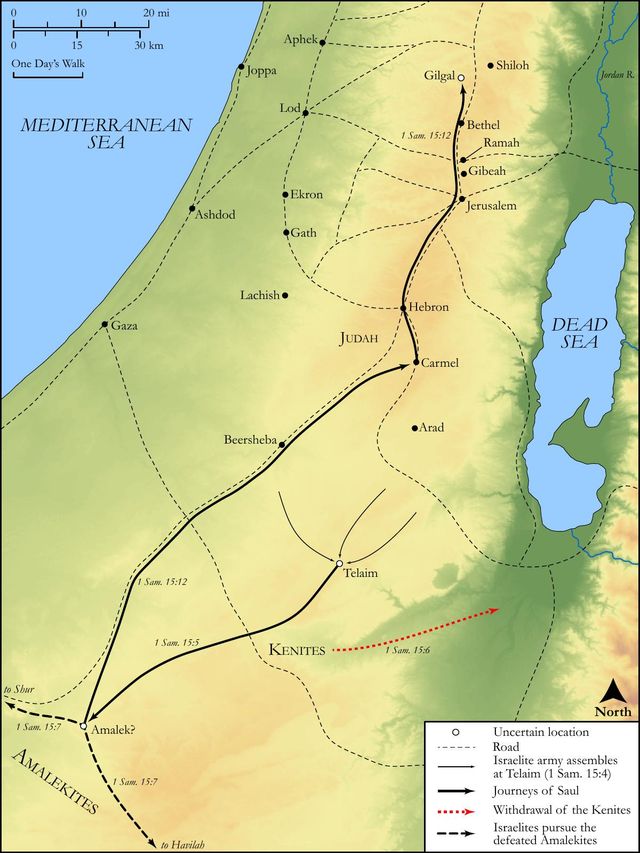
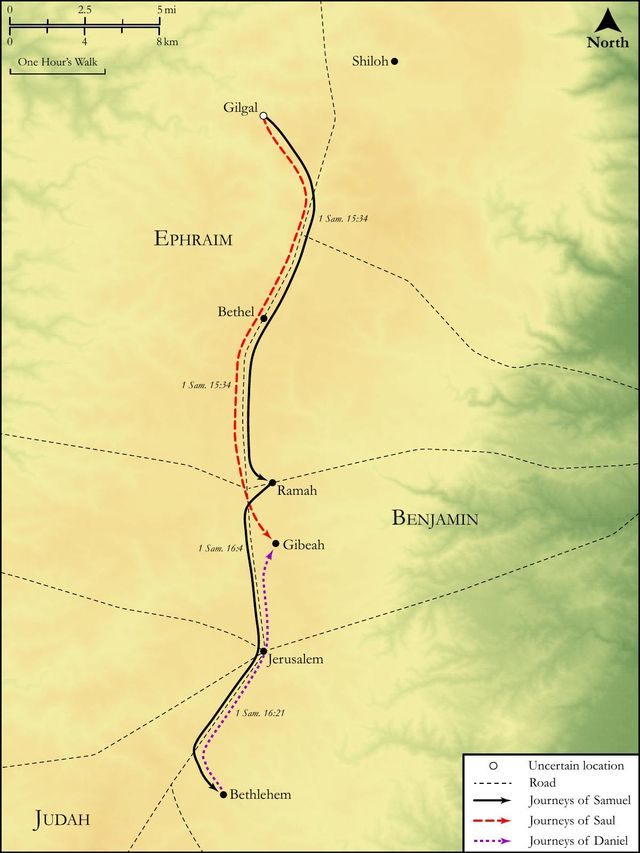
Samuel, being sent of God to him with these heavy tidings, went, as Ezekiel, in bitterness of soul, to meet him, perhaps according to an appointment when Saul went forth on this expedition, for Saul had come to Gilgal (Sa1 15:12), the place where he was made king (Sa1 11:15), and were now he would have been confirmed if he had approved himself well in the trial of his obedience. But Samuel was informed that Saul had set up a triumphal arch, or some monument of his victory, at Carmel, a city in the mountains of Judah, seeking his own honour more than the honour of God, for he set up this place (or hand, as the word is) for himself (he had more need to have been repenting of his sin and making his peace with God than boasting of his victory), and also that he had marched in great state to Gilgal, for this seems to be intimated in the manner of expression: He has gone about, and passed on, and gone down, with a great deal of pomp and parade. There Samuel gave him the meeting, and,
1.Saul makes his boast to Samuel of his obedience, because that was the thing by which he was now to signalize himself (Sa1 15:13): "Blessed be thou of the Lord, for thou sendest me upon a good errand, in which I have had great success, and I have performed the commandment of the Lord." It is very likely, if his conscience had now flown in his face at this time and charged him with disobedience, he would not have been so forward to proclaim his disobedience; for by this he hoped to prevent Samuel's reproving him. Thus sinners think, by justifying themselves, to escape being judged of the Lord; whereas the only way to do that is by judging ourselves. Those that boast most of their religion may be suspected of partiality and hypocrisy in it.
2.Samuel convicts him by a plain demonstration of his disobedience. "Hast thou performed the commandment of the Lord? What means then the bleating of the sheep?" Sa1 15:14. Saul would needs have it thought than God Almighty was wonderfully beholden to him for the good service he had done; but Samuel shows him that God was so far from being a debtor to him that he had just cause of action against him, and produces for evidence the bleating of the sheep, and the lowing of the oxen, which perhaps Saul appointed to bring up the rear of his triumph, but Samuel appears to them as witnesses against him. He needed not go far to disprove his professions. The noise the cattle made (like the rust of silver, Jam 5:3) would be a witness against him. Note, It is no new thing for the plausible professions and protestations of hypocrites to be contradicted and disproved by the most plain and undeniable evidence. Many boast of their obedience to the command of God; but what mean then their indulgence of the flesh, their love of the world, their passion and uncharitableness, and their neglect of holy duties, which witness against them?
3.Saul insists upon his own justification against this charge, Sa1 15:15. The fact he cannot deny; the sheep and oxen were brought from the Amalekites. But,
(1.)It was not his fault, for the people spared them; as if they durst have done it without the express orders of Saul, when they knew it was against the express orders of Samuel. Note, Those that are willing to justify themselves are commonly very forward to condemn others, and to lay the blame upon any rather than take it to themselves. Sin is a brat that nobody cares to have laid at his doors. It is the sorry subterfuge of an impenitent heart, that will not confess its guilt, to lay the blame on those that were tempters, or partners, or only followers in it.
(2.)It was with a good intention: "It was to sacrifice to the Lord thy God. He is thy God, and thou wilt not be against any thing that is done, as this is, for his honour." This was a false plea, for both Saul and the people designed their own profit in sparing the cattle. But, if it had been true, it would still have been frivolous, for God hates robbery for burnt-offering. God appointed these cattle to be sacrificed to him in the field, and therefore will give those no thanks that bring them to be sacrificed at his altar; for he will be served in his own way, and according to the rule he himself has prescribed. Nor will a good intention justify a bad action.
4.Samuel overrules, or rather overlooks, his plea, and proceeds, in God's name, to give judgment against him. He premises his authority. What he was about to say was what the Lord had said to him (Sa1 15:16), otherwise he would have been far from passing so severe a censure upon him. Those who complain that their ministers are too harsh with them should remember that, while they keep to the word of God, they are but messengers, and must say as they are bidden, and therefore be willing, as Saul himself here was, that they should say on. Samuel delivers his message faithfully.
(1.)He reminds Saul of the honour of God had done him in making him king (Sa1 15:17), when he was little in his own sight. God regarded the lowness of his state and rewarded the lowliness of his spirit. Note, Those that are advanced to honour and wealth ought often to remember their mean beginnings, that they may never think highly of themselves, but always study to do great things for the God that had advanced them.
(2.)He lays before him the plainness of the orders he was to execute (Sa1 15:18): The Lord sent thee on a journey; so easy was the service, and so certain the success, that it was rather to be called a journey than a war. The work was honourable, to destroy the sworn enemies of God and Israel; and had he denied himself, and set aside the consideration of his own profit so far as to have destroyed all that belonged to Amalek, he would have been no loser by it at last, nor have gone this warfare on his own charges. God would no doubt have made it up to him, so that he should have no need of spoil. And therefore,
(3.)He shows him how inexcusable he was in aiming to make a profit of this expedition, and to enrich himself by it (Sa1 15:19): "Wherefore then didst thou fly upon the spoil, and convert that to thy own use which was to have been destroyed for God's honour?" See what evil the love of money is the root of; but see what is the sinfulness of sin, and that in it which above any thing else makes it evil in the sight of the Lord. It is disobedience: Thou didst not obey the voice of the Lord.
5.Saul repeats his vindication of himself, as that which, in defiance of conviction, he resolved to abide by, Sa1 15:20, Sa1 15:21. He denies the charge (Sa1 15:20): "Yea, I have obeyed, I have done all I should do;" for he had done all which he thought he needed to do, so much wiser was he in his own eyes than God himself. God bade him kill all, and yet he puts in among the instances of his obedience that he brought Agag alive, which he thought was as good as if he had killed him. Thus carnal deceitful hearts think to excuse themselves from God's commandments with their own equivalents. He insists upon it that he has utterly destroyed the Amalekites themselves, which was the main thing intended; but, as to the spoil, he owns it should have been utterly destroyed; so that he knew his Lord's will, and was under no mistake about the command. But he thought that would be wilful waste; the cattle of the Midianites was taken for a prey in Moses's time (Num 31:32, etc.), and why not the cattle of the Amalekites now? Better it should be prey to the Israelites than to the fowls of the air and the wild beasts; and therefore he connived at the people's carrying it away. But it was their doing and not his; and, besides, it was for sacrifice to the Lord here at Gilgal, whither they were now bringing them. See what a hard thing it is to convince the children of disobedience of their sin and to strip them of their fig-leaves.
6.Samuel gives a full answer to his apology, since he did insist upon it, Sa1 15:22, Sa1 15:23. He appeals to his own conscience: Has the Lord as great delight in sacrifices as in obedience? Though Saul was not a man of any great acquaintance with religion, yet he could not but know this,
(1.)That nothing is so pleasing to God as obedience, no, not sacrifice and offering, and the fat of rams. See here what we should seek and aim at in all the exercises of religion, even acceptance with God, that he may delight in what we do. If God be well pleased with us and our services, we are happy, we have gained our point, but otherwise to what purpose is it? Isa 1:11. Now here we are plainly told that humble, sincere, and conscientious obedience to the will of God, is more pleasing and acceptable to him than all burnt-offerings and sacrifices. A careful conformity to moral precepts recommends us to God more than all ceremonial observances, Mic 6:6-8; Hos 6:6. Obedience is enjoyed by the eternal law of nature, but sacrifice only by a positive law. Obedience was the law of innocency, but sacrifice supposes sin come into the world, and is but a feeble attempt to take that away which obedience would have prevented. God is more glorified and self more denied by obedience than by sacrifice. It is much easier to bring a bullock or lamb to be burnt upon the altar than to bring every high thought into obedience to God and the will subject to his will. Obedience is the glory of angels (Psa 103:20), and it will be ours.
(2.)That nothing is so provoking to God as disobedience, setting up our wills in competition with his. This is here called rebellion and stubbornness, and is said to be as bad as witchcraft and idolatry, Sa1 15:23. It is as bad to set up other gods as to live in disobedience to the true God. Those that are governed by their own corrupt inclinations, in opposition to the command of God, do, in effect, consult the teraphim (as the word here is for idolatry) or the diviners. It was disobedience that made us all sinners (Rom 5:19), and this is the malignity of sin, that it is the transgression of the law, and consequently it is enmity to God, Rom 8:7. Saul was a king, but if he disobey the command of God, his royal dignity and power will not excuse him from the guilt of rebellion and stubbornness. It is not the rebellion of the people against their prince, but of a prince against God, that this text speaks of.
7.He reads his doom: in short, "Because thou has rejected the word of the Lord, hast despised it (so the Chaldee), hast made nothing of it (so the Septuagint), hast cast off the government of it, therefore he has rejected thee, despised and made nothing of thee, but cast thee off from being king. He that made thee king has determined to unmake thee again." Those are unfit and unworthy to rule over men who are not willing that God should rule over them.
Historical interpretation
Historical reception
3 surviving comments on this verse. Each one is dated, so this reads as a timeline rather than a list.
Select a marker to jump to its quote. Markers stagger vertically where authors wrote within a few decades of each other.
Thus Saul, after merit of humility, became swollen with pride, when in the height of power: for his humility he was preferred, for his pride rejected; as the Lord attests, who says, "When you were little in your own sight, did I not make you the head of the tribes of Israel?" He had before seen himself little in his own eyes, but, when propped up by temporal power, he no longer saw himself little. For, preferring himself in comparison with others because he had more power than all, he esteemed himself great above all. Yet in a wonderful way, when he was little with himself, he was great with God; but, when he appeared great with himself, he was little with God. Thus commonly, while the mind is inflated from an affluence of subordinates, it becomes corrupted to a flux of pride, the very summit of power being pander to desire.
Hence against the proud Saul it is said: "When you were little in your own eyes, you were made head among the tribes of Israel." As if it were openly said: When you saw yourself as little, I made you great above others. But because you now see yourself as great, you are esteemed little by me.
And Samuel said: Were you not small in your own eyes? etc. And this rebuke of blessed Samuel is fitting for any Christian transgressing the faith with which he was imbued; someone saying to him, one of the spiritual teachers, whose likeness Samuel presents: Were you not humbled in your mind for the past life, which was without God, when you came to the Church, having already received the grace of faith and baptism, made a principal in exercising the fruits of the Spirit? Through which you should reach the vision of divine clarity. For Israel means a man seeing God. And the Lord anointed you with the chrism of His Spirit, so that being a ruler and moderator of good deeds you might belong to the dominion of the eternal King. And sending you on the way of a new conversation, having defeated the old man with his deeds, He commanded you to mortify all things which are earthly part by part. Why then, disregarding the evangelical and apostolic voice, did you prefer to establish another rule of living for yourself, and to gather the spoils of vices? in which sometimes even if you seemed to deceive the eyes of mortals, before the judgment of the internal arbiter you did a great evil.
Continue studying 1 Samuel 15:17 across the web’s major study libraries — every link below opens this exact verse, chapter, or book on the destination site.
Read & Compare
 BibleGatewayThis verse in more than 200 translations and 70 languages.
 Bible.comThe YouVersion reader — hundreds of translations, reading plans, and highlights.
 ESV.orgCrossway's official English Standard Version reader.
 NET BibleThe NET translation with 60,000+ translators' notes on every rendering decision.
 STEP BibleTyndale House's free study tool — original text, vocabulary, and scholarly resources.
 BibliaLogos Bible Software's free web reader.
 USCCBThe New American Bible (Revised Edition) with the U.S. bishops' study notes.
Commentaries
 BibleHub CommentariesDozens of classic commentaries on this verse, gathered on one page.
 StudyLightMore than 100 commentary sets — the largest collection on the web.
 BibleRefPlain-English commentary on what this verse means, verse by verse.
 Enduring WordDavid Guzik's free commentary on this chapter, widely used by Bible teachers.
 Bible Study ToolsVerse commentary alongside Greek and Hebrew study aids.
Original Language & Research
- BibleHub InterlinearThe verse word by word — original language, transliteration, and English.
- BibleHub LexiconEvery word's original-language definition and Strong's entry.
 Blue Letter BibleDeep-study tools — Strong's numbers, concordance, and word studies.
 SefariaThe Hebrew text with Rashi and centuries of Jewish commentary.
Sermons, Hymns & Audio


TrulyRandomVerse is not affiliated with these sites and doesn’t control their content. They’re linked because they’re genuinely useful.
Summary
In 1 Samuel 15:17, the prophet Samuel delivers a profound and cutting rebuke to King Saul, sharply contrasting Saul's initial, divinely favored humility with his current state of pride and disobedience. Samuel reminds Saul that his elevation to the kingship over Israel was not a result of his own merit or perceived greatness, but a sovereign act of the LORD, who chose and anointed him precisely when he viewed himself as insignificant. This pivotal statement underscores the enduring spiritual principle that God exalts the humble, while simultaneously highlighting the catastrophic consequences of pride and partial obedience for those entrusted with divine authority and leadership.
Context
ShowHideLiterary Context
This verse is strategically placed at a climactic moment in the narrative of King Saul's reign, serving as the immediate prelude to Samuel's definitive pronouncement of God's rejection of Saul. The preceding verses detail Saul's incomplete obedience to God's explicit command, delivered through Samuel, to utterly destroy the Amalekites and all their possessions (the cherem command, found in 1 Samuel 15:2-3). Saul, under the pretense of offering sacrifices, spared Agag, the Amalekite king, and the best of the livestock. Samuel's arrival and the subsequent, devastating declaration that "to obey is better than sacrifice" (1 Samuel 15:22) are directly framed by this verse, which functions as a powerful rhetorical question. It aims to expose the root cause of Saul's disobedience: a fundamental departure from the humility that once characterized him, harking back to Saul's initial self-perception in 1 Samuel 9:21, where he questioned his suitability for kingship due to his humble tribal origins.
Historical & Cultural Context
Saul's anointing marked a monumental shift for Israel, transitioning from a tribal confederacy led by charismatic judges to a centralized monarchy. Unlike the kings of surrounding nations who often claimed divine descent or inherent power, Israel's king was distinctively meant to be a servant of Yahweh, bound by covenant and subject to prophetic authority. The sacred act of anointing with oil (1 Samuel 10:1) signified divine selection, consecration, and empowerment for a specific office, placing the king under a profound spiritual obligation to obey God's commands without reservation. The command to destroy the Amalekites was not arbitrary; it was rooted in ancient history and divine judgment against a people who had perpetually opposed Israel and God's purposes (Exodus 17:14-16). Saul's failure to fully execute this cherem command was therefore not merely a tactical misstep but a profound act of rebellion against the very God who had elevated him, demonstrating a fundamental disregard for the unique nature of Israel's theocratic kingship.
Key Themes
ShowHideThis verse powerfully encapsulates several overarching themes prevalent throughout the books of Samuel and indeed, the broader biblical narrative. Firstly, it highlights the theme of Humility and Divine Favor, illustrating God's consistent pattern of choosing and exalting those who are "little in their own sight," a principle vividly demonstrated later in the selection of David (1 Samuel 16:7). Secondly, it starkly exposes the Dangers of Pride and Self-Reliance, showing how a departure from humility can inevitably lead to disobedience and, ultimately, spiritual downfall and rejection. Saul's tragic shift from a humble individual to one acting independently of God's clear command serves as a potent cautionary tale, echoing the timeless biblical principle that pride goes before destruction, and a haughty spirit before a fall. Thirdly, the verse underscores Obedience as the Foundation of God-ordained Leadership. Saul's anointing as "head of the tribes of Israel" carried with it an absolute expectation of faithful submission to God's word, making his partial obedience a fundamental breach of his divine mandate. Finally, it reinforces the theme of God's Sovereignty in Choosing Leaders, emphasizing that Saul's position was not a human achievement or a matter of popular vote, but a direct, unmerited act of divine will, thereby intensifying his accountability to the Almighty.
Exposition and Analysis
ShowHideKey Word Analysis
ShowHideThis adjective (H6996, קָטָן) literally means "small," "insignificant," or "young." In this critical context, it refers to Saul's humble self-assessment and profound lack of self-importance prior to his elevation to kingship. He genuinely saw himself as coming from the smallest tribe, Benjamin, and the least significant family within it (1 Samuel 9:21). Samuel's pointed use of this word serves as a sharp rhetorical tool, reminding Saul of the very quality—humility—that made him a candidate for God's favor, a quality he has now tragically lost.
This proper noun (H3068, יְהֹוָה) is the self-existent, eternal name of God, often translated as "Jehovah" or "the Lord." It is the covenant name of Israel's God, emphasizing His absolute sovereignty, faithfulness, and unique relationship with His people. When Samuel states that "the LORD anointed thee king," he underscores that Saul's kingship was not a human appointment but a direct, unmerited act of the sovereign God of Israel. This divine origin of Saul's authority is crucial, as it magnifies his accountability for his subsequent disobedience.
The verb (H4886, מָשַׁח) means "to rub with oil," "to smear," or "to anoint." In ancient Israel, anointing with oil was a sacred ritual signifying divine selection, consecration, and empowerment for a specific office, particularly for prophets, priests, and kings. When Samuel reminds Saul that "the LORD anointed thee king over Israel," he emphasizes that Saul's authority was not self-derived or humanly conferred, but directly from God. This divine anointing carried with it the absolute expectation of complete obedience and unwavering accountability to the One who had chosen him.
Verse Breakdown
ShowHide"And Samuel said"
This opening phrase immediately establishes the gravity and divine authority of the words that follow. Samuel is speaking not merely as a man, but as God's prophet, delivering a direct message from the LORD Himself. This sets the stage for a confrontation of immense spiritual significance.
"When thou [wast] little in thine own sight"
This powerful clause serves as a direct and poignant recall to Saul's initial state of humility and self-effacement before his elevation to the throne. It points to a time when Saul did not rely on his own strength, status, or wisdom, but genuinely recognized his own insignificance and utter dependence on God. This humility was a key characteristic that made him receptive to God's call and choice.
"[wast] thou not [made] the head of the tribes of Israel"
This is the first part of Samuel's piercing rhetorical question, designed to highlight God's sovereign and gracious act of elevating Saul from obscurity to the highest position of leadership in the entire nation. It emphasizes that Saul's kingship was a divine gift, not an earned right or a result of his own ambition, thereby increasing his responsibility.
"and the LORD anointed thee king over Israel?"
This second part of the rhetorical question powerfully reiterates the divine source of Saul's authority. The explicit mention of "the LORD" performing the anointing highlights God's direct involvement and Saul's sacred obligation and covenantal bond to Him. The question implicitly accuses Saul of betraying this divine trust and anointing through his disobedience.
Literary Devices
ShowHideSamuel's statement in 1 Samuel 15:17 is masterfully crafted, employing several literary devices to amplify its impact and convey its profound message. The most prominent is the Rhetorical Question, "When thou [wast] little in thine own sight, [wast] thou not [made] the head of the tribes of Israel, and the LORD anointed thee king over Israel?" This question is not posed to elicit information but to make an emphatic point, forcing Saul to confront the undeniable truth of his past and present. This leads to a stark Contrast between Saul's initial humility (the "little in thine own sight") and his current pride and self-will, as well as between God's gracious elevation and Saul's subsequent disobedience. There is also a powerful element of Irony at play; the very humility that qualified Saul for the throne is now conspicuously absent, directly leading to his rejection. The phrase "little in thine own sight" also functions as a Metonymy, where "little" stands for the humble, dependent, and self-effacing disposition that God consistently favors. Furthermore, the passage embodies a classic example of Prophetic Rebuke, a common and vital feature in prophetic literature, where a prophet confronts a leader or the nation with their sin, often recalling past divine acts of grace and favor to highlight the severity of present transgression and its consequences.
Theological and Thematic Connections
ShowHideThis verse serves as a profound theological statement about God's character, His principles for leadership, and the nature of true spiritual authority. It reveals that God often chooses the humble and the lowly, not the outwardly impressive or self-assured, to accomplish His grand purposes. This divine preference for humility is not arbitrary but reflects God's desire for His chosen ones to depend entirely on Him, ensuring that His power, not human strength or wisdom, is glorified. Saul's tragic trajectory vividly illustrates the devastating spiritual truth that pride is not merely a character flaw but a direct affront to God's sovereignty and a gateway to profound disobedience. When one ceases to see themselves as "little" in God's sight, they begin to act independently, substituting their own will for God's, leading to a forfeiture of divine favor and authority. The anointing, a symbol of divine empowerment and selection, becomes a mark of absolute accountability, and its breach carries severe, even kingdom-altering, consequences.
Reflection and Application
ShowHide1 Samuel 15:17 offers a timeless and piercing challenge for every believer, especially those in positions of influence or aspiring to leadership within the church or society. It compels us to regularly and honestly examine the posture of our hearts: Do we still see ourselves as "little" in God's sight, acknowledging our absolute dependence on Him for every breath, every gift, and every success? Or has pride subtly crept in, causing us to lean on our own understanding, abilities, or perceived achievements, slowly eroding our reliance on God? The verse powerfully reminds us that true spiritual authority and lasting impact stem not from self-confidence, human accolades, or strategic brilliance, but from a profound humility that recognizes God as the sole source of all power, wisdom, and blessing. Our consistent and complete obedience to God's clear commands, even when inconvenient, unpopular, or seemingly illogical, is the ultimate test of our humility and devotion. To maintain a vibrant walk with God and to remain effective in His service, we must continually surrender our will, our plans, and our pride, remembering that it is God alone who exalts and God alone who brings low.
Questions for Reflection
ShowHideFAQ
ShowHideWhy did God choose Saul if He knew he would fail?
ShowHideGod's choice of Saul, despite His divine foreknowledge of Saul's eventual failure, highlights several profound theological truths. Firstly, it demonstrates God's absolute sovereignty and His willingness to work through human choices, even flawed ones, to achieve His broader redemptive purposes. Saul's reign served as a crucial object lesson for Israel about the true nature of kingship—that a king must be a faithful servant of God, not merely a charismatic or militarily successful leader. It also underscored the paramount importance of obedience over ritualistic sacrifice, a lesson Israel desperately needed to learn as they transitioned into a monarchy. While God possesses perfect knowledge of all outcomes, He graciously grants humanity genuine free will. Saul's ultimate failure was not due to a lack of divine enablement or opportunity, but directly to his own choices of disobedience, self-will, and pride. God's ultimate plan of salvation, culminating in the perfect King, Jesus Christ, was always in motion, and even Saul's reign, with its inherent flaws, contributed to the unfolding of that grand narrative, revealing the inadequacy of human leadership apart from absolute submission to God's will, as outlined in the laws for kings in Deuteronomy 17:14-20.
What does "little in thine own sight" mean for believers today?
ShowHideFor believers today, the phrase "little in thine own sight" signifies a posture of profound humility, self-awareness, and an acute recognition of one's utter dependence on God. It does not advocate for self-deprecation or a lack of confidence in God-given abilities, but rather the humble acknowledgment that any strength, wisdom, talent, or success we possess originates solely from Him. It means prioritizing God's will and glory above our own desires, ambitions, or perceived achievements, understanding that our plans are secondary to His divine purpose. This profound humility is the fertile ground for God's grace and power to operate effectively within us, as He consistently promises to give grace to the humble and to lift up those who humble themselves before Him (James 4:6). It is a call to live with a servant's heart, recognizing that our true identity, worth, and significance are found securely in Christ, not in our accomplishments, status, or human approval. As the Apostle Paul famously declared, "When I am weak, then I am strong," for it is precisely in our weakness and humble reliance that Christ's perfect power is made manifest (2 Corinthians 12:9-10).
Christ-Centered Fulfillment
ShowHideThe narrative of Saul, particularly the poignant reminder in 1 Samuel 15:17, finds its profound Christ-centered fulfillment in the person and redemptive work of Jesus. Saul, chosen by God when "little in his own sight" and divinely anointed king, ultimately failed due to his pride and persistent disobedience, tragically demonstrating the inherent limitations and corruptibility of human kingship, even when divinely initiated. In stark and glorious contrast, Jesus, though eternally God and co-equal with the Father, perfectly embodied the spirit of being "little in His own sight," not out of inherent insignificance but out of profound, self-emptying, and redemptive humility. He "made Himself nothing, taking the very nature of a servant, being made in human likeness" (Philippians 2:7). Unlike Saul, whose anointing was for a temporary earthly reign that ended in rejection, Jesus was eternally anointed by the Holy Spirit not merely as an earthly king, but as the eternal King, the perfect High Priest, and the ultimate Prophet, commissioned to preach good news to the poor, heal the brokenhearted, proclaim freedom for the prisoners, and release the oppressed (Luke 4:18-19). Where Saul's partial obedience and pride led to his rejection and the loss of his kingdom, Jesus' perfect, unwavering obedience, even to the point of agonizing death on a cross (Philippians 2:8), secured eternal salvation and everlasting life for all who believe in Him. He is the true and faithful King, the spotless Lamb of God who takes away the sin of the world (John 1:29), who perfectly fulfills every divine mandate and invites us into His eternal kingdom, not through our own merit, but solely through His sacrificial love and boundless grace (John 3:16).