


1 Samuel 15:16
Bible text: King James Version (1769 Blayney text) · Public domain
Bible text: Berean Standard Bible · Public domain
Bible text: American Standard Version (1901) · Public domain
Bible text: World English Bible, Messianic edition · Public domain
Bible text: Geneva Bible (1599) · Public domain
Bible text: Young's Literal Translation · Public domain
- וַיֹּאמֶרvai·Yo·merand he saidH559Conj-w ¦ V-Qal-ConsecImperf-3msVerb Qal Consecutive Imperfect 3rd Singular Masculineוַandיֹּאמֶרhe said
- שְׁמוּאֵלshe·mu·'ElSamuelH8050N-proper-mNoun Proper Masculine
- אֶל'eltoH413PrepPreposition
- שָׁאוּלsha·'UlSaulH7586N-proper-mNoun Proper Masculine
- הֶרֶףHe·refbe quietH7503V-Hiphil-Imp-2msVerb Hiphil Imperative 2nd Singular Masculine
- וְאַגִּידָהve·'a·Gi·dahso let me tellH5046Conj-w ¦ V-Hiphil-Imperf-1csVerb Hiphil Imperfect 1st Singular common genderוְsoאַגִּידָהlet me tell
- לְּךָle·Khato <the> youPrep-l ¦ 2msSuffix Personal 2nd Singular Masculineלְּto <the>ךָyou
- אֵת'et<obj.>H853DirObjMParticle Object Indicator
- אֲשֶׁר'a·Sher[that] whichH834RelParticle Relative
- דִּבֶּרdi·Berhe saidH1696V-Piel-Perf-3msVerb Piel Perfect 3rd Singular Masculine
- יְהוָהYah·wehYahwehH3068N-properNoun Proper Title
- אֵלַי'e·Laito meH413Prep ¦ 1csPreposition Definiteאֵלַtoיme
- הַלָּיְלָהha·La·ye·lahthis nightH3915Art ¦ N-msNoun Singular Masculine Absoluteהַthisלָּיְלָהnight
- וַיֹּאמֶרvai·yo·me·ruand he saidH559Conj-w ¦ V-Qal-ConsecImperf-3msVerb Qal Consecutive Imperfect 3rd Singular Masculineוַandיֹּאמֶרhe said
- לוֹloto <the> himPrep-l ¦ 3msSuffix Personal 3rd Singular Masculineלto <the>וֹhim
- דַּבֵּרda·BerspeakH1696V-Piel-Imp-2msVerb Piel Imperative 2nd Singular Masculine
English is a literal word-by-word gloss of the Hebrew, not the KJV's wording. Why?
This is the original text the KJV's translators worked from — each Hebrew word with its own literal English meaning in this verse, prepared by scholars at Tyndale House, Cambridge. The KJV translates whole sentences, not word by word, so its wording differs: one Hebrew word can become several English words, and the KJV may choose “the LORD” where the gloss reads “Yahweh”. Both are faithful — they answer different questions. For the KJV's own rendering, switch to the KJV text.
Details
See on the biblical-era maps
Study this verse
Public-domain commentary
Matthew Henry
From his Commentary on the Whole Bible. Henry comments on passages, not single verses — this entry covers 1 Samuel 15:10–23. His three-level outline is real structure in the source text, so it is rendered as structure.
Saul is here called to account by Samuel concerning the execution of his commission against the Amalekites; and remarkable instances we are here furnished with of the strictness of the justice of God and the treachery and deceitfulness of the heart of man. We are here told,
I.What passed between God and Samuel, in secret, upon this occasion, Sa1 15:10, Sa1 15:11.
1.God determines Saul's rejection, and acquaints Samuel with it: It repenteth me that I have set up Saul to be king. Repentance in God is not, as it is in us, a change of his mind, but a change of his method or dispensation. He does not alter his will, but wills an alteration. The change was in Saul: He has turned back from following me; this construction God put upon the partiality of his obedience, and the prevalency of his covetousness. And hereby he did himself make God his enemy. God repented that he had given Saul the kingdom and the honour and power that belonged to it: but he never repented that he had given any man wisdom and grace, and his fear and love; these gifts and callings of God are without repentance.
2.Samuel laments and deprecates it. It grieved Samuel that Saul had forfeited God's favour, and that God had resolved to cast him off; and he cried unto the Lord all night, spent a whole night in interceding for him, that this decree might not go forth against him. When others were in their beds sleeping, he was upon his knees praying and wrestling with God. He did not thus deprecate his own exclusion from the government; nor was he secretly pleased, as many a one would have been, that Saul, who succeeded him, was so soon laid aside, but on the contrary prayed earnestly for his establishment, so far was he from desiring that woeful day. The rejection of sinners is the grief of good people; God delights not in their death, nor should we.
II.What passed between Samuel and Saul in public.
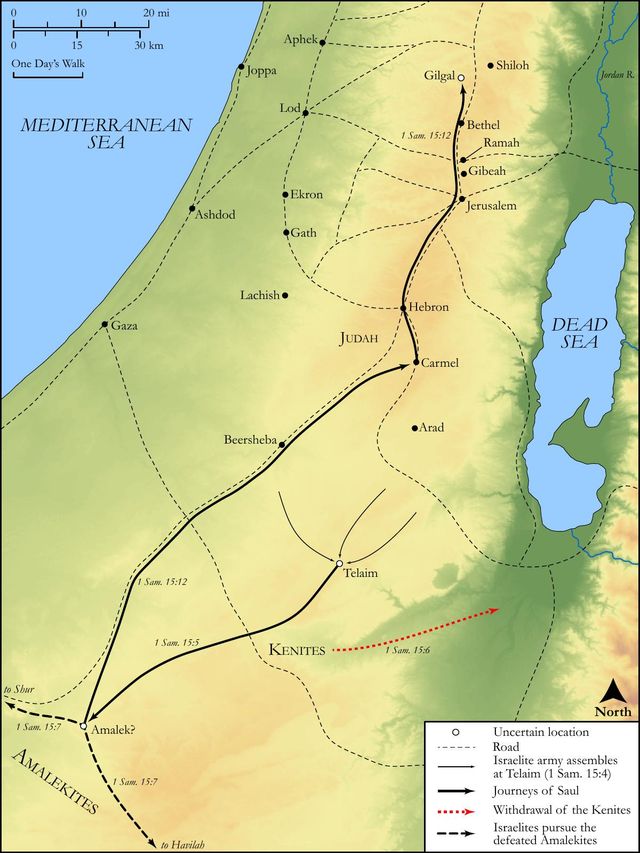
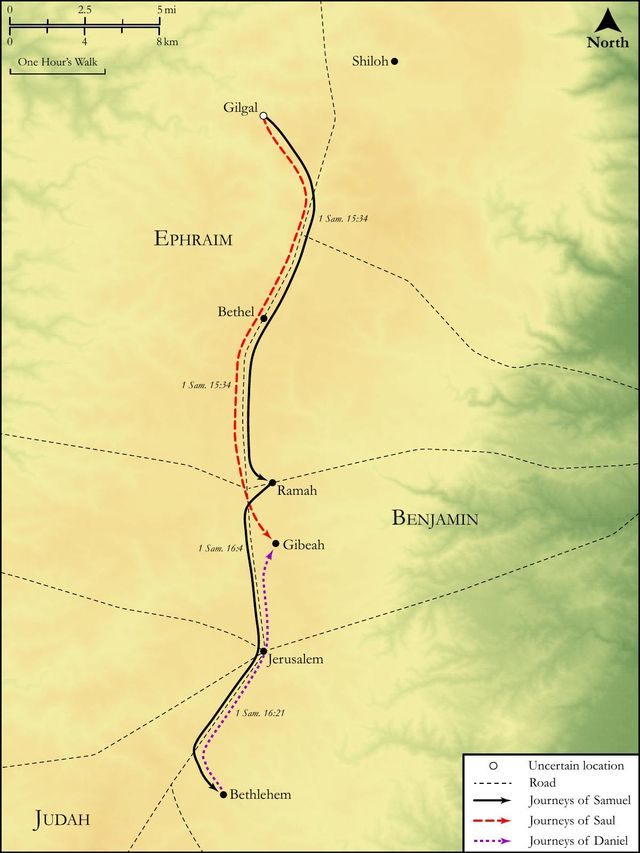
Samuel, being sent of God to him with these heavy tidings, went, as Ezekiel, in bitterness of soul, to meet him, perhaps according to an appointment when Saul went forth on this expedition, for Saul had come to Gilgal (Sa1 15:12), the place where he was made king (Sa1 11:15), and were now he would have been confirmed if he had approved himself well in the trial of his obedience. But Samuel was informed that Saul had set up a triumphal arch, or some monument of his victory, at Carmel, a city in the mountains of Judah, seeking his own honour more than the honour of God, for he set up this place (or hand, as the word is) for himself (he had more need to have been repenting of his sin and making his peace with God than boasting of his victory), and also that he had marched in great state to Gilgal, for this seems to be intimated in the manner of expression: He has gone about, and passed on, and gone down, with a great deal of pomp and parade. There Samuel gave him the meeting, and,
1.Saul makes his boast to Samuel of his obedience, because that was the thing by which he was now to signalize himself (Sa1 15:13): "Blessed be thou of the Lord, for thou sendest me upon a good errand, in which I have had great success, and I have performed the commandment of the Lord." It is very likely, if his conscience had now flown in his face at this time and charged him with disobedience, he would not have been so forward to proclaim his disobedience; for by this he hoped to prevent Samuel's reproving him. Thus sinners think, by justifying themselves, to escape being judged of the Lord; whereas the only way to do that is by judging ourselves. Those that boast most of their religion may be suspected of partiality and hypocrisy in it.
2.Samuel convicts him by a plain demonstration of his disobedience. "Hast thou performed the commandment of the Lord? What means then the bleating of the sheep?" Sa1 15:14. Saul would needs have it thought than God Almighty was wonderfully beholden to him for the good service he had done; but Samuel shows him that God was so far from being a debtor to him that he had just cause of action against him, and produces for evidence the bleating of the sheep, and the lowing of the oxen, which perhaps Saul appointed to bring up the rear of his triumph, but Samuel appears to them as witnesses against him. He needed not go far to disprove his professions. The noise the cattle made (like the rust of silver, Jam 5:3) would be a witness against him. Note, It is no new thing for the plausible professions and protestations of hypocrites to be contradicted and disproved by the most plain and undeniable evidence. Many boast of their obedience to the command of God; but what mean then their indulgence of the flesh, their love of the world, their passion and uncharitableness, and their neglect of holy duties, which witness against them?
3.Saul insists upon his own justification against this charge, Sa1 15:15. The fact he cannot deny; the sheep and oxen were brought from the Amalekites. But,
(1.)It was not his fault, for the people spared them; as if they durst have done it without the express orders of Saul, when they knew it was against the express orders of Samuel. Note, Those that are willing to justify themselves are commonly very forward to condemn others, and to lay the blame upon any rather than take it to themselves. Sin is a brat that nobody cares to have laid at his doors. It is the sorry subterfuge of an impenitent heart, that will not confess its guilt, to lay the blame on those that were tempters, or partners, or only followers in it.
(2.)It was with a good intention: "It was to sacrifice to the Lord thy God. He is thy God, and thou wilt not be against any thing that is done, as this is, for his honour." This was a false plea, for both Saul and the people designed their own profit in sparing the cattle. But, if it had been true, it would still have been frivolous, for God hates robbery for burnt-offering. God appointed these cattle to be sacrificed to him in the field, and therefore will give those no thanks that bring them to be sacrificed at his altar; for he will be served in his own way, and according to the rule he himself has prescribed. Nor will a good intention justify a bad action.
4.Samuel overrules, or rather overlooks, his plea, and proceeds, in God's name, to give judgment against him. He premises his authority. What he was about to say was what the Lord had said to him (Sa1 15:16), otherwise he would have been far from passing so severe a censure upon him. Those who complain that their ministers are too harsh with them should remember that, while they keep to the word of God, they are but messengers, and must say as they are bidden, and therefore be willing, as Saul himself here was, that they should say on. Samuel delivers his message faithfully.
(1.)He reminds Saul of the honour of God had done him in making him king (Sa1 15:17), when he was little in his own sight. God regarded the lowness of his state and rewarded the lowliness of his spirit. Note, Those that are advanced to honour and wealth ought often to remember their mean beginnings, that they may never think highly of themselves, but always study to do great things for the God that had advanced them.
(2.)He lays before him the plainness of the orders he was to execute (Sa1 15:18): The Lord sent thee on a journey; so easy was the service, and so certain the success, that it was rather to be called a journey than a war. The work was honourable, to destroy the sworn enemies of God and Israel; and had he denied himself, and set aside the consideration of his own profit so far as to have destroyed all that belonged to Amalek, he would have been no loser by it at last, nor have gone this warfare on his own charges. God would no doubt have made it up to him, so that he should have no need of spoil. And therefore,
(3.)He shows him how inexcusable he was in aiming to make a profit of this expedition, and to enrich himself by it (Sa1 15:19): "Wherefore then didst thou fly upon the spoil, and convert that to thy own use which was to have been destroyed for God's honour?" See what evil the love of money is the root of; but see what is the sinfulness of sin, and that in it which above any thing else makes it evil in the sight of the Lord. It is disobedience: Thou didst not obey the voice of the Lord.
5.Saul repeats his vindication of himself, as that which, in defiance of conviction, he resolved to abide by, Sa1 15:20, Sa1 15:21. He denies the charge (Sa1 15:20): "Yea, I have obeyed, I have done all I should do;" for he had done all which he thought he needed to do, so much wiser was he in his own eyes than God himself. God bade him kill all, and yet he puts in among the instances of his obedience that he brought Agag alive, which he thought was as good as if he had killed him. Thus carnal deceitful hearts think to excuse themselves from God's commandments with their own equivalents. He insists upon it that he has utterly destroyed the Amalekites themselves, which was the main thing intended; but, as to the spoil, he owns it should have been utterly destroyed; so that he knew his Lord's will, and was under no mistake about the command. But he thought that would be wilful waste; the cattle of the Midianites was taken for a prey in Moses's time (Num 31:32, etc.), and why not the cattle of the Amalekites now? Better it should be prey to the Israelites than to the fowls of the air and the wild beasts; and therefore he connived at the people's carrying it away. But it was their doing and not his; and, besides, it was for sacrifice to the Lord here at Gilgal, whither they were now bringing them. See what a hard thing it is to convince the children of disobedience of their sin and to strip them of their fig-leaves.
6.Samuel gives a full answer to his apology, since he did insist upon it, Sa1 15:22, Sa1 15:23. He appeals to his own conscience: Has the Lord as great delight in sacrifices as in obedience? Though Saul was not a man of any great acquaintance with religion, yet he could not but know this,
(1.)That nothing is so pleasing to God as obedience, no, not sacrifice and offering, and the fat of rams. See here what we should seek and aim at in all the exercises of religion, even acceptance with God, that he may delight in what we do. If God be well pleased with us and our services, we are happy, we have gained our point, but otherwise to what purpose is it? Isa 1:11. Now here we are plainly told that humble, sincere, and conscientious obedience to the will of God, is more pleasing and acceptable to him than all burnt-offerings and sacrifices. A careful conformity to moral precepts recommends us to God more than all ceremonial observances, Mic 6:6-8; Hos 6:6. Obedience is enjoyed by the eternal law of nature, but sacrifice only by a positive law. Obedience was the law of innocency, but sacrifice supposes sin come into the world, and is but a feeble attempt to take that away which obedience would have prevented. God is more glorified and self more denied by obedience than by sacrifice. It is much easier to bring a bullock or lamb to be burnt upon the altar than to bring every high thought into obedience to God and the will subject to his will. Obedience is the glory of angels (Psa 103:20), and it will be ours.
(2.)That nothing is so provoking to God as disobedience, setting up our wills in competition with his. This is here called rebellion and stubbornness, and is said to be as bad as witchcraft and idolatry, Sa1 15:23. It is as bad to set up other gods as to live in disobedience to the true God. Those that are governed by their own corrupt inclinations, in opposition to the command of God, do, in effect, consult the teraphim (as the word here is for idolatry) or the diviners. It was disobedience that made us all sinners (Rom 5:19), and this is the malignity of sin, that it is the transgression of the law, and consequently it is enmity to God, Rom 8:7. Saul was a king, but if he disobey the command of God, his royal dignity and power will not excuse him from the guilt of rebellion and stubbornness. It is not the rebellion of the people against their prince, but of a prince against God, that this text speaks of.
7.He reads his doom: in short, "Because thou has rejected the word of the Lord, hast despised it (so the Chaldee), hast made nothing of it (so the Septuagint), hast cast off the government of it, therefore he has rejected thee, despised and made nothing of thee, but cast thee off from being king. He that made thee king has determined to unmake thee again." Those are unfit and unworthy to rule over men who are not willing that God should rule over them.
Historical interpretation
Historical reception
1 surviving comment on this verse from the historical church.
But Samuel said to Saul: Leave me, and I will tell you, etc. Above, we read that Saul on the day was anointed king; on the day that he should be anointed, and now at night he is shown to be rejected. This is not by chance and without reason, but because the day sometimes signifies justice, night sin, he was chosen by day, and rejected by night, who due to the modesty of humility deserved to rule, due to the sin of disobedience he deserved to be rejected, not by divine judgment, but by the varying merit of man. But today the Lord saying: For many are called, but few are chosen (Matthew 20); whoever is called, by deeds of darkness is separated from the light of the chosen.
Continue studying 1 Samuel 15:16 across the web’s major study libraries — every link below opens this exact verse, chapter, or book on the destination site.
Read & Compare
 BibleGatewayThis verse in more than 200 translations and 70 languages.
 Bible.comThe YouVersion reader — hundreds of translations, reading plans, and highlights.
 ESV.orgCrossway's official English Standard Version reader.
 NET BibleThe NET translation with 60,000+ translators' notes on every rendering decision.
 STEP BibleTyndale House's free study tool — original text, vocabulary, and scholarly resources.
 BibliaLogos Bible Software's free web reader.
 USCCBThe New American Bible (Revised Edition) with the U.S. bishops' study notes.
Commentaries
 BibleHub CommentariesDozens of classic commentaries on this verse, gathered on one page.
 StudyLightMore than 100 commentary sets — the largest collection on the web.
 BibleRefPlain-English commentary on what this verse means, verse by verse.
 Enduring WordDavid Guzik's free commentary on this chapter, widely used by Bible teachers.
 Bible Study ToolsVerse commentary alongside Greek and Hebrew study aids.
Original Language & Research
- BibleHub InterlinearThe verse word by word — original language, transliteration, and English.
- BibleHub LexiconEvery word's original-language definition and Strong's entry.
 Blue Letter BibleDeep-study tools — Strong's numbers, concordance, and word studies.
 SefariaThe Hebrew text with Rashi and centuries of Jewish commentary.
Sermons, Hymns & Audio


TrulyRandomVerse is not affiliated with these sites and doesn’t control their content. They’re linked because they’re genuinely useful.
Summary
1 Samuel 15:16 captures a pivotal moment in the narrative of King Saul's reign, where the prophet Samuel authoritatively silences Saul's attempts at self-justification and prepares to deliver God's uncompromising verdict. This verse underscores Samuel's unwavering role as the direct messenger of the Lord, signaling the end of Saul's rationalizations and the imminent pronouncement of his rejection from kingship, thereby highlighting the severe consequences of disobedience to divine commands and the ultimate authority of God's word over human will.
Context
ShowHideLiterary Context
This verse is strategically positioned at the dramatic climax of the confrontation between Samuel and King Saul, immediately following Saul's disingenuous attempts to rationalize his partial obedience during the war against the Amalekites. God had issued a clear and absolute command to Saul to utterly destroy the Amalekites and all their possessions, an act of divine judgment known as herem (see God's explicit command to Saul). However, Saul, influenced by the people and his own desires for honor and spoils, spared Agag, the Amalekite king, and the best of the livestock, claiming they were intended for sacrifice (as detailed in Saul's partial obedience and his subsequent justification). Samuel, deeply grieved by God's decision to reject Saul as king (Samuel's sorrow), had already begun to confront Saul. Here, Samuel abruptly interrupts Saul's defensive posture, asserting his prophetic authority to deliver the Lord's unyielding word, thereby shifting the narrative decisively from human rationalization to the solemn weight of divine revelation and judgment.
Historical & Cultural Context
The command for herem (devotion to destruction) against the Amalekites was not a typical act of warfare but a unique, severe divine judgment against a people who had historically and consistently opposed Israel from the very beginning of their exodus from Egypt (see Amalek's attack on Israel). This practice demonstrated God's justice and Israel's role as His instrument of judgment. In ancient Israel, the prophet served as God's direct mouthpiece, often tasked with delivering messages that were unpopular, confrontational, and even condemnatory, particularly to kings. Unlike the absolute monarchies of surrounding nations, kingship in Israel was conditional; the king was always under the ultimate authority of Yahweh and His divine law, as mediated by the prophets. Saul's failure to fully obey demonstrated a fundamental misunderstanding of his role as God's anointed leader and a challenge to God's ultimate sovereignty, thereby undermining the very foundation of theocratic rule.
Key Themes
ShowHideThe immediate context of 1 Samuel 15:16 powerfully highlights several key themes central to the book of Samuel and broader biblical theology. Foremost is the theme of Obedience vs. Sacrifice, famously encapsulated in Samuel's later declaration that "to obey is better than sacrifice, and to hearken than the fat of rams." Saul's actions demonstrate a clear preference for outward religious ritual and human approval over heartfelt submission to God's explicit command. Another crucial theme is Divine Sovereignty and Accountability of Leadership. Even a king, chosen by God, is not above God's law and faces severe consequences for disobedience. Samuel's role as God's unwavering messenger underscores the Authority of God's Word and the Gravity of Disobedience, emphasizing that God's commands are not suggestions but binding decrees that demand complete adherence. This confrontation also touches on the Nature of True Repentance, contrasting Saul's self-justification with the genuine sorrow and change of heart God desires from His people.
Exposition and Analysis
ShowHideKey Word Analysis
ShowHideThis verb (H7503) means "to slacken," "cease," or "be still." In this context, Samuel's imperative "Stay!" is a forceful command to halt Saul's ongoing excuses and self-justification. It functions as an abrupt interruption, demanding Saul's immediate and undivided attention, signifying a crucial shift from Saul's narrative to Samuel's authoritative declaration of God's verdict. It conveys the gravity and finality of the message about to be delivered, a verbal "halt!" to Saul's attempts to control the conversation.
The use of the covenant name for God (H3068), "Jehovah" or "the self-Existent One," emphasizes that the message Samuel is about to deliver originates from the sovereign, unchanging God of Israel, not from Samuel's personal opinion or emotional reaction. This underscores the divine authority behind the pronouncement and the absolute truth of what is to follow, elevating the confrontation beyond a mere human dispute to a direct divine judgment from the God who is faithful to His word and covenant.
This imperative verb (H1696) means "to speak," "tell," or "declare." Saul's response, "Say on," while seemingly compliant, likely conveys a sense of resignation or grudging acceptance rather than eager anticipation or genuine humility. It marks his passive submission to hear the inevitable, having exhausted his attempts at self-vindication. It signifies that the king, now silenced by prophetic authority, grants permission for the prophet to deliver the unvarnished and unavoidable divine message.
Verse Breakdown
ShowHide"Then Samuel said unto Saul, Stay,"
This opening phrase immediately establishes Samuel's dominant position in the dialogue, asserting his prophetic authority over the king. The command "Stay" acts as an abrupt and forceful interruption to Saul's previous attempts at self-justification (1 Samuel 15:13-15). It demands Saul's immediate and undivided attention, signaling that the conversation is shifting from Saul's excuses to God's verdict. This imperative verb underscores the prophet's role as God's authoritative messenger, capable of silencing even a king.
"and I will tell thee what the LORD hath said to me this night."
Samuel clarifies his role not as an accuser speaking his own mind, but as a direct conduit for divine revelation. The phrase "what the LORD hath said to me this night" emphasizes the immediacy, directness, and divine origin of the message. The "this night" adds a layer of solemnity and urgency, implying Samuel has been wrestling with God over this very matter, and the message is fresh and unalterable. It underscores that God's word is precise, authoritative, and delivered with specific intent, leaving no room for human negotiation or reinterpretation.
"And he said unto him, Say on."
Saul's response is brief and to the point. Having been effectively silenced by Samuel's authoritative declaration, his "Say on" signifies a reluctant or resigned permission for Samuel to proceed. It marks a moment of submission to the prophetic word, not necessarily out of repentance, but out of an acknowledgment that Samuel speaks with an authority that transcends his own kingship. This phrase sets the stage for the devastating pronouncement of judgment that follows, highlighting Saul's forced acquiescence to the divine will he has so defiantly resisted.
Literary Devices
ShowHideThe exchange in 1 Samuel 15:16 is rich in literary devices that heighten its dramatic impact and theological significance. There is a strong sense of Dramatic Irony, as Saul believes his actions are justifiable and even pious, while the audience knows, through Samuel's grief and God's prior declaration (1 Samuel 15:11), that severe judgment is imminent. Samuel's command "Stay" and his declaration of a divine message serve as powerful Foreshadowing, building intense suspense for the devastating pronouncement of Saul's rejection. The dialogue itself is characterized by Authoritative Dialogue, where Samuel's direct, unyielding speech contrasts sharply with Saul's previous evasiveness and self-justification, highlighting the clash between human will and divine decree. The phrase "what the LORD hath said to me this night" employs Divine Revelation as a narrative device, emphasizing that the truth about to be revealed is not human opinion but the very word of God, lending ultimate weight and finality to Samuel's subsequent words.
Theological and Thematic Connections
ShowHide1 Samuel 15:16 serves as a powerful theological pivot, encapsulating the critical biblical theme of absolute obedience to God's explicit commands, particularly for those in positions of leadership. Samuel's unwavering delivery of God's word, even to the king, underscores the supreme authority of Yahweh over all human institutions and the non-negotiable nature of divine revelation. Saul's grudging "Say on" foreshadows the tragic consequences of a heart that prioritizes self-preservation and human approval over genuine submission to God's will. This moment highlights that God's word, once declared, demands a response—either humble obedience or defiant rejection—and carries with it the full weight of divine judgment or blessing. It reminds us that God is not mocked, and His standards of righteousness are immutable, requiring not just outward compliance but inward devotion and a heart fully yielded to His sovereign will.
Reflection and Application
ShowHideThe stark exchange in 1 Samuel 15:16 offers profound lessons for contemporary believers, challenging us to examine our own hearts when confronted with God's word, particularly when it exposes our shortcomings or calls for uncomfortable changes. Are we quick to justify our actions, offering excuses for partial obedience or outright disobedience, much like Saul? Or do we, like Samuel, stand firm in delivering or receiving God's truth, even when it is difficult and demands personal cost? This verse reminds us of the paramount importance of listening attentively to God's voice, whether through the clear teachings of Scripture, the wise counsel of godly mentors, or the convicting work of the Holy Spirit. True humility is demonstrated not by our ability to articulate elaborate defenses, but by our willingness to be silenced by God's truth and to respond with genuine repentance and a renewed commitment to full obedience. The narrative serves as a sobering reminder that our choices, especially in positions of influence or leadership, have far-reaching consequences, and ultimate accountability before God is inescapable.
Questions for Reflection
ShowHideFAQ
ShowHideWhy did Samuel emphasize "this night" when speaking to Saul?
ShowHideSamuel's emphasis on "this night" (Hebrew: הַלַּיְלָה, hallaylah, from H3915 layil) conveys several layers of meaning and significance. Firstly, it highlights the immediacy and recency of the divine revelation, underscoring that the message is fresh from God's presence and not a long-held personal grievance or a pre-meditated accusation. Secondly, it suggests the solemnity and urgency of the communication; often, significant divine encounters or pronouncements occurred during the night, a time of quiet, introspection, and spiritual intensity (e.g., God speaking to Jacob at night). For Samuel, it likely indicates a period of intense prayer, grief, and wrestling with God over Saul's profound disobedience and God's painful decision to reject him as king, making the message deeply personal and weighty for the prophet himself, and thus for the king. It underscores that this is not Samuel's opinion, but a direct, recent, and weighty word from the Lord.
What was Saul's attitude in saying "Say on"?
ShowHideSaul's "Say on" (Hebrew: דַּבֵּר, dabber, an imperative from H1696 dâbar) likely indicates a complex mixture of resignation, perhaps a grudging acknowledgment of Samuel's prophetic authority, and a sense of inevitability, rather than genuine eagerness or repentance. Having exhausted his attempts to justify his actions and deflect blame (as seen in 1 Samuel 15:13-15), Saul is now effectively silenced by Samuel's authoritative command to "Stay." His brief response suggests he knows he cannot escape the impending divine verdict. It is a passive acceptance to listen, born out of a cornered position and the recognition of Samuel's undeniable prophetic power, rather than an active desire to hear and humbly obey God's will. This contrasts sharply with the humility and eagerness to hear God's word that characterize truly righteous leaders (e.g., David's response to Nathan).
Christ-Centered Fulfillment
ShowHide1 Samuel 15:16, with Samuel delivering God's uncompromising word to a disobedient king, profoundly foreshadows the ultimate prophet and king, Jesus Christ. Samuel, as God's mouthpiece, stands as a type of Christ, who is the Word made flesh, the ultimate and perfect revelation of God to humanity. Unlike Saul, who failed in obedience and was rejected from his kingship, Jesus perfectly fulfilled all of God's commands, living a life of unblemished obedience even to the point of death on a cross. Saul's failure to fully destroy the Amalekites and his preference for his own will over God's command highlights the deep human need for a perfect King who would truly execute God's justice and establish His righteous kingdom. Jesus, the Lamb of God who takes away the sin of the world, perfectly offered Himself as the ultimate sacrifice, thereby fulfilling the spiritual reality that obedience is better than sacrifice through His complete and willing submission to the Father's will. Through His perfect life, atoning death, and victorious resurrection, Christ establishes an eternal and unshakable kingdom, founded not on human fallibility but on divine perfection, offering redemption and true life to all who believe in Him and obey His voice.