


1 Samuel 27:5
Bible text: King James Version (1769 Blayney text) · Public domain
Bible text: King James Version with Strong's numbers · Public domain
Bible text: Berean Standard Bible · Public domain
Bible text: American Standard Version (1901) · Public domain
Bible text: World English Bible, Messianic edition · Public domain
Bible text: Geneva Bible (1599) · Public domain
Bible text: Young's Literal Translation · Public domain
- וַיֹּאמֶרvai·Yo·merand he saidH559Conj-w ¦ V-Qal-ConsecImperf-3msVerb Qal Consecutive Imperfect 3rd Singular Masculineוַandיֹּאמֶרhe said
- דָּוִדda·VidDavidH1732N-proper-mNoun Proper Masculine
- אֶל'eltoH413PrepPreposition
- אָכִישׁ'a·KhishAchishH397N-proper-mNoun Proper Masculine
- אִם'imifH518PrtParticle Conditional
- נָאna'pleaseH4994PrtParticle Interjection
- מָצָאתִיma·Tza·tiI have foundH4672V-Qal-Perf-1csVerb Qal Perfect 1st Singular common gender
- חֵןchenfavorH2580N-msNoun Singular Masculine Absolute
- בְּעֵינֶיךָbe·'ei·Nei·khain your viewH5869Prep-b ¦ N-fdc ¦ 2msNoun Dual Feminine Constructבְּinעֵינֶיviewךָyour
- יִתְּנוּyi·te·nulet people giveH5414V-Qal-Imperf-3mpVerb Qal Imperfect 3rd Plural Masculine
- לִיlito <the> mePrep-l ¦ 1csSuffix Personal 1st Singular common genderלִto <the>יme
- מָקוֹםma·Koma placeH4725N-msNoun Singular Masculine Absolute
- בְּאַחַתbe·'a·Chatin one ofH259Prep-b ¦ N-fscNoun Singular Feminine Constructבְּinאַחַתone of
- עָרֵי'a·Rei[the] cities ofH5892N-mpcNoun Plural Masculine Construct
- הַשָּׂדֶהha·sa·Dehthe fieldH7704Art ¦ N-msNoun Singular Masculine Absoluteהַtheשָּׂדֶהfield
- וְאֵשְׁבָהve·'E·she·vahso I may dwellH3427Conj-w ¦ V-Qal-Imperf-1csVerb Qal Imperfect 1st Singular common genderוְsoאֵשְׁבָהI may dwell
- שָּׁםShamthereH8033AdvAdverb
- וְלָמָּהve·La·mahand <to> why?H4100Conj-w ¦ Prep-l ¦ InterrogPronoun Interrogativeוְandלָ<to>מָּהwhy?
- יֵשֵׁבye·Shevwill he dwellH3427V-Qal-Imperf-3msVerb Qal Imperfect 3rd Singular Masculine
- עַבְדְּךָ'av·de·Khayour servantH5650N-msc ¦ 2msNoun Singular Masculine Constructעַבְדְּservantךָyour
- בְּעִירbe·'Irin [the] city ofH5892Prep-b ¦ N-fscNoun Singular Feminine Constructבְּinעִיר[the] city of
- הַמַּמְלָכָהha·mam·la·Khah<the> royaltyH4467Art ¦ N-fsNoun Singular Feminine Absoluteהַ<the>מַּמְלָכָהroyalty
- עִמָּךְ'i·Makhwith youH5973Prep ¦ 2msPreposition Definiteעִמָּwithךְyou
English is a literal word-by-word gloss of the Hebrew, not the KJV's wording. Why?
This is the original text the KJV's translators worked from — each Hebrew word with its own literal English meaning in this verse, prepared by scholars at Tyndale House, Cambridge. The KJV translates whole sentences, not word by word, so its wording differs: one Hebrew word can become several English words, and the KJV may choose “the LORD” where the gloss reads “Yahweh”. Both are faithful — they answer different questions. For the KJV's own rendering, switch to the KJV text.
Details
See on the biblical-era map
Study this verse
Public-domain commentary
Matthew Henry
From his Commentary on the Whole Bible. Henry comments on passages, not single verses — this entry covers 1 Samuel 27:1–7. His three-level outline is real structure in the source text, so it is rendered as structure.
Here is, I. The prevalency of David's fear, which was the effect of the weakness of his faith (Sa1 27:1): He said to his heart (so it may be read), in his communings with it concerning his present condition, I shall now perish one day by the hand of Saul. He represented to himself the restless rage and malice of Saul (who could not be wrought into a reconciliation) and the treachery of his own countrymen, witness that of the Ziphites, once and again; he looked upon his own forces, and observed how few they were, and that no recruits had come in to him for a great while, nor could he perceive that he got any ground; and hence, in a melancholy mood, he draws this dark conclusion: I shall one day perish by the hand of Saul. But, O thou of little faith! wherefore dost thou doubt? Was he not anointed to be king? Did not that imply an assurance that he should be preserved to the kingdom? Though he had no reason to trust Saul's promises, had he not all the reason in the world to trust the promises of God? His experience of the particular care Providence took of him ought to have encouraged him. He that has delivered does and will. But unbelief is a sin that easily besets even good men. When without are fightings, within are fears, and it is a hard matter to get over them. Lord, increase our faith!
II.The resolution he came to hereupon.
Now that Saul had, for this time, returned to his place, he determined to take this opportunity of retiring into the Philistines' country. Consulting his own heart only, and not the ephod or the prophet, he concludes, There is nothing better for me than that I should speedily escape into the land of the Philistines. Long trials are in danger of tiring the faith and patience even of very good men. Now,
1.Saul was an enemy to himself and his kingdom in driving David to this extremity. He weakened his own interest when he expelled from his service, and forced into the service of his enemies, so great a general as David was, and so brave a regiment as he had the command of.
2.David was no friend to himself in taking this course. God had appointed him to set up his standard in the land of Judah, Sa1 22:5. There God had wonderfully preserved him, and employed him sometimes for the good of his country; why then should he think of deserting his post? How could he expect the protection of the God of Israel if he went out of the borders of the land of Israel? Could he expect to be safe among the Philistines, out of whose hands he had lately escaped so narrowly by feigning himself mad? Would he receive obligations from those now whom he knew he must not return kindness to when he should come to be king, but be under an obligation to make war upon? Hereby he would gratify his enemies, who bade him go and serve other gods that they might have wherewith to reproach him, and very much weaken the hands of his friends, who would not have wherewith to answer that reproach. See what need we have to pray, Lord, lead us not into temptation.
III.The kind reception he had at Gath.
Achish bade him welcome, partly out of generosity, being proud of entertaining so brave a man, partly out of policy, hoping to engage him for ever to his service, and that his example would invite many more to desert and come over to him. No doubt he gave David a solemn promise of protection, which he could rely upon when he could not trust Saul's promises. We may blush to think that the word of a Philistine should go further than the word of an Israelite, who, if an Israelite indeed, would be without guile, and that the city of Gath should be a place of refuge for a good man when the cities of Israel refuse him a safe abode. David,
1.Brought his men with him (Sa1 27:2) that they might guard him, and might themselves be safe where he was, and to recommend himself the more to Achish, who hoped to have service out of him.
2.He brought his family with him, his wives and his household, so did all his men, Sa1 27:2, Sa1 27:3. Masters of families ought to take care of those that are committed to them, to protect and provide for those of their own house, and to dwell with them as men of knowledge.
IV.Saul's desisting from the further prosecution of him (Sa1 27:4):
He sought no more again for him; this intimates that notwithstanding the professions of repentance he had lately made, if he had had David in his reach, he would have aimed another blow. But, because he dares not come where he is, he resolves to let him alone. Thus many seem to leave their sins, but really their sins leave them; they would persist in them if they could. Saul sought no more for him, contenting himself with his banishment, since he could not have his blood, and hoping, it may be (as he had done, Sa1 18:25), that he would, some time or other, fall by the hand of the Philistines; and, though he would rather have the pleasure of destroying him himself, yet, if they do it, he will be satisfied, so that it be done effectually.
V.David's removal from Gath to Ziklag.
1.David's request for leave to remove was prudent and very modest, Sa1 27:5.
(1.)It was really prudent. David knew what it was to be envied in the court of Saul, and had much more reason to fear in the court of Achish, and therefore declines preferment there, and wishes for a settlement in the country, where he might be private, more within himself, and less in other people's way. In a town of his own he might have the more free exercise of his religion, and keep his men better to it, and not have his righteous soul vexed, as it was at Gath, with the idolatries of the Philistines.
(2.)As it was presented to Achish it was very modest. He does not prescribe to him what place he should assign him, only begs it may be in some town in the country, where he pleased (beggars must not be choosers); but he gives this for a reason, "Why should thy servant dwell in the royal city, to crowd thee, and disoblige those about thee?" Note, Those that would stand fast must not covet to stand high; and humble souls aim not to dwell in royal cities.
2.The grant which Achish made to him, upon that request, was very generous and kind (Sa1 27:6, Sa1 27:7): Achish gave him Ziklag. Hereby,
(1.)Israel recovered their ancient right; for Ziklag was in the lot of the tribe of Judah (Jos 15:31), and afterwards, out of that lot, was assigned, with some other cities, to Simeon, Jos 19:5. But either it was never subdued, or the Philistines had, in some struggle with Israel, made themselves masters of it. Perhaps they had got it unjustly, and Achish, being a man of sense and honour, took this occasion to restore it. The righteous God judgeth righteously.
(2.)David gained a commodious settlement, not only at a distance from Gath, but bordering upon Israel, where he might keep up a correspondence with his own countrymen, and whither they might resort to him at the revolution that was now approaching. Though we do not find that he augmented his forces at all while Saul lived (for, Sa1 30:10, he had but his six hundred men), yet, immediately after Saul's death, that was the rendezvous of his friends. Nay, it should seem, while he kept himself close because of Saul, multitudes resorted to him, at least to assure him of their sincere intentions, 1 Chr. 12:1-22. And this further advantage David gained, that Ziklag was annexed to the crown, at least the royalty of it pertained to the kings of Judah, ever after, Sa1 27:6. Note, There is nothing lost by humility and modesty, and a willingness to retire. Real advantages follow those that flee from imaginary honours. Here David continued for some days, even four months, as it may very well be read (Sa1 27:7), or some days above four months: the Septuagint reads it, some months; so long he waited for the set time of his accession to the throne; for he that believeth shall not make haste.
Historical interpretation
Historical reception
1 surviving comment on this verse from the historical church.
But David said to Achis, "If I have found favor in your eyes," etc. The Lord said through his disciples to the Gentile people: "If the doctrine of truth, which I preach, and the life which I promise, are pleasing to you, let a humble heart of the listeners be given to my words in the firm unity of the faithful, where I dwell by the grace of the Holy Spirit."
Continue studying 1 Samuel 27:5 across the web’s major study libraries — every link below opens this exact verse, chapter, or book on the destination site.
Read & Compare
 BibleGatewayThis verse in more than 200 translations and 70 languages.
 Bible.comThe YouVersion reader — hundreds of translations, reading plans, and highlights.
 ESV.orgCrossway's official English Standard Version reader.
 NET BibleThe NET translation with 60,000+ translators' notes on every rendering decision.
 STEP BibleTyndale House's free study tool — original text, vocabulary, and scholarly resources.
 BibliaLogos Bible Software's free web reader.
 USCCBThe New American Bible (Revised Edition) with the U.S. bishops' study notes.
Commentaries
 BibleHub CommentariesDozens of classic commentaries on this verse, gathered on one page.
 StudyLightMore than 100 commentary sets — the largest collection on the web.
 BibleRefPlain-English commentary on what this verse means, verse by verse.
 Enduring WordDavid Guzik's free commentary on this chapter, widely used by Bible teachers.
 Bible Study ToolsVerse commentary alongside Greek and Hebrew study aids.
Original Language & Research
- BibleHub InterlinearThe verse word by word — original language, transliteration, and English.
- BibleHub LexiconEvery word's original-language definition and Strong's entry.
 Blue Letter BibleDeep-study tools — Strong's numbers, concordance, and word studies.
 SefariaThe Hebrew text with Rashi and centuries of Jewish commentary.
Sermons, Hymns & Audio


TrulyRandomVerse is not affiliated with these sites and doesn’t control their content. They’re linked because they’re genuinely useful.
Summary
David, having secured asylum with the Philistine king Achish of Gath, shrewdly requests permission to reside in a rural town rather than remaining in the royal capital. This calculated petition, articulated with deferential language, was designed to gain greater operational autonomy for himself and his 600 men, enabling him to act with reduced oversight from his Philistine overlord while continuing his evasion of King Saul and subtly advancing Israelite interests.
Context
ShowHideLiterary Context
This verse is strategically placed within a tumultuous period of David's life, chronicled from 1 Samuel 19 through 1 Samuel 31, during which he is relentlessly pursued by King Saul. Having previously sought refuge in Gath and feigned madness to escape (as detailed in 1 Samuel 21:10-15), David's return to Philistine territory in 1 Samuel 27:1-4 signifies a desperate yet calculated move to find respite from Saul's relentless hunt. His arrival with a substantial force of 600 armed men and their families indicates a more permanent and significant relocation, establishing a new base of operations. The immediate narrative flow reveals that Achish grants this request in the very next verse, leading to David's settlement in Ziklag and his subsequent deceptive raids, as elaborated in 1 Samuel 27:8-12.
Historical & Cultural Context
David's flight to the Philistines was an extreme measure, given their status as Israel's perennial enemies (e.g., the conflict described in 1 Samuel 17). For an Israelite leader, even one in exile, to seek refuge with such adversaries was highly unusual and fraught with moral complexities. Philistine cities, like Gath, were part of a pentapolis (a confederation of five major cities), typically governed by independent "lords" or "kings" (Hebrew: seranim). It was a common practice in that day for powerful exiles or mercenary leaders to offer their military services to foreign kings in exchange for asylum, provisions, and a place to settle, a system often referred to as client-patronage. Achish, in granting David asylum, likely perceived an opportunity to leverage David's military prowess against Israel or to destabilize Saul's kingdom, remaining unaware of David's true intentions and loyalties. David's specific request for "a town in the country" (literally, "one of the towns of the field") reflects the typical administrative structure where the capital city served as the direct seat of royal power and oversight, while outlying towns offered greater autonomy and less direct scrutiny.
Key Themes
ShowHideThis verse powerfully underscores several critical themes prevalent throughout David's narrative. Firstly, Strategic Survival is paramount; David's decision to seek refuge with Achish and his subsequent request for a separate dwelling vividly demonstrate his cunning, adaptability, and resourcefulness in navigating perilous circumstances, traits essential for his eventual kingship. Secondly, Deception and Moral Compromise are undeniably present; David's actions in Philistine territory involve a significant degree of duplicity to maintain his cover and protect his people (e.g., his deceptive raids described in 1 Samuel 27:8-12). Thirdly, Divine Providence Amidst Human Imperfection is subtly yet profoundly at play; even in this morally ambiguous period, the narrative consistently affirms God's sovereign guidance, preserving David from Saul's relentless pursuit and meticulously preparing him for the throne. This period serves as a powerful testament that God can and does work through imperfect human choices and challenging situations to accomplish His overarching purposes, demonstrating His faithfulness even when His chosen instruments falter or compromise, as seen in David's eventual rise to power in 2 Samuel 5.
Exposition and Analysis
ShowHideKey Word Analysis
ShowHideThis term signifies "graciousness, i.e. subjective (kindness, favor) or objective (beauty); favour, grace(-ious), pleasant, precious, (well-) favoured." When David states, "If I have now found grace in thine eyes," he employs a polite, deferential idiom common in Hebrew diplomacy and supplication (Genesis 33:10). It implies a humble request for a benevolent act from a superior, framing David's petition as an appeal to Achish's goodwill rather than a demand, thereby flattering the king and increasing the likelihood of his request being granted.
This primitive root means "properly, to come forth to, i.e. appear or exist; transitively, to attain, i.e. find or acquire; figuratively, to occur, meet or be present." In the context of "found grace," it denotes the successful acquisition or attainment of favor. David's use of this verb suggests that he has already perceived a favorable disposition from Achish, making his request not a desperate plea from nothing, but an appeal to an already established (or hoped-for) benevolence, thereby making his petition more likely to succeed.
This primitive root means "properly, to sit down (specifically as judge. in ambush, in quiet); by implication, to dwell, to remain; causatively, to settle, to marry." David's repeated use of this verb ("that I may dwell there," "why should thy servant dwell") underscores his desire for a settled, permanent residence. However, the nuance of "to remain" or "to settle" also highlights his strategic aim: to establish a base from which he could operate with a degree of permanence and independence, rather than being a transient guest under constant royal scrutiny.
Verse Breakdown
ShowHide"And David said unto Achish, If I have now found grace in thine eyes"
David initiates his request with a highly deferential and diplomatic opening. This phrasing is a conventional and respectful way to introduce a petition in Israel, acknowledging Achish's authority and appealing to his goodwill. Despite David's strategic and self-serving underlying motives, he presents himself as a humble supplicant, demonstrating political shrewdness.
"let them give me a place in some town in the country, that I may dwell there"
This clause contains the core of David's petition. He specifically requests a settlement outside the capital, emphasizing "in the country" (Hebrew: bāʾāreṣ, "in the land" or "in the field"), implying a less prominent, more autonomous location. This was a calculated move to establish a base where he and his 600 men could operate with greater freedom, less direct Philistine surveillance, and the ability to conduct covert operations without revealing his true allegiances.
"for why should thy servant dwell in the royal city with thee?"
David provides a rhetorical justification for his request, framing it as a matter of propriety and humility. By referring to himself as "thy servant," he reinforces his subordinate status, subtly suggesting that it would be inappropriate, inconvenient, or even presumptuous for a mere "servant" like him to reside in the king's capital. This seemingly humble explanation likely appeased Achish, making the request appear reasonable and unthreatening, while masking David's true strategic intent for operational independence.
Literary Devices
ShowHideThe verse masterfully employs several literary devices to reveal David's strategic cunning and the underlying complexities of his situation. Irony is profoundly present, as David, the anointed future king of Israel, adopts a posture of subservience to a Philistine monarch, using deferential language ("thy servant," "found grace in thine eyes") while secretly formulating plans that would ultimately benefit Israel and undermine its enemies. His request for a "town in the country" is presented as an act of humility, yet it functions as a shrewd euphemism for seeking operational autonomy and a strategic base from which to conduct raids (though presented to Achish as raids against Israelite towns). The rhetorical question, "for why should thy servant dwell in the royal city with thee?", serves as a powerful tool of persuasion, subtly guiding Achish to accept the proposal by making it appear logical and unassuming rather than a demand for independence. This entire interaction is a prime example of dramatic irony, as the reader is fully aware of David's true intentions and his divinely ordained destiny, while King Achish remains oblivious to the strategic depth of David's request.
Theological and Thematic Connections
ShowHideDavid's calculated request in this verse vividly illustrates the complex interplay between human strategy and divine providence, particularly in morally ambiguous circumstances. While David's actions involve a degree of deception and a temporary alliance with an enemy, the broader biblical narrative consistently portrays God's unwavering hand preserving him and meticulously preparing him for his destined kingship. This period serves as a profound demonstration that God can and does work through imperfect human choices and challenging, even compromised, situations to accomplish His overarching purposes, refining His chosen instruments through trials and testing their faith and resourcefulness. It powerfully underscores the theological truth that even when believers find themselves navigating difficult, ethically complex, or seemingly ungodly environments, God remains utterly sovereign, capable of orchestrating events for their ultimate good and for the advancement of His divine plan.
Reflection and Application
ShowHideDavid's strategic request to Achish, born from a desperate need for survival and tactical advantage, offers profound insights into navigating complex and challenging life circumstances. It reminds us that true wisdom often involves discerning when to adapt, when to exercise humility, and when to strategically seek space for maneuver. In our own lives, we may encounter situations where direct confrontation is unwise, and a more subtle, diplomatic, or indirect approach is required to achieve a desired outcome or protect our interests. This verse encourages us to think critically about our environments, to identify opportunities for greater autonomy, influence, or safety, and to present our needs or desires in a way that respects the authority and perspective of others, even when our underlying motives or ultimate goals may differ. It also implicitly challenges us to consider the ethical boundaries of such strategies, prompting self-reflection on how we balance self-preservation with integrity, honesty, and our ultimate trust in divine provision and guidance.
Questions for Reflection
ShowHideFAQ
ShowHideWhy did David not want to stay in the royal city of Gath?
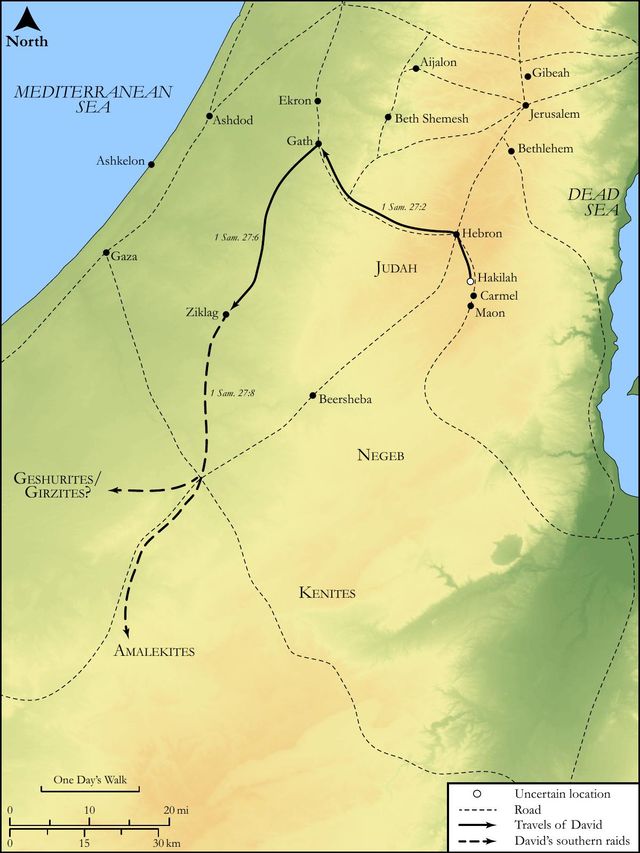
ShowHideDavid's request to reside outside the royal city of Gath was a highly strategic and calculated move. Remaining in Gath, the capital, would have placed him and his 600 men under constant, direct Philistine surveillance and control by King Achish. David desperately needed operational freedom to maintain his true identity and loyalty to Israel, even while feigning allegiance to Achish. By living in a separate, more remote town (which turned out to be Ziklag, as granted in 1 Samuel 27:6), David could conduct raids against non-Israelite enemies—such as the Geshurites, Girzites, and Amalekites, as described in 1 Samuel 27:8-9)—while deceptively reporting to Achish that he was raiding Israelite towns. This elaborate deception allowed him to sustain his men, protect his true mission, and avoid becoming fully integrated into Philistine society or being forced to fight against his own people.
Was David's decision to live among the Philistines a sign of a lack of faith?
ShowHideThis period of David's life is a complex and often debated topic among biblical scholars. While fleeing to the Philistines was undoubtedly a desperate and morally ambiguous act for an Israelite leader, it is crucial to view it within the broader context of David's relentless pursuit by King Saul. David explicitly states in 1 Samuel 27:1 that he believed he would eventually "perish by the hand of Saul" if he remained in Israelite territory. His actions, though involving deception and a temporary alliance with an enemy, can be seen as a resourceful and pragmatic survival strategy in extreme circumstances. Throughout this period, God's providence is still remarkably evident in protecting David and continuing to prepare him for kingship, demonstrating that God can work through imperfect human choices and challenging situations. While it may not represent an act of perfect, unwavering faith, it highlights David's human struggle, fear, and pragmatic decision-making, yet God remains faithful to His promises and purposes despite human imperfections.
Christ-Centered Fulfillment
ShowHideWhile 1 Samuel 27:5 details David's strategic maneuvering during a period of exile and peril, it subtly foreshadows profound aspects of Christ's incarnation and redemptive mission. David, the anointed king-in-waiting, finds himself in a foreign land, seemingly compromised, yet ultimately working out God's sovereign purposes. Similarly, Jesus, the true and eternal King of Israel, "found grace" not by seeking an earthly kingdom but by emptying Himself, taking on the humble form of a servant, and dwelling among us, not in a royal palace but in the "country" of human existence, a world hostile to Him (Philippians 2:6-8). He did not cling to the "royal city" of heavenly glory but strategically positioned Himself in a fallen world to accomplish His mission of redemption. Just as David's actions, despite their moral ambiguity, ultimately served to preserve the lineage and future of Israel's monarchy, Christ's dwelling among humanity, enduring suffering, rejection, and ultimately death, was the ultimate strategic act that secured salvation for all who believe (Hebrews 2:14-18). He became, in a sense, an "exile" from His heavenly glory to reconcile humanity to God, fulfilling the divine purpose that no human strategy, no matter how clever or cunning, could ever achieve (John 1:14).