


Galatians 6:17
Bible text: King James Version (1769 Blayney text) · Public domain
Bible text: Berean Standard Bible · Public domain
Bible text: American Standard Version (1901) · Public domain
Bible text: World English Bible, Messianic edition · Public domain
Bible text: Geneva Bible (1599) · Public domain
Bible text: Young's Literal Translation · Public domain
- ΤοῦTouTheG3588T-GSNDefinite article Genitive Singular Neuter
- λοιποῦloipouhenceforthG3064A-GSNAdjective Genitive Singular Neuter
- κόπουςkopoustroublesG2873N-APMNoun Accusative Plural Masculine
- μοιmoito meG3165P-1DSPersonal pronoun Dative 1st Singular
- μηδεὶςmēdeisno oneG3367A-NSMAdjective Nominative Singular Masculine
- παρεχέτω·parechetōshould giveG3930V-PAM-3SVerb Present Active Imperative 3rd Singular
- ἐγὼegōI myselfG1473P-1NSPersonal pronoun Nominative 1st Singular
- γὰρgarforG1063CONJConjunction
- τὰtatheG3588T-APNDefinite article Accusative Plural Neuter
- στίγματαstigmatamarksG4742N-APNNoun Accusative Plural Neuter
- τοῦtouof theG3588T-GSMDefinite article Genitive Singular Masculine
- κυρίουkuriouLordG2962N-GSM-TNoun Genitive Singular Masculine Title
- ἸησοῦIēsouJesusG2424N-GSM-PNoun Genitive Singular Masculine Individual
- ἐνenonG1722PREPPreposition
- τῷtōof theG3588T-DSNDefinite article Dative Singular Neuter
- σώματίsōmatibodyG4983N-DSNNoun Dative Singular Neuter
- μουmouof mineG3165P-1GSPersonal pronoun Genitive 1st Singular
- βαστάζωbastazōbearG941V-PAI-1SVerb Present Active Indicative 1st Singular
English is a literal word-by-word gloss of the Greek, not the KJV's wording. Why?
This is the original text the KJV's translators worked from — each Greek word with its own literal English meaning in this verse, prepared by scholars at Tyndale House, Cambridge. The KJV translates whole sentences, not word by word, so its wording differs: one Greek word can become several English words, and the KJV may choose “charity” where the gloss reads “love”. Both are faithful — they answer different questions. For the KJV's own rendering, switch to the KJV text.
Details
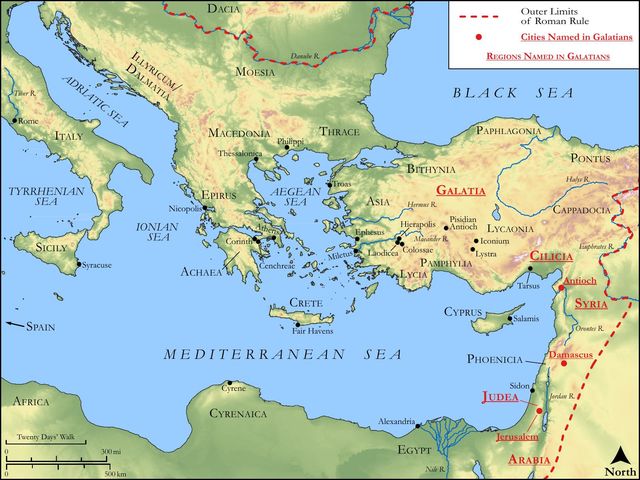
See on the biblical-era maps

Study this verse
Public-domain commentary
Matthew Henry
From his Commentary on the Whole Bible. Henry comments on passages, not single verses — this entry covers Galatians 6:11–18. His three-level outline is real structure in the source text, so it is rendered as structure.
The apostle, having at large established the doctrine of the gospel, and endeavoured to persuade these Christians to a behaviour agreeable to it, seems as if he intended here to have put an end to the epistle, especially when he had acquainted them that, as a particular mark of his respect for them, he had written this large letter with his own hand, and had not made use of another as his amanuensis, and only subscribed his name to it, as he was wont to do in his other epistles: but such is his affection to them such his concern to recover them from the bad impressions made upon them by their false teachers, that he cannot break off till he has once again given them the true character of those teachers, and an account of his own contrary temper and behaviour, that by comparing these together they might the more easily see how little reason they had to depart from the doctrine he had taught them and to comply with theirs.
I.He gives them the true character of those teachers who were industrious to seduce them, in several particulars. As,
1.They were men who desired to make a fair show in the flesh, Gal 6:12. They were very zealous for the externals of religion, forward to observe, and to oblige others to observe, the rites of the ceremonial law, though at the same time they had little or no regard to real piety; for, as the apostle says of them in the following verse, neither do they themselves keep the law. Proud, vain, and carnal hearts desire nothing more than to make a fair show in the flesh, and they can easily be content with so much religion as will help them to keep up such a fair show; but frequently those have least of the substance of religion who are most solicitous to make a show of it.
2.They were men who were afraid of suffering, for they constrained the Gentile Christians to be circumcised, only lest they should suffer persecution for the cross of Christ. It was not so much out of a regard to the law as to themselves; they were willing to sleep in a whole skin, and to save their worldly cargo, and cared not though they made shipwreck of faith and a good conscience. That which they chiefly aimed at was to please the Jews, and to keep up their reputation among them, and so to prevent the trouble that Paul, and other faithful professors of the doctrine of Christ, lay open to. And,
3.Another part of their character was that they were men of a party spirit, and who had no further zeal for the law than as it subserved their carnal and selfish designs; for they desired to have these Christians circumcised, that they might glory in their flesh (Gal 6:13), that they might say they had gained them over to their side, and made proselytes of them, of which they carried the mark in their flesh. And thus, while they pretended to promote religion, they were the greatest enemies of it; for nothing has been more destructive to the interest of religion than men-siding and party-making.
II.He acquaints us, on the other hand, with his own temper and behaviour, or makes profession of his own faith, hope, and joy; particularly,
1.That his principle glory was in the cross of Christ: God forbid, says he, that I should glory, save in the cross of our Lord Jesus Christ, Gal 6:14. By the cross of Christ is here meant his sufferings and death on the cross, or the doctrine of salvation by a crucified Redeemer. This was what the Jews stumbled at and the Greeks accounted foolishness; and the judaizing teachers themselves, though they had embraced Christianity, yet were so far ashamed of it that in compliance with the Jews, and to avoid persecution from them, they were for mixing the observance of the law of Moses with faith in Christ, as necessary to salvation. But Paul had a very different opinion of it; he was so far from being offended at the cross of Christ, or ashamed of it, or afraid to own it, that he gloried in it; yea, he desired to glory in nothing else, and rejected the thought of setting up anything in competition with it, as the object of his esteem, with the utmost abhorrence; God forbid, etc. This was the ground of all his hope as a Christian: this was the doctrine which, as an apostle, he was resolved to preach; and, whatever trials his firm adherence to it might bring upon him, he was ready, not only to submit to them, but to rejoice in them. Note, The cross of Christ is a good Christian's chief glory, and there is the greatest reason why we should glory in it, for to it we owe all our joys and hopes.
2.That he was dead to the world. By Christ, or by the cross of Christ, the world was crucified to him, and he to the world; he had experienced the power and virtue of it in weaning him from the world, and this was one great reason of his glorying in it. The false teachers were men of a worldly temper, their chief concern was about their secular interests, and therefore they accommodated their religion thereunto. But Paul was a man of another spirit; as the world had no kindness for him, so neither had he any great regard to it; he had got above both the smiles and the frowns of it, and had become as indifferent to it as one who is dying out of it. This is a temper of mind that all Christians should be labouring after; and the best way to attain it is to converse much with the cross of Christ. The higher esteem we have of him the meaner opinion shall we have of the world, and the more we contemplate the sufferings our dear Redeemer met with from the world the less likely shall we be to be in love with it.
3.That he did not lay the stress of his religion on one side or the other of the contesting interests, but on sound Christianity, Gal 6:15. There was at that time an unhappy division among Christians; circumcision and uncircumcision had become names by which they were distinguished from each other; for (Gal 2:9, Gal 2:12) the Jewish Christians are called the circumcision, and those of the circumcision. The false teachers were very zealous for circumcision; yea, to such a degree as to represent it as necessary to salvation, and therefore they did all they could to constrain the Gentile Christians to submit to it. In this they had carried the matter much further than others did; for, though the apostles connived at the use of it among the Jewish converts, yet they were by no means for imposing it upon the Gentiles. But what they laid so great a stress upon Paul made very little account of. It was indeed of great importance to the interest of Christianity that circumcision should not be imposed on the Gentile converts, and therefore this he had set himself with the utmost vigour to oppose; but as for mere circumcision or uncircumcision, whether those who embraced the Christian religion had been Jews or Gentiles, and whether they were for or against continuing the use of circumcision, so that they did not place their religion in it - this was comparatively a matter of little moment with him; for he very well knew that in Jesus Christ, that is, in his account, or under the Christian dispensation, neither circumcision availed any thing nor uncircumcision, as to men's acceptance with God, but a new creature. Here he instructs us both wherein real religion does not and wherein it does consist. It does not consist in circumcision or uncircumcision, in our being in this or the other denomination of Christians; but it consists in our being new creatures; not in having a new name, or putting on a new face, but in our being renewed in the spirit of our minds and having Christ formed in us: this is of the greatest account with God, and so it was with the apostle. If we compare this text with some others, we may more fully see what it is that renders us most acceptable to God, and about which we should therefore be chiefly concerned. Here we are told that it is a new creature, and in Gal 5:6 that it is faith which worketh by love, and in Co1 7:19 that it is the keeping of the commandments of God, from all which it appears that it is a change of mind and heart, whereby we are disposed and enabled to believe in the Lord Jesus and to live a life of devotedness to God; and that where this inward, vital, practical religion is wanting, no outward professions, nor particular names, will ever stand us in any stead, or be sufficient to recommend us to him. Were Christians duly concerned to experience this in themselves, and to promote it in others, if it did not make them lay aside their distinguishing names, yet it would at least take them off from laying so great a stress upon them as they too often do. Note, Christians should take care to lay the stress of their religion where God has laid it, namely, on those things which are available to our acceptance with him; so we see the apostle did, and it is our wisdom and interest herein to follow his example. The apostle having shown what was of chief consideration in religion, and what he laid the greatest stress upon, namely, not a mere empty name or profession, but a sound and saving change, in Gal 6:16 he pronounces a blessing upon all those who walk according to this rule: And as many as walk according to this rule peace be upon them, and mercy upon the Israel of God. The rule which he here speaks of may signify more generally the whole word of God, which is the complete and perfect rule of faith and life, or that doctrine of the gospel, or way of justification and salvation, which he had laid down in this epistle, namely, by faith in Christ without the works of the law; or it may be considered as more immediately referring to the new creature, of which he had just before been speaking. The blessings which he desires for those who walk according to this rule, or which he gives them the hope and prospect of (for the words may be taken either as a prayer or a promise), are peace and mercy - peace with God and conscience, and all the comforts of this life as far as they are needful for them, and mercy, or an interest in the free love and favour of God in Christ, which are the spring and fountain of all other blessings. A foundation is laid for these in that gracious change which is wrought in them; and while they behave themselves as new creatures, and govern their lives and hopes by the rule of the gospel, they may most assuredly depend upon them. These, he declares, shall be the portion of all the Israel of God, by whom he means all sincere Christians, whether Jews or Gentiles, all who are Israelites indeed, who, though they may not be the natural, yet are become the spiritual seed of Abraham; these, being heirs of his faith, are also heirs together with him of the same promise, and consequently entitled to the peace and mercy here spoken of. The Jews and judaizing teachers were for confining these blessings to such as were circumcised and kept the law of Moses; but, on the contrary, the apostle declares that they belong to all who walk according to the rule of the gospel, or of the new creature, even to all the Israel of God, intimating that those only are the true Israel of God who walk according to this rule, and not that of circumcision, which they insisted so much upon, and therefore that this was the true way to obtain peace and mercy. Note,
(1.)Real Christians are such as walk by rule; not a rule of their own devising, but that which God himself has prescribed to them.
(2.)Even those who walk according to this rule do yet stand in need of the mercy of God. But,
(3.)All who sincerely endeavour to walk according to this rule may be assured that peace and mercy will be upon them: this is the best way to have peace with God, ourselves, and others; and hereupon, as we may be sure of the favour of God now, so we may be sure that we shall find mercy with him hereafter.
4.That he had cheerfully suffered persecution for the sake of Christ and Christianity, Gal 6:17. As the cross of Christ, or the doctrine of salvation by a crucified Redeemer, was what he chiefly gloried in, so he had been willing to run all hazards rather than he would betray this truth, or suffer it to be corrupted. The false teachers were afraid of persecution, and this was the great reason why they were zealous for circumcision, as we see, Gal 6:12. But this was the least of Paul's concern; he was not moved at any of the afflictions he met with, nor did he count his life dear to him, so that he might finish his course with joy, and the ministry which he had received of the Lord Jesus, to testify the gospel of the grace of God, Act 20:24. He had already suffered much in the cause of Christ, for he bore in his body the marks of the Lord Jesus, the scars of those wounds which he had sustained from persecuting enemies, for his steady adherence to him, and that doctrine of the gospel which he had received from him. As from this it appeared that he was firmly persuaded of the truth and importance of it, and that he was far from being a favourer of circumcision, as they had falsely reported him to be, so hereupon, with a becoming warmth and vehemence, suitable to his authority as an apostle and to the deep concern of mind he was under, he insists upon it that no man should henceforth trouble him, namely by opposing his doctrine or authority, or by any such calumnies and reproaches as had been cast upon him; for as, both from what he had said and what he had suffered, they appeared to be highly unjust and injurious, so also those were very unreasonable who either raised or received them. Note, (1.) It may justly be presumed that men are fully persuaded of those truths in the defence of which they are willing to suffer. And (2.) It is very unjust to charge those things upon others which are contrary not only to their profession, but their sufferings too.
III.The apostle, having now finished what he intended to write for the conviction and recovery of the churches of Galatia, concludes the epistle with his apostolical benediction, Gal 6:18. He calls them his brethren, wherein he shows his great humility, and the tender affection he had for them, notwithstanding the ill treatment he had met with from them; and takes his leave of them with this very serious and affectionate prayer, that the grace of our Lord Jesus Christ may be with their spirit. This was a usual farewell wish of the apostle's, as we see, Rom 16:20, Rom 16:24, and Co1 16:23. And herein he prays that they might enjoy the favour of Christ, both in its special effects and its sensible evidences, that they might receive from him all that grace which was needful to guide them in their way, to strengthen them in their work, to establish them in their Christian course, and to encourage and comfort them under all the trials of life and the prospect of death itself. This is fitly called the grace of our Lord Jesus Christ, as he is both the sole purchaser and the appointed dispenser of it; and though these churches had done enough to forfeit it, by suffering themselves to be drawn into an opinion and practice highly dishonourable to Christ, as well as dangerous to them, yet, out of his great concern for them, and knowing of what importance it was to them, he earnestly desires it on their behalf; yea, that it might be with their spirit, that they might continually experience the influences of it upon their souls, disposing and enabling them to act with sincerity and uprightness in religion. We need desire no more to make us happy than the grace of our Lord Jesus Christ. This the apostle begs for these Christians, and therein shows us what we are chiefly concerned to obtain; and, both for their and our encouragement to hope for it, he adds his Amen.
Historical interpretation
Three Centuries of Reception
11 surviving comments on this verse. Each one is dated, so this reads as a timeline rather than a list.
Select a marker to jump to its quote. Markers stagger vertically where authors wrote within a few decades of each other.
And bare about "the marks of Christ" in his flesh.
However, let me meanwhile add that in the same passage Paul "carries about in his body the marks of the Lord Jesus; " he also forbids our body to be profaned, as being "the temple of God; " he makes our bodies "the members of Christ; " and he exhorts us to exalt and "glorify God in our body.
The world, in the apostle's sense, here means life and conversation according to worldly principles; it is in renouncing these that we and they are mutually crucified and mutually slain. He calls them "persecutors of Christ." But when he adds, that "he bare in his body the scars of Christ"-since scars, of course, are accidents of body -he therefore expressed the truth, that the flesh of Christ is not putative, but real and substantial, the scars of which he represents as borne upon his body.
This man was the first in the struggle of our days; he was the leader among Christ's soldiers; he, in the midst of the burning beginnings of the persecution, engaged with the very chief and author of the disturbance, in conquering with invincible firmness the adversary of his own conflict. He made a way for others to conquer; a victor with no small amount of wounds, but triumphant by a miracle, with the long-abiding and permanent penalties of a tedious conflict. For nineteen days, shut up in the close guard of a dungeon, he was racked and in irons; but although his body was laid in chains, his spirit remained free and at liberty. His flesh wasted away by the long endurance of hunger and thirst; but God fed his soul, that lived in faith and virtue, with spiritual nourishments. He lay in punishments, the stronger for his punishments; imprisoned, greater than those that imprisoned him; lying prostrate, but loftier than those who stood; as bound, and firmer titan the links which bound him; judged, and more sublime than those who judged him; and although his feet were bound on the rack, yet the serpent was trodden on and ground down and vanquished. In his glorious body shine the bright evidences of his wounds; their manifest traces show forth, and appear on the man's sinews and limbs, worn out with tedious wasting away. Great things are they-marvellous things are they-which the brotherhood may hear of his virtues and of his praises. And should any one appear like Thomas, who has little faith in what he hears, the faith of the eyes is not wanting, so that what one hears he may also see. In the servant of God, the glory of the wounds made the victory; the memory of the scars preserves that glory.
And stripes intolerable, and many other dreadful afflictions, and afterwards have been betrayed by the frailty of the flesh, even though they were not at the first received On account of their grievous fall that followed yet because they contended sorely and resisted long; for they did not come to this of their own will, but were betrayed by the frailty of the flesh for they show in their bodies the marks of Jesus,
Paul’s point is this: “All that Christ experienced on the cross—the imprint of the nails, the spear thrust in his side, the other marks of the crucifixion—I bear in my own body. I too have suffered. Therefore you too ought to endure much—indeed all—adversity, since you will be with Christ if you suffer with Christ and begin by your own act, in the face of adversaries, to suffer what Christ suffered.” Through these words Paul reveals what he himself was suffering, how much he shared with Christ and what we also ought to suffer if we wish to live in Christ.
He does not wish to be annoyed any longer by people advocating circumcision—people who would force him to write another letter. He wants the Galatians to respond quickly to his letter and get rid of their mistakes. This hard work will result in genuine rest. If, however, they show themselves to be reluctant and stubborn, refusing to change, Paul wants to be left alone. Let the Galatians spend their time and effort trying to please the Judaizers in an empty search for temporary reward.
“Rejoicing in these lacerations,” Paul says, “I bear the marks of Christ in my own body.” He readily yields to his weakness in all these misfortunes, through which the power of Christ is being perfected in virtue.
"From henceforth let no man trouble me."
This he says not as though he were wearied or overpowered; he who chose to do and suffer all for his disciples' sake; he who said, "Be instant in season, out of season;" (2 Tim. iv: 2.) he who said, "If peradventure God may give them repentance unto the knowledge of the truth, and they may recover themselves out of the snare of the devil;" (2 Tim. ii: 25, 26.) how shall he now become relaxed and fall back? Wherefore does he say this? it is to gird up their slothful mind, and to impress them with deeper fear, and to ratify the laws enacted by himself, and to restrain their perpetual fluctuations.
"For I bear branded on my body the marks of Jesus."
He says not, "I have," but, "I bear," like a man priding himself on trophies and royal ensigns. Although on a second thought it seems a disgrace, yet does this man vaunt of his wounds, and like military standard-bearers, so does he exult in bearing about these wounds. And why does he say this? "More clearly by those wounds than by any argument, than by any language, do I vindicate myself," says he. For these wounds utter a voice louder than a trumpet against my opponents, and against those who say that I play the hypocrite in my teaching, and speak what may please men. For no one who saw a soldier retiring from the battle bathed in blood and with a thousand wounds, would dare to accuse him of cowardice and treachery, seeing that he bears on his body the proofs of his valor, and so ought ye, he says, to judge of me. And if any one desire to hear my defence, and to learn my sentiments, let him consider my wounds, which afford a stronger proof than these words and letters. At the outset of his Epistle he evinced his sincerity by the suddenness of his conversion, at its close he proves it by the perils which attended his conversion. That it might not be objected that he had changed his course with upright intentions, but that he had not continued in the same purpose, he produces his trials, his dangers, his stripes as witnesses that he had so continued.
(Verse 17.) From now on, let no one bother me. Not as if he has failed in teaching; but so that even a farmer will have this labor, if the little plants he has planted wither; and a shepherd will have worry, if the sheep he has gathered are torn apart. Therefore, it is better read in Greek, 'From now on, let no one present me with labor;' lest of course I have the need to work among you again. It is better for the teacher to excel in labor, who lives and feels differently than the teacher who has taught and done otherwise. He can also preempt their argument, if anyone should wish to contradict thereafter, by mentioning that he has addressed the issue of women covering their heads and men not covering theirs among the Corinthians, saying: But if any man seem to be contentious, we have no such custom, neither the Church of God (I Cor. XI, 16): that is, we have expressed what seemed fitting and just to us; but if anyone refuses to accept the truth, let them consider what answer to make and on what grounds to oppose, knowing that they are not worthy of a response, as they are more inclined to argue than to learn.
But I bear the marks of the Lord Jesus in my body. For whoever is circumcised after the coming of Christ does not bear the marks of the Lord Jesus; but he has glory in his shame. But those who endure wounds beyond measure, who are frequently beaten with rods in prisons, who once were stoned, and who have other things written in the catalog of boasting, they bear the marks of the Lord Jesus in their body. And perhaps he who afflicts his own body and subjects himself to servitude, lest while preaching to others he himself should become reprobate, bears the marks of the Lord Jesus in his body (1 Corinthians 9). The apostles rejoiced because they had been considered worthy to suffer dishonor for the name of Jesus (Acts 5).
Anyone who after Christ’s coming is circumcised in the flesh does not carry the marks of the Lord Jesus. Rather he glories in his own confusion. But the one who was flogged beyond what the law required, frequently was in prison, was beaten three times with rods, was once stoned and suffered all the other things that are written in his catalog of boasting—this is the one who carries on his body the marks of the Lord Jesus. Perhaps also the ascetic today who keeps his body under control and subjects it to servitude so that he will not appear reprobate as he preaches to others may in some way carry the marks of the Lord Jesus on his own body.
Continue studying Galatians 6:17 across the web’s major study libraries — every link below opens this exact verse, chapter, or book on the destination site.
Read & Compare
 BibleGatewayThis verse in more than 200 translations and 70 languages.
 Bible.comThe YouVersion reader — hundreds of translations, reading plans, and highlights.
 ESV.orgCrossway's official English Standard Version reader.
 NET BibleThe NET translation with 60,000+ translators' notes on every rendering decision.
 STEP BibleTyndale House's free study tool — original text, vocabulary, and scholarly resources.
 BibliaLogos Bible Software's free web reader.
 USCCBThe New American Bible (Revised Edition) with the U.S. bishops' study notes.
Commentaries
 BibleHub CommentariesDozens of classic commentaries on this verse, gathered on one page.
 StudyLightMore than 100 commentary sets — the largest collection on the web.
 BibleRefPlain-English commentary on what this verse means, verse by verse.
 Enduring WordDavid Guzik's free commentary on this chapter, widely used by Bible teachers.
 Bible Study ToolsVerse commentary alongside Greek and Hebrew study aids.
Original Language & Research
- BibleHub InterlinearThe verse word by word — original language, transliteration, and English.
- BibleHub LexiconEvery word's original-language definition and Strong's entry.
 Blue Letter BibleDeep-study tools — Strong's numbers, concordance, and word studies.
 CNTR CollationThe earliest Greek manuscripts of this verse, collated letter by letter.
Sermons, Hymns & Audio


TrulyRandomVerse is not affiliated with these sites and doesn’t control their content. They’re linked because they’re genuinely useful.
Summary
Galatians 6:17 serves as Paul's final, emphatic declaration in his letter, asserting his apostolic authority and the authenticity of his Gospel message. He demands an end to the challenges against him, citing the physical "marks" he bears on his body—scars and signs of persecution endured for Christ's sake—as irrefutable proof of his genuine apostleship and profound identification with the Lord Jesus, thereby silencing the legalistic demands of the Judaizers and validating the Gospel of grace.
Context
ShowHideLiterary Context
This verse is the penultimate statement in Paul's Epistle to the Galatians, immediately preceding his concluding benediction. It follows a summary of his core theological arguments against the Judaizers, who insisted on circumcision and adherence to the Mosaic Law for salvation. Paul has just pronounced a blessing on "those who walk by this rule" (the rule of the new creation in Christ, not the Law) and on "the Israel of God" in Galatians 6:16. Verse 17 thus functions as a powerful, personal postscript, a final, authoritative word from Paul that seals his argument and dismisses any further contention regarding his ministry or message. It underscores the profound personal cost of his commitment to the true Gospel, contrasting it sharply with the superficiality of outward religious observances advocated by his opponents.
Historical & Cultural Context
The letter to the Galatians was written to churches in Galatia, a Roman province in Asia Minor, where Jewish Christians (Judaizers) were attempting to persuade Gentile converts that they needed to be circumcised and follow Jewish customs to be truly saved. This directly contradicted Paul's Gospel of justification by faith alone. Among the Greeks and Romans, "marks" (Greek: stigmata) carried significant cultural weight. They could be literal brands or tattoos used to identify slaves as property, soldiers as loyal to their commander, or devotees as dedicated to a deity. Paul's audience would have understood the implications of such marks. Furthermore, Paul's life was characterized by intense persecution for his evangelistic efforts, including beatings, stonings, and shipwrecks, as detailed in 2 Corinthians 11:23-27. These physical hardships were visible evidence of his suffering for Christ, serving as a stark contrast to the easy, self-serving demands of the Judaizers.
Key Themes
ShowHideGalatians 6:17 powerfully reinforces several key themes woven throughout the epistle. It highlights Apostolic Authority and Authenticity, as Paul's physical scars serve as undeniable credentials, validating his genuine commission from Christ, unlike the self-appointed authority of the Judaizers. It underscores the theme of Suffering for Christ, demonstrating that true discipleship often involves enduring hardship and persecution for the sake of the Gospel, echoing Paul's earlier statements about bearing the cross in Galatians 2:20. The verse also powerfully asserts Freedom from Legalism, as Paul's "marks" signify a deeper, spiritual reality of ownership by Christ, rendering external rituals like circumcision irrelevant and even antithetical to the Gospel of grace. Finally, it speaks to Identification with Christ, showing that Paul's physical body literally bore the cost of following Jesus, mirroring Christ's own suffering and ultimate sacrifice, a theme central to the entire letter, particularly in Galatians 3:13.
Exposition and Analysis
ShowHideKey Word Analysis
ShowHideDerived from a word meaning "a cut," kópos refers to toil that reduces strength, implying weariness, labor, or pain. Here, it signifies the effort, harassment, and vexation caused by the Judaizers' constant challenges to Paul's authority and message. Paul desires an end to this burdensome opposition, which has caused him considerable distress and effort.
This verb means "to lift," but also carries the sense of "to endure" or "to sustain." Paul is not merely carrying the marks as a burden, but actively enduring them as a testament to his service. It implies a conscious acceptance and public display of these signs of his allegiance and suffering for Christ.
From a root meaning "to prick" or "to stick," stígma refers to an incised or punched mark, often used to denote ownership or service. Among the Greeks and Romans, it could refer to a brand on a slave, a tattoo on a soldier signifying allegiance, or a mark on a devotee indicating dedication to a deity. Paul's use of this term is profoundly significant, indicating that his scars from persecution are not merely injuries, but indelible signs of his belonging to, and service for, the Lord Jesus.
Verse Breakdown
ShowHide"From henceforth let no man trouble me:"
This opening phrase is a forceful, almost exasperated, command from Paul. "From henceforth" (Greek: loipoû) signifies "from this point forward" or "for the rest of time." Paul is drawing a line in the sand, demanding that the constant questioning, opposition, and harassment from the Judaizers cease. The "trouble" (Greek: kópos) refers to the wearisome and painful efforts they have exerted to undermine his ministry and corrupt the Gospel message. Paul, having thoroughly defended his apostleship and the true Gospel, declares that he will no longer tolerate such challenges.
"for I bear in my body the marks of the Lord Jesus."
This clause provides the irrefutable justification for Paul's command. The conjunction "for" (Greek: gár) introduces the reason. Paul's physical body, scarred and worn from his missionary labors and persecutions, bears visible "marks" (Greek: stígmata). These are not self-inflicted or ceremonial marks, but the literal wounds and scars resulting from beatings, stonings, and other forms of suffering endured for the sake of the Gospel. By calling them "the marks of the Lord Jesus," Paul asserts that these scars are not merely personal injuries but badges of honor, signifying his absolute ownership by, allegiance to, and deep identification with Jesus Christ. They are his authentic credentials, far more compelling than any ritualistic mark like circumcision.
Literary Devices
ShowHidePaul employs powerful Symbolism and Metaphor in this verse. The "marks" (stigmata) are deeply symbolic, representing not just physical scars but the profound spiritual reality of Paul's suffering for Christ. They serve as a Metaphor for his total dedication and ownership by Jesus, akin to a slave branded by his master or a soldier marked by his commander. This imagery is a poignant Contrast to the "marks" of circumcision that the Judaizers emphasized, highlighting the superficiality of outward ritual versus the authentic, costly identification with Christ's suffering. The declaration "let no man trouble me" also functions as a Rhetorical Device of dismissal, a final, authoritative pronouncement that aims to silence his opponents through the undeniable evidence of his life and body.
Theological and Thematic Connections
ShowHidePaul's declaration in Galatians 6:17 profoundly connects to the broader biblical narrative of suffering and identification with Christ. His "marks" are a visible testament to the cost of true discipleship and the reality of living out the Gospel. Theologically, these marks underscore the concept of union with Christ, where the believer not only shares in Christ's resurrection life but also in His sufferings. They validate Paul's message of grace by demonstrating that his authority comes not from human approval or legalistic adherence, but from a costly, lived experience of following the crucified and risen Lord. These physical signs of persecution are transformed into glorious badges of honor, proving his authenticity and silencing those who would question his apostleship or the purity of the Gospel he proclaimed.
Reflection and Application
ShowHideGalatians 6:17 challenges believers to consider the true nature of their identification with Christ and the cost of following Him. In a world that often values comfort and outward appearances, Paul's "marks" remind us that genuine faith is often forged in the fires of adversity and self-sacrifice for the sake of the Gospel. Our "marks" today may not be physical scars, but could include social ostracism, professional setbacks, financial sacrifices, or the quiet endurance of misunderstanding when we stand for biblical truth. This verse calls us to move beyond superficial religiosity and embrace a deep, costly commitment to Jesus, allowing our lives to bear witness to His transforming power, even when it involves hardship. It encourages us to be resilient in the face of opposition, knowing that our ultimate validation comes from Christ alone, not from human approval or adherence to man-made rules. Our authenticity as believers is demonstrated not by what we gain, but by what we are willing to endure for the sake of the One who bore the ultimate marks for us.
Questions for Reflection
ShowHideFAQ
ShowHideWhat exactly were "the marks of the Lord Jesus" that Paul bore?
ShowHideThe "marks" (Greek: stígmata) Paul refers to were not self-inflicted or ceremonial tattoos, but the physical scars and lasting effects of the severe persecutions he endured for proclaiming the Gospel of Jesus Christ. These included beatings, stonings, shipwrecks, hunger, thirst, and exposure, as detailed in 2 Corinthians 11:23-27. These physical signs served as irrefutable evidence of his suffering and unwavering commitment to Christ, making them a powerful testament to his genuine apostleship and his profound identification with the Lord Jesus. Among the Greeks and Romans, stigmata were often used to mark slaves, soldiers, or temple devotees, signifying ownership, allegiance, or dedication. Paul's use of the term here powerfully conveys that his scars declare his absolute belonging to Christ.
Why did Paul say, "From henceforth let no man trouble me"?
ShowHidePaul's declaration, "From henceforth let no man trouble me," is a strong, definitive statement meant to put an end to the ongoing harassment and challenges he faced from the Judaizers in Galatia. These false teachers were constantly undermining his apostolic authority and distorting the Gospel by insisting that Gentile believers needed to be circumcised and adhere to the Mosaic Law for salvation. Having spent the entire letter defending the true Gospel of grace and his own divine commission, Paul concludes by presenting his physical sufferings—the "marks of the Lord Jesus"—as the ultimate, undeniable proof of his authenticity. He is essentially saying, "My life and body bear the undeniable evidence of my service to Christ; therefore, cease your accusations and challenges against me and the Gospel I preach." It is a demand for peace and an end to the theological contention that had plagued the Galatian churches.
Christ-Centered Fulfillment
ShowHideGalatians 6:17, though a personal statement from Paul, finds its ultimate fulfillment and deepest meaning in Christ. Paul's "marks" are not merely the scars of a devoted servant, but a visible echo of the ultimate "marks" borne by Jesus Himself—the nail prints in His hands and feet, the spear wound in His side, and the crown of thorns on His brow, all endured on the cross at Calvary. These are the supreme stigmata of ownership and sacrifice, marking Jesus as the Lamb of God who takes away the sin of the world (John 1:29). Paul's suffering, therefore, is a participation in the sufferings of Christ (Philippians 3:10), a living testament to the truth that the disciple is not above his Master (Matthew 10:24). Through His own marks, Jesus purchased us, making us His own, and empowering us to bear witness to Him, even through suffering. Paul's declaration thus points beyond himself to the One who bore the ultimate marks for our redemption, validating the Gospel of grace through the very body of the Son of God, who gave Himself for our sins (Galatians 1:4).