


Genesis 32:23
Bible text: King James Version (1769 Blayney text) · Public domain
Bible text: Berean Standard Bible · Public domain
Bible text: American Standard Version (1901) · Public domain
Bible text: World English Bible, Messianic edition · Public domain
Bible text: Geneva Bible (1599) · Public domain
Bible text: Young's Literal Translation · Public domain
- וַיִּקָּחֵםvai·yi·ka·Chemand he took themH3947Conj-w ¦ V-Qal-ConsecImperf-3ms ¦ 3mpVerb Qal Consecutive Imperfect 3rd Singular Masculineוַandיִּקָּחֵhe tookםthem
- וַיַּעֲבִרֵםvai·ya·'a·vi·Remand he sent over themH5674Conj-w ¦ V-Hiphil-ConsecImperf-3ms ¦ 3mpVerb Hiphil Consecutive Imperfect 3rd Singular Masculineוַandיַּעֲבִרֵhe sent overםthem
- אֶת'et<obj.>H853DirObjMParticle Object Indicator
- הַנָּחַלha·Na·chalthe wadiH5158Art ¦ N-msNoun Singular Masculine Absoluteהַtheנָּחַלwadi
- וַיַּעֲבֵרvai·ya·'a·Verand he sent overH5674Conj-w ¦ V-Hiphil-ConsecImperf-3msVerb Hiphil Consecutive Imperfect 3rd Singular Masculineוַandיַּעֲבֵרhe sent over
- אֶת'et<obj.>H853DirObjMParticle Object Indicator
- אֲשֶׁר'a·Sher[that] whichH834RelParticle Relative
- לוֹlov[belonged] to <the> himPrep-l ¦ 3msSuffix Personal 3rd Singular Masculineל[belonged] to <the>וֹhim
English is a literal word-by-word gloss of the Hebrew, not the KJV's wording. Why?
This is the original text the KJV's translators worked from — each Hebrew word with its own literal English meaning in this verse, prepared by scholars at Tyndale House, Cambridge. The KJV translates whole sentences, not word by word, so its wording differs: one Hebrew word can become several English words, and the KJV may choose “the LORD” where the gloss reads “Yahweh”. Both are faithful — they answer different questions. For the KJV's own rendering, switch to the KJV text.
Details
See on the biblical-era maps


Study this verse
Public-domain commentary
Matthew Henry
From his Commentary on the Whole Bible. Henry comments on passages, not single verses — this entry covers Genesis 32:13–23. His two-level outline is real structure in the source text, so it is rendered as structure.
Jacob, having piously made God his friend by a prayer, is here prudently endeavouring to make Esau his friend by a present. He had prayed to God to deliver him from the had of Esau, for he feared him; but neither did his fear sink into such a despair as dispirits for the use of means, nor did his prayer make him presume upon God's mercy, without the use of means. Note, When we have prayed to God for any mercy, we must second our prayers with our endeavours; else, instead of trusting god, we tempt him; we must so depend upon God's providence as to make use of our own prudence. "Help thyself, and God will help thee;" God answers our prayers by teaching us to order our affairs with discretion. To pacify Esau,
I.Jacob sent him a very noble present, not of jewels or fine garments (he had them not), but of cattle, to the number of 580 in all, Gen 32:13-15. Now,
1.It was an evidence of the great increase with which God had blessed Jacob that he could spare such a number of cattle out of his stock.
2.It was an evidence of his wisdom that he would willingly part with some, to secure the rest; some men's covetousness loses them more than ever it gained them, and, by grudging a little damage; skin for skin, and all that a man has, if he be a wise man, he will give for his life.
3.It was a present that he thought would be acceptable to Esau, who had traded so much in hunting wild beasts that perhaps he was but ill furnished with tame cattle with which to stock his new conquests. And we may suppose that the mixed colours of Jacob's cattle, ring-straked, speckled, and spotted, would please Esau's fancy.
4.He promised himself that by this present he should gain Esau's favour; for a gift commonly prospers, which way soever it turns (Pro 17:8), and makes room for a man (Pro 18:16); nay, it pacifies anger and strong wrath, Pro 21:14. Note, [1.] We must not despair of reconciling ourselves even to those that have been most exasperated against us; we ought not to judge men unappeasable, till we have tried to appease them. [2.] Peace and love, though purchased dearly, will prove a good bargain to the purchaser. Many a morose ill-natured man would have said, in Jacob's case, "Esau has vowed my death without cause, and he shall never be a farthing the better for me; I will see him far enough before I will send him a present:" but Jacob forgives and forgets.
II.He sent him a very humble message, which he ordered his servants to deliver in the best manner, Gen 32:17, Gen 32:18.
They must call Esau their lord, and Jacob his servant; they must tell him the cattle they had was a small present which Jacob had sent him, as a specimen of his acquisitions while he was abroad. The cattle he sent were to be disposed of in several droves, and the servants that attended each drove were to deliver the same message, that the present might appear the more valuable, and his submission, so often repeated, might be the more likely to influence Esau. They must especially take care to tell him that Jacob was coming after (Gen 32:18-20), that he might not suspect he had fled through fear. Note, A friendly confidence in men's goodness may help to prevent the mischief designed us by their badness: if Jacob will seem not to be afraid of Esau, Esau, it may be hoped, will not be a terror to Jacob.
Continue studying Genesis 32:23 across the web’s major study libraries — every link below opens this exact verse, chapter, or book on the destination site.
Read & Compare
 BibleGatewayThis verse in more than 200 translations and 70 languages.
 Bible.comThe YouVersion reader — hundreds of translations, reading plans, and highlights.
 ESV.orgCrossway's official English Standard Version reader.
 NET BibleThe NET translation with 60,000+ translators' notes on every rendering decision.
 STEP BibleTyndale House's free study tool — original text, vocabulary, and scholarly resources.
 BibliaLogos Bible Software's free web reader.
 USCCBThe New American Bible (Revised Edition) with the U.S. bishops' study notes.
Commentaries
 BibleHub CommentariesDozens of classic commentaries on this verse, gathered on one page.
 StudyLightMore than 100 commentary sets — the largest collection on the web.
 BibleRefPlain-English commentary on what this verse means, verse by verse.
 Enduring WordDavid Guzik's free commentary on this chapter, widely used by Bible teachers.
 Bible Study ToolsVerse commentary alongside Greek and Hebrew study aids.
Original Language & Research
- BibleHub InterlinearThe verse word by word — original language, transliteration, and English.
- BibleHub LexiconEvery word's original-language definition and Strong's entry.
 Blue Letter BibleDeep-study tools — Strong's numbers, concordance, and word studies.
 SefariaThe Hebrew text with Rashi and centuries of Jewish commentary.
Sermons, Hymns & Audio


TrulyRandomVerse is not affiliated with these sites and doesn’t control their content. They’re linked because they’re genuinely useful.
Summary
Genesis 32:23 recounts Jacob's decisive action of strategically sending his entire family, servants, and all his possessions across the Jabbok brook, intentionally isolating himself on the opposite bank. This deliberate maneuver served as a final, critical preparation for a daunting and uncertain encounter, setting the stage for the profound spiritual wrestling match that immediately followed and underscoring his complete vulnerability before God.
Context
ShowHideLiterary Context
This verse is situated at a pivotal moment in the narrative of Jacob's return to Canaan after two decades with Laban. It immediately follows Jacob's elaborate and fear-driven preparations to appease his estranged brother, Esau, whom he anticipates meeting. Having divided his camp, dispatched waves of gifts ahead of him (Genesis 32:13-21), and offered a fervent prayer for deliverance (Genesis 32:9-12), Jacob's actions in Genesis 32:23 represent the culmination of his strategic foresight. By sending his entire household and possessions across the Jabbok, he deliberately creates a scene of profound solitude, directly preceding the momentous and transformative wrestling match with a mysterious divine figure in Genesis 32:24, which marks a turning point in his life.
Historical & Cultural Context
Jacob's actions reflect the patriarchal customs of the house of Abraham, where the head of the household bore ultimate responsibility for the safety and welfare of his extended family and possessions. His fear of Esau was not unfounded; tribal feuds and blood vengeance were common, and Esau's approach with 400 men (Genesis 32:6) would have been perceived as a hostile act. The Jabbok, a significant eastern tributary of the Jordan River, served as a natural geographical boundary, often a wadi or seasonal torrent that could be formidable. Crossing it implied a commitment to a new territory or a decisive separation. Jacob's decision to remain behind, facing the potential danger alone, aligns with the role of a leader protecting his dependents, while simultaneously creating a space for a deeply personal, unmediated encounter with the divine, a common motif in biblical narratives where individuals seek solitude for spiritual communion.
Key Themes
ShowHideGenesis 32:23 contributes significantly to several overarching themes in Jacob's narrative and the book of Genesis. It highlights the theme of divine providence amidst human anxiety, as Jacob's meticulous, fear-driven preparations ultimately serve to position him for God's transformative intervention. The deliberate act of self-isolation underscores the theme of vulnerability as a prerequisite for spiritual breakthrough, demonstrating that profound encounters with God often occur when individuals are stripped of all human and material supports, forced into complete dependence on the divine. Furthermore, it reinforces the theme of God's faithfulness to His covenant promises, even when His people are fearful or manipulative, as seen in God's earlier promise to Jacob in Genesis 28:15 and His continued presence with him despite his past deceptions.
Exposition and Analysis
ShowHideGenesis 32:23 meticulously describes Jacob's methodical and complete separation from his extensive household and all his accumulated wealth. The verse details a strategic and deliberate act designed to place him in a unique position of isolation and vulnerability before a pivotal encounter.
Key Word Analysis
ShowHideA primitive root meaning "to take (in the widest variety of applications)." In this context, it signifies Jacob's active and intentional gathering and removal of his family and possessions. It's not a passive observation but a deliberate act of leadership, implying control and purpose in his actions.
A primitive root meaning "to cross over; used very widely of any transition (literal or figurative)." Here, it denotes the act of causing his family and belongings to traverse the physical barrier of the brook. The repetition of "sent over" emphasizes the completeness and thoroughness of this transfer, ensuring nothing and no one remained with him. This "crossing over" is both a physical movement and a symbolic transition into a new, isolated state.
Meaning "a stream, especially a winter torrent; (by implication) a (narrow) valley (in which a brook runs)." This specific term for a "brook" (the Jabbok) denotes a natural geographical feature that served as a significant boundary. Its nature as a wadi or torrent-bed highlights the potential difficulty of the crossing, underscoring the deliberate effort involved in Jacob's actions.
Verse Breakdown
ShowHide"And he took them"
This phrase refers to Jacob's wives, children, and female servants, indicating his direct agency in gathering and directing his family. It highlights his role as the patriarch, responsible for their movement and safety.
"and sent them over the brook"
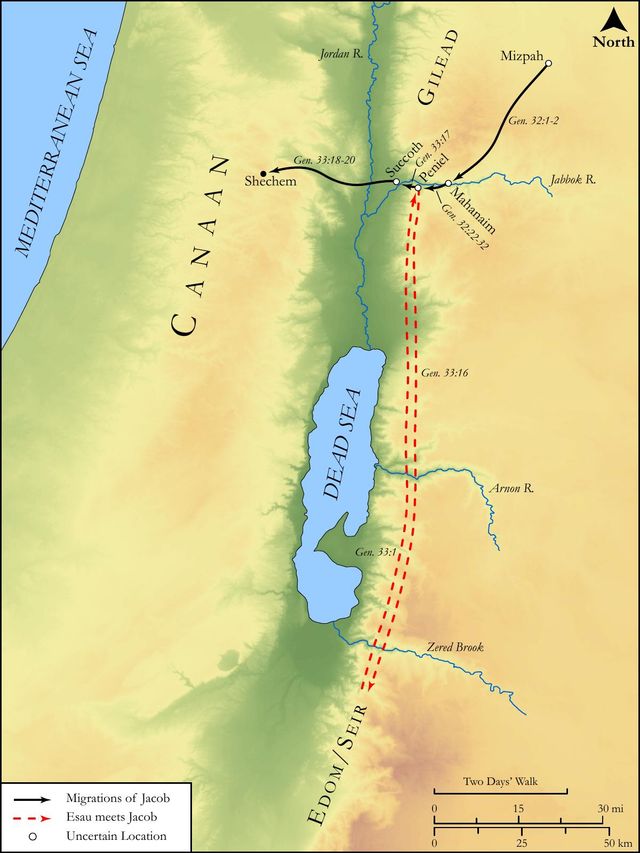
This details the specific action Jacob performed with his family—he caused them to cross the Jabbok. This act was a deliberate physical separation, placing them on the opposite bank, presumably out of immediate danger from Esau, and creating a distinct physical boundary between Jacob and his most cherished dependents.
"and sent over that he had"
This final clause encompasses all of Jacob's material wealth—his flocks, herds, and other possessions. The repetition of "sent over" emphasizes the comprehensive nature of this divestment. Jacob retained nothing with him, ensuring his complete physical and material isolation.
Literary Devices
ShowHideGenesis 32:23 is rich in literary technique, primarily employing Foreshadowing, Symbolism, and Juxtaposition. The act of Jacob sending his entire household and possessions across the Jabbok brook serves as powerful Foreshadowing for the intense, solitary struggle that is about to unfold in Genesis 32:24. This physical separation dramatically sets the stage for a spiritual encounter, signaling that something profound and personal is imminent. The Jabbok itself functions as potent Symbolism, representing a threshold or a liminal space—a boundary between Jacob's past and an uncertain future, between human reliance and divine encounter. His deliberate act of remaining alone on one side, while everything he holds dear crosses to the other, symbolizes a stripping away of all external supports, forcing him into a state of utter vulnerability. This creates a stark Juxtaposition between Jacob's prior meticulous, human-centric preparations (sending gifts, dividing camps) and his ultimate, divinely ordained isolation, highlighting the shift from human strategy to divine confrontation.
Theological and Thematic Connections
ShowHideJacob's deliberate act of isolating himself at the Jabbok is a profound theological statement, demonstrating that moments of deep spiritual encounter often necessitate a stripping away of all human and material supports. This vulnerability is not a weakness but a necessary condition for true dependence on God and for receiving divine revelation and transformation. It underscores that God often meets us not in our self-sufficiency, but in our fear, our solitude, and our perceived weakness, revealing His power and presence in ways that transcend human understanding or planning.
Reflection and Application
ShowHideGenesis 32:23 offers profound insights into the nature of preparation and vulnerability in the face of life's daunting challenges. Jacob's deliberate actions remind us that sometimes, significant spiritual or personal breakthroughs necessitate intentionally creating space for solitude, stepping away from the comforts and distractions of our everyday lives to rely solely on God. It illustrates that moments of deep transformation often follow periods of intense preparation, fear, and even a stripping away of what we hold dear, ultimately leading to a new understanding of our identity and purpose. Just as Jacob received his new name, Israel, signifying his wrestling with God and man and prevailing, we too are called to embrace moments of vulnerability, trusting that God meets us in our weakness and uses our solitude to forge a deeper, more authentic relationship with Him, preparing us for the next chapter of our spiritual journey.
Questions for Reflection
ShowHideFAQ
ShowHideWhy did Jacob choose to be alone at this critical moment?
ShowHideJacob's decision to send his family and possessions across the Jabbok before him was a deliberate act of strategic prudence and spiritual preparation. It served multiple purposes: to protect his family from the immediate danger of Esau's potential wrath, to create a physical and spiritual space for a direct, unmediated encounter with God, and to strip himself of all reliance on human or material support, forcing him into complete dependence on the divine. This intentional isolation was a necessary precursor for the profound, identity-altering encounter that followed in Genesis 32:24.
What is the significance of the Jabbok brook?
ShowHideThe Jabbok brook (Hebrew: nachal Yabboq) was a geographical landmark, a significant tributary of the Jordan River. Symbolically, it represented a boundary or a threshold. Jacob's crossing of his family and possessions over it, while he remained on the other side, marked a point of no return and a deliberate separation. It signified a liminal space where he was poised between his past and a new, uncertain future, ready for divine intervention. The Jabbok became the place where Jacob's old self died and his new identity as Israel was forged, a place of wrestling and transformation.
Was Jacob abandoning his family by sending them across the brook first?
ShowHideNo, Jacob was not abandoning his family. His actions were a protective measure, placing them out of immediate harm's way should the encounter with Esau turn violent. By remaining behind, he positioned himself as the first line of defense and the one who would face the primary danger. This demonstrates his profound responsibility and leadership as the patriarch, willing to face the unknown alone to ensure the safety of those entrusted to his care. His actions are an act of self-sacrificial protection, not abandonment.
Christ-Centered Fulfillment
ShowHideJacob's solitary struggle at the Jabbok, culminating in a new name and a limping walk, profoundly foreshadows the transformative work of Christ. Just as Jacob faced his deepest fears and wrestled with God in a state of complete vulnerability, so too did Christ, in His ultimate act of identification with humanity, face the full weight of sin and death in solitary agony. In the Garden of Gethsemane (Matthew 26:36-46), Jesus wrestled in prayer, submitting to the Father's will, and on the cross (John 19:28-30), He became utterly vulnerable for our sake, bearing our infirmities and sorrows. Through His perfect obedience and sacrifice, Christ secured a new identity and a new walk for all who believe, fulfilling the promise of a prevailing "Israel." He is the true "brook" crossed, bridging the chasm between God and humanity (Hebrews 10:19-20), offering reconciliation and a new name to all who are united with Him (Revelation 2:17). Through Christ, we are enabled to prevail, not by our own strength, but by His victorious power, inheriting the blessings of the covenant established through His ultimate sacrifice.