


Hosea 12:3
Bible text: King James Version (1769 Blayney text) · Public domain
Bible text: Berean Standard Bible · Public domain
Bible text: American Standard Version (1901) · Public domain
Bible text: World English Bible, Messianic edition · Public domain
Bible text: Geneva Bible (1599) · Public domain
Bible text: Young's Literal Translation · Public domain
- בַּבֶּטֶןba·Be·tenin the wombH990Prep-b ¦ N-fsNoun Singular Feminine Absoluteבַּin theבֶּטֶןwomb
- עָקַב'a·Kavhe took by [the] heelH6117V-Qal-Perf-3msVerb Qal Perfect 3rd Singular Masculine
- אֶת'et<obj.>H853DirObjMParticle Object Indicator
- אָחִיו'a·Chivhis brotherH251N-msc ¦ 3msNoun Singular Masculine Constructאָחִיbrotherוhis
- וּבְאוֹנוֹu·ve·'o·Noand in his manly vigorH202Conj-w ¦ Prep-b ¦ N-msc ¦ 3msNoun Singular Masculine Constructוּandבְinאוֹנmanly vigorוֹhis
- שָׂרָהsa·Rahhe struggledH8280V-Qal-Perf-3msVerb Qal Perfect 3rd Singular Masculine
- אֶת'etwithH854PrepPreposition
- אֱלֹהִים'E·lo·HimGodH430N-mpNoun Plural Masculine Absolute
English is a literal word-by-word gloss of the Hebrew, not the KJV's wording. Why?
This is the original text the KJV's translators worked from — each Hebrew word with its own literal English meaning in this verse, prepared by scholars at Tyndale House, Cambridge. The KJV translates whole sentences, not word by word, so its wording differs: one Hebrew word can become several English words, and the KJV may choose “the LORD” where the gloss reads “Yahweh”. Both are faithful — they answer different questions. For the KJV's own rendering, switch to the KJV text.
Details
See on the biblical-era map
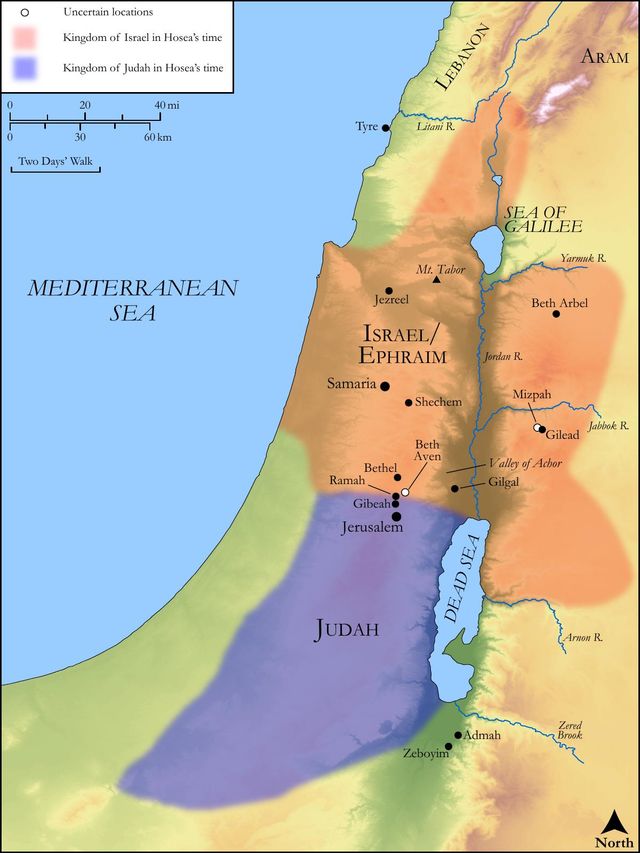
Study this verse
Public-domain commentary
Matthew Henry
From his Commentary on the Whole Bible. Henry comments on passages, not single verses — this entry covers Hosea 12:1–6. His four-level outline is real structure in the source text, so it is rendered as structure.
In these verses,
I.Ephraim is convicted of folly, in staying himself upon Egypt and Assyria, when he was in straits (Hos 12:1):
Ephraim feeds on wind, that is, feeds himself with vain hopes of assistance from man, when he is at variance with God; and, when he meets with disappointments, he still pursues the same game, and greedily pants and follows after the east wind, which he cannot catch holy of, nor, if he could, would it be nourishing, nay, would be noxious. We say of the wind in the east, It is good neither for man nor beast. It was said (Hos 8:7), He sows the wind; and as he sows so he reaps (He reaps the whirlwind); and as he reaps so he feeds - He feeds on the wind, the east wind. Note, Those that make creatures their confidence make fools of themselves, and take a great deal of pains to put a cheat upon their own souls and to prepare vexation for themselves: He daily increaseth lies, that is, multiplies his correspondences and leagues with his neighbours, which will all prove deceitful to him; nay, they will prove desolation to him. Those very nations that he makes his refuge will prove his ruin. Those that stay themselves upon lies will be still coveting to increase them, that they may build their hopes firmly upon them; as if many lies twisted together would make one truth, or many broken reeds and rotten supports one sound one, which is a great delusion and will prove to them a great desolation; for those that observe lying vanities the more they increase them the more disappointments they prepare for themselves and the further they run from their own mercies. The men of Ephraim did so when they thought to secure the Assyrians in their interests by a solemn league, signed, sealed, and sworn to: They make a covenant with the Assyrians, but they will find there is no hold of them; that potent prince will be a slave to his word no longer than he pleases. They thought to secure the Egyptians for their confederates by a rich present of the commodities of their country, not only to purchase their favour, but to show that their friendship was worth having: Oil is carried into Egypt. But the Egyptians, when they had got the bribe, dropped the cause, and Ephraim was never the better for them. Oleum perdidit et operam - The oil and the labour are both lost. This was feeding on wind; this was increasing lies and desolation.
II.Judah is contended with too, and Jacob, which includes both Ephraim and Judah (Hos 12:2):
The Lord has also a controversy with Judah; for though he had a while ago ruled with God, and been faithful with the saints, yet now he begins to degenerate. Or though, in keeping close to the house of David and the house of Aaron, and in them to the covenants of royalty and priesthood, they were so far in the right, in the former they ruled with God and in the latter were faithful to the saints, yet upon other accounts God had a controversy with them, and would punish them. Note, Man's being in the right in some things, in the main things, will not exempt them from correction, and therefore should not exempt them from reproof, for those things wherein they are in the wrong. There were those of the seven churches of Asia whom Christ approved and commended, and yet he adds, Nevertheless I have something against thee. So here; though the seed of Jacob are a people near to God, yet God will punish them according to the evil ways they are found in and the evil doings they are found guilty of; for God sees sin even in his own people, and will reckon with them for it.
III.Both Ephraim and Judah are put in mind of their father Jacob, whose seed they were and whose name they bore (and it was their honour), of the extraordinary things which he did and which God did for him, that they might be the more ashamed of themselves for degenerating from so illustrious a progenitor and staining the lustre of so great a name, and yet that they might be engaged and encouraged to return to God, the God of their father Jacob, in hopes for his sake to find favour with him. He had called this people Jacob (Hos 12:2), threatening to punish them; but how shall I give them up? How shall that dear name be forgotten?
1.Three glorious things concerning Jacob the person Jacob the people are here put in mind of; but by brief hints only, for it is presumed that they knew the story: - (1.) His struggling with Esau in the womb: There he took his brother by the heel, Hos 12:3. We have the story Gen 25:26. It was an early act of bravery, and an effort for the best precedency, a pious ambition for that birthright in the covenant which Esau is justly branded as profane for despising. But his degenerate seed, by mingling with the nations, and making leagues with them, profaned that crown, and laid that honour in the dust, which he so gloriously put in for. Then it was that the dominion was given to him: The elder shall serve the younger. Then he was owned of God as his beloved: Jacob have I loved, but Esau have I hated. But they had by their sin forfeited both the love of God and dominion over their neighbours. (2.) His wrestling with the angel. "Remember how your father Jacob had power with God by his own strength, the strength he had by the gift of God, who pleaded not against him by his great power, but put strength into him," Job 22:6. The angel he wrestled with is called God, and therefore is supposed to be the Son of God, the angel of the covenant. "God was both a combatant with Jacob and an assistant of him, showing, in the latter respect, greater strength than in the former, fighting as it were against him with his left hand and for him with his right, and to that putting greater force." So, Dr. Pocock. The providence of God fought against him when he met with one danger after another, in his return homewards; but the grace of God enabled him to go on cheerfully in his way, and, when his faith acted upon the divine promise that was for him prevailed above his fears that arose from the divine providences that wee against him, then by his strength he had power with God. But it refers especially to his prayer for deliverance from Esau, and for a blessing: He had power over the angel and prevailed, for he wept and made supplication. Here was a mixture of the greatest courage and the greatest tenderness, Jacob wrestling like a champion and yet weeping like a child. Note, Prayers and tears are the weapons with which the saints have obtained the most glorious victories. Thus Jacob commenced Israel - a prince with God; his posterity was called Israel, but they were unworthy the name, for they had forfeited and lost their communion with God, and their interest in him, by revolting from their duty to him. (3.) His meeting with God at Bethel: God found him in Bethel, and there he spoke with us. God found him the first time in Bethel, as he went to Padanaram (Gen 28:10), and a second time after his return, Gen 35:9, etc. It is probable that this refers to both; for in both God spoke to Jacob, and renewed the covenant with him, and the prophet might very well say, There he spoke with us who are the seed of Jacob, for both times that God spoke with Jacob at Bethel he spoke with him concerning his seed. Gen 28:14, Thy seed shall be as the dust of the earth; and Gen 35:12, This land I will give unto thy seed. Thus God then covenanted with him and his seed after him. Now justly are they upbraided with this; for in that very place which their father Jacob called Bethel - the house of God, in remembrance of the communion he there had with God, did they set up one of the calves, and worship it; thus they turned that Bethel into a Beth-aven - a house of iniquity. There God spoke with them exceedingly great and precious promises, which they had despised and lost the benefit of.
2.Two inferences are here drawn from these stories concerning Jacob, for instruction to his seed: -
(1.)Here is a use of information. From what passed between God and Jacob we may learn that Jehovah, the Lord God of hosts, is the God of Israel; he was the God of Jacob, and this is his memorial throughout all the generations of the seed of Jacob (Hos 12:5) - the more shame for those who forgot the memorial of their church, deserted the God of their fathers, and exchanged a Lord of hosts for Baalim. Note, Those only are accounted the people of God that keep up a memorial of God, such a memorial of him as he himself has instituted, by which he makes himself known and will have us to remember him. Here are two memorials of his, by which he is distinguished from all others, and is to be acknowledged and adored by us.
[1.]The former denotes his existence of himself. He is Jehovah, much the same with I AM, the same that was, and is, and is to come, infinite, eternal, and unchangeable. Jehovah is his memorial, his peculiar name.
[2.]The latter denotes his dominion over all: He is the God of hosts, that has all the hosts of heaven and earth at his beck and command, and makes what use he pleases of them. Jacob saw Mahanaim - God's two hosts, about the time that he wrestled with the angel (Gen 32:1, Gen 32:2), and so learned to call God the God of hosts, and transmitted it to us as his memorial. God's names, titles, and attributes, are the memorials of him; there is no need for images to be such. And that which was a revelation of God to one is his memorial to many, to all generations.
(2.)Here is a use of exhortation, Hos 12:6. "Is this so, that Jacob thy father had this communion with the Lord God of hosts, and is this still his memorial?" Then,
[1.]Let those that have gone astray from God be converted to him: Therefore turn thou to thy God. He that was the God of Jacob is the God of Israel, is thy God; from him thou hast unjustly and unkindly revolted; therefore turn thou to him by repentance and faith, turn to him as thine, to love him, obey him, and depend upon him.
[2.]Let those that are converted to him walk with him in all holy conversation and godliness: "Keep mercy and judgment, mercy in relieving and succouring the poor and distressed, judgment in rendering to all their due; be kind to all; do wrong to none. Keep piety and judgment" (so it may be read); "live righteously and godly in this present world; be devout and be honest. Do not only practise these occasionally, but be careful, and constant, and conscientious in the practice of them." [3.] Let those that walk with God be encouraged to live a life of dependence upon him: "Wait on thy God continually, with a believing expectation to receive from him all the succours and supplies thou standest in need of." Those that live a life of conformity to God may live a life of confidence and comfort in him, if it be not their own fault. Let our eyes be ever towards the Lord, and let us preserve a holy security and serenity of mind under the protection of the divine power and the influence of the divine favour, looking, without anxiety, for a dubious event, and by faith keeping our spirits sedate and even; this is waiting on God as our God in covenant, and this we must do continually.
Historical interpretation
Historical reception
1 surviving comment on this verse from the historical church.
The judgment therefore of the Lord with Judah: and a visitation upon Jacob. He will render to him according to his ways, and according to his inventions he will recompense him. In the womb he supplanted his brother: and in his strength he had success with the angel, and he prevailed over the angel, and was strengthened: he wept and made supplication to him: he found him in Bethel, and there he spoke with us. And the Lord God of hosts, the Lord is his memorial, therefore turn to thy God, keep mercy and judgment, and hope in thy God always. And the judgment of the Lord with Judah, that he may revenge Jacob, and his ways according to his inventions will render unto him. In the womb he supplanted his brother, and by his strength he had success with God, and he had power with the angel, and prevailed: he wept, and made supplication to him: he found him in Bethel, and there he spoke with him. And the Lord of hosts will be his memorial, and thou Israel shalt be turned to thy God, keep mercy and judgment, and approach thy God always. Ephraim feedeth on the wind, and followeth after the east wind: he daily multiplieth lies and desolation: and they have made a covenant with the Assyrians, and oil is carried into Egypt. Now all their wickedness is in Gilgal, for there I hated them: for the wickedness of their practices I will cast them forth out of my house: I will love them no more, all their princes are revolters. However, he calls visitation scourges and punishments, so that he who has restored Ephraim, what he deserved, may also restore Judah, who is also of the seed of Jacob, according to its ways and inventions, who has not only been deceived by chance error, and fell by human frailty; but he sought and found in what he should sin and fall. However, he tells how much good Judah, that is, Jacob, has received, and the son is named in the father, and the ancient history is remembered, so that the mercy of God towards Jacob and his hardness against the Lord may also be known. While he was still in Rebecca's womb, he supplanted his brother Esau (Gen. 25), not by his own strength, which he could not feel, but by the mercy of God, who knows and loves those whom he has predestined. And he did not only supplant his brother in the womb; but he also wrestled with an angel in his strength, when he fought against the angel all night by the stream (Gen. 32). And because he wrestled with the angel, he received the name Isar, which in Hebrew means "directed" or "straightest". And he prevailed," he said, "against the angel; and by his blessing, whom he had conquered, he was strengthened. He also wept, and asked him, that is, the angel, saying: "I will not let you go, unless you bless me." And when he fled to Mesopotamia by the counsel of his father and mother, the same angel found him in Bethel, who spoke to him, spoke with us, that is, spoke in the father and with the sons, and loved Jacob and Judas: from that time until the present, his name, which was given to him by the angel and by God, endures in memory. When things are this way, and you, O Judas, imitate your parent, mourn and plead with the Lord of hosts, and turn to Him. Keep both mercy and judgment, and when you have done this, always hope in your God, making progress by good deeds. On account of what is in Hebrew, "he wept and begged him: he found him in Bethel, and there he spoke with us," we read in the Vulgate edition: "they wept and begged me, being in" a "house they found me, and there it was" said "to them;" "a" is interpreted as "pain." So, if anyone weeps, and does penance, and implores the Lord, they will find him in the pain of their heart, and when they call upon him, they will hear him respond to them. We can understand the Ecclesiastical (Jewish) man who is rebuked by the Lord because he does not remember his previous benefits but rather sins daily, and he reveals what those benefits are: "When you were born in the faith, the Church gave birth to you and you supplanted your Jewish or Gentile brother and received his birthright, and in your strength you were directed with the angel, either conquering opposing strengths or strengthened by the blessings of the angel who is God, and you prevailed in the image against an angel so that you could prevail against men, and you were strengthened". And when you had achieved victory, you wept, and you begged the angel of the Lord, and remembering the sins of old, you found him in Bethel, that is, in the house of God, which is the Church, or in his own house, of pain and tears and penitence. And we know who this Judas was, there, he said, he spoke with us, that is, with us Christians, and from that time until the present day, we are known by the name of Christ and are corrected by him. So, Ecclesiastical man, who is called Judas, and confesses, turn daily through penance to your Lord, and if by chance you have sinned, imitate the prophet saying: "I have labored in my groaning, every night I will wash my bed; I will water my couch with my tears" (Ps. 6:7). Let it be enough to have said this, but keep the commandments of God, show mercy to others, so that you may also obtain mercy. Judge with true judgment, so that in whatever you judge, you may be judged. And always hope in your God, whether you draw near to your God constantly, so that at every time, making progress in virtue, you draw near to your God.
Continue studying Hosea 12:3 across the web’s major study libraries — every link below opens this exact verse, chapter, or book on the destination site.
Read & Compare
 BibleGatewayThis verse in more than 200 translations and 70 languages.
 Bible.comThe YouVersion reader — hundreds of translations, reading plans, and highlights.
 ESV.orgCrossway's official English Standard Version reader.
 NET BibleThe NET translation with 60,000+ translators' notes on every rendering decision.
 STEP BibleTyndale House's free study tool — original text, vocabulary, and scholarly resources.
 BibliaLogos Bible Software's free web reader.
 USCCBThe New American Bible (Revised Edition) with the U.S. bishops' study notes.
Commentaries
 BibleHub CommentariesDozens of classic commentaries on this verse, gathered on one page.
 StudyLightMore than 100 commentary sets — the largest collection on the web.
 BibleRefPlain-English commentary on what this verse means, verse by verse.
 Enduring WordDavid Guzik's free commentary on this chapter, widely used by Bible teachers.
 Bible Study ToolsVerse commentary alongside Greek and Hebrew study aids.
Original Language & Research
- BibleHub InterlinearThe verse word by word — original language, transliteration, and English.
- BibleHub LexiconEvery word's original-language definition and Strong's entry.
 Blue Letter BibleDeep-study tools — Strong's numbers, concordance, and word studies.
 SefariaThe Hebrew text with Rashi and centuries of Jewish commentary.
Sermons, Hymns & Audio


TrulyRandomVerse is not affiliated with these sites and doesn’t control their content. They’re linked because they’re genuinely useful.
Summary
Hosea 12:3 vividly recalls two pivotal moments in the life of the patriarch Jacob: his birth, where he grasped his twin brother Esau's heel, and his later wrestling match with a divine being, through which he prevailed and received the name Israel. This verse serves as a profound historical and theological parallel, highlighting both the deceptive nature inherent in Israel's origins (represented by Jacob's early character) and the transformative power of struggling with God, which ultimately led to a new identity and a relationship marked by divine favor.
Context
ShowHideLiterary Context
Hosea 12:3 is embedded within a broader prophetic indictment of the northern kingdom of Israel (Ephraim) by God through the prophet Hosea. The chapter begins with a strong rebuke of Ephraim's reliance on foreign alliances (Assyria, Egypt) and their practice of idolatry, likening their actions to chasing the east wind and multiplying lies and violence. The prophet then shifts to a historical recounting, drawing parallels between Israel's current unfaithfulness and the life of their patriarch, Jacob. This specific verse, by recalling Jacob's birth and his wrestling with God, serves to remind Israel of their foundational identity and the nature of their covenant relationship with Yahweh. The subsequent verses in the chapter continue this historical review, emphasizing God's consistent faithfulness to Jacob and, by extension, to Israel, despite their persistent rebellion, culminating in a call to return to the Lord.
Historical & Cultural Context
Hosea prophesied during a tumultuous period in the 8th century BCE, leading up to the fall of the Northern Kingdom of Israel to Assyria in 722 BCE. The nation was characterized by political instability, internal strife, and a pervasive syncretism where the worship of Yahweh was mixed with Baal worship and other pagan practices. Culturally, the story of Jacob was foundational to Israel's national identity, serving as a narrative of their origins and their unique relationship with God. By recalling Jacob's early deceptive nature and his later transformative encounter with God, Hosea confronts a nation that has forgotten its spiritual heritage, relying on human strength and foreign gods rather than the covenant God who transformed their ancestor. The reference to Jacob's "heel-grabbing" would immediately evoke the cultural understanding of his name (Ya'akov) as "supplanter" or "deceiver," setting the stage for the contrast with his later, God-given name, Israel.
Key Themes
ShowHideThis verse powerfully encapsulates several key themes central to the book of Hosea and the broader biblical narrative. Firstly, it highlights the theme of National Identity and Origins, tracing Israel's roots back to Jacob, whose very name and birth story signify a struggle for advantage. Secondly, it introduces the theme of Divine Struggle and Transformation, exemplified by Jacob's wrestling match at Peniel, where his tenacious persistence led to a profound encounter with God and a new identity as "Israel" (meaning "he strives with God" or "God strives"). This transformation is detailed in Genesis 32:24-32. Thirdly, the verse underscores the theme of God's Sovereignty and Faithfulness amidst Human Flaws. Despite Jacob's deceptive beginnings (as seen in Genesis 25:26 and Genesis 27), God chose him and worked through his struggles to shape him into the patriarch of a nation. Hosea uses this historical example to call Israel to remember God's persistent grace and their own need for repentance and transformation, echoing Jacob's journey from supplanter to prince with God.
Exposition and Analysis
ShowHideKey Word Analysis
ShowHideA primitive root meaning "to seize by the heel; figuratively, to circumvent (as if tripping up the heels); also to restrain (as if holding by the heel); take by the heel, stay, supplant, [idiom] utterly." This word is directly related to Jacob's name, Ya'akov, which means "heel-grabber" or "supplanter." It vividly describes his action at birth and foreshadows his later character marked by cunning and deception.
Probably from the same as אָוֶן (in the sense of effort, but successful); meaning "ability, power, (figuratively) wealth; force, goods, might, strength, substance." In the context of Jacob's wrestling, this refers not merely to physical might but to his tenacious, desperate, and persistent effort and resolve in clinging to the divine being until he received a blessing.
A primitive root meaning "to prevail; have power (as a prince)." This word is the verbal root of the name "Israel" (Yisra'el), signifying "he who strives with God" or "God strives." It denotes Jacob's victory in his spiritual struggle, not through physical dominance, but through a prevailing, tenacious faith that refused to let go until he was blessed and transformed.
Verse Breakdown
ShowHide"He took his brother by the heel in the womb"
This clause directly alludes to the Genesis account of Jacob's birth (Genesis 25:26), where he emerged from the womb grasping the heel of his twin brother, Esau. This act, culturally understood as an attempt to supplant or trip up, immediately established Jacob's character as a "heel-grabber" or "supplanter." Hosea uses this historical detail to remind Israel of their ancestral origins, implying a foundational character marked by striving, cunning, and a desire to gain advantage, which sadly mirrored their own national behavior.
"and by his strength he had power with God:"
This second clause shifts to a later, transformative event in Jacob's life: his night-long wrestling match with a divine being at the Jabbok ford (Genesis 32:24-32). The "strength" here is not merely physical but refers to Jacob's tenacious, desperate, and persistent resolve to cling to the divine being until he received a blessing. The phrase "had power with God" (from which the name "Israel" is derived) signifies that Jacob prevailed in this spiritual struggle, not by overcoming God, but by wrestling with Him in faith and perseverance, ultimately receiving a new identity and a blessing that transformed his destiny. This part of the verse presents a stark contrast to the first, moving from Jacob's deceptive nature to his spiritual triumph and transformation.
Literary Devices
ShowHideHosea 12:3 is rich in literary devices that enhance its prophetic message. The primary device is Allusion, directly referencing two foundational narratives from the life of Jacob in Genesis (his birth in Genesis 25 and his wrestling match in Genesis 32). This allusive technique allows Hosea to tap into Israel's collective memory and national identity, using their revered patriarch as a mirror for their own character and history with God. There is also significant Symbolism at play: Jacob's act of grasping the heel symbolizes his innate, flawed, and supplanting nature, while his wrestling with God symbolizes the intense spiritual struggle and tenacious faith required for genuine transformation. The verse also employs Juxtaposition, placing Jacob's deceptive birth alongside his later, victorious struggle with God, highlighting the potential for transformation from a "supplanter" to a "prince with God." This serves as a Typology, presenting Jacob's personal journey as a type or pattern for the nation of Israel, illustrating their own history of unfaithfulness and God's persistent call to a transformative encounter.
Theological and Thematic Connections
ShowHideHosea 12:3 profoundly illustrates the enduring theological truth that God works with and through flawed humanity to accomplish His sovereign purposes. Jacob, whose very name and initial actions bespoke deception and self-reliance, was nonetheless chosen by God. His transformation from "heel-grabber" to "prince with God" through a desperate, tenacious struggle underscores that genuine spiritual growth often involves wrestling with God, confronting our own limitations, and clinging to Him for blessing and identity. This verse reminds Israel, and us, that our origins or past failures do not define our ultimate destiny when we engage with God in persistent faith. It highlights God's covenant faithfulness, demonstrating His willingness to transform even the most challenging characters into instruments for His glory, provided there is a turning towards Him in earnest.
Reflection and Application
ShowHideHosea's use of Jacob's story in Hosea 12:3 serves as a powerful mirror for believers today, inviting us to reflect on our own spiritual journey and relationship with God. Just as Jacob began with a nature prone to self-reliance and manipulation, we too often find ourselves wrestling with our own sinful inclinations and a desire to control our circumstances. This verse challenges us to acknowledge our inherent flaws and to recognize that true transformation comes not from our own cunning or strength, but through a desperate, tenacious clinging to God. Jacob's wrestling at Peniel teaches us that genuine encounters with God are not always comfortable or easy; they can be profoundly challenging, even painful, but it is in these moments of spiritual struggle and vulnerability that we are most open to God's refining touch and receive a new identity in Him. The call to Israel to remember their patriarch's journey is a call to us to remember our own spiritual heritage, to cease relying on our own devices or worldly alliances, and to return to a persistent, wrestling faith that seeks God's blessing and transformation above all else.
Questions for Reflection
ShowHideFAQ
ShowHideWhy does Hosea refer to Jacob's story in a prophecy to Israel?
ShowHideHosea refers to Jacob's story in Hosea 12:3 to draw a pointed parallel between the patriarch's character and journey and the current state of the nation of Israel (Ephraim). Jacob's early life was marked by deception and striving for advantage, as seen in his grasping Esau's heel at birth and later deceiving his father for the blessing. This mirrors Israel's current unfaithfulness, their reliance on deceitful alliances, and their departure from God's covenant. However, Jacob's story also includes a profound transformation at Peniel, where he wrestled with God and was renamed Israel, signifying a new identity and a prevailing relationship with God. By recalling both aspects, Hosea reminds Israel of their foundational heritage—both their flawed origins and the potential for divine transformation—implicitly calling them to repent and return to the God who can transform their character, just as He transformed their ancestor. The prophet uses this historical narrative to underscore God's enduring faithfulness despite human failings and to urge the nation to seek God with the same tenacity Jacob displayed, rather than continuing in their rebellious ways, as highlighted throughout Hosea 12.
Christ-Centered Fulfillment
ShowHideHosea 12:3, through the lens of Jacob's journey, finds its ultimate Christ-centered fulfillment in several profound ways. Jacob's initial act of "supplanting" and his subsequent wrestling with God foreshadow the human condition and God's redemptive plan. While Jacob wrestled with God, Jesus, the true Israel, wrestled for us. He perfectly embodied the "strength" and "power with God" not for personal gain, but in submission to the Father's will, culminating in His agonizing struggle in Gethsemane and His ultimate victory on the cross. Where Jacob was wounded in his struggle, Christ bore our wounds, becoming the Lamb of God who takes away the sin of the world (John 1:29). Through His perfect life, atoning death, and resurrection, Jesus secured a new identity for all who believe, transforming us from "supplanters" (those prone to sin and self-reliance) into "children of God" (John 1:12) and "more than conquerors" (Romans 8:37) in Him. He is the ultimate "Israel," the one who perfectly strives with God and prevails, not for His own blessing, but to bestow blessing and a new covenant identity upon His people, making us heirs according to the promise (Galatians 3:29).