


Genesis 32:27
Bible text: King James Version (1769 Blayney text) · Public domain
Bible text: Berean Standard Bible · Public domain
Bible text: American Standard Version (1901) · Public domain
Bible text: World English Bible, Messianic edition · Public domain
Bible text: Geneva Bible (1599) · Public domain
Bible text: Young's Literal Translation · Public domain
- וַיֹּאמֶרvai·Yo·merand he saidH559Conj-w ¦ V-Qal-ConsecImperf-3msVerb Qal Consecutive Imperfect 3rd Singular Masculineוַandיֹּאמֶרhe said
- אֵלָיו'e·Lavto himH413Prep ¦ 3msPreposition Definiteאֵלָיtoוhim
- מַהmahwhat?H4100InterrogPronoun Interrogative
- שְּׁמֶךָshe·Me·kha[is] your nameH8034N-msc ¦ 2msNoun Singular Masculine Constructשְּׁמֶ[is] nameךָyour
- וַיֹּאמֶרvai·Yo·merand he saidH559Conj-w ¦ V-Qal-ConsecImperf-3msVerb Qal Consecutive Imperfect 3rd Singular Masculineוַandיֹּאמֶרhe said
- יַעֲקֹבya·'a·KoJacobH3290N-proper-mNoun Proper Masculine
English is a literal word-by-word gloss of the Hebrew, not the KJV's wording. Why?
This is the original text the KJV's translators worked from — each Hebrew word with its own literal English meaning in this verse, prepared by scholars at Tyndale House, Cambridge. The KJV translates whole sentences, not word by word, so its wording differs: one Hebrew word can become several English words, and the KJV may choose “the LORD” where the gloss reads “Yahweh”. Both are faithful — they answer different questions. For the KJV's own rendering, switch to the KJV text.
Details
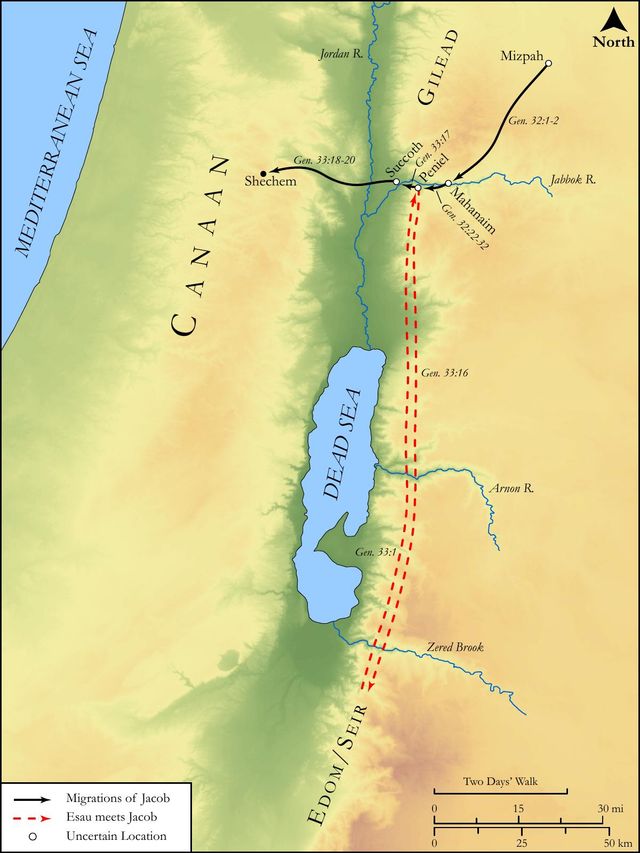
See on the biblical-era maps


Study this verse
Public-domain commentary
Matthew Henry
From his Commentary on the Whole Bible. Henry comments on passages, not single verses — this entry covers Genesis 32:24–32. His two-level outline is real structure in the source text, so it is rendered as structure.
We have here the remarkable story of Jacob's wrestling with the angel and prevailing, which is referred to, Hos 12:4. Very early in the morning, a great while before day, Jacob had helped his wives and his children over the river, and he desired to be private, and was left alone, that he might again more fully spread his cares and fears before God in prayer. Note, We ought to continue instant in prayer, always to pray and not to faint: frequency and importunity in prayer prepare us for mercy. While Jacob was earnest in prayer, stirring up himself to take hold on God, an angel takes hold on him. Some think this was a created angel, the angel of his presence (Isa 63:9), one of those that always behold the face of our Father and attend on the shechinah, or the divine Majesty, which probably Jacob had also in view. Others think it was Michael our prince, the eternal Word, the angel of the covenant, who is indeed the Lord of the angels, who often appeared in a human shape before he assumed the human nature for a perpetuity; whichsoever it was, we are sure God's name was in him, Exo 23:21. Observe,
I.How Jacob and this angel engaged, Gen 32:24.
It was a single combat, hand to hand; they had neither of them any seconds. Jacob was now full of care and fear about the interview he expected, next day, with his brother, and, to aggravate the trial, God himself seemed to come forth against him as an enemy, to oppose his entrance into the land of promise, and to dispute the pass with him, not suffering him to follow his wives and children whom he had sent before. Note, Strong believers must expect divers temptations, and strong ones. We are told by the prophet (Hos 12:4) how Jacob wrestled: he wept, and made supplication; prayers and tears were his weapons. It was not only a corporal, but a spiritual, wrestling, by the vigorous actings of faith and holy desire; and thus all the spiritual seed of Jacob, that pray in praying, still wrestle with God.
II.What was the success of the engagement.
1.Jacob kept his ground; though the struggle continued long, the angel, prevailed not against him (Gen 32:25), that is, this discouragement did not shake his faith, nor silence his prayer. It was not in his own strength that he wrestled, nor by his own strength that he prevailed, but in and by strength derived from Heaven. That of Job illustrates this (Job 23:6), Will he plead against me with his great power? No (had the angel done so, Jacob had been crushed), but he will put strength in me; and by that strength Jacob had power over the angel, Hos 12:4. Note, We cannot prevail with God but in his own strength. It is his Spirit that intercedes in us, and helps our infirmities, Rom 8:26.
2.The angel put out Jacob's thigh, to show him what he could do, and that it was God he was wrestling with, for no man could disjoint his thigh with a touch. Some think that Jacob felt little or no pain from this hurt; it is probable that he did not, for he did not so much as halt till the struggle was over (Gen 32:31), and, if so, this was an evidence of a divine touch indeed, which wounded and healed at the same time. Jacob prevailed, and yet had his thigh put out. Note, Wrestling believers may obtain glorious victories, and yet come off with broken bones; for when they are weak then are they strong, weak in themselves, but strong in Christ, Co2 12:10. Our honours and comforts in this world have their alloys.
3.The angel, by an admirable condescension, mildly requests Jacob to let him go (Gen 32:26), as God said to Moses (Exo 32:10), Let me alone. Could not a mighty angel get clear of Jacob's grapples? He could; but thus he would put an honour on Jacob's faith and prayer, and further try his constancy. The king is held in the galleries (Sol 7:5); I held him (says the spouse) and would not let him go, Sol 3:4. The reason the angel gives why he would be gone is because the day breaks, and therefore he would not any longer detain Jacob, who had business to do, a journey to go, a family to look after, which, especially in this critical juncture, called for his attendance. Note, Every thing is beautiful in its season; even the business of religion, and the comforts of communion with God, must sometimes give way to the necessary affairs of this life: God will have mercy, and not sacrifice.
4.Jacob persists in his holy importunity: I will not let thee go, except thou bless me; whatever becomes of his family and journey, he resolves to make the best he can of this opportunity, and not to lose the advantage of his victory: he does not mean to wrestle all night for nothing, but humbly resolves he will have a blessing, and rather shall all his bones be put out of joint than he will go away without one. The credit of a conquest will do him no good without the comfort of a blessing. In begging this blessing he owns his inferiority, though he seemed to have the upper hand in the struggle; for the less is blessed of the better. Note, Those that would have the blessing of Christ must be in good earnest, and be importunate for it, as those that resolve to have no denial. It is the fervent prayer that is the effectual prayer.
5.The angel puts a perpetual mark of honour upon him, by changing his name (Gen 32:27, Gen 32:28): "Thou art a brave combatant" (says the angel), "a man of heroic resolution; what is thy name?" "Jacob," says he, a supplanter; so Jacob signifies: "Well," says the angel, "be thou never so called any more; henceforth thou shalt be celebrated, not for craft and artful management, but for true valour; thou shalt be called Israel, a prince with God, a name greater than those of the great men of the earth." He is a prince indeed that is a prince with God, and those are truly honourable that are mighty in prayer, Israels, Israelites indeed. Jacob is here knighted in the field, as it were, and has a title of honour given him by him that is the fountain of honour, which will remain, to his praise, to the end of time. Yet this was not all; having power with God, he shall have power with men too. Having prevailed for a blessing from heaven, he shall, no doubt, prevail for Esau's favour. Note, Whatever enemies we have, if we can but make God our friend, we are well off; those that by faith have power on earth as they have occasion for.
6.He dismisses him with a blessing, Gen 32:29. Jacob desired to know the angel's name, that he might, according to his capacity, do him honour, Jdg 13:17. But that request was denied, that he might not be too proud of his conquest, nor think he had the angel at such an advantage as to oblige him to what he pleased. No, "Wherefore dost thou ask after my name? What good will it do thee to know that?" The discovery of that was reserved for his death-bed, upon which he was taught to call him Shiloh. But, instead of telling him his name, he gave him his blessing, which was the thing he wrestled for: He blessed him there, repeated and ratified the blessing formerly given him. Note, Spiritual blessings, which secure our felicity, are better and much more desirable than fine notions which satisfy our curiosity. An interest in the angel's blessing is better than an acquaintance with his name. The tree of life is better than the tree of knowledge. Thus Jacob carried his point; a blessing he wrestled for, and a blessing he had; nor did ever any of his praying seed seek in vain. See how wonderfully God condescends to countenance and crown importunate prayer: those that resolve, though God slay them, yet to trust in him, will, at length, be more than conquerors.
7.Jacob gives a new name to the place; he calls it Peniel, the face of God (Gen 32:30), because there he had seen the appearance of God, and obtained the favour of God. Observe, The name he gives to the place preserves and perpetuates, not the honour of his valour or victory, but only the honour of God's free grace. He does not say, "In this place I wrestled with God, and prevailed;" but, "In this place I saw God face to face, and my life was preserved;" not, "It was my praise that I came off a conqueror, but it was God's mercy that I escaped with my life." Note, It becomes those whom God honours to take shame to themselves, and to admire the condescensions of his grace to them. Thus David did, after God had sent him a gracious message (Sa2 7:18), Who am I, O Lord God?
8.The memorandum Jacob carried of this in his bones: He halted on his thigh (Gen 32:31); some think he continued to do so to his dying-day; and, if he did, he had no reason to complain, for the honour and comfort he obtained by this struggle were abundantly sufficient to countervail the damage, though he went limping to his grave. He had no reason to look upon it as his reproach thus to bear in his body the marks of the Lord Jesus (Gal 6:17); yet it might serve, like Paul's thorn in the flesh, to keep him from being lifted up with the abundance of the revelations. Notice is taken of the sun's rising upon him when he passed over Penuel; for it is sunrise with that soul that has communion with God. The inspired penman mentions a traditional custom which the seed of Jacob had, in remembrance of this, never to eat of that sinew, or muscle, in any beast, by which the hip-bone is fixed in its cup: thus they preserved the memorial of this story, and gave occasion to their children to enquire concerning it; they also did honour to the memory of Jacob. And this use we may still make of it, to acknowledge the mercy of God, and our obligations to Jesus Christ, that we may now keep up our communion with God, in faith, hope, and love, without peril either of life or limb.
Historical interpretation
Historical reception
1 surviving comment on this verse from the historical church.
(Verse 27 and 28.) And he said to him: What is your name? He said, Jacob. And he said to him: Your name shall no longer be called Jacob, but your name shall be called Israel: for you have wrestled with God, and have prevailed with men. Josephus, in the first book of Antiquities, thinks that Israel was called so because he wrestled with an angel. I carefully examined this, but I could not find it at all in Hebrew. And why should I seek the opinions of individuals, when the one who gave the name explains the etymology himself? He said, 'Your name will no longer be Jacob, but Israel will be your name.' Why? Aquila interprets it as 'because you have begun with God,' Symmachus as 'because I will start towards God,' the Septuagint and Theodotio as 'because you have prevailed with God.' Sarith (which is derived from the word Israel) means 'prince.' Therefore, the meaning is: Your name will not be supplanter, that is, Jacob, but your name will be prince with God, that is, Israel. For just as I am a prince, so you, who were able to wrestle with me, shall be called a prince. But if you were able to wrestle with me, who am God or an angel (for many interpret it differently), how much more so with humans, that is, with Esau, whom you should not fear! However, that which is interpreted as 'Israel' in the book of Numbers, 'a man who sees God' or 'a mind that sees God', seems to me to have been interpreted not so truly, but rather forcefully, in the common speech. For here Israel, as it is written in these letters, is spelled Iod, Sin, Res, Aleph, Lamed, which means Prince of God, or Direct of God, that is, εὐθύτατος Θεοῦ. But the word for "seeing" God is spelled Aleph, Iod, Sin, so that it is written with three letters and pronounced Is (), while "seeing" is spelled with three letters, Res, Aleph, He, and pronounced Raa (). And El () is formed by two letters, Aleph and Lamed, and it means God, or strong. Although, therefore, they are of great authority, and the shadow of their eloquence oppresses us, who have transformed the man, or rather the mind perceiving God, into the Israel: we are rather led by the authority of Scripture, and of the Angels, or of God, who called him Israel, than by any worldly eloquence. That which also follows afterwards:
Continue studying Genesis 32:27 across the web’s major study libraries — every link below opens this exact verse, chapter, or book on the destination site.
Read & Compare
 BibleGatewayThis verse in more than 200 translations and 70 languages.
 Bible.comThe YouVersion reader — hundreds of translations, reading plans, and highlights.
 ESV.orgCrossway's official English Standard Version reader.
 NET BibleThe NET translation with 60,000+ translators' notes on every rendering decision.
 STEP BibleTyndale House's free study tool — original text, vocabulary, and scholarly resources.
 BibliaLogos Bible Software's free web reader.
 USCCBThe New American Bible (Revised Edition) with the U.S. bishops' study notes.
Commentaries
 BibleHub CommentariesDozens of classic commentaries on this verse, gathered on one page.
 StudyLightMore than 100 commentary sets — the largest collection on the web.
 BibleRefPlain-English commentary on what this verse means, verse by verse.
 Enduring WordDavid Guzik's free commentary on this chapter, widely used by Bible teachers.
 Bible Study ToolsVerse commentary alongside Greek and Hebrew study aids.
Original Language & Research
- BibleHub InterlinearThe verse word by word — original language, transliteration, and English.
- BibleHub LexiconEvery word's original-language definition and Strong's entry.
 Blue Letter BibleDeep-study tools — Strong's numbers, concordance, and word studies.
 SefariaThe Hebrew text with Rashi and centuries of Jewish commentary.
Sermons, Hymns & Audio


TrulyRandomVerse is not affiliated with these sites and doesn’t control their content. They’re linked because they’re genuinely useful.
Summary
Genesis 32:27 captures a seminal moment during Jacob's night-long struggle at the Jabbok ford, as his mysterious opponent demands, "What is thy name?" Jacob's unvarnished reply, "Jacob," serves as a profound confession of his identity as "supplanter" or "deceiver," a name he had consistently embodied. This honest admission before the divine presence is the crucial prerequisite for his impending transformation, the bestowal of a new name, and the forging of a deeper covenant relationship, underscoring the spiritual necessity of self-confrontation and humility before God.
Context
ShowHideLiterary Context
This verse is the climax of Jacob's solitary night encounter at the Jabbok ford, immediately preceding his anxious reunion with his estranged brother, Esau. Having sent his family and possessions across the ford, Jacob remained alone, a deliberate act of isolation that set the stage for a profound spiritual confrontation. The wrestling match, initiated by a mysterious "man," began in Genesis 32:24 and continued until daybreak. Jacob's refusal to release his opponent without a blessing, as recorded in Genesis 32:26, highlights his desperate desire for divine favor and marks the transition from physical struggle to a deeper, more personal interrogation of his identity. The question of his name is the pivotal turning point, leading directly to his renaming as Israel in Genesis 32:28, signifying a new spiritual status and destiny.
Historical & Cultural Context
In Hebrew thought, a name was far more than a mere label; it was believed to encapsulate a person's character, reputation, destiny, and even their very essence. To know someone's name was to know their true nature and to have a measure of power or intimacy over them. The act of naming, or being named, often carried profound significance, particularly when divinely ordained, as seen in the patriarchal narratives. The Jabbok ford itself, a geographical boundary, served as a liminal space—a threshold between Jacob's past and his uncertain future with Esau, making it an appropriate setting for a transformative, boundary-crossing encounter. The concept of wrestling with a divine being, though unique in its portrayal here, aligns with the broader biblical theme of humanity's direct, often challenging, interactions with God, frequently resulting in profound spiritual growth and revelation.
Key Themes
ShowHideGenesis 32:27 is central to several overarching themes within the book of Genesis and biblical theology. Foremost is the theme of identity and transformation, as Jacob is forced to confront his past self ("supplanter") before he can embrace his divinely appointed future ("Israel"). This encounter also powerfully illustrates divine initiative and sovereignty, showing God actively engaging with and shaping the character of His chosen individuals, even through intense struggle. The narrative emphasizes the significance of names as indicators of character and destiny, a motif seen throughout the Bible (e.g., Abram to Abraham, Sarai to Sarah, Simon to Peter). Finally, the scene highlights the necessity of confession and humility as prerequisites for divine blessing and spiritual advancement, demonstrating that true growth often begins with an honest acknowledgment of one's true nature before God, as foreshadowed in the broader narrative of Jacob's life, from his birth in Genesis 25:26 to his deception of Isaac in Genesis 27:35-36.
Exposition and Analysis
ShowHideKey Word Analysis
ShowHideH559 from a primitive root, meaning "to say" but used with great latitude to include answering, appointing, commanding, declaring, demanding, or even determining. In this context, the divine figure's "saying" is not a mere utterance but carries the weight of a profound, authoritative declaration and a demand for a response, signifying a purposeful and intentional communication designed to elicit a specific outcome from Jacob.
An appellation that serves as a mark or memorial of individuality. Beyond a simple label, it implies honor, authority, and character. For the divine figure to ask for Jacob's name is not an inquiry for information (which God already possesses) but a demand for Jacob to articulate and confess his true identity, character, and history, thereby acknowledging who he is at his core.
Derived from the root meaning "heel-catcher" or, by implication, "supplanter" or "deceiver." This name was given to him at birth because he grasped Esau's heel (Genesis 25:26), and he subsequently lived up to its meaning through his cunning acquisition of the birthright (Genesis 25:33) and the blessing (Genesis 27:35-36). His simple, unadorned confession of this name is an admission of his past and his inherent character.
Verse Breakdown
ShowHide"And he said unto him,"
This phrase refers to the mysterious divine figure who had been wrestling with Jacob throughout the night. The "he" is the one who initiated the physical struggle and now initiates this crucial verbal exchange. The authoritative nature of the questioner is implicit, setting the stage for a demand rather than a casual inquiry.
"What [is] thy name?"
This is the pivotal question of the encounter. While the divine being undoubtedly knew Jacob's name, the question is not for information but for confession. In ancient thought, a name encapsulated one's character, history, and destiny. By asking Jacob to state his name, the divine figure compels him to confront his true identity—his past actions, his deceptive nature, and his very essence—before God. It is a demand for self-acknowledgment and honesty.
"And he said, Jacob."
Jacob's immediate and unembellished response is profound in its simplicity. He does not offer excuses, justifications, or a revised self-perception. He simply states the name that has defined his life and character: "Jacob," meaning "supplanter" or "deceiver." This honest confession of his true, flawed identity is the necessary step for him to move beyond his past and receive a new, divinely ordained identity. It signifies his surrender and vulnerability before the divine.
Literary Devices
ShowHideThe encounter in Genesis 32:27 is rich with literary devices that amplify its theological significance. The Interrogative Rhetoric of the question, "What is thy name?", is paramount. It is not a genuine inquiry for information, as the divine being is omniscient, but a rhetorical device designed to elicit a specific, transformative response from Jacob. This question forces Jacob into a moment of profound Self-Confrontation, compelling him to articulate his identity and acknowledge his past, which is directly tied to the Symbolism of his name, "Jacob" (supplanter/deceiver). The entire wrestling match serves as a powerful Metaphor for Jacob's lifelong struggle, not just with others, but with his own nature and ultimately with God. The scene also contains a subtle Irony: the all-knowing divine figure asks a question that seems simple but demands the deepest form of self-revelation. This moment functions as a Turning Point or Climax in the narrative, where the physical struggle transitions to a spiritual and psychological one, setting the stage for Jacob's renaming and the profound shift in his destiny.
Theological and Thematic Connections
ShowHideGenesis 32:27 profoundly illustrates the biblical principle that genuine transformation often begins with an honest, humble confession of one's true identity and past before God. Jacob's admission of his name, "supplanter," is not merely a verbal act but a deep acknowledgment of his character and the life he had lived. This moment underscores God's initiative in confronting individuals not to condemn, but to prepare them for a new, divinely purposed identity. It is a testament to the idea that God meets us in our weakness and brokenness, inviting us to lay bare our true selves as a prerequisite for His redemptive work. The significance of names in the Bible, representing character and destiny, is highlighted, showing that a new name signifies a new covenant relationship and purpose, divinely bestowed.
Reflection and Application
ShowHideThe profound encounter at the Jabbok, culminating in Jacob's confession, offers timeless lessons for believers today. We are often called to confront our own "names"—the identities we have adopted, the labels others have placed on us, or the self-perceptions we cling to, especially those rooted in past failures, self-reliance, or deceptive patterns. True spiritual growth necessitates an honest, unvarnished acknowledgment of who we are before God, laying bare our flaws, weaknesses, and the ways we have "supplanted" His will with our own. This narrative reminds us that our most significant transformations often occur not in comfort, but in moments of intense struggle, isolation, or vulnerability, where God meets us in our wrestling matches to refine our character and reveal His purposes. Just as Jacob received a new name and identity, believers are invited into a new identity in Christ, moving from an old self defined by sin and human effort to a new creation, a process that begins with acknowledging our past and surrendering to God's transformative power.
Questions for Reflection
ShowHideFAQ
ShowHideWhy did the divine figure ask for Jacob's name if he presumably already knew it?
ShowHideThe question "What is thy name?" was not an inquiry for information but a profound demand for self-identification and confession. In Hebrew thought, a name encapsulated one's character, history, and destiny. By asking Jacob to state his name, "Jacob" (meaning "supplanter" or "deceiver"), the divine figure compelled him to acknowledge his past and his true nature, a necessary step before he could receive a new identity and blessing from God. It was an act designed to elicit honesty and humility, marking a pivotal moment of self-confrontation that prepared Jacob for his new covenant relationship and name, "Israel," as seen in the very next verse, Genesis 32:28.
Who was the "man" Jacob wrestled with at the Jabbok?
ShowHideThe identity of the "man" is mysterious and has been a subject of theological debate, but the biblical text strongly implies a divine encounter. While initially called a "man" in Genesis 32:24, Jacob himself later declares, "I have seen God face to face, and my life is preserved" in Genesis 32:30. The prophet Hosea further clarifies this encounter, stating that Jacob "wrestled with God" and "had power over the angel" in Hosea 12:3-4. This suggests a theophany or Christophany—a pre-incarnate appearance of God or Christ—in human form, engaging Jacob in a profound, transformative encounter designed to prepare him for his destiny as the father of the nation of Israel.
Christ-Centered Fulfillment
ShowHideThe pivotal encounter at the Jabbok, where Jacob confronts his true identity and confesses his name, finds its ultimate and glorious fulfillment in the person and work of Jesus Christ. Jacob's wrestling with a divine figure, his injury, and his ultimate reception of a new identity foreshadow the spiritual struggle and ultimate victory found in Christ. Just as Jacob had to confess his old, deceptive identity before receiving a new name, believers are called to confess their sinful nature and surrender their old self to Christ. It is through Christ's perfect life, atoning death, and triumphant resurrection that a true and lasting new identity—one of righteousness, adoption, and sonship—is bestowed upon us, far surpassing the partial transformation experienced by Jacob. Christ is the ultimate "blessing" Jacob sought, the one who truly grapples with our fallenness, bears our infirmities, and through His finished work on the cross, grants us a complete and unblemished new name and standing before God. We are no longer defined by our past "supplanter" nature but are made "new creations" in Him (2 Corinthians 5:17), clothed in His righteousness (Philippians 3:9), and given the right to be called "children of God" (John 1:12). His victory over sin and death is our new identity, enabling us to walk in "newness of life" (Romans 6:4) as those who have truly "wrestled with God" through faith and found grace.