


Genesis 33:5
Bible text: King James Version (1769 Blayney text) · Public domain
Bible text: King James Version with Strong's numbers · Public domain
Bible text: Berean Standard Bible · Public domain
Bible text: American Standard Version (1901) · Public domain
Bible text: World English Bible, Messianic edition · Public domain
Bible text: Geneva Bible (1599) · Public domain
Bible text: Young's Literal Translation · Public domain
- וַיִּשָּׂאvai·yi·Sa'and he lifted upH5375Conj-w ¦ V-Qal-ConsecImperf-3msVerb Qal Consecutive Imperfect 3rd Singular Masculineוַandיִּשָּׂאhe lifted up
- אֶת'et<obj.>H853DirObjMParticle Object Indicator
- עֵינָיו'ei·Navhis eyesH5869N-fdc ¦ 3msNoun Dual Feminine Constructעֵינָיeyesוhis
- וַיַּרְאvai·Yar'and he sawH7200Conj-w ¦ V-Qal-ConsecImperf-3msVerb Qal Consecutive Imperfect 3rd Singular Masculineוַandיַּרְאhe saw
- אֶת'et<obj.>H853DirObjMParticle Object Indicator
- הַנָּשִׁיםha·na·Shimthe womenH802Art ¦ N-mpNoun Plural Masculine Absoluteהַtheנָּשִׁיםwomen
- וְאֶתve·'Etand <obj.>H853Conj-w ¦ DirObjMParticle Object Indicatorוְandאֶת<obj.>
- הַיְלָדִיםhay·la·Dimthe childrenH3206Art ¦ N-mpNoun Plural Masculine Absoluteהַtheיְלָדִיםchildren
- וַיֹּאמֶרvai·Yo·merand he saidH559Conj-w ¦ V-Qal-ConsecImperf-3msVerb Qal Consecutive Imperfect 3rd Singular Masculineוַandיֹּאמֶרhe said
- מִיmiwho?H4310InterrogPronoun Interrogative
- אֵלֶּה'E·leh[are] theseH428PrtParticle Demonstrative
- לָּךְLakhto <the> youPrep-l ¦ 2msSuffix Personal 2nd Singular Masculineלָּto <the>ךְyou
- וַיֹּאמַרvai·yo·Marand he saidH559Conj-w ¦ V-Qal-ConsecImperf-3msVerb Qal Consecutive Imperfect 3rd Singular Masculineוַandיֹּאמַרhe said
- הַיְלָדִיםhay·la·Dimthe childrenH3206Art ¦ N-mpNoun Plural Masculine Absoluteהַtheיְלָדִיםchildren
- אֲשֶׁר'a·SherwhomH834RelParticle Relative
- חָנַןcha·Nanhe has shown favor toH2603V-Qal-Perf-3msVerb Qal Perfect 3rd Singular Masculine
- אֱלֹהִים'E·lo·HimGodH430N-mpNoun Plural Masculine Absolute
- אֶת'et<obj.>H853DirObjMParticle Object Indicator
- עַבְדֶּךָ'av·De·khayour servantH5650N-msc ¦ 2msNoun Singular Masculine Constructעַבְדֶּservantךָyour
English is a literal word-by-word gloss of the Hebrew, not the KJV's wording. Why?
This is the original text the KJV's translators worked from — each Hebrew word with its own literal English meaning in this verse, prepared by scholars at Tyndale House, Cambridge. The KJV translates whole sentences, not word by word, so its wording differs: one Hebrew word can become several English words, and the KJV may choose “the LORD” where the gloss reads “Yahweh”. Both are faithful — they answer different questions. For the KJV's own rendering, switch to the KJV text.
Details
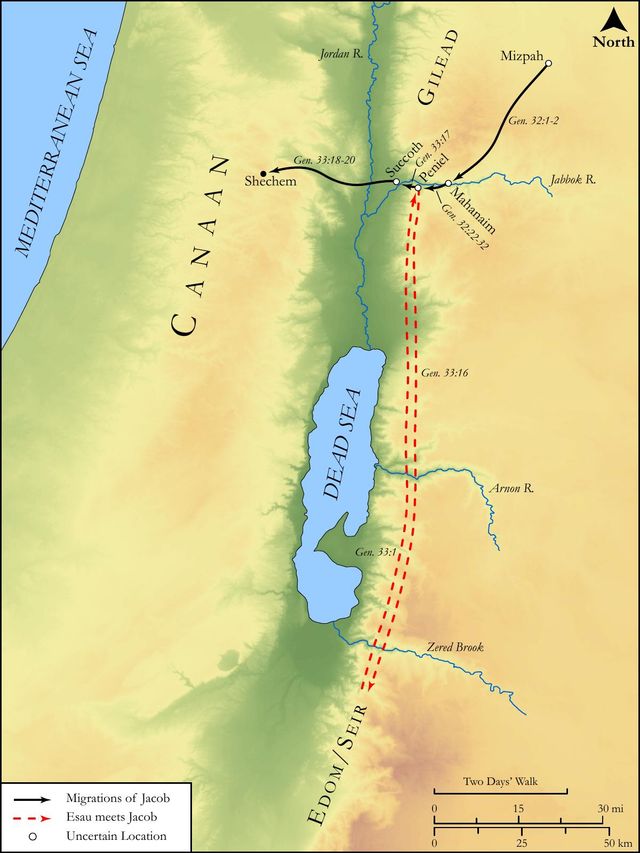
See on the biblical-era maps


Study this verse
Public-domain commentary
Matthew Henry
From his Commentary on the Whole Bible. Henry comments on passages, not single verses — this entry covers Genesis 33:5–15. His three-level outline is real structure in the source text, so it is rendered as structure.
We have here the discourse between the two brothers at their meeting, which is very free and friendly, without the least intimation of the old quarrel. It was the best way to say nothing of it. They converse,
I.About Jacob's retinue, Gen 33:5-7.
Eleven or twelve little ones, the eldest of them no fourteen years old, followed Jacob closely: Who are these? says Esau. Jacob had sent him an account of the increase of his estate (Gen 32:5), but made no mention of his children; perhaps because he would not expose them to his rage if he should meet him as an enemy, or would please him with the unexpected sight if he should meet him as a friend: Esau therefore had reason to ask, Who are those with thee? to which common question Jacob returns a serious answer, such as became his character: They are the children which God hath graciously given they servant. It had been a sufficient answer to the question, and fit enough to be given to profane Esau, if he had only said, "They are my children;" but then Jacob would not have spoken like himself, like a man whose eyes were ever towards the Lord. Note, It becomes us not only to do common actions, but to speak of them, after a godly sort, Jo3 1:6. Jacob speaks of his children,
1.As God's gifts; they are a heritage of the Lord, Psa 128:3; Psa 112:9; Psa 107:41.
2.As choice gifts; he hath graciously given them. Though they were many, and now much his care, and as yet but slenderly provided for, yet he accounts them great blessings. His wives and children, hereupon, come up in order, and pay their duty to Esau, as he had done before them (Gen 33:6, Gen 33:7); for it becomes the family to show respect to those to whom the master of the family shows respect.
II.About the present he had sent him.
1.Esau modestly refused it because he had enough, and did not need it, Gen 33:9. Note, Those who wish to be considered men of honour will not seem to be mercenary in their friendship: whatever influence Jacob's present had upon Esau to pacify him, he would not have it thought that it had any, and therefore he refused it. His reason is I have enough, I have much (so the word is), so much that he was not willing to take any thing that was his brother's. Note,
(1.)Many that come short of spiritual blessings, and are out of covenant, yet have much of this world's wealth. Esau had what was promised him, the fatness of the earth and a livelihood by his sword.
(2.)It is a good thing for those that have much to know that they have enough, though they have not so much as some others have. Even Esau can say, I have enough.
(3.)Those that are content with what they have must show it by not coveting what others have. Esau, for his part, needs it not, either to supply him, for he was rich, or to pacify him, for he was reconciled: we should take heed lest at any time our covetousness impose upon the courtesy of others, and meanly take advantage of their generosity.
2.Jacob affectionately urges him to accept it, and prevails, Gen 33:10, Gen 33:11. Jacob sent it, through fear (Gen 32:20), but, the fear being over, he now importunes his acceptance of it for love, to show that he desired his brother's friendship, and did not merely dread his wrath; two things he urges: - (1.) The satisfaction he had in his brother's favour, of which he thought himself bound to make this thankful acknowledgment. It is a very high compliment that he passes upon him: I have seen thy face, as though I had seen the face of God, that is, "I have seen thee reconciled to me, and at peace with me, as I desire to see God reconciled." Or the meaning is that Jacob saw God's favour to him in Esau's: it was a token for good to him that God had accepted his prayers. Note, Creature-comforts are comforts indeed to us when they are granted as answers to prayer, and are tokens of our acceptance with God. Again, It is matter of great joy to those that are of a peaceable and affectionate disposition to recover the friendship of those relations with whom they have been at variance. (2.) The competency he had of this world's goods: God has dealt graciously with me. Note, If what we have in this world increase under our hands, we must take notice of it with thankfulness, to the glory of God, and own that therein he has dealt graciously with us, better than we deserve. It is he that gives power to get wealth, Deu 8:18. He adds, "And I have enough; I have all," so the word is. Esau's enough was much, but Jacob's enough was all. Note, a godly man, though he have but little in the world, yet may truly say, "I have all," [1.] Because he has the God of all, and has all in him; all is yours if you be Christ's, Co1 3:22. [2.] Because he has the comfort of all. I have all, and abound, Phi 4:18. He that thinks he has all is sure he has enough. He has all in prospect; he will have all shortly, when he comes to heaven: upon this principle Jacob urged Esau, and he took his present. Note, It is an excellent thing when men's religion makes them generous, free-hearted, and open-handed, scorning to do a thing that is paltry and sneaking.
III.About the progress of their journey.
1.Esau offers himself to be his guide and companion, in token of sincere reconciliation, Gen 33:12. We never find that Jacob and Esau were so sociable with one another, and so affectionate, as they were now. Note, As for God his work is perfect. He made Esau, not only not an enemy, but a friend. This bone that had been broken, being well set, became stronger than ever. Esau has become fond of Jacob's company, courts him to Mount Seir: let us never despair of any, nor distrust God in whose hand all hearts are. Yet Jacob saw cause modestly to refuse this offer (Gen 33:13, Gen 33:14), wherein he shows a tender concern for his own family and flocks, like a good shepherd and a good father. He must consider the children, and the flocks, with young, and not lead the one, nor drive the other, too fast. This prudence and tenderness of Jacob ought to be imitated by those that have the care and charge of young people in the things of God. They must not be over-driven, at first, by heavy tasks in religious services, but led, as they can bear, having their work made as easy to them as possible. Christ, the good Shepherd, does so, Isa 40:11. Now Jacob will not desire Esau to slacken his pace, nor force his family to quicken theirs, nor leave them, to keep company with his brother, as many would have done, that love any society better than their own house; but he desires Esau to march before, and promises to follow him leisurely, as he could get forward. Note, It is an unreasonable thing to tie others to our rate; we may come with comfort, at last, to the same journey's end, though we do not journey together, either in the same path or with the same pace. There may be those with whom we cannot fall in and yet with whom we need not fall out by the way. Jacob intimates to him that it was his present design to come to him to Mount Seir; and we may presume he did so, after he had settled his family and concerns elsewhere, though that visit is not recorded. Note, When we have happily recovered peace with our friends we must take care to cultivate it, and not to be behind-hand with them in civilities.
2.Esau offers some of his men to be his guard and convoy, Gen 33:15. He saw Jacob but poorly attended, no servants but his husbandmen and shepherds, no pages or footmen; and therefore, thinking he was as desirous as himself (if he could afford it) to take state upon him, and look great, he would needs lend him some of his retinue, to attend upon him, that he might appear like Esau's brother; but Jacob humbly refuses his offer, only desiring he would not take it amiss that he did not accept it: What needeth it?
(1.)Jacob is humble, and needs it not for state; he desires not to make a fair show in the flesh, by encumbering himself with a needless retinue. Note, It is the vanity of pomp and grandeur that they are attended with a great deal of which it may be said, What needeth it?
(2.)Jacob is under the divine protection, and needs it not for safety. Note, Those are sufficiently guarded that have God for their guard and are under a convoy of his hosts, as Jacob was. Those need not be beholden to an arm of flesh that have God for their arm every morning. Jacob adds, "Only let me find grace in the sight of my lord; having thy favour, I have all I need, all I desire from thee." If Jacob thus valued the good-will of a brother, much more reason have we to reckon that we have enough if we have the good-will of our God.
Continue studying Genesis 33:5 across the web’s major study libraries — every link below opens this exact verse, chapter, or book on the destination site.
Read & Compare
 BibleGatewayThis verse in more than 200 translations and 70 languages.
 Bible.comThe YouVersion reader — hundreds of translations, reading plans, and highlights.
 ESV.orgCrossway's official English Standard Version reader.
 NET BibleThe NET translation with 60,000+ translators' notes on every rendering decision.
 STEP BibleTyndale House's free study tool — original text, vocabulary, and scholarly resources.
 BibliaLogos Bible Software's free web reader.
 USCCBThe New American Bible (Revised Edition) with the U.S. bishops' study notes.
Commentaries
 BibleHub CommentariesDozens of classic commentaries on this verse, gathered on one page.
 StudyLightMore than 100 commentary sets — the largest collection on the web.
 BibleRefPlain-English commentary on what this verse means, verse by verse.
 Enduring WordDavid Guzik's free commentary on this chapter, widely used by Bible teachers.
 Bible Study ToolsVerse commentary alongside Greek and Hebrew study aids.
Original Language & Research
- BibleHub InterlinearThe verse word by word — original language, transliteration, and English.
- BibleHub LexiconEvery word's original-language definition and Strong's entry.
 Blue Letter BibleDeep-study tools — Strong's numbers, concordance, and word studies.
 SefariaThe Hebrew text with Rashi and centuries of Jewish commentary.
Sermons, Hymns & Audio


TrulyRandomVerse is not affiliated with these sites and doesn’t control their content. They’re linked because they’re genuinely useful.
Summary
Genesis 33:5 captures the deeply moving moment of reconciliation between Jacob and Esau, two brothers long estranged by deception and fear. As Esau beholds Jacob's large family, his question about their identity elicits Jacob's profound and humble declaration that these children are a gracious gift from God. This exchange underscores themes of divine blessing, the transformative power of God's grace in restoring broken relationships, and the essential role of humility and gratitude in receiving and acknowledging God's unmerited favor.
Context
ShowHideLiterary Context
This pivotal encounter in Genesis 33 follows two decades of separation, during which Jacob fled Esau's wrath after deceiving his blind father Isaac to steal Esau's birthright and blessing. Jacob's arduous return journey from Haran was marked by profound apprehension regarding this reunion, prompting meticulous preparations, including sending lavish gifts ahead and strategically dividing his camp to mitigate potential harm. Just prior to meeting Esau, Jacob experienced a transformative, all-night wrestling match with a mysterious divine figure, where his name was changed to Israel (Genesis 32:24-32), signifying his readiness for this momentous reconciliation and a new identity rooted in his struggle with God. The immediate verses (Genesis 33:1-4) describe Jacob's cautious approach, his bowing seven times, and Esau's unexpected embrace, setting the stage for the tender dialogue in verse 5.
Historical & Cultural Context
In the households of the patriarchs, a large family was universally recognized as a clear and undeniable sign of divine blessing, prosperity, and the fulfillment of covenant promises. Children were seen as a heritage from the Lord, a source of strength, and a guarantee of lineage and legacy. The concept of reconciliation between estranged family members, especially brothers, was of immense social and cultural importance, as it preserved tribal and familial cohesion. Jacob's deferential posture (bowing seven times) and his self-designation as "thy servant" were culturally appropriate gestures of humility and respect, designed to appease and honor the elder brother, thereby facilitating peace and demonstrating his changed heart. The inquiry about family was a natural and polite way to begin a conversation, particularly after a long absence, indicating Esau's genuine curiosity rather than hostility.
Key Themes
ShowHideGenesis 33:5 contributes significantly to several overarching themes in the book of Genesis and the broader biblical narrative. It powerfully illustrates Divine Faithfulness and Providence, demonstrating how God orchestrates events, even over decades, to fulfill His promises and protect His covenant people, transforming fear into peace. The theme of Reconciliation and Forgiveness is central, showing that deep-seated animosity can be overcome through God's intervention and human humility, echoing the broader biblical call to peace. Furthermore, the verse highlights Humility and Gratitude, as Jacob, despite his wealth and large family, attributes everything to God's grace and adopts a humble posture before Esau. Finally, it reinforces the theme of Family as a Divine Blessing, presenting children not merely as offspring but as tangible evidence of God's favor and a continuation of the covenant lineage, as seen throughout the patriarchal narratives.
Exposition and Analysis
ShowHideKey Word Analysis
ShowHideThis primitive root, translated as "graciously given," means to bend or stoop in kindness to an inferior; to favor, bestow; causatively to implore (i.e. move to favor by petition). Jacob's use of this word emphasizes that his children are not merely a natural outcome of procreation or the result of his own efforts, but a direct, unmerited act of God's kindness, favor, and mercy towards him. It underscores the concept of divine grace as the source of all blessings.
Derived from the verb "to be born," this word refers to something born, a lad, or offspring. In this context, it specifically denotes "children." Jacob's acknowledgment of these "children" as a gift from God highlights the biblical understanding of family and offspring as a precious heritage and a tangible sign of God's covenant faithfulness and blessing, particularly in the patriarchal narratives where descendants were central to God's promises.
Meaning "a servant" or "bondman," Jacob's self-designation as "thy servant" to Esau is a profound act of humility and deference. Despite his own prosperity and the divine blessing he had received (including his new name, Israel), Jacob consciously adopts a subordinate position before his elder brother. This demonstrates a transformed character, a willingness to humble himself for the sake of reconciliation, and a recognition of Esau's birthright status, which he had previously usurped.
Verse Breakdown
ShowHide"And he lifted up his eyes, and saw the women and the children;"
This opening clause describes Esau's action. "Lifting up his eyes" (H5375, nâsâʼ, and H5869, ʻayin) signifies a deliberate observation, a moment of recognition and assessment. Esau's gaze falls upon the "women" (H802, ʼishshâh) and "children" (H3206, yeled) accompanying Jacob, immediately drawing his attention to the large family that has grown during their separation. This visual cue sets the stage for his inquiry, indicating a genuine curiosity about Jacob's life.
"and said, Who [are] those with thee?"
Esau's direct question (H559, ʼâmar, and H428, ʼêl-leh) is crucial. It is not accusatory or hostile, but rather one of simple inquiry and perhaps even wonder. The question "Who are those with thee?" suggests an immediate interest in Jacob's new family, signaling a potential shift from past animosity to present engagement and a desire for connection, paving the way for a peaceful dialogue rather than a confrontation.
"And he said, The children which God hath graciously given thy servant."
Jacob's response (H559, ʼâmar) is laden with theological significance and humility. He immediately identifies them as "The children" (H3206, yeled) and, crucially, attributes their existence to "God" (H430, ʼĕlôhîym) who "hath graciously given" (H2603, chânan) them. This declaration emphasizes divine sovereignty and grace as the source of his family's growth. Furthermore, Jacob refers to himself as "thy servant" (H5650, ʻebed), a profound act of humility and deference towards Esau, signaling his desire for reconciliation and acknowledging his brother's position.
Literary Devices
ShowHideThe verse effectively employs Dialogue as its primary literary device, presenting a direct exchange between Esau and Jacob. This immediate interaction allows the reader to witness the unfolding reconciliation firsthand, building tension and then releasing it through Jacob's humble and grateful response. The Symbolism of the children is also potent; they are not just offspring but represent God's abundant blessing and faithfulness to Jacob, especially in light of the covenant promises to Abraham and Isaac regarding numerous descendants. Jacob's reference to himself as "thy servant" is an act of Humility, a rhetorical posture designed to appease and honor Esau, demonstrating a profound change in Jacob's character from his earlier deceptive nature. The entire scene, particularly Jacob's response, serves as a subtle Foreshadowing of the peace and reconciliation that God brings, even in the most strained relationships, setting a tone of divine grace that permeates the reunion.
Theological and Thematic Connections
ShowHideGenesis 33:5 profoundly illustrates the theme of divine grace and providence in the lives of God's covenant people. Jacob's immediate attribution of his numerous children to God's gracious provision highlights that true prosperity, family growth, and even reconciliation are ultimately gifts from the Almighty, not solely the result of human cunning or effort. It underscores God's active involvement in fulfilling His promises, even when human actions (like Jacob's past deception) have created deep rifts. This moment serves as a powerful testament to God's ability to transform fear and conflict into unexpected peace, often exceeding human expectations and demonstrating His sovereign hand in preparing hearts for reconciliation.
Reflection and Application
ShowHideGenesis 33:5 offers profound encouragement for believers today to recognize and acknowledge God's sovereign hand in all aspects of their lives, particularly in family and provision. It serves as a powerful reminder that every good and perfect gift comes from above, originating from the Father of lights, who gives generously and without reproach. This verse also provides a compelling example of God's transformative power, capable of turning situations of deep-seated fear and conflict into moments of peace and reconciliation, often in ways we could never anticipate or orchestrate ourselves. It calls us to cultivate a spirit of profound gratitude and genuine humility, consistently attributing our blessings and successes to God's unmerited grace rather than our own efforts or merits. In our relationships, it challenges us to extend grace and seek reconciliation, trusting that God can soften even the hardest hearts and bridge the widest divides, just as He did for Jacob and Esau.
Questions for Reflection
ShowHideFAQ
ShowHideWhy does Jacob refer to himself as "thy servant" to Esau?
ShowHideJacob's use of "thy servant" (עַבְדֶּךָ, avdekha) to Esau is a deliberate and significant act of humility and deference. It signals his profound desire for reconciliation, acknowledging Esau's position as the elder brother and seeking to appease any lingering resentment from the past deception. This humble posture was crucial in diffusing tension and facilitating their peaceful reunion, demonstrating Jacob's transformed character and his willingness to submit for the sake of peace, a stark contrast to his earlier manipulative tendencies.
What is the theological significance of Jacob attributing his children to God's grace?
ShowHideBy stating "The children which God hath graciously given thy servant," Jacob explicitly acknowledges divine sovereignty and grace in his life. This is profoundly significant because it grounds his prosperity and the growth of his family not in his own cunning or hard work, but solely in God's unmerited favor. It aligns with the covenant promises made to Abraham and Isaac regarding numerous descendants (e.g., Genesis 12:2), emphasizing that the increase of his family is a direct fulfillment of God's faithfulness. This declaration reinforces the biblical theme that all blessings, especially the gift of children, ultimately flow from God's benevolent hand.
Does this verse suggest Esau was truly reconciled, or was Jacob still fearful?
ShowHideWhile Jacob had prepared extensively due to his deep-seated fear of Esau, Esau's question in this verse, asked in a spirit of curiosity rather than hostility, strongly indicates a genuine desire for reconciliation on Esau's part. The subsequent actions described in Genesis 33:4, where Esau ran to meet Jacob, embraced him, fell on his neck, and kissed him, confirm the authenticity and warmth of their reunion. Jacob's answer, attributing his family to God's grace, further solidifies the atmosphere of peace, suggesting that God had indeed prepared Esau's heart to receive Jacob without animosity, transforming what could have been a violent confrontation into a tender reconciliation.
Christ-Centered Fulfillment
ShowHideThe reconciliation between Jacob and Esau, facilitated by God's grace and Jacob's humility, serves as a powerful foreshadowing of the ultimate reconciliation achieved through Jesus Christ. Just as God transformed Jacob's fear into peace and Esau's bitterness into brotherly affection, Christ's atoning work on the cross reconciles estranged humanity to a holy God and to one another, effectively breaking down the dividing wall of hostility that separates us (as powerfully articulated in Ephesians 2:14-16). Jacob's acknowledgment of his children as a gracious gift from God points to the spiritual family of God, composed of those whom the Father has graciously given to the Son (a truth beautifully expressed in John 6:37), making them heirs of a greater, eternal inheritance and co-heirs with Christ (Romans 8:17). The overcoming of deep-seated animosity through divine intervention in this narrative serves as a powerful testament to Christ's ability to bring about true and lasting peace, fulfilling the promise of a new creation where former things are passed away and all things are made new in Him (2 Corinthians 5:17-19).