


Genesis 19:13
Bible text: King James Version (1769 Blayney text) · Public domain
Bible text: Berean Standard Bible · Public domain
Bible text: American Standard Version (1901) · Public domain
Bible text: World English Bible, Messianic edition · Public domain
Bible text: Geneva Bible (1599) · Public domain
Bible text: Young's Literal Translation · Public domain
- כִּיkiforH3588PrtParticle Conditional
- מַשְׁחִתִיםmash·chi·Tim[are] about to destroyH7843V-Hiphil-Prtcpl-mpVerb Hiphil Participle Plural Masculine Absolute
- אֲנַחְנוּ'a·Nach·nuweH587Pro-1cpPronoun Personal 1st Plural common gender
- אֶת'et<obj.>H853DirObjMParticle Object Indicator
- הַמָּקוֹםha·ma·Komthe placeH4725Art ¦ N-msNoun Singular Masculine Absoluteהַtheמָּקוֹםplace
- הַזֶּהha·Zeh<the> thisH2088Art ¦ PrtParticle Demonstrativeהַ<the>זֶּהthis
- כִּיkiforH3588PrtParticle Conditional
- גָדְלָהga·de·Lahit is greatH1431V-Qal-Perf-3fsVerb Qal Perfect 3rd Singular Feminine
- צַעֲקָתָםtza·'a·ka·Tamtheir outcryH6818N-fsc ¦ 3mpNoun Singular Feminine Constructצַעֲקָתָoutcryםtheir
- אֶת'etwithH854PrepPreposition
- פְּנֵיpe·Nei[the] face ofH6440N-mpcNoun Plural Masculine Construct
- יְהוָהYah·wehYahwehH3068N-properNoun Proper Title
- וַיְשַׁלְּחֵנוּvay·sha·le·Che·nuand he has sent usH7971Conj-w ¦ V-Piel-ConsecImperf-3ms ¦ 1cpVerb Piel Consecutive Imperfect 3rd Singular Masculineוַandיְשַׁלְּחֵhe has sentנוּus
- יְהוָהYah·wehYahwehH3068N-properNoun Proper Title
- לְשַׁחֲתָהּle·sha·cha·Tahto destroy itH7843Prep-l ¦ V-Piel-Inf ¦ 3fsVerb Piel Infinitive Constructלְtoשַׁחֲתָdestroyהּit
English is a literal word-by-word gloss of the Hebrew, not the KJV's wording. Why?
This is the original text the KJV's translators worked from — each Hebrew word with its own literal English meaning in this verse, prepared by scholars at Tyndale House, Cambridge. The KJV translates whole sentences, not word by word, so its wording differs: one Hebrew word can become several English words, and the KJV may choose “the LORD” where the gloss reads “Yahweh”. Both are faithful — they answer different questions. For the KJV's own rendering, switch to the KJV text.
Details
See on the biblical-era maps


Study this verse
Public-domain commentary
Matthew Henry
From his Commentary on the Whole Bible. Henry comments on passages, not single verses — this entry covers Genesis 19:12–14. His two-level outline is real structure in the source text, so it is rendered as structure.
We have here the preparation for Lot's deliverance.
I.Notice is given him of the approach of Sodom's ruin:
We will destroy this place, Gen 19:13. Note, The holy angels are ministers of God's wrath for the destruction of sinners, as well as of his mercy for the preservation and deliverance of his people. In this sense, the good angels become evil angels, Psa 78:49.
II.He is directed to give notice to his friends and relations, that they, it they would, might be saved with him (Gen 19:12):
"Hast thou here any besides, that thou art concerned for? If thou hast, go tell them what is coming." Now this implies,
1.The command of a great duty, which was to do all he could for the salvation of those about him, to snatch them as brands out of the fire. Note, Those who through grace are themselves delivered out of a sinful state should do what they can for the deliverance of others, especially their relations.
2.The offer of great favour. They do not ask whether he knew any righteous ones in the city fit to be spared: no, they knew there were none; but they ask what relations he had there, that, whether righteous or unrighteous, they might be saved with him. Note, Bad people often fare the better in this world for the sake of their good relations. It is good being akin to a godly man.
III.He applies himself accordingly to his sons-in-law, Gen 19:14. Observe,
1.The fair warning that Lot gave them: Up, get you out of this place. The manner of expression is startling and quickening. It was no time to trifle when the destruction was just at the door. They had not forty days to repent in, as the Ninevites had. Now or never they must make their escape. At midnight this cry was made. Such as this is our call to the unconverted, to turn and live.
2.The slight they put upon this warning: He seemed to them as one that mocked. They thought, perhaps, that the assault which the Sodomites had just now made upon his house had disturbed his head, and put him into such a fright that he knew not what he said; or they thought that he was not in earnest with them. Those who lived a merry life, and made a jest of everything, made a jest of this warning, and so they perished in the overthrow. Thus many who are warned of the misery and danger they are in by sin make a light matter of it, and think their ministers do but jest with them; such will perish with their blood upon their own heads.
Historical interpretation
Historical reception
1 surviving comment on this verse from the historical church.
However, how do we account for the fact that the Savior himself has brought to mind that all who spurned the gospel were worse? Finally to Capernaum he said, “If in Sodom had been wrought the miracles that had been wrought in you, perhaps it would have remained unto this day. But I say unto you that it shall be more tolerable for the land of Sodom in the day of judgment than for you.” If he says the people of Sodom are less worthy of damnation than all those who neglect the Gospels, then it is most certainly reasonable that we, who neglect the Gospels in most things, should have all the more fear. This is especially so because we are unwilling to be content with sins to which we are already long accustomed and, as it were, on daily familiarity.
Continue studying Genesis 19:13 across the web’s major study libraries — every link below opens this exact verse, chapter, or book on the destination site.
Read & Compare
 BibleGatewayThis verse in more than 200 translations and 70 languages.
 Bible.comThe YouVersion reader — hundreds of translations, reading plans, and highlights.
 ESV.orgCrossway's official English Standard Version reader.
 NET BibleThe NET translation with 60,000+ translators' notes on every rendering decision.
 STEP BibleTyndale House's free study tool — original text, vocabulary, and scholarly resources.
 BibliaLogos Bible Software's free web reader.
 USCCBThe New American Bible (Revised Edition) with the U.S. bishops' study notes.
Commentaries
 BibleHub CommentariesDozens of classic commentaries on this verse, gathered on one page.
 StudyLightMore than 100 commentary sets — the largest collection on the web.
 BibleRefPlain-English commentary on what this verse means, verse by verse.
 Enduring WordDavid Guzik's free commentary on this chapter, widely used by Bible teachers.
 Bible Study ToolsVerse commentary alongside Greek and Hebrew study aids.
Original Language & Research
- BibleHub InterlinearThe verse word by word — original language, transliteration, and English.
- BibleHub LexiconEvery word's original-language definition and Strong's entry.
 Blue Letter BibleDeep-study tools — Strong's numbers, concordance, and word studies.
 SefariaThe Hebrew text with Rashi and centuries of Jewish commentary.
Sermons, Hymns & Audio


TrulyRandomVerse is not affiliated with these sites and doesn’t control their content. They’re linked because they’re genuinely useful.
Summary
Genesis 19:13 marks the climactic declaration by two angelic messengers of God's unyielding and imminent judgment upon the city of Sodom. This pronouncement reveals that the pervasive and egregious wickedness of its inhabitants had reached an intolerable threshold, prompting a divine commission for the city's complete and irreversible destruction, thereby sealing its fate after Abraham's fervent but ultimately unfulfilled intercession.
Context
ShowHideLiterary Context
This verse is a direct and definitive statement delivered by the two angels who have just arrived in Sodom, immediately following their harrowing experience at Lot's house. Having been graciously hosted and protected by Lot from the depraved and violent men of the city who sought to sexually assault them, the angels now reveal the true, terrifying purpose of their visit. Their declaration of impending destruction serves as the culmination of the narrative established in Genesis 18, where the Lord revealed His intent to investigate the "great cry" against Sodom and Gomorrah. Abraham's subsequent intercession, moving from fifty righteous down to ten, underscores the divine principle that even a small remnant of righteousness could avert judgment. The angels' pronouncement in Genesis 19:13 confirms that not even ten righteous individuals were found, validating God's righteous decision to execute judgment due to Sodom's profound and unrepentant moral decay, setting the stage for the dramatic events of the following verses.
Historical & Cultural Context
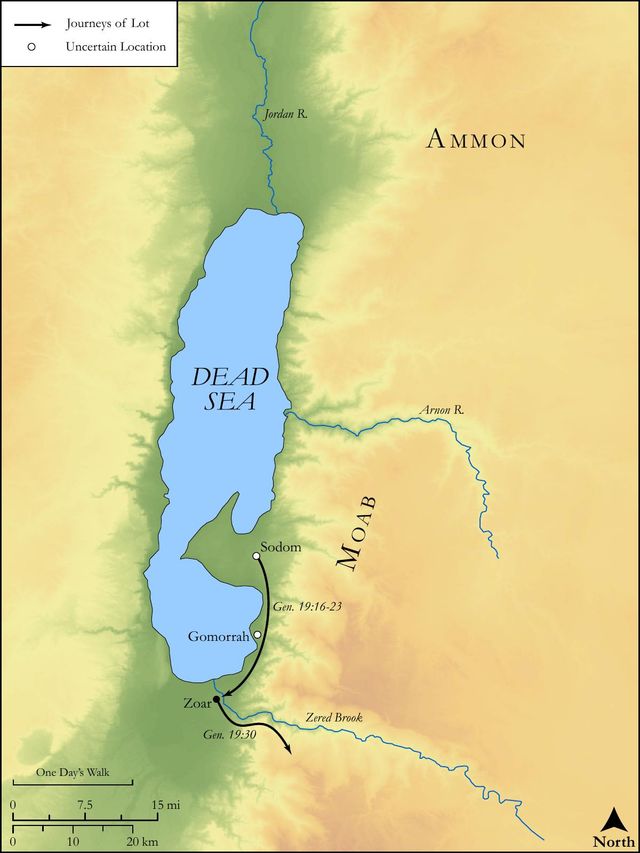
Sodom, alongside Gomorrah and other cities of the plain, was situated in the fertile Jordan Valley, a region known for its prosperity, which often led to complacency and moral corruption. Prosperity was often viewed as a sign of divine favor, but the narrative here highlights how such blessings, when coupled with a lack of justice and righteousness, could lead to severe moral decay. The specific sin that "cried out" against Sodom is often understood to encompass not only the attempted homosexual rape described in Genesis 19:4-9 but also a broader spectrum of oppression, arrogance, and lack of compassion, as later described in Ezekiel 16:49-50. The concept of a "cry" reaching God's ears is a common biblical motif, signifying that the iniquity had accumulated to such an extent that it demanded divine intervention and judgment, a reflection of God's active involvement in human affairs and His ultimate commitment to justice.
Key Themes
ShowHideThis verse powerfully contributes to several overarching themes within Genesis and the broader biblical narrative. Firstly, it underscores the theme of Divine Justice and Judgment, demonstrating God's unwavering commitment to righteousness and His ultimate intolerance for unrepentant sin. The destruction of Sodom serves as a stark example of the consequences of profound moral depravity and rebellion against God's standards, a theme echoed in later prophetic warnings and New Testament teachings on judgment, such as those found in 2 Peter 2:6. Secondly, the passage highlights God's Omniscience and Active Involvement in human affairs; the "cry" reaching "before the face of the LORD" emphasizes that no sin, however hidden, escapes His notice, and He is intimately aware of the moral state of humanity. Lastly, it reinforces the theme of Divine Sovereignty and Commission, as the angels explicitly state they were "sent" by the LORD to execute His will, illustrating that God uses agents to carry out His purposes and that His judgments are deliberate acts of His sovereign power, not arbitrary outbursts.
Exposition and Analysis
ShowHideKey Word Analysis
ShowHideThis primitive root signifies to "decay" or, causatively, to "ruin" (literally or figuratively). In Genesis 19:13, it denotes a complete and utter ruination, a total annihilation. The angels are not merely damaging or punishing; they are bringing about a final, irreversible end to the city and its inhabitants, consistent with the Strong's definition's emphasis on "destroyer," "destruction," and "utterly waste."
From the root meaning "to shriek," this word denotes a "cry" or "crying." While it can refer to a cry of distress or injustice from the oppressed, in this context, it represents the overwhelming, accumulated weight of Sodom's wickedness and moral offense. It is not an audible sound from victims but a metaphorical "cry" of the city's depravity itself, ascending to God as an accusation that demands a response, signifying an intolerable level of iniquity.
This plural noun, always used as singular, refers to "the face" as the part that turns. Figuratively, "before the face of the LORD" (לִפְנֵי יְהוָה - lifnei Yahweh) indicates direct presence, personal attention, and intimate awareness. It emphasizes that Sodom's sin was not merely observed from afar but was a direct, personal affront to God's holy presence and character, demanding His immediate and direct intervention.
This is the self-existent or eternal name of God, Jehovah, the Jewish national name of God. Its use here underscores the absolute sovereignty and covenant faithfulness of the God who is executing judgment. It is not a lesser deity or an impersonal force, but the personal, holy, and all-powerful God of Abraham who is bringing about this destruction, highlighting His authority and unchangeable nature.
Verse Breakdown
ShowHide"For we will destroy this place,"
The angels, acting as direct emissaries and agents of God's will, declare the absolute and irreversible doom of Sodom. This is not a warning or a conditional threat, but a statement of immediate and certain execution of judgment. The "we" signifies their active participation in carrying out the divine decree, demonstrating God's use of heavenly agents to fulfill His purposes on earth.
"because the cry of them is waxen great before the face of the LORD;"
This clause provides the divine justification for the impending destruction. The "cry" (tsaʻăqâh) refers to the overwhelming moral offense and spiritual corruption of Sodom, which has accumulated to such an egregious degree that it has metaphorically "waxen great" (gâdal – grown large, magnified) and ascended directly "before the face of the LORD." This emphasizes God's omniscient awareness of the city's profound wickedness and the direct affront its sin posed to His holy presence and character, indicating that the iniquity had reached its full measure, demanding a divine response.
"and the LORD hath sent us to destroy it."
This final segment explicitly states the divine commission and authority behind the angels' actions. The destruction is not an arbitrary act of violence but a deliberate, sovereign act of God's justice, initiated and commanded by "the LORD" (Yᵉhôvâh) Himself. This highlights God's active and direct role in upholding righteousness and His willingness to intervene decisively when sin reaches an intolerable level, underscoring His absolute sovereignty over all creation and His commitment to moral order.
Literary Devices
ShowHideGenesis 19:13 employs several potent Literary Devices to convey its message. The most prominent is Anthropomorphism, seen in the phrase "the cry of them is waxen great before the face of the LORD." While God does not literally have a "face" or "ears" to hear a "cry," this imagery vividly conveys His intimate awareness and direct attention to the profound wickedness of Sodom. It emphasizes that the city's sin was not merely observed but was a direct and personal affront to His holy presence, demanding a response. Furthermore, the "cry" itself functions as a form of Personification, where the collective sin and injustice of Sodom are given a voice, metaphorically crying out for judgment. The angels' declaration, "we will destroy this place," also demonstrates Divine Commission, highlighting that they are not acting on their own accord but as direct agents of God's sovereign will, emphasizing the divine origin and authority behind the impending destruction. The entire verse serves as a powerful instance of Foreshadowing, setting the stage for the dramatic and devastating judgment that immediately follows, reinforcing the theme of divine retribution for unrepentant sin.
Theological and Thematic Connections
ShowHideGenesis 19:13 stands as a profound theological statement, powerfully conveying God's unyielding commitment to justice and His active opposition to pervasive evil. It reveals that while God is infinitely patient and merciful, there is a limit to His tolerance for unrepentant sin, beyond which His righteous judgment is inevitable. The "cry" of Sodom's iniquity reaching "before the face of the LORD" underscores God's perfect omniscience and His intimate awareness of all human actions, whether public or hidden. This verse also highlights God's absolute sovereignty, demonstrating that He is not a passive observer but an active participant in human history, willing and able to intervene decisively to uphold His moral order. The destruction of Sodom serves as a timeless warning, illustrating the severe consequences that await individuals and societies that persist in grave sin, emphasizing the necessity of repentance and alignment with divine standards.
Reflection and Application
ShowHideGenesis 19:13 offers profound and sobering lessons for believers today, primarily affirming God's unchanging character as a just, holy, and sovereign God who will ultimately judge all unrighteousness. This truth should instill both a deep reverence for God and a sober understanding of sin's gravity, reminding us that persistent and unrepentant sin, whether individual or societal, carries serious and often catastrophic consequences. While God is incredibly patient and merciful, as demonstrated by Abraham's intercession, there comes a point when His patience gives way to righteous judgment. This urges a timely response to His warnings, a turning away from evil, and a pursuit of righteousness. Furthermore, the assurance that "the cry of them is waxen great before the face of the LORD" reminds us that God is intimately aware of all injustice, oppression, and suffering in the world. This provides immense comfort for the oppressed, knowing that their cries do not go unheard, and serves as a powerful warning for those who perpetrate harm, as God will ultimately bring about perfect justice in His time. It calls us to live lives that reflect God's holiness, seek justice, and share the message of repentance and salvation before the day of judgment arrives.
Questions for Reflection
ShowHideFAQ
ShowHideWhy did God destroy Sodom?
ShowHideGod destroyed Sodom because its wickedness had become exceedingly great and pervasive, reaching a point where it was an intolerable affront to His holy character and justice. The "cry" of their sin, encompassing profound moral depravity, oppression, arrogance, and sexual perversion (as evidenced by the attempted assault on the angels in Genesis 19:4-9), had "waxen great before the face of the LORD." This signifies that the city's iniquity had reached its full measure, necessitating divine intervention and judgment as a demonstration of God's righteousness and His commitment to upholding moral order.
What does "the cry of them is waxen great" mean?
ShowHideThis phrase does not refer to an audible sound of distress from the victims of Sodom, but rather to the accumulated weight and intensity of the city's moral corruption and sin. It signifies that the wickedness had reached such an extreme level that it metaphorically ascended to God, demanding His attention and righteous judgment. The Hebrew word for "cry" (tsaʻăqâh) often denotes a cry for justice or redress, and here it represents the pervasive evil that had saturated the city, becoming an offense that "magnified" itself before God. It highlights God's perfect knowledge of human sin and His active response to profound moral decay, as seen in other biblical accounts of divine judgment (e.g., Jonah 1:2).
Christ-Centered Fulfillment
ShowHideWhile Genesis 19:13 speaks of God's righteous judgment against sin, executed through angelic agents, it ultimately points to Christ as the ultimate Judge and, more profoundly, as the sole means of escape from divine wrath. Jesus Himself referenced the destruction of Sodom as a solemn warning of future judgment, comparing it to the sudden and decisive nature of His second coming, as recorded in Luke 17:28-30. Just as Lot and his family were offered a way of escape from Sodom's impending destruction, Christ offers salvation and refuge from the coming judgment for all who believe in Him. He is the righteous One whose perfect life and atoning sacrifice on the cross (Romans 5:8) provide the only way to avoid the just consequences of wickedness that Sodom experienced. Through His shed blood, He takes away the sin of the world (John 1:29), offering mercy and eternal life where only judgment was due, fulfilling God's ultimate plan for justice and redemption. The judgment upon Sodom, therefore, foreshadows the ultimate judgment to come, while simultaneously magnifying the grace and salvation offered uniquely through Jesus Christ, the Lamb of God.