


Genesis 19:12
Bible text: King James Version (1769 Blayney text) · Public domain
Bible text: King James Version with Strong's numbers · Public domain
Bible text: Berean Standard Bible · Public domain
Bible text: American Standard Version (1901) · Public domain
Bible text: World English Bible, Messianic edition · Public domain
Bible text: Geneva Bible (1599) · Public domain
Bible text: Young's Literal Translation · Public domain
- וַיֹּאמְרוּvai·yo·me·Ruand they saidH559Conj-w ¦ V-Qal-ConsecImperf-3mpVerb Qal Consecutive Imperfect 3rd Plural Masculineוַandיֹּאמְרוּthey said
- הָאֲנָשִׁיםha·'a·na·Shimthe menH582Art ¦ N-mpNoun Plural Masculine Absoluteהָtheאֲנָשִׁיםmen
- אֶל'eltoH413PrepPreposition
- לוֹטLotLotH3876N-proper-mNoun Proper Masculine
- עֹד'odyetH5750Adj-msAdjective Numerical Singular Masculine Absolute
- מִיmiwho?H4310InterrogPronoun Interrogative
- לְךָle·Kha[belongs] to <the> youPrep-l ¦ 2msSuffix Personal 2nd Singular Masculineלְ[belongs] to <the>ךָyou
- פֹהFohhereH6311AdvAdverb
- חָתָןcha·Tana son-in-lawH2860N-msNoun Singular Masculine Absolute
- וּבָנֶיךָu·va·Nei·khaand your sonsH1121Conj-w ¦ N-mpc ¦ 2msNoun Plural Masculine Constructוּandבָנֶיsonsךָyour
- וּבְנֹתֶיךָu·ve·no·Tei·khaand your daughtersH1323Conj-w ¦ N-fpc ¦ 2msNoun Plural Feminine Constructוּandבְנֹתֶיdaughtersךָyour
- וְכֹלve·Kholand allH3605Conj-w ¦ N-msNoun Singular Masculine Absoluteוְandכֹלall
- אֲשֶׁר'a·SherwhoH834RelParticle Relative
- לְךָle·Kha[belong] to <the> youPrep-l ¦ 2msSuffix Personal 2nd Singular Masculineלְ[belong] to <the>ךָyou
- בָּעִירba·'Irin the cityH5892Prep-b ¦ N-fsNoun Singular Feminine Absoluteבָּin theעִירcity
- הוֹצֵאho·Tze'bring outH3318V-Hiphil-Imp-2msVerb Hiphil Imperative 2nd Singular Masculine
- מִןminfromH4480PrepPreposition
- הַמָּקוֹםha·ma·Komthe placeH4725Art ¦ N-msNoun Singular Masculine Absoluteהַtheמָּקוֹםplace
English is a literal word-by-word gloss of the Hebrew, not the KJV's wording. Why?
This is the original text the KJV's translators worked from — each Hebrew word with its own literal English meaning in this verse, prepared by scholars at Tyndale House, Cambridge. The KJV translates whole sentences, not word by word, so its wording differs: one Hebrew word can become several English words, and the KJV may choose “the LORD” where the gloss reads “Yahweh”. Both are faithful — they answer different questions. For the KJV's own rendering, switch to the KJV text.
Details
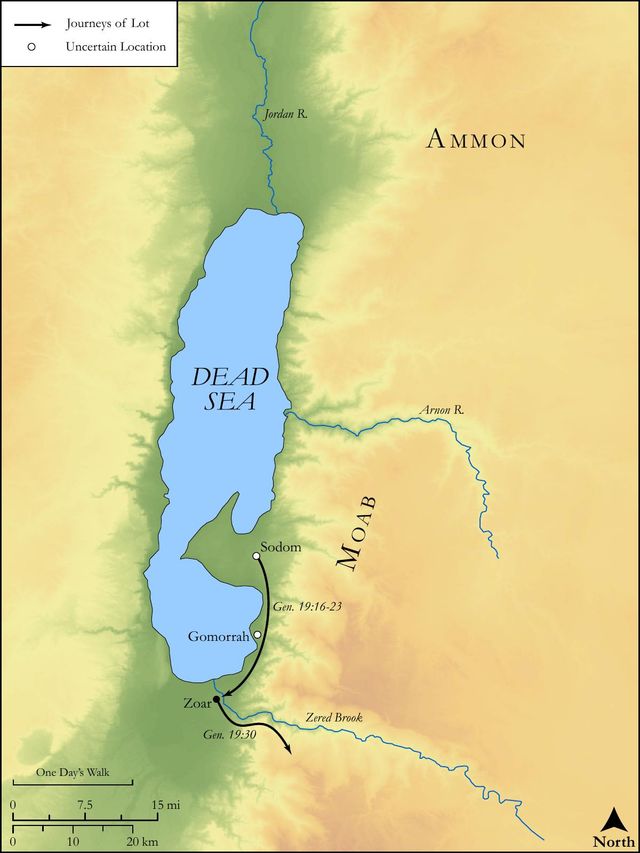
See on the biblical-era maps


Study this verse
Public-domain commentary
Matthew Henry
From his Commentary on the Whole Bible. Henry comments on passages, not single verses — this entry covers Genesis 19:12–14. His two-level outline is real structure in the source text, so it is rendered as structure.
We have here the preparation for Lot's deliverance.
I.Notice is given him of the approach of Sodom's ruin:
We will destroy this place, Gen 19:13. Note, The holy angels are ministers of God's wrath for the destruction of sinners, as well as of his mercy for the preservation and deliverance of his people. In this sense, the good angels become evil angels, Psa 78:49.
II.He is directed to give notice to his friends and relations, that they, it they would, might be saved with him (Gen 19:12):
"Hast thou here any besides, that thou art concerned for? If thou hast, go tell them what is coming." Now this implies,
1.The command of a great duty, which was to do all he could for the salvation of those about him, to snatch them as brands out of the fire. Note, Those who through grace are themselves delivered out of a sinful state should do what they can for the deliverance of others, especially their relations.
2.The offer of great favour. They do not ask whether he knew any righteous ones in the city fit to be spared: no, they knew there were none; but they ask what relations he had there, that, whether righteous or unrighteous, they might be saved with him. Note, Bad people often fare the better in this world for the sake of their good relations. It is good being akin to a godly man.
III.He applies himself accordingly to his sons-in-law, Gen 19:14. Observe,
1.The fair warning that Lot gave them: Up, get you out of this place. The manner of expression is startling and quickening. It was no time to trifle when the destruction was just at the door. They had not forty days to repent in, as the Ninevites had. Now or never they must make their escape. At midnight this cry was made. Such as this is our call to the unconverted, to turn and live.
2.The slight they put upon this warning: He seemed to them as one that mocked. They thought, perhaps, that the assault which the Sodomites had just now made upon his house had disturbed his head, and put him into such a fright that he knew not what he said; or they thought that he was not in earnest with them. Those who lived a merry life, and made a jest of everything, made a jest of this warning, and so they perished in the overthrow. Thus many who are warned of the misery and danger they are in by sin make a light matter of it, and think their ministers do but jest with them; such will perish with their blood upon their own heads.
Continue studying Genesis 19:12 across the web’s major study libraries — every link below opens this exact verse, chapter, or book on the destination site.
Read & Compare
 BibleGatewayThis verse in more than 200 translations and 70 languages.
 Bible.comThe YouVersion reader — hundreds of translations, reading plans, and highlights.
 ESV.orgCrossway's official English Standard Version reader.
 NET BibleThe NET translation with 60,000+ translators' notes on every rendering decision.
 STEP BibleTyndale House's free study tool — original text, vocabulary, and scholarly resources.
 BibliaLogos Bible Software's free web reader.
 USCCBThe New American Bible (Revised Edition) with the U.S. bishops' study notes.
Commentaries
 BibleHub CommentariesDozens of classic commentaries on this verse, gathered on one page.
 StudyLightMore than 100 commentary sets — the largest collection on the web.
 BibleRefPlain-English commentary on what this verse means, verse by verse.
 Enduring WordDavid Guzik's free commentary on this chapter, widely used by Bible teachers.
 Bible Study ToolsVerse commentary alongside Greek and Hebrew study aids.
Original Language & Research
- BibleHub InterlinearThe verse word by word — original language, transliteration, and English.
- BibleHub LexiconEvery word's original-language definition and Strong's entry.
 Blue Letter BibleDeep-study tools — Strong's numbers, concordance, and word studies.
 SefariaThe Hebrew text with Rashi and centuries of Jewish commentary.
Sermons, Hymns & Audio


TrulyRandomVerse is not affiliated with these sites and doesn’t control their content. They’re linked because they’re genuinely useful.
Summary
Genesis 19:12 records the urgent and pivotal command issued by two angelic messengers to Lot. They instruct him to identify and gather every member of his household—including his sons-in-law, sons, and daughters—along with all his possessions within the city, and immediately bring them out of Sodom. This divine directive underscores the imminent and certain nature of God's righteous judgment upon the exceedingly wicked city, while simultaneously highlighting His sovereign mercy and provision for Lot and his family to escape the impending, catastrophic destruction.
Context
ShowHideLiterary Context
This verse is situated at a critical and climactic point in the narrative of God's judgment upon Sodom and Gomorrah, immediately preceding their fiery destruction. Prior to this, two angels, appearing as men, had arrived in Sodom and were hospitably received by Lot, a righteous man living amidst profound wickedness, as detailed in Genesis 19:1. The extreme depravity of the city's inhabitants was immediately and graphically displayed when the men of Sodom surrounded Lot's house, demanding access to the angelic visitors for perverse sexual acts (Genesis 19:4-9). After Lot's desperate and failed attempt to protect his guests, and the angels' miraculous intervention to blind the attackers, the angels reveal their true mission: to destroy the city due to the grievous outcry of its sin, a judgment previously discussed between the Lord and Abraham in Genesis 18:20-21. Genesis 19:12 marks the direct, urgent, and non-negotiable instruction to Lot to gather his family and prepare for immediate evacuation, signifying the final moments before divine wrath is unleashed.
Historical & Cultural Context
In the days of the patriarchs, hospitality was a sacred duty, especially towards strangers, and Lot's actions in Genesis 19:1-3 reflect this cultural norm, contrasting sharply with the egregious violation of hospitality by the men of Sodom. The cities of Sodom and Gomorrah were known for their fertile plain, but also for their profound moral corruption, which had reached a point of no return in God's sight. The concept of divine messengers, or angels, acting as agents of God's will was a common understanding, and their appearance as men would have been a test of the inhabitants' character. Furthermore, the patriarchal structure of society placed immense responsibility on the head of the household, like Lot, to ensure the well-being and safety of his extended family, including sons, daughters, and sons-in-law. This cultural expectation is directly addressed by the angels' explicit command to Lot regarding his dependents.
Key Themes
ShowHideGenesis 19:12 contributes significantly to several overarching themes within the book of Genesis and the broader biblical narrative. Foremost is the theme of Divine Judgment, demonstrating God's absolute righteousness and His intolerance for pervasive wickedness, a theme echoed in the flood narrative of Genesis 6-9. Simultaneously, it highlights Divine Mercy and Deliverance, as God, in His sovereign grace, provides a way of escape for the righteous, a promise often seen throughout salvation history, such as in the Passover deliverance in Exodus 12. The verse also emphasizes the Urgency of Response to God's warnings, illustrating that procrastination in the face of impending judgment can lead to dire consequences. Lastly, it underscores the theme of Separation from Evil, portraying the necessity for God's people to physically and spiritually distance themselves from corrupting influences and environments marked for divine wrath, a principle that recurs in calls for holiness throughout Scripture, from Leviticus 11:44 to 2 Corinthians 6:17.
Exposition and Analysis
ShowHideThe command in Genesis 19:12 is delivered by "the men," who are clearly identified as angels (Hebrew: mal'akhim, מַלְאָכִים, meaning "messengers") throughout the broader context of Genesis 19. Their divine authority imbues their pronouncements with absolute weight, urgency, and the certainty of impending judgment.
Key Word Analysis
ShowHideThis primitive root signifies not merely speaking, but often carries the weight of declaring, commanding, appointing, or determining. In this context, it conveys a divine decree, an authoritative pronouncement that demands immediate and unquestioning obedience, rather than a mere suggestion or inquiry. The angels are not asking for Lot's opinion but delivering a non-negotiable mandate from God.
This term refers to a relative by marriage, specifically through the bride. Its inclusion here is significant, as it highlights Lot's responsibility not only for his immediate offspring but also for those who have married into his family. The subsequent narrative reveals the tragic skepticism and ultimate refusal of these sons-in-law to heed the warning, underscoring the spiritual blindness that can accompany worldly attachment.
This primitive root means "to go out" or, in its causative form as used here, "to bring out." It implies a forceful, decisive, and complete extraction or removal. The urgency of the situation is captured in this imperative verb, demanding swift action to physically separate Lot's household and possessions from the condemned city, symbolizing a spiritual severance from its pervasive wickedness.
Verse Breakdown
ShowHide"And the men said unto Lot, Hast thou here any besides?"
This opening clause establishes the divine origin of the command and introduces a rhetorical question. It is not an inquiry born of ignorance on the part of the angels, but a direct, probing prompt designed to ensure Lot fully accounts for everyone connected to him within the city's boundaries. It serves as a stark reminder of Lot's patriarchal responsibility and a call to immediate action, leaving no room for oversight.
"son in law, and thy sons, and thy daughters,"
This specific enumeration of Lot's immediate and extended family members underscores the angels' meticulous concern for human life and Lot's profound responsibility as the head of the household. It highlights the inclusive nature of the divine warning, extending the opportunity for escape to all within Lot's sphere of influence, even those who might be reluctant or skeptical.
"and whatsoever thou hast in the city,"
This phrase broadens the scope of the command beyond just people to encompass all of Lot's material possessions, livestock, servants, and any other valuables he had accumulated within Sodom. It signifies a complete and urgent severance from the condemned city and its economy, emphasizing that nothing from Sodom should be retained or valued above escaping God's judgment. It implies a call to abandon all worldly attachments to a place marked for destruction.
"bring [them] out of this place:"
This is the forceful, imperative core of the command. The Hebrew verb implies a decisive and immediate action, demanding a complete physical removal. "Out of this place" underscores the absolute necessity of complete separation from a location marked for imminent destruction, symbolizing a spiritual separation from sin and its inevitable consequences. The urgency of this command leaves no room for delay, negotiation, or looking back.
Literary Devices
ShowHideGenesis 19:12 employs several potent literary devices to convey its message. The angels' opening query, Rhetorical Question ("Hast thou here any besides?"), serves not as a genuine inquiry but as a forceful directive, compelling Lot to consider and account for every individual under his care. This device heightens the urgency and Lot's personal responsibility. The core of the verse is an Imperative Mood command ("bring [them] out"), which conveys the absolute authority of the divine messengers and the non-negotiable nature of the instruction. This direct command leaves no room for hesitation or negotiation, emphasizing the critical need for immediate obedience. Furthermore, the act of "bringing them out of this place" functions as powerful Symbolism. Sodom itself symbolizes profound human depravity and the inevitable judgment it incurs, while the act of leaving it represents a necessary separation from sin and its consequences. This physical exodus foreshadows a spiritual principle of separating oneself from the corrupting influences of the world. The verse also contains an element of Foreshadowing, as the specific mention of "son in law" subtly hints at the tragic unbelief and ultimate fate of those who would mock Lot's warning in the subsequent verses (Genesis 19:14), illustrating the dire consequences of rejecting divine counsel.
Theological and Thematic Connections
ShowHideGenesis 19:12 stands as a profound theological statement on the nature of God, humanity, and salvation. It powerfully illustrates God's unyielding righteousness and His commitment to execute justice upon persistent wickedness, yet simultaneously showcases His boundless mercy and sovereign provision for those He chooses to deliver. The urgent command to Lot underscores the critical and immediate need for a decisive response to divine warnings, emphasizing that there is no time for delay or negotiation when facing impending judgment. It also highlights the divinely assigned responsibility of the head of a household to ensure the spiritual and physical well-being of those under their care. The imperative to "bring them out of this place" is a foundational call to complete separation from a condemned environment, symbolizing the necessity for believers to distance themselves from the corrupting influences of the world, especially when God's judgment is at hand.
Reflection and Application
ShowHideGenesis 19:12 serves as a timeless warning and a profound call to decisive action for believers today. Just as Sodom faced imminent physical destruction, the Scriptures speak of a future and certain judgment for all who reject God and His ways, a truth reiterated in passages like John 3:18. This verse implores us to recognize and actively flee from spiritual dangers and the pervasive influence of sin in the world around us, understanding that God's warnings are given for our salvation and require immediate, unwavering action. Procrastination in spiritual matters can have dire and eternal consequences, as tragically exemplified by Lot's wife, a warning Jesus Himself echoed in Luke 17:32. Furthermore, Lot's instruction to gather his family highlights the profound responsibility believers have to share the urgent message of salvation with their loved ones, urging them to escape the coming judgment and embrace God's mercy and provision in Christ. It calls us to examine our own lives: are we clinging to "whatsoever thou hast in the city" that might hinder our full obedience and escape from the world's destructive influences?
Questions for Reflection
ShowHideFAQ
ShowHideWhy did the angels specifically ask Lot about his family members?
ShowHideThe angels' question, "Hast thou here any besides?", was not born of ignorance, but was a deliberate and rhetorical prompt. It served as a divine directive, ensuring Lot took full responsibility for gathering everyone under his care—his sons-in-law, sons, and daughters. This emphasized his patriarchal duty to protect his household from the impending judgment, thereby offering them a chance at salvation through his obedience. It underscored the comprehensive nature of God's concern for the righteous and those connected to them, even amidst widespread condemnation.
What does 'whatsoever thou hast in the city' include?
ShowHideThis phrase refers comprehensively to all of Lot's material possessions, including his wealth, livestock, servants, and any other valuable belongings he had acquired within Sodom. The command to bring them out signifies a complete and urgent severance from the condemned city. It emphasizes that nothing associated with its corrupt environment should remain or be valued above escaping God's judgment. This instruction highlights the principle that when God calls for separation, it often involves a radical detachment from worldly comforts and accumulations tied to a place under divine wrath.
Christ-Centered Fulfillment
ShowHideThe urgent divine command to Lot to "bring them out of this place" from a city destined for utter destruction profoundly foreshadows the ultimate deliverance offered through Jesus Christ. Just as Lot and his family were called to physically separate from Sodom to escape physical judgment, believers are called to "come out" from the dominion of sin and the world's condemnation through faith in Christ. Jesus Himself is the ultimate "place of refuge" and the only means of escape from the wrath to come, as 1 Thessalonians 1:10 declares, "Jesus, who delivers us from the wrath to come." The angels' urgent plea for Lot to gather his family echoes the urgency of the Gospel call, inviting all to flee the spiritual judgment on sin and find salvation in Christ's atoning sacrifice. He is the true Ark, the only way to escape the flood of divine justice, offering not merely physical escape but eternal redemption and reconciliation with God, as promised in Matthew 1:21. Through His death and resurrection, Christ has delivered us from the domain of darkness and transferred us to His kingdom (Colossians 1:13), offering freedom from the fear of death and the power of the devil (Hebrews 2:14-15).