


Genesis 38:9
- וַיֵּדַעvai·Ye·da'and he knewH3045Conj-w ¦ V-Qal-ConsecImperf-3msVerb Qal Consecutive Imperfect 3rd Singular Masculineוַandיֵּדַעhe knew
- אוֹנָן'o·NanOnanH209N-proper-mNoun Proper Masculine
- כִּיkithatH3588PrtParticle Conditional
- לֹּאlo'notH3808NegParticle Negative
- לוֹloto <the> himPrep-l ¦ 3msSuffix Personal 3rd Singular Masculineלto <the>וֹhim
- יִהְיֶהyih·Yehit will belongH1961V-Qal-Imperf-3msVerb Qal Imperfect 3rd Singular Masculine
- הַזָּרַעha·Za·ra'the offspringH2233Art ¦ N-msNoun Singular Masculine Absoluteהַtheזָּרַעoffspring
- וְהָיָהve·ha·Yahand it wasH1961Conj-w ¦ V-Qal-ConsecPerf-3msVerb Qal Consecutive Perfect 3rd Singular Masculineוְandהָיָהit was
- אִם'imifH518PrtParticle Conditional
- בָּאba'he wentH935V-Qal-Perf-3msVerb Qal Perfect 3rd Singular Masculine
- אֶל'elintoH413PrepPreposition
- אֵשֶׁת'E·shet[the] wife ofH802N-fscNoun Singular Feminine Construct
- אָחִיו'a·Chivhis brotherH251N-msc ¦ 3msNoun Singular Masculine Constructאָחִיbrotherוhis
- וְשִׁחֵתve·shi·Chetand he spoiledH7843Conj-w ¦ V-Piel-ConsecPerf-3msVerb Piel Consecutive Perfect 3rd Singular Masculineוְandשִׁחֵתhe spoiled
- אַרְצָה'Ar·tzah[the] ground towardsH776N-fs ¦ SfxNoun Singular Feminine Absoluteאַרְצָ[the] groundהtowards
- לְבִלְתִּיle·vil·Tito notH1115Prep-l ¦ N-csNoun Singular common gender Absoluteלְtoבִלְתִּיnot
- נְתָןne·tonto giveH5414V-Qal-InfVerb Qal Infinitive Construct
- זֶרַעZe·ra'offspringH2233N-msNoun Singular Masculine Absolute
- לְאָחִיוle·'a·Chivto his brotherH251Prep-l ¦ N-msc ¦ 3msNoun Singular Masculine Constructלְtoאָחִיbrotherוhis
English is a literal word-by-word gloss of the Hebrew, not the KJV's wording. Why?
This is the original text the KJV's translators worked from — each Hebrew word with its own literal English meaning in this verse, prepared by scholars at Tyndale House, Cambridge. The KJV translates whole sentences, not word by word, so its wording differs: one Hebrew word can become several English words, and the KJV may choose “the LORD” where the gloss reads “Yahweh”. Both are faithful — they answer different questions. For the KJV's own rendering, switch to the KJV text.
Details
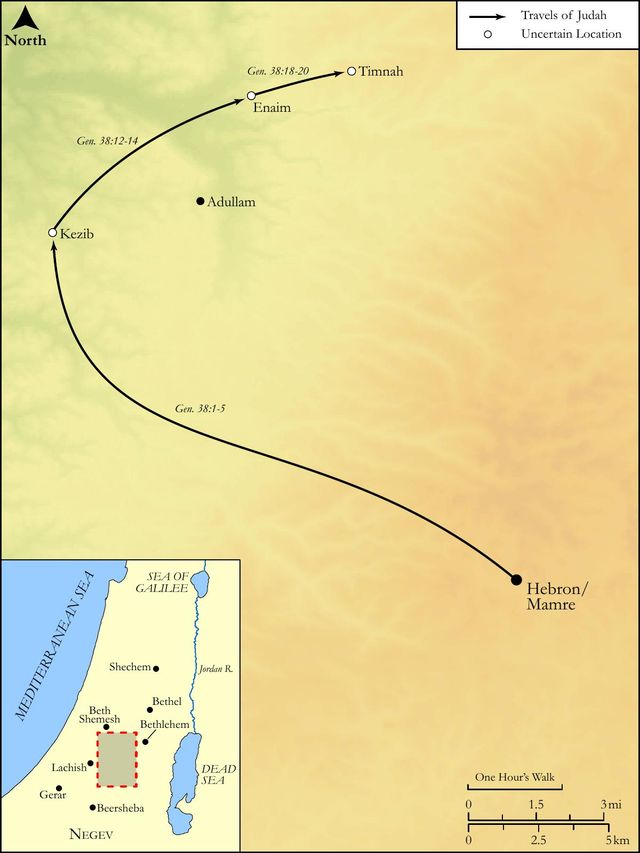
See on the biblical-era map


Study this verse
Public-domain commentary
Matthew Henry
From his Commentary on the Whole Bible. Henry comments on passages, not single verses — this entry covers Genesis 38:1–11.
Here is, 1. Judah's foolish friendship with a Canaanite-man. He went down from his brethren, and withdrew for a time from their society and his father's family, and got to be intimately acquainted with one Hirah, an Adullamite, Gen 38:1. It is computed that he was now not much above fifteen or sixteen years of age, an easy prey to the tempter. Note, When young people that have been well educated begin to change their company, they will soon change their manners, and lose their good education. Those that go down from their brethren, that despise and forsake the society of the seed of Israel, and pick up Canaanites for their companions, are going down the hill apace. It is of great consequence to young people to choose proper associates; for these they will imitate, study to recommend themselves to, and, by their opinion of them, value themselves: an error in this choice is often fatal. 2. His foolish marriage with a Canaanite-woman, a match made, not by his father, who, it should seem, was not consulted, but by his new friend Hirah, Gen 38:2. Many have been drawn into marriages scandalous and pernicious to themselves and their families by keeping bad company, and growing familiar with bad people: one wicked league entangles men in another. Let young people be admonished by this to take their good parents for their best friends, and to be advised by them, and not by flatterers, who wheedle them, to make a prey of them. 3. His children by this Canaanite, and his disposal of them. Three sons he had by her, Er, Onan, and Shelah. It is probable that she embraced the worship of the God of Israel, at least in profession, but, for aught that appears, there was little of the fear of God in the family. Judah married too young, and very rashly; he also married his sons too young, when they had neither wit nor grace to govern themselves, and the consequences were very bad. (1.) His first-born, Er, was notoriously wicked; he was so in the sight of the Lord, that is, in defiance of God and his law; or, if perhaps he was not wicked in the sight of God, to whom all men's wickedness is open; and what came of it? Why, God cut him off presently (Gen 38:7): The Lord slew him. Note, Sometimes God makes quick work with sinners, and takes them away in his wrath, when they are but just setting out in a wicked course of life. (2.) The next son, Onan, was, according to the ancient usage, married to the widow, to preserve the name of his deceased brother that died childless. Though God had taken away his life for his wickedness, yet they were solicitous to preserve his memory; and their disappointment therein, through Onan's sin, was a further punishment of his wickedness. The custom of marrying the brother's widow was afterwards made one of the laws of Moses, Deu 25:5. Onan, though he consented to marry the widow, yet, to the great abuse of his own body, of the wife that he had married, and of the memory of his brother that was gone, he refused to raise up seed unto his brother, as he was in duty bound. This was so much the worse because the Messiah was to descend from Judah, and, had he not been guilty of this wickedness, he might have had the honour of being one of his ancestors. Note, Those sins that dishonour the body and defile it are very displeasing to God and evidences of vile affections. (3.) Shelah, the third son, was reserved for the widow (Gen 38:11), yet with a design that he should not marry so young as his brothers had done, lest he die also. Some think that Judah never intended to marry Shelah to Tamar, but unjustly suspected her to have been the death of her two former husbands (whereas it was their own wickedness that slew them), and then sent her to her father's house, with a charge to remain a widow. If so, it was an inexcusable piece of prevarication that he was guilty of. However, Tamar acquiesced for the present, and waited the issue.
Continue studying Genesis 38:9 across the web’s major study libraries — every link below opens this exact verse, chapter, or book on the destination site.
Read & Compare
 BibleGatewayThis verse in more than 200 translations and 70 languages.
 Bible.comThe YouVersion reader — hundreds of translations, reading plans, and highlights.
 ESV.orgCrossway's official English Standard Version reader.
 NET BibleThe NET translation with 60,000+ translators' notes on every rendering decision.
 STEP BibleTyndale House's free study tool — original text, vocabulary, and scholarly resources.
 BibliaLogos Bible Software's free web reader.
 USCCBThe New American Bible (Revised Edition) with the U.S. bishops' study notes.
Commentaries
 BibleHub CommentariesDozens of classic commentaries on this verse, gathered on one page.
 StudyLightMore than 100 commentary sets — the largest collection on the web.
 BibleRefPlain-English commentary on what this verse means, verse by verse.
 Enduring WordDavid Guzik's free commentary on this chapter, widely used by Bible teachers.
 Bible Study ToolsVerse commentary alongside Greek and Hebrew study aids.
Original Language & Research
- BibleHub InterlinearThe verse word by word — original language, transliteration, and English.
- BibleHub LexiconEvery word's original-language definition and Strong's entry.
 Blue Letter BibleDeep-study tools — Strong's numbers, concordance, and word studies.
 SefariaThe Hebrew text with Rashi and centuries of Jewish commentary.
Sermons, Hymns & Audio


TrulyRandomVerse is not affiliated with these sites and doesn’t control their content. They’re linked because they’re genuinely useful.
Summary
Genesis 38:9 details Onan's deliberate act of preventing conception during his levirate marriage duty to Tamar, his deceased brother Er's widow. Fully aware that any child born would legally belong to Er, Onan selfishly refused to provide an heir, thereby protecting his own future inheritance. This calculated defiance of familial obligation and the preservation of his brother's lineage was deemed evil in the sight of the Lord.
Context
ShowHideLiterary Context
This verse is an integral part of the narrative concerning Judah, one of Jacob's sons, and his family. The chapter interrupts the Joseph narrative (Genesis 37, 39) to provide crucial background on Judah's character and the complexities of his lineage. Following the premature death of Judah's firstborn, Er, who died without an heir, the custom of levirate marriage (from the Latin levir, "brother-in-law") became applicable. This ancient practice, later formally codified in Israelite law (Deuteronomy 25:5-10), mandated that the deceased's brother marry the widow to "raise up seed" for the departed. Onan, as the next brother, was obligated to fulfill this duty to Tamar, ensuring the continuation of Er's name and inheritance within the family. His actions in this verse directly precede God's judgment upon him in Genesis 38:10, setting the stage for the subsequent dramatic events involving Tamar and Judah.
Historical & Cultural Context
Levirate marriage was a widespread custom in the ancient Near East, not unique to Israel. Its primary functions were socio-economic and religious: to perpetuate the deceased husband's name and lineage, to prevent his inheritance from passing out of the family, and to provide for the widow, who would otherwise be left vulnerable and destitute in a patriarchal society. A child born of such a union was legally considered the son of the deceased, not the biological father. This system was vital for maintaining tribal and family structures, land tenure, and the memory of the departed. Onan's refusal was therefore a profound transgression against established societal norms, familial duty, and the welfare of a vulnerable woman, directly undermining the very fabric of his community's understanding of justice and continuity.
Key Themes
ShowHideGenesis 38, including this verse, contributes to several significant themes within the broader book of Genesis. The overarching theme of lineage and the promised "seed" is paramount, as the Abrahamic covenant's promises are tied to a continuous line of descendants (e.g., Genesis 12:7). Onan's refusal to provide a "seed" for his brother is a direct affront to this emphasis on generational continuity. The chapter also explores themes of righteousness and unrighteousness, contrasting Judah's initial failures and Onan's blatant disobedience with Tamar's eventual demonstration of greater righteousness (Genesis 38:26). Furthermore, the narrative highlights divine sovereignty and judgment, as God intervenes directly in response to human sin, demonstrating His active involvement in the unfolding story of His chosen people and the preservation of the messianic line, despite human failings.
Exposition and Analysis
ShowHideKey Word Analysis
ShowHideThis verb (H3045) signifies not merely intellectual awareness but often a deep, experiential, and intimate knowledge. In this context, Onan's "knowing" implies full comprehension of his levirate duty and its implications—that the "seed" would not be legally his. This highlights the deliberate and premeditated nature of his subsequent actions, underscoring his culpability.
The term (H2233) here refers primarily to offspring, descendants, or posterity. It is crucial for understanding the levirate custom's purpose: to raise up a "seed" for the deceased brother. Onan's refusal to "give seed to his brother" was a direct violation of this core purpose, preventing the continuation of Er's name and lineage. The word's broader biblical usage often points to the promised "seed" (e.g., Genesis 3:15) through whom God's redemptive plan would unfold, making Onan's act of preventing "seed" particularly significant.
This verb (H7843) carries a strong connotation of decay, ruin, or destruction. While used euphemistically here for coitus interruptus, its underlying meaning suggests an act of marring or wasting. Onan's action was not merely a physical discharge but a "ruining" or "destroying" of the potential for life and the fulfillment of his duty, consistent with the divine judgment that followed.
Verse Breakdown
ShowHide"And Onan knew that the seed should not be his;"
This opening clause establishes Onan's full awareness and understanding of the levirate law. He was not ignorant of his obligation or the legal ramifications of any offspring from his union with Tamar. He knew that any child born would be legally attributed to his deceased brother, Er, and would carry Er's name and inheritance rights, not his own. This knowledge makes his subsequent actions a deliberate act of defiance.
"and it came to pass, when he went in unto his brother's wife,"
This phrase describes the context of Onan's action—his engagement in sexual relations with Tamar, fulfilling the initial physical requirement of the levirate custom. The phrase "went in unto" is a common biblical euphemism for sexual intercourse, indicating that the act itself was initiated.
"that he spilled [it] on the ground,"
This is the core of Onan's transgression, a euphemism for coitus interruptus. It describes his intentional act of preventing conception by withdrawing and ejaculating outside of Tamar's body. This was not an accident but a calculated and deliberate physical action designed to thwart the purpose of the union.
"lest that he should give seed to his brother."
This final clause explicitly states Onan's motivation: to avoid providing an heir for his deceased brother. His concern was not for Tamar or for the continuation of his brother's lineage, but for his own self-interest. By preventing the birth of a child who would legally inherit from Er, Onan sought to protect his own share of the family inheritance, as an additional heir would diminish his portion. This reveals a profound selfishness and disregard for his familial and societal obligations.
Literary Devices
ShowHideThe passage employs Euphemism in the phrase "spilled [it] on the ground" to describe Onan's act of coitus interruptus. This indirect language, common in biblical texts when discussing sexual matters, conveys the action without explicit anatomical detail, preserving decorum while clearly communicating the intent and outcome. There is also a strong element of Contrast in this narrative. Onan's selfish and disobedient act stands in stark contrast to the expected fulfillment of duty and the preservation of family lineage, highlighting the destructive nature of self-interest when pitted against communal and divine expectations. Furthermore, the emphasis on "seed" and lineage, and Onan's failure to provide it, serves as a subtle Foreshadowing of the greater need for a righteous "seed" who would truly fulfill God's promises, ultimately pointing towards the Messiah.
Theological and Thematic Connections
ShowHideGenesis 38:9 powerfully illustrates the gravity of Onan's sin, which was not merely a physical act but a profound rejection of his God-given familial and societal responsibilities. His actions underscore the ancient Near Eastern, and particularly Israelite, emphasis on the continuation of lineage, which was often tied to divine promises and the preservation of identity and inheritance. Onan's deliberate refusal to provide an heir for his deceased brother, driven by selfish motives to protect his own inheritance, was a direct affront to the custom of levirate marriage, which served to uphold justice for the widow and maintain the deceased's name. This act of calculated disobedience, selfishness, and disregard for the vulnerable was deemed "evil in the sight of the Lord" (Genesis 38:10), demonstrating God's active judgment against those who violate established norms of justice, duty, and compassion within the covenant community.
Reflection and Application
ShowHideOnan's story serves as a potent reminder that our actions, even those performed in private or seemingly motivated by personal gain, are weighed by God and carry significant consequences. It challenges us to examine our own hearts for areas where self-interest, greed, or a desire for personal advantage might tempt us to neglect our responsibilities, whether to family, community, or the broader body of Christ. The principle of fulfilling our duties with integrity, especially those that benefit the vulnerable or uphold justice, remains profoundly relevant. Are we willing to sacrifice personal comfort or gain for the well-being of others and the advancement of God's purposes? Onan's sin was fundamentally a sin of omission—a refusal to do what was right and expected—rooted in a heart that prioritized self over others and divine expectation. This narrative calls us to cultivate a heart of selfless service, obedience, and compassion, recognizing that true flourishing comes from aligning our will with God's, even when it demands personal sacrifice.
Questions for Reflection
ShowHideFAQ
ShowHideWhat was the purpose of levirate marriage?
ShowHideLevirate marriage was an ancient custom, later codified in Israelite law (Deuteronomy 25:5-10), where a man was obligated to marry his deceased brother's childless widow. Its primary purpose was to raise up an heir for the deceased brother, ensuring his name and lineage continued and his inheritance remained within the family. It also provided for the widow, who might otherwise be left without support or status in society.
Why was Onan's action considered evil by the Lord?
ShowHideOnan's action was considered evil not primarily because of the method of contraception itself, but because it was a deliberate and selfish refusal to fulfill his divinely sanctioned familial duty to his deceased brother and Tamar. He knew the child would carry his brother's name and inheritance, and he intentionally prevented conception to protect his own future inheritance. His sin was one of profound disobedience, selfishness, and a callous disregard for the custom designed to preserve his brother's lineage and provide for his widow. His act was a calculated subversion of justice and familial responsibility.
Does this passage condemn all forms of contraception?
ShowHideThis passage is not primarily a condemnation of contraception in general. The focus of the biblical text and the reason for God's judgment on Onan was his malicious intent and his refusal to fulfill his specific levirate duty to raise up an heir for his deceased brother. His sin was rooted in his selfish desire to avoid diminishing his own inheritance, rather than the method of preventing conception itself. Interpreting this verse as a blanket condemnation of all contraception is a misapplication of the text's specific context and purpose, which highlights Onan's deliberate defiance of a specific familial and societal obligation.
Christ-Centered Fulfillment
ShowHideThe narrative of Onan and the importance of lineage in Genesis 38:9 ultimately points to Christ in several profound ways. The entire Old Testament narrative, particularly the meticulous genealogies and the emphasis on heirs, underscores the divine plan to bring forth the promised "seed" (Genesis 3:15 and Galatians 3:16) who would crush the serpent's head and secure humanity's redemption. Onan's selfish refusal to raise up a seed for his brother stands in stark contrast to Christ, who, as the ultimate and perfect "seed" of Abraham and David, willingly laid down His life to secure an eternal inheritance for His people. Unlike Onan, who sought to preserve his earthly inheritance and avoid personal loss, Christ, though rich, for our sakes became poor, that we through His poverty might be rich (2 Corinthians 8:9). He demonstrated perfect selflessness and obedience to God's will (Philippians 2:5-8), ensuring an eternal lineage and inheritance for all who believe in Him, fulfilling all righteousness and duty that Onan so tragically failed to uphold.