


1 Chronicles 21:6
Bible text: King James Version (1769 Blayney text) · Public domain
Bible text: Berean Standard Bible · Public domain
Bible text: American Standard Version (1901) · Public domain
Bible text: World English Bible, Messianic edition · Public domain
Bible text: Geneva Bible (1599) · Public domain
Bible text: Young's Literal Translation · Public domain
- וְלֵוִיve·le·Viand LeviH3878Conj-w ¦ N-proper-mNoun Proper MasculineוְandלֵוִיLevi
- וּבִנְיָמִןu·vin·ya·Minand BenjaminH1144Conj-w ¦ N-proper-mNoun Proper MasculineוּandבִנְיָמִןBenjamin
- לֹאlo'notH3808NegParticle Negative
- פָקַדfa·Kadhe enrolledH6485V-Qal-Perf-3msVerb Qal Perfect 3rd Singular Masculine
- בְּתוֹכָםbe·to·Khamin midst of themH8432Prep-b ¦ N-msc ¦ 3mpNoun Singular Masculine Constructבְּinתוֹכָmidst ofםthem
- כִּיkiforH3588PrtParticle Conditional
- נִתְעַבnit·'Avit was abhorredH8581V-Niphal-Perf-3msVerb Niphal Perfect 3rd Singular Masculine
- דְּבַרde·var[the] word ofH1697N-mscNoun Singular Masculine Construct
- הַמֶּלֶךְha·Me·lekhthe kingH4428Art ¦ N-msNoun Singular Masculine Absoluteהַtheמֶּלֶךְking
- אֶת'et<obj.>H854PrepPreposition
- יוֹאָבyo·'AvJoabH3097N-proper-mNoun Proper Masculine
English is a literal word-by-word gloss of the Hebrew, not the KJV's wording. Why?
This is the original text the KJV's translators worked from — each Hebrew word with its own literal English meaning in this verse, prepared by scholars at Tyndale House, Cambridge. The KJV translates whole sentences, not word by word, so its wording differs: one Hebrew word can become several English words, and the KJV may choose “the LORD” where the gloss reads “Yahweh”. Both are faithful — they answer different questions. For the KJV's own rendering, switch to the KJV text.
Details
See on the biblical-era map
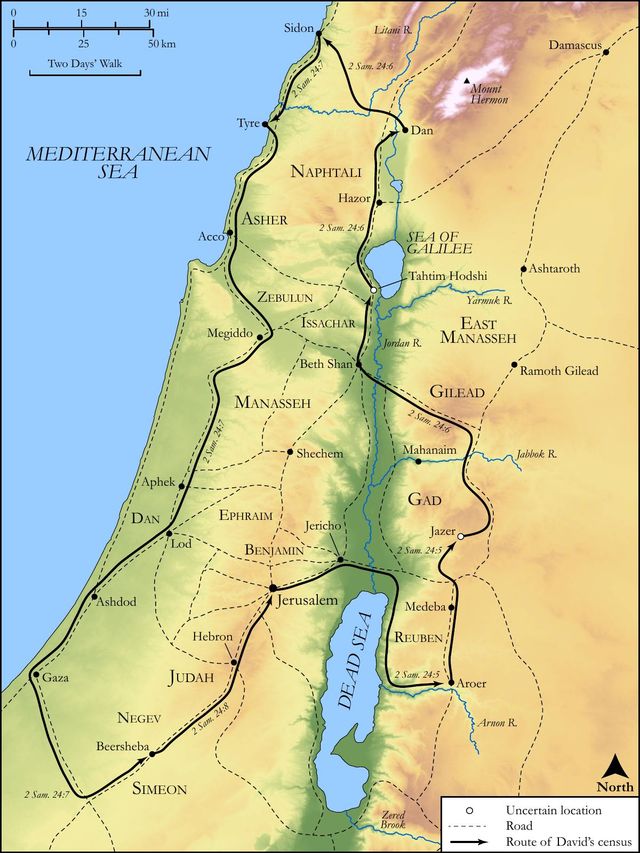
Study this verse
Public-domain commentary
Matthew Henry
From his Commentary on the Whole Bible. Henry comments on passages, not single verses — this entry covers 1 Chronicles 21:1–6. His three-level outline is real structure in the source text, so it is rendered as structure.
Numbering the people, one would think, was no bad thing. Why should not the shepherd know the number of his flock? But God sees not as man sees. It is plain it was wrong in David to do it, and a great provocation to God, because he did it in the pride of his heart; and there is no sin that has in it more of contradiction and therefore more of offence to God than pride. The sin was David's; he alone must bear the blame of it. But here we are told,
I.How active the tempter was in it (Ch1 21:1):
Satan stood up against Israel, and provoked David to do it. Is is said (Sa2 24:1) that the anger of the Lord was kindled against Israel, and he moved David to do it. The righteous judgments of God are to be observed and acknowledged even in the sins and unrighteousness of men. We are sure that God is not the author of sin - he tempts no man; and therefore, when it is said that he moved David to do it, it must be explained by what is intimated here, that, for wise and holy ends, he permitted the devil to do it. Here we trace this foul stream to its foundation. That Satan, the enemy of God and all good, should stand up against Israel, is not strange; it is what he aims at, to weaken the strength, diminish the numbers, and eclipse the glory of God's Israel, to whom he is Satan, a sworn adversary. But that he should influence David, the man of God's own heart to do a wrong thing, may well be wondered at. One would think him one of those whom the wicked one touches not. No, even the best saints, till they come to heaven, must never think themselves out of the reach of Satan's temptations. Now, when Satan meant to do Israel a mischief, what course did he take? He did not move God against them to destroy them (as Job, Job 2:3), but he provoked David, the best friend they had, to number them, and so to offend God, and set him against them. Note,
1.The devil does us more mischief by tempting us to sin against our God than he does by accusing us before our God. He destroys none but by their own hands,
2.The greatest spite he can do to the church of God is to tempt the rulers of the church to pride; for none can conceive the fatal consequences of that sin in all, especially in church-rulers. You shall not be so, Luk 22:26.
II.How passive the instrument was.
Joab, the person whom David employed, was an active man in public business; but to this he was perfectly forced, and did it with the greatest reluctance imaginable.
1.He put in a remonstrance against it before he began it. No man more forward that he in any thing that really tended to the honour of the king or the welfare of the kingdom; but in this matter he would gladly be excused. For,
(1.)It was a needless thing. there was not occasion at all for it. God had promised to multiply them, and he needed not question the accomplishment of that promise. They were all his servants, and he needed not doubt of their loyalty and affection to him. Their number was as much his strength as he could desire.
(2.)It was a dangerous thing. In doing it he might be a cause of trespass to Israel, and might provoke God against them. This Joab apprehended, and yet David himself did not. The most learned in the laws of God are not always the most quick-sighted in the application of those laws.
2.He was quite weary of it before he had done it; for the king's word was abominable to Joab, Ch1 21:6. Time was when whatever king David did pleased all the people, Sa2 3:36. But now there was a general disgust at these orders, which confirmed Joab in his dislike of them. so that, though the produce of this muster was really very great, yet he had no heart to perfect it, but left two tribes unnumbered (Ch1 21:5, Ch1 21:6), two considerable ones, Levi and Benjamin, and perhaps was not very exact in numbering the rest, because he did not do it with any pleasure, which might be one occasion of the difference between the sums here and Sa2 24:9.
Continue studying 1 Chronicles 21:6 across the web’s major study libraries — every link below opens this exact verse, chapter, or book on the destination site.
Read & Compare
 BibleGatewayThis verse in more than 200 translations and 70 languages.
 Bible.comThe YouVersion reader — hundreds of translations, reading plans, and highlights.
 ESV.orgCrossway's official English Standard Version reader.
 NET BibleThe NET translation with 60,000+ translators' notes on every rendering decision.
 STEP BibleTyndale House's free study tool — original text, vocabulary, and scholarly resources.
 BibliaLogos Bible Software's free web reader.
 USCCBThe New American Bible (Revised Edition) with the U.S. bishops' study notes.
Commentaries
 BibleHub CommentariesDozens of classic commentaries on this verse, gathered on one page.
 StudyLightMore than 100 commentary sets — the largest collection on the web.
 BibleRefPlain-English commentary on what this verse means, verse by verse.
 Enduring WordDavid Guzik's free commentary on this chapter, widely used by Bible teachers.
 Bible Study ToolsVerse commentary alongside Greek and Hebrew study aids.
Original Language & Research
- BibleHub InterlinearThe verse word by word — original language, transliteration, and English.
- BibleHub LexiconEvery word's original-language definition and Strong's entry.
 Blue Letter BibleDeep-study tools — Strong's numbers, concordance, and word studies.
 SefariaThe Hebrew text with Rashi and centuries of Jewish commentary.
Sermons, Hymns & Audio


TrulyRandomVerse is not affiliated with these sites and doesn’t control their content. They’re linked because they’re genuinely useful.
Summary
1 Chronicles 21:6 provides a critical detail within the narrative of King David's ill-fated census, revealing Joab's deliberate omission of the tribes of Levi and Benjamin from the count. This act underscores Joab's profound moral and spiritual objection to David's command, which he perceived as "abominable" – a deeply offensive and sinful action against God. Joab's discerning resistance highlights a spiritual sensitivity that David momentarily lacked, foreshadowing the severe divine displeasure and judgment that would subsequently fall upon Israel.
Context
ShowHideLiterary Context
This verse is intricately woven into the broader narrative of David's census, which commences in 1 Chronicles 21:1 with Satan inciting David to number Israel, a parallel account found in 2 Samuel 24. Immediately prior to this verse, David issues the command for the census, despite Joab's strong initial protest and warning that such an act would bring guilt upon Israel (1 Chronicles 21:3). Verse 6 then describes Joab's partial execution of the command, specifically his refusal to count Levi and Benjamin. The subsequent verses detail God's severe displeasure with David's action (1 Chronicles 21:7) and the devastating plague that follows as divine judgment (1 Chronicles 21:14). Joab's partial disobedience thus serves as a pivotal moment, illustrating the depth of the sin and setting the stage for the unfolding divine consequences and the eventual establishment of the altar on Ornan's threshing floor (1 Chronicles 21:18-28).
Historical & Cultural Context
Among the nations of that day, censuses were typically undertaken for pragmatic reasons such as military conscription, taxation, or labor organization. However, a census could also signify a king's pride, indicating a reliance on human strength and numbers rather than on divine provision and protection. The tribe of Levi held a unique status, consecrated for priestly and temple service, and was explicitly exempt from military duty and associated censuses, as stipulated in Numbers 1:49. Joab's exclusion of Levi was therefore consistent with established Mosaic law. The exclusion of Benjamin, however, is particularly noteworthy and deliberate. Benjamin was a significant and populous tribal unit, historically important as the tribe of King Saul and strategically located. Joab's omission of Benjamin, alongside Levi, signifies a conscious act of defiance or an attempt to mitigate the sin, reflecting his profound conviction that the king's command was fundamentally wrong. The term "abominable" (תּוֹעֵבָה, to'evah) carries immense theological weight in Israelite culture, frequently denoting practices or actions that are morally repugnant and utterly offensive to God, such as idolatry or certain sexual sins. Joab's deployment of this strong term underscores the gravity of David's sin from a spiritual perspective.
Key Themes
ShowHideThis verse significantly contributes to several overarching themes within 1 Chronicles 21 and the broader Chronicler's theological agenda. Firstly, it powerfully illustrates the theme of divine displeasure with human pride and self-reliance, as David's trust seemingly shifts from God's omnipotence to the numerical strength of his army. Secondly, it highlights the importance of moral conviction and wise counsel, as Joab, despite his often ruthless character, demonstrates a surprising spiritual sensitivity and attempts to dissuade David, and then to mitigate the sin through partial non-compliance. His actions serve as a silent protest against a command he knew to be an affront to God. Thirdly, the verse subtly introduces the theme of God's sovereignty and judgment, even amidst human error and partial obedience. Joab's incomplete census, whether an act of mercy or an unfinished task due to divine intervention, ultimately plays a role in the unfolding of God's judgment and the subsequent path to redemption through the altar built on the threshing floor of Ornan (1 Chronicles 21:18-28).
Exposition and Analysis
ShowHideKey Word Analysis
ShowHideThis primitive root means "to visit (with friendly or hostile intent); by analogy, to oversee, muster, charge, care for, miss, deposit, etc." In this context, it refers to the act of numbering or mustering the people for a census. Joab's deliberate not counting of Levi and Benjamin signifies a refusal to fully execute David's command, a conscious act of omission that stems from his moral objection. The word implies a systematic and official registration, which Joab intentionally left incomplete.
This term encompasses "a word; by implication, a matter (as spoken of) or thing; adverbially, a cause." It refers to David's command, his spoken instruction to Joab to conduct the census. The significance here lies not just in the utterance itself, but in the content and implications of that command, which Joab found morally repugnant. It was the "matter" or "affair" of the census, initiated by David's "word," that was so offensive.
This primitive root means "to loathe, i.e. (morally) detest; (make to be) abhor(-red), (be, commit more, do) abominable(-y), [idiom] utterly." This powerful Hebrew term signifies something detestable, disgusting, or morally repugnant, particularly in the sight of God. It is frequently used in the Old Testament to describe practices strictly forbidden by God, such as idolatry (Deuteronomy 7:25), sexual perversions (Leviticus 18:22), or unjust dealings (Proverbs 11:1). Joab's use of this word to describe the king's command reveals his profound moral and spiritual insight: he perceived David's census not merely as a tactical error or a lapse in judgment, but as a grave offense against divine principles, an act that violated God's honor and invited His wrath. His strong reaction underscores the severity of David's sin in the eyes of a discerning individual.
Verse Breakdown
ShowHide"But Levi and Benjamin counted he not among them:"
This clause details Joab's specific deviation from David's command. The tribe of Levi was traditionally exempt from military censuses due to their dedicated service to the tabernacle/temple (Numbers 1:49). Their omission was therefore standard practice. However, the exclusion of Benjamin is highly significant. Benjamin was a full tribal unit, typically included in military counts. Joab's deliberate omission of Benjamin, the last tribe to be counted, suggests either that he stopped the census prematurely out of protest, or that he intentionally left them out as a partial act of defiance against a command he found morally reprehensible. This partial compliance highlights Joab's internal conflict and his attempt to mitigate the perceived sin, even as he ultimately obeyed David's overarching directive to conduct the census.
"for the king's word was abominable to Joab."
This explanatory clause provides the explicit motivation for Joab's actions. The term "abominable" (תּוֹעֵבָה, to'evah) signifies Joab's deep moral revulsion towards David's command. He understood that the census, likely driven by pride or a lack of faith in God's provision, was not merely a political misstep but a profound spiritual transgression. Joab, despite his reputation as a ruthless military commander, demonstrates a surprising spiritual discernment here, recognizing the act as something detestable to God. This phrase serves as a powerful indictment of David's decision, validating the gravity of the sin even before God's judgment is explicitly stated in the subsequent verses.
Literary Devices
ShowHideThe verse employs several potent literary devices that deepen its impact and theological significance. Contrast is strikingly evident in the juxtaposition of David's kingly authority and Joab's profound moral conviction; the king commands, but his loyal general finds the command "abominable," highlighting a significant spiritual disconnect between them. Foreshadowing is also present, as Joab's strong moral objection and his partial non-compliance subtly hint at the severe divine judgment that will soon follow David's sin, setting a tone of impending consequence. The exclusion of Levi and Benjamin can be seen as a form of Synecdoche, where a part (these two tribes) represents the incomplete or morally flawed nature of the whole census, reflecting its inherent corruption in God's eyes. Finally, there is a degree of Irony in Joab, often portrayed as a pragmatic, even brutal military figure, being the one to exhibit a profound spiritual sensitivity and moral compass that David, the "man after God's own heart," momentarily lacks.
Theological and Thematic Connections
ShowHide1 Chronicles 21:6 powerfully illustrates the inherent tension between human authority and divine will, emphasizing that even righteous leaders can err significantly, and that true wisdom lies in discerning and adhering to God's principles above all else. Joab's "abominable" reaction serves as a profound theological warning against human pride and self-reliance, which can manifest as a desire to quantify and control rather than to trust implicitly in God's boundless power and provision. It underscores the critical truth that actions deemed strategically sound or pragmatically advantageous by human standards can be spiritually offensive to God, thereby inviting divine displeasure and judgment. The verse also implicitly highlights the value of prophetic or discerning counsel, even when it comes from an unexpected source like Joab, and the tragic consequences of ignoring such warnings, leading to widespread suffering for the people.
Reflection and Application
ShowHideThis verse challenges us to cultivate a keen spiritual discernment, much like Joab's, that recognizes what is truly "abominable" in God's sight, even when it comes from respected authorities, is widely accepted, or seems pragmatically advantageous. It reminds us that our ultimate allegiance is to God, and there are times when we must respectfully, yet firmly, resist commands or cultural norms that violate divine principles. Joab's partial resistance, while not a full rebellion, reflects a conscience burdened by the king's sin. For us, this means diligently examining our motives, ensuring our actions are rooted in humble trust in God's sovereign provision rather than pride in our own achievements, resources, or perceived strength. It also encourages us to be courageous and wise counselors when we perceive others, especially those in leadership, straying from God's path, even if our counsel is initially rejected. The devastating consequences of David's sin, despite Joab's partial mitigation, serve as a sobering reminder of the profound importance of heeding such warnings and aligning our will unequivocally with God's.
Questions for Reflection
ShowHideFAQ
ShowHideWhy were Levi and Benjamin specifically excluded from the census?
ShowHideThe exclusion of the tribe of Levi was standard and mandated by Mosaic Law. The Levites were set apart for sacred religious service to God and were explicitly exempt from military duties and therefore from military censuses, as detailed in Numbers 1:49. Their role was spiritual and ceremonial, not military. The exclusion of Benjamin, however, was Joab's deliberate act of protest and partial non-compliance. While the exact reason isn't explicitly stated, it is widely understood that Joab, finding the census "abominable" to God, intentionally left this tribe uncounted as a way to mitigate the sin or to express his profound moral objection to David's command. This suggests he either stopped the census before completing the last tribe or purposefully omitted them as a silent act of defiance against what he perceived as a grievous offense against God.
Christ-Centered Fulfillment
ShowHide1 Chronicles 21:6, with Joab's profound moral objection to David's census, points forward to Christ in several significant ways. David's sin of relying on numbers and human strength rather than God's power foreshadows humanity's consistent failure to trust perfectly in God. In stark contrast, Jesus Christ is the perfect King who never relied on human strength, earthly armies, or numerical advantage, but always on the Father's will and divine power. He perfectly fulfilled the law and never commanded anything "abominable" to God, demonstrating perfect obedience in all things (Hebrews 5:8-9). Furthermore, Joab's attempt to mitigate the sin by partially omitting the census, while perhaps well-intentioned, ultimately proved insufficient to avert the divine judgment. This highlights the profound insufficiency of human efforts to atone for sin or to appease God's righteous wrath. Only Christ, the ultimate Lamb of God who takes away the sin of the world, could bear the full weight of humanity's sin and pride. His perfect obedience and sacrificial death on the cross fully satisfied God's righteous demands, offering true and complete atonement where human efforts like Joab's partial compliance fall tragically short (Romans 5:8-10). Through Christ, we are counted not by human census for judgment, but by divine grace for eternal life, becoming part of a spiritual kingdom whose strength is found not in earthly numbers, but in the power of God's Spirit (Ephesians 2:8-9). He is the true King who leads His people in perfect trust and obedience, ensuring that no "abominable" act will ever mar His reign or His people's standing before God (Hebrews 4:15).