


Exodus 14:19
Bible text: King James Version (1769 Blayney text) · Public domain
Bible text: King James Version with Strong's numbers · Public domain
Bible text: Berean Standard Bible · Public domain
Bible text: American Standard Version (1901) · Public domain
Bible text: World English Bible, Messianic edition · Public domain
Bible text: Geneva Bible (1599) · Public domain
Bible text: Young's Literal Translation · Public domain
- וַיִּסַּעvai·yi·Sa'and he set outH5265Conj-w ¦ V-Qal-ConsecImperf-3msVerb Qal Consecutive Imperfect 3rd Singular Masculineוַandיִּסַּעhe set out
- מַלְאַךְmal·'Akh[the] angel ofH4397N-mscNoun Singular Masculine Construct
- הָאֱלֹהִיםha·'E·lo·Him<the> GodH430Art ¦ N-mpNoun Plural Masculine Absoluteהָ<the>אֱלֹהִיםGod
- הַהֹלֵךְha·ho·leKhwho had been goingH1980Art ¦ V-Qal-Prtcpl-msVerb Qal Participle Singular Masculine Absoluteהַwhoהֹלֵךְhad been going
- לִפְנֵיlif·Nei<to> beforeH6440Prep-l ¦ N-mpcNoun Plural Masculine Constructלִ<to>פְנֵיbefore
- מַחֲנֵהma·cha·Neh[the] camp ofH4264N-fscNoun Singular Feminine Construct
- יִשְׂרָאֵלYis·ra·'ElIsraelH3478N-properNoun Proper Location
- וַיֵּלֶךְvai·Ye·lekhand he wentH1980Conj-w ¦ V-Qal-ConsecImperf-3msVerb Qal Consecutive Imperfect 3rd Singular Masculineוַandיֵּלֶךְhe went
- מֵאַחֲרֵיהֶםme·'a·cha·rei·Hem<from> behind themH310Prep-m ¦ Adj-mpc ¦ 3mpAdjective Numerical Plural Masculine Constructמֵ<from>אַחֲרֵיbehindהֶםthem
- וַיִּסַּעvai·yi·Sa'and it set outH5265Conj-w ¦ V-Qal-ConsecImperf-3msVerb Qal Consecutive Imperfect 3rd Singular Masculineוַandיִּסַּעit set out
- עַמּוּד'a·Mud[the] pillar ofH5982N-mscNoun Singular Masculine Construct
- הֶעָנָןhe·'a·Nan<the> cloudH6051Art ¦ N-msNoun Singular Masculine Absoluteהֶ<the>עָנָןcloud
- מִפְּנֵיהֶםmi·pe·nei·Hemfrom before themH6440Prep-m ¦ N-mpc ¦ 3mpNoun Plural Masculine Constructמִfromפְּנֵיbeforeהֶםthem
- וַיַּעֲמֹדvai·ya·'a·Modand it stoodH5975Conj-w ¦ V-Qal-ConsecImperf-3msVerb Qal Consecutive Imperfect 3rd Singular Masculineוַandיַּעֲמֹדit stood
- מֵאַחֲרֵיהֶםme·'a·cha·rei·Hem<from> behind themH310Prep-m ¦ Adj-mpc ¦ 3mpAdjective Numerical Plural Masculine Constructמֵ<from>אַחֲרֵיbehindהֶםthem
English is a literal word-by-word gloss of the Hebrew, not the KJV's wording. Why?
This is the original text the KJV's translators worked from — each Hebrew word with its own literal English meaning in this verse, prepared by scholars at Tyndale House, Cambridge. The KJV translates whole sentences, not word by word, so its wording differs: one Hebrew word can become several English words, and the KJV may choose “the LORD” where the gloss reads “Yahweh”. Both are faithful — they answer different questions. For the KJV's own rendering, switch to the KJV text.
Details
See on the biblical-era maps

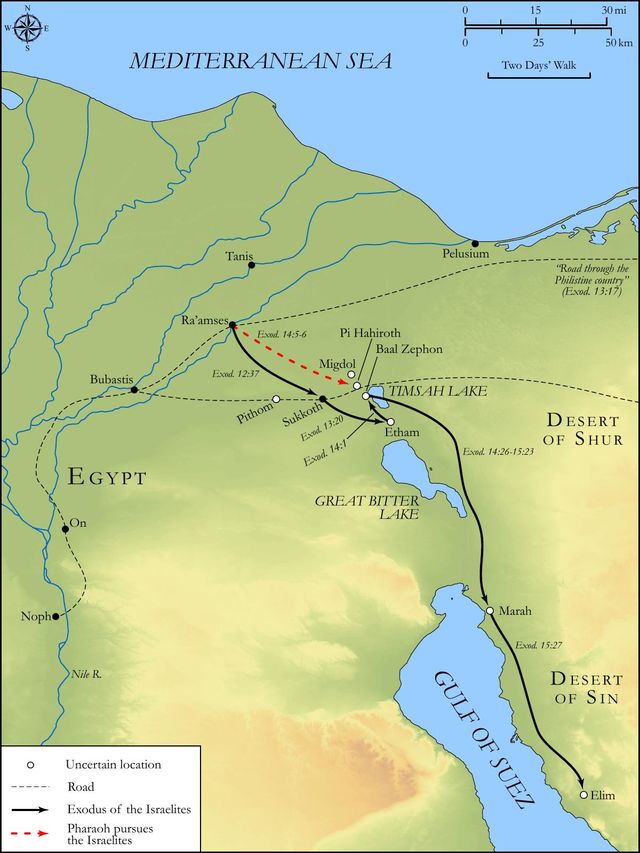
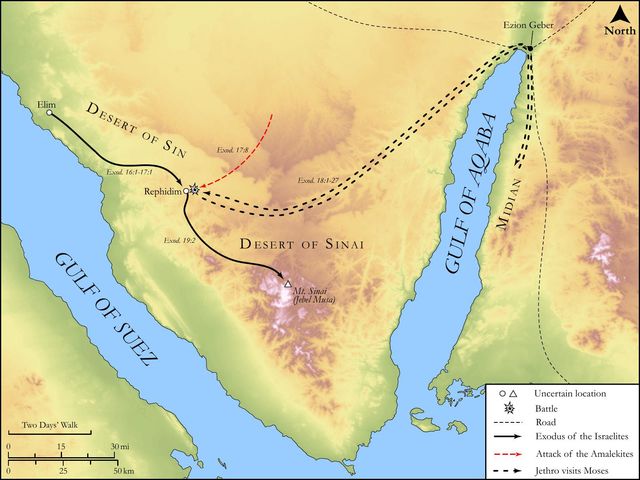
Study this verse
Public-domain commentary
Matthew Henry
From his Commentary on the Whole Bible. Henry comments on passages, not single verses — this entry covers Exodus 14:15–20. His three-level outline is real structure in the source text, so it is rendered as structure.
We have here,
I.Direction given to Israel's leader.
1.What he must do himself. He must, for the present, leave off praying, and apply himself to his business (Exo 14:15): Wherefore cryest thou unto me? Moses, though he was assured of a good issue to the present distress, yet did not neglect prayer. We read not of one word he said in prayer, but he lifted up to God his heart, the language of which God well understood and took notice of. Moses's silent prayers of faith prevailed more with God than Israel's loud outcries of fear, Exo 14:10. Note,
(1.)Praying, if of the right kind, is crying to God, which denotes it to be the language both of a natural and of an importunate desire.
(2.)To quicken his diligence. Moses had something else to do besides praying; he was to command the hosts of Israel, and it was now requisite that he should be at his post. Every thing is beautiful in its season.
2.What he must order Israel to do. Speak to them, that they go forward. Some think that Moses had prayed, not so much for their deliverance (he was assured of that) as for the pardon of heir murmurings, and that God's ordering them to go forward was an intimation of the pardon. There is no going forward with any comfort but in the sense of our reconciliation to God. Moses had bidden them stand still, and expect orders from God; and now orders are given. They thought they must have been directed either to the right hand or to the left. "No," says God, "speak to them to go forward, directly to the sea-side;" as if there had lain a fleet of transport-ships ready for them to embark in. Note, When we are in the way of our duty, though we met with difficulties, we must go forward, and not stand in mute astonishment; we must mind present work and then leave the even to God, use means and trust him with the issue.
3.What he might expect God to do. Let the children of Israel go as far as they can upon dry ground, and then God will divide the sea, and open a passage for them through it, Exo 14:16-18. God designs, not only to deliver the Israelites, but to destroy the Egyptians; and the plan of his counsels is accordingly.
(1.)He will show favour to Israel; the waters shall be divided for them to pass through, Exo 14:16. The same power could have congealed the waters for them to pass over; but Infinite Wisdom chose rather to divide the waters for them to pass through; for that way of salvation is always pitched upon which is most humbling. Thus it is said, with reference to this (Isa 63:13, Isa 63:14), He led them through the deep, as a beast goes down into the valley, and thus made himself a glorious name.
(2.)He will get him honour upon Pharaoh. If the due rent of honour be not paid to the great landlord, by and from whom we have and hold our beings and comforts, he will distrain for it, and recover it. God will be a loser by no man. In order to this, it is threatened: I, behold I, will harden Pharaoh's heart, Exo 14:17. The manner of expression is observable: I, behold I, will do it. "I, that may do it;" so it is the language of his sovereignty. We may not contribute to the hardening of any man's heart, nor withhold any thing that we can do towards the softening of it; but God's grace is his own, he hath mercy on whom he will have mercy, and whom he will be hardeneth. "I, that can do it;" so it is the language of his power; none but the Almighty can make the heart soft (Job 23:16), nor can any other being make it hard. "I, that will do it;" for it is the language of his justice; it is a righteous thing with God to put those under the impressions of his wrath who have long resisted the influences of his grace. It is spoken in a way of triumph over this obstinate and presumptuous rebel: "I even I, will take an effectual course to humble him; he shall break that would not bend." It is an expression like that (Isa 1:24), Ah, I will ease me of my adversaries.
II.A guard set upon Israel's camp where it now lay most exposed, which was in the rear, Exo 14:19, Exo 14:20.
The angel of God, whose ministry was made use of in the pillar of cloud and fire, went from before the camp of Israel, where they did not now need a guide (there was no danger of missing their way through the sea, nor needed they any other word of command than to go forward), and it came behind them, where now they needed a guard (the Egyptians being just ready to seize the hindmost of them), and so was a wall of partition between them. There it was of use to the Israelites, not only to protect them, but to light them through the sea, and, at the same time, it confounded the Egyptians, so that they lost sight of their prey just when they were ready to lay hands on it. The word and providence of God have a black and dark side towards sin and sinners, but a bright and pleasant side towards those that are Israelites indeed. That which is a savour of life unto life to some is a savour of death unto death to others. This was not the first time that he who in the beginning divided between light and darkness (Gen 1:4), and still forms both (Isa 45:7), had, at the same time, allotted darkness to the Egyptians and light to the Israelites, a specimen of the endless distinction which will be made between the inheritance of the saints in light and that utter darkness which for ever will be the portion of hypocrites. God will separate between the precious and the vile.
Continue studying Exodus 14:19 across the web’s major study libraries — every link below opens this exact verse, chapter, or book on the destination site.
Read & Compare
 BibleGatewayThis verse in more than 200 translations and 70 languages.
 Bible.comThe YouVersion reader — hundreds of translations, reading plans, and highlights.
 ESV.orgCrossway's official English Standard Version reader.
 NET BibleThe NET translation with 60,000+ translators' notes on every rendering decision.
 STEP BibleTyndale House's free study tool — original text, vocabulary, and scholarly resources.
 BibliaLogos Bible Software's free web reader.
 USCCBThe New American Bible (Revised Edition) with the U.S. bishops' study notes.
Commentaries
 BibleHub CommentariesDozens of classic commentaries on this verse, gathered on one page.
 StudyLightMore than 100 commentary sets — the largest collection on the web.
 BibleRefPlain-English commentary on what this verse means, verse by verse.
 Enduring WordDavid Guzik's free commentary on this chapter, widely used by Bible teachers.
 Bible Study ToolsVerse commentary alongside Greek and Hebrew study aids.
Original Language & Research
- BibleHub InterlinearThe verse word by word — original language, transliteration, and English.
- BibleHub LexiconEvery word's original-language definition and Strong's entry.
 Blue Letter BibleDeep-study tools — Strong's numbers, concordance, and word studies.
 SefariaThe Hebrew text with Rashi and centuries of Jewish commentary.
Sermons, Hymns & Audio


TrulyRandomVerse is not affiliated with these sites and doesn’t control their content. They’re linked because they’re genuinely useful.
Summary
Exodus 14:19 narrates a profound and strategic divine maneuver during Israel's perilous escape from Egypt. The visible manifestations of God's presence—the angel of God and the pillar of cloud—which had previously led the Israelite camp, dramatically shifted their position. They moved from the front to the rear, forming a protective barrier between the vulnerable Israelites and the rapidly advancing Egyptian army, thereby demonstrating God's unwavering commitment to shield and deliver His people in their moment of extreme vulnerability.
Context
ShowHideLiterary Context
This pivotal verse occurs at the climax of Israel's initial flight from Egypt, immediately after Pharaoh and his army have launched a determined pursuit, trapping the Israelites against the impassable Red Sea. Prior to this, the pillar of cloud and fire had consistently served as God's guiding presence, leading Israel by day and night since their departure from Succoth (Exodus 13:21-22). The sudden, strategic repositioning described in Exodus 14:19 marks a critical transition from divine guidance to divine defense. This act sets the stage for the miraculous parting of the waters (Exodus 14:21-22), and the subsequent verses detail how this divine barrier brought darkness to the Egyptians while providing light for Israel, effectively hindering the pursuers and securing safe passage for God's people (Exodus 14:20).
Historical & Cultural Context
In the wars of that day, engagements often involved a relentless pursuit of a fleeing enemy, with the aim of total subjugation or annihilation. The Israelite multitude, largely untrained and burdened with families and livestock, was exceptionally vulnerable to the highly organized and formidable chariotry of the Egyptian army, one of the most advanced military forces of its time. The concept of a "rear guard" was a vital military strategy for protecting the most exposed and vulnerable part of a moving column. Pharaoh's pursuit was not merely a military maneuver but also deeply rooted in his perception of his own divine authority and the affront to his kingship by Yahweh, who had orchestrated the plagues and Israel's release. God's intervention, therefore, was a direct and public challenge to Pharaoh's power and a resounding declaration of His sovereignty over all earthly rulers and armies, demonstrating His unique ability to protect His people against overwhelming odds.
Key Themes
ShowHideThis verse powerfully contributes to several overarching themes in the book of Exodus and the broader Pentateuch. It highlights God's active and immanent presence among His people, not as a distant deity but as one who directly intervenes in their affairs. It underscores the theme of divine protection and deliverance, showcasing God's absolute sovereignty over natural elements and human armies alike. The strategic shift of the pillar and angel emphasizes God's role as Israel's ultimate defender and rear guard, a concept later echoed in prophetic literature (Isaiah 52:12). Furthermore, it reinforces the theme that salvation belongs to the Lord, demonstrating that in seemingly impossible situations, God alone provides the solution, not human strength or strategy (Psalm 3:8). Finally, the cloud's new position, creating light for Israel and darkness for Egypt (Exodus 14:20), foreshadows the separation of God's people from the world and its influences, a recurring motif throughout biblical history.
Exposition and Analysis
ShowHideExodus 14:19 vividly portrays God's dynamic and strategic intervention on behalf of His people. The verse is characterized by a striking parallelism, emphasizing the unified action of two distinct yet unified manifestations of the divine presence.
Key Word Analysis
ShowHideTranslated "angel of God" (H4397, H430). This compound phrase refers to a divine messenger, often understood in Old Testament contexts as a special manifestation of God Himself (a Christophany or Theophany), embodying God's presence and authority. The actions of the "angel of the Lord" are frequently indistinguishable from the actions of Yahweh, underscoring that God Himself, not merely an emissary, is directly involved in protecting Israel.
Translated "removed" (H5265). This primitive root means "to pull up," especially tent-pins, signifying the act of starting a journey or removing oneself from a place. Here, it denotes a deliberate, purposeful movement or repositioning of the divine presence, indicating a strategic shift rather than an accidental or reactive change.
Translated "behind" (H310). This term refers to the hind part, often used as an adverb or conjunction indicating position "after" or "behind." Its repeated use in this verse ("went behind them," "stood behind them") is crucial, highlighting the new, defensive posture of the divine presence. It signifies a strategic placement to act as a protective rear guard, shielding Israel from their pursuers.
Verse Breakdown
ShowHideThe verse consists of two parallel clauses, each detailing the movement of a divine manifestation:
"And the angel of God, which went before the camp of Israel, removed and went behind them;"
"and the pillar of the cloud went from before their face, and stood behind them:"
Literary Devices
ShowHideThe primary literary device employed in Exodus 14:19 is parallelism, specifically synonymous parallelism. The two clauses of the verse describe the same divine action (repositioning for protection) using two distinct but unified manifestations of God's presence (the angel and the pillar). This parallelism emphasizes the singular, unified will and action of God in protecting His people. The pillar of cloud itself functions as a powerful symbol and metaphor for God's protective presence, transforming from a guiding light to an impenetrable shield. The anthropomorphic language of the "angel of God" "going" and the "pillar" "standing" imbues these divine manifestations with active, purposeful agency.
Theological and Thematic Connections
ShowHideExodus 14:19 teaches profound theological truths about God's character and His relationship with His people. It vividly illustrates God's active and immanent presence, not as a distant deity but as one who intimately walks with, guides, and defends His chosen ones. This verse underscores God's absolute sovereignty over all creation, including the most formidable human armies, as He actively intervenes to protect His people, positioning Himself as an impenetrable barrier against their enemies. This highlights His essential role as Israel's ultimate defender and deliverer. The strategic shift in position, from vanguard to rear guard, reveals God's comprehensive and adaptive care. He not only leads the way forward but also guards the vulnerable rear, protecting His people from threats they cannot see or defend against themselves. In a seemingly hopeless situation, God alone provides the solution, reinforcing the biblical theme that salvation and deliverance come solely from God's power, not human strength or strategy.
Reflection and Application
ShowHideExodus 14:19 offers immense comfort and profound challenge for believers today. In life, we frequently find ourselves in "Red Sea moments"—situations where we feel utterly trapped, with overwhelming challenges looming ahead and relentless pressures, regrets, or spiritual attacks threatening from behind. This verse provides a powerful assurance that God's presence is not limited to leading us forward in times of clarity and progress; He is also powerfully present as our "rear guard" when we are most vulnerable, exposed, and seemingly without escape. When spiritual attacks, the weight of past failures, or unseen anxieties threaten to overwhelm us from behind, this passage reminds us that God Himself stands between us and our enemies, shielding us from what pursues us. It calls us to trust in His active and dynamic defense, even when the path forward seems impassable and our own strength is utterly insufficient. This divine protection allows us to face the future with courage, knowing that our rear is secured by the Almighty.
Questions for Reflection
ShowHideFAQ
ShowHideWas the "angel of God" a created angel or a manifestation of God Himself?
ShowHideIn many Old Testament contexts, including this one, the "angel of God" (Hebrew: malak Elohim or malak Yahweh) is widely understood by scholars to be a Christophany or Theophany—a pre-incarnate appearance of God Himself, or a manifestation so closely identified with God that His actions are definitively God's actions. The fact that the angel moves in perfect concert with the pillar of cloud, which is explicitly recognized as the visible manifestation of God's presence and glory, strongly reinforces this understanding. It emphasizes that God Himself was directly and personally protecting Israel, not merely delegating the task to a created being. This divine agent is the very embodiment of God's active will and power in the narrative of Exodus.
Why did the pillar of cloud move from front to back? Was it a sign of retreat or abandonment?
ShowHideThe movement of the pillar of cloud was emphatically not a sign of retreat, abandonment, or weakness on God's part. Instead, it was a highly strategic and purposeful repositioning for divine protection. What had previously served as a guide leading the Israelites forward now transformed into a formidable guard, forming an impenetrable barrier between the vulnerable Israelite camp and the pursuing Egyptian army. This shift demonstrated God's dynamic and adaptive care, illustrating His willingness to adjust His presence to meet the specific and urgent needs of His people in a crisis. It was an act of aggressive defense and unwavering commitment, not a withdrawal, ensuring Israel's safety as they faced the Red Sea (Exodus 14:20).
Does this mean God only protects us from "behind" or from past threats?
ShowHideNo, this verse highlights God's comprehensive protection, demonstrating His ability to guard His people from every angle. While Exodus 14:19 specifically emphasizes God protecting Israel's rear from the pursuing Egyptians, the broader biblical narrative consistently portrays God as protecting His people from all sides—leading them forward, surrounding them with His presence, and defending them from every direction. This particular instance simply emphasizes His willingness and power to guard the most vulnerable point, assuring believers that no angle of attack, whether from past regrets, spiritual adversaries, or future uncertainties, is left exposed. God is both our vanguard and our rear guard (Isaiah 52:12).
Christ-Centered Fulfillment
ShowHideExodus 14:19 finds its ultimate fulfillment and amplification in the person and work of Jesus Christ. The "angel of God" and the "pillar of the cloud" were temporary, visible manifestations of God's presence, guiding and guarding His people in a specific historical moment. Jesus, however, is the eternal, ultimate, and embodied presence of God among humanity—the very "God with us" (Immanuel) as prophesied and fulfilled in Matthew 1:23. Just as the cloud and angel stood as an impenetrable barrier between Israel and their physical enemies, Jesus stands as the ultimate barrier between humanity and our spiritual adversaries: sin, death, and the power of darkness. His sacrificial death on the cross is the supreme act of "standing behind us," absorbing the wrath of God against sin and creating an impenetrable wall of grace and forgiveness for all who believe (Romans 5:8). He became our "rear guard" against the condemning consequences of our past and the relentless accusations of the enemy (Romans 8:1). Furthermore, Jesus's ongoing ministry through the indwelling Holy Spirit continues to fulfill this protective role. The Holy Spirit, the Spirit of Christ, guides and guards believers from within, just as God's presence guided and guarded Israel from without. Jesus's resurrection and ascension ensure that He is perpetually positioned to intercede for us at the right hand of God (Romans 8:34) and to defend us from all spiritual attacks, providing a shield against the "flaming darts of the evil one" (Ephesians 6:16). Thus, the temporary, visible protection in Exodus points powerfully to the permanent, spiritual, and all-encompassing protection found eternally in Christ.