


2 Corinthians 2:12
- ἘλθὼνElthōnHaving comeG2064V-2AAP-NSMVerb 2nd Aorist Active Participle Nominative Singular Masculine
- δὲdenowG1161CONJConjunction
- εἰςeistoG1519PREPPreposition
- τὴνtēn<the>G3588T-ASFDefinite article Accusative Singular Feminine
- ΤρῳάδαTrōadaTroasG5174N-ASF-LNoun Accusative Singular Feminine Location
- εἰςeisforG1519PREPPreposition
- τὸtotheG3588T-ASNDefinite article Accusative Singular Neuter
- εὐαγγέλιονeuangeliongospelG2098N-ASNNoun Accusative Singular Neuter
- τοῦtou<the>G3588T-GSMDefinite article Genitive Singular Masculine
- ΧριστοῦChristouof ChristG5547N-GSM-TNoun Genitive Singular Masculine Title
- καὶkaialsoG2532CONJConjunction
- θύραςthurasa doorG2374N-GSFNoun Genitive Singular Feminine
- μοιmoito meG3165P-1DSPersonal pronoun Dative 1st Singular
- ἀνεῳγμένηςaneōgmenēshaving been openedG455V-2RPP-GSFVerb Perfect Passive Participle Genitive Singular Feminine
- ἐνeninG1722PREPPreposition
- κυρίῳkuriō[the] LordG2962N-DSM-TNoun Dative Singular Masculine Title
English is a literal word-by-word gloss of the Greek, not the KJV's wording. Why?
This is the original text the KJV's translators worked from — each Greek word with its own literal English meaning in this verse, prepared by scholars at Tyndale House, Cambridge. The KJV translates whole sentences, not word by word, so its wording differs: one Greek word can become several English words, and the KJV may choose “charity” where the gloss reads “love”. Both are faithful — they answer different questions. For the KJV's own rendering, switch to the KJV text.
Details
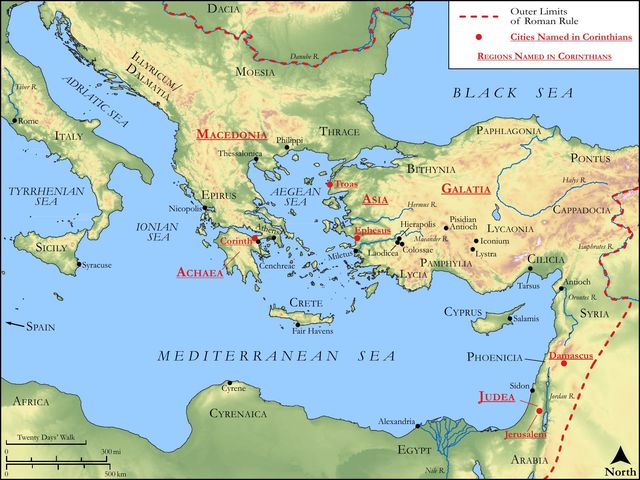
See on the biblical-era map

Study this verse
Public-domain commentary
Matthew Henry
From his Commentary on the Whole Bible. Henry comments on passages, not single verses — this entry covers 2 Corinthians 2:12–17. His three-level outline is real structure in the source text, so it is rendered as structure.
After these directions concerning the excommunicated person the apostle makes a long digression, to give the Corinthians an account of his travels and labours for the furtherance of the gospel, and what success he had therein, declaring at the same time how much he was concerned for them in their affairs, how he had no rest in his spirit, when he found not Titus at Troas (Co2 2:13), as he expected, from whom he hoped to have understood more perfectly how it fared with them. And we find afterwards (Co2 7:5-7) that when the apostle had come into Macedonia he was comforted by the coming of Titus, and the information he gave him concerning them. So that we may look upon all that we read from this second chapter, v. 12, to ch. 7:5, as a kind of parenthesis. Observe here,
I.Paul's unwearied labour and diligence in his work, Co2 2:12, Co2 2:13.
He travelled from place to place, to preach the gospel. He went to Troas from Philippi by sea (Act 20:6), and thence he went to Macedonia; so that he was prevented from passing by Corinth, as he had designed, Co2 1:16. But, though he was prevented in his design as to the place of working, yet he was unwearied in his work.
II.His success in his work:
A great door was opened to him of the Lord, Co2 2:12. He had a great deal of work to do wherever he came, and had good success in his work; for God made manifest the savour of his knowledge by him in every place where he came. He had an opportunity to open the door of his mouth freely, and God opened the hearts of his hearers, as the heart of Lydia (Act 16:14), and the apostle speaks of this as a matter of thankfulness to God and of rejoicing to his soul: Thanks be to God, who always causeth us to triumph in Christ. Note,
1.A believer's triumphs are all in Christ. In ourselves we are weak, and have neither joy nor victory; but in Christ we may rejoice and triumph.
2.True believers have constant cause of triumph in Christ, for they are more than conquerors through him who hath loved them, Rom 8:37.
3.God causeth them to triumph in Christ. It is God who has given us matter for triumph, and hearts to triumph. To him therefore be the praise and glory of all.
4.The good success of the gospel is a good reason for a Christian's joy and rejoicing.
III.The comfort that the apostle and his companions in labour found, even when the gospel was not successful to the salvation of some who heard it, Co2 2:15-17. Here observe,
1.The different success of the gospel, and its different effects upon several sorts of persons to whom it is preached. The success is different; for some are saved by it, while others perish under it. Nor is this to be wondered at, considering the different effects the gospel has. For,
(1.)Unto some it is a savour of death unto death. Those who are willingly ignorant, and wilfully obstinate, disrelish the gospel, as men dislike an ill savour, and therefore they are blinded and hardened by it: it stirs up their corruptions, and exasperates their spirits. They reject the gospel, to their ruin, even to spiritual and eternal death.
(2.)Unto others the gospel is a savour of life unto life. To humble and gracious souls the preaching of the word is most delightful and profitable. As it is sweeter than honey to the taste, so it is more grateful than the most precious odours to the senses, and much more profitable; for as it quickened them at first, when they were dead in trespasses and sins, so it makes them more lively, and will end in eternal life.
2.The awful impressions this matter made upon the mind of the apostle, and should also make upon our spirits: Who is sufficient for these things? Co2 2:16. Tis hikanos - who is worthy to be employed in such weighty work, a work of such vast importance, because of so great consequence? Who is able to perform such a difficult work, that requires so much skill and industry? The work is great and our strength is small; yea, of ourselves we have no strength at all; all our sufficiency is of God. Note, If men did seriously consider what great things depend upon the preaching of the gospel, and how difficult the work of the ministry is, they would be very cautious how they enter upon it, and very careful to perform it well.
3.The comfort which the apostle had under this serious consideration,
(1.)Because faithful ministers shall be accepted of God, whatever their success be: We are, if faithful, unto God a sweet savour of Christ (Co2 2:15), in those who are saved and in those also who perish. God will accept of sincere intentions, and honest endeavours, though with many they are not successful. Ministers shall be accepted, and recompensed, not according to their success, but according to their fidelity. Though Israel be not gathered, yet shall I be glorious in the eyes of the Lord, Isa 49:5.
(2.)Because his conscience witnessed to his faithfulness, Co2 2:17. Though many did corrupt the word of God, yet the apostle's conscience witnessed to his fidelity. He did not mix his own notions with the doctrines and institutions of Christ; he durst not add to, nor diminish fRom. the word of God; he was faithful in dispensing the gospel, as he received it from the Lord, and had no secular turn to serve; his aim was to approve himself to God, remembering that his eye was always upon him; he therefore spoke and acted always as in the sight of God, and therefore in sincerity. Note, What we do in religion is not of God, does not come from God, will not reach to God, unless it be done in sincerity, as in the sight of God.
Historical interpretation
Historical reception
6 surviving comments on this verse. Each one is dated, so this reads as a timeline rather than a list.
Select a marker to jump to its quote. Markers stagger vertically where authors wrote within a few decades of each other.
Paul means that when he got to Troas to preach the gospel of Christ, there were people who received the message.
In Acts [16:9] it says that a man of Macedonia appeared to Paul in a dream and asked him to come over and help them. Paul does not mention this incident in his letter, evidently because he realized that this was not the right time to say such things about himself.
In Acts [:] it says that a man of Macedonia appeared to Paul in a dream and asked him to come over and help them. Paul does not mention this incident in his letter, evidently because he realized that this was not the right time to say such things about himself. .
These words seem on the one hand to be unworthy of Paul, if because of a brother's absence he threw away so great an opportunity of saving; and on the other, to hang apart from the context. What then? Will ye that we should first prove that they hang upon the context, or, that he hath said nothing unworthy of himself? As I think, the second, for so the other point also will be easier and clearer.
How then do these words hang upon those before them? Let us recall to mind what those were, and so we shall perceive this. What then were those before? What he said at the beginning. "I would not have you," saith he, "ignorant concerning our affliction which befell us in Asia, that we were weighed down exceedingly, beyond our power." Now having shown the manner of his deliverance, and inserted the intermediate matter, he is of necessity led to teach them again that in yet another way he had been afflicted. How, and in what way? In not finding Titus. Fearful indeed, and enough to prostrate the soul, is it even to endure trials; but when there is none to comfort and that can help to bear the burden, the tempest becometh greater.
He doth not say that the absence of Titus impeded the salvation of those who were about to come over, nor yet that he neglected those that believed on this account, but that he had no relief, that is, 'I was afflicted, I was distressed for the absence of my brother;' showing how great a matter a brother's absence is; and therefore he departed thence. But what means, "when I came to Troas, for the Gospel?" he saith not simply 'I arrived," but 'so as to preach.' But still, though I had both come for that and found very much to do, (for "a door was opened unto me in the Lord,") I had, saith he, "no relief," not that for this he impeded the work.
And again, in his second letter to the Corinthians, the same apostle says, “When I had come to Troas for the gospel of Christ, and a door was opened to me in the Lord, I had no rest in my spirit, because I did not find Titus my brother, but bidding them farewell, I went into Macedonia.” To whom did he declare farewell except to those who had believed, that is to say, to those in whose hearts a door was opened for him to preach the gospel? But note well what he adds: “Now thanks be to God, who always makes us triumph in Christ and manifests the aroma of Christ to God, in those who are saved and in those who perish; to some indeed the odor of death to death but to others the fragrance of life to life.” Behold why this most intrepid soldier, this most invincible defender of grace, gives thanks. Behold why he gives thanks—that the apostles are the good odor of Christ to God, both in those who are saved by his grace and in those who perish in virtue of his judgment.
Continue studying 2 Corinthians 2:12 across the web’s major study libraries — every link below opens this exact verse, chapter, or book on the destination site.
Read & Compare
 BibleGatewayThis verse in more than 200 translations and 70 languages.
 Bible.comThe YouVersion reader — hundreds of translations, reading plans, and highlights.
 ESV.orgCrossway's official English Standard Version reader.
 NET BibleThe NET translation with 60,000+ translators' notes on every rendering decision.
 STEP BibleTyndale House's free study tool — original text, vocabulary, and scholarly resources.
 BibliaLogos Bible Software's free web reader.
 USCCBThe New American Bible (Revised Edition) with the U.S. bishops' study notes.
Commentaries
 BibleHub CommentariesDozens of classic commentaries on this verse, gathered on one page.
 StudyLightMore than 100 commentary sets — the largest collection on the web.
 BibleRefPlain-English commentary on what this verse means, verse by verse.
 Enduring WordDavid Guzik's free commentary on this chapter, widely used by Bible teachers.
 Bible Study ToolsVerse commentary alongside Greek and Hebrew study aids.
Original Language & Research
- BibleHub InterlinearThe verse word by word — original language, transliteration, and English.
- BibleHub LexiconEvery word's original-language definition and Strong's entry.
 Blue Letter BibleDeep-study tools — Strong's numbers, concordance, and word studies.
 CNTR CollationThe earliest Greek manuscripts of this verse, collated letter by letter.
Sermons, Hymns & Audio


TrulyRandomVerse is not affiliated with these sites and doesn’t control their content. They’re linked because they’re genuinely useful.
Summary
In 2 Corinthians 2:12, the Apostle Paul recounts his arrival in Troas with the specific intention of proclaiming the gospel of Christ. Despite a divinely orchestrated opportunity for ministry, signified by an "open door from the Lord," Paul ultimately decided to depart from Troas due to his profound anxiety over the absence of Titus, highlighting the complex interplay between divine leading, personal distress, and the strategic demands of apostolic ministry.
Context
ShowHideLiterary Context
This verse is situated within Paul's deeply personal and emotionally charged defense of his apostolic ministry and his recent travel plans to the Corinthian church. In the preceding verses of 2 Corinthians 2, Paul explains his decision to postpone a painful visit to Corinth, opting instead for a letter that caused sorrow but led to repentance. He emphasizes his desire for reconciliation and the importance of forgiving the offending brother (2 Corinthians 2:5-11). Verse 12 then transitions to Paul's subsequent journey from Macedonia to Troas, where he expected to meet Titus. The "open door" for the gospel sets up the tension with Paul's decision to leave Troas in the very next verse (2 Corinthians 2:13), driven by his concern for Titus and the Corinthian situation, rather than capitalizing on the immediate ministry opportunity.
Historical & Cultural Context
Troas (modern-day Ezine, Turkey) was a significant Roman port city located on the northwest coast of Asia Minor, near the site of ancient Troy. It served as a crucial gateway between Asia and Europe, making it a strategic hub for trade, communication, and missionary activity. Paul had visited Troas previously, notably in Acts 16:8-10, where he received the "Macedonian Call" vision, leading him to preach the gospel in Europe for the first time. Its strategic location meant a constant flow of people, providing ample opportunities for evangelism and church planting. The concept of an "open door" for ministry was a well-understood metaphor in the ancient world, signifying access, opportunity, or a receptive audience, often facilitated by the social and political conditions of a given city or region.
Key Themes
ShowHideThis verse contributes to several key themes within 2 Corinthians and Paul's broader theology. Firstly, it highlights the theme of divine guidance and providence in ministry, as God actively opens doors for the gospel's advance, even amidst human plans and anxieties. Secondly, it underscores Paul's unwavering commitment to the gospel; his primary purpose in any city was always to "preach Christ's gospel." This dedication is a recurring motif in his letters, as seen in his declaration in Romans 1:16. Thirdly, the verse subtly introduces the theme of the paradox of apostolic suffering and divine strength, where Paul's personal distress (his anxiety over Titus) intersects with God's provision of ministry opportunities. This tension is further explored in 2 Corinthians 4:7-12, where Paul speaks of carrying "treasure in jars of clay."
Exposition and Analysis
ShowHideKey Word Analysis
ShowHideFrom the same root as the verb "to evangelize," this noun refers to a "good message" or "good news." In the New Testament, it specifically denotes the good news of salvation through Jesus Christ—His life, death, resurrection, and the implications for humanity's reconciliation with God. Paul's purpose in Troas was not merely to share information but to proclaim this transformative message, which is the power of God for salvation (Romans 1:16).
Literally a portal or entrance, this word is used metaphorically here to signify an opportunity or access. In the context of ministry, an "open door" implies a favorable circumstance, a receptive audience, or an unhindered path for the proclamation of the gospel. It suggests that God had prepared the way for Paul's evangelistic efforts in Troas.
This term denotes supreme authority and control. In this context, "the Lord" refers to God, specifically Jesus Christ, as the sovereign orchestrator of events and opportunities. The phrase "of the Lord" emphasizes that the open door was not a random occurrence or human initiative but a direct, divine provision, highlighting God's active involvement in the spread of His word.
Verse Breakdown
ShowHide"Furthermore, when I came to Troas to preach Christ's gospel"
Paul begins by recounting his journey to Troas, a significant port city. His explicit purpose for arriving there was "to preach Christ's gospel." This underscores his unwavering commitment to his apostolic calling and the centrality of the evangelistic mission in his life. He was not merely passing through but actively seeking opportunities to proclaim the good news of Jesus Christ, the Messiah.
"and a door was opened unto me of the Lord"
This clause describes the immediate outcome or circumstance Paul encountered upon his arrival. The "door was opened" is a powerful metaphor for a divinely provided opportunity for ministry. It indicates that the conditions in Troas were receptive, or circumstances were favorable, for the gospel to be proclaimed effectively. The crucial addition "of the Lord" attributes this opening directly to God's sovereign hand, emphasizing that this was a supernatural enablement and not a mere coincidence or human arrangement.
Literary Devices
ShowHideThe verse employs several significant literary devices. The most prominent is Metaphor, specifically the image of "a door was opened." This vivid idiom conveys the idea of an opportunity or access for ministry, making an abstract concept tangible and relatable. An open door implies ease of entry, receptivity, and a clear path forward for Paul's evangelistic endeavors. This metaphor is further amplified by the concept of Divine Agency, as the door was "opened unto me of the Lord." This emphasizes that the opportunity was not a product of human effort or chance but a direct, sovereign act of God, highlighting His active involvement in preparing the way for the gospel's advance. There is also a subtle Juxtaposition between the promising "open door" and Paul's subsequent decision to leave, which is explained in the following verse, creating a narrative tension that underscores the complexities of ministry and personal well-being.
Theological and Thematic Connections
ShowHideThis verse powerfully illustrates the theological truth that God sovereignly orchestrates opportunities for the spread of His gospel. Even when human circumstances are challenging or personal anxieties are high, God is actively at work, preparing hearts and opening pathways for His message to be proclaimed. The "open door" signifies divine favor and enablement, reminding believers that effective ministry is ultimately dependent on God's initiative and blessing. It also highlights the tension between recognizing divine opportunities and the often-complex realities of human relationships and personal well-being, as Paul's concern for Titus ultimately outweighed his immediate desire to capitalize on the open door in Troas. This demonstrates that discerning God's will in ministry can involve weighing multiple, sometimes conflicting, divine and human factors.
Reflection and Application
ShowHide2 Corinthians 2:12 offers profound insights for contemporary believers concerning divine guidance and ministry. It challenges us to cultivate a spiritual attentiveness to the "open doors" that God provides in our own lives, whether for sharing our faith, serving in our communities, or pursuing specific callings. These opportunities, divinely orchestrated, often present themselves in unexpected ways and require a readiness to step out in faith. While Paul ultimately chose to leave Troas due to his profound concern for Titus, his initial recognition of the "open door" serves as a powerful reminder that God is always at work, preparing the way for His gospel. We are called not only to recognize these divine invitations but also to exercise wisdom and discernment, understanding that God's will sometimes involves complex decisions that balance ministry opportunities with personal and relational responsibilities. Our response to these open doors should be rooted in prayer, trust, and a willingness to follow God's leading, even when the path is not entirely clear.
Questions for Reflection
ShowHideFAQ
ShowHideWhat does "a door was opened unto me of the Lord" mean in a practical sense?
ShowHidePractically, "a door was opened unto me of the Lord" means that God created favorable circumstances and receptivity for Paul's message in Troas. This could have manifested in various ways: perhaps a significant number of people were eager to hear the gospel, local authorities were tolerant or even welcoming, there were no immediate persecutions, or key individuals were prepared to embrace the faith. It implies that the spiritual ground was fertile, and there was an unhindered pathway for the gospel to take root and spread. It signifies a divine enablement that made effective evangelism possible in that specific location at that time, much like the "great door and effectual" Paul mentioned in 1 Corinthians 16:9 regarding his ministry in Ephesus.
Why did Paul leave Troas if there was an "open door" for the gospel?
ShowHidePaul explains his departure from Troas in the very next verse, 2 Corinthians 2:13. Despite the promising ministry opportunity, he was deeply distressed by the absence of Titus, whom he expected to meet there with news from the Corinthian church. Paul's pastoral concern for the Corinthians and his anxiety over their spiritual state outweighed his desire to capitalize on the immediate evangelistic opportunity in Troas. This demonstrates that even divinely opened doors for ministry can sometimes be set aside for other, equally important, pastoral or relational priorities, especially when those priorities involve the well-being of existing churches and fellow laborers in the gospel.
Christ-Centered Fulfillment
ShowHideThe "open door" in Troas, divinely provided for the preaching of Christ's gospel, ultimately points to Christ Himself as the ultimate "door" and the source of all true spiritual access. Jesus declared, "I am the door: by me if any man enter in, he shall be saved, and shall go in and out, and find pasture" (John 10:9). Paul's mission to preach Christ's gospel was to invite people through this very door—the door of salvation and reconciliation with God, opened by Christ's sacrificial death and resurrection. The opportunity in Troas was not merely for a message, but for a Person, Jesus Christ, who embodies the good news. Furthermore, Christ, as the head of the church, continues to open and close doors for His gospel to advance through His Spirit, empowering His followers to be His witnesses "to the end of the earth" (Acts 1:8). The "open door" in Troas, therefore, is a microcosm of Christ's ongoing work to build His kingdom and gather His people from every nation, tribe, and tongue, through the faithful proclamation of His liberating truth.