


2 Thessalonians 1:11
Bible text: King James Version (1769 Blayney text) · Public domain
Bible text: King James Version with Strong's numbers · Public domain
Bible text: Berean Standard Bible · Public domain
Bible text: American Standard Version (1901) · Public domain
Bible text: World English Bible, Messianic edition · Public domain
Bible text: Geneva Bible (1599) · Public domain
Bible text: Young's Literal Translation · Public domain
- εἰςeisforG1519PREPPreposition
- ὃhowhichG3739R-ASNRelative pronoun Accusative Singular Neuter
- καὶkaialsoG2532CONJConjunction
- προσευχόμεθαproseuchomethawe prayG4336V-PNI-1PVerb Present Middle Or Passive Deponent Indicative 1st Plural
- πάντοτεpantotealwaysG3842ADVAdverb
- περὶperiforG4012PREPPreposition
- ὑμῶνhumōnyouG4771P-2GPPersonal pronoun Genitive 2nd Plural
- ἵναinathatG2443CONJConjunction
- ὑμᾶςhumasyouG4771P-2APPersonal pronoun Accusative 2nd Plural
- ἀξιώσῃaxiōsēHe may count worthyG515V-AAS-3SVerb Aorist Active Subjunctive 3rd Singular
- τῆςtēsof theG3588T-GSFDefinite article Genitive Singular Feminine
- κλήσεωςklēseōscallingG2821N-GSFNoun Genitive Singular Feminine
- ὁhoof theG3588T-NSMDefinite article Nominative Singular Masculine
- θεὸςtheosGodG2316N-NSM-TNoun Nominative Singular Masculine Title
- ἡμῶνhēmōnof usG3165P-1GPPersonal pronoun Genitive 1st Plural
- καὶkaiandG2532CONJConjunction
- πληρώσῃplērōsēHe may fulfillG4137V-AAS-3SVerb Aorist Active Subjunctive 3rd Singular
- πᾶσανpasaneveryG3956A-ASFAdjective Accusative Singular Feminine
- εὐδοκίανeudokiangood pleasureG2107N-ASFNoun Accusative Singular Feminine
- ἀγαθωσύνηςagathōsunēsof goodnessG19N-GSFNoun Genitive Singular Feminine
- καὶkaiandG2532CONJConjunction
- ἔργονergonworkG2041N-ASNNoun Accusative Singular Neuter
- πίστεωςpisteōsof faithG4102N-GSFNoun Genitive Singular Feminine
- ἐνenwithG1722PREPPreposition
- δυνάμειdunameipowerG1411N-DSFNoun Dative Singular Feminine
English is a literal word-by-word gloss of the Greek, not the KJV's wording. Why?
This is the original text the KJV's translators worked from — each Greek word with its own literal English meaning in this verse, prepared by scholars at Tyndale House, Cambridge. The KJV translates whole sentences, not word by word, so its wording differs: one Greek word can become several English words, and the KJV may choose “charity” where the gloss reads “love”. Both are faithful — they answer different questions. For the KJV's own rendering, switch to the KJV text.
Details
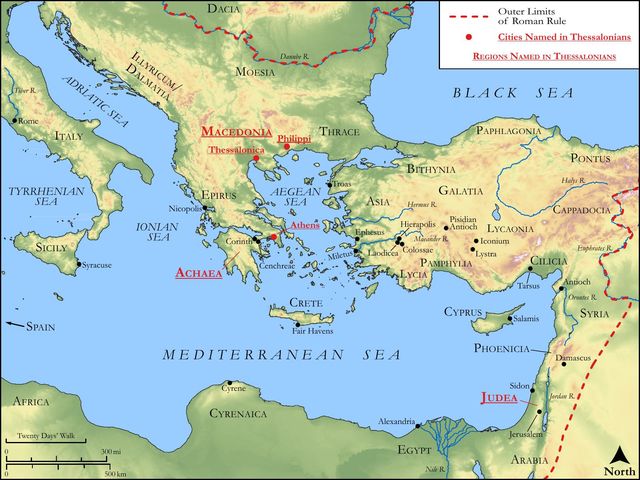
See on the biblical-era maps

Study this verse
Public-domain commentary
Matthew Henry
From his Commentary on the Whole Bible. Henry comments on passages, not single verses — this entry covers 2 Thessalonians 1:11–12. His three-level outline is real structure in the source text, so it is rendered as structure.
In these verses the apostle again tells the Thessalonians of his earnest and constant prayer for them. He could not be present with them, yet he had a constant remembrance of them; they were much upon his thoughts; he wished them well, and could not express his good-will and good wishes to them better than in earnest constant prayer to God for them: Wherefore also we pray, etc. Note, The believing thoughts and expectation of the second coming of Christ should put us upon prayer to God for ourselves and others. We should watch and pray, so our Saviour directs his disciples (Luk 21:36), Watch therefore, and pray always, that you may be counted worthy to stand before the Son of man. Observe,
I.What the apostle prayed for, Th2 1:11.
It is a great concern to be well instructed what to pray for; and without divine instruction we know not what to pray for, as without divine assistance we shall not pray in such a manner as we ought. Our prayers should be suitable to our expectations. Thus the apostle prays for them,
1.That God would begin his good work of grace in them; so we may understand this expression: That our God would count you (or, as it might be read, make you) worthy of this calling. We are called with a high and holy calling; we are called to God's kingdom and glory; and no less than the inheritance of the saints is the hope of our calling, nothing less than the enjoyment of that glory and felicity which shall be revealed when Christ Jesus shall be revealed from heaven. Now, if this be our calling, our great concern should be to be worthy of it, or meet and prepared for this glory: and because we have no worthiness of our own, but what is owing purely to the grace of God, we should pray that he would make us worthy, and then count us worthy, of this calling, or that he would make us meet to partake of the inheritance of the saints in light, Col 1:12.
2.That God would carry on the good work that is begun, and fulfil all the good pleasure of his goodness. The good pleasure of God denotes his gracious purposes towards his people, which flow from his goodness, and are full of goodness towards them; and it is thence that all good comes to us. If there be any good in us, it is the fruit of God's good-will to us, it is owing to the good pleasure of his goodness, and therefore is called grace. Now, there are various and manifold purposes of grace and good-will in God towards his people; and the apostle prays that all of them may be fulfilled or accomplished towards these Thessalonians. There are several good works of grace begun in the hearts of God's people, which proceed from this good pleasure of God's goodness, and we should desire that they may be completed and perfected. In particular, the apostle prays that God would fulfil in them the work of faith with power. Note,
(1.)The fulfilling of the work of faith is in order to the fulfilling of every other good work. And,
(2.)It is the power of God that not only begins, but that carries on and perfects the work of faith.
II.Why the apostle prayed for these things (Th2 1:12):
That the name of the Lord Jesus may be glorified; this is the end we should aim at in every thing we do and desire, that God and Christ in all things may be glorified. Our own happiness and that of others should be subordinate to this ultimate end. Our good works should so shine before men that others may glorify God, that Christ may be glorified in and by us, and then we shall be glorified in and with him. And this is the great end and design of the grace of our God and the Lord Jesus Christ, which is manifested to us and wrought in us. Or thus: it is according to the grace of God and Christ, that is, it is an agreeable thing, considering the grace that is manifested to us and bestowed on us, by God and Christ, that we direct all we do to the glory of our Creator and Redeemer.
Historical interpretation
Five Centuries of Reception
3 surviving comments on this verse. Each one is dated, so this reads as a timeline rather than a list.
Select a marker to jump to its quote. Markers stagger vertically where authors wrote within a few decades of each other.
"To which end also we pray always for you, that our God may count you worthy of your calling, and fulfill every desire of goodness and every work of faith, with power."
"That He may count you," he says, "worthy of calling"; for they were not called. Therefore he has added, "and fulfill every desire of goodness." Since he also who was clothed in filthy garments, was called, but did not abide in his calling, but for this reason was the more rejected. "Of the calling," namely that to the bride-chamber. Since the five virgins also were called. "Arise" it says, "the bridegroom cometh." And they prepared themselves, but did not enter in. But he speaks of that other calling. Showing therefore what calling he is speaking of, he has added, "And fulfill every desire of goodness and every work of faith, with power." This is the calling, he says, that we seek. See how gently he takes them down. For that they may not be rendered vain by the excess of commendation, as if they had done great deeds, and may not become slothful, he shows that something still is wanting to them, so long as they are in this life. Which also he said in his Epistle to the Hebrews. "Ye have not yet resisted unto blood, striving against sin." "Unto all wellpleasing," he says, that is, His gratification, persuasion, full assurance. That is, that the persuasion of God may be fulfilled, that nothing may be wanting to you, that you may be so, as He wills. "And every work of faith," he says, "with power." What is this? The patient endurance of persecutions, that we may not faint, he says.
I said, “Salvation through this religion, through which alone true salvation is promised and truly promised, has never been lacking to anyone who was worthy of it, and the one to whom it was lacking was unworthy of it.” I did not mean this as though anyone were worthy according to his own merits, but as the apostle says, “God’s purpose in election” does not depend on deeds but is applied according to him who calls—Rebekah was told, “The elder shall serve the younger”—and he asserts that this call depends on the purpose of God. Hence Paul says, “Not according to our works, but according to his own purpose and grace.” Similarly, he says, “We know that for those who love God all things work together for good, for those who are called according to his purpose.” Concerning this call he says, “that he may consider you worthy of his calling.”
so that our God may make you worthy of his calling
that is, understood to make worthy. Here he asks that that calling be understood according to a purpose. On this account, in order that they might separate what is universal from that which is special, they added 'his.' In order that they might show that there is not power or merit in man, but in God alone.
may complete every act of his goodness
As though they should say, May virtue be bestowed upon you by God, that through it your faith may be filled up with effort.
Continue studying 2 Thessalonians 1:11 across the web’s major study libraries — every link below opens this exact verse, chapter, or book on the destination site.
Read & Compare
 BibleGatewayThis verse in more than 200 translations and 70 languages.
 Bible.comThe YouVersion reader — hundreds of translations, reading plans, and highlights.
 ESV.orgCrossway's official English Standard Version reader.
 NET BibleThe NET translation with 60,000+ translators' notes on every rendering decision.
 STEP BibleTyndale House's free study tool — original text, vocabulary, and scholarly resources.
 BibliaLogos Bible Software's free web reader.
 USCCBThe New American Bible (Revised Edition) with the U.S. bishops' study notes.
Commentaries
 BibleHub CommentariesDozens of classic commentaries on this verse, gathered on one page.
 StudyLightMore than 100 commentary sets — the largest collection on the web.
 BibleRefPlain-English commentary on what this verse means, verse by verse.
 Enduring WordDavid Guzik's free commentary on this chapter, widely used by Bible teachers.
 Bible Study ToolsVerse commentary alongside Greek and Hebrew study aids.
Original Language & Research
- BibleHub InterlinearThe verse word by word — original language, transliteration, and English.
- BibleHub LexiconEvery word's original-language definition and Strong's entry.
 Blue Letter BibleDeep-study tools — Strong's numbers, concordance, and word studies.
 CNTR CollationThe earliest Greek manuscripts of this verse, collated letter by letter.
Sermons, Hymns & Audio


TrulyRandomVerse is not affiliated with these sites and doesn’t control their content. They’re linked because they’re genuinely useful.
Summary
In 2 Thessalonians 1:11, the Apostle Paul offers a profound intercessory prayer for the Thessalonian believers, expressing his earnest desire that God would enable them to live lives that fully correspond to their divine calling. This prayer is rooted in the assurance of God's sovereign power and benevolent will, seeking His active fulfillment of every good intention and empowering of their faith-driven actions, particularly as they endure persecution and anticipate Christ's glorious return.
Context
ShowHideLiterary Context
This verse concludes Paul's opening section in 2 Thessalonians 1. Having commended the Thessalonians for their growing faith and steadfast endurance amidst severe persecution (2 Thessalonians 1:3-4), Paul then reassures them of God's righteous judgment. He explains that their suffering is evidence of God's just plan, which will ultimately bring relief to the afflicted and retribution to those who trouble them when the Lord Jesus returns in flaming fire (2 Thessalonians 1:5-10). Against this backdrop of present tribulation and future vindication, Paul's prayer in verse 11 serves as a bridge, articulating his pastoral longing for their spiritual perseverance and the divine enablement necessary to live out their faith until that glorious day. It transitions from a statement of fact about God's justice to an expression of fervent hope for the believers' sanctification.
Historical & Cultural Context
The Thessalonian church was established during Paul's second missionary journey, facing immediate and intense opposition from both Jewish and Gentile populations (Acts 17:1-9). This persecution continued, as evidenced by both 1 Thessalonians and 2 Thessalonians. Believers were likely ostracized, economically disadvantaged, and potentially subjected to violence for their allegiance to Christ. In this climate, Paul's prayer for them to be "counted worthy of this calling" was not a call to earn salvation, but rather an encouragement for them to live consistently with the high standard of their new identity in Christ, despite external pressures. The "work of faith" would have been particularly challenging and visible in such an environment, requiring divine "power" to sustain their commitment and witness.
Key Themes
ShowHidePaul's prayer in this verse encapsulates several vital themes prevalent in his epistles. Firstly, it underscores the theme of Divine Empowerment for the Christian Life. Paul consistently teaches that believers are not left to their own strength to fulfill God's purposes; rather, God Himself works in and through them, providing the necessary grace and power. This is evident in passages like Philippians 2:13 where it states, "For it is God which worketh in you both to will and to do of his good pleasure." Secondly, the concept of Living Worthy of God's Calling is central. This isn't about earning salvation, but about living a life that reflects the profound privilege and transformative power of God's gracious invitation, a theme echoed in Ephesians 4:1. Lastly, the "work of faith" highlights the theme of Active Faith, emphasizing that genuine faith is not merely intellectual assent but a dynamic force that manifests itself in tangible actions and perseverance, as Paul also noted in 1 Thessalonians 1:3.
Exposition and Analysis
ShowHideKey Word Analysis
ShowHideFrom ἄξιος; "to deem entitled or fit." In this context, it signifies God's act of enabling or qualifying the believers to live in a manner that is appropriate for, or corresponds to, the high and holy nature of their divine calling. It is not about human merit earning God's favor, but God's grace empowering them to reflect His character and purpose.
From a presumed compound of εὖ and the base of δοκέω; "satisfaction, i.e. (subjectively) delight, or (objectively) kindness, wish, purpose." This word refers to God's benevolent will, His gracious disposition, or His favorable intention. It points to what God delights to do out of His intrinsic goodness and sovereign design for His people.
From δύναμαι; "force (literally or figuratively); specially, miraculous power (usually by implication, a miracle itself)." This term denotes inherent strength, ability, or might. Here, it refers to the divine energy and supernatural enablement that God provides, allowing believers to accomplish the "work of faith" and live out their calling effectively.
Verse Breakdown
ShowHide"Wherefore also we pray always for you,"
Paul introduces his prayer, emphasizing its consistent and fervent nature ("always"). This highlights his deep pastoral care and intercessory commitment for the Thessalonian believers, demonstrating that prayer is a vital component of his ministry and spiritual leadership.
"that our God would count you worthy of this calling,"
The primary request is for God to "count" or "deem" them worthy. This is not about the Thessalonians earning worthiness, but God's gracious act of equipping them to live up to the high standard of their "calling" – their invitation into salvation, sanctification, and service in Christ. It implies a life that corresponds to the immense privilege and holy purpose of being God's chosen people.
"and fulfil all the good pleasure of his goodness,"
Paul prays that God would bring to completion ("fulfil") His benevolent will and gracious intentions ("good pleasure") that stem from His inherent character of "goodness." This refers to God's desire to accomplish His gracious purposes in and through the believers, manifesting His kindness and favorable disposition towards them. It suggests that God's ultimate design for their lives is rooted in His own perfect nature.
"and the work of faith with power:"
This clause specifies a key aspect of God's fulfillment: empowering their "work of faith." It underscores that genuine faith is not passive but active, manifesting itself through deeds that demonstrate its reality. These "works" are not human-initiated efforts to earn favor, but rather actions that are supernaturally energized ("with power") by God Himself, enabling believers to live out their convictions and endure trials.
Literary Devices
ShowHideThe verse primarily employs Intercession as a literary device, showcasing Paul's fervent prayer on behalf of the Thessalonians. This highlights his deep pastoral concern and serves as an example for believers to pray for one another. There is also a strong sense of Emphasis on divine agency; while the believers are called to live worthy lives and perform works of faith, Paul's prayer explicitly states that it is "our God" who will "count you worthy," "fulfil all the good pleasure of his goodness," and empower "the work of faith." This underscores the theological truth that Christian living is not by human strength but by God's enabling grace. Furthermore, the phrasing exhibits a form of Parallelism, linking "the good pleasure of his goodness" with "the work of faith with power," suggesting that God's benevolent will and His empowering action are two sides of the same divine work in the believer's life.
Theological and Thematic Connections
ShowHideThis prayer beautifully articulates the profound theological truth that Christian living, particularly in the face of adversity, is ultimately a work of God's grace and power. It counters any notion of self-sufficiency, emphasizing that our ability to live a life worthy of our divine calling and to perform genuine "works of faith" is entirely dependent on God's active involvement. His "good pleasure" and "goodness" are the source and motivation for His empowering work within us, ensuring that His purposes are fulfilled. This aligns with the broader biblical narrative of God's sovereignty and His commitment to sanctifying His people, not based on their merit, but on His unfailing character and covenant faithfulness.
Reflection and Application
ShowHideFor believers today, 2 Thessalonians 1:11 serves as a powerful reminder of God's active role in our spiritual journey and the importance of prayer. We are called to live lives that genuinely reflect our identity as God's children, a calling that extends to every area of our existence, especially in challenging circumstances. This verse reassures us that we are not left to our own limited strength; rather, God Himself, out of His infinite goodness and "good pleasure," is committed to empowering us to fulfill His purposes. Our faith is meant to be active, producing "works" that are supernaturally energized by His "power," demonstrating the reality of our transformation. Therefore, we are encouraged to lean into His grace, trusting that He will complete the good work He has begun in us, enabling us to persevere and bear fruit for His glory.
Questions for Reflection
ShowHideFAQ
ShowHideDoes "count you worthy of this calling" imply that believers must earn their salvation or God's favor?
ShowHideNo, the phrase "count you worthy of this calling" does not imply earning salvation or God's favor through human merit. Instead, it refers to God's gracious act of enabling believers to live a life that is consistent with, and appropriate for, the divine calling they have already received through grace. The "calling" itself is a gift from God, an invitation into His kingdom and purpose. Paul's prayer is that God would empower them to live up to the high standard of that calling, reflecting His holiness and character in their conduct. It is God who "counts" or "deems" them fit, providing the necessary strength and grace, rather than them achieving worthiness on their own. This aligns with the broader New Testament teaching that salvation is by grace through faith, not by works (Ephesians 2:8-9).
What is meant by "the good pleasure of his goodness"?
ShowHide"The good pleasure of his goodness" refers to God's benevolent will, His gracious disposition, and His favorable intentions that stem from His inherent character of "goodness." It speaks to what God delights to do out of His intrinsic nature. In this context, Paul is praying that God would fully accomplish all the good things He desires for and through the Thessalonians, all flowing from His perfect and kind will. It emphasizes that God's ultimate purpose for His people is rooted in His own goodness and His desire to bless and empower them for His glory. This concept is often linked to God's sovereign plan and His delight in working for the good of those who love Him (Romans 8:28).
Christ-Centered Fulfillment
ShowHideThe prayer in 2 Thessalonians 1:11 finds its ultimate fulfillment and enablement in Jesus Christ. It is through Christ that we receive "this calling" – the gracious invitation into God's kingdom and purpose, made possible by His atoning sacrifice and resurrection. The "good pleasure of his goodness" is supremely revealed in God's sending of His Son, Jesus, to redeem humanity and establish His reign (John 3:16). Furthermore, the "work of faith with power" is not merely human effort but a dynamic reality empowered by the indwelling Holy Spirit, whom Christ poured out upon His ascension (Acts 2:33). As believers are united with Christ, they draw upon His limitless power to live lives worthy of their calling, bearing fruit that glorifies God (John 15:5). Christ Himself is the perfect embodiment of a life lived in full accordance with God's good pleasure, and it is His life, death, and resurrection that enable us to participate in that divine reality, ensuring that God's purposes are accomplished in and through us.