


Ezekiel 1:15
Bible text: King James Version (1769 Blayney text) · Public domain
Bible text: Berean Standard Bible · Public domain
Bible text: American Standard Version (1901) · Public domain
Bible text: World English Bible, Messianic edition · Public domain
Bible text: Geneva Bible (1599) · Public domain
Bible text: Young's Literal Translation · Public domain
- וָאֵרֶאva·'E·re'and I sawH7200Conj-w ¦ V-Qal-ConsecImperf-1csVerb Qal Consecutive Imperfect 1st Singular common genderוָandאֵרֶאI saw
- הַחַיּוֹתha·chai·Yotthe living creaturesH2416Art ¦ N-fpNoun Plural Feminine Absoluteהַtheחַיּוֹתliving creatures
- וְהִנֵּהve·hi·Nehand there!H2009Conj-w ¦ PrtParticle Interjectionוְandהִנֵּהthere!
- אוֹפַן'o·Fana wheelH212N-msNoun Singular Masculine Absolute
- אֶחָד'e·ChadoneH259Adj-fsAdjective Numerical Singular Feminine Absolute
- בָּאָרֶץba·'A·retz[was] on the groundH776Prep-b ¦ N-fsNoun Singular Feminine Absoluteבָּ[was] on theאָרֶץground
- אֵצֶל'E·tzelbesideH681N-cscNoun Singular common gender Construct
- הַחַיּוֹתha·chai·Yotthe living creaturesH2416Art ¦ N-fpNoun Plural Feminine Absoluteהַtheחַיּוֹתliving creatures
- לְאַרְבַּעַתle·'ar·Ba·'atfor [the] fourH702Prep-l ¦ Adj-cscAdjective Numerical Singular common gender Constructלְforאַרְבַּעַת[the] four
- פָּנָיוpa·Navits facesH6440N-mpc ¦ 3msNoun Plural Masculine Constructפָּנָיfacesוits
English is a literal word-by-word gloss of the Hebrew, not the KJV's wording. Why?
This is the original text the KJV's translators worked from — each Hebrew word with its own literal English meaning in this verse, prepared by scholars at Tyndale House, Cambridge. The KJV translates whole sentences, not word by word, so its wording differs: one Hebrew word can become several English words, and the KJV may choose “the LORD” where the gloss reads “Yahweh”. Both are faithful — they answer different questions. For the KJV's own rendering, switch to the KJV text.
Details
See on the biblical-era map
Study this verse
Public-domain commentary
Matthew Henry
From his Commentary on the Whole Bible. Henry comments on passages, not single verses — this entry covers Ezekiel 1:15–25. His three-level outline is real structure in the source text, so it is rendered as structure.
The prophet is very exact in making and recording his observations concerning this vision. And here we have,
I.The notice he took of the wheels, Eze 1:15-21.
The glory of God appears not only in the splendour of his retinue in the upper world, but in the steadiness of his government here in this lower world. Having seen how God does according to his will in the armies of heaven, let us now see how he does according to it among the inhabitants of the earth; for there, on the earth, the prophet saw the wheels, Eze 1:15. As he beheld the living creatures, and was contemplating the glory of that vision and receiving instruction from it, this other vision presented itself to his view. Note, Those who make a good use of the discoveries God has favoured them with may expect further discoveries; for to him that hath shall be given. We are sometimes tempted to think there is nothing glorious but what is in the upper world, whereas, could we with an eye of faith discern the beauty of Providence and the wisdom, power, and goodness, which shine in the administration of that kingdom, we should see, and say, Verily he is a God that judgeth in the earth and acts like himself. There are many things in this vision which give us some light concerning the divine Providence.
1.The dispensations of Providence are compared to wheels, either the wheels of a chariot, in which the conqueror rides in triumph, or rather the wheels of a clock or watch, which all contribute to the regular motion of the machine. We read of the course or wheel of nature (Jam 3:6), which is here set before us as under the direction of the God of nature. Wheels, though they move not of themselves, as the living creatures do, are yet made movable and are almost continually kept in action. Providence, represented by these wheels, produces changes; sometimes one spoke of the wheel is uppermost and sometimes another; but the motion of the wheel on its own axletree, like that of the orbs above, is very regular and steady. The motion of the wheels is circular; by the revolutions of Providence things are brought to the same posture and pass which they were in formerly; for the thing that is is that which has been, and there is no new thing under the sun, Ecc 1:9, Ecc 1:10.
2.The wheel is said to be by the living creatures, who attended it to direct its motion; for the angels are employed as the ministers of God's providence, and have a greater hand in directing the motions of second causes to serve the divine purpose than we think they have. Such a close connexion is there between the living creatures and the wheels that they moved and rested together. Were angels busily employed? Men were busily employed as instruments in their hand, whether of mercy or judgment, though they themselves were not aware of it. Or, Are men active to compass their designs? Angels at the same time are acting to control and overrule them. This is much insisted on here (Eze 1:19): When the living creatures went, to bring about any business, the wheels went by them; when God has work to do by the ministry of angels second causes are all found, or made, ready to concur in it; and (Eze 1:21) when those stood these stood; when the angels had done their work the second causes had done theirs. If the living creatures were lifted up from the earth, were elevated to any service above the common course of nature and out of the ordinary road (as suppose in the working of miracles, the dividing of the water, the standing still of the sun), the wheels, contrary to their own natural tendency, which is towards the earth, move in concert with them, and are lifted up over against them; this is thrice mentioned, Eze 1:19-21. Note, All inferior creatures are, and move, and act, as the Creator, by the ministration of angels, directs and influences them. Visible effects are managed and governed by invisible causes. The reason given of this is because the spirit of the living creatures was in the wheels; the same wisdom, power, and holiness of God, the same will and counsel of his, that guides and governs the angels and all their performances, does, by them, order and dispose of all the motions of the creatures in this lower world and the events and issues of them. God is the soul of the world, and animates the whole, both that above and that beneath, so that they move in perfect harmony, as the upper and lower parts of the natural body do, so that whithersoever the Spirit is to go (whatever God wills and purposes to be done and brought to pass) thither their spirit is to go; that is, the angels, knowingly and designedly, set themselves to bring it about. And their spirit is in the wheels, which are therefore lifted up over against them; that is, both the powers of nature and the wills of men are all made to serve the intention, which they infallibly and irresistibly effect, though perhaps they mean not so, neither doth their heart think so, Isa 10:7; Mic 4:11, Mic 4:12. Thus, though the will of God's precept be not done on earth as it is done in heaven, yet the will of his purpose and counsel is, and shall be.
3.The wheel is said to have four faces, looking four several ways (Eze 1:15), denoting that the providence of God exerts itself in all parts of the world, east, west, north, and south, and extends itself to the remotest corners of it. Look which way you will upon the wheel of Providence, and it has a face towards you, a beautiful one, which you may admire the features and complexion of; it looks upon you as ready to speak to you, if you be but ready to hear the voice of it; like a well-drawn picture, it has an eye upon all that have an eye upon it. The wheel had so four faces that it had in it four wheels, which went upon their four sides, Eze 1:17. At first Ezekiel saw it as one wheel (Eze 1:15), one sphere; but afterwards he saw it was four, but they four had one likeness (Eze 1:16); not only they were like one another, but they were as if they had been one. This intimates,
(1.)That one event of providence is like another; what happens to us is that which is common to men and what we are not to think strange.
(2.)That various events have a tendency to the same issue and concur to answer the same intention.
4.Their appearance and their work are said to be like the colour of a beryl (Eze 1:16), the colour of Tarshish (so the word is), that is, of the sea; the beryl is of that colour, sea-green; blue Neptune we call it. The nature of things in this world is like that of the sea, which is in a continual flux and yet there is a constant coherence and succession of its parts. There is a chain of events which is always drawing one way or other. The sea ebbs and flows, so does Providence in its disposals, but always in the stated appointed times and measures. The sea looks blue, as the air does, because of the shortness and feebleness of our sight, which can see but a little way of either; to that colour therefore are the appearance and work of Providence fitly compared, because we cannot find out that which God does from the beginning to the end, Ecc 3:11. We see but parts of his ways (Job 26:14), and all beyond looks blue, which gives us to understand no more concerning it but that in truth we know it not; it is far above out of our sight.
5.Their appearance and their work are likewise said to be as it were a wheel in the middle of a wheel. Observe here again, Their appearance to the prophet is designed to set forth what their work really is. Men's appearance and their work often differ, but the appearance of God's providence and its work agree; if they seem to differ, it is through our ignorance and mistake. Now both were as a wheel in a wheel, a less wheel moved by a greater. We pretend not to give a mathematical description of it. The meaning is that the disposals of Providence seem to us intricate, perplexed, and unaccountable, and yet that they will appear in the issue to have been all wisely ordered for the best; so that though what God does we know not now, yet we shall know hereafter, Joh 13:7.
6.The motion of these wheels, like that of the living creatures, was steady, regular, and constant: They returned not when they went (Eze 1:17), because they never went amiss, nor otherwise than they should do. God, in his providence, takes his work before him, and he will have it forward; and it is going on even when it seems to us to be going backward. They went as the Spirit directed them, and therefore returned not. We should not have occasion to return back as we have, and to undo that by repentance which we have done amiss, and to do it over again, if we were but led by the Spirit and followed his direction. The Spirit of life (so some read it) was in the wheels, which carried them on with ease and evenness, and then they returned not when they went.
7.The rings, or rims, of the wheels were so high that they were dreadful, Eze 1:18. They were of a vast circumference, so that when they were reared, and put in motion, the prophet was even afraid to look upon them. Note, The vast compass of God's thought, and the vast reach of his design, are really astonishing; when we go about to describe the circle of Providence we are struck with amazement and are even swallowed up. O the height and depth of God's councils! The consideration of them should strike an awe upon us.
8.They were full of eyes round about. This circumstance of the vision is most surprising of all, and yet most significant, plainly denoting that the motions of Providence are all directed by infinite wisdom. The issues of things are not determined by a blind fortune, but by those eyes of the Lord which run to and fro through the earth, and are in every place, beholding the evil and the good. Note, It is a great satisfaction to us, and ought to be so, that, though we cannot account for the springs and tendencies of events, yet they are all under the cognizance and direction of an all-wise all-seeing God.
II.The notice he took of the firmament above over the heads of the living creatures.
When he saw the living creatures moving, and the wheels by them, he looked up, as it is proper for us to do when we observe the various motions of providence in this lower world; looking up, he saw the firmament stretched forth over the heads of the living creatures, Eze 1:22. What is done on earth is done under the heaven (as the scripture often speaks), under its inspection and influence. Observe,
1.What he saw: The firmament was as the colour of the terrible crystal, truly glorious, but terribly so; the vastness and brightness of it put the prophet into an amazement and struck him with an awful reverence. The terrible ice, or frost (so it may be read), the colour of snow congealed, or as mountains of ice in the northern seas, which are very frightful. Daring sinners ask, Can God judge through the dark cloud? Job 22:13. But that which we take to be a dark cloud is to him transparent as crystal, through which, from the place of his habitation, he looks upon all the inhabitants of the earth, Psa 33:14. Under the firmament he saw the wings of the living creatures erect, Eze 1:23. When they pleased they used them either for flight or for covering. God is on high, above the firmament; the angels are under the firmament, which denotes their subjection to God's dominion and their readiness to fly on his errands in the open firmament of heaven, and to serve him unanimously.
2.What he heard.
(1.)He heard the noise of the angels' wings, Eze 1:24. Bees and other insects make a great noise with the vibration of their wings; here the angels do so, to awaken the attention of the prophet to that which God was about to say to him from the firmament, Eze 1:25. Angels, by the providences they are employed in, sound God's alarms to the children of men and stir them up to hear his voice; for that is it that cries in the city and is heard and understood by the men of wisdom. The noise of their wings was loud and terrible, as the noise of great waters (like the rout or roaring of the sea), and as the noise of a host, the noise of war; but it was articulate and intelligible, and did not give an uncertain sound; for it was the voice of speech; nay, it was as the voice of the Almighty, for God, by his providences, speaks once, yea, twice, if we could by perceive it, Job 33:14. The Lord's voice cries, Mic 6:9.
(2.)He heard a voice from the firmament, from him that sits upon the throne there, Eze 1:25. When the angels moved they made a noise with their wings; but, when with that they had roused a careless world, they stood still, and let down their wings, that there might be a profound silence, and so God's voice might be the better heard. The voice of Providence is designed to open men's ears to the voice of the word, to do the office of the crier, who with a loud voice charges silence while the judge passes sentence. He that has ears to hear, let him hear. Note, Noises on earth should awaken our attention to the voice from the firmament; for how shall we escape if we turn away from him that speaks from heaven!
Historical interpretation
Three Centuries of Reception
7 surviving comments on this verse. Each one is dated, so this reads as a timeline rather than a list.
Select a marker to jump to its quote. Markers stagger vertically where authors wrote within a few decades of each other.
The wheels that lie beneath it signify the various periods of time in which all the component members of the world are constantly being whirled forward. Furthermore, feet have been given to these members that they may not always stand still but move on. All their limbs are studded with eyes because the works of God are to be contemplated with ever careful observation. And within their very bosom is a fire of glowing coals, to signify that this world is hastening to the fiery day of judgment or that all the works of God are fiery and not obscure.
Whoever is stretching forward, like a wheel, touching the earth with a small part of itself, is really such as that wheel was, about which Ezekiel spoke.
And so, I recognize more clearly what I read: For the wheel runs within the wheel and is not hindered (Ezek. 1:16-17). For he passes his life without any offense in any passion, and even within these things the wheel runs. The Law runs within grace, and obedience to the Law is within the course of divine mercy: for the more it turns, the more it is proven.
Everything that is earthly and heavenly and whatever falls under human understanding turns on its own wheels.… But if anyone considers the wheel and the movement of the Gospels—that is, of the four animals that breathe and live—and understands, [that person] will in a short space of time see that the world is completed by the teaching of the apostles.
(Verse 15 and following) And as I looked at the animals, a wheel appeared on the earth beside the animals, having four faces. And the appearance of the wheels and their work was like the vision of the sea, and the four of them had the same likeness, and their appearance and work was as a wheel within a wheel. They went in the four directions, and they did not turn as they walked. The wheels also had a height and a terrifying appearance, and the whole body was full of eyes all around the four of them. LXX: And I saw, and behold, a wheel was following animals four over the earth. And the appearance of the wheels and their construction was like the color of tarshish. And their appearance was in four: and their work was as it were a wheel within a wheel. They walked in their four parts, and did not turn back when they walked. And their backs and their height were to them. And I saw them, and their backs were full of eyes all around the four. Up to this point, the picture describes the four living creatures that had four faces, following the spirits and the cloud that was in the midst of the spirit, now the individual wheels are mentioned for each animal, which were not attached to the animals but followed them. Or a wheel appeared upon the Earth, which, divided into four, had as many faces as the number of animals that followed. And such was the similarity of the four wheels to the four following animals, that one wheel was truly believed. And their work and creation was like the vision of tharsis, which we turn into the sea. The eagle placed the hyacinth; which stone resembles the sky. And their appearance was like one wheel in another, so that you would not believe it was one wheel, but rather one wheel joined to another. They were moving in four directions, and they were not being dragged or turned back. For how could they turn back when they were following animals that always move towards the front? The height and size of the wheels were also so great that it amazed those who saw it. The entire body and backs were filled with light all around, so that you could not see any part that did not have the light of eyes: like the stories of the poets describe Argus, who had a hundred or many eyes, which Juno turned into a peacock for his careless watch, so that what is a miracle of God the Creator would be a punishment for adultery without recompense. All things celestial and terrestrial, and whatever falls under human understanding, are turned by the wheels of the Sun. The Sun travels through its yearly circle, with the Moon coursing through each month. The Morning Star itself, known as Lucifer, as it twinkles from East to West, tempers the darkness of the night with a small light and completes its course in two years. The four other wandering stars, called planets, and everything that shines in the sky, as well as the varieties of crops, trees, and herbs, follow their courses in four seasons on their own respective wheels; and we behold nothing that has not existed before. The spirit moves by whirling and returns to its own circles. All rivers run into the sea, yet the sea is not full (Ecclesiastes 1:6-7). Why? Because they return to their sources from the deep abyss. But of the Gospels, that is, of the four living creatures that breathe, live, and understand, if anyone considers the wheel and its course, in a short time he will see the world to be complete with the Apostolic proclamation. The wheel is also within a wheel, or the joining of the two Testaments, which indicates the ladder of Jacob (Genesis 28) and the prophetic word of Isaiah (Isaiah 6) and the double-edged sword. Or it represents the harmonious Gospels whose course and stature tend towards heaven and touch the earth only briefly, always hastening towards the heights. About which it is said elsewhere: Holy stones roll upon the earth (Zech. IX, 16); from which the celestial Jerusalem is built. I believe this signifies the same thing as what is sung in the psalm: The voice of your thunder is in the wheel (Psalm LXXVI, 19). And elsewhere: Which sets the wheel of birth on fire (James III, 6). The meaning of these testimonies in their proper places is not of this time. But whoever sees that there is nothing in the Gospels that does not shine with its own light and illuminate the world with its splendor, will approve the whole body and the backs filled with eyes, so that even the things considered small and lowly may shine with the majesty of the Holy Spirit.
[Daniel 7:9] "I beheld until thrones were set up, and the Ancient of days took His seat. His garment was as white as snow, and the hair of His head was like pure wool. His throne was composed of fiery flames and its wheels were set on fire. From before His presence there issued forth a rushing, fiery stream." We read something similar in John's Apocalypse: "After these things I was immediately in the Spirit, and lo, a throne was set up in heaven, and one was seated upon the throne; and He who sat upon it had the likeness of jasper and sardine stone, and there was a rainbow round about the throne like the appearance of emerald. Around the throne there were twenty-four other thrones, and upon the twenty-four thrones there sat twenty-four elders, clothed in shining garments; upon their heads was a golden crown, and lightning flashes issued from the throne, and voices and thunder. And in front of the throne there were seven torches of burning fire, which were the seven spirits of God. And in front of the throne lay a glassy sea like unto crystal." (Revelation 4:2-6) And so the many thrones which Daniel saw seem to me to be what John called the twenty-four thrones. And the Ancient of days is the One who, according to John sits alone upon His throne. Likewise the Son of man, who came unto the Ancient of days, is the same as He who, according to John, is called the Lion of the tribe of Judah, the Root of David, and the titles of that sort (Revelation 5:5). I imagine that these thrones are the ones of which the Apostle Paul says, "Whether thrones or dominions..." (Colossians 1:16). And in the Gospel we read, "Ye yourselves shall sit upon twelve thrones, judging the twelve tribes of Israel" (Matthew 19:28). And God is called the One who sits and who is the Ancient of days, in order that His character as eternal Judge might be indicated. His garment is shining white like the snow, and the hair of His head is like pure wool. The Savior also, when He was transfigured on the mount and assumed the glory of His divine majesty, appeared in shining white garments (Matthew 17:2). And as for the fact that His hair is compared to perfectly pure wool, the even-handedness and uprightness of His judgment is shown forth, a judgment which shows no partiality in its exercise. Moreover He is described as an elderly man, in order that the ripeness of His judgment may be established. His throne consists of fiery flames, in order that sinners may tremble before the severity of the torments, and also that the just may be saved, but so as by fire. The wheels of the throne are set aflame, or else it is the wheels of His chariot which are aflame. In Ezekiel also God is ushered on the scene seated in a four-horse chariot (Ezekiel 1:4-28), and everything pertaining to God is of a fiery consistency. In another place also a statement is made on this subject: "God is a consuming fire" (Deuteronomy 4:24), that we might know that wood, hay and stubble are going to burn up in the day of judgment. And in the Psalms we read: "Fire goeth before Him, and He shall set aflame all His enemies round about Him" (Psalm 97:3). A rushing, fiery stream proceeded from before Him in order that it might carry sinners to hell (Gehenna).
But what does the wheel signify except sacred Scripture, which turns from every side toward the minds of its hearers, and is held back from the way of its preaching by no corner of error? It turns from every side because amid adversity and prosperity it proceeds rightly and humbly. For the circle of its precepts is now above, now below, since what is spoken spiritually to the more perfect suits the weak according to the letter; and the very things that little ones understand according to the letter, learned men raise to the heights through spiritual understanding. For which of the little ones, in the deed of Esau and Jacob—that the one is sent to hunt so that he might be blessed, while the other is blessed by his father through his mother's substitution—is nourished except according to the history of sacred reading? In which history, if one is drawn a little more subtly to understanding, he sees that Jacob did not seize the blessing of the firstborn through fraud, but received what was owed to him, which he had purchased from his consenting brother for the price of lentils given.
But if anyone thinking more deeply should wish to discuss the deeds of both through the mysteries of allegory, he immediately rises from history into mystery. For what does it mean that Isaac desired to eat from the hunting of his elder son, except that almighty God desired to be fed by the good works of the Jewish people? But while that one delayed, Rebecca substituted the younger, because while the Jewish people sought good works outside, mother grace instructed the gentile people to offer the food of good work to the almighty Father and to receive the blessing of the elder brother. He provided those same foods from domestic animals, because the gentile people, not seeking to please God through external sacrifices, says through the voice of the Prophet: "In me, O God, are your vows, which I will pay, praises to you." What does it mean that the same Jacob covered his hands and arms and neck with goatskins, except that a goat was customarily offered for sin? And the gentile people indeed slaughtered the sins of the flesh in themselves, but were not ashamed to confess themselves covered with carnal sins. What does it mean that he was clothed in the garments of the elder brother, except that he was clothed in good work with the precepts of sacred Scripture which had been given to the elder people? And the younger uses in the house those things which the elder, going out, left inside, because the gentile people hold in mind those precepts which the Jewish people could not have, while they attended only to the letter in them. And what does it mean that Isaac did not know the son whom he blessed, except what the Lord said concerning the gentile people through the Psalmist: "A people whom I did not know served me; at the hearing of the ear they obeyed me"? What does it mean that he did not see him present, and yet saw what would come to him in the future, except that almighty God, when through his prophets he foretold that grace was to be bestowed upon the gentiles, both did not see them in the present through grace, because he then left them in error, and yet because he would someday gather them, he foresaw them through the grace of blessing? Hence also to the same Jacob, bearing the figure of the gentile people, it is said in blessing: "Behold, the smell of my son is like the smell of a full field, which the Lord God has blessed." For just as Truth says in the Gospel, "The field is this world," and because the gentile people brought to faith are fragrant with virtues through their elect throughout the whole world, the smell of the son is the smell of a full field.
For the flower of the grape smells one way, because great is the virtue and reputation of preachers who intoxicate the minds of their hearers; the flower of the olive smells another way, because sweet is the work of mercy which, like oil, refreshes and gives light; the flower of the rose smells another way, because wondrous is the fragrance that gleams and is fragrant from the blood of martyrs; the flower of the lily smells another way, because the chaste life of the flesh comes from the incorruption of virginity; the flower of the violet smells another way, because great is the virtue of the humble, who from desire hold the lowest places, and do not raise themselves up from the earth on high through humility, and preserve the purple of the heavenly kingdom in their mind; the ear of grain gives off its fragrance another way, when it is brought to maturity, because the perfection of good works is prepared for the satisfaction of those who hunger for justice. Therefore, because the Gentile people is scattered throughout the world in its elect, and from those virtues which it practices fills all who understand with the fragrance of good reputation, let it rightly be said: Behold, the smell of my son is as the smell of a full field. But because he does not have these same virtues from himself, let him add: Which the Lord God has blessed.
And since the same people of the elect rise through certain ones even into contemplation, but through certain others grow fat only in the works of the active life, rightly it is added there: "May God give you of the dew of heaven, and of the fatness of the earth." For dew falls from above and subtly. And we receive of the dew of heaven as often as through the infusion of intimate contemplation we see something finely from above. But when we also do good works through the body, we are enriched from the fatness of the earth.
But what does it mean that Esau returns late to his father, except that the Jewish people return late to pleasing the Lord? To whom this also is said in the blessing: And the time will come when the yoke shall be loosened from your neck. Because the Jewish people will be freed from the servitude of sin at the end, as it is written: Until the fullness of the Gentiles should enter in, and so all Israel should be saved.
Which person would the evangelical history itself not refresh among the little ones in the working of the miracle, because the Lord commanded empty water jars to be filled with water, and immediately turned that same water into wine? But when the more vigilant in understanding hear these things, they both venerate the sacred history by believing, and they seek what it signifies inwardly. For he who was able to change water into wine was also able to fill the empty water jars immediately with wine. But he commands the water jars to be filled with water, because first our hearts must be filled through the history of sacred reading. And he turns the water into wine for us, when that very history is changed for us into spiritual understanding through the mystery of allegory. Therefore the wheel is dragged as if along the ground, because it agrees with the little ones in humble speech, and yet pouring forth spiritual things to the great, it raises as if a circle on high; and it is raised upward from the very place where it seemed to touch the ground a little before.
Because it builds on all sides, it runs as if in a circle like a wheel. Hence it is also written in the Law: "You shall make a lampstand of hammered work from the purest gold, its shaft and branches, cups and spheres and lilies proceeding from it." Who is designated by the lampstand but the Redeemer of the human race? He who in the nature of humanity shone with the light of divinity, so that he might become the lampstand of the world, in order that in his light every sinner might see in what darkness he lay. Because he assumed our nature without guilt, the lampstand of the tabernacle is commanded to be made from the purest gold. Now hammered work is produced by striking, because our Redeemer, who from conception and birth existed as perfect God and man, endured the sufferings of the passion, and thus arrived at the glory of the resurrection. Therefore the lampstand was hammered work from the purest gold, because he both had no sin, and yet his body advanced to immortality through the insults of the passion. For according to the virtues of the soul, he had absolutely nothing by which he could have advanced through blows. But in his members, which we are, he daily advances through blows, because while we are struck and afflicted so that we may deserve to be his body, he himself advances. Concerning his body it is written: "From whom the whole body, supplied and constructed through joints and connections, grows into the increase of God." For we all are his body. Through joints and connections the body is bound together, because while the chest is joined to the head, while the arms are joined to the chest, while the hands are joined to the arms, the fingers to the hands, and the other members adhere to the members, the whole body is completed—just as the holy apostles, because they stood close to our Redeemer, were like the chest adhering to the head. Because the martyrs followed them, they were like arms joined to the chest. When pastors and teachers were joined to these through good works, the hands adhered to the arms. But this whole body of our Redeemer is daily supplied in heaven through joints and connections, because when chosen souls are led there to him, his members are bound together to him. Concerning this it is well said: "Supplied and constructed, it grows into the increase of God," because God almighty, our Redeemer, who has nothing in himself by which he might advance, still daily has increase through his members. Hence it is written again: "Until we all meet in a perfect man, in the measure of the age of the fullness of Christ." The shaft of this same lampstand should be understood as the Church itself, which is his body, because it stands free amid so many adversities. The branches that proceed from the shaft are the preachers, who produced a sweet sound in the world, namely the new song. Cups are usually filled with wine. What then are the minds of the hearers but cups, which are filled by the holy preachers with the wine of knowledge? And what is the sphere but the mobility of preaching? For a sphere is rolled from every side. And preaching, which can neither be held back by adversity nor lifted up by prosperity, is a sphere, because it is both strong amid adversities and humble amid prosperity, and has neither the corner of fear nor of pride. Therefore it cannot be fixed in its course, because it rolls itself through all things.
When we follow through on the example we have set forth, lilies are fittingly described on the lampstand after the reeds, cups, and spheres, because after the grace and fluency of preaching which we have mentioned, that verdant homeland follows, which blooms with eternal flowers for holy souls. The spheres therefore pertain to labor, the lilies to recompense. And so just as in Moses the sphere is understood as the teaching of preaching, so here the sacred Scripture itself is signified by the wheel. Therefore when the prophet saw the living creatures, he added: "And as I beheld the living creatures, there appeared one wheel upon the earth."
On this matter it must be asked, since the wheels are described below, why is one wheel said to have appeared first, unless because to the ancient people only the Old Testament was given, which would turn like a wheel to instruct their mind? And rightly is the same wheel said to have appeared upon the earth. For to sinning man it was said: You are earth, and into earth you will go. Therefore the wheel appeared upon the earth, because almighty God gave the law upon the hearts of sinners. But since these winged living creatures designate the holy evangelists, as we said before, how is it that the living creatures are seen first and afterward one wheel, when the Old Testament came first and the holy evangelists followed afterward? But we can understand in these things that those were seen first by the prophet who transcend in merit. For as much as the holy Gospel excels the Old Testament, so much also ought its preachers to have been given precedence in the prophetic description.
Although there is still something else that ought to be considered in this description, because the spirit of prophecy gathers together within itself things prior and posterior simultaneously in such a way that the prophet's tongue cannot utter these things simultaneously. But the vast things which he sees flow forth from divided discourses, and now he speaks the last things after the first, now indeed the first things after the last. Hence the prophet Ezekiel, under the figure of the holy universal Church, both sees the glory of the evangelists through the likeness of the four living creatures, and yet suddenly adds those things which were done in earlier times, so that he might openly indicate that he saw simultaneously what the tongue of flesh would not suffice to say simultaneously. But since we have said that all the perfect are also signified by the four living creatures, it must also be considered that certain of the saints existed even before the law, who lived strictly by natural law and were pleasing to the almighty Lord. Therefore the wheel is described after the living creatures, because many of the elect were perfect before the almighty Lord even before the law. But if we ought to take the living creatures as referring to the Evangelists alone, as we have said, there is still something else that we ought to consider. For the holy prophet was seeing that these very words which he was uttering wrapped in obscurities would be opened not to the Jewish people but to the Gentiles. Therefore, speaking to us, he ought to have described the living creatures first and the wheel afterward, because we, coming to faith by the Lord's bounty, learned the law not through the law but through the holy Gospel. But where or what kind of wheel appeared, he adds when he says: "Beside the living creatures having four faces."
What is this, that when one wheel was spoken of, shortly after it is added, "As if there were a wheel in the middle of a wheel," unless that in the letter of the Old Testament the New Testament lay hidden through allegory? Hence the same wheel which appeared beside the living creatures is described as having four faces, because Sacred Scripture through both Testaments is distinguished into four parts. For the Old Testament consists in the Law and the Prophets, while the New consists in the Gospels and the Acts and sayings of the Apostles. Now we know that where we direct our face, there we see what is necessary. The wheel therefore has four faces, because first it saw through the Law the evils to be cut away in the peoples, afterwards it saw through the Prophets, more subtly through the Gospel, and finally through the Apostles it beheld those things which were to be cut away from the faults of men. It can also be understood that the wheel has four faces on account of the fact that Sacred Scripture, extended through the grace of preaching into the four parts of the world, became known. Hence the same wheel is well described as having first appeared as one beside the living creatures and afterwards as having four faces, because unless the Law agreed with the Gospel, it would not become known in the four parts of the world.
Continue studying Ezekiel 1:15 across the web’s major study libraries — every link below opens this exact verse, chapter, or book on the destination site.
Read & Compare
 BibleGatewayThis verse in more than 200 translations and 70 languages.
 Bible.comThe YouVersion reader — hundreds of translations, reading plans, and highlights.
 ESV.orgCrossway's official English Standard Version reader.
 NET BibleThe NET translation with 60,000+ translators' notes on every rendering decision.
 STEP BibleTyndale House's free study tool — original text, vocabulary, and scholarly resources.
 BibliaLogos Bible Software's free web reader.
 USCCBThe New American Bible (Revised Edition) with the U.S. bishops' study notes.
Commentaries
 BibleHub CommentariesDozens of classic commentaries on this verse, gathered on one page.
 StudyLightMore than 100 commentary sets — the largest collection on the web.
 BibleRefPlain-English commentary on what this verse means, verse by verse.
 Enduring WordDavid Guzik's free commentary on this chapter, widely used by Bible teachers.
 Bible Study ToolsVerse commentary alongside Greek and Hebrew study aids.
Original Language & Research
- BibleHub InterlinearThe verse word by word — original language, transliteration, and English.
- BibleHub LexiconEvery word's original-language definition and Strong's entry.
 Blue Letter BibleDeep-study tools — Strong's numbers, concordance, and word studies.
 SefariaThe Hebrew text with Rashi and centuries of Jewish commentary.
Sermons, Hymns & Audio


TrulyRandomVerse is not affiliated with these sites and doesn’t control their content. They’re linked because they’re genuinely useful.
Summary
Ezekiel 1:15 introduces a pivotal and dynamic element into the prophet's inaugural vision: the appearance of a wheel intimately connected to the previously described living creatures. This verse marks a crucial transition from the static description of the celestial beings to the revelation of the intricate mechanism of their movement, thereby unveiling the unified and highly organized nature of God's mobile throne-chariot and powerfully emphasizing His omnipresent, sovereign, and purposeful activity across all realms.
Context
ShowHideLiterary Context
Ezekiel 1:15 is an integral component of Ezekiel's profound inaugural vision of God's glory, which commences in Ezekiel 1:4. Having meticulously detailed the four living creatures—their form, wings, and four distinct faces (human, lion, ox, eagle) in Ezekiel 1:5-14—the narrative now shifts its focus. This verse serves as the initial description of the wheels that operate in conjunction with these creatures, setting the stage for the more complex "wheel within a wheel" imagery elaborated in Ezekiel 1:16 and leading to the firmament and the throne above them in Ezekiel 1:22-28. It is crucial for understanding the functional unity and mobility of the entire divine apparatus, revealing how God's presence is not static but dynamically engaged.
Historical & Cultural Context
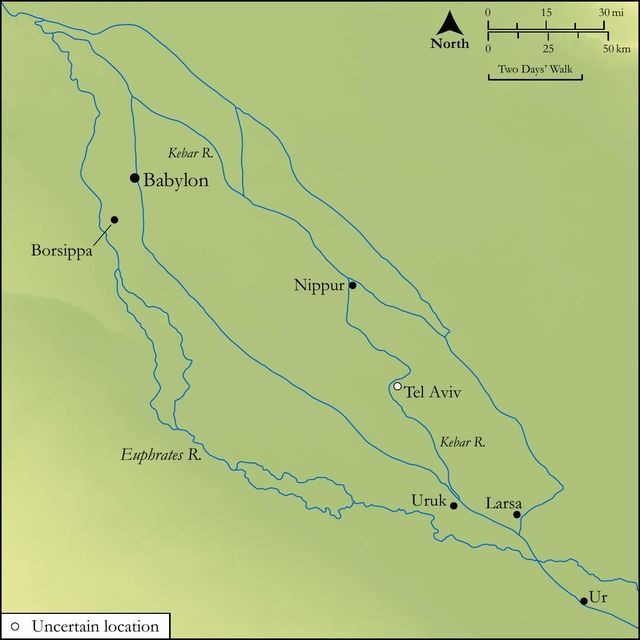
The vision unfolds while Ezekiel is among the Judean exiles by the Chebar Canal in Babylon, as explicitly stated in Ezekiel 1:1. This geographical and historical setting is profoundly significant. The prevailing belief among the exiled people of Judah was that God's presence was confined to the Temple in Jerusalem. Ezekiel's vision dramatically shatters this misconception, revealing a God whose glory is not bound by geography, human structures, or political circumstances, but is mobile, transcendent, and intimately present even in the foreign land of exile. While the imagery of a divine chariot-throne was familiar in Israel from the cherubim of the ark, Ezekiel's portrayal uniquely presents Yahweh's unparalleled sovereignty, boundless mobility, and absolute transcendence, demonstrating His active presence and ultimate control over history, even amidst His people's despair and sense of abandonment.
Key Themes
ShowHideThe introduction of the wheels in Ezekiel 1:15 contributes significantly to several overarching themes that permeate Ezekiel's prophecy. It powerfully illustrates God's Divine Mobility and Omnipresence, signifying that His presence and power are not static but dynamic, capable of reaching and operating anywhere, transcending all limitations. The intricate connection between the wheels and the living creatures highlights the Intricate Design and Order of God's operations, suggesting a profound wisdom and perfect coordination in His divine plans, which are further elaborated in Ezekiel 1:16-17. This symbiotic relationship also underscores the Unity of Divine Operation, where all aspects of God's being and action work in perfect concert and purpose. Ultimately, the entire vision, including the wheels, reinforces God's absolute Sovereignty, portraying Him as being in complete control, moving according to His own will, unaffected by earthly circumstances or human limitations, thereby offering a message of profound hope and divine oversight to a dispirited exiled community.
Exposition and Analysis
ShowHideKey Word Analysis
ShowHideDerived from an unused root meaning "to revolve," this term denotes a wheel. In Ezekiel's vision, the "wheel" is far more than a simple mechanical device; it is an integral component of the divine chariot-throne, symbolizing divine mobility, dynamic action, and the ever-present, active nature of God's being. Its appearance here introduces the mechanism by which the divine glory moves, signifying God's unhindered movement and purpose.
From a root meaning "alive," this word describes the animate, vibrant beings Ezekiel has just meticulously detailed. The repetition of "living creatures" in this verse emphasizes the intimate, organic connection between these celestial beings and the wheels. The wheels are not independent but are intrinsically linked to and animated by the "life" or spirit of these creatures, highlighting a unified, purposeful, and coordinated movement of the divine presence.
This plural noun, though often used singularly, refers to the face or presence. Here, "his four faces" explicitly links the wheel's orientation and movement to the four faces of the living creatures. This connection signifies that the wheels move in perfect alignment with the creatures' multifaceted directionality, suggesting comprehensive awareness, omnipresence, and purposeful action in every conceivable direction, without needing to turn.
Verse Breakdown
ShowHide"Now as I beheld the living creatures,"
This opening clause establishes Ezekiel's role as an eyewitness to this extraordinary divine manifestation. The phrase "as I beheld" (from H7200, râʼâh') underscores the visual, observational, and direct nature of the revelation, emphasizing that the prophet is describing what he literally sees. This provides a tangible, though awe-inspiring, account of the ineffable divine reality.
"behold one wheel upon the earth"
The sudden appearance of "one wheel" (H259, ʼechâd'), though singular in description, likely represents the initial, overwhelming perception of a unified and singular mechanism, or perhaps a representative of the four wheels. Its position "upon the earth" (H776, ʼerets') suggests its grounding in the terrestrial realm, yet its divine origin and function elevate it far beyond ordinary earthly mechanics. This detail hints at God's active engagement with the world He created and His sovereign presence within it.
"by the living creatures,"
The preposition "by" (H681, ʼêtsel') signifies immediate proximity and intimate association. This phrase explicitly states that the wheel is not isolated but positioned directly alongside the living creatures, indicating a profound functional and spatial relationship. Their movements are interdependent, suggesting a unified and synchronized operation of the divine chariot.
"with his four faces."
This crucial phrase clarifies the orientation and directional capabilities of the wheel. The "four faces" (H702, ʼarbaʻ' for "four," and H6440, pânîym' for "faces") refers back to the four faces of the living creatures described in Ezekiel 1:6. This connection means the wheel moves in perfect coordination with the creatures, able to proceed in any of the four cardinal directions without turning, symbolizing God's comprehensive knowledge, omnipresence, and unhindered movement across all dimensions of existence.
Literary Devices
ShowHideEzekiel 1:15, like the entirety of the inaugural vision, is profoundly rich in Symbolism and Visionary Language. The "wheel" itself is a potent symbol: it represents divine mobility, omnipresence, the dynamic and purposeful movement of God's will, and the intricate machinery of His providence. Its intimate connection to the "living creatures" symbolizes the unified, coordinated, and Spirit-driven nature of God's actions and attributes. The phrase "with his four faces" employs Synecdoche, where the "four faces" of the creatures stand for the creatures themselves, emphasizing their comprehensive awareness and directional capabilities, which the wheel perfectly mirrors. The entire passage is a majestic Theophany, a visual manifestation of God's glory, conveyed through highly descriptive and often fantastical imagery that transcends ordinary human comprehension. This imagery aims to impress upon the prophet and the reader the awe-inspiring majesty, sovereign power, and unceasing activity of Yahweh. The detailed, almost architectural description of the divine chariot-throne also hints at Divine Order and intricate design, reflecting the profound wisdom underlying God's creation and governance of all things.
Theological and Thematic Connections
ShowHideEzekiel 1:15's introduction of the wheel, intimately connected to the living creatures, profoundly underscores the dynamic and active nature of God's presence. It shatters any notion of a static or localized deity, revealing a God who is constantly in motion, sovereignly engaged with His creation and history. The seamless coordination between the wheels and the living creatures speaks to the unified purpose and perfect order of God's will. Even in the midst of exile and apparent divine absence, this vision assures the prophet and the exiles that God is not only present but actively working, moving with purpose and power. This mobility signifies God's ability to transcend human limitations and geographical boundaries, bringing His justice, judgment, and ultimately, His redemptive purposes to bear wherever and whenever He chooses.
Reflection and Application
ShowHideEzekiel's vision of the wheels, moving in perfect concert with the living creatures, offers a powerful antidote to feelings of abandonment or chaos, especially during times of personal or collective upheaval. It reminds us that God is not a distant, static deity, but an actively engaged, omnipresent, and sovereign Lord whose plans are intricate, purposeful, and always in motion. Just as the wheels facilitated the movement of the divine throne-chariot, God is continually working behind the scenes, orchestrating events and guiding circumstances according to His perfect will. This vision encourages us to trust in God's active presence, even when our circumstances seem bewildering or out of control. It invites us to surrender our anxieties to the One whose movements are always coordinated, whose purposes are always unified, and whose power is limitless. We can find profound peace in knowing that the God of Ezekiel's vision is still at work, moving in our lives and in the world, bringing about His ultimate good, ensuring that even in exile or despair, His divine presence and purpose remain steadfast.
Questions for Reflection
ShowHideFAQ
ShowHideWhat is the significance of "one wheel" rather than explicitly stating multiple wheels in Ezekiel 1:15?
ShowHideWhile Ezekiel 1:16 and subsequent verses clearly describe four wheels, each appearing as "a wheel within a wheel," the initial mention of "one wheel" in Ezekiel 1:15 serves several purposes. It might emphasize the prophet's initial, overwhelming impression of a singular, unified mechanism, or it could be a representative description where one stands for the whole system. The focus on "one" could also highlight the singular purpose and coordinated action of the divine mechanism. It sets the stage for the more detailed description to follow, allowing the reader to grasp the concept of the wheel before its complex, multi-directional nature is revealed.
How do these wheels relate to the "wheel within a wheel" described later in Ezekiel 1:16?
ShowHideEzekiel 1:15 introduces the fundamental element of the wheel, establishing its presence "by the living creatures." Ezekiel 1:16 then elaborates on this, describing the astonishing "wheel within a wheel" configuration. This unique design allows the wheels to move in any of the four cardinal directions (north, south, east, west) without needing to turn or rotate on an axis, as explained in Ezekiel 1:17. This intricate design symbolizes God's absolute freedom of movement, His omnipresence, and His ability to act decisively and purposefully in any direction, without hindrance or delay. The initial mention of "one wheel" in Ezekiel 1:15 is thus a foundational statement, with Ezekiel 1:16 providing the astonishing detail of its divine engineering.
Christ-Centered Fulfillment
ShowHideThe dynamic, mobile throne-chariot of God in Ezekiel's vision, with its intricately coordinated wheels and living creatures, finds its ultimate fulfillment in the person and work of Jesus Christ. The very concept of God's unhindered movement and omnipresent sovereignty, so vividly portrayed by the wheels, is perfectly embodied in Christ. He is the one through whom God's presence is made fully manifest and accessible, not confined to a temple or a specific location, but universally present. Just as the wheels moved wherever the Spirit directed the living creatures (Ezekiel 1:20), so too is Christ the ultimate agent of God's will, empowered by the Holy Spirit. His ascension to the right hand of the Father (Acts 2:33) signifies His universal reign and authority over all creation (Matthew 28:18). He is the one who "upholds the universe by the word of his power" (Hebrews 1:3), demonstrating the same intricate, sovereign control and purposeful movement that the wheels symbolize. Moreover, Christ's sending of the Holy Spirit at Pentecost (Acts 2:1-4) ensures God's dynamic presence with His people in every corner of the earth, fulfilling the vision of a mobile, unconfined divine glory. In Christ, the awe-inspiring, mysterious movements of God's throne are revealed as the purposeful, redemptive work of a loving Savior who is "with you always, to the end of the age" (Matthew 28:20), making His sovereign and active presence a living reality for all believers.