


Ezekiel 1:24
Bible text: King James Version (1769 Blayney text) · Public domain
Bible text: King James Version with Strong's numbers · Public domain
Bible text: Berean Standard Bible · Public domain
Bible text: American Standard Version (1901) · Public domain
Bible text: World English Bible, Messianic edition · Public domain
Bible text: Geneva Bible (1599) · Public domain
Bible text: Young's Literal Translation · Public domain
- וָאֶשְׁמַעva·'esh·Ma'and I heardH8085Conj-w ¦ V-Qal-ConsecImperf-1csVerb Qal Consecutive Imperfect 1st Singular common genderוָandאֶשְׁמַעI heard
- אֶת'et<obj.>H853DirObjMParticle Object Indicator
- קוֹלKol[the] sound ofH6963N-mscNoun Singular Masculine Construct
- כַּנְפֵיהֶםkan·fei·Hemtheir wingsH3671N-fdc ¦ 3mpNoun Dual Feminine Constructכַּנְפֵיwingsהֶםtheir
- כְּקוֹלke·kOllike [the] sound ofH6963Prep-k ¦ N-mscNoun Singular Masculine Constructכְּlikeקוֹל[the] sound of
- מַיִםMa·yimwatersH4325N-mpNoun Plural Masculine Absolute
- רַבִּיםra·BimmanyH7227Adj-mpAdjective Plural Masculine Absolute
- כְּקוֹלke·kollike [the] sound ofH6963Prep-k ¦ N-mscNoun Singular Masculine Constructכְּlikeקוֹל[the] sound of
- שַׁדַּיsha·Dai[the] AlmightyH7706N-properNoun Proper Title
- בְּלֶכְתָּםbe·lekh·Tamwhen they movedH1980Prep-b ¦ V-Qal-Inf ¦ 3mpVerb Qal Infinitive Constructבְּwhenלֶכְתָּmovedםthey
- קוֹלKol[the] sound ofH6963N-mscNoun Singular Masculine Construct
- הֲמֻלָּהha·mu·Laha rainstormH1999N-fsNoun Singular Feminine Absolute
- כְּקוֹלke·Kollike [the] sound ofH6963Prep-k ¦ N-mscNoun Singular Masculine Constructכְּlikeקוֹל[the] sound of
- מַחֲנֶהma·cha·Nehan armyH4264N-fsNoun Singular Feminine Absolute
- בְּעָמְדָםbe·'a·me·Damwhen they stood stillH5975Prep-b ¦ V-Qal-Inf ¦ 3mpVerb Qal Infinitive Constructבְּwhenעָמְדָstood stillםthey
- תְּרַפֶּינָהte·ra·Pei·nahthey let dropH7503V-Piel-Imperf-3fpVerb Piel Imperfect 3rd Plural Feminine
- כַנְפֵיהֶןkhan·fei·Hentheir wingsH3671N-fdc ¦ 3fpNoun Dual Feminine Constructכַנְפֵיwingsהֶןtheir
English is a literal word-by-word gloss of the Hebrew, not the KJV's wording. Why?
This is the original text the KJV's translators worked from — each Hebrew word with its own literal English meaning in this verse, prepared by scholars at Tyndale House, Cambridge. The KJV translates whole sentences, not word by word, so its wording differs: one Hebrew word can become several English words, and the KJV may choose “the LORD” where the gloss reads “Yahweh”. Both are faithful — they answer different questions. For the KJV's own rendering, switch to the KJV text.
Details
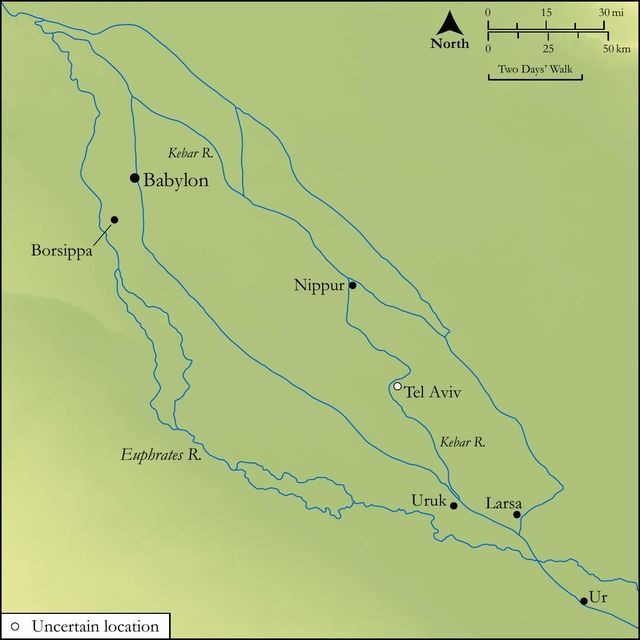
See on the biblical-era map
Study this verse
Public-domain commentary
Matthew Henry
From his Commentary on the Whole Bible. Henry comments on passages, not single verses — this entry covers Ezekiel 1:15–25. His three-level outline is real structure in the source text, so it is rendered as structure.
The prophet is very exact in making and recording his observations concerning this vision. And here we have,
I.The notice he took of the wheels, Eze 1:15-21.
The glory of God appears not only in the splendour of his retinue in the upper world, but in the steadiness of his government here in this lower world. Having seen how God does according to his will in the armies of heaven, let us now see how he does according to it among the inhabitants of the earth; for there, on the earth, the prophet saw the wheels, Eze 1:15. As he beheld the living creatures, and was contemplating the glory of that vision and receiving instruction from it, this other vision presented itself to his view. Note, Those who make a good use of the discoveries God has favoured them with may expect further discoveries; for to him that hath shall be given. We are sometimes tempted to think there is nothing glorious but what is in the upper world, whereas, could we with an eye of faith discern the beauty of Providence and the wisdom, power, and goodness, which shine in the administration of that kingdom, we should see, and say, Verily he is a God that judgeth in the earth and acts like himself. There are many things in this vision which give us some light concerning the divine Providence.
1.The dispensations of Providence are compared to wheels, either the wheels of a chariot, in which the conqueror rides in triumph, or rather the wheels of a clock or watch, which all contribute to the regular motion of the machine. We read of the course or wheel of nature (Jam 3:6), which is here set before us as under the direction of the God of nature. Wheels, though they move not of themselves, as the living creatures do, are yet made movable and are almost continually kept in action. Providence, represented by these wheels, produces changes; sometimes one spoke of the wheel is uppermost and sometimes another; but the motion of the wheel on its own axletree, like that of the orbs above, is very regular and steady. The motion of the wheels is circular; by the revolutions of Providence things are brought to the same posture and pass which they were in formerly; for the thing that is is that which has been, and there is no new thing under the sun, Ecc 1:9, Ecc 1:10.
2.The wheel is said to be by the living creatures, who attended it to direct its motion; for the angels are employed as the ministers of God's providence, and have a greater hand in directing the motions of second causes to serve the divine purpose than we think they have. Such a close connexion is there between the living creatures and the wheels that they moved and rested together. Were angels busily employed? Men were busily employed as instruments in their hand, whether of mercy or judgment, though they themselves were not aware of it. Or, Are men active to compass their designs? Angels at the same time are acting to control and overrule them. This is much insisted on here (Eze 1:19): When the living creatures went, to bring about any business, the wheels went by them; when God has work to do by the ministry of angels second causes are all found, or made, ready to concur in it; and (Eze 1:21) when those stood these stood; when the angels had done their work the second causes had done theirs. If the living creatures were lifted up from the earth, were elevated to any service above the common course of nature and out of the ordinary road (as suppose in the working of miracles, the dividing of the water, the standing still of the sun), the wheels, contrary to their own natural tendency, which is towards the earth, move in concert with them, and are lifted up over against them; this is thrice mentioned, Eze 1:19-21. Note, All inferior creatures are, and move, and act, as the Creator, by the ministration of angels, directs and influences them. Visible effects are managed and governed by invisible causes. The reason given of this is because the spirit of the living creatures was in the wheels; the same wisdom, power, and holiness of God, the same will and counsel of his, that guides and governs the angels and all their performances, does, by them, order and dispose of all the motions of the creatures in this lower world and the events and issues of them. God is the soul of the world, and animates the whole, both that above and that beneath, so that they move in perfect harmony, as the upper and lower parts of the natural body do, so that whithersoever the Spirit is to go (whatever God wills and purposes to be done and brought to pass) thither their spirit is to go; that is, the angels, knowingly and designedly, set themselves to bring it about. And their spirit is in the wheels, which are therefore lifted up over against them; that is, both the powers of nature and the wills of men are all made to serve the intention, which they infallibly and irresistibly effect, though perhaps they mean not so, neither doth their heart think so, Isa 10:7; Mic 4:11, Mic 4:12. Thus, though the will of God's precept be not done on earth as it is done in heaven, yet the will of his purpose and counsel is, and shall be.
3.The wheel is said to have four faces, looking four several ways (Eze 1:15), denoting that the providence of God exerts itself in all parts of the world, east, west, north, and south, and extends itself to the remotest corners of it. Look which way you will upon the wheel of Providence, and it has a face towards you, a beautiful one, which you may admire the features and complexion of; it looks upon you as ready to speak to you, if you be but ready to hear the voice of it; like a well-drawn picture, it has an eye upon all that have an eye upon it. The wheel had so four faces that it had in it four wheels, which went upon their four sides, Eze 1:17. At first Ezekiel saw it as one wheel (Eze 1:15), one sphere; but afterwards he saw it was four, but they four had one likeness (Eze 1:16); not only they were like one another, but they were as if they had been one. This intimates,
(1.)That one event of providence is like another; what happens to us is that which is common to men and what we are not to think strange.
(2.)That various events have a tendency to the same issue and concur to answer the same intention.
4.Their appearance and their work are said to be like the colour of a beryl (Eze 1:16), the colour of Tarshish (so the word is), that is, of the sea; the beryl is of that colour, sea-green; blue Neptune we call it. The nature of things in this world is like that of the sea, which is in a continual flux and yet there is a constant coherence and succession of its parts. There is a chain of events which is always drawing one way or other. The sea ebbs and flows, so does Providence in its disposals, but always in the stated appointed times and measures. The sea looks blue, as the air does, because of the shortness and feebleness of our sight, which can see but a little way of either; to that colour therefore are the appearance and work of Providence fitly compared, because we cannot find out that which God does from the beginning to the end, Ecc 3:11. We see but parts of his ways (Job 26:14), and all beyond looks blue, which gives us to understand no more concerning it but that in truth we know it not; it is far above out of our sight.
5.Their appearance and their work are likewise said to be as it were a wheel in the middle of a wheel. Observe here again, Their appearance to the prophet is designed to set forth what their work really is. Men's appearance and their work often differ, but the appearance of God's providence and its work agree; if they seem to differ, it is through our ignorance and mistake. Now both were as a wheel in a wheel, a less wheel moved by a greater. We pretend not to give a mathematical description of it. The meaning is that the disposals of Providence seem to us intricate, perplexed, and unaccountable, and yet that they will appear in the issue to have been all wisely ordered for the best; so that though what God does we know not now, yet we shall know hereafter, Joh 13:7.
6.The motion of these wheels, like that of the living creatures, was steady, regular, and constant: They returned not when they went (Eze 1:17), because they never went amiss, nor otherwise than they should do. God, in his providence, takes his work before him, and he will have it forward; and it is going on even when it seems to us to be going backward. They went as the Spirit directed them, and therefore returned not. We should not have occasion to return back as we have, and to undo that by repentance which we have done amiss, and to do it over again, if we were but led by the Spirit and followed his direction. The Spirit of life (so some read it) was in the wheels, which carried them on with ease and evenness, and then they returned not when they went.
7.The rings, or rims, of the wheels were so high that they were dreadful, Eze 1:18. They were of a vast circumference, so that when they were reared, and put in motion, the prophet was even afraid to look upon them. Note, The vast compass of God's thought, and the vast reach of his design, are really astonishing; when we go about to describe the circle of Providence we are struck with amazement and are even swallowed up. O the height and depth of God's councils! The consideration of them should strike an awe upon us.
8.They were full of eyes round about. This circumstance of the vision is most surprising of all, and yet most significant, plainly denoting that the motions of Providence are all directed by infinite wisdom. The issues of things are not determined by a blind fortune, but by those eyes of the Lord which run to and fro through the earth, and are in every place, beholding the evil and the good. Note, It is a great satisfaction to us, and ought to be so, that, though we cannot account for the springs and tendencies of events, yet they are all under the cognizance and direction of an all-wise all-seeing God.
II.The notice he took of the firmament above over the heads of the living creatures.
When he saw the living creatures moving, and the wheels by them, he looked up, as it is proper for us to do when we observe the various motions of providence in this lower world; looking up, he saw the firmament stretched forth over the heads of the living creatures, Eze 1:22. What is done on earth is done under the heaven (as the scripture often speaks), under its inspection and influence. Observe,
1.What he saw: The firmament was as the colour of the terrible crystal, truly glorious, but terribly so; the vastness and brightness of it put the prophet into an amazement and struck him with an awful reverence. The terrible ice, or frost (so it may be read), the colour of snow congealed, or as mountains of ice in the northern seas, which are very frightful. Daring sinners ask, Can God judge through the dark cloud? Job 22:13. But that which we take to be a dark cloud is to him transparent as crystal, through which, from the place of his habitation, he looks upon all the inhabitants of the earth, Psa 33:14. Under the firmament he saw the wings of the living creatures erect, Eze 1:23. When they pleased they used them either for flight or for covering. God is on high, above the firmament; the angels are under the firmament, which denotes their subjection to God's dominion and their readiness to fly on his errands in the open firmament of heaven, and to serve him unanimously.
2.What he heard.
(1.)He heard the noise of the angels' wings, Eze 1:24. Bees and other insects make a great noise with the vibration of their wings; here the angels do so, to awaken the attention of the prophet to that which God was about to say to him from the firmament, Eze 1:25. Angels, by the providences they are employed in, sound God's alarms to the children of men and stir them up to hear his voice; for that is it that cries in the city and is heard and understood by the men of wisdom. The noise of their wings was loud and terrible, as the noise of great waters (like the rout or roaring of the sea), and as the noise of a host, the noise of war; but it was articulate and intelligible, and did not give an uncertain sound; for it was the voice of speech; nay, it was as the voice of the Almighty, for God, by his providences, speaks once, yea, twice, if we could by perceive it, Job 33:14. The Lord's voice cries, Mic 6:9.
(2.)He heard a voice from the firmament, from him that sits upon the throne there, Eze 1:25. When the angels moved they made a noise with their wings; but, when with that they had roused a careless world, they stood still, and let down their wings, that there might be a profound silence, and so God's voice might be the better heard. The voice of Providence is designed to open men's ears to the voice of the word, to do the office of the crier, who with a loud voice charges silence while the judge passes sentence. He that has ears to hear, let him hear. Note, Noises on earth should awaken our attention to the voice from the firmament; for how shall we escape if we turn away from him that speaks from heaven!
Historical interpretation
Two Centuries of Reception
6 surviving comments on this verse. Each one is dated, so this reads as a timeline rather than a list.
Select a marker to jump to its quote. Markers stagger vertically where authors wrote within a few decades of each other.
(Verse 22 onwards) And the likeness above the heads of the living creatures was like the appearance of a crystal dreadful ice; extended above their heads was what appeared to be a firmament. Under the firmament their wings were straight, one toward another. Each of them had two wings that covered their bodies, and each one had two wings that covered one side. And I heard the sound of the wings, like the sound of many waters, like the sound of the Almighty God. When they walked, it was like the sound of a multitude, like the sound of a camp; and when they stood still, their wings were let down. For when the voice was being made above the firmament that was above their heads, they would stand and submit their wings. And above the firmament that was over their heads, there was a likeness of a throne, and above the likeness of the throne, there was a likeness as the appearance of a man from above. Wherever we would place ourselves, their wings were straight, and like the sound or voice of the exalted God, the seventy translated it. Their wings were extended and flying; and like a strong voice: which in Hebrew is called 'Almighty' (Saddai). Many things in this chapter and in other chapters have been omitted by them, which they have chosen to skip due to their length. But what we have interpreted more clearly, from one to another: each one covered their body with two wings, and the other likewise covered theirs, for which it is written in Hebrew, a man, on account of his sister, covered his body with two wings, and a man likewise covered his; therefore, after woman, man is put in the same person, so that we may not think of gender in heavenly things: since in one and the same way, according to the Hebrew usage, both man and woman are called the same. Moreover, there appears above four living creatures and as many wheels, the likeness of the firmament, which we call the sky, having the appearance of crystal, which is most pure, and is said to solidify from clean and shining waters by excessive coldness - as much as water is also constricted by frost and called κρύσταλλος in Greek. But it was fitting that in the higher things there be extraordinary purity, which protects all things, that is, rational and wise virtues, and the course of the four seasons, and the regions of the world, and the order of all things, and the preaching of the Gospel, which is understood in part and veiled in part. And the voice that is heard of flying wings, like the voice of many waters, which, according to the Apocalypse of John (Chapter XVII), signifies peoples, and gradually progresses as the voice of camps, and as the voice of the sublime God, which in Hebrew is called Saddai, and according to the Septuagint, the voice of the word; so that we may believe that the voice of the Son of God is everything that is proclaimed in the world. But while the animals were standing, their wings were lowered. For they could not bear the resonating voice of Almighty God in the heavens, but they stood and marveled; and with their silence, they demonstrated the power of God, who sat upon the firmament. The firmament below had the likeness of crystal, but the firmament above appeared like a sapphire stone. The likeness of the sapphire stone was the throne of the one who sat in the likeness of a human. From this, we understand that the firmament, crystal, sapphire, and human are shown in resemblance, not in truth. However, many testimonies teach that the human should be understood as God the Father. Among these is the parable in the Gospel: A certain man planted a vineyard and leased it to farmers (Matthew 21:33). And shortly after: He sent his servants, and above all his son. Again: A certain man made a wedding feast for his son. Not that the son is excluded from the kingdom, of which Isaiah wrote: I saw the Lord sitting on a high and lofty throne. And John said: Isaiah said these things because he saw the glory of the Son of God; but he reigns in the Father and the Son. For all the Son of the Father are, who is the image of the invisible Father God (Colossians 1:15). For also in Daniel, God the Father is portrayed sitting (Daniel 7), and the Son of man is offered to him, that he may receive the kingdom. And in the Apocalypse of John, the same things are written about the Son (Revelation 3:7). And in the battle of the first martyr Stephen, he is seen standing at the right hand of the Father. Of whom it is sung in the psalm: The Lord said to my Lord: Sit at my right hand. I will make your enemies the footstool of your feet (Psalm 110:1). Just as the most pure and shining things are shown in the heavenly bodies, which illuminate our seeing body, so in the sapphire, that is, in the throne of God, and above the firmament that we perceive as the sky, the hidden and secret and incomprehensible mysteries of God are revealed: He made darkness His hiding place (Psalm 18:11), and He is seen in the cloud and in the darkness. And in Exodus it is written: And under the feet of God there was as it were a work of sapphire stone, and as the appearance of the sky when it is most clear (Exodus 24:10). And the bride describes the beauty of the bridegroom in the Song of Songs: His belly is like a block of ivory, set on sapphire stone (Song of Songs 5:14). And in the Book of Revelation, the first foundation is jasper, the second sapphire (Revelation 21). And in the breastplate of the high priest, in the order and arrangement of each stone, the second order has carbuncle, sapphire, and jasper (Exodus 28). Concerning which we have spoken in part about the stones, in the Expositions of Isaiah.
[Daniel 7:9] "I beheld until thrones were set up, and the Ancient of days took His seat. His garment was as white as snow, and the hair of His head was like pure wool. His throne was composed of fiery flames and its wheels were set on fire. From before His presence there issued forth a rushing, fiery stream." We read something similar in John's Apocalypse: "After these things I was immediately in the Spirit, and lo, a throne was set up in heaven, and one was seated upon the throne; and He who sat upon it had the likeness of jasper and sardine stone, and there was a rainbow round about the throne like the appearance of emerald. Around the throne there were twenty-four other thrones, and upon the twenty-four thrones there sat twenty-four elders, clothed in shining garments; upon their heads was a golden crown, and lightning flashes issued from the throne, and voices and thunder. And in front of the throne there were seven torches of burning fire, which were the seven spirits of God. And in front of the throne lay a glassy sea like unto crystal." (Revelation 4:2-6) And so the many thrones which Daniel saw seem to me to be what John called the twenty-four thrones. And the Ancient of days is the One who, according to John sits alone upon His throne. Likewise the Son of man, who came unto the Ancient of days, is the same as He who, according to John, is called the Lion of the tribe of Judah, the Root of David, and the titles of that sort (Revelation 5:5). I imagine that these thrones are the ones of which the Apostle Paul says, "Whether thrones or dominions..." (Colossians 1:16). And in the Gospel we read, "Ye yourselves shall sit upon twelve thrones, judging the twelve tribes of Israel" (Matthew 19:28). And God is called the One who sits and who is the Ancient of days, in order that His character as eternal Judge might be indicated. His garment is shining white like the snow, and the hair of His head is like pure wool. The Savior also, when He was transfigured on the mount and assumed the glory of His divine majesty, appeared in shining white garments (Matthew 17:2). And as for the fact that His hair is compared to perfectly pure wool, the even-handedness and uprightness of His judgment is shown forth, a judgment which shows no partiality in its exercise. Moreover He is described as an elderly man, in order that the ripeness of His judgment may be established. His throne consists of fiery flames, in order that sinners may tremble before the severity of the torments, and also that the just may be saved, but so as by fire. The wheels of the throne are set aflame, or else it is the wheels of His chariot which are aflame. In Ezekiel also God is ushered on the scene seated in a four-horse chariot (Ezekiel 1:4-28), and everything pertaining to God is of a fiery consistency. In another place also a statement is made on this subject: "God is a consuming fire" (Deuteronomy 4:24), that we might know that wood, hay and stubble are going to burn up in the day of judgment. And in the Psalms we read: "Fire goeth before Him, and He shall set aflame all His enemies round about Him" (Psalm 97:3). A rushing, fiery stream proceeded from before Him in order that it might carry sinners to hell (Gehenna).
"When they walked, there was a sound like that of a multitude, like the noise of an army camp."
If by the sound of the heights the praise of our creator God is designated in the heavenly homeland, it is not surprising that the prophetic discourse returns again to the works of the saints still living in this life, because the Holy Spirit in the hearts of the prophets does not simultaneously cast forth through the tongue outwardly what He simultaneously shows inwardly. For the water of knowledge with which the soul of the one prophesying is filled overflows vehemently in contemplation. But because every mouth of man is narrow for the Spirit, that is, the opening of the flesh is insufficient for expressing that immensity which is beheld, the tongue varies in its utterance. Therefore, after he beheld the sound of the wings to be as the sound of the most high God in the heavens, he returns again to earth and speaks of what the winged creatures do here, so that they may merit those highest things there, saying: "When they walked, there was as it were the sound of a multitude, like the noise of an army." When the holy preachers go about the world preaching and drawing people, the living creatures walk. And because those whom they gather, as soon as they have believed, rise up in praise of our creator, a sound is made like the sound of a multitude. And because in that preaching they take up war against the powers of the air, it is rightly added: "Like the noise of an army." For when faithful peoples are joined to the holy preachers, multitudes of armies are formed in the battle array of faith against the malignant spirits. And while each day all the faithful are filled with heavenly desires, despise earthly things, and set before themselves harsh things for love of the heavenly homeland, they become armies against the powers of the air, because they advance armed with faith and fortified with good works. For as if to certain armies of a spiritual host, it is said through Paul: "Put on the armor of God, that you may be able to stand against the wiles of the devil, for our struggle is not against flesh and blood, but against principalities and powers, against the rulers of the darkness of this world, against spiritual wickedness in high places."
Therefore, the multitudes of the saints are an army camp, which has undertaken war against the powers of the air. Hence also the holy universal Church is described under the figure of the beloved, so that it is said: "You are beautiful, my friend, sweet and comely as Jerusalem, terrible as an army set in battle array." For since Jerusalem is interpreted as "the vision of peace," by which name the heavenly homeland is expressed, the holy Church is called sweet and comely as Jerusalem, because its life and desire are now compared to the vision of intimate peace, so that in that it loves its Creator, in that it longs to see His face, of whom it is written, "into whom the angels desire to look," through those very desires of its love it may be called similar to the angels. And the more it becomes lovable to God, the more it acts so as to become terrible to malign spirits. But how it is terrible is shown by the comparison added, that is, "as an army set in battle array." What does it mean that the holy Church is to be feared by its enemies as an army set in battle array? For this comparison is not without great meaning, and therefore must be carefully examined. For we know and it is certain that an army's battle line appears terrible to enemies when it has been so closely packed and densely formed that it appears broken at no point. For if it is so arranged that an empty space is left through which the enemy can enter, it is certainly no longer terrible to its enemies. And so when we set our battle line of spiritual combat against malign spirits, it is supremely necessary that we be found always united and bound together through charity, and never broken apart through discord, because whatever good works may be in us, if charity is lacking, through the evil of discord a gap is opened in the battle line through which the enemy may be able to enter to strike us.
The ancient enemy, however, does not fear chastity in us if it exists without charity, because he himself is not burdened by flesh so as to be dissolved in its luxury. He does not fear abstinence, because he himself does not use food, since he is not pressed by bodily necessity. He does not fear the distribution of earthly things if charity is lacking from that work, because he himself does not need the support of riches. But he greatly fears true charity in us—that is, the humble love which we mutually bestow upon one another—and he exceedingly envies our concord, because we hold on earth what he, being unwilling to hold, lost in heaven. Rightly therefore it is said: "Terrible as an army set in battle array," because the malign spirits fear the multitude of the elect insofar as they see them united against themselves and gathered together through the harmony of charity.
How great the virtue of concord is, is shown when without it the remaining virtues are demonstrated not to be virtues. For great is the virtue of abstinence; but if someone so abstains from food that he judges others in their eating, and even condemns the very foods which God created to be received with thanksgiving by the faithful, what has the virtue of abstinence become for him except a snare of guilt? Hence the Psalmist also, indicating that there is no abstinence without concord, says: "Praise him with timbrel and chorus." For in the timbrel dry skin resounds, but in the chorus voices sing together in harmony. What then is signified by the timbrel except abstinence, and what by the chorus except the concord of charity? Therefore whoever so maintains abstinence that he abandons concord, praises indeed with the timbrel, but does not praise in the chorus. And there are some who, while they strive to be wiser than is necessary, recoil from peace with their neighbors, while they despise them as dull and foolish. Hence Truth itself admonishes, saying: "Have salt in yourselves, and have peace among yourselves," so that whoever strives to have the salt of wisdom must necessarily take care that he never depart from the peace of concord. But what we have said concerning these two virtues must be understood of all the others. Hence Paul admonishes terribly, saying: "Follow peace with all, and holiness, without which no one shall see God."
But that nothing is pleasing to God without concord, Truth itself demonstrates, saying: "If you offer your gift at the altar, and there remember that your brother has something against you, leave your gift there at the altar, and go first to be reconciled to your brother, and then coming you will offer your gift." Behold, He does not wish to receive a sacrifice from those who are in discord; He refuses to accept a burnt offering. Hence therefore consider how great an evil discord is, on account of which even that is rejected through which fault is forgiven. But because the elect are always joined together in charity, and this same charity of theirs renders a sound of praise to its Author, while to malign spirits, that is, to their ancient enemies, it strikes the punishment of fear, rightly now it is said of the winged creatures: "When they walked, there was as it were a sound of a multitude, like the noise of an army camp."
It is pleasing, however, to extend the eye of faith from the origin of the holy Church all the way to the end of the world, and to see how these same camps march. For camps is the name given to multitudes of an army when they proceed in battle array or remain in any fixed place along the journey. The camp's way, therefore, is the life of the present age for all the saints living in harmony. Some camps are those of preachers, who labor here and there in the battle array of holy work to gather souls. Other camps are those of the continent and those withdrawing from this world, who daily prepare themselves in heart against the wars of malign spirits. Other camps are those of good married people, who living harmoniously in love of almighty God, pay to one another the debt of the flesh in such a way that they never forget what they owe to God in good works. But even if they sin in any way as humans do, they ceaselessly redeem these sins through pious acts. Therefore, because the distinct orders of the faithful, living harmoniously from the origin of the holy Church to the end of the world, fight against the powers of the air, the camps march; and there arises as it were a certain sound of camps, because in them the swords of virtues and the weapons of miracles resound to the praise of almighty God.
"And I heard the sound of their wings, as the sound of many waters."
In sacred speech, peoples are customarily designated by waters. Hence it is said through John: "The waters are peoples." Peoples are designated by waters for this reason: because in life they have sound from the tumult of the flesh, and daily they flow away through the course of mortality. As we have now often said, the wings of the living creatures are the virtues of the saints. What then does it mean that the prophet hears the sound of wings as the sound of many waters, except that by the mercy of almighty God those wings of virtues, which formerly sounded in few saints, now also, with preaching spread abroad, resound in the conversion of many peoples? For when the Lord was incarnate, suffered, and rose again, the winged living creatures were few, because those who desired heavenly things and raised themselves on high by the wings of virtues were very rare. But after the preaching of his divinity was spread throughout the world, how many little ones, how many older persons, how many strong youths, how many weak ones, how many converted sinners, how many aged virgins fly to heavenly things through faith, through hope, through love—who is able to tell, who to estimate? Behold, the sound of wings, which formerly was in few living creatures, now resounds among peoples, now the wings of virtues lift the multitude of the world to heavenly desire. Well therefore is it said: "And I heard the sound of their wings, as the sound of many waters," because, as we said before, that sound of virtues which was made in God's ear formerly from few saints was afterward multiplied from many waters, that is, from innumerable peoples.
"And when they stood, their wings were let down."
The holy living creatures stand when they consider the things of God with intent contemplation. But their wings are lowered, because while they behold the lofty judgments of God, their own virtues become worthless to them.
"As the sound of the most high God."
What is it that the sound of wings in the holy living creatures is called as the sound of the Most High God, except that Almighty God both fills the minds of the saints with heavenly desire, and himself hears them when filled? For he himself creates love in the hearts of the saints, and he himself receives prayer from loving hearts. Peter wept bitterly over his denial, but yet there it is first stated that Jesus looked upon Peter. Mary Magdalene came after many stains of guilt, to the feet of our Redeemer with tears; but who poured this into her within, except he who kindly received her outwardly? Who was urging her to tears through the spirit of compunction, except he who outwardly was receiving her unto pardon before those reclining together at table? Therefore our Redeemer was drawing forth the mind of the sinful woman when he pierced her with compunction over her guilt, and was receiving her so that he might free her from guilt. Well therefore is this sound of wings called as the sound of the Most High God, because whatever is done in the virtues of the saints belongs to the grace of him who bestows merits.
He is rightly called the Most High God through the prophet. For in Sacred Scripture, God is sometimes spoken of nominally, and sometimes essentially. He is spoken of nominally, as it is written: "Behold, I have made you a god to Pharaoh." And as Moses says: "If anyone does this or that, bring him to the gods," that is, to the priests. Who again says: "You shall not revile the gods," that is, the priests. And as the Psalmist says: "God stood in the assembly of gods, and in their midst He judges gods." But God is spoken of essentially, as He Himself says to Moses: "I am the God of your father, the God of Abraham, the God of Isaac, the God of Jacob." Hence the Apostle Paul, wishing to distinguish the nominal name of God from the essential, spoke of our Redeemer, saying: "Whose are the fathers, from whom is Christ according to the flesh, who is God over all, blessed forever." For he who is called God nominally is among all things; but he who is called God essentially is God over all things. Therefore, to show that Christ is God by nature, he mentioned that He is not merely God, but God over all things, because any chosen person, as we said before, placed as an example of righteousness, can be called a god, but among all things, since he is god nominally; but Christ is God over all things, because He is God by nature. Therefore, He whom Paul calls God over all things, the prophet Ezekiel calls the Most High God. After it was said: "I heard the sound of wings, like the sound of many waters," because it is further added: "Like the sound of the Most High God," we can also understand this as what we know will be for all the elect. For the sound of wings, as we said, was in the holy preachers; the sound of waters, in the peoples converted and following. But that same sound will one day be the sound of the Most High God, because the multitude that is now drawn to the faith through holy teachers will one day be gathered into the heavenly homeland, so that there all the elect may praise without end, when they see without end Him whom they praise. And because then the whole multitude of saints becomes perfectly the body of the Redeemer, according to Paul's words saying: "Because creation itself will be freed from slavery to corruption into the freedom of the glory of the children of God"; and they will then so cling to Him that nothing from the corruption, which is conquered through the resurrection, will any longer oppose them in their holy love, but they will become united to the glory of their Redeemer; it is rightly said: "Like the sound of the Most High God."
The order of the description must be noted, because first the sound from the wings of the living creatures is mentioned, which afterward is called like the sound of many waters, and finally like the sound of the most high God. For what the saints first preached, this the peoples converted to the faith afterward believed and held, who finally, raised up to the heavenly realms, will also render praise to the liberator of all. Thus the sound of the living creatures becomes like the sound of waters, and the sound of waters becomes like the sound of the most high God, because the praise of the almighty Lord, which at first few proclaimed in the world, many afterward cried out. And the praise which many now cry out, while their own corruption still fights against them within themselves, all the elect, now united to their head, will resound in the heavenly fatherland.
Continue studying Ezekiel 1:24 across the web’s major study libraries — every link below opens this exact verse, chapter, or book on the destination site.
Read & Compare
 BibleGatewayThis verse in more than 200 translations and 70 languages.
 Bible.comThe YouVersion reader — hundreds of translations, reading plans, and highlights.
 ESV.orgCrossway's official English Standard Version reader.
 NET BibleThe NET translation with 60,000+ translators' notes on every rendering decision.
 STEP BibleTyndale House's free study tool — original text, vocabulary, and scholarly resources.
 BibliaLogos Bible Software's free web reader.
 USCCBThe New American Bible (Revised Edition) with the U.S. bishops' study notes.
Commentaries
 BibleHub CommentariesDozens of classic commentaries on this verse, gathered on one page.
 StudyLightMore than 100 commentary sets — the largest collection on the web.
 BibleRefPlain-English commentary on what this verse means, verse by verse.
 Enduring WordDavid Guzik's free commentary on this chapter, widely used by Bible teachers.
 Bible Study ToolsVerse commentary alongside Greek and Hebrew study aids.
Original Language & Research
- BibleHub InterlinearThe verse word by word — original language, transliteration, and English.
- BibleHub LexiconEvery word's original-language definition and Strong's entry.
 Blue Letter BibleDeep-study tools — Strong's numbers, concordance, and word studies.
 SefariaThe Hebrew text with Rashi and centuries of Jewish commentary.
Sermons, Hymns & Audio


TrulyRandomVerse is not affiliated with these sites and doesn’t control their content. They’re linked because they’re genuinely useful.
Summary
Ezekiel 1:24 offers a powerful auditory description of the living creatures supporting God's throne-chariot within the prophet's inaugural vision. As these celestial beings moved, their wings produced a thunderous roar, vividly compared to the sound of mighty waters, the authoritative voice of the Almighty, and the disciplined clamor of a vast army. This intense sensory experience underscores the immense power, majestic presence, and perfect order inherent in God's heavenly retinue, conveying His active sovereignty and unyielding control, even amidst the profound desolation of the Babylonian exile.
Context
ShowHideLiterary Context
Ezekiel 1:24 is a pivotal moment within Ezekiel's foundational vision, which unfolds from Ezekiel 1 through Ezekiel 3. The preceding verses (Ezekiel 1:4-23) meticulously detail the complex appearance of the four living creatures, their multiple faces, their straight legs, and their four wings, along with the intricate wheels beside them, all covered with eyes. This elaborate visual description systematically builds a sense of divine complexity, power, and omnipresence, culminating in the overwhelming auditory experience presented in verse 24. The movement and sound described here are intrinsically linked to the creatures' function as bearers of the divine throne, emphasizing their immediate and perfect responsiveness to God's command. The subsequent verses (Ezekiel 1:25-28) further heighten the vision's majesty by describing the firmament above the creatures and the glorious appearance of the One seated upon the throne, solidifying the awe-inspiring nature of the divine encounter.
Historical & Cultural Context
Ezekiel received this profound vision in the fifth year of King Jehoiachin's exile (Ezekiel 1:2), placing the event around 593 BC. The prophet was among the Jewish exiles by the Chebar Canal in Babylon, a land far removed from the Jerusalem Temple, which, though still standing, was soon to be destroyed. In this period of national humiliation, spiritual disorientation, and shattered hopes, the vision served as a profound theological counter-narrative. It directly challenged any prevailing notion that God was confined to Jerusalem or rendered powerless in a foreign land. The imagery of "great waters" and a "host" speaks of divine power and military might, here applied to Yahweh, demonstrating His unparalleled supremacy over all earthly and heavenly forces. The vision provided crucial assurance to the exiles that God's presence was dynamic and mobile, not static or limited by geographical boundaries, and that He remained sovereign over His people's destiny, even in their desperate circumstances.
Key Themes
ShowHideThis verse powerfully contributes to several overarching themes evident throughout Ezekiel and the broader biblical narrative. Firstly, it emphatically highlights the overwhelming majesty and transcendence of God. The sounds described are not merely loud; they convey an incomprehensible power and scale, affirming that God is utterly distinct, supreme, and beyond human comprehension. Secondly, the immediate and synchronized obedience of the creatures—moving and stopping in perfect synchronicity—underscores the theme of divine order and absolute sovereignty. Despite the immense power manifested, there is no chaos, only purposeful action directed by God's will. This divine order is a recurring motif in Ezekiel, often contrasting sharply with the spiritual and moral disorder of Israel. Thirdly, the dynamic movement and powerful presence of the divine chariot emphasize God's active presence and mobility, even in exile. This directly challenges the belief among the nations that deities were tied to specific temples or lands, assuring the exiles that the God of Israel was indeed with them, ready to act on their behalf, a theme powerfully echoed in God's promise to be a "little sanctuary" to the exiles in Ezekiel 11:16.
Exposition and Analysis
ShowHideKey Word Analysis
ShowHideThis word, appearing five times in the verse, signifies more than just an indistinct "noise"; it denotes a potent "voice" or "sound" that carries profound meaning and authority. Derived from an unused root meaning "to call aloud," it describes a powerful, discernible utterance. In Ezekiel 1:24, it conveys the overwhelming auditory impact of the creatures' movement, which is then explicitly equated with the "voice of the Almighty" and "voice of speech," indicating a direct manifestation of divine communication or presence.
This divine title, Shadday, emphasizes God's absolute power, self-sufficiency, and omnipotence. It is derived from a root meaning "to be mighty" or "to deal violently," conveying a sense of irresistible force. When Ezekiel hears the "voice of the Almighty," it signifies an encounter with the supreme, all-powerful God, a force capable of both bringing about judgment and delivering salvation. This name frequently appears in contexts emphasizing God's covenant faithfulness and overwhelming might, as seen in His self-revelation to Abram in Genesis 17:1.
This term refers to an "encampment" or "army," whether a literal military formation or a figurative multitude. The comparison of the sound to that of an "host" evokes the disciplined, overwhelming force of a vast military formation on the move. It suggests not only immense numbers but also a unified, purposeful, and formidable power, highlighting the organized might of God's heavenly retinue acting in perfect concert and readiness for divine command.
Verse Breakdown
ShowHide"And when they went, I heard the noise of their wings"
As the living creatures, whose appearance was meticulously detailed in the preceding verses, began their movement, Ezekiel's attention was immediately captured by the powerful sound generated by their wings. This initial observation establishes the dynamic and active nature of the divine presence and sets the stage for the dramatic and awe-inspiring comparisons that follow. The verb "went" (Hebrew, yâlak') implies purposeful, directed movement, not random motion.
"like the noise of great waters"
The first powerful simile used to describe the sound is that of "great waters" (Hebrew, mayim rabbim'). This evokes the immense, roaring sound of a mighty waterfall, a surging ocean, or a powerful flood. It conveys an overwhelming, irresistible force and volume, suggesting the vastness, majesty, and uncontainable power associated with God's presence, reminiscent of the voice of God in Psalm 29:3.
"as the voice of the Almighty, the voice of speech"
This crucial phrase elevates the sound from a mere natural phenomenon to a direct divine utterance. It is not simply a loud noise, but the very "voice of the Almighty" (Hebrew, qôl Shadday'), indicating ultimate authority, omnipotence, and sovereign power. The subsequent addition, "the voice of speech" (Hebrew, _qôl _hămullâh'__), further clarifies that this is a discernible, intentional communication, implying divine revelation or command, rather than an inarticulate roar, underscoring God's active engagement.
"as the noise of an host"
The third vivid simile compares the sound to that of a vast "host" or army. This imagery conveys a sense of immense numbers, disciplined movement, and formidable power. It suggests the organized might of God's heavenly retinue, moving in perfect unison and readiness for action, emphasizing the divine order and formidable strength that govern even the most overwhelming manifestations of God's presence.
"when they stood, they let down their wings"
In stark contrast to the thunderous sound of movement, the creatures demonstrate immediate and perfect obedience. The moment they "stood" (Hebrew, ʻâmad'), indicating a halt or cessation of movement, they "let down" (Hebrew, râphâh') their wings. This action signifies a transition from active, powerful motion to a state of reverence, stillness, and attentiveness, implying their readiness to receive further divine instruction or to acknowledge the presence of the One on the throne.
Literary Devices
ShowHideEzekiel 1:24 is exceptionally rich in Simile, a literary device that employs "like" or "as" to draw comparisons between disparate things, creating vivid and impactful imagery. The prophet utilizes three potent similes to convey the overwhelming sound of the creatures' wings: "like the noise of great waters," "as the voice of the Almighty," and "as the noise of an host." These comparisons are not merely descriptive; they are designed to communicate the immense, majestic, and authoritative nature of God's presence, transcending ordinary human experience. The use of Hyperbole is also evident, as the descriptions stretch the limits of human comprehension to articulate an unearthly sound, emphasizing its immense volume and power beyond any normal earthly experience. Furthermore, the passage skillfully employs Sensory Imagery, particularly auditory imagery, to fully immerse the reader in Ezekiel's overwhelming encounter, making the divine manifestation palpable. The dramatic shift from the dynamic, thunderous sound to profound silence when the creatures stand and let down their wings creates a powerful Contrast, highlighting their perfect obedience and the divine order that governs the heavenly realm. Finally, the entire passage is imbued with Symbolism, where the sounds themselves represent divine power, ultimate authority, and the disciplined, formidable might of God's rule over all things.
Theological and Thematic Connections
ShowHideEzekiel 1:24 offers profound theological insights into the very nature of God and His dynamic interaction with creation. The overwhelming sounds described—likened to mighty waters, the authoritative voice of the Almighty, and a vast army—collectively portray God as supremely powerful, utterly sovereign, and perfectly ordered in His operations. This passage powerfully affirms God's transcendence, demonstrating that His presence is not confined by human constructs, physical temples, or geographical boundaries, but is dynamic, mobile, and actively manifest wherever He chooses to reveal Himself. The immediate and synchronized obedience of the creatures, ceasing their movement and lowering their wings in reverence, underscores the theme of divine authority and the perfect harmony and submission within God's heavenly court. This awe-inspiring vision served to reassure the exiled Israelites that their God, Yahweh, remained in absolute control, majestic, and intimately present, even in the foreign land of Babylon, capable of both righteous judgment and ultimate restoration.
Other passages that echo or expand upon these themes include:
Reflection and Application
ShowHideEzekiel's vision, particularly the raw power and perfect order described in verse 24, invites us to cultivate a profound sense of awe and reverence for the Most High God. In a world that often seeks to diminish, domesticate, or even dismiss the divine, this verse serves as a powerful and necessary reminder of God's uncontainable majesty and sovereign control over all things. It challenges us to move beyond a casual or superficial understanding of God and to embrace a worship that authentically acknowledges His absolute otherness and overwhelming power. The immediate and perfect obedience of the living creatures, silencing their thunderous wings at a moment's notice, models a posture of humble submission, attentiveness, and readiness to respond to the divine will. This calls us to consider our own responsiveness to God's voice and leading in our lives: are we quick to obey, or do we resist His guidance? The profound truth that God's presence is dynamic and mobile, even in the midst of exile and desolation, offers immense comfort and hope: no matter our circumstances—whether personal struggles, societal upheaval, or spiritual dryness—God is with us, active and sovereign, ever ready to speak and to act on our behalf. This vision encourages us to trust implicitly in His perfect plan and to find profound peace in His unwavering presence, knowing that the God who commands the universe is intimately involved in the details of our lives.
Questions for Reflection
ShowHideFAQ
ShowHideWhat is the significance of the sound being "like the noise of great waters"?
ShowHideThe comparison to "great waters" (Hebrew, mayim rabbim) is a potent and recurring biblical metaphor for immense, overwhelming power, vastness, and majestic authority. It evokes the roaring sound of a mighty waterfall, the crashing waves of the sea, or the irresistible force of a flood—all forces of nature beyond human control. In Ezekiel 1:24, this imagery signifies the irresistible force, awe-inspiring volume, and omnipresent nature of God's power and presence. This powerful auditory motif is frequently used in scripture to describe divine power, such as in Psalm 29:3, where the voice of the Lord is said to be "over the waters." It underscores that the sound emanating from God's throne is not merely loud, but carries the weighty essence of divine authority and an uncontainable, majestic force that demands attention and reverence.
Why is the sound also described as "the voice of the Almighty, the voice of speech"?
ShowHideThis phrase is crucial because it elevates the description from a mere natural phenomenon (like great waters) to a direct and intentional manifestation of divine communication and authority. "The voice of the Almighty" (Hebrew, qôl Shadday) emphasizes God's absolute omnipotence, self-sufficiency, and sovereign power, indicating that this sound is an emanation of ultimate authority. The subsequent addition of "the voice of speech" (Hebrew, _qôl _hămullâh'__) is particularly significant, as it clarifies that the overwhelming sound is not chaotic, inarticulate, or random, but purposeful and communicative. It implies that God is not a silent, distant deity, but one who actively speaks, reveals Himself, and issues commands, even through the powerful, symbolic sounds of His heavenly court. This highlights God's active desire to communicate with His creation and His people, even in the midst of overwhelming power.
Christ-Centered Fulfillment
ShowHideEzekiel 1:24, with its awe-inspiring depiction of overwhelming divine power, majestic authority, and perfect order, finds its profound Christ-centered fulfillment in the person and redemptive work of Jesus Christ. The "noise of great waters" and the "voice of the Almighty" foreshadow the inherent, majestic authority of the Son of God. Just as the thunderous sound of the cherubim's wings signifies God's dynamic and active presence, Christ is the ultimate and perfect embodiment of God's presence among humanity, the very Word made flesh. The "voice of speech" emanating from the Almighty points directly to Jesus as the definitive and final revelation of God; as Hebrews 1:1-2 declares, God, "in these last days has spoken to us by His Son." The disciplined movement and immediate obedience of the heavenly host prefigure the perfect, unwavering obedience of Christ, who humbled Himself and became obedient to the point of death, even death on a cross. Furthermore, the imagery of a powerful "host" speaks to the overwhelming power and ultimate victory of God, which is fully realized in Christ's triumph over sin, death, and all principalities and powers. The very voice of the resurrected Christ is described with similar majesty in Revelation 1:15, where it is likened to "the roar of many waters," directly connecting the Old Testament manifestation of divine power to the glorified Son. Thus, Ezekiel's vision, while terrifying in its grandeur, ultimately points to Jesus Christ, the One through whom God's power, presence, and perfect will are fully revealed and eternally accomplished for humanity.