


Ezekiel 1:18
Bible text: King James Version (1769 Blayney text) · Public domain
Bible text: Berean Standard Bible · Public domain
Bible text: American Standard Version (1901) · Public domain
Bible text: World English Bible, Messianic edition · Public domain
Bible text: Geneva Bible (1599) · Public domain
Bible text: Young's Literal Translation · Public domain
- וְגַבֵּיהֶןve·Ga·bei·Henand their rimsH1354Conj-w ¦ N-mpc ¦ 3fpNoun Plural Masculine Constructוְandגַבֵּיrimsהֶןtheir
- וְגֹבַהּve·Goahand heightH1363Conj-w ¦ N-msNoun Singular Masculine Absoluteוְandגֹבַהּheight
- לָהֶםla·Hem[belonged] to themPrep-l ¦ 3mpSuffix Personal 3rd Plural Masculineלָ[belonged] toהֶםthem
- וְיִרְאָהve·yir·'Ahand fearH3374Conj-w ¦ N-fsNoun Singular Feminine Absoluteוְandיִרְאָהfear
- לָהֶםla·Hem[belonged] to themPrep-l ¦ 3mpSuffix Personal 3rd Plural Masculineלָ[belonged] toהֶםthem
- וְגַבֹּתָםve·ga·bo·Tamand their rimsH1354Conj-w ¦ N-fpc ¦ 3mpNoun Plural Feminine Constructוְandגַבֹּתָrimsםtheir
- מְלֵאֹתme·le·'Ot[were] full ofH4392Adj-fpcAdjective Plural Feminine Construct
- עֵינַיִם'ei·Na·yimeyesH5869N-fdNoun Dual Feminine Absolute
- סָבִיבsa·Vivall aroundH5439N-csNoun Singular common gender Absolute
- לְאַרְבַּעְתָּןle·'ar·ba'·Tanto [the] four of themH702Prep-l ¦ Adj-fsc ¦ 3fpAdjective Numerical Singular Feminine Constructלְtoאַרְבַּעְתָּ[the] four ofןthem
English is a literal word-by-word gloss of the Hebrew, not the KJV's wording. Why?
This is the original text the KJV's translators worked from — each Hebrew word with its own literal English meaning in this verse, prepared by scholars at Tyndale House, Cambridge. The KJV translates whole sentences, not word by word, so its wording differs: one Hebrew word can become several English words, and the KJV may choose “the LORD” where the gloss reads “Yahweh”. Both are faithful — they answer different questions. For the KJV's own rendering, switch to the KJV text.
Details
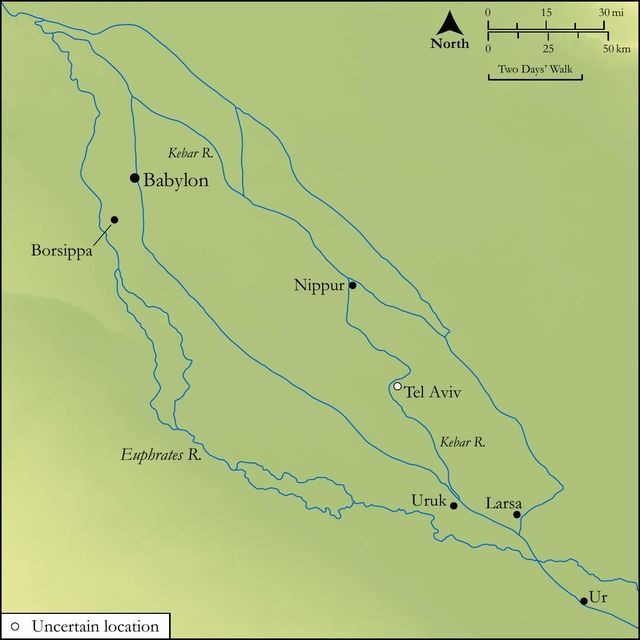
See on the biblical-era map
Study this verse
Public-domain commentary
Matthew Henry
From his Commentary on the Whole Bible. Henry comments on passages, not single verses — this entry covers Ezekiel 1:15–25. His three-level outline is real structure in the source text, so it is rendered as structure.
The prophet is very exact in making and recording his observations concerning this vision. And here we have,
I.The notice he took of the wheels, Eze 1:15-21.
The glory of God appears not only in the splendour of his retinue in the upper world, but in the steadiness of his government here in this lower world. Having seen how God does according to his will in the armies of heaven, let us now see how he does according to it among the inhabitants of the earth; for there, on the earth, the prophet saw the wheels, Eze 1:15. As he beheld the living creatures, and was contemplating the glory of that vision and receiving instruction from it, this other vision presented itself to his view. Note, Those who make a good use of the discoveries God has favoured them with may expect further discoveries; for to him that hath shall be given. We are sometimes tempted to think there is nothing glorious but what is in the upper world, whereas, could we with an eye of faith discern the beauty of Providence and the wisdom, power, and goodness, which shine in the administration of that kingdom, we should see, and say, Verily he is a God that judgeth in the earth and acts like himself. There are many things in this vision which give us some light concerning the divine Providence.
1.The dispensations of Providence are compared to wheels, either the wheels of a chariot, in which the conqueror rides in triumph, or rather the wheels of a clock or watch, which all contribute to the regular motion of the machine. We read of the course or wheel of nature (Jam 3:6), which is here set before us as under the direction of the God of nature. Wheels, though they move not of themselves, as the living creatures do, are yet made movable and are almost continually kept in action. Providence, represented by these wheels, produces changes; sometimes one spoke of the wheel is uppermost and sometimes another; but the motion of the wheel on its own axletree, like that of the orbs above, is very regular and steady. The motion of the wheels is circular; by the revolutions of Providence things are brought to the same posture and pass which they were in formerly; for the thing that is is that which has been, and there is no new thing under the sun, Ecc 1:9, Ecc 1:10.
2.The wheel is said to be by the living creatures, who attended it to direct its motion; for the angels are employed as the ministers of God's providence, and have a greater hand in directing the motions of second causes to serve the divine purpose than we think they have. Such a close connexion is there between the living creatures and the wheels that they moved and rested together. Were angels busily employed? Men were busily employed as instruments in their hand, whether of mercy or judgment, though they themselves were not aware of it. Or, Are men active to compass their designs? Angels at the same time are acting to control and overrule them. This is much insisted on here (Eze 1:19): When the living creatures went, to bring about any business, the wheels went by them; when God has work to do by the ministry of angels second causes are all found, or made, ready to concur in it; and (Eze 1:21) when those stood these stood; when the angels had done their work the second causes had done theirs. If the living creatures were lifted up from the earth, were elevated to any service above the common course of nature and out of the ordinary road (as suppose in the working of miracles, the dividing of the water, the standing still of the sun), the wheels, contrary to their own natural tendency, which is towards the earth, move in concert with them, and are lifted up over against them; this is thrice mentioned, Eze 1:19-21. Note, All inferior creatures are, and move, and act, as the Creator, by the ministration of angels, directs and influences them. Visible effects are managed and governed by invisible causes. The reason given of this is because the spirit of the living creatures was in the wheels; the same wisdom, power, and holiness of God, the same will and counsel of his, that guides and governs the angels and all their performances, does, by them, order and dispose of all the motions of the creatures in this lower world and the events and issues of them. God is the soul of the world, and animates the whole, both that above and that beneath, so that they move in perfect harmony, as the upper and lower parts of the natural body do, so that whithersoever the Spirit is to go (whatever God wills and purposes to be done and brought to pass) thither their spirit is to go; that is, the angels, knowingly and designedly, set themselves to bring it about. And their spirit is in the wheels, which are therefore lifted up over against them; that is, both the powers of nature and the wills of men are all made to serve the intention, which they infallibly and irresistibly effect, though perhaps they mean not so, neither doth their heart think so, Isa 10:7; Mic 4:11, Mic 4:12. Thus, though the will of God's precept be not done on earth as it is done in heaven, yet the will of his purpose and counsel is, and shall be.
3.The wheel is said to have four faces, looking four several ways (Eze 1:15), denoting that the providence of God exerts itself in all parts of the world, east, west, north, and south, and extends itself to the remotest corners of it. Look which way you will upon the wheel of Providence, and it has a face towards you, a beautiful one, which you may admire the features and complexion of; it looks upon you as ready to speak to you, if you be but ready to hear the voice of it; like a well-drawn picture, it has an eye upon all that have an eye upon it. The wheel had so four faces that it had in it four wheels, which went upon their four sides, Eze 1:17. At first Ezekiel saw it as one wheel (Eze 1:15), one sphere; but afterwards he saw it was four, but they four had one likeness (Eze 1:16); not only they were like one another, but they were as if they had been one. This intimates,
(1.)That one event of providence is like another; what happens to us is that which is common to men and what we are not to think strange.
(2.)That various events have a tendency to the same issue and concur to answer the same intention.
4.Their appearance and their work are said to be like the colour of a beryl (Eze 1:16), the colour of Tarshish (so the word is), that is, of the sea; the beryl is of that colour, sea-green; blue Neptune we call it. The nature of things in this world is like that of the sea, which is in a continual flux and yet there is a constant coherence and succession of its parts. There is a chain of events which is always drawing one way or other. The sea ebbs and flows, so does Providence in its disposals, but always in the stated appointed times and measures. The sea looks blue, as the air does, because of the shortness and feebleness of our sight, which can see but a little way of either; to that colour therefore are the appearance and work of Providence fitly compared, because we cannot find out that which God does from the beginning to the end, Ecc 3:11. We see but parts of his ways (Job 26:14), and all beyond looks blue, which gives us to understand no more concerning it but that in truth we know it not; it is far above out of our sight.
5.Their appearance and their work are likewise said to be as it were a wheel in the middle of a wheel. Observe here again, Their appearance to the prophet is designed to set forth what their work really is. Men's appearance and their work often differ, but the appearance of God's providence and its work agree; if they seem to differ, it is through our ignorance and mistake. Now both were as a wheel in a wheel, a less wheel moved by a greater. We pretend not to give a mathematical description of it. The meaning is that the disposals of Providence seem to us intricate, perplexed, and unaccountable, and yet that they will appear in the issue to have been all wisely ordered for the best; so that though what God does we know not now, yet we shall know hereafter, Joh 13:7.
6.The motion of these wheels, like that of the living creatures, was steady, regular, and constant: They returned not when they went (Eze 1:17), because they never went amiss, nor otherwise than they should do. God, in his providence, takes his work before him, and he will have it forward; and it is going on even when it seems to us to be going backward. They went as the Spirit directed them, and therefore returned not. We should not have occasion to return back as we have, and to undo that by repentance which we have done amiss, and to do it over again, if we were but led by the Spirit and followed his direction. The Spirit of life (so some read it) was in the wheels, which carried them on with ease and evenness, and then they returned not when they went.
7.The rings, or rims, of the wheels were so high that they were dreadful, Eze 1:18. They were of a vast circumference, so that when they were reared, and put in motion, the prophet was even afraid to look upon them. Note, The vast compass of God's thought, and the vast reach of his design, are really astonishing; when we go about to describe the circle of Providence we are struck with amazement and are even swallowed up. O the height and depth of God's councils! The consideration of them should strike an awe upon us.
8.They were full of eyes round about. This circumstance of the vision is most surprising of all, and yet most significant, plainly denoting that the motions of Providence are all directed by infinite wisdom. The issues of things are not determined by a blind fortune, but by those eyes of the Lord which run to and fro through the earth, and are in every place, beholding the evil and the good. Note, It is a great satisfaction to us, and ought to be so, that, though we cannot account for the springs and tendencies of events, yet they are all under the cognizance and direction of an all-wise all-seeing God.
II.The notice he took of the firmament above over the heads of the living creatures.
When he saw the living creatures moving, and the wheels by them, he looked up, as it is proper for us to do when we observe the various motions of providence in this lower world; looking up, he saw the firmament stretched forth over the heads of the living creatures, Eze 1:22. What is done on earth is done under the heaven (as the scripture often speaks), under its inspection and influence. Observe,
1.What he saw: The firmament was as the colour of the terrible crystal, truly glorious, but terribly so; the vastness and brightness of it put the prophet into an amazement and struck him with an awful reverence. The terrible ice, or frost (so it may be read), the colour of snow congealed, or as mountains of ice in the northern seas, which are very frightful. Daring sinners ask, Can God judge through the dark cloud? Job 22:13. But that which we take to be a dark cloud is to him transparent as crystal, through which, from the place of his habitation, he looks upon all the inhabitants of the earth, Psa 33:14. Under the firmament he saw the wings of the living creatures erect, Eze 1:23. When they pleased they used them either for flight or for covering. God is on high, above the firmament; the angels are under the firmament, which denotes their subjection to God's dominion and their readiness to fly on his errands in the open firmament of heaven, and to serve him unanimously.
2.What he heard.
(1.)He heard the noise of the angels' wings, Eze 1:24. Bees and other insects make a great noise with the vibration of their wings; here the angels do so, to awaken the attention of the prophet to that which God was about to say to him from the firmament, Eze 1:25. Angels, by the providences they are employed in, sound God's alarms to the children of men and stir them up to hear his voice; for that is it that cries in the city and is heard and understood by the men of wisdom. The noise of their wings was loud and terrible, as the noise of great waters (like the rout or roaring of the sea), and as the noise of a host, the noise of war; but it was articulate and intelligible, and did not give an uncertain sound; for it was the voice of speech; nay, it was as the voice of the Almighty, for God, by his providences, speaks once, yea, twice, if we could by perceive it, Job 33:14. The Lord's voice cries, Mic 6:9.
(2.)He heard a voice from the firmament, from him that sits upon the throne there, Eze 1:25. When the angels moved they made a noise with their wings; but, when with that they had roused a careless world, they stood still, and let down their wings, that there might be a profound silence, and so God's voice might be the better heard. The voice of Providence is designed to open men's ears to the voice of the word, to do the office of the crier, who with a loud voice charges silence while the judge passes sentence. He that has ears to hear, let him hear. Note, Noises on earth should awaken our attention to the voice from the firmament; for how shall we escape if we turn away from him that speaks from heaven!
Historical interpretation
Two Centuries of Reception
6 surviving comments on this verse. Each one is dated, so this reads as a timeline rather than a list.
Select a marker to jump to its quote. Markers stagger vertically where authors wrote within a few decades of each other.
(Verse 15 and following) And as I looked at the animals, a wheel appeared on the earth beside the animals, having four faces. And the appearance of the wheels and their work was like the vision of the sea, and the four of them had the same likeness, and their appearance and work was as a wheel within a wheel. They went in the four directions, and they did not turn as they walked. The wheels also had a height and a terrifying appearance, and the whole body was full of eyes all around the four of them. LXX: And I saw, and behold, a wheel was following animals four over the earth. And the appearance of the wheels and their construction was like the color of tarshish. And their appearance was in four: and their work was as it were a wheel within a wheel. They walked in their four parts, and did not turn back when they walked. And their backs and their height were to them. And I saw them, and their backs were full of eyes all around the four. Up to this point, the picture describes the four living creatures that had four faces, following the spirits and the cloud that was in the midst of the spirit, now the individual wheels are mentioned for each animal, which were not attached to the animals but followed them. Or a wheel appeared upon the Earth, which, divided into four, had as many faces as the number of animals that followed. And such was the similarity of the four wheels to the four following animals, that one wheel was truly believed. And their work and creation was like the vision of tharsis, which we turn into the sea. The eagle placed the hyacinth; which stone resembles the sky. And their appearance was like one wheel in another, so that you would not believe it was one wheel, but rather one wheel joined to another. They were moving in four directions, and they were not being dragged or turned back. For how could they turn back when they were following animals that always move towards the front? The height and size of the wheels were also so great that it amazed those who saw it. The entire body and backs were filled with light all around, so that you could not see any part that did not have the light of eyes: like the stories of the poets describe Argus, who had a hundred or many eyes, which Juno turned into a peacock for his careless watch, so that what is a miracle of God the Creator would be a punishment for adultery without recompense. All things celestial and terrestrial, and whatever falls under human understanding, are turned by the wheels of the Sun. The Sun travels through its yearly circle, with the Moon coursing through each month. The Morning Star itself, known as Lucifer, as it twinkles from East to West, tempers the darkness of the night with a small light and completes its course in two years. The four other wandering stars, called planets, and everything that shines in the sky, as well as the varieties of crops, trees, and herbs, follow their courses in four seasons on their own respective wheels; and we behold nothing that has not existed before. The spirit moves by whirling and returns to its own circles. All rivers run into the sea, yet the sea is not full (Ecclesiastes 1:6-7). Why? Because they return to their sources from the deep abyss. But of the Gospels, that is, of the four living creatures that breathe, live, and understand, if anyone considers the wheel and its course, in a short time he will see the world to be complete with the Apostolic proclamation. The wheel is also within a wheel, or the joining of the two Testaments, which indicates the ladder of Jacob (Genesis 28) and the prophetic word of Isaiah (Isaiah 6) and the double-edged sword. Or it represents the harmonious Gospels whose course and stature tend towards heaven and touch the earth only briefly, always hastening towards the heights. About which it is said elsewhere: Holy stones roll upon the earth (Zech. IX, 16); from which the celestial Jerusalem is built. I believe this signifies the same thing as what is sung in the psalm: The voice of your thunder is in the wheel (Psalm LXXVI, 19). And elsewhere: Which sets the wheel of birth on fire (James III, 6). The meaning of these testimonies in their proper places is not of this time. But whoever sees that there is nothing in the Gospels that does not shine with its own light and illuminate the world with its splendor, will approve the whole body and the backs filled with eyes, so that even the things considered small and lowly may shine with the majesty of the Holy Spirit.
[Daniel 7:9] "I beheld until thrones were set up, and the Ancient of days took His seat. His garment was as white as snow, and the hair of His head was like pure wool. His throne was composed of fiery flames and its wheels were set on fire. From before His presence there issued forth a rushing, fiery stream." We read something similar in John's Apocalypse: "After these things I was immediately in the Spirit, and lo, a throne was set up in heaven, and one was seated upon the throne; and He who sat upon it had the likeness of jasper and sardine stone, and there was a rainbow round about the throne like the appearance of emerald. Around the throne there were twenty-four other thrones, and upon the twenty-four thrones there sat twenty-four elders, clothed in shining garments; upon their heads was a golden crown, and lightning flashes issued from the throne, and voices and thunder. And in front of the throne there were seven torches of burning fire, which were the seven spirits of God. And in front of the throne lay a glassy sea like unto crystal." (Revelation 4:2-6) And so the many thrones which Daniel saw seem to me to be what John called the twenty-four thrones. And the Ancient of days is the One who, according to John sits alone upon His throne. Likewise the Son of man, who came unto the Ancient of days, is the same as He who, according to John, is called the Lion of the tribe of Judah, the Root of David, and the titles of that sort (Revelation 5:5). I imagine that these thrones are the ones of which the Apostle Paul says, "Whether thrones or dominions..." (Colossians 1:16). And in the Gospel we read, "Ye yourselves shall sit upon twelve thrones, judging the twelve tribes of Israel" (Matthew 19:28). And God is called the One who sits and who is the Ancient of days, in order that His character as eternal Judge might be indicated. His garment is shining white like the snow, and the hair of His head is like pure wool. The Savior also, when He was transfigured on the mount and assumed the glory of His divine majesty, appeared in shining white garments (Matthew 17:2). And as for the fact that His hair is compared to perfectly pure wool, the even-handedness and uprightness of His judgment is shown forth, a judgment which shows no partiality in its exercise. Moreover He is described as an elderly man, in order that the ripeness of His judgment may be established. His throne consists of fiery flames, in order that sinners may tremble before the severity of the torments, and also that the just may be saved, but so as by fire. The wheels of the throne are set aflame, or else it is the wheels of His chariot which are aflame. In Ezekiel also God is ushered on the scene seated in a four-horse chariot (Ezekiel 1:4-28), and everything pertaining to God is of a fiery consistency. In another place also a statement is made on this subject: "God is a consuming fire" (Deuteronomy 4:24), that we might know that wood, hay and stubble are going to burn up in the day of judgment. And in the Psalms we read: "Fire goeth before Him, and He shall set aflame all His enemies round about Him" (Psalm 97:3). A rushing, fiery stream proceeded from before Him in order that it might carry sinners to hell (Gehenna).
Three things are equally indicated in the animals and the wheels; when they stand, when they walk and when they arise, what they do as animals and wheels and what they do in common.
What is it that in the words of Sacred Scripture these three things are said to be present, so that they are mentioned as having stature, height, and a horrible appearance, that is, a terrible one? We must greatly inquire what is called the stature of divine Scripture, what is its height, what is its horrible appearance. Therefore it must be known that to stand corresponds to the life of one who works well. Hence it is said through Paul: Let him who stands take heed lest he fall. He who also says to his disciples: So stand in the Lord, beloved. And the prophet, who saw himself standing before the Lord in life and conduct, said: The Lord lives, in whose sight I stand. Height, however, is the promise of the heavenly kingdom. Which is reached when all corruption of mortal life is now subdued. The horrible appearance, however, is the terror of hell, which tortures the reprobate without end, and always preserves them in torment. Therefore stature is in the rectitude of precept, height in the loftiness of the heavenly promise, and horrible appearance in the threats and terrors of the punishment that follows. Sacred Scripture therefore has stature, because it directs conduct toward standing, so that the minds of hearers may not be bent toward earthly desire. It has height, because it promises the joys of eternal life in the heavenly homeland. It also has a horrible appearance, because it threatens all the reprobate with the punishments of hell. Therefore it shows its stature in the building of conduct, it shows its height in the promise of rewards, it shows its horrible appearance in the terrors of punishments. For it is upright in precepts, lofty in promises, horrible in threats. It has stature when it says through the prophet: Cease to do evil, learn to do good, seek judgment, relieve the oppressed, judge the orphan, defend the widow. And again: Break your bread for the hungry, and bring the needy and wandering into your house; when you see the naked, cover him, and do not despise those of your own flesh. It has height when it says through the same prophet: The sun shall no longer be your light by day, nor shall the splendor of the moon illuminate you; but the Lord shall be your everlasting light, and your God shall be your glory. It has a horrible appearance when, describing hell, it says: The day of vengeance of the Lord, the year of retribution for the judgment of Zion; and its torrents shall be turned into pitch, and its soil into sulphur; and the land shall be burning pitch, day and night it shall not be extinguished forever. Which blessed Job also describes, saying: A land of darkness and covered with the mist of death, a land of misery and darkness, where is the shadow of death, and no order, but everlasting horror dwelling there. It has stature when through it the Lord graciously promises, saying: As the new heavens and the new earth, which I make to stand before me, says the Lord; so shall your seed and your name stand. For they truly stand before the Lord who do not waste their life in wickedness. It has height when it immediately adds: And there shall be month after month, and Sabbath after Sabbath, and all flesh shall come to worship before my face, says the Lord. What is a month but the perfection of days? And what is the Sabbath but rest in which servile work is not permitted? Therefore month after month means that those who live perfectly here are led to the perfection of glory there. And Sabbath after Sabbath means that those who cease from wicked work here rest in heavenly reward there. It also has a horrible appearance when it immediately adds: And they shall go out and see the corpses of the men who have transgressed against me. Their worm shall not die, and their fire shall not be extinguished. For what can be said or thought more horrible than to receive the wounds of damnation, and never to end the pains of the wounds! Of this horrible appearance of the wheels it is well said through Zephaniah, when the day of judgment is announced as coming upon hard hearts: The great day of the Lord is near, near and exceedingly swift. The voice of the day of the Lord is bitter, the strong man shall be troubled there. That day is a day of wrath, a day of tribulation and distress, a day of calamity and misery, a day of darkness and gloom, a day of cloud and whirlwind, a day of trumpet and clamor.
But since we have set forth the statements about the outer wheel, it remains now that we should also present the stature, height, and terrifying appearance of the inner wheel. Indeed, the inner wheel has its stature when through the holy Gospel it forbids us to bend toward earthly desires, saying in the words of our Redeemer: "Take heed lest your hearts be weighed down with carousing and drunkenness, or with the cares of this life." It has height when it promises concerning the same Redeemer, saying: "But as many as believed in him, he gave them power to become sons of God." For what can be said to be higher than this power, what more sublime than this height, in which every created being is made a son of the Creator? It has a terrifying appearance when it speaks of the reprobate, saying: "These shall go into everlasting punishment." It has stature when the Truth admonishes the disciples, saying: "Sell what you possess and give alms. Make for yourselves purses that do not grow old." It has the height of promise when it says: "They shall come from the East and the West, and shall recline with Abraham and Isaac and Jacob in the kingdom of heaven." It has a terrifying appearance when it adds: "But the sons of the kingdom shall be cast out into outer darkness; there shall be weeping and gnashing of teeth." To whom again it is said by the voice of Truth: "You shall die in your sins." It has stature when it says in the words of the first pastor: "Supply in your faith virtue, and in virtue knowledge, and in knowledge self-control, and in self-control patience, and in patience godliness, and in godliness brotherly love, and in brotherly love charity." It has height when shortly after it says: "For so an entrance shall be ministered to you abundantly into the eternal kingdom of our Lord and Savior Jesus Christ." Who again promises to good pastors, saying: "When the chief Shepherd appears, you shall receive the unfading crown of glory." It has a terrifying appearance when it says: "But the day of the Lord will come as a thief, in which the heavens shall pass away with great violence, and the elements shall be dissolved with heat. Since all these things are to be dissolved, what manner of persons ought you to be in holy conduct and godliness, looking for and hastening unto the coming of the day of God, whereby the heavens being on fire shall be dissolved, and the elements shall melt with the ardor of fire?" It has stature when through Paul it raises us from earthly desires, saying: "Mortify your members which are upon the earth: fornication, uncleanness, lust, evil desire, and covetousness, which is the service of idols." It has height when it promises, saying: "Your life is hidden with Christ in God. For when Christ your life shall appear, then you also shall appear with him in glory." It has a terrifying appearance when it threatens, saying: "In the revelation of our Lord Jesus Christ from heaven, with the angels of his power in a flame of fire, giving vengeance to those who do not know God, and who do not obey the Gospel of our Lord Jesus Christ, who shall suffer eternal punishments from the face of the Lord and from the glory of his power." It has stature when it admonishes us, saying: "See that no one renders evil for evil to anyone, but always pursue what is good toward one another and toward all." It has height when it promises, saying: "If we die with him, we shall also live with him; if we endure, we shall also reign with him." And again: "The sufferings of this present time are not worthy to be compared with the future glory that shall be revealed in us." It has a terrifying appearance when it threatens, saying: "A certain fearful expectation of judgment, and the fury of fire which shall consume the adversaries." Who again says: "It is a fearful thing to fall into the hands of the living God." All of which it also draws together in a brief statement, saying: "That you may be able to comprehend with all the saints what is the breadth, and length, and height, and depth." For charity is broad, because it encompasses even the love of enemies, and through that charity by which Almighty God loves us broadly, he also bears with us patiently. Therefore we ought to show to our neighbors what we see being shown to us who are unworthy by our Creator. And so breadth and length pertain to stature, because through love it enlarges our conduct, so that charity may patiently bear the faults of the brethren. But height is that reward of eternal prizes, of whose immensity it is said: "Eye has not seen, nor ear heard, nor has it entered into the heart of man, what things God has prepared for those who love him." Therefore it has height in its sublimity, because the eternal joys of the saints cannot now be penetrated by any thought. The depth also is that inestimable condemnation of punishments, which plunges those whom it receives into the lowest depths. In these things the sacred words have a terrifying appearance, because they strike inestimable terror into those who hear, when they speak of the punishments of hell. Rightly therefore it is said: "There was also stature in the wheels, and height, and terrifying appearance," because Sacred Scripture in both Testaments is upright in admonishing, lofty in promising, and terrible in threatening. Let it suffice, dearest brethren, for us to have said these things on this day by the Lord's bounty, so that we may return refreshed by rest to discuss the things that follow, trusting in God the author of all things and our Lord Jesus Christ, who lives and reigns with the Father in the unity of the Holy Spirit, God, through all ages of ages. Amen.
As you know, dearest brothers, it is the custom of prophecy to look now at this, now at that, and suddenly to turn words from one thing to another, as the Psalmist, when speaking of the Lord, said: "God is a just judge, strong and patient; is He angry every day? Unless you are converted, He has brandished His sword, He has bent His bow and made it ready; and in it He has prepared instruments of death, He has made His arrows for those who burn"; suddenly he adds: "He conceived sorrow and brought forth iniquity; he opened a pit and dug it out, and fell into the hole he made." Behold, when he was narrating the Lord's justice, as if without changing his voice, he suddenly introduced the guilt of the sinner. Let it suffice that I have said this one example by way of illustration, because whoever has practice in reading the prophets knows how frequently they do this. Hence now the prophet Ezekiel, when he was speaking about the wheels, added: "And the whole body was full of eyes around the four of them."
For he who said "of them" (masculine) rather than "of them" (feminine) clearly indicates that his speech suddenly returned from the wheels to the living creatures. By these, as was said before, all perfect persons are designated. Therefore the bodies of the living creatures are described as full of eyes, because the action of the saints is circumspect on every side, desirously providing for good things, skillfully guarding against evil things. And this is more laborious where the mind of the saints vigilantly watches lest evils hide themselves before their eyes under the appearance of good things. Therefore the life of the saints is circumspect, lest it be so free as to be proud, because often pride exceeds in words, and desires to appear as the freedom of purity. Lest it be so humble as to be fearful, because sometimes fear constrains the mind and does not presume to speak what is right, yet in that same timid thought it pretends to be humility. Lest it be so sparing as to be grasping, because very often greed desires to be considered frugality, so that it may seem to hold justly and necessarily whatever it does not wish to mercifully expend upon a needy neighbor. Lest it be so merciful as to be wasteful, because sometimes it thinks wastefulness to be mercy. For it is one thing to give necessities to neighbors from the zeal of piety, and another to scatter what one possesses without intention of reward. Therefore whatever is done must be weighed in the root of intention, by what merit it may be held at the judgment of the Creator. Hence the same Creator says: "If your eye be simple, your whole body will be full of light." Calling the eye, of course, intention, and the body, action. Because if our intention is simple before God, our action will not be dark in His judgment. Therefore, because holy men skillfully watch so that they may look upon themselves from every side and guard themselves everywhere, lest they either desire evils for their own sake, or do these same things under the appearance of good things—namely, lest vices deceive them into thinking they are virtues—they have the whole body full of eyes round about, because all their action is both filled and surrounded by the providence of solicitude.
Hence it is that the Apostle Paul, when he perceived that the Corinthians wished to show mercy to a certain penitent for a crime he had committed, says: "If you have forgiven anyone anything, so have I. For what I have forgiven, if I have forgiven anything, I have done for your sake in the person of Christ, lest we be outwitted by Satan. For we are not ignorant of his designs." For if pardon was to be granted, why did that excellent teacher associate himself with such humility to the will of his disciples, so that neither he himself seemed divided from his disciples, nor they from him, in the matter of compassion, unless because with the watchful eye of providence he observed that very often when one pardons, another grows angry? And what kind of sacrifice of mercy is that which is offered together with discord toward one's neighbor? Hence he rightly says: "Lest we be outwitted by Satan. For we are not ignorant of his designs." Because, that is to say, from the very source where he sees one person performing a work of piety, he is accustomed to cast the evil of strife into another's heart. For the good is imperfect which is done in such a way that no attention is paid lest some evil creep up on it from another side, unless perhaps it would be a fault not to do that which cannot be done without giving offense to someone.
We say this, however, to make known to your love that in our good work we must sometimes beware of scandalizing our neighbor, but sometimes it must be despised as nothing. We learned this from our own Author, who, when tribute was sought from Peter after inquiry, first proposed an example through which he answered that he owed nothing, saying: "The kings of the earth, from whom do they receive tribute or tax—from their own sons, or from strangers?" When he was told "From strangers," he immediately replied: "Therefore the sons are free." But after he showed that he was free, lest perhaps he cause scandal to anyone, he added: "But so that we may not scandalize them, go to the sea and cast a hook, and take the first fish that comes up, and when you open its mouth you will find a coin; take that and give it to them for me and for you." Again, when he said that everything which enters the mouth does not defile a man, then the disciples came and said to him: "Do you know that the Pharisees, having heard this word, were scandalized?" But he answered and said: "Every plant which my heavenly Father has not planted will be uprooted. Leave them alone; they are blind, and guides of the blind." Behold, the Master Truth, lest scandal be generated in the hearts of some, paid the tribute that he did not owe; and again, because he saw that scandal against truth was being generated in the hearts of some, he allowed them to remain in their scandal.
From which matter we must consider that, insofar as we are able without sin, we ought to avoid giving scandal to our neighbors. If, however, scandal is taken from the truth, it is more profitable to permit scandal to arise than for truth to be abandoned. Therefore the bodies of the living creatures are full of eyes when they cautiously look around themselves on every side.
But we must know that often, while we are attending to some things, it happens that we neglect others; and where we neglect, there without doubt we do not have an eye. For that Pharisee who had gone up to the temple to pray, as the Gospel attests, we have recognized what he said. For he said: God, I thank you. And rightly he gave thanks to God, from whom he had received the good things he had done. He also added: That I am not like the rest of men, robbers, unjust, adulterers, even like this Publican; I fast twice on the Sabbath, I give tithes of all that I possess. Behold, the Pharisee had an eye for displaying abstinence, for bestowing mercy, for giving thanks to God, but he did not have an eye for guarding humility. And what does it profit if a city is carefully guarded almost entirely against the ambushes of enemies, if one opening is left exposed through which enemies may enter? What then does a guard profit that is placed almost everywhere around, when the whole city is opened to enemies through the neglect of one place? But the Pharisee who practiced fasting, gave tithes, returned thanks to God, as it were kept watch almost completely around in guarding his city. But because he did not attend to one opening of pride in himself, there he suffered the enemy, where through negligence he closed his eye. Because therefore the minds of the saints keeping watch examine themselves on every side, and in all their work lead around the eye of fear and solicitude, lest they either do wrong things, or fail to do right things that are commanded, or having completed good actions, become swollen in their thoughts, and offend all the more grievously the more they appear righteous outwardly and sin more secretly, it is rightly said: Their whole body is full of eyes round about.
It should also be known that in the old translation it does not read: "Their whole body was full of eyes round about," but rather it says: "Their backs were full of eyes." This statement, of course, does not depart from the sense of edification. For sinful people are often accustomed to guard those things which are in front. But righteous men, because they guard themselves even in those things which are not readily seen and in front, are said to have eyes in their backs. Therefore those who examine even the things that are hidden, and guard themselves from those very things that lie concealed, certainly have eyes in their backs. This, however, can also be understood in another way: because we see the things that are before our face, but another person sees our backs in us, and we ourselves cannot see them. But since holy men carefully examine themselves in those matters by which they can be judged by others, and strictly see themselves just as they are often strictly seen by others—they who are not ignorant even of those things in themselves that could remain hidden—they carry light on their back.
Those who are over others are to be warned that through prudence they should attain watchful eyes within and round about and strive to become living creatures of heaven. For the living creatures of heaven are described as full of eyes round about and within. So it is fitting that those who are over others should have eyes within and round about, so that in striving to please the inward judge and in serving outwardly as examples of life, they may detect the things that should be corrected in others.
Continue studying Ezekiel 1:18 across the web’s major study libraries — every link below opens this exact verse, chapter, or book on the destination site.
Read & Compare
 BibleGatewayThis verse in more than 200 translations and 70 languages.
 Bible.comThe YouVersion reader — hundreds of translations, reading plans, and highlights.
 ESV.orgCrossway's official English Standard Version reader.
 NET BibleThe NET translation with 60,000+ translators' notes on every rendering decision.
 STEP BibleTyndale House's free study tool — original text, vocabulary, and scholarly resources.
 BibliaLogos Bible Software's free web reader.
 USCCBThe New American Bible (Revised Edition) with the U.S. bishops' study notes.
Commentaries
 BibleHub CommentariesDozens of classic commentaries on this verse, gathered on one page.
 StudyLightMore than 100 commentary sets — the largest collection on the web.
 BibleRefPlain-English commentary on what this verse means, verse by verse.
 Enduring WordDavid Guzik's free commentary on this chapter, widely used by Bible teachers.
 Bible Study ToolsVerse commentary alongside Greek and Hebrew study aids.
Original Language & Research
- BibleHub InterlinearThe verse word by word — original language, transliteration, and English.
- BibleHub LexiconEvery word's original-language definition and Strong's entry.
 Blue Letter BibleDeep-study tools — Strong's numbers, concordance, and word studies.
 SefariaThe Hebrew text with Rashi and centuries of Jewish commentary.
Sermons, Hymns & Audio


TrulyRandomVerse is not affiliated with these sites and doesn’t control their content. They’re linked because they’re genuinely useful.
Summary
Ezekiel 1:18 offers a profound glimpse into the awe-inspiring nature of the divine chariot-throne, specifically detailing the extraordinary characteristics of its accompanying wheels. This verse emphasizes their immense height, which inspires a sense of holy dread, and their unique feature of being completely covered in eyes. These attributes collectively convey the transcendent majesty, omnipresence, and perfect omniscience of God, revealing a divine reality that is both overwhelmingly powerful and intimately aware of all things.
Context
ShowHideLiterary Context
Ezekiel 1:18 is an integral part of the prophet Ezekiel's inaugural vision, which spans the entirety of Ezekiel chapter 1. This initial revelation, occurring by the Chebar canal, serves as Ezekiel's prophetic commission. The verse immediately follows descriptions of four living creatures (later identified as cherubim in Ezekiel 10:15) and precedes the description of the firmament above them and the glorious throne of God. The wheels, or ophanim, are depicted as intimately connected to the living creatures, moving in perfect synchronicity with them and the Spirit of God, as highlighted in Ezekiel 1:20-21. The detailed, almost architectural, description of each component builds a cumulative picture of God's transcendent power and mobile presence, setting the stage for the prophet's subsequent messages of judgment and restoration.
Historical & Cultural Context
Ezekiel received this vision while exiled in Babylon, among the first wave of deportees from Judah in 597 BC. The Jewish people were grappling with the destruction of Jerusalem and the Temple, questioning God's presence and power away from their homeland. In this context, Ezekiel's vision served a crucial purpose: to assure the exiles that God's glory was not confined to Jerusalem but was mobile and sovereign even in Babylon. The imagery of a divine chariot-throne, while unique in its detail, draws on the cherubim of the ark and the temple, but transforms them to emphasize the incomparable majesty and freedom of Yahweh, who is not bound by earthly temples or political boundaries. The "dreadful" nature of the vision would have underscored God's immense power in a time when His people felt utterly powerless and abandoned, reminding them of His enduring sovereignty despite their circumstances.
Key Themes
ShowHideThe description of the wheels in Ezekiel 1:18 contributes significantly to several overarching themes in Ezekiel and the broader biblical narrative. Firstly, it powerfully conveys Divine Transcendence and Sovereignty. The "dreadful" height and intricate design of the wheels underscore God's otherness and His absolute control over all creation, a theme echoed in Daniel 4:35. Secondly, the "eyes round about them" symbolize Omniscience and Providence. These eyes represent God's all-seeing, all-knowing nature, implying that His movements and actions (represented by the wheels) are always guided by perfect knowledge and wisdom, ensuring His divine plan unfolds with precision, as seen in the Psalmist's declaration in Psalm 139:7-12. Finally, the complex, interconnected nature of the wheels with the living creatures and the Spirit highlights the Mysterious and Ordered Nature of God's Operations. God's ways are profound, not simplistic, reflecting a divine order that is beyond full human comprehension but perfectly coordinated and purposeful.
Exposition and Analysis
ShowHideKey Word Analysis
ShowHideFrom an unused root meaning to hollow or curve, this term refers to the back, top, or rim. In this context, it specifically denotes the rims or felloes of the wheels. The use of "rings" rather than a more common word for "wheel" (like 'owphan) might emphasize the circular, encompassing nature of these components, suggesting their vast circumference and continuous movement, essential for the mobility of the divine throne.
Feminine of יָרֵא, this word signifies fear, reverence, or that which inspires awe. It carries the connotation of inspiring profound respect, holy terror, or overwhelming reverence due to immense power or holiness. It indicates that the height of the wheels was not merely impressive but evoked a sense of overwhelming, holy fear, signifying the transcendent and unapproachable majesty of God's presence. It is a fear that leads to worship and submission, not paralysis or despair.
Probably a primitive word, meaning an eye (literally or figuratively); by analogy, a fountain (as the eye of the landscape). Here, it symbolizes knowledge, awareness, vigilance, and wisdom. The multitude of eyes covering the rings signifies God's complete omniscience—His all-seeing, all-knowing nature—and His active, constant awareness of all things, everywhere. It also implies divine watchfulness, providential oversight, and the impossibility of anything escaping His notice.
Verse Breakdown
ShowHide"As for their rings, they were so high that they were dreadful;"
This clause describes the extraordinary scale and impact of the wheels. The "rings" refer to the rims of the wheels, which were of immense, towering height. This towering dimension was not merely impressive but evoked a profound sense of awe and holy dread, indicating the overwhelming grandeur, transcendent power, and unapproachable holiness of the divine presence they supported. The height suggests an unearthly, supernatural scale, far beyond human engineering or comprehension, emphasizing God's absolute otherness.
"and their rings [were] full of eyes round about them four."
This second clause introduces a striking and unique feature: the rings were completely covered with eyes. The repetition of "rings" emphasizes this specific component. The "four" refers to the four wheels associated with the four living creatures, indicating a symmetrical and comprehensive design. The eyes, distributed "round about" each ring, signify God's perfect omniscience and omnipresence, indicating that His movements and operations are characterized by complete awareness, wisdom, and vigilance, leaving nothing unseen or unknown. This imagery assures that God's actions are always informed by perfect knowledge and executed with divine purpose.
Literary Devices
ShowHideEzekiel 1:18 is rich with Symbolism and Hyperbole. The "rings" themselves are symbolic of the divine chariot-throne's mobility and the dynamic, active nature of God's presence, indicating His ability to move freely and purposefully throughout creation. Their immense "height" is a Hyperbole that emphasizes God's transcendence and majesty, portraying a reality that far surpasses human scale and comprehension, thereby inspiring Awe. The description of them being "dreadful" uses Pathos to evoke a strong emotional response of holy fear and reverence in the reader, underscoring the overwhelming nature of encountering divine glory. Most significantly, the "eyes round about them" are powerful Symbols of God's omniscience, omnipresence, and provident care, illustrating His all-seeing, all-knowing nature. This Visual Imagery is vivid and fantastical, designed to communicate profound spiritual truths about God's character through an earthly, albeit supernatural, form, making the invisible attributes of God tangible in the prophet's mind and serving as a powerful reminder of His constant watchfulness.
Theological and Thematic Connections
ShowHideEzekiel 1:18 profoundly contributes to our understanding of God's character, particularly His transcendence, omniscience, and sovereign control. The "dreadful" height of the wheels speaks to God's unapproachable majesty and His absolute otherness, reminding humanity of the vast chasm between the Creator and creation. Simultaneously, the "eyes round about" reveal an intimately aware and ever-vigilant God, whose providential hand guides all things with perfect knowledge. This combination of transcendent power and immanent awareness assures believers that even in chaos, God is perfectly in control, His plans unfolding with divine precision. It underscores that God's movements are not random or uninformed, but are always purposeful, guided by His perfect wisdom and all-encompassing sight.
Reflection and Application
ShowHideEzekiel 1:18 challenges us to expand our understanding of God beyond human limitations. The "dreadful" height of the wheels calls us to a deeper reverence and awe for a God whose majesty is truly incomprehensible. In a world that often seeks to reduce God to human terms or confine Him to our understanding, this verse reminds us of His infinite greatness and transcendence. It invites us to worship a God who is utterly beyond us, yet intimately involved. Furthermore, the "eyes round about" offer immense comfort and accountability. They assure us that God sees every detail of our lives, our struggles, our joys, and our hidden thoughts. No prayer goes unheard, no tear unseen, no injustice unnoticed. This divine omniscience should inspire both profound trust in His providential care—knowing that His intricate plans, though often mysterious, are always perfect and purposeful—and a holy conviction to live in integrity, knowing that we are always in His sight. It encourages us to surrender our limited perspectives to His all-seeing wisdom, trusting His sovereign guidance in every circumstance.
Questions for Reflection
ShowHideFAQ
ShowHideWhat is the significance of the "dreadful" height of the wheels?
ShowHideThe "dreadful" height of the wheels in Ezekiel 1:18 signifies the overwhelming majesty, transcendence, and unapproachable holiness of God. It's not a terror that paralyzes, but rather a profound awe that inspires reverence and worship. It emphasizes that God's being and operations are far beyond human comprehension or control, elevating Him to an incomparable status. This aspect of divine glory is also seen in descriptions of God's presence in Exodus 19:16, where His arrival at Sinai is accompanied by thunder, lightning, and a thick cloud, evoking fear and awe.
What do the "eyes round about" the wheels symbolize?
ShowHideThe "eyes round about" the wheels are a powerful symbol of God's omniscience and omnipresence. They signify that God is all-seeing, all-knowing, and constantly aware of every detail across all creation. This imagery conveys His perfect wisdom, vigilance, and providential oversight, ensuring that His divine will is executed with absolute knowledge and precision. This concept resonates with the biblical truth found in Psalm 33:13-15, which states that the Lord looks down from heaven and observes all humanity, understanding all their deeds.
Christ-Centered Fulfillment
ShowHideWhile Ezekiel's vision primarily reveals the glory and sovereignty of Yahweh in the Old Covenant, its imagery finds profound Christ-centered fulfillment in the person and work of Jesus Christ. The "dreadful" height of the wheels, signifying God's transcendent majesty and unapproachable holiness, is fully embodied in Christ, who is the "radiance of God's glory and the exact representation of his being" (Hebrews 1:3). In Jesus, the incomprehensible God becomes comprehensible, the unapproachable God draws near, making God known to humanity (John 1:18). Furthermore, the "eyes round about" the wheels, symbolizing divine omniscience and providential oversight, are perfectly manifested in Christ. Jesus demonstrated perfect knowledge of human hearts and circumstances (John 2:24-25), and He is now seated at the right hand of God, exercising all authority and overseeing the unfolding of God's redemptive plan (Matthew 28:18). The mobility and purposeful movement of God's throne-chariot, hinted at in Ezekiel, find their ultimate expression in the global mission of the Church, empowered by the Spirit, to spread the gospel of Christ to every corner of the earth, guided by the all-seeing, all-knowing Lord who promises to be with us "to the very end of the age" (Matthew 28:20).