


Job 37:22
Bible text: King James Version (1769 Blayney text) · Public domain
Bible text: Berean Standard Bible · Public domain
Bible text: American Standard Version (1901) · Public domain
Bible text: World English Bible, Messianic edition · Public domain
Bible text: Geneva Bible (1599) · Public domain
Bible text: Young's Literal Translation · Public domain
- מִצָּפוֹןMi·tza·fonfrom [the] northH6828Prep-m ¦ N-fsNoun Singular Feminine Absoluteמִfromצָּפוֹן[the] north
- זָהָבza·HavgoldH2091N-msNoun Singular Masculine Absolute
- יֶאֱתֶהye·'e·Tehit comesH857V-Qal-Imperf-3msVerb Qal Imperfect 3rd Singular Masculine
- עַל'al[is] onH5921PrepPreposition
- אֱלוֹהַּ'e·Lo·ahGodH433N-msNoun Singular Masculine Absolute
- נוֹרָאNo·ra'awesome ofH3372V-Niphal-Prtcpl-msVerb Niphal Participle Singular Masculine Construct
- הוֹדHodmajestyH1935N-msNoun Singular Masculine Absolute
English is a literal word-by-word gloss of the Hebrew, not the KJV's wording. Why?
This is the original text the KJV's translators worked from — each Hebrew word with its own literal English meaning in this verse, prepared by scholars at Tyndale House, Cambridge. The KJV translates whole sentences, not word by word, so its wording differs: one Hebrew word can become several English words, and the KJV may choose “the LORD” where the gloss reads “Yahweh”. Both are faithful — they answer different questions. For the KJV's own rendering, switch to the KJV text.
Details
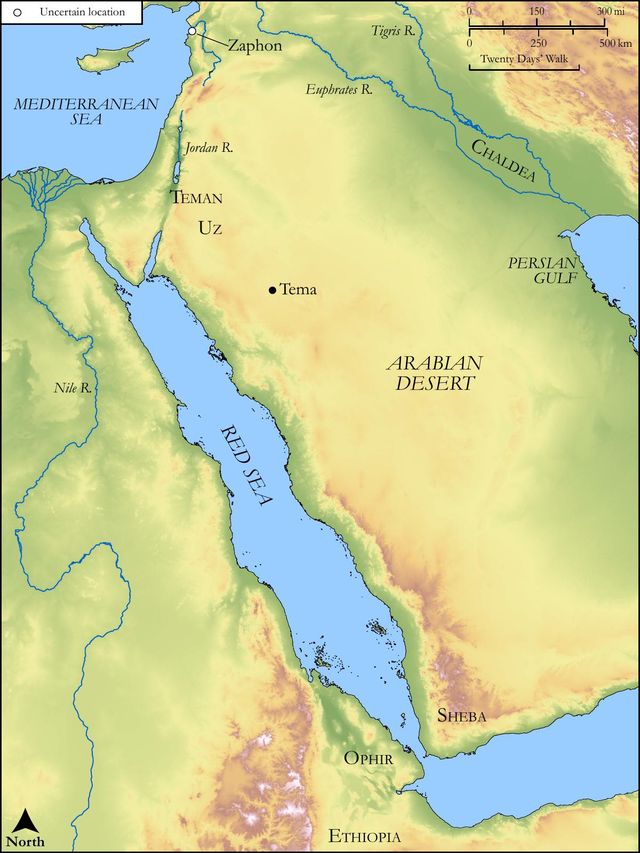
See on the biblical-era map
Study this verse
Public-domain commentary
Matthew Henry
From his Commentary on the Whole Bible. Henry comments on passages, not single verses — this entry covers Job 37:21–24.
Elihu here concludes his discourse with some short but great sayings concerning the glory of God, as that which he was himself impressed, and desired to impress others, with a holy awe of. He speaks concisely, and in haste, because, it should seem, he perceived that God was about to take the work into his own hands. 1. He observes that God who has said that he will dwell in the thick darkness and make that his pavilion (Ch2 6:1, Psa 18:11) is in that awful chariot advancing towards them, as if he were preparing his throne for judgment, surrounded with clouds and darkness, Psa 97:2, Psa 97:9. He saw the cloud, with a whirlwind in the bosom of it, coming out of the south; but now it hung so thick, so black, over their heads, that they could none of them see the bright light which just before was in the clouds. The light of the sun was now eclipsed. This reminded him of the darkness by reason of which he could not speak (Job 37:19), and made him afraid to go on, Job 37:20. Thus the disciples feared when they entered into a cloud, Luk 9:34. Yet he looks to the north, and sees it clear that way, which gives him hope that the clouds are not gathering for a deluge; they are covered, but not surrounded, with them. He expects that the wind will pass (so it may be read) and cleanse them, such a wind as passed over the earth to clear it from the waters of Noah's flood (Gen 8:1), in token of the return of God's favour; and then fair weather will come out of the north (Job 37:22) and all will be well. God will not always frown, nor contend for ever. 2. He hastens to conclude, now that God is about to speak; and therefore delivers much in a few words, as the sum of all that he had been discoursing of, which, if duly considered, would not only clench the nail he had been driving, but make way for what God would say. He observes, (1.) That with God is terrible majesty. He is a God of glory and such transcendent perfection as cannot but strike an awe upon all his attendants and a terror upon all his adversaries. With God is terrible praise (so some), for he is fearful in praises, Ex. 15. 11. (2.) That when we speak touching the Almighty we must own that we cannot find him out; our finite understandings cannot comprehend his infinite perfections, Job 37:23. Can we put the sea into an egg-shell? We cannot trace the steps he takes in his providence. His way is in the sea. (3.) That he is excellent in power. It is the excellency of his power that he can do whatever he pleases in heaven and earth. The universal extent and irresistible force of his power are the excellency of it; no creature has an arm like him, so long, so strong. (4.) That he is not less excellent in wisdom and righteousness, in judgment and plenty of justice, else there would be little excellency in his power. We may be sure that he who can do every thing will do every thing for the best, for he is infinitely wise, and will not in any thing do wrong, for he is infinitely just. When he executes judgment upon sinners, yet there is plenty of justice in the execution, and he inflicts not more than they deserve. (5.) That he will not afflict, that is, that he will not afflict willingly; it is no pleasure to him to grieve the children of men, much less his own children. He never afflicts but when there is cause and when there is need, and he does not overburden us with affliction, but considers our frame. Some read it thus: "The Almighty, whom we cannot find out, is great in power, but he will not afflict in judgment, and with him is plenty of justice, nor is he extreme to mark what we do amiss." (6.) He values not the censures of those who are wise in their own conceit: He respecteth them not, Job 37:24. He will not alter his counsels to oblige them, nor can those that prescribe to him prevail with him to do as they would have him do. He regards the prayer of the humble, but not the policies of the crafty. No, the foolishness of God is wiser than men, Co1 1:15. (7.) From all this it is easy to infer that, since God is great, he is greatly to be feared; nay, because he is gracious and will not afflict, men do therefore fear him, for there is forgiveness with him, that he may be feared, Psa 130:1-8. 4. It is the duty and interest of all men to fear God. Men shall fear him (so some); sooner or later they shall fear him. Those that will not fear the Lord and his goodness shall for ever tremble under the pourings out of the vials of his wrath.
Historical interpretation
Historical reception
2 surviving comments on this verse. Each one is dated, so this reads as a timeline rather than a list.
Select a marker to jump to its quote. Markers stagger vertically where authors wrote within a few decades of each other.
“But now they do not see the light; suddenly the sky is covered with clouds; and the passing wind will drive them away.” With his words he demonstrates how they do not see the light he demonstrates with his words by saying, “Suddenly the sky is covered with clouds”; the splendor of the sun is hidden by thick clouds and a darkened sky, but it is called back for the use of mortals through the repelling of the clouds. “From Aquilon comes gold.” “From Aquilon the golden-colored clouds [come], the great glory and honor of God is in them.” “From Aquilon gold comes.” He said “Aquilon” for the east and “gold” for dawn, which imitates the appearance of the shining metal with its glowing color. “And the timorous praise of God”; certainly the service of praising him is not taken without fear because of the immensity of his fame.
71. What is designated by the ‘north,’ but the Gentile world, fast bound in the cold of sin? Which he held under the yoke of his tyranny, who proudly said, I will sit in the mount of the covenant, in the sides of the north, I will ascend above the height of the clouds, I will be like the Most High. [Is. 14, 13. 14.] And what is expressed by ‘gold,’ but faithful souls? Of which it is said by Jeremiah, How is the gold become dim? the finest colour is changed? [Lam. 4, 1] For he lamented that the gold was dimmed, because he beheld in some persons the brightness of innocence changed into the blackness of sin. Gold, therefore, is said to come from the north; because through the favour of the grace of the Redeemer, the life of the faithful, which is precious before God, is increased within Holy Church, from the Gentile world, which had been long frozen in the torpor of unbelief. For gold comes from the north, when the true faith in God shines forth from the very worshippers of idols. But when the Gentiles were converted to the faith, the Jewish people gainsays them; and scorns to admit to the recompense of eternal rewards, those who had been so long worshippers of idols. Whence it is said to Peter, after the conversion of the Gentiles, Wherefore wentest thou in, to men uncircumcised, and didst eat with them? [Acts 11, 3] In contradiction to which, the Lord rightly says by Isaiah, I will say to the north, Give up, and to the south, Keep not back. [Is. 43, 6] For as the Gentile world is signified by the ‘north,’ so is the Jewish People signified by the ‘south,’ which was warmed, as it were, by the mid-day sun, because when our Redeemer appeared in the flesh, it first received the warmth of faith. Give up, then, is said to the north, when the Gentile world is ordered to offer to God the gifts of its faith. But the south is commanded not to keep back, because the Hebrews who stood firm in the faith were ordered not to condemn and reject the life of the Gentiles. Whence here also, because it was said, Gold cometh from the north; it is fitly subjoined;
And from God fearful praise.
72. For fearful praise is said to come from God, as if it were said to come from those who are on the side of God, that is, the faithful. When gold then comes from the north, fearful praise proceeds from God; because, while the Gentiles offered the brightness of their faith, the multitude of the faithful Hebrews praised with fear the Divine judgments. But how gold comes from the north, and how fearful praise bursts forth from those who are under God, the sacred history itself informs us. For it is written, Cornelius, a centurion of the band, which is called Italian, a religious man, and fearing God with all his house, giving much alms to the people, and praying to God always, saw in a vision manifestly, about the ninth hour of the day, an Angel of God coming in to him, saying unto him, Cornelius. But he looking on him, being seized with fear, said, Who art thou, Lord? But he said unto him, Thy prayers and thine alms have come up as a memorial in the sight of God. [Acts 10, 1-4] Gold therefore came from the north, when prayer with alms went up from the Gentiles in the sight of God. But when Peter had related to the brethren, either how Cornelius had seen an Angel, or he himself had seen a linen cloth let down from heaven to him with beasts, and creeping things and birds, or how the Holy Spirit had bedewed the hearts of the Gentiles, even before Baptism, [Acts 11, 5-17] Who had never come into the minds of the Jews, excepting after the water of Baptism, it is immediately written, When they heard these things they held their peace, and glorified God, saying, God hath therefore granted to the Gentiles also repentance unto life. [ib. 18.] The multitude therefore of the faithful, which, on the salvation of the Gentiles, restrained itself from its murmurs, by admiring the gifts of heavenly grace offered fearful praise to God. Whence Peter himself also wonders, saying, I have found in truth, that God is no acceptor of persons. [Acts 10, 34]
73. But when the Gentiles receive the faith, why is fearful praise said to come from those who are already believers, when it ought to come from them, joyful rather than fearful? But fearful praise came from the Hebrews who already believed, on the conversion of the Gentiles, doubtless, because Judaea was justly rejected, while the Gentiles were called in mercy; and feared the loss of its own rejection, while it beheld the gain of the others’ calling. Whence we also, when we suddenly behold the wicked raised up to an unexpected eminence of life, daily rejoice with fear under the secret judgments of God, lest God should desert by His secret judgments some who are counted worthy, Who calls thereby those to Himself who are considered unworthy.
Continue studying Job 37:22 across the web’s major study libraries — every link below opens this exact verse, chapter, or book on the destination site.
Read & Compare
 BibleGatewayThis verse in more than 200 translations and 70 languages.
 Bible.comThe YouVersion reader — hundreds of translations, reading plans, and highlights.
 ESV.orgCrossway's official English Standard Version reader.
 NET BibleThe NET translation with 60,000+ translators' notes on every rendering decision.
 STEP BibleTyndale House's free study tool — original text, vocabulary, and scholarly resources.
 BibliaLogos Bible Software's free web reader.
 USCCBThe New American Bible (Revised Edition) with the U.S. bishops' study notes.
Commentaries
 BibleHub CommentariesDozens of classic commentaries on this verse, gathered on one page.
 StudyLightMore than 100 commentary sets — the largest collection on the web.
 BibleRefPlain-English commentary on what this verse means, verse by verse.
 Enduring WordDavid Guzik's free commentary on this chapter, widely used by Bible teachers.
 Bible Study ToolsVerse commentary alongside Greek and Hebrew study aids.
Original Language & Research
- BibleHub InterlinearThe verse word by word — original language, transliteration, and English.
- BibleHub LexiconEvery word's original-language definition and Strong's entry.
 Blue Letter BibleDeep-study tools — Strong's numbers, concordance, and word studies.
 SefariaThe Hebrew text with Rashi and centuries of Jewish commentary.
Sermons, Hymns & Audio


TrulyRandomVerse is not affiliated with these sites and doesn’t control their content. They’re linked because they’re genuinely useful.
Summary
Job 37:22 serves as Elihu's culminating declaration, masterfully encapsulating his extended discourse on God's absolute sovereignty and awe-inspiring power, particularly as manifested through the natural world. This verse presents a striking contrast: the familiar, predictable phenomenon of clear weather emerging from the north wind, followed immediately by a profound theological statement affirming the overwhelming, reverential majesty that inherently belongs to God. It functions as a powerful summation, urging Job and his companions—and indeed all humanity—to acknowledge the Creator's incomprehensible grandeur and unchallengeable authority over all things, both seen and unseen.
Context
ShowHideLiterary Context
Job 37:22 stands as the grand finale to Elihu's extensive and passionate speeches, which span from Job 32 through Job 37. Unlike Job's three friends, Elihu does not accuse Job of specific sins but critiques his self-righteousness and his questioning of God's justice and wisdom. Chapters 36 and 37 are particularly dedicated to Elihu's detailed exposition of God's power revealed in creation—from the intricacies of rain and clouds to the terrifying force of lightning and thunder. Elihu's aim is to humble Job, demonstrating that God's ways are inscrutable and His power absolute, far beyond human comprehension or challenge. This verse, therefore, acts as a powerful capstone, transitioning from specific examples of meteorological phenomena to a universal declaration of divine majesty, setting the stage for God's own direct address from the whirlwind in Job 38.
Historical & Cultural Context
Among the nations round about, weather patterns were not merely scientific phenomena but direct manifestations of divine power, often attributed to the actions of various deities. The "north" (צָפוֹן, tsaphon) was commonly associated with the source of clear, cold, and often dry winds that would sweep away storm clouds, bringing clarity and fair weather, a common observation for the inhabitants of the Levant. Elihu leverages this familiar natural occurrence to illustrate a profound theological truth: just as God orchestrates the clearing of the skies, so too does He govern all of creation with an unchallengeable hand. The concept of a deity's "majesty" (הוֹד, hod) was also prevalent, often associated with kingship and divine authority, but Elihu elevates this to an unparalleled degree when describing the God of Israel, whose majesty is not merely grand but "terrible" (נוֹרָא, nora')—awe-inspiring and evoking reverential dread.
Key Themes
ShowHideThis verse powerfully contributes to several overarching themes within the book of Job and the broader biblical narrative. Firstly, it underscores Divine Sovereignty over Nature, highlighting God's meticulous and absolute control over all aspects of creation, from the smallest raindrop to the most fearsome storm, as seen throughout Job 37. Elihu's argument is that if God can orchestrate such complex natural processes, His governance of human affairs is equally perfect, though often beyond human understanding. Secondly, the verse emphasizes God's Awe-Inspiring Majesty. The phrase "terrible majesty" conveys a sense of overwhelming grandeur, power, and holiness that demands profound reverence and awe, rather than mere fear in a negative sense. This majesty is so immense that it transcends human capacity to fully grasp, echoing themes found in Psalms 104. Lastly, the verse reinforces the Incomprehensibility of God. Elihu consistently points to the limits of human understanding when it comes to God's ways, using the unpredictable yet ordered nature of weather as a metaphor for divine wisdom that is both mysterious and perfectly ordered, a concept also explored in Isaiah 55:8-9.
Exposition and Analysis
ShowHideKey Word Analysis
ShowHideFrom an unused root meaning "to shimmer," this word primarily means "gold." Figuratively, it refers to something gold-colored, like a clear sky, hence "fair weather." In this context, it denotes the clear, bright conditions that follow a storm, often brought by the north wind.
From a root meaning "hidden" or "dark," this term refers to the north as a quarter, often associated with gloomy and unknown regions. However, in the context of weather patterns in the Levant, winds from the north were known to bring clear, cool air, sweeping away clouds and storms, thus leading to "fair weather."
A primitive root meaning "to fear" or "to revere," and causatively "to frighten." In this context, it signifies something "awe-inspiring," "dreadful" in a reverential sense, or "magnificent." It speaks to the overwhelming, majestic quality of God that evokes profound reverence, holy fear, and wonder, rather than mere negative dread.
From an unused root, this word signifies "grandeur," "imposing form and appearance," "beauty," "excellency," "glory," or "honor." When coupled with yârêʼ, it describes a glory so immense and powerful that it naturally inspires awe and reverence, highlighting God's supreme authority and magnificent presence.
Verse Breakdown
ShowHide"Fair weather cometh out of the north"
This opening clause grounds the verse in a common meteorological observation familiar to Elihu's audience. The north wind, known for clearing the skies and bringing forth clear, bright weather after storms, serves as a tangible example of natural order. It implies a transition from chaos (storm) to clarity (fair weather), signaling a divine orchestration of creation's elements. This natural phenomenon is not random but part of a divinely established pattern.
"with God [is] terrible majesty"
This second clause abruptly shifts from the observable natural world to a profound theological declaration. The "fair weather" is not merely a natural event but a demonstration of the power and wisdom of the One who brings it forth. The phrase "terrible majesty" (or "awe-inspiring splendor") is the culmination of Elihu's argument. It asserts that God's very being is characterized by an overwhelming, magnificent glory that compels profound reverence and holy fear. This majesty is not something God acquires but is inherent to His nature, transcending all created things and human comprehension, demanding a posture of humility and worship.
Literary Devices
ShowHideElihu's statement in Job 37:22 employs several potent literary devices to convey its profound theological truth. The most prominent is Juxtaposition, where the familiar, observable natural phenomenon of "fair weather coming out of the north" is immediately followed by the profound, transcendent declaration of God's "terrible majesty." This stark contrast highlights the divine hand behind the natural order and elevates the discussion from the physical to the spiritual, demonstrating that the mundane is infused with the divine. The phrase "fair weather cometh out of the north" also functions as a Metaphor for divine control and the restoration of order, implying that just as God brings clarity to the skies, He also brings clarity and resolution (or at least, His sovereign will) to complex situations like Job's suffering. The term "terrible majesty" itself can be seen as a form of Hyperbole in its original Hebrew sense, emphasizing the extreme, overwhelming nature of God's splendor beyond ordinary human experience or description. Finally, the verse is deeply Didactic, serving as a concluding teaching point in Elihu's discourse, designed to instruct Job and the reader about the proper posture of humility and awe before an incomprehensibly powerful God.
Theological and Thematic Connections
ShowHideJob 37:22 stands as a powerful testament to the biblical understanding of God's transcendence and immanence, particularly His sovereign control over creation and His inherent, awe-inspiring nature. It echoes the consistent biblical theme that the natural world serves as a profound witness to the Creator's power, wisdom, and glory, inviting humanity to a posture of worship and humility. This verse challenges any anthropocentric view that places human understanding or experience at the center, instead directing all focus to the unchallengeable and majestic God who orchestrates both the grand events of the heavens and the subtle shifts in weather patterns. It reminds us that true wisdom begins with acknowledging God's unapproachable light and His overwhelming presence, which is both glorious and terrifying in its holiness, demanding our reverent awe.
Reflection and Application
ShowHideJob 37:22 calls us to a profound posture of humility, reverence, and worship before God. In an age often characterized by scientific reductionism and human self-sufficiency, this verse serves as a vital reminder that there is a transcendent Power at work, whose majesty is not only beyond our full grasp but also inherently awe-inspiring. It encourages us to look beyond the immediate and the observable, to perceive the divine hand behind all phenomena, from the clearing of a stormy sky to the intricate workings of the universe. This perspective cultivates a deep sense of wonder and prompts us to acknowledge our finite nature in the face of infinite glory. It invites us to trust in the sovereign God who governs all things, finding comfort and peace in His perfect control, even when His ways seem mysterious or His providence brings hardship. Ultimately, it fosters a worshipful heart that delights in the incomprehensible greatness of our Creator, recognizing that His power is always intertwined with His perfect wisdom and justice.
Questions for Reflection
ShowHideFAQ
ShowHideWhat does "terrible majesty" mean in Job 37:22?
ShowHideThe King James Version's translation "terrible majesty" can be misleading to modern readers, as "terrible" today often implies something bad or dreadful. However, in its original context, and reflecting the Hebrew word נוֹרָא (nora'), it signifies something "awe-inspiring," "fear-inducing" in a reverential sense, or "magnificent." It describes a majesty so overwhelming and grand that it naturally evokes profound reverence, holy fear, and wonder. It's the kind of awe that makes one fall on their face, not out of terror of harm, but out of recognition of supreme, unapproachable glory and power. This concept is similar to how God's presence is described as "awesome" in other biblical passages, such as Psalms 68:35 and Nahum 1:3-6.
Why does Elihu focus so much on nature in his arguments to Job?
ShowHideElihu's extensive focus on nature, particularly in Job 36 and Job 37, serves several key purposes in his discourse. Firstly, it's a common and accessible way to demonstrate God's power and sovereignty. Everyone experiences weather, and its unpredictable yet ordered nature provides clear evidence of a divine orchestrator. Secondly, Elihu uses nature to highlight God's wisdom and justice, arguing that if God perfectly controls the complex systems of the natural world, He certainly governs human affairs with perfect wisdom, even if humans cannot discern it. Thirdly, by emphasizing the overwhelming power of natural phenomena (storms, lightning, clouds), Elihu aims to humble Job and his friends, showing them that humanity is insignificant compared to the Creator. This prepares them for God's own direct address from the whirlwind in Job 38, where God also extensively uses creation to challenge Job's limited understanding and invite him to a posture of trust.
Christ-Centered Fulfillment
ShowHideWhile Job 37:22 speaks of God's "terrible majesty" revealed in creation, its ultimate fulfillment and most profound expression are found in Jesus Christ. The God whose power orchestrates the north wind and clears the skies is the same God who, in the person of Jesus, entered His own creation. The awe-inspiring majesty that Elihu proclaims is not merely a distant, unapproachable power, but one that became intimately accessible in the Incarnation. Jesus, the Word made flesh, demonstrates this divine majesty not only through His miraculous power, such as calming a storm with a word or walking on water, but supremely through His humble obedience and sacrificial love. The "terrible majesty" of God, which demands reverence and holy fear, is fully displayed and perfectly reconciled with divine love at the cross, where the Lamb of God takes away the sin of the world. Through Christ, we are invited not just to stand in awe of a distant Creator, but to enter into a relationship with Him, experiencing His majesty as both glorious and gracious. The One who will one day return with power and great glory is the same One who first came in humility, making the unapproachable God approachable, and revealing the full spectrum of His awe-inspiring, yet loving, majesty.