


Ezekiel 1:27
Bible text: King James Version (1769 Blayney text) · Public domain
Bible text: King James Version with Strong's numbers · Public domain
Bible text: Berean Standard Bible · Public domain
Bible text: American Standard Version (1901) · Public domain
Bible text: World English Bible, Messianic edition · Public domain
Bible text: Geneva Bible (1599) · Public domain
Bible text: Young's Literal Translation · Public domain
- וָאֵרֶאva·'E·re'and I sawH7200Conj-w ¦ V-Qal-ConsecImperf-1csVerb Qal Consecutive Imperfect 1st Singular common genderוָandאֵרֶאI saw
- כְּעֵיןke·'Einlike [the] appearance ofH5869Prep-k ¦ N-fscNoun Singular Feminine Constructכְּlikeעֵין[the] appearance of
- חַשְׁמַלchash·Mala shining substanceH2830N-msNoun Singular Masculine Absolute
- כְּמַרְאֵהke·mar·'ehlike [the] appearance ofH4758Prep-k ¦ N-mscNoun Singular Masculine Constructכְּlikeמַרְאֵה[the] appearance of
- אֵשׁ'eshfireH784N-csNoun Singular common gender Absolute
- בֵּיתbeitwithinH1004N-mscNoun Singular Masculine Construct
- לָהּlahto itPrep-l ¦ 3fsSuffix Personal 3rd Singular Feminineלָtoהּit
- סָבִיבsa·Viv[was] all aroundH5439N-csNoun Singular common gender Absolute
- מִמַּרְאֵהmi·mar·'Ehfrom [the] appearance ofH4758Prep-m ¦ N-mscNoun Singular Masculine Constructמִfromמַּרְאֵה[the] appearance of
- מָתְנָיוma·te·Navhis hipsH4975N-mdc ¦ 3msNoun Dual Masculine Constructמָתְנָיhipsוhis
- וּלְמָעְלָהu·le·Ma·'e·lahand <to> upwards <towards>H4605Conj-w ¦ Prep-l ¦ Adj-cs ¦ SfxAdjective Numerical Singular common gender Absoluteוּandלְ<to>מָעְלָupwardsה<towards>
- וּמִמַּרְאֵהu·mi·mar·'Ehand from [the] appearance ofH4758Conj-w ¦ Prep-m ¦ N-mscNoun Singular Masculine Constructוּandמִfromמַּרְאֵה[the] appearance of
- מָתְנָיוma·te·Navhis hipsH4975N-mdc ¦ 3msNoun Dual Masculine Constructמָתְנָיhipsוhis
- וּלְמַטָּהu·le·Ma·tahand <to> downwardsH4295Conj-w ¦ Prep-l ¦ Adj-msAdjective Numerical Singular Masculine Absoluteוּandלְ<to>מַטָּהdownwards
- רָאִיתִיra·'I·tiI sawH7200V-Qal-Perf-1csVerb Qal Perfect 1st Singular common gender
- כְּמַרְאֵהke·mar·'ehlike [the] appearance ofH4758Prep-k ¦ N-mscNoun Singular Masculine Constructכְּlikeמַרְאֵה[the] appearance of
- אֵשׁ'EshfireH784N-csNoun Singular common gender Absolute
- וְנֹגַהּve·No·gahand brightnessH5051Conj-w ¦ N-fsNoun Singular Feminine Absoluteוְandנֹגַהּbrightness
- לוֹloof himPrep-l ¦ 3msSuffix Personal 3rd Singular Masculineלofוֹhim
- סָבִיבsa·Viv[was] all aroundH5439N-csNoun Singular common gender Absolute
English is a literal word-by-word gloss of the Hebrew, not the KJV's wording. Why?
This is the original text the KJV's translators worked from — each Hebrew word with its own literal English meaning in this verse, prepared by scholars at Tyndale House, Cambridge. The KJV translates whole sentences, not word by word, so its wording differs: one Hebrew word can become several English words, and the KJV may choose “the LORD” where the gloss reads “Yahweh”. Both are faithful — they answer different questions. For the KJV's own rendering, switch to the KJV text.
Details
See on the biblical-era map
Study this verse
Public-domain commentary
Matthew Henry
From his Commentary on the Whole Bible. Henry comments on passages, not single verses — this entry covers Ezekiel 1:26–28.
All the other parts of this vision were but a preface and introduction to this. God in them had made himself known as Lord of angels and supreme director of all the affairs of this lower world, whence it is easy to infer that whatever God by his prophets either promises or threatens to do he is able to effect it. Angels are his servants; men are his tools. But now that a divine revelation is to be given to a prophet, and by him to the church, we must look higher than the living creatures or the wheels, and must expect that from the eternal Word, of whom we have an account in these verses. Ezekiel, hearing a voice from the firmament, looked up, as John did, to see the voice that spoke with him, and he saw one like unto the Son of man, Rev 1:12, Rev 1:13. The second person sometimes tried the fashion of a man occasionally before he clothed himself with it for good and all; and the Spirit of prophecy is called the Spirit of Christ (Pe1 1:11) and the testimony of Jesus, Rev 19:10. 1. This glory of Christ that the prophet saw was above the firmament that was over the heads of the living creatures, Eze 1:26. Note, The heads of angels themselves are under the feet of the Lord Jesus; for the firmament that is over their heads is under his feet. Angels, principalities, and powers are made subject to him, Pe1 3:22. This dignity and dominion of the Redeemer before his incarnation magnify his condescension in his incarnation, when he was made a little lower than the angels, Heb 2:9. 2. The first thing he observed was a throne; for divine revelation comes backed and supported with a royal authority. We must have an eye of faith to God and Christ as upon a throne. The first thing that John discovered in his visions was a throne set in heaven (Rev 4:2), which commands reverence and subjection. It is a throne of glory, a throne of grace, a throne of triumph, a throne of government, a throne of judgment. The Lord has prepared his throne in the heavens, has prepared it for his Son, whom he has set King on his holy hill of Zion. 3. On the throne he saw the appearance of a man. This is good new to the children of men, that the throne above the firmament is filled with one that is not ashamed to appear, even there, in the likeness of man. Daniel, in vision, saw the kingdom and dominion given to one like the Son of man, who therefore has authority given him to execute judgment because he is the Son of man (Joh 5:27), so appearing in these visions. 4. He saw him as a prince and judge upon this throne. Though he appeared in fashion as a man, yet he appeared in more than human glory, Eze 1:27. (1.) Is God a shining light? So is he: when the prophet saw him he saw as the colour of amber, that is, a brightness round about; for God dwells in light, and covers himself with light as with a garment. How low did the Redeemer stoop for us when, to bring about our salvation, he suffered his glory to be eclipsed by the veil of his humanity! (2.) Is God a consuming fire? So is he: from his loins, both upward and downward, there was the appearance of fire. The fire above the loins was round about within the amber; it was inward and involved. That below the loins was more outward and open, and yet that also had brightness round about. Some make the former to signify Christ's divine nature, the glory and virtue of which are hidden within the colour of amber; it is what no man has seen nor can see. The latter they suppose to be his human nature, the glory of which there were those who saw; the glory as of the only begotten of the Father, full of grace and truth, Joh 1:14. He had rays coming out of his hand, and yet there was the hiding of his power, Hab 3:4. The fire in which the Son of man appeared here might be intended to signify the judgments that were ready to be executed upon Judah and Jerusalem, coming form that fiery indignation of the Almighty which devours the adversaries. Nothing is more dreadful to the most daring sinners than the wrath of him that sits upon the throne, and of the Lamb, Rev 6:16. The day is coming when the Lord Jesus shall be revealed in flaming fire, Th2 1:7, Th2 1:8. It concerns us therefore to kiss the Son lest he be angry. 5. The throne is surrounded with a rainbow, Eze 1:28. It is so in St. John's vision, Rev 4:3. The brightness about it was of divers colours, as the bow that is in the cloud in the day of rain, which, as it is a display of majesty, and looks very great, so it is a pledge of mercy, and looks very kind; for it is a confirmation of that gracious promise God has made that he will not drown the world again, and he has said, I will look upon the bow and remember the covenant, Gen 9:16. This intimates that he who sits upon the throne is the Mediator of the covenant, that his dominion is for our protection, not our destruction, that he interposes between us and the judgments our sins have deserved, and that all the promises of God are in him yea and amen. Now that the fire of God's wrath was breaking out against Jerusalem bounds should be set to it, and he would not make an utter destruction of it, for he would look upon the bow and remember the covenant, as he promised in such a case, Lev 26:42.
Lastly, We have the conclusion of this vision. Observe, 1. What notion the prophet himself had of it: This was the appearance of the likeness of the glory of the Lord. Here, as all along, he is careful to guard against all gross corporeal thoughts of God, which might derogate from the transcendent purity of his nature. he does not say, This was the Lord (for he is invisible), but, This was the glory of the Lord, in which he was pleased to manifest himself a glorious being; yet it is not the glory of the Lord, but the likeness of that glory, some faint resemblance of it; nor is it any adequate likeness of that glory, but only the appearance of that likeness, a shadow of it, and not the very image of the thing, Heb 10:1. 2. What impressions it made upon him: When I saw it, I fell upon my face. (1.) He was overpowered by it; the dazzling lustre of it conquered him and threw him upon his face; for who is able to stand before this holy Lord God? Or, rather, (2.) He prostrated himself in a humble sense of his own unworthiness of the honour now done him, and of the infinite distance which he now, more than ever, perceived to be between him and God; he fell upon his face in token of that holy awe and reverence of God with which his mind was possessed and filled. Note, The more God is pleased to make known of himself to us the more low we should be before him. He fell upon his face to adore the majesty of God, to implore his mercy and to deprecate the wrath he saw ready to break out against the children of his people. 3. What instructions he had from it. All he saw was only to prepare him for that which he was to hear; for faith comes by hearing. He therefore heard a voice of one that spoke; for we are taught by words, not merely by hieroglyphics. When he fell on his face, ready to received the word, then he heard the voice of one that spoke; for God delights to teach the humble.
Historical interpretation
Two Centuries of Reception
5 surviving comments on this verse. Each one is dated, so this reads as a timeline rather than a list.
Select a marker to jump to its quote. Markers stagger vertically where authors wrote within a few decades of each other.
In fact, even in Ezekiel, from what looked like from his waist upward God resembled amber, but from his waist downward he resembled fire. Whatever is above is gold, and whatever is below is ready for purgation in Gehenna.
(Verse 27, 28.) And I saw something like the appearance of electrum, like the appearance of fire within it all around. From the appearance of his loins and upward, I saw something like the appearance of glowing fire all around, like the appearance of a rainbow in the clouds on a rainy day. This was the appearance of the splendor of the Lord's glory. When I saw it, I fell facedown and heard a voice speaking. The electrum had the appearance of fire both inside and outside. But from the loins downwards, there was a shining fire all around, to show that those things which are above the loins, where the senses and reason reside, do not need fire or flames, but rather the most precious and pure metal. However, those things that are below the loins, where sexual intercourse, procreation, and the incitement of vices take place, need the purifying flames, so that when they have been purified, they may have a resemblance to a rainbow, which is commonly called Iris, when it appears in a cloud on a rainy day. For indeed the rainbow, which is called Iris in the Holy Scriptures, and in the Apocalypse of John is also called Iris (Apoc. IV), can only appear in rain and a watery cloud, of diverse and most beautiful colors, gradually transitioning into others. Hence the poet (Virgil, Aeneid IV).
Adversity brings a thousand different colors. But the same poet also follows the custom of the common people when he says: 'When he drinks, the rainbow.' From this he signifies that the rainbow never appears unless in the cloud and in the waters. This rainbow is a sign of God's mercy and covenant that he made with humans: that when it appears in the cloud, we, according to the example of antiquity, may know that we will never be destroyed by a flood (Genesis 9). From this it is shown that after punishment and punishment, and the purification of sins, there will be future mercy, only for those who deserve to see God reigning. Where it is said: Here was the appearance of splendor in a circle. In a circle of God, or of thrones, or of all things that are seen. And this is the vision of the glory of the likeness of God: not that he saw the glory of the Lord, but the likeness of his glory. And this whole vision is: a Spirit lifting up, and a great cloud, and four living creatures, and wheels following the same creatures, and the spirit, which deserve to be under the firmament of God. And after they were lifted up, and heard a voice like many waters, and like the sublime word of God, and the voice of camps and armies, they let down their wings, and showed astonishment in silence: and there appeared one sitting upon the likeness of a sapphire stone, as it were the likeness of a man that was from his loins upward, and the likeness of fire from his loins downward, and from his loins upward, as the appearance of amber. Afterwards, a sign of mercy is given to counteract this fear; just as the appearance of a rainbow when it is in the cloud on a rainy day. We have spoken at length about this vision because it is both obscure and interpreted in various ways by many. In the remaining parts, as much as possible without harming the senses, we will strive for brevity due to the large volume of the work.
[Daniel 7:9] "I beheld until thrones were set up, and the Ancient of days took His seat. His garment was as white as snow, and the hair of His head was like pure wool. His throne was composed of fiery flames and its wheels were set on fire. From before His presence there issued forth a rushing, fiery stream." We read something similar in John's Apocalypse: "After these things I was immediately in the Spirit, and lo, a throne was set up in heaven, and one was seated upon the throne; and He who sat upon it had the likeness of jasper and sardine stone, and there was a rainbow round about the throne like the appearance of emerald. Around the throne there were twenty-four other thrones, and upon the twenty-four thrones there sat twenty-four elders, clothed in shining garments; upon their heads was a golden crown, and lightning flashes issued from the throne, and voices and thunder. And in front of the throne there were seven torches of burning fire, which were the seven spirits of God. And in front of the throne lay a glassy sea like unto crystal." (Revelation 4:2-6) And so the many thrones which Daniel saw seem to me to be what John called the twenty-four thrones. And the Ancient of days is the One who, according to John sits alone upon His throne. Likewise the Son of man, who came unto the Ancient of days, is the same as He who, according to John, is called the Lion of the tribe of Judah, the Root of David, and the titles of that sort (Revelation 5:5). I imagine that these thrones are the ones of which the Apostle Paul says, "Whether thrones or dominions..." (Colossians 1:16). And in the Gospel we read, "Ye yourselves shall sit upon twelve thrones, judging the twelve tribes of Israel" (Matthew 19:28). And God is called the One who sits and who is the Ancient of days, in order that His character as eternal Judge might be indicated. His garment is shining white like the snow, and the hair of His head is like pure wool. The Savior also, when He was transfigured on the mount and assumed the glory of His divine majesty, appeared in shining white garments (Matthew 17:2). And as for the fact that His hair is compared to perfectly pure wool, the even-handedness and uprightness of His judgment is shown forth, a judgment which shows no partiality in its exercise. Moreover He is described as an elderly man, in order that the ripeness of His judgment may be established. His throne consists of fiery flames, in order that sinners may tremble before the severity of the torments, and also that the just may be saved, but so as by fire. The wheels of the throne are set aflame, or else it is the wheels of His chariot which are aflame. In Ezekiel also God is ushered on the scene seated in a four-horse chariot (Ezekiel 1:4-28), and everything pertaining to God is of a fiery consistency. In another place also a statement is made on this subject: "God is a consuming fire" (Deuteronomy 4:24), that we might know that wood, hay and stubble are going to burn up in the day of judgment. And in the Psalms we read: "Fire goeth before Him, and He shall set aflame all His enemies round about Him" (Psalm 97:3). A rushing, fiery stream proceeded from before Him in order that it might carry sinners to hell (Gehenna).
"As the appearance of fire within all around, from his loins and upward; and from his loins downward I saw as it were the appearance of shining fire round about."
What is it that the Mediator of God and men, the man Christ Jesus, is described as having the appearance of fire inwardly round about from the loins and upward, and from the loins and downward the appearance of shining fire round about? For we must investigate why from the loins and upward He is said to have fire inwardly, yet not shining fire; but from the loins and downward He is said to have the appearance of fire, yet it is not mentioned that He has it inwardly, because He is described as having it both shining and round about. For what is expressed by the name of loins, if not the propagation of mortality? On account of which it is also said of Levi that he was still in the loins of his father when Melchizedek met Abraham. From the loins of Abraham indeed the Virgin Mary came forth, in whose womb the Only-begotten of the Father deigned to become incarnate through the Holy Spirit. From which incarnation God became known to the whole world, as it is said through the Psalmist: Gird your sword upon your thigh, O most mighty one. For the Most Mighty took His sword upon His thigh, because the word of His preaching gained strength from His incarnation. But what does this fire signify, if not the ardor of the Holy Spirit, who sets ablaze the hearts that He has filled? Of which the Truth Himself says: I came to cast fire upon the earth. What is it therefore that in this appearance of the man who appeared to the prophet, the fire burns inwardly round about from the loins upward, but from the loins downward it shines not inwardly but round about, unless that before the incarnation of our only-begotten Redeemer, Judea alone had within herself the ardor of His love; but after His incarnation the fire shone round about Him, because He poured out the brightness of the Holy Spirit upon the nations throughout the whole world? First therefore the fire was inward, but was not shining, because the Holy Spirit indeed filled Judea in many fathers, but His light had not yet shone forth to the knowledge of the nations. But from His loins and downward the fire shines round about, because after He took flesh from the Virgin, He spread abroad the gifts of the Holy Spirit far and wide in the human race. And it should be noted that this fire from the loins upward is described as being round about, not outwardly but inwardly, because the flame of love, as has been said, filled Judea everywhere within its borders in the elect and spiritual men. Yet it did not go forth outwardly, because it was not spreading itself to the multitude of nations. Which flame of ardor was seen afterward to shine round about, because through the corners of the world the love of almighty God began to increase in all nations.
Therefore the fire was previously inward, when Jacob said: "I will wait for your salvation, O Lord." For what we call "salvation" in Latin is called "Jesus" in the Hebrew word. In which word the mind of blessed Jacob is shown how it burned with desire for Jesus, whom he declared he was awaiting as he died. The fire burned when Moses said: "If I have found grace in your sight, show me yourself, that I may see you." The fire burned in his mind when David said: "My soul has thirsted for the living God; when shall I come and appear before the face of my God?" Who, desiring the incarnation of the Word, said: "Show us, O Lord, your mercy, and give us your salvation." The fire burned when Simeon, desiring to depart from the corruption of this present life, heard that he would not see death before he saw the Christ of the Lord. But behold, now this fire shines outwardly as if from beneath the loins, because all the Gentile world is kindled with love of God incarnate.
Yet this can also be understood in another way, because our Redeemer, God the Lord Jesus Christ, became known to human beings through His humanity, He who through His divinity was known to the angels even before His incarnation. Therefore, to us He shines round about from the loins downward, whose fire burns inwardly in heaven from the loins upward, because those heavenly spirits behold Him in His divinity and are set ablaze by the fires of His love. But we, who love Him through His assumed humanity, still placed in this corruptible life, have the splendor of that fire outwardly. Therefore One is upon the throne, who both has fire inwardly above the loins in the angels, and has fire round about below the loins in human beings, because in all that is loved by angels, through all that is desired by human beings, there is One who burns in the hearts of those who love. For hence it is that those great angelic powers are called Seraphim, that is, burning. Hence concerning the Creator of all things it is written: "Our God is a consuming fire." For God is called fire because He sets ablaze with the flames of His love the minds which He fills. And therefore the Seraphim are called burning, because those powers nearest to Him in heaven are kindled with the inestimable fire of His love. Kindled by this fire, the hearts of the righteous burn on earth. Warmed by this fire, the hearts of sinners return to repentance, which, having been greatly inflamed, turn fear into love. For those which had first begun to waste away with dread, afterward blaze with the fire of love. And because the elect angels in heaven are His members, converted human beings on earth are His members; there is one man who both burns inwardly above the loins and sends forth the splendor of His fire round about below the loins, because He both held the angels to His love through His divinity and recalled human beings to the desire of His holy ardor through His humanity.
"And I saw something like the appearance of amber."
And so that the holy prophet might show that he had seen the union of both natures in His person, he immediately added: "And I saw something like the appearance of amber." What is it that the appearance of a man is seen upon the throne as the likeness of amber, except that in amber, as we said far above, gold and silver are mixed, so that one thing is made from two metals? In which both the brightness of the gold is tempered through the silver, and through the brightness of the gold the appearance of the silver is made bright. But in our Redeemer both natures, that is of divinity and humanity, are united and joined to each other without confusion and inseparably, so that through his humanity the brightness of his divinity could be tempered to our eyes, and through his divinity the human nature in him would be made bright, and being exalted would have splendor beyond what it had been created with.
Continue studying Ezekiel 1:27 across the web’s major study libraries — every link below opens this exact verse, chapter, or book on the destination site.
Read & Compare
 BibleGatewayThis verse in more than 200 translations and 70 languages.
 Bible.comThe YouVersion reader — hundreds of translations, reading plans, and highlights.
 ESV.orgCrossway's official English Standard Version reader.
 NET BibleThe NET translation with 60,000+ translators' notes on every rendering decision.
 STEP BibleTyndale House's free study tool — original text, vocabulary, and scholarly resources.
 BibliaLogos Bible Software's free web reader.
 USCCBThe New American Bible (Revised Edition) with the U.S. bishops' study notes.
Commentaries
 BibleHub CommentariesDozens of classic commentaries on this verse, gathered on one page.
 StudyLightMore than 100 commentary sets — the largest collection on the web.
 BibleRefPlain-English commentary on what this verse means, verse by verse.
 Enduring WordDavid Guzik's free commentary on this chapter, widely used by Bible teachers.
 Bible Study ToolsVerse commentary alongside Greek and Hebrew study aids.
Original Language & Research
- BibleHub InterlinearThe verse word by word — original language, transliteration, and English.
- BibleHub LexiconEvery word's original-language definition and Strong's entry.
 Blue Letter BibleDeep-study tools — Strong's numbers, concordance, and word studies.
 SefariaThe Hebrew text with Rashi and centuries of Jewish commentary.
Sermons, Hymns & Audio


TrulyRandomVerse is not affiliated with these sites and doesn’t control their content. They’re linked because they’re genuinely useful.
Summary
Ezekiel 1:27 presents a breathtaking portrayal of the divine presence, depicting the figure seated upon the throne in Ezekiel's inaugural vision. This verse, rich in vivid sensory imagery, describes an indescribable being enveloped in a radiant, fiery brilliance that emanates symmetrically from the waist both upward and downward. It powerfully conveys the overwhelming holiness, transcendent power, and unapproachable glory of God, revealed to the prophet amidst profound national despair, thereby assuring the exiled Israelites of God's unconfined presence and sovereign control even in their Babylonian captivity.
Context
ShowHideLiterary Context
Ezekiel 1:27 serves as the climactic description of the divine figure in Ezekiel's foundational vision, which begins with a dramatic storm from the north (Ezekiel 1:4). The vision unfolds systematically, first introducing four living creatures, each with four faces and four wings, moving with incredible speed and purpose (Ezekiel 1:5-14). These creatures are intimately connected to four astonishing "wheels within wheels" (Ezekiel 1:15-21), which move in perfect harmony, guided by the Spirit. Above this intricate chariot-throne structure, Ezekiel perceives a firmament, "as the colour of the terrible crystal" (Ezekiel 1:22-25), upon which rests a throne of sapphire (Ezekiel 1:26a). It is upon this glorious throne that a figure "as the appearance of a man" is seen (Ezekiel 1:26b), and Ezekiel 1:27 then elaborates on the resplendent, fiery nature of this divine occupant, leading directly to the prophet's prostration in awe and reverence (Ezekiel 1:28). This meticulous progression builds the reader's sense of wonder, moving from the initial chaos of the storm to the highly ordered, yet utterly transcendent, manifestation of God's presence.
Historical & Cultural Context
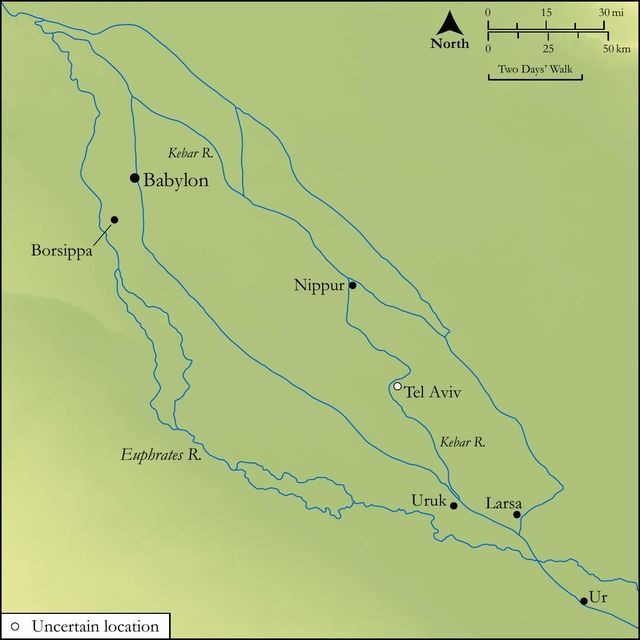
Ezekiel received this profound vision in the fifth year of King Jehoiachin's exile, approximately 593 BC, by the Chebar River in Babylon (Ezekiel 1:1-3). This period was one of deep national crisis for the Judeans. Jerusalem had been conquered, the Temple was still standing but would soon be destroyed, and a significant portion of the population, including Ezekiel himself, had been forcibly deported. Far from their homeland, their religious center, and their Davidic king, the exiles grappled with profound questions about God's presence, power, and faithfulness. In this disorienting context, Ezekiel's vision functioned as a powerful theological affirmation: God's glory was not confined to the Temple in Jerusalem; He remained sovereign and present even in Babylon, demonstrating His transcendent power and immanent concern to a bewildered people. The imagery employed, while drawing on ancient Near Eastern iconography of divine thrones and chariots, transforms these familiar motifs to emphasize YHWH's unique, incomparable majesty and His absolute freedom from geographical or political limitations.
Key Themes
ShowHideThe overarching theme of Ezekiel's prophecy, powerfully introduced and underscored in this inaugural vision, is the Glory of God (Hebrew: kavod). The intense visual descriptions in Ezekiel 1 emphasize God's overwhelming majesty, His transcendent power, and His unapproachable holiness. The pervasive imagery of "fire" and "brightness" consistently points to God's Purity and Holiness, signifying His unblemished character and His consuming judgment against sin, a concept echoed in passages such as Hebrews 12:29. Furthermore, the vision's occurrence in Babylon powerfully asserts God's Sovereignty and Omnipresence, demonstrating that His presence and authority are not limited by geographical location or human circumstances, a vital message of hope and reassurance for the exiled community who felt abandoned. This foundational vision also serves to establish Ezekiel's prophetic authority, as he is commissioned by this glorious God to speak to a rebellious house, as detailed in Ezekiel 2:3-5.
Exposition and Analysis
ShowHideKey Word Analysis
ShowHideOf uncertain derivation (H2830), this unique term, found only in Ezekiel (Ezekiel 1:4, 1:27, 8:2), is translated as "amber" in the KJV. The Ground Truth Strong's data suggests "probably bronze or polished spectrum metal," indicating a material that is both precious and intensely radiant, perhaps an alloy like electrum. In the context of divine appearance, chashmal conveys a sense of brilliant, fiery luster, a shimmering, almost electric quality that is both awe-inspiring and difficult to define, emphasizing the ineffable nature of God's glory. It is not merely a color but a glowing, living substance that pulsates with divine energy.
Derived from the root raʼah (H7200, "to see"), marʼeh (H4758) denotes "a view (the act of seeing); also an appearance (the thing seen), whether (real) a shape... or (mental) a vision." The repeated use of "appearance" in Ezekiel 1:27 ("as the appearance of fire," "from the appearance of his loins") underscores that Ezekiel is not seeing God directly in His essence or full being, but rather a manifestation, a visible form, or a semblance of His glory. This term highlights the revelatory yet veiled nature of the divine encounter, emphasizing that human perception can only grasp a partial, mediated glimpse of God's true, transcendent being.
From the root nâgah (H5051), meaning "to shine," nôgahh signifies "brilliancy (literally or figuratively); bright(-ness), light, (clear) shining." This word captures the intense luminosity and radiant splendor that surrounds the divine figure. It is not merely light but a powerful, active effulgence that emanates from God, contributing to the overwhelming and unapproachable nature of His presence. This brightness is an inherent quality of the divine being, symbolizing His glory, purity, and illuminating power, filling the surrounding space with His effulgence.
Verse Breakdown
ShowHide"And I saw as the colour of amber"
Ezekiel initiates his description by likening a general, shimmering quality of the divine figure to chashmal, or "amber." This sets the stage for the revelation of the divine, indicating an extraordinary, luminous, and perhaps metallic-like brilliance that transcends ordinary light or fire, hinting at a unique and precious radiance.
"as the appearance of fire round about within it"
This clause immediately clarifies that the "amber" quality is not static but dynamic, characterized by an internal, pervasive fiery appearance. The phrase "within it" suggests that the fire is not merely an external aura but an intrinsic, consuming part of the divine manifestation, burning intensely from its very core.
"from the appearance of his loins even upward"
The description then becomes more specific, localizing the origin point of this fiery appearance to the "loins" (waist) of the figure. The fire is depicted as extending upwards from this central point, enveloping the entire upper half of the divine form in its radiant glow.
"and from the appearance of his loins even downward"
Symmetrically, the fiery appearance also extends downwards from the loins, enveloping the lower half of the figure. This creates a powerful image of a being entirely consumed and defined by this radiant, internal fire, radiating intensely from head to foot, signifying complete and pervasive glory.
"I saw as it were the appearance of fire"
This phrase serves as a powerful reiteration and summary, emphasizing that the dominant visual impression was one of pure, intense fire. The repetition reinforces the overwhelming nature of this phenomenon and highlights fire as the primary, all-encompassing element of the divine manifestation, deeply impressing the prophet.
"and it had brightness round about"
Finally, the verse concludes by noting the surrounding effulgence. This "brightness" (nôgahh) indicates a radiant halo or an aura of intense light that emanated from the fiery figure, further contributing to its majestic, unapproachable splendor. It suggests an outward emanation of the internal fire, filling the entire space around the divine presence with its glory.
Literary Devices
ShowHideEzekiel 1:27 is profoundly rich in Symbolism, where "fire," "amber," and "brightness" are not literal descriptions but potent representations of the ineffable qualities of God: His absolute holiness, His purifying presence, His consuming glory, and His unapproachable power. The deliberate Repetition of phrases like "appearance of fire" and "from the appearance of his loins" serves to emphasize the central visual element of fire and highlight the symmetrical, all-encompassing nature of the divine manifestation, reinforcing the prophet's awe and the indescribable nature of what he witnessed. The pervasive use of "as" or "as it were" (Hebrew: ke) throughout the vision, including prominently in this verse, is a form of Simile or Analogy. This linguistic humility indicates that human language and earthly comparisons are inherently inadequate to fully capture the divine reality, underscoring the profound Transcendence of God. It acknowledges that His true form is beyond full human comprehension, yet He graciously chooses to reveal a glimpse of His glory in terms that humans can partially grasp.
Theological and Thematic Connections
ShowHideEzekiel 1:27 powerfully asserts the absolute sovereignty and unparalleled glory of God, even in the midst of Israel's exile and profound despair. The fiery, radiant appearance of the divine figure speaks to God's inherent holiness, His unchangeable nature, and His purifying presence, assuring the exiles that His character and power remain undiminished, regardless of their circumstances or the destruction of the Temple. This vision establishes that God's presence is not confined to a physical structure but is transcendent and omnipresent, capable of manifesting His glory anywhere. It also foreshadows the ultimate revelation of God's glory, which will not be contained within a temple made with human hands, but will be fully revealed in the person of Christ and ultimately in the New Creation.
Reflection and Application
ShowHideEzekiel 1:27 calls us to a profound and reverent sense of awe for the God who reveals Himself in such overwhelming glory. In a world often characterized by chaos, uncertainty, and suffering, this vision serves as a powerful reminder that God remains firmly on His throne, majestic and sovereign, untouched by human limitations or earthly turmoil. Just as Ezekiel's vision brought hope and assurance to a people in exile, so too can it profoundly comfort and orient us in our own seasons of difficulty, reminding us that God is actively present, powerfully at work, and eternally glorious, even when His ways are mysterious or our circumstances seem bleak. This passage challenges us to move beyond a casual or domesticated understanding of God, prompting us to worship Him with the deep reverence and holy fear His infinite splendor demands, recognizing that the One who is "as the appearance of fire" is also the One who graciously draws near to His people. This vision encourages us to earnestly seek His presence, knowing that even a glimpse of His unapproachable glory can radically transform our perspective, renew our hope, and ignite our worship.
Questions for Reflection
ShowHideFAQ
ShowHideWhat is "amber" (chashmal) in Ezekiel's vision?
ShowHideThe Hebrew word chashmal (H2830), translated as "amber" in the KJV, is a unique and somewhat enigmatic term found only in Ezekiel's visions (Ezekiel 1:4, 1:27, 8:2). While "amber" in English refers to fossilized tree resin, most biblical scholars and ancient Near Eastern experts believe chashmal more accurately refers to "electrum," a naturally occurring alloy of gold and silver. This metal was highly valued in the ancient world for its brilliant, fiery luster, especially when polished. Therefore, the "color of amber" or "appearance of electrum" suggests a dazzling, shimmering, and intensely radiant quality, perfectly suited to describe the overwhelming and ineffable glory of God. It conveys a sense of preciousness combined with an almost electric, living brilliance, indicating a divine manifestation that is both glorious and awe-inspiring.
Why is God described with such intense and fiery imagery in Ezekiel 1:27?
ShowHideThe pervasive use of "fire" and "brightness" to describe God's appearance in Ezekiel 1:27 is highly symbolic and deeply consistent with biblical descriptions of divine presence throughout Scripture. Fire in the Bible often represents God's holiness and purity, signifying His unapproachable nature and His consuming judgment against sin, as vividly stated in Deuteronomy 4:24. It also powerfully conveys His glory and majesty, indicating His supreme power, transcendent splendor, and active presence, seen in the burning bush that Moses encountered (Exodus 3:2) or the glory that settled on Mount Sinai (Exodus 24:17). For the exiled Israelites, this imagery would have been both terrifying and profoundly comforting: terrifying because of God's unapproachable holiness and power over judgment, but comforting because it affirmed that their God was still powerfully present, active, and sovereign, even far from the Temple in Jerusalem, demonstrating His undiminished authority over all creation and circumstances.
Christ-Centered Fulfillment
ShowHideEzekiel's vision of God's fiery glory, culminating in the description of the figure on the throne in Ezekiel 1:27, finds its ultimate and most accessible fulfillment in the person of Jesus Christ. While Ezekiel saw a veiled "appearance" of God's glory, a manifestation that required human comparisons, the New Testament unequivocally declares that Jesus is "the radiance of God's glory and the exact representation of his being" (Hebrews 1:3). In Christ, the unapproachable fire of God's holiness and majesty became incarnate, tabernacling among humanity so that we could "behold his glory, glory as of the only Son from the Father, full of grace and truth" (John 1:14). The "brightness round about" seen by Ezekiel is fully embodied in Jesus, who is the "light of the world" (John 8:12), illuminating the darkness of sin and revealing the Father's true character. Furthermore, the fiery judgment and purification symbolized by the "appearance of fire" are fulfilled in Christ's redemptive work on the cross, where He bore the consuming fire of God's wrath against sin, and in His future return, when He will come in "flaming fire" to bring both judgment upon the disobedient and salvation to those who know God (2 Thessalonians 1:7-8). Thus, the terrifying yet glorious vision of Ezekiel points forward to the Lamb of God, who is both the consuming fire of divine holiness and the illuminating light of divine grace, making God's glory approachable and redemptive.