


Ezekiel 1:9
Bible text: King James Version (1769 Blayney text) · Public domain
Bible text: Berean Standard Bible · Public domain
Bible text: American Standard Version (1901) · Public domain
Bible text: World English Bible, Messianic edition · Public domain
Bible text: Geneva Bible (1599) · Public domain
Bible text: Young's Literal Translation · Public domain
- חֹבְרֹתchoe·Rot[were] touchingH2266V-Qal-Prtcpl-fpVerb Qal Participle Plural Feminine Absolute
- אִשָּׁה'i·ShaheachH802N-fsNoun Singular Feminine Absolute
- אֶל'el<to>H413PrepPreposition
- אֲחוֹתָהּ'a·cho·Tahits sisterH269N-fsc ¦ 3fsNoun Singular Feminine Constructאֲחוֹתָsisterהּits
- כַּנְפֵיהֶםkan·fei·Hemtheir wingsH3671N-fdc ¦ 3mpNoun Dual Feminine Constructכַּנְפֵיwingsהֶםtheir
- לֹאlo'notH3808NegParticle Negative
- יִסַּבּוּyi·Sa·buthey turnedH5437V-Niphal-Imperf-3mpVerb Niphal Imperfect 3rd Plural Masculine
- בְלֶכְתָּןve·lekh·Tanwhen they movedH1980Prep-b ¦ V-Qal-Inf ¦ 3fpVerb Qal Infinitive Constructבְwhenלֶכְתָּmovedןthey
- אִישׁ'isheachH376N-msNoun Singular Masculine Absolute
- אֶל'eltoH413PrepPreposition
- עֵבֶר'E·ver[the] side ofH5676N-mscNoun Singular Masculine Construct
- פָּנָיוpa·Navits faceH6440N-mpc ¦ 3msNoun Plural Masculine Constructפָּנָיfaceוits
- יֵלֵכוּye·Le·khuthey movedH1980V-Qal-Imperf-3mpVerb Qal Imperfect 3rd Plural Masculine
English is a literal word-by-word gloss of the Hebrew, not the KJV's wording. Why?
This is the original text the KJV's translators worked from — each Hebrew word with its own literal English meaning in this verse, prepared by scholars at Tyndale House, Cambridge. The KJV translates whole sentences, not word by word, so its wording differs: one Hebrew word can become several English words, and the KJV may choose “the LORD” where the gloss reads “Yahweh”. Both are faithful — they answer different questions. For the KJV's own rendering, switch to the KJV text.
Details
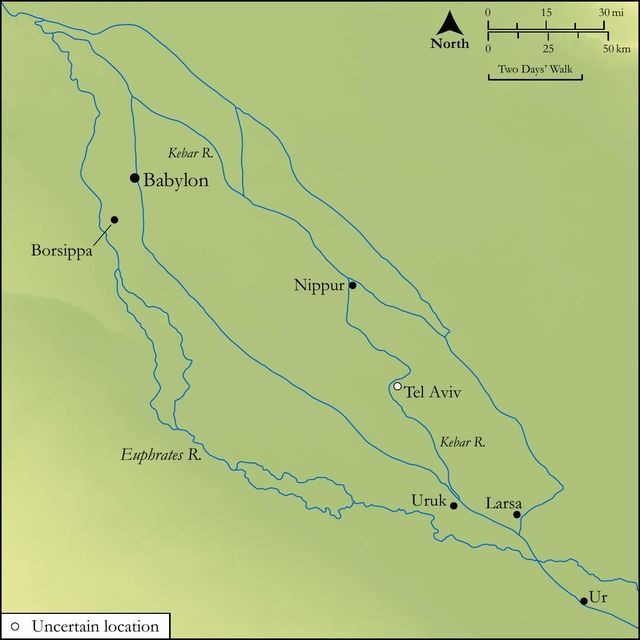
See on the biblical-era map
Study this verse
Public-domain commentary
Matthew Henry
From his Commentary on the Whole Bible. Henry comments on passages, not single verses — this entry covers Ezekiel 1:4–14. His four-level outline is real structure in the source text, so it is rendered as structure.
The visions of God which Ezekiel here saw were very glorious, and had more particulars than those which other prophets saw. It is the scope and intention of these vision, 1. To possess the prophet's mind with very great, and high, and honourable thoughts of that God by whom he was commissioned and for whom he was employed. It is the likeness of the glory of the Lord that he sees (Eze 1:28), and hence he may infer that it is his honour to serve him, for he is one whom angels serve. He may serve him with safety, for he has power sufficient to bear him out in his work. It is at his peril to draw back from his service, for he has power to pursue him, as he did Jonah. So great a God as this must be served with reverence and godly fear; and with assurance may Ezekiel foretel what this God will do, for he is able to make his words good. 2. To strike a terror upon the sinners who remained in Zion, and those who had already come to Babylon, who were secure, and bade defiance to the threatenings of Jerusalem's ruin, as we have found in Jeremiah's prophecy, and shall find in this, many did. "Let those who said, We shall have peace though we go on, know that our God is a consuming fire, whom they cannot stand before." That this vision had a reference to the destruction of Jerusalem seems plain from Jer 43:3, where he says that it was the vision which he saw when he came to destroy the city, that is, to prophesy the destruction of it. 3. To speak comfort to those that feared God, and trembled at his word, and humbled themselves under his mighty hand. "Let them know that, though they are captives in Babylon, yet they have God nigh unto them; though they have not the place of the sanctuary to be their glorious high throne, they have the God of the sanctuary." Dr. Lightfoot observes, "Now that the church is to be planted for a long time in another country, the Lord shows a glory in the midst of them, as he had done at their first constituting into a church in the wilderness; and out of a cloud and fire, as he had done there, he showed himself; and from between living creatures, as from between the cherubim, he gives his oracles." This put an honour upon them, by which they might value themselves when the Chaldeans insulted over them, and this might encourage their hopes of deliverance in due time.
Now, to answer these ends, we have in these verses the first part of the vision, which represents God as attended and served by an innumerable company of angels, who are all his messengers, his ministers, doing his commandments and hearkening to the voice of his word. This denotes his grandeur, as it magnifies an earthly prince to have a splendid retinue and numerous armies at his command, which engages his allies to trust him and his enemies to fear him.
I.The introduction to this vision of the angels is very magnificent and awakening, Eze 1:4.
The prophet, observing the heavens to open, looked, looked up (as it was time), to see what discoveries God would make to him. Note, When the heavens are opened it concerns us to have our eyes open. To clear the way, behold, a whirlwind came out of the north, which would drive away the interposing mists of this lower region. Fair weather comes out of the north, and thence the wind comes that drives away rain. God can by a whirlwind clear the sky and air, and produce that serenity of mind which is necessary to our communion with Heaven. Yet this whirlwind was attended with a great cloud. When we think that the clouds which arise from this earth are dispelled and we can see beyond them, yet still there is a cloud which heavenly things are wrapped in, a cloud from above, so that we cannot order our speech concerning them by reason of darkness. Christ here descended, as he ascended, in a cloud. Some by this whirlwind and cloud understand the Chaldean army coming out of the north against the land of Judah, bearing down all before them as a tempest; and so it agrees with that which was signified by one of the first of Jeremiah's visions (Jer 1:14, Out of the north an evil shall break forth); but I take it here as an introduction rather to the vision than to the sermons. This whirlwind came to Ezekiel (as that to Elijah, Kg1 19:11), to prepare the way of the Lord, and to demand attention. He that has eyes, that has ears, let him see, let him hear.
II.The vision itself.
A great cloud was the vehicle of this vision, in which it was conveyed to the prophet; for God's pavilion in which he rests, his chariot in which he rides, is darkness and thick clouds, Psa 18:11; Psa 104:3. Thus he holds back the face of his throne, lest its dazzling light and lustre should overpower us, by spreading a cloud upon it. Now,
1.The cloud is accompanied with a fire, as upon Mount Sinai, where God resided in a thick cloud; but the sight of his glory was like a devouring fire (Exo 24:16, Exo 24:17), and his first appearance to Moses was in a flame of fire in the bush; for our God is a consuming fire. This was a fire enfolding itself, a globe, or orb, or wheel of fire. God being his own cause, his own rule, and his own end, if he be as a fire, he is as a fire enfolding itself, or (as some read it) kindled by itself. The fire of God's glory shines forth, but it quickly enfolds itself; for he lets us know but part of his ways; the fire of God's wrath breaks forth, but it also quickly enfolds itself, for the divine patience suffers not all his wrath to be stirred up. If it were not a fire thus enfolding itself, O Lord! who shall stand?
2.The fire is surrounded with a glory: A brightness was about it, in which it enfolded itself, yet it made some discovery of itself. Though we cannot see into the fire, cannot by searching find out God to perfection, yet we see the brightness that is round about it, the reflection of this fire from the thick cloud. Moses might see God's back parts, but not his face. We have some light concerning the nature of God, from the brightness which encompasses it, though we have not an insight into it, by reason of the cloud spread upon it. Nothing is more easy than to determine that God is, nothing more difficult than to describe what he is. When God displays his wrath as fire, yet there is a brightness about it; for his holiness and justice appear very illustrious in the punishment of sin and sinners: even about the devouring fire there is a brightness, which glorified saints will for ever admire.
3.Out of this fire there shines the colour of amber. We are not told who or what it was that had this colour of amber, and therefore I take it to be the whole frame of the following vision, which came into Ezekiel's view out of the midst of the fire and brightness; and the first thing he took notice of before he viewed the particulars was that it was of the colour of amber, or the eye of amber; that is, it looked as amber does to the eye, of a bright flaming fiery colour, the colour of a burning coal; so some think it should be read. The living creatures which he saw coming out of the midst of the fire were seraphim - burners; for he maketh his angels spirits, his ministers a flaming fire.
4.That which comes out of the fire, of a fiery amber colour, when it comes to be distinctly viewed, is the likeness of four living creatures; not the living creatures themselves (angels are spirits, and cannot be seen), but the likeness of them, such a hieroglyphic, or representation, as God saw fit to make use of for the leading of the prophet, and us with him, into some acquaintance with the world of angels (a matter purely of divine revelation), so far as is requisite to possess us with an awful sense of the greatness of that God who has angels for his attendants, and the goodness of that God who has appointed them to be attendants on his people. The likeness of these living creatures came out of the midst of the fire; for angels derive their being and power from God; they are in themselves, and to us, what he is pleased to make them; their glory is a ray of his. The prophet himself explains this vision (Eze 10:20): I knew that the living creatures were the cherubim, which is one of the names by which the angels are known in scripture. To Daniel was made known their number, ten thousand times ten thousand, Dan 7:10. But, though they are many, yet they are one, and that is made known to Ezekiel here; they are one in nature and operation, as an army, consisting of thousands, is yet called a body of men. We have here an account of,
(1.)Their nature. They are living creatures; they are the creatures of God, the work of his hands; their being is derived; they have not life in and of themselves, but receive it from him who is the fountain of life. As much as the living creatures of this lower world excel the vegetables that are the ornaments of earth, so much do the angels, the living creatures of the upper world, excel the sun, moon, and stars, the ornaments of the heavens. The sun (say some) is a flame of fire enfolding itself, but it is not a living creature, as angels, those flames of fire, are. Angels are living creatures, living beings, emphatically so. Men on earth are dying creatures, dying daily (in the midst of life we are in death), but angels in heaven are living creatures; they live indeed, live to good purpose; and, when saints come to be equal unto the angels, they shall not die any more, Luk 20:36.
(2.)Their number. They are four; so they appear here, though they are innumerable; not as if these were four particular angels set up above the rest, as some have fondly imagined, Michael and Gabriel, Raphael and Uriel, but for the sake of the four faces they put on, and to intimate their being sent forth towards the four winds of heaven, Mat 24:31. Zechariah saw them as four chariots going forth east, west, north, and south, Zac 6:1. God has messengers to send every way; for his kingdom is universal, and reaches to all parts of the world.
(3.)Their qualifications, by which they are fitted for the service of their Maker and Master. These are set forth figuratively and by similitude, as is proper in visions, which are parables to the eye. Their description here is such, and so expressed, that I think it is not possible by it to form an exact idea of them in our fancies, or with the pencil, for that would be a temptation to worship them; but the several instances of their fitness for the work they are employed in are intended in the several parts of this description. Note, It is the greatest honour of God's creatures to be in a capacity of answering the end of their creation; and the more ready we are to every good work the nearer we approach to the dignity of angels. These living creatures are described here,
[1.]By their general appearance: They had the likeness of a man; they appeared, for the main, in a human shape, First, To signify that these living creatures are reasonable creatures, intelligent beings, who have the spirit of a man which is the candle of the Lord. Secondly, To put an honour upon the nature of man, who is made lower, yet but a little lower, than the angels, in the very next rank of beings below them. When the invisible intelligences of the upper world would make themselves visible, it is in the likeness of man. Thirdly, To intimate that their delights are with the sons of men, as their Master's are (Pro 8:31), that they do service to men, and men may have spiritual communion with them by faith, hope, and holy love. Fourthly, The angels of God appear in the likeness of man because in the fulness of time the Son of God was not only to appear in that likeness, but to assume that nature; they therefore show this love to it.
[2.]By their faces: Every one had four faces, looking four several ways. In St. John's vision, which has a near affinity with this, each of the four living creatures has one of these faces here mentioned (Rev 4:7); here each of them has all four, to intimate that they have all the same qualifications for service; though, perhaps, among the angels of heaven, as among the angels of the churches, some excel in one gift and others in another, but all for the common service. Let us contemplate their faces till we be in some measure changed into the same image, that we may do the will of God as the angels do it in heaven. They all four had the face of a man (for in that likeness they appeared, Eze 1:5), but, besides that, they had the face of a lion, an ox, and an eagle, each masterly in its kind, the lion among wild beasts, the ox among tame ones, and the eagle among fowls, Eze 1:10. Does God make use of them for the executing of judgments upon his enemies? They are fierce and strong as the lion and the eagle in tearing their prey. Does he make use of them for the good of his people? They are as oxen strong for labour and inclined to serve. And in both they have the understanding of a man. The scattered perfections of the living creatures on earth meet in the angels of heaven. They have the likeness of man; but, because there are some things in which man is excelled even by the inferior creatures, they are therefore compared to some of them. They have the understanding of a man, and such as far exceeds it; they also resemble man in tenderness and humanity. But, First, A lion excels man in strength and boldness, and is much more formidable; therefore the angels, who in this resemble them, put on the face of a lion. Secondly, An ox excels man in diligence, and patience, and painstaking, and an unwearied discharge of the work he has to do; therefore the angels, who are constantly employed in the service of God and the church, put on the face of an ox. Thirdly, An eagle excels man in quickness and piercingness of sight, and in soaring high; and therefore the angels, who seek things above, and see far into divine mysteries, put on the face of a flying eagle.
[3.]By their wings: Every one had four wings, Eze 1:6. In the vision Isaiah had of them they appeared with six, now with four; for they appeared above the throne, and had occasion for two to cover their faces with. The angels are fitted with wings to fly swiftly on God's errands; whatever business God sends them upon they lose no time. Faith and hope are the soul's wings, upon which it soars upward; pious and devout affections are its wings on which it is carried forward with vigour and alacrity. The prophet observes here, concerning their wings, First, That they were joined one to another, Eze 1:9 and again Eze 1:11. They did not make use of their wings for fighting, as some birds do; there is no contest among the angels. God makes peace, perfect peace, in his high places. But their wings were joined, in token of their perfect unity and unanimity and the universal agreement there is among them. Secondly, That they were stretched upward, extended, and ready for use, not folded up, or flagging. Let an angel receive the least intimation of the divine will, and he has nothing to seek, but is upon the wings immediately; while our poor dull souls are like the ostrich, that with much difficulty lifts up herself on high. Thirdly, That two of their wings were made use of in covering their bodies, the spiritual bodies they assumed. The clothes that cover us are our hindrance in work; angels need no other covering than their own wings, which are their furtherance. They cover their bodies from us, so forbidding us needless enquiries concerning them. Ask not after them, for they are wonderful, Jdg 13:18. They cover them before God, so directing us, when we approach to God, to see to it that we be so clothed with Christ's righteousness that the shame of our nakedness may not appear.
[4.]By their feet, including their legs and thighs: They were straight feet (Eze 1:7); they stood straight, and firm, and steady; no burden of service could make their legs to bend under them. The spouse makes this part of the description of her beloved, that his legs were as pillars of marble set upon sockets of fine gold (Sol 5:15); such are the angels' legs. The sole of their feet was like that of a calf's foot, which divides the hoof and is therefore clean: as it were the sole of a round foot (as the Chaldee words it); they were ready for motion any way. Their feet were winged (so the Septuagint); they went so swiftly that it was as if they flew. And their very feet sparkled like the colour of burnished brass; not only the faces, but the very feet, of those are beautiful whom God sends on his errands (Isa 52:7); every step the angels take is glorious. In the vision John had of Christ it is said, His feet were like unto fine brass, as if they burned in a furnace, Rev 1:15.
[5.]By their hands (Eze 1:8): They had the hands of a man under their wings on their four sides, an arm and a hand under every wing. They had not only wings for motion, but hands for action. Many are quick who are not active; they hurry about a great deal, but do nothing to purpose, bring nothing to pass; they have wings, but no hands: whereas God's servants, the angels, not only go when he sends them and come when he calls them, but do what he bids them. They are the hands of a man, which are wonderfully made and fitted for service, which are guided by reason and understanding; for what angles do they do intelligently and with judgment. They have calves' feet; this denotes the swiftness of their motion (the cedars of Lebanon are said to skip like a calf, Psa 29:6); but they have a man's hand, which denotes the niceness and exactness of their performances, as the heavens are said to be the work of God's fingers. Their hands were under their wings, which concealed them, as they did the rest of their bodies. Note, The agency of angels is a secret thing and their work is carried on in an invisible way. In working for God, though we must not, with the sluggard, hide our hand in our bosom, yet we must, with the humble, not let our left hand know what our right hand doeth. We may observe that where these wings were their hands were under their wings; wherever their wings carried them they carried hands along with them, to be still doing something suitable something that the duty of the place requires.
(4.)Their motions. The living creatures are moving. Angels are active beings; it is not their happiness to sit still and do nothing, but to be always well employed; and we must reckon ourselves then best when we are doing good, doing it as the angels do it, or whom it is here observed,
[1.]That whatever service they went about they went every one straight forward (Eze 1:9, Eze 1:12), which intimates, First, That they sincerely aimed at the glory of God, and had a single eye to that, in all they did. Their going straight forward supposes that they looked straight forward, and never had any sinister intentions in what they did. And, if thus our eye be single, our whole body will be full of light. The singleness of the eye is the sincerity of the heart. Secondly, That they were intent upon the service they were employed in, and did it with a close application of mind. They went forward with their work; for what their hand found to do they did with all their might and did not loiter in it. Thirdly, That they were unanimous in it: They went straight forward, every one about his own work; they did not thwart or jostle one another, did not stand in one another's light, in one another's way. Fourthly, That they perfectly understood their business, and were thoroughly apprised of it, so that they needed not to stand still, to pause of hesitate, but pursue their work with readiness, as those that knew what they had to do and how to do it. Fifthly, They were steady and constant in their work. They did not fluctuate, did not tire, did not vary, but were of a piece with themselves. They moved in a direct line, and so went the nearest way to work in all they did and lost no time. When we go straight we go forward; when we serve God with one heart we rid ground, we rid work.
[2.]They turned not when they went, Eze 1:9, Eze 1:12. First, They made no blunders or mistakes, which would give them occasion to turn back to rectify them; their work needed no correction, and therefore needed not to be gone over again. Secondly, They minded no diversions; as they turned not back, so they turned not aside, to trifle with any thing that was foreign to their business.
[3.]They went whither the Spirit was to go (Eze 1:12), either, First, Whither their own spirit was disposed to go; thither they went, having no bodies, as we have, to clog or hinder them. It is our infelicity and daily burden that, when the spirit if willing, yet the flesh is weak and cannot keep pace with it, so that the good which we would do we do it not; but angels and glorified saints labour under no such impotency; whatever they incline or intend to do they do it, and never come short of it. Or, rather, Secondly, Whithersoever the Spirit of God would have them go, thither they went. Though they had so much wisdom of their own, yet in all their motions and actions they subjected themselves to the guidance and government of the divine will. Whithersoever the divine Providence was to go they went, to serve its purposes and to execute its orders. The Spirit of God (says Mr. Greenhill) is the great agent that sets angels to work, and it is their honour that they are led, they are easily led, by the Spirit. See how tractable and obsequious these noble creatures are. Whithersoever the Spirit is to go they go immediately, with all possible alacrity. Note, Those that walk after the Spirit do the will of God as the angels do it.
[4.]They ran and returned like a flash of lightning, Eze 1:14. This intimates, First, That they made haste; they were quick in their motions, as quick as lightning. Whatever business they went about they despatched it immediately, in a moment, in the twinkling of an eye. Happy they that have no bodies to retard their motion in holy exercises. And happy shall we be when we come to have spiritual bodies for spiritual work. Satan falls like lightning into his own ruin, Luk 10:18. Angels fly like lightning in their Master's work. The angel Gabriel flew swiftly. Secondly, That they made haste back: They ran and returned; ran to do their work and execute their orders, and then returned to give an account of what they had done and receive new instructions, that they might be always doing. They ran into the lower world, to do what was to be done there; but, when they had done it, they returned like flash of lightning to the upper world again, to the beatific vision of their God, which they could not with any patience be longer from than their service did require. Thus we should be in the affairs of this world as out of our element. Though we run into them, we must not repose in them, but our souls must quickly return like lightning to God their rest and centre.
5.We have an account of the light by which the prophet saw these living creatures, or the looking-glass in which he saw them, Eze 1:13.
(1.)He saw them by their own light, for their appearance was like burning coals of fire; they are seraphim-burners, denoting the ardour of their love to God, their fervent zeal in his service, their splendour and brightness, and their terror against God's enemies. When God employs them to fight his battles they are as coals of fire (Psa 18:12) to devour the adversaries, as lightnings shot out to discomfit them.
(2.)He saw them by the light of some lamps, which went up and down among them, the shining whereof was very bright. Satan's works are works of darkness; he is the ruler of the darkness of this world. But the angels of light are in the light, and, though they conceal their working, they show their work, for it will bear the light. But we see them and their works only by candle-light, but the dim light of lamps that go up and down among them; when the day breaks, and the shadows flee away, we shall see them clearly. Some make the appearance of these burning coals, and of the lightning that issues out of the fire, to signify the wrath of God, and his judgments, that were now to be executed upon Judah and Jerusalem for their sins, in which angels were to be employed; and accordingly we find afterwards coals of fire scattered upon the city to consume it, which were fetched from between the cherubim, Eze 10:2. But by the appearance of the lamps then we may understand the light of comfort which shone forth to the people of God in the darkness of this present trouble. If the ministry of the angels is as a consuming fire to God's enemies, it is as a rejoicing light to his own children. To the one this fire is bright, it is very reviving and refreshing; to the other, out of the fire comes fresh lightning to destroy them. Note, Good angels are our friends, or enemies, according as God is.
Historical interpretation
Five Centuries of Reception
16 surviving comments on this verse. Each one is dated, so this reads as a timeline rather than a list.
Select a marker to jump to its quote. Markers stagger vertically where authors wrote within a few decades of each other.
The cherubim have four faces, and their faces are images of the activity of the Son of God. For the first living creature, it says, was like a lion, signifying his active and princely and royal character; the second was like an ox, showing his sacrificial and priestly order; the third had the face of a man, indicating very clearly his coming in human guise; and the fourth was like a flying eagle, making plain the giving of the Spirit who broods over the church. Now the Gospels, in which Christ is enthroned, are like these. John expounds his princely and mighty and glorious birth from the Father, saying, “In the beginning was the Word, and the Word was with God, and the Word was God,” and “All things were made by him, and without him was nothing made.” Therefore this Gospel is deserving of all confidence, for such indeed is his person. That according to Luke has a priestly character, and it began with the priest Zechariah offering incense to God. For the fatted calf was already being prepared that was to be sacrificed for the finding of the younger son. Matthew proclaims his human birth, saying, “The book of the generation of Jesus Christ, son of David, son of Abraham,” and “The birth of Jesus Christ was in this manner.” This Gospel is manlike, and so through the whole Gospel Christ appears as a man of humble mind and gentle. But Mark takes his beginning from the prophetic Spirit who comes on people from on high, saying, “The beginning of the gospel of Jesus Christ, as it is written in Isaiah the prophet,” showing a winged image of the Gospel. Therefore he made his message concise and immediate, for such is the prophetic character.
This is also how Ezekiel depicts those animals that praise God. In the four figures of the four Evangelists he demonstrates the glory of the Father and draws attention to his workings, in whom all four points of the compass are fulfilled. “The one animal,” he says, “had four figures”; because each figure is a Gospel, it appears in a fourfold fashion. The first figure, he says, which was like an ox, indicates the priestly glory of Jesus, which Luke depicts. The second, which was like a lion, indicates the leadership and regal nature of the lion “of the tribe of Judah”; this is what Matthew depicts. The third was like a human being and shows the Son’s capacity for suffering and the lowly nature of humanity; this is what Mark shows. However, the fourth, the eagle, teaches the spiritual secret of his power and might who flies up to the Father’s heaven; this is John’s message.
After this description of the prophet, we still cannot comprehend as we read. But if we cannot comprehend the throne that he has described, how will we be able to comprehend him who sits on it, the invisible and ineffable God? It is impossible to examine closely the nature of God, but for his works, which we see, we can offer him praise and glory.
After I wrote the letter, I remembered what is written in Ezekiel, which he showed as an example of perfection. He saw an animal above the river Chebar that had four faces and four feet and four wings. The face of the cherub is when the Spirit of God rests in the soul and ensures that it gives praise with a pleasant and beautiful voice. When he wants to rise and enquire of a person, he takes on himself the face of the man. But what is the ox? That is surely when the faithful soul is involved in struggle; the Spirit assists in the form of an ox, which is a strong animal, able to confound Satan. And what of the eagle? The eagle flies to the heights, higher than all the birds that fly. When the soul ascends to the heights, the Spirit comes and acts in the form of an eagle, so that it can remain on high and be near to God.
Now, in every sort of person, the astute Greeks have said, are to be found logisticon, thymeticon, epithymeticon, dioraticon; in Latin these are prudence, fortitude, temperance and justice. Prudence concerns the human reason. Fortitude bestows a certain power of fierce strength and contempt for death. Temperance, when it contemplates the heavenly mysteries and is retrained by consecrated chastity, cares nothing for bodily pleasures. And justice, from a certain high position of revelation, sees and searches out anything produced for others rather than itself; justice does not examine its own conveniences as much as what benefits society. It is appropriate that the soul that has acted with justice is symbolized by an eagle. It should fly away from earthly things and be totally intent on the divine mystery of the sublime resurrection. It struggles for and attains glory insofar as it is impartial.
Four living creatures with four forms stand announcing the coming of Christ: the form of the man for one of them, because Jesus Christ was born at Bethlehem, as the Evangelist Matthew tells us; the form of the lion for another, as Mark proclaims him as having come from the Jordan, like the royal lion, as it is written, “Behold, like a lion coming up from the jungle of the Jordan”; the form of the bull for another, because Luke proclaims—and not only him, but all the Evangelists also—that at the appointed time, until the ninth hour, he was sacrificed on the cross as the ox for the world; the form of the eagle for the last, because John proclaims the Word that has come down from heaven and became flesh and has gone to heaven like an eagle, for a complete resurrection, full of the divine nature.
The Gospels are joined to each other. They stick together, and they run hither and thither in different ways in the whole circle of their flight. And they do not have an end to their flight, nor do they ever rise above and fall down, but they always move to higher places.
(Vers. 8, 9.) And they had four wings, and their wings were joined one to another. They did not turn back when they walked, but each one moved forward before its face. The Gospels are joined to each other and cling together, and they fly to and fro throughout the whole world, running here and there, without end to their flight, never surpassing or receding, but always proceeding to further things. And both Paul and Virgil say: Forgetting the things that are past, and reaching forth towards those things that are still to come. We can say the same about the virtues of the soul, about the passage of time, and about the mingling of the elements, that, leaving behind the past, they always hurry back to the former things. And the fact that times slip away and flee is demonstrated in a short verse.
But meanwhile it flees, time flees irreparably. And in a lyric poem (Horace, Odes, 14).
Alas, alas, fleeting years slip away, Posthumus, Posthumus!
Most people interpret the man, the lion and the ox as the rational, emotional and appetitive parts of the soul.… And they come with a fourth part that is above and beyond these three and that the Greeks call συνειδησιν: that spark of conscience that was not even extinguished in the breast of Cain after he was turned out of paradise and by which we discern that we sin, when we are overcome by pleasures or frenzy and meanwhile are misled by an imitation of reason. They reckon that this is strictly speaking, the eagle, which is not mixed up with the other three but corrects them when they go wrong.
The four-faced creature that we met in the Apocalypse of John and in the beginning of Ezekiel’s prophecy that had the face of a man, the face of a calf, the face of a lion, the face of an eagle, has also special significance for the text we are considering. In Matthew, this human being has the face of a man; in Luke, an ox; in John, an eagle; in Mark, the lion crying in the desert.
The face means the beginning of the Gospels, from which the man and the lion, that is, the nativity of Christ and the voice of prophecy crying in the wilderness, are on the right-hand side; but the ox, that is, about the victims and the sacrifice of the Jews, is on the left, is abolished and is transformed into a spiritual priesthood … just so that all things may hold fast to him and be thought of as in one body; and the eagle, which is over the nativity and is over the prophecy that is fulfilled in the coming of Christ and over the priesthood that it surpasses, and is beyond all these things, refers to the spiritual nativity, how the Father is the Son and the Son is the Father.
[Daniel 7:9] "I beheld until thrones were set up, and the Ancient of days took His seat. His garment was as white as snow, and the hair of His head was like pure wool. His throne was composed of fiery flames and its wheels were set on fire. From before His presence there issued forth a rushing, fiery stream." We read something similar in John's Apocalypse: "After these things I was immediately in the Spirit, and lo, a throne was set up in heaven, and one was seated upon the throne; and He who sat upon it had the likeness of jasper and sardine stone, and there was a rainbow round about the throne like the appearance of emerald. Around the throne there were twenty-four other thrones, and upon the twenty-four thrones there sat twenty-four elders, clothed in shining garments; upon their heads was a golden crown, and lightning flashes issued from the throne, and voices and thunder. And in front of the throne there were seven torches of burning fire, which were the seven spirits of God. And in front of the throne lay a glassy sea like unto crystal." (Revelation 4:2-6) And so the many thrones which Daniel saw seem to me to be what John called the twenty-four thrones. And the Ancient of days is the One who, according to John sits alone upon His throne. Likewise the Son of man, who came unto the Ancient of days, is the same as He who, according to John, is called the Lion of the tribe of Judah, the Root of David, and the titles of that sort (Revelation 5:5). I imagine that these thrones are the ones of which the Apostle Paul says, "Whether thrones or dominions..." (Colossians 1:16). And in the Gospel we read, "Ye yourselves shall sit upon twelve thrones, judging the twelve tribes of Israel" (Matthew 19:28). And God is called the One who sits and who is the Ancient of days, in order that His character as eternal Judge might be indicated. His garment is shining white like the snow, and the hair of His head is like pure wool. The Savior also, when He was transfigured on the mount and assumed the glory of His divine majesty, appeared in shining white garments (Matthew 17:2). And as for the fact that His hair is compared to perfectly pure wool, the even-handedness and uprightness of His judgment is shown forth, a judgment which shows no partiality in its exercise. Moreover He is described as an elderly man, in order that the ripeness of His judgment may be established. His throne consists of fiery flames, in order that sinners may tremble before the severity of the torments, and also that the just may be saved, but so as by fire. The wheels of the throne are set aflame, or else it is the wheels of His chariot which are aflame. In Ezekiel also God is ushered on the scene seated in a four-horse chariot (Ezekiel 1:4-28), and everything pertaining to God is of a fiery consistency. In another place also a statement is made on this subject: "God is a consuming fire" (Deuteronomy 4:24), that we might know that wood, hay and stubble are going to burn up in the day of judgment. And in the Psalms we read: "Fire goeth before Him, and He shall set aflame all His enemies round about Him" (Psalm 97:3). A rushing, fiery stream proceeded from before Him in order that it might carry sinners to hell (Gehenna).
The lion represents kingship (for it is the royal animal); the ox priesthood, for an ox was offered for the chief of the priests; prophecy is shown through the eagle, for it is the creature that flies high and has very sharp sight. The prophecy is of this kind: it contemplates the heights and looks very far into the future. It therefore teaches through what has been spoken, that the whole of human nature, together with its own leaders, has been subjected to the ruler and maker of all things, and he has instructed the human race in so many gifts.
The four animals that bore the chariot were a type of the leading characteristics of the soul. For as the eagle rules over all the other birds and the lion is king of the wild beasts and the bull over the tamed animals and humanity rules over all creatures, so the soul has certain dominant powers that are superior to others. I am speaking of the faculties of the will: conscience, the mind and the power of loving. For it is through such that the chariot of the soul is directed, and it is in these that God resides. In some other fashion also such a symbolism can be applied to the heavenly church of the saints. In this text of Ezekiel’s vision it is said that the animals were exceedingly tall, full of eyes. It was impossible for anyone to comprehend the number of eyes or grasp their height since the knowledge of such was not given. And in a similar manner the stars in the sky are given for people to gaze on and be filled with awe, but to know their number is given to no one. So in regard to the saints in the heavenly church it is permitted to all who only enter into it and enjoy it as they strive to live in it. But to know and comprehend the number of the saints is given only to God.
"And they had faces and wings on four sides, and their wings were joined one to another." They have faces and wings in four directions, because in preaching throughout all regions of the world they demonstrate whatever they perceive concerning the humanity and whatever concerning the divinity of our Redeemer. For when they preach the incarnate God everywhere, they display their face in the four parts of the world. And when they announce that He is one with the Father and the Holy Spirit, they fly everywhere with the wing of contemplation. Their wings are joined one to another, because all their virtue and all their wisdom, by which they transcend other men through the flight of their contemplation, is mutually joined together in peace and unanimity. Hence it is written: The wisdom that is from above is first indeed pure, then peaceable. Hence also Truth says to these same preachers of His: Have salt in yourselves, and have peace among you. Therefore the wing of the living creatures is joined one to another, because the virtue and wisdom of the holy preachers is mutually united together in the peace of charity and concord. But the wing of one would be divided from another if, in that by which each one soars into wisdom, he refused to have peace with another.
"They did not turn back when they went, but each one walked straight before its face." The feathered creatures, namely the holy preachers, when they advance, by no means turn back, because they pass from earthly actions to spiritual things in such a way that they are in no way turned back again to those things which they left behind. For to advance is, as it were, for them to go along a certain path, always moving in mind toward better things. On the contrary, it is said of the reprobate that they turned back in heart to Egypt. And Truth says through Himself: No one putting his hand to the plow and looking back is fit for the kingdom of God. For to put one's hand to the plow is, as it were, to open up the soil of one's heart through a certain plowshare of compunction for bringing forth fruit. But he looks back after the plow who, after the beginnings of good work, returns to the evils which he left behind. Because this by no means happens to God's elect, it is rightly now said through the prophet: They did not turn back when they advanced.
He indicates why they do not turn back when he adds: "Each one was going before its own face." For eternal things are before us, temporal things behind us, because we find those as we advance, and we leave these behind us as if behind our back as we depart. Hence that great winged creature who had flown to the secrets of the third heaven said: "But one thing, forgetting what lies behind and stretching forward to what lies ahead, I press on toward the prize of the heavenly calling." For stretched forward to the things ahead, he had forgotten the things behind, because, despising temporal things, he was seeking only those which are eternal. Therefore the holy living creatures go before their own face, because they no longer look back with any desire upon the things they have left behind, and in the eternal things they seek, they place the foot of good work under the eyes of their contemplation.
Whoever, therefore, has already decided to walk before his own face must consider with great deliberation that looking back occurs in one way through deed and in another way through thought. For there are some who deliberate on great things, and, conscious of their sins, they carefully consider distributing much of what they possess to the needy, so that they may redeem their faults before God's eyes through the bowels of mercy. And they begin to do these works, but often as they are doing them, fear of poverty strikes their mind, and fearing that they may become needy themselves, they become tight-fisted toward the needy and suspend themselves from the good work they had begun. These indeed have turned back while walking, because they refused to walk before their own face. Against these it is rightly said through Solomon: "Because of the cold, the sluggard refused to plow; therefore he will beg in summer, and it will not be given to him." For he who now neglects to do good works because of fear and torpor of mind, when the sun of justice shines forth in judgment as if in summer, will beg for life but will not receive it, because he scorned to do good works for its sake. Another, having despised the desires of the flesh, carefully considers leaving all things and subjecting himself to the service of almighty God, and deliberates on restraining himself under the bridle of continence and chastity; but when he sees that others have fallen even after chastity, he fears to do that very thing he had deliberated upon. And so it happens that he returns backward through thought, who, looking toward what lies ahead, was already advancing to higher things with the steps of his mind. Of such a one it is well said through Solomon: "He who observes the wind will not sow; and he who considers the clouds will never reap." Indeed, by the name of wind is meant the malign spirit, who drives the mind with temptations; and by the designation of cloud is expressed the sinner, who is moved by the impulse of temptation. He who watches the wind, therefore, does not sow, and he who considers the clouds never reaps, because he who fears the temptations of the malign spirit and observes the falls of the wicked despairs of himself, and is neither exercised now in the good seed of work, nor will he afterward be refreshed by the gift of just retribution. There are, moreover, some who indeed do the good works they know, and while doing these, deliberate on better things; but reconsidering the better things they had deliberated upon, they change their minds; and indeed they do the good things they had begun, but they succumb from the better things they had deliberated upon. These indeed appear to stand in their work before human judgments, but before the eyes of almighty God they have fallen in their deliberation. Hence it often happens that even their good work pleases God less, because when the foot of the mind is inconstantly placed on the better step of deliberation, this very inconstancy of thought accuses it. But because all who are perfect observe themselves with great subtlety of discretion, lest they ever slip back to worse things either in deed or in thought, they ceaselessly consider how much they progress daily; rightly it is said of them: "They did not turn back when they walked, but each one walked before its own face."
In the figure of the four living creatures the two designated by the man and the calf display the tokens of his passion and death, but the two prefigured by the lion and the eagle reveal the signs of the victory in which he destroyed death. For the man represents the Lord as he was made mortal through the incarnation; the calf stands for him as he was offered for us on the altar of the cross; the lion portrays him when he bravely conquered death; the eagle when he ascended into heaven.
Continue studying Ezekiel 1:9 across the web’s major study libraries — every link below opens this exact verse, chapter, or book on the destination site.
Read & Compare
 BibleGatewayThis verse in more than 200 translations and 70 languages.
 Bible.comThe YouVersion reader — hundreds of translations, reading plans, and highlights.
 ESV.orgCrossway's official English Standard Version reader.
 NET BibleThe NET translation with 60,000+ translators' notes on every rendering decision.
 STEP BibleTyndale House's free study tool — original text, vocabulary, and scholarly resources.
 BibliaLogos Bible Software's free web reader.
 USCCBThe New American Bible (Revised Edition) with the U.S. bishops' study notes.
Commentaries
 BibleHub CommentariesDozens of classic commentaries on this verse, gathered on one page.
 StudyLightMore than 100 commentary sets — the largest collection on the web.
 BibleRefPlain-English commentary on what this verse means, verse by verse.
 Enduring WordDavid Guzik's free commentary on this chapter, widely used by Bible teachers.
 Bible Study ToolsVerse commentary alongside Greek and Hebrew study aids.
Original Language & Research
- BibleHub InterlinearThe verse word by word — original language, transliteration, and English.
- BibleHub LexiconEvery word's original-language definition and Strong's entry.
 Blue Letter BibleDeep-study tools — Strong's numbers, concordance, and word studies.
 SefariaThe Hebrew text with Rashi and centuries of Jewish commentary.
Sermons, Hymns & Audio


TrulyRandomVerse is not affiliated with these sites and doesn’t control their content. They’re linked because they’re genuinely useful.
Summary
Ezekiel 1:9 offers a profound glimpse into the unified and unwavering movement of the four living creatures (cherubim) within Ezekiel's inaugural vision of God's glory. This verse specifically describes their interconnected wings and their direct, unswerving progression, emphasizing their perfect synchronization and purposeful direction. It highlights the divine order, unity, and the unhesitating execution of God's sovereign will, as these celestial beings move in perfect accord with the Spirit, symbolizing the precision and immutability of divine action.
Context
ShowHideLiterary Context
Ezekiel 1:9 is intricately woven into the opening chapter of the book of Ezekiel, which vividly recounts the prophet's awe-inspiring vision of God's glory and the divine throne-chariot by the Chebar Canal in Babylon. The preceding verses (Ezekiel 1:4-8) introduce the four living creatures, detailing their general appearance, four faces, and four wings. Verse 9 specifically elaborates on the function of their wings and their precise manner of movement, serving as a crucial bridge to further descriptions of the intricate wheels (Ezekiel 1:15-21) and the firmament above them (Ezekiel 1:22-25), all of which culminate in the majestic appearance of the divine throne and the glory of God Himself (Ezekiel 1:26-28). This verse is fundamental for grasping the dynamic, purposeful, and perfectly ordered nature of the divine presence that Ezekiel encounters.
Historical & Cultural Context
Ezekiel received this extraordinary vision around 593 BC, approximately five years after he was exiled to Babylon along with King Jehoiachin and other prominent Judeans (Ezekiel 1:1-3). Living among a disheartened community of exiles, far from the sacred Jerusalem Temple, Ezekiel's vision served a vital purpose: to reassure the people that God's presence and sovereignty were not confined to Jerusalem but extended even to foreign lands, demonstrating His omnipresence and active involvement. The imagery of a mobile throne-chariot, supported by powerful, precisely moving creatures, would have recalled "the chariot of the cherubims, that spread out their wings, and covered the ark of the covenant of the LORD," yet Ezekiel's portrayal uniquely emphasizes these elements in service of the singular, transcendent God of Israel. This vision powerfully conveyed God's absolute control, purposeful action, and continued covenant faithfulness, even amidst their displacement and perceived abandonment.
Key Themes
ShowHideThis verse powerfully contributes to several overarching themes that permeate Ezekiel's prophetic message. First, it profoundly underscores Divine Sovereignty and Omnipresence, illustrating that God's presence is not static but dynamic, mobile, and capable of manifesting anywhere, even in the foreign land of exile, through His divinely appointed agents. Second, the unified and direct movement of the creatures highlights Divine Order and Purpose, emphasizing that God's actions are never chaotic, arbitrary, or indecisive, but always perfectly coordinated and aimed toward a specific, unalterable end. This precision, evident in the entire vision of the divine chariot-throne, reflects the truth that God's plans are unchangeable and His word will not return to Him empty, but will accomplish its intended purpose, as echoed in Isaiah 55:11. Finally, the interconnectedness of the creatures and their unwavering focus point to Divine Unity and Harmony, suggesting that there is no discord, deviation, or internal conflict in the execution of God's will, a profound theological truth that resonates throughout biblical theology concerning the unified nature of God and His heavenly host (compare the blessing of unity in Psalm 133:1).
Exposition and Analysis
ShowHideKey Word Analysis
ShowHideThis primitive root (H2266) signifies "to join," "compact," or "couple together." In the context of the wings, it implies a seamless, interlocking connection, suggesting more than mere proximity; it speaks of an organic unity and perfect synchronization. This indicates that the creatures operate as a single, integrated unit, not as four independent entities, reflecting a singular divine impulse guiding their every movement.
The root (H5437) means "to revolve," "surround," or "turn." The negation, "turned not," profoundly emphasizes the creatures' unwavering, direct progression. They do not deviate, pivot, or alter their course in any way. This speaks to the absolute focus and unswerving determination with which divine purposes are executed, without hesitation, distraction, or the need for reorientation, signifying the immutability of God's will.
This word (H5676) typically means "across" or "opposite side." However, in conjunction with "forward" (H6440, pânîym), which literally means "face" or "presence," it conveys the sense of moving directly ahead, "face forward" or "straight ahead." This powerfully reinforces the idea of unhindered, direct motion, implying a clear path and an immediate, unmediated advance towards their divine destination, devoid of any circuitous routes or exploratory movements, signifying divine efficiency and purpose.
Verse Breakdown
ShowHide"Their wings were joined one to another"
This clause describes the profound physical and functional interconnectedness of the four living creatures. The "joining" of their wings indicates a perfect, seamless unity in their operation, suggesting that their individual movements are not independent but are synchronized and integrated, forming a single, cohesive unit. This unity is paramount for the precise and harmonious functioning of the divine chariot-throne, symbolizing the perfect cooperation within the divine realm.
"they turned not when they went"
This phrase emphatically highlights the creatures' directness, unwavering resolve, and absolute precision. Unlike earthly beings that might need to pivot, reorient themselves, or hesitate, these celestial beings move with unyielding accuracy, without the slightest deviation or hesitation. Their path is fixed and unalterable, reflecting the unchangeable, direct, and efficient nature of God's will and purpose.
"they went every one straight forward"
This final clause powerfully reinforces the preceding one, emphasizing the singular, undeviating direction of their movement. "Straight forward" means directly ahead, without turning to the left or right, or looking back. This signifies a singular focus and an unswerving commitment to their divine commission. Each creature, though distinct in its appearance, moves in perfect alignment with the others, all propelled by a unified, divine impetus, demonstrating perfect harmony in divine action.
Literary Devices
ShowHideEzekiel 1:9 is rich with powerful literary devices that enhance its theological impact. Symbolism is paramount, as the joined wings and the direct, unwavering movement of the living creatures are not merely physical descriptions but profound representations of divine unity, purpose, and the unswerving execution of God's will. They symbolize the harmonious and precise nature of God's operations in the world. The Repetition of the idea of direct movement ("turned not when they went; they went every one straight forward") serves to powerfully emphasize and reinforce the absolute precision, unwavering nature, and inevitability of the divine agents' actions. This repetition creates a sense of certainty, divine control, and irresistible force. Furthermore, the description employs vivid Imagery to paint a compelling picture of the creatures' synchronized motion, allowing the reader to visualize the awe-inspiring order, power, and majesty of the heavenly realm. While not strictly human, the attribution of intentional, coordinated actions to these celestial beings also hints at a form of Anthropomorphism, allowing human understanding to grasp their divine purpose through relatable terms of movement and direction.
Theological and Thematic Connections
ShowHideEzekiel 1:9 provides profound theological insights into the very nature of God's being and operation. The unified, unwavering movement of the living creatures serves as a powerful metaphor for the singular will and perfect harmony within the Godhead. It speaks to God's absolute sovereignty, demonstrating that His plans are executed with precision, without deviation or hesitation. This divine order stands in stark contrast to human chaos, indecision, and uncertainty, offering profound assurance that God's purposes, though sometimes mysterious to human understanding, are always direct, unfailing, and ultimately victorious. The creatures' inability to "turn" suggests that God's gaze and intention are fixed, always moving towards the fulfillment of His covenant promises and His grand redemptive plan for humanity, reflecting His unchanging character.
Reflection and Application
ShowHideEzekiel 1:9 offers a compelling and challenging model for Christian living, urging believers to emulate the unwavering focus and unity seen in the heavenly realm. Just as the cherubim move with singular purpose and perfect alignment, we are called to pursue God's will with unswerving dedication, avoiding the myriad distractions, temptations, and detours that can pull us off course. This verse encourages us to live with profound intentionality, ensuring that our actions, decisions, and priorities are consistently aligned with God's revealed purposes, rather than being swayed by fleeting desires, worldly pressures, or personal whims. Furthermore, the "joined wings" serve as a potent reminder of the indispensable importance of unity within the body of Christ. When believers work together in harmony, guided by the Holy Spirit and bound by a common mission, their collective efforts become a powerful, undeniable testament to God's unified purpose, enabling them to advance His kingdom with greater effectiveness and spiritual impact, reflecting the divine order and precision seen in Ezekiel's vision.
Questions for Reflection
ShowHideFAQ
ShowHideWhat is the significance of the creatures not turning when they went?
ShowHideThe phrase "they turned not when they went" carries profound significance, symbolizing the absolute precision, unwavering purpose, and directness of the living creatures' movement. This reflects the flawless execution of God's will. It implies that their actions are perfectly aligned with the divine Spirit within them (as explicitly stated in Ezekiel 1:12), requiring no reorientation, hesitation, or correction. This characteristic underscores God's unchanging nature and the certainty of His plans, which are not subject to deviation, error, or second-guessing. Their movement is efficient, purposeful, and without any wasted motion, emphasizing the divine order, control, and the irresistible force of God's sovereign intent.
Christ-Centered Fulfillment
ShowHideWhile Ezekiel 1:9 describes the movements of celestial beings in a prophetic vision, its underlying principles find profound Christ-centered fulfillment and resonance. The unwavering purpose and directness of the cherubim powerfully foreshadow the resolute determination of Jesus Christ in fulfilling His redemptive mission. Just as the creatures "turned not," Christ steadfastly "set His face to go to Jerusalem" (Luke 9:51), knowing full well the suffering, rejection, and death that awaited Him, yet never deviating from the Father's perfect will. His entire earthly life was a direct, focused march towards the cross, the ultimate act of obedience and sacrificial love, meticulously fulfilling all prophecy concerning Him (as seen in Matthew 5:17). The "joined wings" symbolizing unity and harmony among the heavenly host point to the perfect, indivisible unity within the Trinity, from which all divine purpose flows. This unity is perfectly embodied in Christ, who unequivocally declared, "I and the Father are one" (John 10:30). Furthermore, Christ, as the head of the church, calls His body, believers, to a similar unity and focused mission, praying that His followers might be "perfectly one" (John 17:23), moving together "straight forward" in proclaiming the Gospel and building His kingdom, empowered by the very same Spirit that guided the living creatures in Ezekiel's awe-inspiring vision.