


Revelation 3:4
Bible text: King James Version (1769 Blayney text) · Public domain
Bible text: King James Version with Strong's numbers · Public domain
Bible text: Berean Standard Bible · Public domain
Bible text: American Standard Version (1901) · Public domain
Bible text: World English Bible, Messianic edition · Public domain
Bible text: Geneva Bible (1599) · Public domain
Bible text: Young's Literal Translation · Public domain
- ἔχειςecheisyou haveG2192V-PAI-2SVerb Present Active Indicative 2nd Singular
- ὀλίγαoligaa fewG3641A-APNAdjective Accusative Plural Neuter
- ὀνόματαonomatapeopleG3686N-APNNoun Accusative Plural Neuter
- ἐνeninG1722PREPPreposition
- ΣάρδεσινSardesinSardisG4554N-DPF-LNoun Dative Plural Feminine Location
- ἃhawhoG3739R-NPNRelative pronoun Nominative Plural Neuter
- οὐκouknotG3756PRT-NNegative Particle Negative
- ἐμόλυνανemolunansoiledG3435V-AAI-3PVerb Aorist Active Indicative 3rd Plural
- τὰtatheG3588T-APNDefinite article Accusative Plural Neuter
- ἱμάτιαhimatiagarmentsG2440N-APNNoun Accusative Plural Neuter
- αὐτῶνautōnof themG846P-GPMPersonal pronoun Genitive Plural Masculine
- καὶkaiandG2532CONJConjunction
- περιπατήσουσινperipatēsousinthey will walkG4043V-FAI-3PVerb Future Active Indicative 3rd Plural
- μετ᾽met᾽withG3326PREPPreposition
- ἐμοῦemouMeG1473S-1SGSNPossessive pronoun Genitive 1st Person Singular Neuter
- ἐνeninG1722PREPPreposition
- λευκοῖςleukoiswhiteG3022A-DPNAdjective Dative Plural Neuter
- ὅτιhotibecauseG3754CONJConjunction
- ἄξιοίaxioiworthyG514A-NPMAdjective Nominative Plural Masculine
- εἰσινeisinthey areG1510V-PAI-3PVerb Present Active Indicative 3rd Plural
English is a literal word-by-word gloss of the Greek, not the KJV's wording. Why?
This is the original text the KJV's translators worked from — each Greek word with its own literal English meaning in this verse, prepared by scholars at Tyndale House, Cambridge. The KJV translates whole sentences, not word by word, so its wording differs: one Greek word can become several English words, and the KJV may choose “charity” where the gloss reads “love”. Both are faithful — they answer different questions. For the KJV's own rendering, switch to the KJV text.
Details
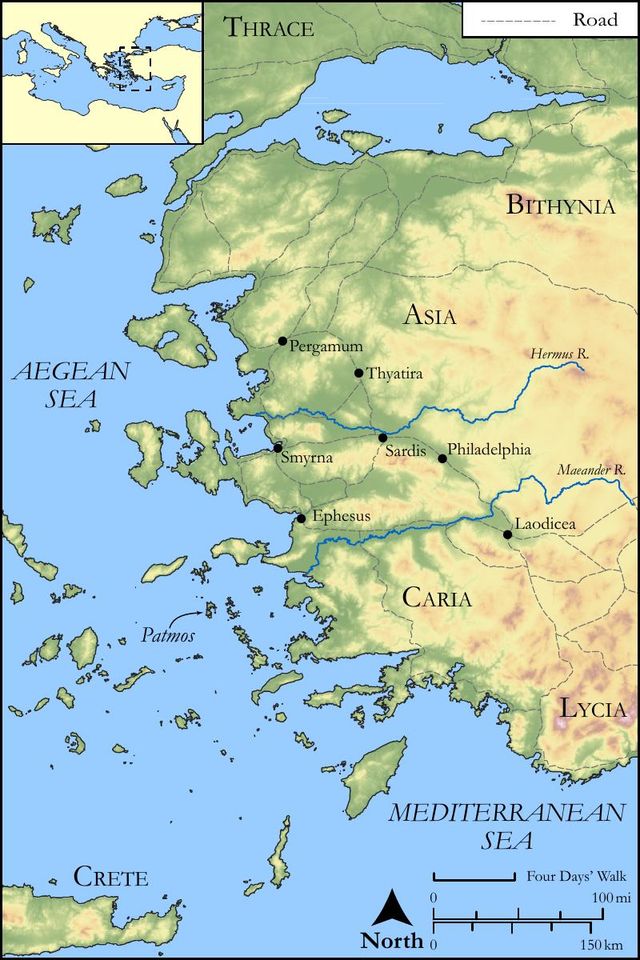
See on the biblical-era maps

Study this verse
Public-domain commentary
Matthew Henry
From his Commentary on the Whole Bible. Henry comments on passages, not single verses — this entry covers Revelation 3:1–6. His four-level outline is real structure in the source text, so it is rendered as structure.
Here is, I. The preface, showing, 1. To whom this letter is directed: To the angel of the church of Sardis, an ancient city of Lydia, on the banks of the mountain Tmolus, said to have been the chief city of Asia the Less, and the first city in that part of the world that was converted by the preaching of John; and, some say, the first that revolted from Christianity, and one of the first that was laid in its ruins, in which it still lies, without any church or ministry. 2. By whom this message was sent - the Lord Jesus, who here assumes the character of him that hath the seven spirits of God, and the seven stars, taken out of Rev 1:4, where the seven spirits are said to be before the throne. (1.) He hath the seven spirits, that is, the Holy Spirit with his various powers, graces, and operations; for he is personally one, though efficaciously various, and may be said here to be seven, which is the number of the churches, and of the angels of the churches, to show that to every minister, and to every church, there is a dispensation and measure of the Spirit given for them to profit withal - a stock of spiritual influence for that minister and church to improve, both for enlargement and continuance, which measure of the Spirit is not ordinarily withdrawn from them, till they forfeit it by misimprovement. Churches have their spiritual stock and fund, as well as particular believers; and, this epistle being sent to a languishing ministry and church, they are very fitly put in mind that Christ has the seven spirits, the Spirit without measure and in perfection, to whom they may apply themselves for the reviving of his work among them. (2.) He hath the seven stars, the angels of the churches; they are disposed of by him, and accountable to him, which should make them faithful and zealous. He has ministers to employ, and spiritual influences to communicate to his ministers for the good of his church. The Holy Spirit usually works by the ministry, and the ministry will be of no efficacy without the Spirit; the same divine hand holds them both.
II.The body of this epistle.
There is this observable in it, that whereas in the other epistles Christ begins with commending what is good in the churches, and then proceeds to tell them what is amiss, in this (and in the epistle to Laodicea) he begins,
1.With a reproof, and a very severe one: I know thy works, that thou hast a name that thou livest, and art dead. Hypocrisy, and a lamentable decay in religion, are the sins charged upon this church, by one who knew her well, and all her works.
(1.)This church had gained a great reputation; it had a name, and a very honourable one, for a flourishing church, a name for vital lively religion, for purity of doctrine, unity among themselves, uniformity in worship, decency, and order. We read not of any unhappy divisions among themselves. Every thing appeared well, as to what falls under the observation of men.
(2.)This church was not really what it was reputed to be. They had a name to live, but they were dead; there was a form of godliness, but not the power, a name to live, but not a principle of life. If there was not a total privation of life, yet there was a great deadness in their souls and in their services, a great deadness in the spirits of their ministers, and a great deadness in their ministrations, in their praying, in their preaching, in their converse, and a great deadness in the people in hearing, in prayer, and in conversation; what little life was yet left among them was, in a manner, expiring, ready to die.
2.Our Lord proceeds to give this degenerate church the best advice: Be watchful, and strengthen the things, etc., Rev 3:2.
(1.)He advises them to be upon their watch. The cause of their sinful deadness and declension was that they had let down their watch. Whenever we are off our watch, we lose ground, and therefore must return to our watchfulness against sin, and Satan, and whatever is destructive to the life and power of godliness.
(2.)To strengthen the things that remain, and that are ready to die. Some understand this of persons; there were some few who had retained their integrity, but they were in danger of declining with the rest. It is a difficult thing to keep up to the life and power of godliness ourselves, when we see a universal deadness and declension prevailing round about us. Or it may be understood of practices, as it follows: I have not found thy works perfect before God, not filled up; there is something wanting in them; there is the shell, but not the kernel; there is the carcase, but not the soul - the shadow, but not the substance. The inward thing is wanting, thy works are hollow and empty; prayers are not filled up with holy desires, alms-deeds not filled up with true charity, sabbaths not filled up with suitable devotion of soul to God; there are not inward affections suitable to outward acts and expressions. Now when the spirit is wanting the form cannot long subsist.
(3.)To recollect themselves, and remember how they have received and heard (Rev 3:3); not only to remember what they had received and heard, what messages they had received from God, what tokens of his mercy and favour towards them, what sermons they had heard, but how they had received and heard, what impressions the mercies of God had made upon their souls at first, what affections they felt working under their word and ordinances, the love of their espousals, the kindness of their youth, how welcome the gospel and the grace of God were to them when they first received them. Where is the blessedness they then spoke of?
(4.)To hold fast what they had received, that they might not lose all, and repent sincerely that they had lost so much of the life of religion, and had run the risk of losing all.
3.Christ enforces his counsel with a dreadful threatening in case it should be despised: I will come unto thee as a thief, and thou shalt not know the hour, Rev 3:3. Observe,
(1.)When Christ leaves a people as to his gracious presence, he comes to them in judgment; and his judicial presence will be very dreadful to those who have sinned away his gracious presence.
(2.)His judicial approach to a dead declining people will be surprising; their deadness will keep them in security, and, as it procures an angry visit from Christ to them, it will prevent their discerning it and preparing for it.
(3.)Such a visit from Christ will be to their loss; he will come as a thief, to strip them of their remaining enjoyments and mercies, not by fraud, but in justice and righteousness, taking the forfeiture they have made of all to him.
4.Our blessed Lord does not leave this sinful people without some comfort and encouragement: In the midst of judgment he remembers mercy (Rev 3:4), and here (1.) He makes honourable mention of the faithful remnant in Sardis, though but small: Thou hast a few names in Sardis which have not defiled their garments; they had not given into the prevailing corruptions and pollution of the day and place in which they lived. God takes notice of the smallest number of those who abide with him; and the fewer they are the more precious in his sight. (2.) He makes a very gracious promise to them: They shall walk with me in white, for they are worthy - in the stola, the white robes of justification, and adoption, and comfort, or in the white robes of honour and glory in the other world. They shall walk with Christ in the pleasant walks of the heavenly paradise; and what delightful converse will there be between Christ and them when they thus walk together! This is an honour proper and suitable to their integrity, which their fidelity has prepared them for, and which it is no way unbecoming Christ to confer upon them, though it is not a legal but a gospel worthiness that is ascribed to them, not merit but meetness. Those who walk with Christ in the clean garments of real practical holiness here, and keep themselves unspotted from the world, shall walk with Christ in the white robes of honour and glory in the other world: this is a suitable reward.
III.We now come to the conclusion of this epistle, in which, as before, we have,
1.A great reward promised to the conquering Christian (Rev 3:5), and it is very much the same with what has been already mentioned: He that overcometh shall be clothed in white raiment. The purity of grace shall be rewarded with the perfect purity of glory. Holiness, when perfected, shall be its own reward; glory is the perfection of grace, differing not in kind, but in degree. Now to this is added another promise very suitable to the case: I will not blot his name out of the book of life, but will confess his name before my Father, and before his angels. Observe,
(1.)Christ has his book of life, a register and roll of all who shall inherit eternal life.
[1.]The book of eternal election.
[2.]The book of remembrance of all those who have lived to God, and have kept up the life and power of godliness in evil times.
(2.)Christ will not blot the names of his chosen and faithful ones out of this book of life; men may be enrolled in the registers of the church, as baptized, as making a profession, as having a name to live, and that name may come to be blotted out of the roll, when it appears that it was but a name, a name to live, without spiritual life; such often lose the very name before they die, they are left of God to blot out their own names by their gross and open wickedness. But the names of those that overcome shall never be blotted out.
(3.)Christ will produce this book of life, and confess the names of the faithful who stand there, before God, and all the angels; he will do this as their Judge, when the books shall be opened; he will do this as their captain and head, leading them with him triumphantly to heaven, presenting them to the Father: Behold me, and the children that thou hast given me. How great will this honour and reward be!
2.The demand of universal attention finishes the message. Every word from God deserves attention from men; that which may seem more particularly directed to one body of men has something in it instructive to all.
Historical interpretation
Eight Centuries of Reception
5 surviving comments on this verse. Each one is dated, so this reads as a timeline rather than a list.
Select a marker to jump to its quote. Markers stagger vertically where authors wrote within a few decades of each other.
Thus in the Revelation of John it is said: "These are they which have not defiled their clothes with women," -indicating, of course, virgins, and such as have become "eunuchs for the kingdom of heaven's sake.
Everyone who is not soiled with the filth of sin walks with the Lord in white, and he is made worthy so that he might follow the footsteps of the Lamb.
But you have a few names in Sardis who have not defiled their garments. He did not say a few people, but a few names. For he calls his own sheep by name; he knows Moses by name, and he writes the names of his saints in heaven.
But I have a few names in Sardis, who have not defiled their garments: and they shall walk with me in white, because they are worthy. Those who do not stain their garments with filth are those who commit no deadly sin after the sacrament of baptism; but since they are rare, it is first said a few names. Where then, Lord, shall they walk with you to? Where from, and where to, if not from you into you? For they walk with you every day, because they follow and observe the footprints of your Passion. You lead the way by giving examples, and they follow by imitating those examples. By worthy he means either “clean” or “wholly deserving my esteem.” Now should those who defile their lives after baptism lose hope? No. Let them therefore run to the blood of the Lamb, not so that they may be wetted in it by the water of baptism again, but that they may be washed from the stains of their sins by a fountain of tears; whence there soon follows:
He says, Nevertheless, you have a few names in Sardis who have not defiled their garments; and they shall walk with me in white, for they are worthy, whom I say I am now postponing and patiently enduring for you. The garments not defiled refer to the bodies of the saints according to what was said by the patriarch Jacob; he washes his robe in wine (Gen. 49:11); and Isaiah says the same: Why are your garments red, as if they were stained in a winepress? (Isa. 63:2-3) The white garment thus symbolizes the purity of the body.
Continue studying Revelation 3:4 across the web’s major study libraries — every link below opens this exact verse, chapter, or book on the destination site.
Read & Compare
 BibleGatewayThis verse in more than 200 translations and 70 languages.
 Bible.comThe YouVersion reader — hundreds of translations, reading plans, and highlights.
 ESV.orgCrossway's official English Standard Version reader.
 NET BibleThe NET translation with 60,000+ translators' notes on every rendering decision.
 STEP BibleTyndale House's free study tool — original text, vocabulary, and scholarly resources.
 BibliaLogos Bible Software's free web reader.
 USCCBThe New American Bible (Revised Edition) with the U.S. bishops' study notes.
Commentaries
 BibleHub CommentariesDozens of classic commentaries on this verse, gathered on one page.
 StudyLightMore than 100 commentary sets — the largest collection on the web.
 BibleRefPlain-English commentary on what this verse means, verse by verse.
 Enduring WordDavid Guzik's free commentary on this chapter, widely used by Bible teachers.
 Bible Study ToolsVerse commentary alongside Greek and Hebrew study aids.
Original Language & Research
- BibleHub InterlinearThe verse word by word — original language, transliteration, and English.
- BibleHub LexiconEvery word's original-language definition and Strong's entry.
 Blue Letter BibleDeep-study tools — Strong's numbers, concordance, and word studies.
 CNTR CollationThe earliest Greek manuscripts of this verse, collated letter by letter.
Sermons, Hymns & Audio


TrulyRandomVerse is not affiliated with these sites and doesn’t control their content. They’re linked because they’re genuinely useful.
Summary
Revelation 3:4 offers a poignant commendation within the otherwise severe rebuke to the church in Sardis, highlighting God's discerning eye for individual faithfulness. Amidst a community largely characterized by spiritual apathy and a "name" for being alive while being spiritually dead, Jesus acknowledges a precious remnant—a "few names"—who have steadfastly maintained their spiritual and moral purity, symbolized by their undefiled garments. This verse promises these faithful ones intimate fellowship with Christ, depicted as walking with Him in white, affirming their worthiness and divine recognition.
Context
ShowHideLiterary Context
Revelation 3:4 is nestled within the letter to the church in Sardis, one of the seven churches of Asia Minor. The preceding verses (Revelation 3:1-3) deliver a scathing indictment against the majority of the church for their spiritual lifelessness, despite possessing a reputation for vitality. This verse, therefore, serves as a stark contrast, introducing a note of hope and divine commendation for a faithful minority. It emphasizes God's precise knowledge of each individual's spiritual state, distinguishing the truly alive from the merely reputed. The promise of walking in white also foreshadows the broader theme of victory and righteousness for overcomers found throughout the book of Revelation.
Historical & Cultural Context
The city of Sardis, once a powerful capital of Lydia, had a notable history of complacency leading to sudden, unexpected defeats. Famously, it was captured twice (by Cyrus the Great in 546 BC and by Antiochus III in 214 BC) because its inhabitants, confident in their seemingly impregnable acropolis, neglected their watch. This historical pattern provides a powerful backdrop for Jesus's warning to the church in Revelation 3:2-3, urging them to "wake up" and strengthen what remained. Culturally, white garments were highly significant in Israel and among the Gentiles of that day, symbolizing purity, celebration, victory, and honor. They were worn by priests, by those celebrating triumphs, and by individuals of high status. The imagery of "defiled garments" would have evoked a strong sense of shame or ritual impurity, making the "undefiled" status of the remnant all the more striking.
Key Themes
ShowHideThis verse powerfully contributes to several overarching themes within Revelation and the broader New Testament. Firstly, it underscores the theme of individual faithfulness amidst compromise, demonstrating that even within a compromised or lukewarm community, God recognizes and honors those who maintain their spiritual integrity. Secondly, the imagery of "undefiled garments" highlights the theme of purity and righteousness, emphasizing the call to live a life free from the defilement of sin and worldly compromise. This purity is not merely external but reflects an inward consecration to Christ. Thirdly, the promise of walking with Christ in white, because "they are worthy," speaks to the theme of divine recognition and reward for perseverance and holiness. This aligns with the broader message of Revelation 2-3 where promises are given to those who "overcome," culminating in a glorious future with Christ, as seen in the vision of the multitude in white robes.
Exposition and Analysis
ShowHideKey Word Analysis
ShowHideThis word (G3435) means "to soil (figuratively)." In this context, it refers to a spiritual or moral staining, polluting, or corrupting. It implies a compromise with the world's values, sinful practices, or false doctrines that would render one spiritually impure in God's sight. The faithful few in Sardis had avoided such contamination.
This term (G2440) denotes a "dress (inner or outer)" or "raiment." In biblical symbolism, garments often represent one's character, conduct, or spiritual state. To have "defiled their garments" would mean to have stained one's spiritual reputation, moral integrity, or righteous standing through sin or compromise. The undefiled garments of the remnant signify their preserved purity and blameless conduct.
This verb (G4043) literally means "to tread all around, i.e. walk at large." Figuratively, it means "to live, deport oneself, follow (as a companion or votary)." Here, "they shall walk with me" signifies an intimate, ongoing fellowship and communion with Christ, a life lived in His presence and according to His ways. It is a promise of sustained, honored companionship with the Lord.
Verse Breakdown
ShowHide"Thou hast a few names even in Sardis"
Despite the pervasive spiritual deadness of the church in Sardis, Jesus's omniscient gaze identifies a small, distinct group of individuals. The phrase "a few names" (G3641 olígos for "few," G3686 ónoma for "names") underscores God's personal knowledge and recognition of each faithful believer, even within a compromised collective. This highlights divine discernment and the reality of a faithful remnant.
"which have not defiled their garments"
This is a powerful metaphorical statement describing the spiritual and moral integrity of the remnant. Their "garments" (representing their character, conduct, and spiritual purity) have remained unstained by the prevailing spiritual apathy, worldliness, or sin that characterized the broader Sardian church. It speaks to a conscious choice to live a life of holiness and separation unto God.
"and they shall walk with me in white"
This clause presents the glorious promise to the undefiled remnant. "Walking with me" (G3326 metá "with" + G1700 emoû "me") signifies intimate fellowship and communion with Christ, a privileged and honored position. The phrase "in white" (G1722 en "in" + G3022 leukós "white") symbolizes purity, righteousness, victory, and honor. It is a sign of divine approval and shared glory, indicating their acceptance into God's presence and their participation in Christ's triumph.
"for they are worthy."
This concluding phrase (G3754 hóti "for" + G1526 eisí "they are" + G514 áxios "worthy") provides the divine rationale for the promised reward. Their worthiness is not inherent merit but stems from their faithful perseverance, their commitment to purity, and their steadfastness in a compromising environment. It is a worthiness recognized and affirmed by Christ Himself, signifying their suitability for the honor bestowed upon them.
Literary Devices
ShowHideThe verse employs several potent literary devices to convey its profound message. Metaphor is central, particularly in the imagery of "defiled their garments" and "walk with me in white." These phrases are not literal descriptions of clothing but powerful representations of spiritual and moral states. "Defiled garments" metaphorically signifies a life stained by sin, compromise, or spiritual impurity, while "walking in white" metaphorically represents a life of purity, righteousness, and intimate fellowship with Christ. Symbolism is also prominent, with the white garments serving as a recurring symbol throughout Revelation for purity, victory, divine approval, and the righteousness of the saints. The contrast between the "few names" and the implied majority of the church in Sardis creates a striking juxtaposition, highlighting God's discerning judgment and the value He places on individual faithfulness even within a large, compromised community.
Theological and Thematic Connections
ShowHideRevelation 3:4 deeply affirms the biblical truth of God's unwavering commitment to holiness and His precise discernment of individual hearts, even within a collective body that may have strayed. It underscores that while corporate witness is vital, personal accountability and integrity remain paramount in God's eyes. The concept of a "remnant" is a recurring theological theme throughout scripture, from Noah to Elijah, highlighting God's preservation of a faithful few even in times of widespread apostasy. This verse serves as a powerful encouragement for believers to pursue personal sanctification and to guard their spiritual purity, knowing that such faithfulness is not overlooked but is divinely recognized and rewarded with the most intimate fellowship with Christ. The promise of walking in white is a profound assurance of future glory and vindication for those who endure in holiness.
Reflection and Application
ShowHideRevelation 3:4 serves as a profound call to introspection and a powerful motivation for personal holiness in an age often characterized by spiritual complacency or compromise. It challenges us to look beyond outward appearances or congregational reputation and to examine the true state of our hearts and lives before God. Are our "garments"—our character, our conduct, our inner spiritual condition—being preserved from the defilement of the world, sin, and spiritual apathy? This verse reminds us that genuine faith is not merely a name or a past reputation, but a vibrant, ongoing walk with Christ that manifests in purity and integrity. It encourages us to cultivate a deep, personal relationship with the Lord, knowing that He sees and values our individual faithfulness, even when it feels like we are among "a few." The promise of walking with Him in white offers a glorious future hope, providing immense motivation to persevere in holiness today, assuring us that our dedication will culminate in intimate fellowship and eternal honor with our Savior.
Questions for Reflection
ShowHideFAQ
ShowHideWhat does "defiled their garments" mean spiritually for believers today?
ShowHideSpiritually, "defiling one's garments" refers to allowing sin, worldly compromise, false teachings, or spiritual apathy to stain one's character, conduct, and relationship with God. It implies a loss of moral and spiritual purity, a deviation from the holy standard of Christ. For believers today, it means actively resisting the temptations of the world, maintaining a clear conscience, adhering to sound doctrine, and living a life that honors God, rather than conforming to the patterns of sin or spiritual indifference prevalent in society or even within the church. It's about preserving the integrity of one's faith and walk with God, as James 1:27 describes pure religion as keeping oneself "unspotted from the world."
Why are "white garments" significant in the book of Revelation?
ShowHideWhite garments are a powerful and recurring symbol throughout the book of Revelation, consistently representing purity, righteousness, victory, and divine approval. They are worn by Christ Himself (Revelation 1:14), by the angels (Revelation 15:6), and most significantly, by the redeemed saints who have overcome (Revelation 3:5, Revelation 7:9, Revelation 19:8). The white robes signify that these individuals have been cleansed from sin by the blood of the Lamb (Revelation 7:14) and are now clothed in the righteousness of Christ, fit to stand in God's holy presence and participate in His triumph.
Christ-Centered Fulfillment
ShowHideThe promise of walking with Christ in white, for "they are worthy," finds its ultimate fulfillment and foundation in the person and work of Jesus Christ. Humanity, by nature, is unworthy and defiled by sin, incapable of earning such purity or intimate fellowship with God. However, Christ, the spotless Lamb of God, entered into our defiled state to cleanse us. He became sin for us, "that we might become the righteousness of God in Him" (2 Corinthians 5:21). The "worthy" status of the Sardian remnant, and indeed of all believers, is not based on their own perfect merit but on the imputed righteousness of Christ, received through faith (Romans 3:22). It is His atoning sacrifice that washes our "garments" white, making us pure and acceptable before God. Therefore, the "walking with me in white" is a profound picture of the believer's union with Christ, a participation in His victory and holiness that is entirely His accomplishment. Our ability to "walk" in purity and worthiness is a direct result of His transformative power and indwelling Spirit, enabling us to live a life "worthy of the calling" (Ephesians 4:1) as we fix our eyes on "Jesus, the founder and perfecter of our faith" (Hebrews 12:2). He is the one who presents His church to Himself "without spot or wrinkle or any such thing, that she might be holy and blameless" (Ephesians 5:27).