


John 21:6
- ὁho<the>G3588T-NSMDefinite article Nominative Singular Masculine
- δὲdeAndG1161CONJConjunction
- εἶπενeipenHe saidG2036V-2AAI-3SVerb 2nd Aorist Active Indicative 3rd Singular
- αὐτοῖς·autoisto themG846P-DPMPersonal pronoun Dative Plural Masculine
- βάλετεbaletedo castG906V-2AAM-2PVerb 2nd Aorist Active Imperative 2nd Plural
- εἰςeistoG1519PREPPreposition
- τὰtatheG3588T-APNDefinite article Accusative Plural Neuter
- δεξιὰdexiarightG1188A-APNAdjective Accusative Plural Neuter
- μέρηmerēsideG3313N-APNNoun Accusative Plural Neuter
- τοῦtouof theG3588T-GSNDefinite article Genitive Singular Neuter
- πλοίουploiouboatG4143N-GSNNoun Genitive Singular Neuter
- τὸtotheG3588T-ASNDefinite article Accusative Singular Neuter
- δίκτυονdiktuonnetG1350N-ASNNoun Accusative Singular Neuter
- καὶkaiandG2532CONJConjunction
- εὑρήσετεheurēseteyou will find [some]G2147V-FAI-2PVerb Future Active Indicative 2nd Plural
- ἔβαλονebalonThey castG906V-2AAI-3PVerb 2nd Aorist Active Indicative 3rd Plural
- οὖνounthereforeG3767CONJConjunction
- καὶkaiandG2532CONJConjunction
- οὐκέτιouketino longerG2089PRT-N + G2089=ADV
- αὐτὸautoitG846P-ASNPersonal pronoun Accusative Singular Neuter
- ἑλκύσαιhelkusaito haul inG1670V-AANVerb Aorist Active Infinitive
- ἴσχυονischuonwere they ableG2480V-IAI-3PVerb Imperfect Active Indicative 3rd Plural
- ἀπὸapofromG575PREPPreposition
- τοῦtoutheG3588T-GSNDefinite article Genitive Singular Neuter
- πλήθουςplēthousmultitudeG4128N-GSNNoun Genitive Singular Neuter
- τῶνtōnof theG3588T-GPMDefinite article Genitive Plural Masculine
- ἰχθύωνichthuōnfishG2486N-GPMNoun Genitive Plural Masculine
English is a literal word-by-word gloss of the Greek, not the KJV's wording. Why?
This is the original text the KJV's translators worked from — each Greek word with its own literal English meaning in this verse, prepared by scholars at Tyndale House, Cambridge. The KJV translates whole sentences, not word by word, so its wording differs: one Greek word can become several English words, and the KJV may choose “charity” where the gloss reads “love”. Both are faithful — they answer different questions. For the KJV's own rendering, switch to the KJV text.
Details
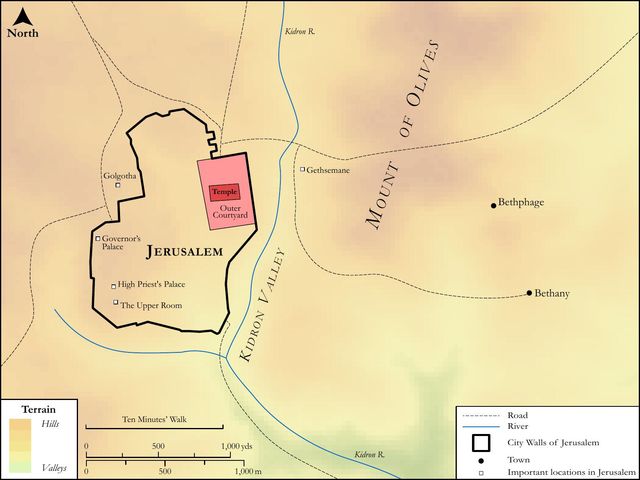
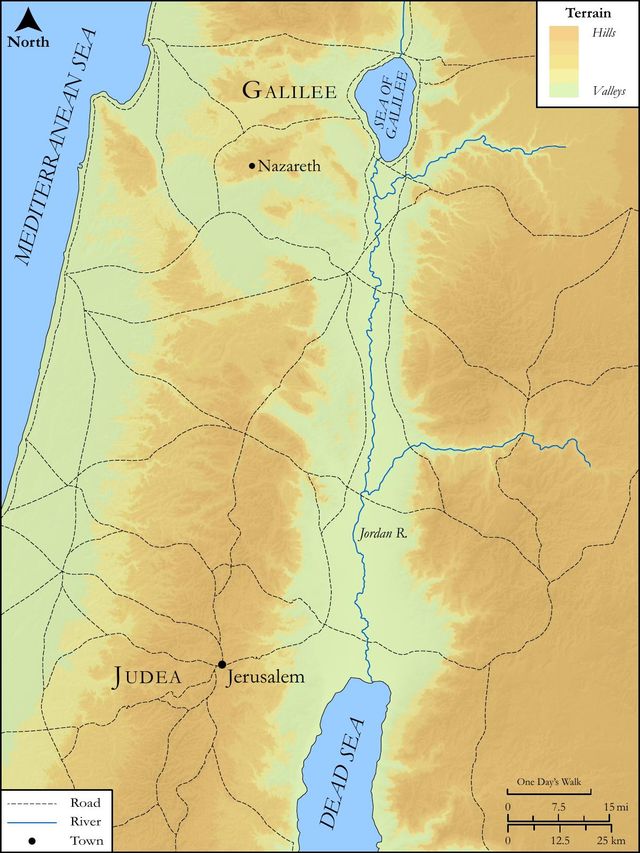
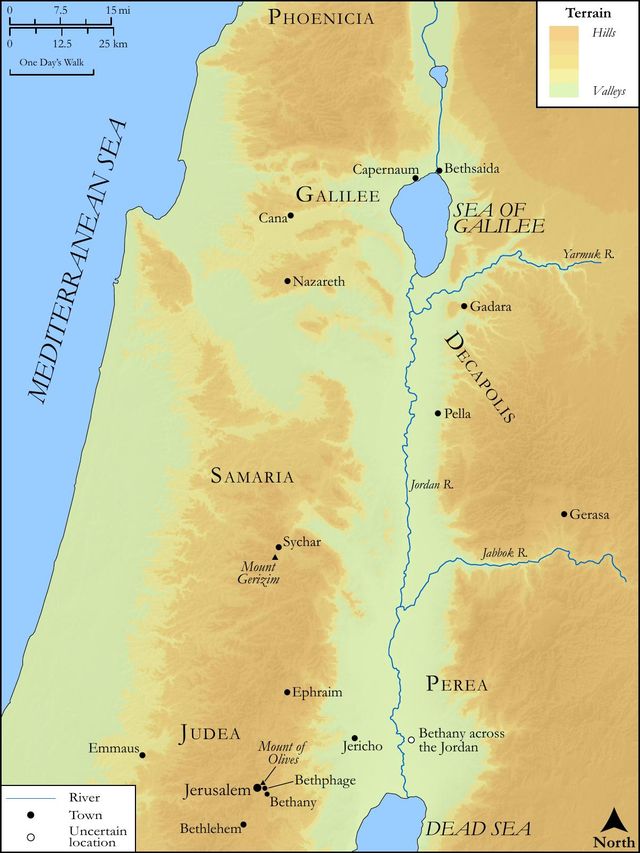
See on the biblical-era map
Study this verse
Public-domain commentary
Matthew Henry
From his Commentary on the Whole Bible. Henry comments on passages, not single verses — this entry covers John 21:1–14. His four-level outline is real structure in the source text, so it is rendered as structure.
We have here an account of Christ's appearance to his disciples at the sea of Tiberias. Now, 1. Let us compare this appearance with those that went before, In those Christ showed himself to his disciples when they were met in a solemn assembly (it should seem, for religious worship) upon a Lord's day, and when they were all together, perhaps expecting his appearing; but in this he showed himself to some of them occasionally, upon a week-day, when they were fishing, and little thought of it. Christ has many ways of making himself known to his people usually in his ordinances, but sometimes by his Spirit he visits them when they are employed in common business, as the shepherds who were keeping their flocks by night (Luk 2:8), even so here also, Gen 16:13. 2. Let us compare it with that which followed at the mountain in Galilee, where Christ had appointed them to meet him, Mat 28:16. Thitherward they moved as soon as the days of unleavened bread were over, and disposed of themselves as they saw fit, till the time fixed for this interview, or general rendezvous. Now this appearance was while they were waiting for that, that they might not be weary of waiting. Christ is often better than his word, but never worse, often anticipates and outdoes the believing expectations of his people, but never disappoints them. As to the particulars of the story, we may observe,
I.Who they were to whom Christ now showed himself (Joh 21:2):
not to all the twelve, but to seven of them only. Nathanael is mentioned as one of them, whom we have not met with since, ch. 1. But some think he was the same with Bartholomew, one of the twelve. The two not named are supposed to be Philip of Bethsaida and Andrew of Capernaum. Observe here, 1. It is good for the disciples of Christ to be much together; not only in solemn religious assemblies, but in common conversation, and about common business. Good Christians should by this means both testify and increase their affection to, and delight in, each other, and edify one another both by discourse and example. 2. Christ chose to manifest himself to them when they were together; not only to countenance Christian society, but that they might be joint witnesses of the same matter of fact, and so might corroborate one another's testimony. Here were seven together to attest this, on which some observe that the Roman law required seven witnesses to a testament. 3. Thomas was one of them, and is named next to Peter, as if he now kept closer to the meetings of the apostles than ever. It is well if losses by our neglects make us more careful afterwards not to let opportunities slip.
II.How they were employed, Joh 21:3. Observe,
1.Their agreement to go a fishing. They knew not well what to do with themselves. For my part, says Peter, I will go a fishing; We will go with thee then, say they, for we will keep together. Though commonly two of a trade cannot agree, yet they could. Some think they did amiss in returning to their boats and nets, which they had left; but then Christ would not have countenanced them in it with a visit. It was rather commendable in them; for they did it,
(1.)To redeem time, and not be idle. They were not yet appointed to preach the resurrection of Christ. Their commission was in the drawing, but not perfected. The hour for entering upon action was to come. It is probable that their Master had directed them to say nothing of his resurrection till after his ascension, nay, not till after the pouring out of the Spirit, and then they were to begin at Jerusalem. Now, in the mean time, rather than do nothing, they would go a fishing; not for recreation, but for business. It is an instance of their humility. Though they were advanced to be sent of Christ, as he was of the Father, yet they did not take state upon them, but remembered the rock out of which they were hewn. It is an instance likewise of their industry, and bespeaks them good husbands of their time. While they were waiting, they would not be idling. Those who would give an account of their time with joy should contrive to fill up the vacancies of it, to gather up the fragments of it.
(2.)That they might help to maintain themselves and not be burdensome to any. While their Master was with them those who ministered to him were kind to them; but now that the bridegroom was taken from them they must fast in those days, and therefore their own hands, as Paul's, must minister to their necessities and for this reason Christ asked them, Have you any meat? This teaches us with quietness to work and eat our own bread.
2.Their disappointment in their fishing. That night they caught nothing, though, it is probable, they toiled all night, as Luk 5:5. See the vanity of this world; the hand of the diligent often returns empty. Even good men may come short of desired success in their honest undertakings. We may be in the way of our duty, and yet not prosper. Providence so ordered it that all that night they should catch nothing, that the miraculous draught of fishes in the morning might be the more wonderful and the more acceptable. In those disappointments which to us are very grievous God has often designs that are very gracious. Man has indeed a dominion over the fish of the sea, but they are not always at his beck; God only knows the paths of the sea, and commands that which passeth through them.
III.After what manner Christ made himself known to them.
It is said (Joh 21:1), He showed himself. His body, though a true and real body, was raised, as ours will be, a spiritual body, and so was visible only when he himself was pleased to make it so; or, rather, came and removed so quickly that it was here or there in an instant, in a moment, in the twinkling of an eye. Four things are observable in the appearance of Christ to them: -
1.He showed himself to them seasonably (Joh 21:4): When the morning was now come, after a fruitless night's toil, Jesus stood on the shore. Christ's time of making himself known to his people is when they are most at a loss. When they think they have lost themselves, he will let them know that they have not lost him. Weeping may endure for a night; but joy comes, if Christ comes, in the morning. Christ appeared to them, not walking upon the water, because, being risen from the dead, he was not to be with them as he had been; but standing upon the shore, because now they were to make towards him. Some of the ancients put this significancy upon it, that Christ, having finished his work, was got through a stormy sea, a sea of blood, to a safe and quiet shore, where he stood in triumph; but the disciples, having their work before them, were yet at sea, in toil and peril. It is a comfort to us, when our passage is rough and stormy, that our Master is at shore, and we are hastening to him.
2.He showed himself to them gradually. The disciples, though they had been intimately acquainted with him, knew not, all at once, that it was Jesus. Little expecting to see him there, and not looking intently upon him, they took him for some common person waiting the arrival of their boat, to buy their fish. Note, Christ is often nearer to us than we think he is, and so we shall find afterwards, to our comfort.
3.He showed himself to them by an instance of his pity, Joh 21:5. He called to them, Children, paidia - "Lads, have you any meat? Have you caught any fish?" Here,
(1.)The compellation is very familiar; he speaks unto them as unto his sons, with the care and tenderness of a father: Children. Though he had now entered upon his exalted state, he spoke to his disciples with as much kindness and affection as ever. They were not children in age, but they were his children, the children which God had given him.
(2.)The question is very kind: Have you any meat? He asks as a tender father concerning his children whether they be provided with that which is fit for them, that if they be not, he may take care for their supply. Note, The Lord is for the body, Co1 6:13. Christ takes cognizance of the temporal wants of his people, and has promised them not only grace sufficient, but food convenient. Verily they shall be fed, Psa 27:3. Christ looks into the cottages of the poor, and asks, Children, have you any meat? thereby inviting them to open their case before him, and by the prayer of faith to make their requests known to him: and then let them be careful for nothing; for Christ takes care of them, takes care for them. Christ has herein set us an example of compassionate concern for our brethren. There are many poor householders disabled for labour, or disappointed in it, that are reduced to straits, whom the rich should enquire after thus, Have you any meat? For the most necessitous are commonly the least clamorous. To this question the disciples gave a short answer, and, some think, with an air of discontent and peevishness. They said, No; not giving him any such friendly and respectful title as he had given them. So short do the best come in their returns of love to the Lord Jesus. Christ put the question to them, not because he did not know their wants, but because he would know them from them. Those that would have supplies from Christ must own themselves empty and needy.
4.He showed himself to them by an instance of his power; and this perfected the discovery (Joh 21:6): he ordered them to cast the net on the right side of the ship, the contrary side to what they had been casting it on; and then they, who were going home empty-handed, were enriched with a great draught of fishes. Here we have,
(1.)The orders Christ gave them, and the promise annexed to those orders: Cast the net there in such a place, and you shall find. He from whom nothing is hid, no, not the inhabitants under the waters (Job 26:5), knew on what side of the ship the shoal of fishes was, and to that side he directs them. Note, Divine providence extends itself to things most minute and contingent; and they are happy that know how to take hints thence in the conduct of their affairs, and acknowledge it in all their ways.
(2.)Their obedience of these orders, and the good success of it. As yet they knew not that it was Jesus; however, they were willing to be advised by any body, and did not bid this supposed stranger mind his own business and not meddle with theirs, but took his counsel; in being thus observant of strangers, they were obedient to their Master unawares. And it sped wonderfully well; now they had a draught that paid them for all their pains. Note, Those that are humble, diligent, and patient (though their labours may be crossed) shall be crowned; they sometimes live to see their affairs take a happy turn, after many struggles and fruitless attempts. There is nothing lost by observing Christ's orders. Those are likely to speed well that follow the rule of the word, the guidances of the Spirit, and the intimations of Providence; for this is casting the net on the right side of the ship. Now the draught of fishes may be considered,
[1.]As a miracle in itself: and so it was designed to prove that Jesus Christ was raised in power, though sown in weakness, and that all things were put under his feet, the fishes of the sea not excepted. Christ manifests himself to his people by doing that for them which none else can do, and things which they looked not for.
[2.]As a mercy to them; for the seasonable and abundant supply of their necessities. When their ingenuity and industry failed them, the power of Christ came in opportunely for their relief; for he would take care that those who had left all for him should not want any good thing. When we are most at a loss, Jehovah - jireh.
[3.]As the memorial of a former mercy, with which Christ had formerly recompensed Peter for the loan of his boat, Luk 5:4, etc. This miracle nearly resembled that, and could not but put Peter in mind of it, which helped him to improve this; for both that and this affected him much, as meeting him in his own element, in his own employment. Latter favours are designed to bring to mind former favours, that eaten bread may not be forgotten.
[4.]As a mystery, and very significant of that work to which Christ was now with an enlarged commission sending them forth. The prophets had been fishing for souls, and caught nothing, or very little; but the apostles, who let down the net at Christ's word, had wonderful success. Many were the children of the desolate, Gal 4:27. They themselves, in pursuance of their former mission, when they were first made fishers of men, had had small success in comparison with what they should now have. When, soon after this, three thousand were converted in one day, then the net was cast on the right side of the ship. It is an encouragement to Christ's ministers to continue their diligence in their work. One happy draught, at length, may be sufficient to repay many years of toil at the gospel net.
IV.How the disciples received this discovery which Christ made of himself, Joh 21:7, Joh 21:8, where we find,
1.That John was the most intelligent and quick-sighted disciple. He whom Jesus loved was the first that said, It is the Lord; for those whom Christ loves he will in a special manner manifest himself to: his secret is with his favourites. John had adhered more closely to his Master in his sufferings than any of them: and therefore he has a clearer eye and a more discerning judgment than any of them, in recompence for his constancy. When John was himself aware that it was the Lord, he communicated his knowledge to those with him; for this dispensation of the Spirit is given to every one to profit withal. Those that know Christ themselves should endeavor to bring others acquainted with him; we need not engross him, there is enough in him for us all. John tells Peter particularly his thoughts, that it was the Lord, knowing he would be glad to see him above any of them. Though Peter had denied his Master, yet, having repented, and being taken into the communion of the disciples again, they were as free and familiar with him as ever.
2.That Peter was the most zealous and warm-hearted disciple; for as soon as he heard it was the Lord (for which he took John's word) the ship could not hold him, nor could he stay till the bringing of it to shore, but into the sea he throws himself presently, that he might come first to Christ.
(1.)He showed his respect to Christ by girding his fisher's coat about him that he might appear before his Master in the best clothes he had, and to rudely rush into his presence, stripped as he was to his waistcoat and drawers, because the work he was about was toilsome, and he was resolved to take pains in it. Perhaps the fisher's coat was made of leather, or oil-cloth, and would keep out wet; and he girt it to him that he might make the best of his way through the water to Christ, as he used to do after his nets, when he was intent upon his fishing.
(2.)He showed the strength of his affection to Christ, and his earnest desire to be with him, by casting himself into the sea; and either wading or swimming to shore, to come to him. When he walked upon the water to Christ (Mat 14:28, Mat 14:29), it was said, He came down out of the ship deliberately; but here it is said, He cast himself into the sea with precipitation; sink or swim, he would show his good-will and aim to be with Jesus. "If Christ suffer me," thinks he, "to drown, and come short of him, it is but what I deserve for denying him." Peter had had much forgiven, and made it appear he loved much by his willingness to run hazards, and undergo hardships, to come to him. Those that have been with Jesus will be willing to swim through a stormy sea, a sea of blood, to come to him. And it is a laudable contention amongst Christ's disciples to strive who shall be first with him.
3.That the rest of the disciples were careful and honest hearted. Though they were not in such a transport of zeal as to throw themselves into the sea, like Peter, yet they hastened in the boat to the shore, and made the best of their way (Joh 21:8): The other disciples, and John with them, who had first discovered that it was Christ, came slowly, yet they came to Christ. Now here we may observe,
(1.)How variously God dispenses his gifts. Some excel, as Peter and John; are very eminent in gifts and graces, and are thereby distinguished from their brethren; others are but ordinary disciples, that mind their duty, and are faithful to him, but do nothing to make themselves remarkable; and yet both the one and the other, the eminent and the obscure, shall sit down together with Christ in glory; nay, and perhaps the last shall be first. Of those that do excel, some, like John, are eminently contemplative, have great gifts of knowledge, and serve the church with them; others, like Peter, are eminently active and courageous, are strong, and do exploits, and are thus very serviceable to their generation. Some are useful as the church's eyes, others as the church's hands, and all for the good of the body.
(2.)What a great deal of difference there may be between some good people and others in the way of their honouring Christ, and yet both accepted of him. Some serve Christ more in acts of devotion, and extraordinary expressions of a religious zeal; and they do well, to the Lord they do it. Peter ought not to be censured for casting himself into the sea, but commended for his zeal and the strength of his affection; and so must those be who, in love to Christ, quit the world, with Mary, to sit at his feet. But others serve Christ more in the affairs of the world. They continue in that ship, drag the net, and bring the fish to shore, as the other disciples here; and such ought not to be censured as worldly, for they, in their place, are as truly serving Christ as the other, even in serving tables. If all the disciples had done as Peter did, what had become of their fish and their nets? And yet if Peter had done as they did we had wanted this instance of holy zeal. Christ was well pleased with both, and so must we be.
(3.)That there are several ways of bringing Christ's disciples to shore to him from off the sea of this world. Some are brought to him by a violent death, as the martyrs, who threw themselves into the sea, in their zeal for Christ; others are brought to him by a natural death, dragging the net, which is less terrible; but both meet at length on the safe and quiet shore with Christ.
V.What entertainment the Lord Jesus gave them when they came ashore.
1.He had provision ready for them. When they came to land, wet and cold, weary and hungry, they found a good fire there to warm them and dry them, and fish and bread, competent provision for a good meal.
(1.)We need not be curious in enquiring whence this fire, and fish, and bread, came, any more than whence the meat came which the ravens brought to Elijah. He that could multiply the loaves and fishes that were could make new ones if he pleased, or turn stones into bread, or send his angels to fetch it, where he knew it was to be had. It is uncertain whether this provision was made ready in the open air, or in some fisher's cabin or hut upon the shore; but here was nothing stately or delicate. We should be content with mean things, for Christ was.
(2.)We may be comforted in this instance of Christ's care of his disciples; he has wherewith to supply all our wants, and knows what things we have need of. He kindly provided for those fishermen, when they came weary from their work; for verily those shall be fed who trust in the Lord and do good. It is encouraging to Christ's ministers, whom he hath made fishers of men, that they may depend upon him who employs them to provide for them; and if they should miss of encouragement in this world, should be reduced as Paul was to hunger, and thirst, and fastings often, let them content themselves with what they have here; they have better things in reserve, and shall eat and drink with Christ at his table in his kingdom, Luk 22:30. Awhile ago, the disciples had entertained Christ with a broiled fish (Luk 24:42), and now, as a friend, he returned their kindness, and entertained them with one; nay, in the draught of fishes, he repaid them more than a hundred fold.
2.He called for some of that which they had caught, and they produced it, Joh 21:10, Joh 21:11. Observe here,
(1.)The command Christ gave them to bring their draught of fish to shore: "Bring of the fish hither, which you have now caught, and let us have some of them;" not as if he needed it; and could not make up a dinner for them without it; but,
[1.]He would have them eat the labour of their hands, Psa 128:2. What is got by God's blessing on our own industry and honest labour, if withal God give us power to eat of it, and enjoy good in our labour, hath a peculiar sweetness in it. It is said of the slothful man that he roasteth not that which he took in hunting; he cannot find in his heart to dress what he has been at the pains to take, Pro 12:27. But Christ would hereby teach us to use what we have.
[2.]He would have them taste the gifts of his miraculous bounty, that they might be witnesses both of his power and of his goodness. The benefits Christ bestows upon us are not to be buried and laid up, but to be used and laid out.
[3.]He would give a specimen of the spiritual entertainment he has for all believers, which, in this respect, is most free and familiar - that he sups with them, and they with him; their graces are pleasing to him, and his comforts are so to them; what he works in them he accepts from them.
[4.]Ministers, who are fishers of men, must bring all they catch to their Master, for on him their success depends.
(2.)Their obedience to this command, Joh 21:11. It was said (Joh 21:6), They were not able to draw the net to shore, for the multitude of fishes; that is, they found it difficult, it was more than they could well do; but he that bade them bring it to shore made it easy. Thus the fishers of men, when they have enclosed souls in the gospel net, cannot bring them to shore, cannot carry on and complete the good work begun, without the continued influence of the divine grace. If he that helped us to catch them, when without his help we should have caught nothing, do not help us to keep them, and draw them to land, by building them up in their most holy faith, we shall lose them at last, Co1 3:7. Observe,
[1.]Who it was that was most active in landing the fishes: it was Peter, who, as in the former instance (Joh 21:7), had shown a more zealous affection to his Master's person than any of them, so in this he showed a more ready obedience to his Master's command; but all that are faithful are not alike forward.
[2.]The number of the fishes that were caught. They had the curiosity to count them, and perhaps it was in order to the making of a dividend; they were in all a hundred and fifty three, and all great fishes. These were many more than they needed for their present supply, but they might sell them, and the money would serve to bear their charges back to Jerusalem, whither they were shortly to return.
[3.]A further instance of Christ's care of them, to increase both the miracle and the mercy: For all there were so many, and great fishes too, yet was not the net broken; so that they lost none of their fish, nor damaged their net. It was said (Luk 5:6), Their net broke. Perhaps this was a borrowed net, for they had long since left their own; and, if so, Christ would teach us to take care of what we have borrowed, as much as if it were our own. It was well that their net did not break, for they had not now the leisure they had formerly had to mend their nets. The net of the gospel has enclosed multitudes, three thousand in one day, and yet is not broken; it is still as mighty as ever to bring souls to God.
3.He invited them to dinner. Observing them to keep their distance and that they were afraid to ask him, Who art thou? because they knew it was their Lord, he called to them very familiarly, Come, and dine.
(1.)See here how free Christ was with his disciples; he treated them as friends; he did not say, Come, and wait, Come, and attend me, but Come, and dine; not, Go dine by yourselves, as servants are appointed to do, but Come, and dine with me. This kind invitation may be alluded to, to illustrate,
[1.]The call Christ gives his disciples into communion with him in grace here. All things are now ready; Come, and dine. Christ is a feast; come, dine upon him; his flesh is meat indeed, his blood drink indeed. Christ is a friend; come, dine with him, he will bid you welcome, Sol 5:1.
[2.]The call he will give into the fruition of him in glory hereafter: Come, ye blessed of my Father; come, and sit down with Abraham, and Isaac, and Jacob. Christ has wherewithal to dine all his friends and followers; there is room and provision enough for them all.
(2.)See how reverent the disciples were before Christ. They were somewhat shy of using the freedom he invited them to, and, by his courting them to their meat, it should seem that they stood pausing. Being to eat with a ruler, such a ruler, they consider diligently what is before them. None of them durst ask him, Who art thou? Either,
[1.]Because they would not be so bold with him. Though perhaps he appeared now in something of a disguise at first, as to the two disciples when their eyes were holden that they should not know him, yet they had very good reason to think it was he, and could be no other. Or,
[2.]Because they would not so far betray their own folly. When he had given them this instance of his power and goodness, they must be stupid indeed if they questioned whether it was he or no. When God, in his providence, has given us sensible proofs of his care for our bodies, and has given us, in his grace, manifest proofs of his good-will to our souls, and good work upon them, we should be ashamed of our distrusts, and not dare to question that which he has left us no room to question. Groundless doubts must be stifled, and not started.
4.He carved for them, as the master of the feast, Joh 21:13. Observing them to be still shy and timorous, he comes, and takes bread himself, and gives them, some to each of them, and fish likewise. No doubt he craved a blessing and gave thanks (as Luk 24:30), but, it being his known and constant practice, it did not need to be mentioned.
(1.)The entertainment here was but ordinary; it was only a fish-dinner, and coarsely dressed; here was nothing pompous, nothing curious; plentiful indeed, but plain and homely. Hunger is the best sauce. Christ, though he entered upon his exalted state, showed himself alive by eating, not showed himself a prince by feasting. Those that could not content themselves with bread and fish, unless they had sauce and wine, would scarcely have found in their hearts to dine with Christ himself here.
(2.)Christ himself began. Though, perhaps, having a glorified body, he needed not eat, yet he would show that he had a true body, which was capable of eating. The apostles produced this as one proof of his resurrection, that they had eaten and drank with him, Act 10:41.
(3.)He gave the meat about to all his guests. He not only provided it for them, and invited them to it, but he himself divided it among them, and put it into their hands. Thus to him we owe the application, as well as the purchase, of the benefits of redemption. He gives us power to eat of them.
The evangelist leaves them at dinner, and makes this remark (Joh 21:14): This is now the third time that Jesus showed himself alive to his disciples, or the greater part of them. This is the third day; so some. On the day he rose he appeared five times; the second day was that day seven-night; and this was the third. Or this was his third appearance to any considerable number of his disciples together; though he had appeared to Mary, to the women, to the two disciples, and to Cephas, yet he had but twice before this appeared to any company of them together. This is taken notice of, [1.] For confirming the truth of his resurrection; the vision was doubled, was trebled, for the thing was certain. Those who believed not the first sign would be brought to believe the voice of the latter signs. [2.] As an instance of Christ's continued kindness to his disciples; once, and again, and a third time, he visited them. It is good to keep account of Christ's gracious visits; for he keeps account of them, and they will be remembered against us if we walk unworthily of them, as they were against Solomon, when he was reminded that the Lord God of Israel had appeared unto him twice. This is now the third; have we made a due improvement of the first and second? See Co2 12:14. This is the third, perhaps it may be the last.
Historical interpretation
Two Centuries of Reception
12 surviving comments on this verse. Each one is dated, so this reads as a timeline rather than a list.
Select a marker to jump to its quote. Markers stagger vertically where authors wrote within a few decades of each other.
For no ordinary signs were they which had taken place. What were they? First, that so many fish were caught; then, that the net did not break; then, that before they landed, the coals had been found, and fish laid thereon, and bread. For He no longer made things out of matter already subsisting, as, through a certain dispensation, He did before the Crucifixion. When therefore Peter knew Him, he threw down all, both fish and nets, and girded himself. Seest thou his respect and love? Yet they were only two hundred cubits off; but not even so could Peter wait to go to Him in the boat, but reached the shore by swimming.
(Hom. lxxxvii) He says, Afterwards, because He did not go continually with His disciples as before; and, manifested Himself, because His body being incorruptible, it was a condescension to allow Himself to be seen. He mentions the place, to show that our Lord had taken away a good deal of their fear, and that they no longer kept within doors, though they had gone to Galilee to avoid the persecution of the Jews.
(Hom. lxxxvii) As our Lord was not with them regularly, and the Spirit was not given them, and they had received no commission, and had nothing to do, they followed the trade of fishermen: And on this wise showed He Himself. There were together Simon Peter, and Thomas called Didymus, and Nathanael of Cana in Galilee; he who was called by Philip, and the sons of Zebedee, i. e. James and John, and two other of His disciples. Simon Peter saith unto them, I go a fishing.
(Hom. lxxxvii) The other disciples followed Peter: They say unto him, We also go with thee; for from this time they were all bound together; and they wished too to see the fishing: They went forth and entered into a ship immediately. And that night they caught nothing. They fished in the night, from fear.
(Hom. lxxxvii) In the midst of their labour and distress, Jesus presented Himself to them: But when the morning was now come, Jesus stood on the shore: but the disciples knew not that it was Jesus. He did not make Himself known to them immediately, but entered into conversation; and first He speaks after human fashion: Then Jesus saith unto them, Children, have ye any meat? as if He wished to beg some of them. They answered, No. He then gives them a sign to know Him by: And He said unto them, Cast the net on the right side of the ship, and ye shall find. They cast therefore, and now they were not able to draw it for the multitude of fishes. The recognition of Him brings out Peter and John in their different tempers of mind; the one fervid, the other sublime; the one ready, the other penetrating. John is the first to recognise our Lord: Therefore that disciple whom Jesus loved saith unto Peter, It is the Lord; Peter is the first to come to Him: Now when Simon Peter heard that it was the Lord, he girt his fisher's coat unto Him, for he was naked.
(Hom. lxxxvii) Another miracle follows: As soon then as they were come to land, they saw a fire of coals there, and fish laid thereon, and bread. He no longer works upon already existing materials, but in a still more wonderful way; showing that it was only in condescension that He wrought His miracles upon existing matter before His crucifixion.
Seest thou that He remaineth not with them continually, nor as before? He appeared, for instance, in the evening, and flew away; then after eight days again once, and again flew away; then after these things by the sea, and again with great terror. But what is the, "showed"? From this it is clear that He was not seen unless He condescended, because His body was henceforth incorruptible, and of unmixed purity. But wherefore hath the writer mentioned the place? To show that he had now taken away the greater part of their fear, so that they now ventured forth from their dwelling, and went about everywhere. For they were no longer shut up at home, but had gone into Galilee, avoiding the danger from the Jews. Simon, therefore, comes to fish. For since neither was He with them continually, nor was the Spirit yet given, nor they at that time yet entrusted with anything, having nothing to do, they went after their trade.
Having then nothing to do, they went to their fishing, and this same they did by night, because they were greatly afraid. This Luke also mentions; but this is not the same occasion, but a different one. And the other disciples followed, because they were henceforth bound to one another, and at the same time desired to see the fishing, and to bestow their leisure well. As they then were laboring and wearied, Jesus presenteth Himself before them, and doth not at once reveal Himself, so that they enter into converse with Him. He therefore saith to them, "Have ye any meat?"
For a time He speaketh rather after a human manner, as if about to buy somewhat of them. But when they made signs that they had none, He bade them cast their nets to the right; and on casting they obtained a haul. But when they recognized Him, the disciples Peter and John again exhibited the peculiarities of their several tempers. The one was more fervent, the other more lofty; the one more keen, the other more clear-sighted. On this account John first recognized Jesus, Peter first came to Him.
That, however, is a parable in word, not one embodied in outward action; and just as in the passage before us the Lord indicated by an outward action the kind of character the Church would have in the end of the world, so in the same way, by that other fishing, He indicated its present character. In doing the one at the commencement of His preaching and this latter after His resurrection, He showed thereby in the former case that the capture of fishes signified the good and bad presently existing in the Church; but in the latter, the good only, whom it will contain everlastingly, when the resurrection of the dead shall have been completed in the end of this world.
On that previous occasion Jesus stood not, as here, on the shore, when He gave orders for the taking of the fish, but "entered into one of the ships, which was Simon's, and prayed him that he would thrust out a little from the land; and He sat down therein, and taught the crowds. And when He had left speaking, He said unto Simon, Launch out into the deep, and let down your nets for a draught." There also they put the fishes that were caught into the ship, and did not, as here, draw the net to the shore. By these signs, and any others that may be found, on the former occasion the Church was prefigured as it exists in this world, and on the other, as it shall be in the end of the world: the one accordingly took place before, and the other subsequently to the resurrection of the Lord; because there we were signified by Christ as called, and here as raised from the dead. On that occasion the nets are not let down on the right side, that the good alone might not be signified, nor on the left, lest the application should be limited to the bad; but without any reference to either side, He says, "Let down your nets for a draught," that we may understand the good and bad as mingled together: while on this He says, "Cast the net on the right side of the ship," to signify those who stood on the right hand, the good alone.
(Tract. cxxii) The preceding words of the Evangelist seem to indicate the end of the book; but He goes on farther to give an account of our Lord's appearance by the sea of Tiberias: After these things Jesus showed Himself again to the disciples at the sea of Tiberias.
(Tract. cxxii) If the disciples had done this after the death of Jesus, and before His resurrection, we should have imagined that they did it in despair. But now after that He has risen from the grave, after seeing the marks of His wounds, after receiving, by means of His breathing, the Holy Ghost, all at once they become what they were before, fishers, not of men, but of fishes. We must remember then that they were not forbidden by their Apostleship from earning their livelihood by a lawful craft, provided they had no other means of living. For if the blessed Paul used not that power which he had with the rest of the preachers of the Gospel, as they did, but went a warfare upon his own resources, lest the Gentiles, who were aliens from the name of Christ, might be offended at a doctrine apparently venal; if, educated in another way, he learnt a craft he never knew before, that, while the teacher worked with his own hands, the hearer might not be burdened; much more might Peter, who had been a fisherman, work at what he knew, if he had nothing else to live upon at the time. But how had he not, some one will ask, when our Lord promises, Seek ye first the kingdom of God and His righteousness, and all these things shall be added unto you? (Matt. 6:33) Our Lord, we answer, fulfilled this promise, by bringing them the fishes to catch: for who else brought them? He did not bring upon them that poverty which obliged them to go fishing, except in order to exhibit a miracle.
(Tract. cxxii) We must not understand that the bread was laid on the coals, but read it as if it stood, They saw a fire of coals there, and fish laid on the coals; and they saw bread.
(Tract. cxxii) Mystically, in the draught of fishes He signified the mystery of the Church, such as it will be at the final resurrection of the dead. And to make this clearer, it is put near the end of the book. The number seven, which is the number of the disciples who were fishing, signifies the end of time; for time is counted by periods of seven days.
(Tract. cxxii) The shore is the end of the sea, and therefore signifies the end of the world. The Church is here typified as she will be at the end of the world, just as other draughts of fishes typified her as she is now. Jesus before did not stand on the shore, but went into a ship which was Simon's, and asked him to put out a little from the land. In a former draught the nets are not thrown to the right, or to the left, so that the good or the bad should be typified alone, but indifferently: Let down your nets for a draught, (Luke 5:4) meaning that the good and bad were mixed together. But here it is, Cast the net on the right side of the ship; to signify those who should stand on the right hand, the good. The one our Lord did at the beginning of His ministry, the other after His resurrection, showing therein that the former draught of fishes signified the mixture of bad and good, which composes the Church at present; the latter the good alone, which it will contain in eternity, when the world is ended, and the resurrection of the dead completed. But they who belong to the resurrection of life, i. e. to the right hand, and are caught within the net of the Christian name, shall only appear on the shore, i. e. at the end of the world, after the resurrection: wherefore they were not able to draw the net into the ship, and unload the fishes, as they were before. The Church keeps these of the right hand, after death, in the sleep of peace, as it were in the deep, till the net come to shore. That the first draught was taken in two little ships, the last two hundred cubits from land, a hundred and a hundred, typifies, I think, the two classes of elect, circumcised and uncircumcised.
(Tract. cxxii) In the draught before, the number of the fishes is not mentioned, as if in fulfilment of the prophecy in the Psalm, If I should declare them, and speak of them, they should be more than I am able to express; (Ps. 41:7) but here there is a certain number mentioned, which we must explain. The number which signifies the law is ten, from the ten Commandments. But when to the law is joined grace, to the letter spirit, the number seven is brought in, that being the number which represents the Holy Spirit, to Whom sanctification properly belongs. For sanctification was first heard of in the law, with respect to the seventh day; and Isaiah praises the Holy Spirit for His sevenfold work and office. The seven of the Spirit added to the ten of the law make seventeen; and the numbers from one up to seventeen when added together, make a hundred and fifty-three.
(Tract. cxxii) It is not then signified that only a hundred and fifty-three saints are to rise again to eternal life, but this number represents all who partake of the grace of the Holy Spirit: which number too contains three fifties, and three over, with reference to the mystery of the Trinity. And the number fifty is made up of seven sevens, and one in addition, signifying that those sevens are one. That they were great fishes too, is not without meaning. For when our Lord says, I came not to destroy the law, but to fulfil, by giving, that is, the Holy Spirit through Whom the law can be fulfilled, He says almost immediately after, Whosoever shall do and teach them, the same shall be called great in the kingdom of heaven. In the first draught the net was broken, to signify schisms; but here to show that in that perfect peace of the blessed there would be no schisms, the Evangelist continues: And for all they were so great, yet was not the net broken; as if alluding to the case before, in which it was broken, and making a favourable comparison.
Precisely also in this very way did the Lord fulfill His promise. For who else placed there the fishes that were to be caught, but He, who, we are bound to believe, threw them into the penury that compelled them to go a fishing, for no other reason than that He wished to show them the miracle He had prepared, that so He might both feed the preachers of His gospel, and at the same time enhance that gospel itself, by the great mystery which He was about to impress on their minds by the number of the fishes.
The Lord appeared to his disciples after his resurrection by the sea of Tiberius and found them fishing, although they had caught nothing. While fishing at night, they caught nothing. Day dawned, and they made a catch because they saw Christ the day, and at a word from the Lord they cast their nets and made a catch. Now we find two catches of fish made by Christ’s disciples at a word from Christ. The first one refers to when he chose them and made them disciples. The second one refers to this current period after he had risen from the dead. Let us compare them, if you agree, and take careful note of the differences between them. It has a lot to do, after all, with the consolidation of our faith.On the first occasion, then, when the Lord came across the fishermen whom he had not found previously, they had also caught nothing all night, having worked hard without result. He ordered them to throw out the nets. He did not say, on the right, he did not say, on the left, but he simply said, “Throw out the nets.” Before the resurrection, the nets were let out all over the place. After the resurrection, the right side is chosen. Next, in the first catch of fish, the boats are overloaded, the nets are breaking. In this last one after the resurrection, there is no overloading of the boat or breaking of the seine. When they fished the first time, the number of fish caught is not mentioned. This time, after the resurrection, a definite number of fish is mentioned. So let us carry on with the first, in order to arrive at the last.… In the first account we have the nets, the nets of the word, the nets of preaching. Here are the nets. Let the psalm tell us, “I proclaimed, and I spoke. They were multiplied beyond counting.” It is as plain as a pikestaff that it is happening now. The gospel is being proclaimed, Christians are multiplying beyond counting. If they all lived good lives, they would not be overloading the boat. If they were not divided by heretics and schisms, the net would not be breaking.…
The last catch of fish refers to the holy church that exists now in the few, toiling away among the many who are evil. This holy church will be realized in that certain, definite number in which no sinner will be found.… And they will be big fish because they will all be immortal, all destined to live without end. What can be bigger than what has no end? And the Evangelist made it his business to give your memory a flashback to the first catch of fish. Why else did he add, after all, “And though they were such big fish, the nets were not torn”? It was as though he were saying, “Remember that first catch of fish, when the nets were torn.” This will be the kingdom of heaven, no heretics will be barking, no schismatics setting themselves apart. All will be inside, all will be at peace.
This is a great mystery in the great Gospel of John; and to commend it the more forcibly to our attention, the last chapter has been made its place of record. Accordingly, inasmuch as there were seven disciples taking part in that fishing, Peter, and Thomas, and Nathanael, and the two sons of Zebedee, and two others whose names are withheld, they point, by their septenary number, to the end of time. For there is a revolution of all time in seven days. To this also pertains the statement, that when the morning was come, Jesus stood on the shore; for the shore likewise is the limit of the sea, and signifies therefore the end of the world. The same end of the world is shown also by the act of Peter, in drawing the net to land, that is, to the shore. Which the Lord has Himself elucidated, when in a certain other place He drew His similitude from a fishing net let down into the sea: "And they drew it," He said, "to the shore." And in explanation of what that shore was, He added, "So will it be in the end of the world."
Our Lord Jesus Christ once more gladdens His disciples with the enjoyment of the sight of Himself, Whom they so greatly longed to see, and vouchsafes unto them a third visit, in addition to the other two, in order that He might confirm their minds, and render them unchangeably steadfast in faith towards Him. For how after they had seen Him not once, but now for the third time, could they fail to have their minds released from all wavering in the faith, and to become faithful instructors of the rest of mankind in the doctrines of the religion of Christ? Peter then goes forth with the others a fishing. For when he was bound on this errand they hurried with him, and doubtless our Saviour Christ is here seen working for their good. For He once said to them, when He put upon them the yoke of their discipleship, and called them to the dignity of apostleship: Come ye after Me, and I will make you to become fishers of men. In order, then, that He might convince them by a palpable sign that every Word that He had spoken would surely come to pass, and that His promise would result in complete fulfilment, He draws a convincing proof from the trade at which they were at work. For the blessed disciples were practising their art, and were fishing, but yet had they caught nothing, though they had toiled all the night. And when it was already early morning, and the dawn was beginning to break, and the sun's rays to appear, Jesus stood on the beach. And they knew not that it was Jesus. And when He questioned them whether they had any fish fit for the table in their nets, they said they had taken nothing at all. Then He bids them cast down the net on the right side of the boat. And they, although all the night they had spent their toil in vain, replied: "At Thy word we will cast down the net." And when this was done, the weight of the fish that were caught overpowered the strength of the fishermen who were hauling it up.
Such is the narrative of the inspired Evangelist. As we have just observed, the Saviour, by the actual performance of a palpable miracle, satisfied the holy disciples that they were destined to be, as He had said, fishers of men. Come, then, let us convert, so far as in us lies, that which was fulfilled in type into the truth of which it is symbolical; and let us bear witness to the truth of the Saviour's Words, and, according to our ability, unfolding the meaning of everything that took place, let us put before those who may light on these pages what may serve in some measure, I think, to start a spiritual train of thought. For give instruction to a wise man, and, he will be yet wiser: teach a just man, and he will increase in learning. I think, then, that the fact of the disciples fishing all the night, and taking nothing, but spending their labour in vain, signifies that no one, as we shall find, or very few, would be wholly won over by the teaching of the first instructors of old, and caught into their net to do God's pleasure in all things. We may regard what is very small in amount as equivalent to nothing, especially when it is taken out of a great multitude. And, surely, we must regard the number of mankind scattered throughout the whole world as exceedingly great. What hindrance, then, or obstacle was there in the way which rendered the labour of the pioneers of the faith fruitless? And why did their preaching fail to bear fruit? There was still night and darkness, and a kind of mental mist and devilish deceit brooding over the eyes of the mind, not suffering men to perceive the true light of God. For there was no man that doeth good, as said the Psalmist; yea, not one; but all had gone astray and become abominable. And though the Israelites had been, in a manner, caught in the net by Moses, yet were they as though they had not been caught at all, and were devoted to the worship of types and shadows, and had no instruction in the law that bringeth to perfection. For that we shall find that the worship of types was abominable, and displeasing to God, it is easy to see, from His rejection of bloody sacrifices, and every kind of earthly and physical offering. To what purpose, He says, bring ye to Me incense from Sheba, and the sweet cane from a far country? Your burnt offerings are not acceptable, nor your sacrifices sweet unto Me.
This we say not wishing to disparage the first commandment given of old, nor with the intent to accuse the Law, but rather desiring to suggest to our hearers that as God the Lord of all hath regard only to the beauty of the Gospel life, even those who were caught in the net by the Law, and brought to the barren worship of shadows and types, were but on a par with those who had not been caught at all until the time of reformation dawned, Christ saying clearly, when He became Man, I am the Truth. And if it be necessary to add any further words, I shall not shrink from doing so, if it be for our profit. They who were called by Moses to learn the Law, spurned the Law given unto them, and, as it were, opened their mouth wide and gaped upon the holy ordinance, and made the precepts of men their code of instruction, and relapsed into such stubbornness and perversity of heart that even the word of the holy prophets lost its power. Therefore, also, they cried: Lord, who hath believed our report? Jeremiah also exclaims: Woe is me, my mother, that thou hast borne me a man of strife and a man of contention to the whole earth: I have not helped any man, nor hath any man helped me. My strength hath failed me because of them that curse me. Surely, then, one is constrained to admit that the disobedient and unruly Israelites were on a par with those who had not been caught at all, when they trampled under foot even the Law that Moses had laid down. And it needs no demonstration to show that the great multitude of the Gentiles was still uncaptured, and remained altogether outside the net. Darkness, then, and devilish night was in their hearts, driving out the light of true knowledge of God. Therefore they toiled, so to say, during the whole night, and still had their spiritual net barren of fish before Christ's coming; but when early morning came, that is, when the mist of the devil was dispersed, and the true light dawned, that is, Christ, and when Christ inquired of the toilers, Have you anything within your nets which may serve as food for God, Who thirsts, as it were, for the salvation of us all (for the Scripture called the conversion of the Samaritans His food), and when they gave His question the plain answer that they had nothing, then Christ bade them cast down the net again on the right side of the boat. For the blessed Moses also let down the line of instruction, that is, by the letter of the Law; but this was fishing on the left side, the commandment of Christ unto us being on the right. For incomparably greater, then, and far exceeding in honour and glory the commandments of the Law, is the teaching of Christ; for the reality |698 greatly surpasses the type, and the Master the servant, and the grace of the Spirit, which justifies, surpasses the letter, which condemneth. Christ's teaching, therefore, is placed on the right, the right hand signifying to us its superiority over the Law and the prophets.
The inspired disciples, then, without hesitation, obeyed the bidding of our Saviour, and let down the net. And the meaning of this is, that they did not seize fpr themselves the grace of apostleship, but at His bidding went forth to capture the souls of men. Go ye, He said, and make disciples of all the nations. The disciples themselves say, that at the Word of Christ they let down the net. For they fish for men only by the Saviour's Words and commandments in the Gospels. And great was the, multitude of fish within the net, so that the disciples, were no longer able to haul it up. For they who have been caught, and believed, are innumerable, and the marvel thereof seems in truth to surpass, and be out of all proportion to the strength of the holy Apostles. For it is the working of Christ, Who gathereth by His own power the multitude of the saved into the Church on earth, as into the net of the Apostles.
A great difficulty in fishing arose for the disciples, so that when the Master came there would be a great height of wonder. He immediately said: "Cast the net on the right side of the boat, and you will find." Twice in the holy Gospel it is read that the Lord commanded that nets be cast for fishing, namely before the Passion and after the Resurrection. But before our Redeemer suffered and rose again, He commands the net to be cast for fishing, but does not command whether it should be cast on the right or on the left; however, appearing to the disciples after the Resurrection, He commands the net to be cast on the right. In that fishing so many were caught that the nets were torn; but in this one both many were caught and the nets were not torn. Who indeed does not know that the good are signified by the right and the wicked by the left? That fishing, therefore, in which it is not specifically commanded on which side the net should be cast, designates the present Church, which gathers the good together with the wicked, and does not choose whom it draws in, because it does not know whom it might choose. But this fishing done after the Lord's Resurrection was cast only on the right, because only the Church of the elect attains to seeing the glory of His brightness, which will have nothing from sinful works. In that fishing the net is torn because of the multitude of fish, because now so many reprobate enter into the confession of faith along with the elect that they even tear the Church itself apart with heresies. But in this fishing both many fish and large ones are caught, and the net is not torn, because the holy Church of the elect, resting in the continual peace of its Author, is no longer torn apart by any dissensions.
Continue studying John 21:6 across the web’s major study libraries — every link below opens this exact verse, chapter, or book on the destination site.
Read & Compare
 BibleGatewayThis verse in more than 200 translations and 70 languages.
 Bible.comThe YouVersion reader — hundreds of translations, reading plans, and highlights.
 ESV.orgCrossway's official English Standard Version reader.
 NET BibleThe NET translation with 60,000+ translators' notes on every rendering decision.
 STEP BibleTyndale House's free study tool — original text, vocabulary, and scholarly resources.
 BibliaLogos Bible Software's free web reader.
 USCCBThe New American Bible (Revised Edition) with the U.S. bishops' study notes.
Commentaries
 BibleHub CommentariesDozens of classic commentaries on this verse, gathered on one page.
 StudyLightMore than 100 commentary sets — the largest collection on the web.
 BibleRefPlain-English commentary on what this verse means, verse by verse.
 Enduring WordDavid Guzik's free commentary on this chapter, widely used by Bible teachers.
 Bible Study ToolsVerse commentary alongside Greek and Hebrew study aids.
Original Language & Research
- BibleHub InterlinearThe verse word by word — original language, transliteration, and English.
- BibleHub LexiconEvery word's original-language definition and Strong's entry.
 Blue Letter BibleDeep-study tools — Strong's numbers, concordance, and word studies.
 CNTR CollationThe earliest Greek manuscripts of this verse, collated letter by letter.
Sermons, Hymns & Audio


TrulyRandomVerse is not affiliated with these sites and doesn’t control their content. They’re linked because they’re genuinely useful.
Summary
John 21:6 vividly portrays a pivotal post-resurrection encounter between Jesus and His disciples, highlighting the dramatic contrast between human futility and divine abundance. After a night of exhausting yet fruitless toil on the Sea of Tiberias, the disciples, at the unexpected instruction of an unrecognized figure on the shore, cast their net one final time. The immediate and overwhelming catch that follows not only provides for their physical needs but also serves as a profound sign, revealing the identity of their Lord and underscoring the principle that true fruitfulness in life and ministry stems from obedient reliance on Christ's specific guidance rather than mere human effort.
Context
ShowHideLiterary Context
This verse is situated within the twenty-first chapter of John's Gospel, widely considered an epilogue that provides a final, tender post-resurrection appearance of Jesus to a select group of disciples. Following the crucifixion and initial resurrection appearances in Jerusalem, several disciples, led by Peter, return to their former livelihood of fishing in Galilee, perhaps feeling a sense of uncertainty or a need for familiar routine. Their entire night of labor yields nothing, setting the stage for Jesus' intervention. The scene echoes an earlier miraculous catch at the beginning of Jesus' ministry (Luke 5), creating a narrative bookend that underscores continuity and the re-commissioning of His followers. This specific instruction and the subsequent miraculous catch serve as a prelude to Jesus' intimate conversation with Peter, where Peter's triple denial is met with a triple affirmation of love and a renewed call to shepherd Christ's flock.
Historical & Cultural Context
Fishing was a primary industry in Galilee, particularly on the Sea of Tiberias (also known as the Sea of Galilee or Lake Gennesaret). The disciples, many of whom were professional fishermen, would have been highly skilled and experienced in this trade. Fishing at night was common, as it often yielded better results due to cooler temperatures and fish behavior. The failure to catch anything after an entire night's work would have been a significant professional setback, highlighting their exhaustion and the futility of their efforts. The act of a stranger on the shore calling out to fishermen on the water was not unusual, as shore-based observers might spot schools of fish. However, the specific, counter-intuitive instruction to cast on the "right side" and the immediate, overwhelming result would have defied all professional experience and natural explanation, pointing to a supernatural source.
Key Themes
ShowHideJohn 21:6 powerfully contributes to several overarching themes within John's Gospel and the broader biblical narrative. The most prominent is the theme of Obedience and Abundance, illustrating that genuine fruitfulness in life and ministry is not merely a result of human effort, but flows from aligning one's actions with divine instruction. The disciples' strenuous, all-night labor produced nothing, yet a single act of obedience to Jesus' word brought an overwhelming catch, far more than they could handle. This highlights that true blessing often comes not from strenuous labor alone, but from alignment with God's will. Another crucial theme is Divine Knowledge and Providence. Jesus, from the shore, knew exactly where the fish were, even though the disciples, from their boat, could not perceive them. This demonstrates His omniscience and sovereign control over creation, even in His resurrected state. He guides His followers to where true fruitfulness lies, whether in physical provision or spiritual harvest. Furthermore, the miraculous catch serves as a powerful sign for Recognizing Jesus. The sheer impossibility of the catch helped the disciples, particularly John, to recognize that the stranger on the shore was indeed "the Lord" (John 21:7). This echoes an earlier miraculous catch at the beginning of Jesus' ministry, which led to Peter's call to be a "fisher of men" (Luke 5:10), and where they also caught so many fish their nets broke (Luke 5:6). Finally, for Peter, who had denied Jesus three times, this miracle serves as a tender prelude to his Restoration and Re-commissioning (John 21:15-17). It reminded him that despite his failures, Jesus still had a purpose for him, and that purpose would be fruitful through Christ's guidance.
Exposition and Analysis
ShowHideKey Word Analysis
ShowHideThis verb signifies a forceful or decisive throwing motion. In this context, it describes the act of launching the fishing net into the water. Its use here emphasizes the disciples' immediate and complete obedience to Jesus' command, despite their exhaustion and the unlikelihood of success based on their professional experience. It's not a hesitant or half-hearted attempt, but a full commitment to the instruction.
"Dexios" refers to the right hand or, as here, the right side. "Meros" denotes a part, division, or share. The combination "on the right side" (eis dexiōn meros) indicates a specific and precise direction. While some interpret this symbolically, its primary significance in the narrative is Jesus' exact and supernatural knowledge of where the fish were located, contrasting sharply with the disciples' generalized and unfruitful efforts across the entire body of water. It underscores the precision of divine guidance.
This noun denotes a fullness, a large number, or a throng. Its use here emphasizes the overwhelming, abundant, and unexpected nature of the catch. It signifies not just a good haul, but an extraordinary quantity that exceeded their capacity to manage, highlighting the super-abundance that results from obedience to Christ's specific counsel. The sheer volume of fish makes it clear that this was no ordinary catch but a miraculous intervention.
Verse Breakdown
ShowHide"And he said unto them, 'Cast the net on the right side of the ship, and ye shall find.'"
This opening clause establishes Jesus' authoritative and precise instruction. Having observed their fruitless labor, the unrecognized Lord offers a simple, yet counter-intuitive, command. The phrase "ye shall find" serves as a promise, directly linking their obedience to a guaranteed outcome. This is a direct test of their faith and willingness to follow guidance that contradicts their professional experience and recent failure.
"They cast therefore, and now they were not able to draw it for the multitude of fishes."
This second clause details the immediate and overwhelming result of their obedience. The word "therefore" (G3767, oûn) highlights the direct consequence of their action. The phrase "not able to draw it" (G2480, ischýō, "to have force or strength"; G1670, helkýō, "to drag") underscores the sheer volume and weight of the catch, indicating that the net was so full it exceeded their physical capacity to pull it into the boat. The "multitude of fishes" (G4128, plēthos of G2486, ichthýs) dramatically emphasizes the miraculous abundance, showcasing divine provision that far surpasses human expectation or capability.
Literary Devices
ShowHideJohn 21:6 employs several powerful literary devices. Contrast is central, starkly juxtaposing the disciples' "nothing" caught after a night of professional toil with the "multitude of fishes" caught instantly upon following Jesus' instruction. This highlights the difference between human effort alone and effort guided by divine wisdom. There is also a strong sense of Irony, as these seasoned fishermen, unable to catch anything, are instructed by a seemingly unknown figure on the shore, only to achieve an unprecedented catch. The event functions as a Sign, a common literary feature in John's Gospel, pointing beyond the physical miracle to a deeper spiritual truth about Jesus' identity, power, and the nature of His kingdom work. The overwhelming "multitude of fishes" can be seen as Symbolism, foreshadowing the abundant harvest of souls that the disciples would gather through their future ministry, empowered by the resurrected Christ. Furthermore, the narrative creates an Echo or Parallelism with the first miraculous catch in Luke 5, reinforcing the theme of Jesus calling His followers to be "fishers of men" and demonstrating His consistent power and purpose throughout His ministry.
Theological and Thematic Connections
ShowHideThis passage profoundly illustrates God's sovereign control over creation and His desire to bless His obedient children. The disciples' fruitless night symbolizes human effort apart from divine guidance, while the overflowing net represents the super-abundance that flows from obedience to Christ's specific word. It teaches that true fruitfulness in any endeavor—be it ministry, work, or personal life—is not solely dependent on our skill or labor, but on our alignment with God's will and our willingness to trust His direction, even when it seems counter-intuitive. This divine provision also serves as a powerful testament to Jesus' post-resurrection power and continued care for His disciples, reminding them that He is still Lord over all circumstances and the source of all blessing. It underscores the principle that God often provides in ways and at times we least expect, turning our barrenness into overflow.
Reflection and Application
ShowHideJohn 21:6 offers a timeless lesson for every believer: our greatest breakthroughs often come not from more strenuous effort, but from deeper obedience to Christ's specific instructions. In a world that often values relentless striving, this passage reminds us that there are times when our "toiling all night" yields nothing, and what is truly needed is a simple, faith-filled act of casting our net where Jesus tells us. This applies to our ministries, careers, relationships, and personal spiritual growth. Are we exhausted from striving in our own strength, or are we listening for the Lord's quiet, precise guidance? The abundance that follows is not a reward for our labor, but a demonstration of His power and grace. This story also offers immense hope for those who feel they have failed or are experiencing a barren season. Just as Jesus met the disheartened disciples, He meets us in our moments of frustration, ready to offer a fresh word of direction that can turn scarcity into overflowing blessing, reminding us that His purposes for us are not thwarted by our past failures.
Questions for Reflection
ShowHideFAQ
ShowHideWhy did Jesus tell them to cast the net on the "right side"?
ShowHideThe instruction to cast the net on the "right side of the ship" is primarily a demonstration of Jesus' supernatural knowledge and authority. From a practical standpoint, it highlights His omniscience – He knew exactly where the fish were, even when the experienced fishermen did not. While some commentators have sought symbolic meaning (e.g., the "right" side representing favor or blessing), the text emphasizes the literal, precise instruction that leads to an immediate and overwhelming result. It underscores that the success was not due to a random chance or the disciples' skill, but solely to their obedience to Christ's specific and divinely informed command. This specificity contrasts sharply with their generalized, fruitless efforts throughout the night.
How does this miracle relate to the disciples' mission?
ShowHideThis miraculous catch is deeply symbolic and serves as a powerful re-commissioning of the disciples, particularly Peter. It echoes Jesus' earlier call to Peter to become a "fisher of men" (Luke 5:10). Just as Jesus provided an impossible catch of fish, He would empower them to gather a vast harvest of souls for His kingdom. The overwhelming "multitude of fishes" foreshadows the abundant spiritual harvest that would follow their preaching of the Gospel, especially after Pentecost (Acts 2:41). It reminds the disciples that while their human efforts might yield little, their ministry, empowered and directed by the resurrected Christ, would be incredibly fruitful.
What is the significance of the disciples not recognizing Jesus at first?
ShowHideThe disciples' initial failure to recognize Jesus (John 21:4) is a recurring theme in post-resurrection appearances (e.g., Mary Magdalene in John 20, the Emmaus disciples in Luke 24). This lack of immediate recognition serves several purposes. It emphasizes that Jesus' resurrected body was transformed, though still recognizable. More significantly, it highlights that spiritual recognition often comes through divine revelation or a specific act of the Lord. In this case, it was the miraculous catch, a sign of His power and knowledge, that opened their eyes to His identity (John 21:7). It teaches that while Christ is always present, our ability to perceive and acknowledge His presence and work in our lives may require a moment of divine illumination or a specific act of faith and obedience.
Christ-Centered Fulfillment
ShowHideJohn 21:6 finds its ultimate Christ-centered fulfillment in demonstrating the resurrected Lord's ongoing sovereignty, provision, and redemptive purpose for His people. Jesus, the ultimate "Lamb of God, who takes away the sin of the world!" (John 1:29), is not merely an earthly teacher but the risen King who holds all authority in heaven and on earth. His precise instruction to "Cast the net on the right side" underscores His omniscience and power over creation, even after His crucifixion, proving that His resurrection was not merely a return to life but an ascension to new levels of glory and authority. The miraculous catch itself, the "multitude of fishes," profoundly foreshadows the vast, impossible harvest of souls that would be gathered into God's kingdom through the church's mission, empowered by Christ's Spirit. This abundance is not achieved by human strength or wisdom, but by abiding in Christ, for "apart from me you can do nothing" (John 15:5). Furthermore, this encounter serves as a tender prelude to Peter's restoration and re-commissioning, illustrating Christ's unwavering grace to forgive, heal, and restore those who have failed, empowering them for His purposes. The scene thus becomes a powerful testament to Jesus as the source of all spiritual fruitfulness, the one who equips His disciples for the Great Commission (Matthew 28:19-20), and the ever-present Lord who guides His church to abundant success for His glory.