


Luke 5:7
- καὶkaiAndG2532CONJConjunction
- κατένευσανkateneusanthey beckonedG2656V-AAI-3PVerb Aorist Active Indicative 3rd Plural
- τοῖςtoisto theG3588T-DPMDefinite article Dative Plural Masculine
- μετόχοιςmetochoispartnersG3353N-DPMNoun Dative Plural Masculine
- τοῖςtoisto theG3588T-DPMDefinite article Dative Plural Masculine
- ἐνeninG1722PREPPreposition
- τῷtōtheG3588T-DSNDefinite article Dative Singular Neuter
- ἑτέρῳheterōotherG2087A-DSNAdjective Dative Singular Neuter
- πλοίῳploiōboatG4143N-DSNNoun Dative Singular Neuter
- τοῦtou<the>G3588T-GSNDefinite article Genitive Singular Neuter
- ἐλθόνταςelthontashaving comeG2064V-2AAP-APMVerb 2nd Aorist Active Participle Accusative Plural Masculine
- συλλαβέσθαιsullabesthaito helpG4815V-2AMNVerb 2nd Aorist Middle Infinitive
- αὐτοῖςautoisthemG846P-DPMPersonal pronoun Dative Plural Masculine
- καὶkaiandG2532CONJConjunction
- ἦλθονēlthonthey cameG2064V-2AAI-3PVerb 2nd Aorist Active Indicative 3rd Plural
- καὶkaiandG2532CONJConjunction
- ἔπλησανeplēsanfilledG4130V-AAI-3PVerb Aorist Active Indicative 3rd Plural
- ἀμφότεραamphoterabothG297A-APNAdjective Accusative Plural Neuter
- τὰtatheG3588T-APNDefinite article Accusative Plural Neuter
- πλοῖαploiaboatsG4143N-APNNoun Accusative Plural Neuter
- ὥστεhōsteso thatG5620CONJConjunction
- βυθίζεσθαιbuthizesthai[were] sinkingG1036V-PPNVerb Present Passive Infinitive
- αὐτάautatheyG846P-APNPersonal pronoun Accusative Plural Neuter
English is a literal word-by-word gloss of the Greek, not the KJV's wording. Why?
This is the original text the KJV's translators worked from — each Greek word with its own literal English meaning in this verse, prepared by scholars at Tyndale House, Cambridge. The KJV translates whole sentences, not word by word, so its wording differs: one Greek word can become several English words, and the KJV may choose “charity” where the gloss reads “love”. Both are faithful — they answer different questions. For the KJV's own rendering, switch to the KJV text.
Details
See on the biblical-era map

Study this verse
Public-domain commentary
Matthew Henry
From his Commentary on the Whole Bible. Henry comments on passages, not single verses — this entry covers Luke 5:1–11. His four-level outline is real structure in the source text, so it is rendered as structure.
This passage of story fell, in order of time, before the two miracles we had in the close of the foregoing chapter, and is the same with that which was more briefly related by Matthew and Mark, of Christ's calling Peter and Andrew to be fishers of men, Mat 4:18, and Mar 1:16. They had not related this miraculous draught of fishes at that time, having only in view the calling of his disciples; but Luke gives us that story as one of the many signs which Jesus did in the presence of his disciples, which had not been written in the foregoing books, Joh 20:30, Joh 20:31. Observe here,
I.What vast crowds attended Christ's preaching:
The people pressed upon him to hear the word of God (Luk 5:1), insomuch that no house would contain them, but he was forced to draw them out to the strand, that they might be reminded of the promise made to Abraham, that his seed should be as the sand upon the sea shore (Gen 22:17), and yet of them but a remnant shall be saved, Rom 9:27. The people flocked about him (so the word signifies); they showed respect to his preaching, though not without some rudeness to his person, which was very excusable, for they pressed upon him. Some would reckon this a discredit to him, to be thus cried up by the vulgar, when none of the rulers or of the Pharisees believed in him; but he reckoned it an honour to him, for their souls were as precious as the souls of the grandees, and it is his aim to bring not so much the mighty as the many sons to God. It was foretold concerning him that to him shall the gathering of the people be. Christ was a popular preacher; and though he was able, at twelve, to dispute with the doctors, yet he chose, at thirty, to preach to the capacity of the vulgar. See how the people relished good preaching, though under all external disadvantages: they pressed to hear the word of God; they could perceive it to be the word of God, by the divine power and evidence that went along with it, and therefore they coveted to hear it.
II.What poor conveniences Christ had for preaching:
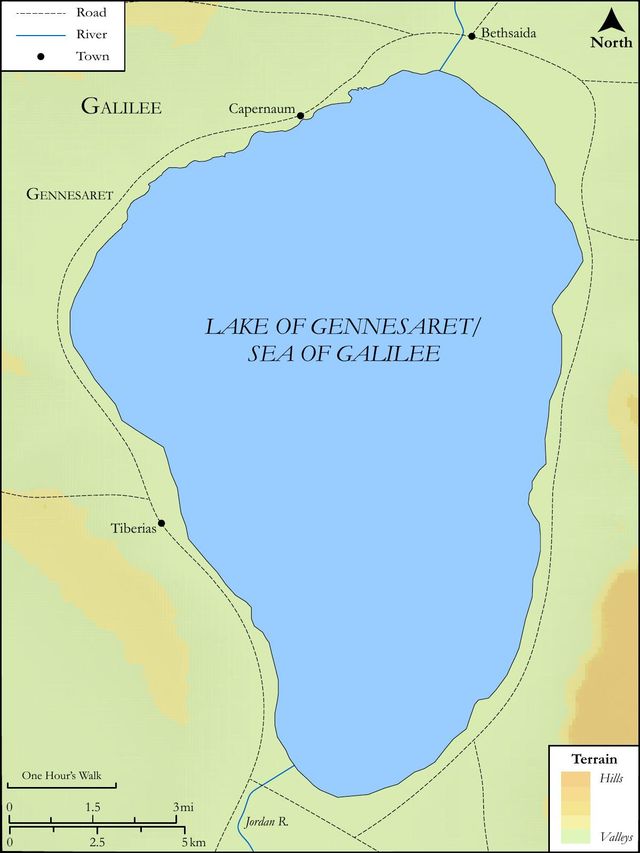
He stood by the lake of Gennesareth (Luk 5:1), upon a level with the crowd, so that they could neither see him nor hear him; he was lost among them, and, every one striving to get near him, he was crowded, and in danger of being crowded into the water: what must he do? It does not appear that his hearers had any contrivance to give him advantage, but there were two ships, or fishing boats, brought ashore, one belonging to Simon and Andrew, the other to Zebedee and his sons, Luk 5:2. At first, Christ saw Peter and Andrew fishing at some distance (so Matthew tells us, Mat 4:18); but he waited till they came to land, and till the fishermen, that is, the servants, were gone out of them having washed their nets, and thrown them by for that time: so Christ entered into that ship that belonged to Simon, and begged of him that he would lend it him for a pulpit; and, though he might have commanded him, yet, for love's sake, he rather prayed him that he would thrust out a little from the land, which would be the worse for his being heard, but Christ would have it so, that he might the better be seen; and it is his being lifted up that draws men to him. Wisdom cries in the top of high places, Pro 8:2. It intimates that Christ had a strong voice (strong indeed, for he made the dead to hear it), and that he did not desire to favour himself. There he sat down, and taught the people the good knowledge of the Lord.
III.What a particular acquaintance Christ, hereupon, fell into with these fishermen.
They had had some conversation with him before, which began at John's baptism (Joh 1:40, Joh 1:41); they were with him at Cana of Galilee (Joh 2:2), and in Judea (Joh 4:3); but as yet they were not called to attend him constantly, and therefore here we have them at their calling, and now it was that they were called into a more intimate fellowship with Christ.
1.When Christ had done preaching, he ordered Peter to apply himself to the business of his calling again: Launch out into the deep, and let down your nets, Luk 5:4. It was not the sabbath day, and therefore, as soon as the lecture was over, he set them to work. Time spent on week-days in the public exercises of religion may be but little hindrance to us in time, and a great furtherance to us in temper of mind, in our worldly business. With what cheerfulness may we go about the duties of our calling when we have been in the mount with God, and from thence fetch a double blessing into our worldly employments, and thus have them sanctified to us by the word and prayer! It is our wisdom and duty so to manage our religious exercises as that they may befriend our worldly business, and so to manage our worldly business as that it may be no enemy to our religious exercises.
2.Peter having attended upon Christ in his preaching, Christ will accompany him in his fishing. He staid with Christ at the shore, and now Christ will launch out with him into the deep. Note, Those that will be constant followers of Christ shall have him a constant guide to them.
3.Christ ordered Peter and his ship's crew to cast their nets into the sea, which they did, in obedience to him, though they had been hard at it all night, and had caught nothing, Luk 5:4, Luk 5:5. We may observe here,
(1.)How melancholy their business had now been: "Master, we have toiled all the night, when we should have been asleep in our beds, and have taken nothing, but have had our labour for our pains." One would have thought that this should have excused them from hearing the sermon; but such a love had they to the word of God that it was more refreshing and reviving to them, after a wearisome night, than the softest slumbers. But they mention it to Christ, when he bids them go a fishing again. Note,
[1.]Some callings are much more toilsome than others are, and more perilous; yet Providence has so ordered it for the common good that there is no useful calling so discouraging but some or other have a genius for it. Those who follow their business, and get abundance by it with a great deal of ease, should think with compassion of those who cannot follow theirs but with a great fatigue, and hardly get a bare livelihood by it. When we have rested all night, let us not forget those who have toiled all night, as Jacob, when he kept Laban's sheep.
[2.]Be the calling ever so laborious, it is good to see people diligent in it, and make the best of it; these fishermen, that were thus industrious, Christ singled out for his favourites. They were fit to be preferred as good soldiers of Jesus Christ who had thus learned to endure hardness.
[3.]Even those who are most diligent in their business often meet with disappointments; they who toiled all night yet caught nothing; for the race is not always to the swift. God will have us to be diligent, purely in duty to his command and dependence upon his goodness, rather than with an assurance of worldly success. We must do our duty, and then leave the event to God.
[4.]When we are tired with our worldly business, and crossed in our worldly affairs, we are welcome to come to Christ, and spread our case before him, who will take cognizance of it.
(2.)How ready their obedience was to the command of Christ: Nevertheless, at thy word, I will let down the net.
[1.]Though they had toiled all night, yet, if Christ bid them, they will renew their toil, for they know that they who wait on him shall renew their strength, as work is renewed upon their hands; for every fresh service they shall have a fresh supply of grace sufficient.
[2.]Though they have taken nothing, yet, if Christ bid them let down for a draught, they will hope to take something. Note, We must not abruptly quit the callings wherein we are called because we have not the success in them we promised ourselves. The ministers of the gospel must continue to let down that net, though they have perhaps toiled long and caught nothing; and this is thank-worthy, to continue unwearied in our labours, though we see not the success of them.
[3.]In this they have an eye to the word of Christ, and a dependence upon that: "At thy word, I will let down the net, because thou dost enjoin it, and thou dost encourage it." We are then likely to speed well when we follow the guidance of Christ's word.
4.The draught of fish they caught was so much beyond what was ever known that it amounted to a miracle (Luk 5:6): They enclosed a great multitude of fishes, so that their net broke, and yet, which is strange, they did not lose their draught. It was so great a draught that they had not hands sufficient to draw it up; but they were obliged to beckon to their partners, who were at a distance, out of call, to come and help them, Luk 5:7. But the greatest evidence of the vastness of the draught was that they filled both the ships with fish, to such a degree that they overloaded them, and they began to sink, so that the fish had like to have been lost again with their own weight. Thus many an overgrown estate, raised out of the water, returns to the place whence it came. Suppose these ships were but five or six tons a piece, what a vast quantity of fish must there be to load, nay to over-load, them both!
Now by this vast draught of fishes, (1.) Christ intended to show his dominion in the seas as well as on the dry land, over its wealth as over its waves. Thus he would show that he was that Son of man under whose feet all things were put, and particularly the fish of the sea and whatsoever passeth through the paths of the sea, Psa 8:8. (2.) He intended hereby to confirm the doctrine he had just now preached out of Peter's ship. We may suppose that the people on shore, who heard the sermon, having a notion that the preacher was a prophet sent of God, carefully attended his motions afterward, and staid halting about there, to see what he would do next; and this miracle immediately following would be a confirmation to their faith, of his being at least a teacher come from God. (3.) He intended hereby to repay Peter for the loan of his boat; for Christ's gospel now, as his ark formerly in the house of Obed-edom, will be sure to make amends, rich amends, for its kind entertainment. None shall shut a door or kindle a fire in God's house for nought, Mal 1:10. Christ's recompences for services done to his name are abundant, they are superabundant. (4.) He intended hereby to give a specimen, to those who were to be his ambassadors to the world, of the success of their embassy, that though they might for a time, and in one particular place, toil and catch nothing, yet they should be instrumental to bring in many to Christ, and enclose many in the gospel net.
5.The impression which this miraculous draught of fishes made upon Peter was very remarkable.
(1.)All concerned were astonished, and the more astonished for their being concerned. All the boat's crew were astonished at the draught of fishes which they had taken (Luk 5:9); they were all surprised; and the more they considered it, and all the circumstances of it, the more they were wonder-struck, I had almost said thunder-struck, at the thought of it, and so were also James and John, who were partners with Simon (Luk 5:10), and who, for aught that appears, were not so well acquainted with Christ, before this, as Peter and Andrew were. Now they were the more affected with it,
[1.]Because they understood it better than others did. They that were well acquainted with this sea, and it is probable had plied upon it many years, had never seen such a draught of fishes fetched out of it, nor any thing like it, any thing near it; and therefore they could not be tempted to diminish it, as others might, by suggesting that it was accidental at this time, and what might as well have happened at any time. It greatly corroborates the evidence of Christ's miracles that those who were best acquainted with them most admired them.
[2.]Because they were most interested in it, and benefited by it. Peter and his part-owners were gainers by this great draught of fishes; it was a rich booty for them and therefore it transported them, and their joy was a helper to their faith. Note, When Christ's works of wonder are to us, in particular, works of grace, then especially they command our faith in his doctrine.
(2.)Peter, above all the rest, was astonished to such a degree that he fell down at Jesus's knees, as he sat in the stern of his boat, and said, as one in an ecstasy or transport, that knew not where he was or what he said, Depart from me, for I am a sinful man, O Lord, Luk 5:8. Not that he feared the weight of the fish would sink him because he was a sinful man, but that he thought himself unworthy of the favour of Christ's presence in his boat, and worthy that it should be to him a matter rather of terror than of comfort. This word of Peter's came from the same principle with theirs who, under the Old Testament, so often said that they did exceedingly fear and quake at the extraordinary display of the divine glory and majesty. It was the language of Peter's humility and self-denial, and had not the least tincture of the devils' dialect, What have we to do with thee, Jesus, thou Son of God?
[1.]His acknowledgment was very just, and what it becomes us all to make: I am a sinful man, O Lord. Note, Even the best men are sinful men, and should be ready upon all occasions to own it, and especially to own it to Jesus Christ; for to whom else, but to him who came into the world to save sinners, should sinful men apply themselves?
[2.]His inference from it was what might have been just, though really it was not so. If I be a sinful man, as indeed I am, I ought to say, "Come to me, O Lord, or let me come to thee, or I am undone, for ever undone." But, considering what reason sinful men have to tremble before the holy Lord God and to dread his wrath, Peter may well be excused, if, in a sense of his own sinfulness and vileness, he cried out on a sudden, Depart from me. Note, Those whom Christ designs to admit to the most intimate acquaintance with him he first makes sensible that they deserve to be set at the greatest distance from him. We must all own ourselves sinful men, and that therefore Jesus Christ might justly depart from us; but we must therefore fall down at his knees, to pray him that he would not depart; for woe unto us if he leave us, if the Saviour depart from the sinful man.
6.The occasion which Christ took from this to intimate to Peter (Luk 5:10), and soon after to James and John (Mat 4:21), his purpose to make them his apostles, and instruments of planting his religion in the world. He said unto Simon, who was in the greatest surprise of any of them at this prodigious draught of fishes, "Thou shalt both see and do greater things than these; fear not; let not this astonish thee; be not afraid that, after having done thee this honour, it is so great that I shall never do thee more; no, henceforth thou shalt catch men, by enclosing them in the gospel net, and that shall be a greater instance of the Redeemer's power, and his favour to thee, than this is; that shall be a more astonishing miracle, and infinitely more advantageous than this." When by Peter's preaching three thousand souls were, in one day, added to the church, then the type of this great draught of fishes was abundantly answered.
Lastly, The fishermen's farewell to their calling, in order to their constant attendance on Christ (Luk 5:11): When they had brought their ships to land, instead of going to seek for a market for their fish, that they might make the best hand they could of this miracle, they forsook all and followed him, being more solicitous to serve the interests of Christ than to advance any secular interests of their own. It is observable that they left all to follow Christ, when their calling prospered in their hands more than ever it had done and they had had uncommon success in it. When riches increase, and we are therefore most in temptation to set our hearts upon them, then to quit them for the service of Christ, this is thank-worthy.
Historical interpretation
Seven Centuries of Reception
12 surviving comments on this verse. Each one is dated, so this reads as a timeline rather than a list.
Select a marker to jump to its quote. Markers stagger vertically where authors wrote within a few decades of each other.
We have been toiling all night. This refers symbolically to the prophets. His teaching came down from on high on the world, which stands by way of parable for the sea. The two boats represent the circumcised and the uncircumcised. They made a sign to their companions. This refers symbolically to the seventy-two, for these disciples were too few in number for the catch and the harvest.
Now in a mystery, the ship of Peter, according to Matthew, is beaten about by the waves, (Matt. 8:24.) according to Luke, is filled with fishes, in order that you might understand the Church at first wavering, at last abounding. The ship is not shaken which holds Peter; that is which holds Judas. In each was Peter; but he who trusts in his own merits is disquieted by another's. Let us beware then of a traitor, lest through one we should many of us be tossed about. Trouble is found there where faith is weak, safety here where love is perfect. Lastly, though to others it is commanded, Let down your nets, to Peter alone it is said, Launch out into the deep, i. e. into deep researches. What is so deep, as the knowledge of the Son of God! But what are the nets of the Apostles which are ordered to be let down, but the interweaving of words and certain folds, as it were, of speech, and intricacies of argument, which never let those escape whom they have once caught. And rightly are nets the Apostolical instruments for fishing, which kill not the fish that are caught, but keep them safe, and bring up those that are tossing about in the waves from the depths below to the regions above. But he says, Master, we have toiled the whole night and have caught nothing; for this is not the work of human eloquence but the gift of divine calling. But they who had before caught nothing, at the word of the Lord inclosed a great multitude of fishes.
But the other ship is Judæa, out of which James and John are chosen. These then came from the synagogue to the ship of Peter in the Church, that they might fill both ships. For at the name of Jesus every knee shall bow, whether Jew or Greek.
We may understand also by the other ship another Church, since from one Church several are derived.
(Hom. 6. in Matt.) For in His condescension to men, He called the wise men by a star, the fishermen by their art of fishing.
(de Con. Ev. lib. 4. c. 6.) John seems indeed to speak of a similar miracle, but this is very different from the one he mentions. That took place after our Lord's resurrection at the lake of Tiberias, and not only the time, but the miracle itself is very different. For in the latter the nets being let down on the right side took one hundred and fifty-three fishes, and these of large size, which it was necessary for the Evangelist to mention, because though so large the nets were not broken, and this would seem to have reference to the event which Luke relates, when from the multitude of the fishes the nets were broken.
(ut sup.) Now the circumstance of the nets breaking, and the ships being filled with the multitude of fishes so that they began to sink, signifies that there will be in the Church so great a multitude of carnal men, that unity will be broken up, and it will be split into heresies and schisms.
Having sufficiently taught the people, He returns again to His mighty works, and by the employment of fishing fishes for His disciples. Hence it follows, When he had left off speaking, he said unto Simon, Launch out into the deep, and let down your nets for a draught.
Now this was a figure of the future. For they will not labour in vain who let down the net of evangelical doctrine, but will gather together the shoals of the Gentiles.
But Peter beckons to his companions to help them. For many follow the labours of the Apostles, and first those who brought out the writings of the Gospels, next to whom are the other heads and shepherds of the Gospel, and those skilled in the teaching of the truth.
He told Simon and his companions to sail off a little from the land and to let down the net for a draught. But they replied that they had been toiling the whole night and had caught nothing. However, in the name of Christ, they let down the net, and immediately it was full of fish. By a visible sign and by a miraculous type and representation, they were fully convinced that their labor would be rewarded, and the zeal displayed in spreading out the net of the gospel teaching would be fruitful. Within this net they should most certainly catch the shoals of the heathen. But note that neither Simon nor his companions could draw the net to land. Speechless from fright and astonishment—for their wonder had made them mute—they beckoned to their partners, to those who shared their labors in fishing, to come and help them in securing their prey. For many have taken part with the holy apostles in their labors, and still do so, especially those who inquire into the meaning of what is written in the holy Gospels. Yet besides them there are also others: the pastors and teachers and rulers of the people, who are skilled in the doctrines of truth. For the net is still being drawn, while Christ fills it, and calls to conversion those who, according to the Scripture phrase, are in the depths of the sea, that is to say, those who live in the surge and waves of worldly things.
That you may understand that the Lord was speaking of spiritual fishing, however, Peter says, “Master, we toiled all night and took nothing! But at your word I will let down the nets.” It is as if he were saying, “Through the whole night our fishing has brought us nothing, and we have been laboring in vain. Now I will not fish with fishing gear but with grace, not with diligence acquired by skill but with the perseverance acquired by devotion.” When Peter lets down the nets at the word, therefore, he is in fact letting down the teachings in Christ. When he unfolds the tightly woven and well-ordered nets at the command of the Master, he is really laying out words in the name of the Savior in a fitting and clear fashion. By these words he is able to save not creatures but souls. “We toiled all night,” he says, “and took nothing.” Peter, who beforehand was unable to see in order to make a catch, enduring darkness without Christ, had indeed toiled through the whole night. But when the Savior’s light shone upon him the darkness scattered, and by faith he began to discern in the deep what he could not see with his eyes.
He chooses Peter’s boat and forsakes Moses’—that is to say, he spurns the faithless synagogue and takes the faithful church. For God appointed the two as boats, so to speak, which would fish for the salvation of humankind in this world as in a sea. As the Lord says to the apostles, “Follow me, and I will make you fishers of men.” …The church is called out into the deep, delving, as it were, into the profound mysteries of the heavens, into that depth concerning which the apostle says, “O the depth of the riches and wisdom and knowledge of God!” For this reason he says to Peter, “Put out into the deep,”—that is to say, into the depths of reflection upon the divine generation. For what is more profound than what Peter says to the Lord, “You are the Christ, the Son of the living God?” …
This boat sails upon the deeps of this world, so that, when the earth is destroyed, it will preserve unharmed all those it has taken in. Its foreshadowing can be seen already in the Old Testament. For as Noah’s ark preserved alive everyone whom it had taken in when the world was going under, so also Peter’s church will bring back unhurt everyone whom it embraces when the world goes up in flames. And as a dove brought the sign of peace to Noah’s ark when the flood was over, so also Christ will bring the joy of peace to Peter’s church when the judgment is over.
And they signaled to their partners in the other boat to come and help them. The other boat (as we have said before) is the Church of the Gentiles, which also, with one little boat not being sufficient, is filled with elect fish, because the Lord knows who are his, and with him the number of the elect is certain. And when he did not find as many in Judea as he knew to be predestined to faith and eternal life, as if seeking receptacles for his fish in another boat, he also fills the hearts of the Gentiles with the grace of faith. And it is well that, with the net being broken, the partner boat is called, for before Judas the betrayer, before Simon Magus, the abominable fish, were caught, before Ananias and Sapphira tried to deceitfully enter the net of faith, as John testifies, many of his disciples went back and walked no more with him (John VI). And then Barnabas and Paul were set apart for the apostleship to the Gentiles (Acts XIII).
And they came and filled both boats, so that they began to sink. The filling of these boats increases up to the end of the age. But that being filled they begin to sink, that is, they are pressed down in submersion (for they are not submerged, but are, however, endangered), the Apostle explains, saying: In the last days perilous times will come, and men will be lovers of themselves, etc. (II Tim. III). For boats sinking means that people, having been lifted up through faith, fall back into corrupt behavior in the world. This is also demonstrated by Peter himself in this place, still in a state of weakness. Hence it follows:
The net is broken, but the fish escape not, for the Lord preserves His own amid the violence of persecutors.
Or the other ship is the Church of the Gentiles, which itself also (one ship being not sufficient) is filled with chosen fishes. For the Lord knows who are His, and with Him the number of His elect is sure. And when He finds not in Judæa so many believers as He knows are destined to eternal life, He seeks as it were another ship to receive His fishes, and fills the hearts of the Gentiles also with the grace of faith. And well when the net brake did they call to their assistance the ship of their companions, since the traitor Judas, Simon Magus, Ananias and Sapphira, and many of the disciples, went back. And then Barnabas and Paul were separated for the Apostleship of the Gentiles.
But the filling of these ships goes on until the end of the world. But the fact that the ships, when filled, begin to sink, i. e. become weighed low down in the water; (for they are not sunk, but are in great danger,) the Apostle explains when he says, In the last days perilous times shall come; men shall be lovers of their own selves, &c. (2 Tim. 3:1, 2.) For the sinking of the ships is when men, by vicious habits, fall back into that world from which they have been elected by faith.
Peter did not refuse to comply, as it follows, And Simon answering said unto him, Master, we have toiled all night and have taken nothing. He did not go on to say, "I will not hearken to thee, nor expose myself to additional labour," but rather adds, Nevertheless, at thy word I will let down the net. But our Lord, since he had taught the people out of the ship, left not the master of the ship without reward, but conferred on him a double kindness, giving him first a multitude of fishes, and next making him His disciple: as it follows, And when they had done this, they inclosed a great multitude of fishes. They took so many fishes that they could not pull them out, but sought the assistance of their companions; as it follows, But their net brake, and they beckoned to their partners who were in the other ship to come, &c. Peter summons them by a sign, being unable to speak from astonishment at the draught of fishes. We next hear of their assistance, And they came and filled both the ships.
Continue studying Luke 5:7 across the web’s major study libraries — every link below opens this exact verse, chapter, or book on the destination site.
Read & Compare
 BibleGatewayThis verse in more than 200 translations and 70 languages.
 Bible.comThe YouVersion reader — hundreds of translations, reading plans, and highlights.
 ESV.orgCrossway's official English Standard Version reader.
 NET BibleThe NET translation with 60,000+ translators' notes on every rendering decision.
 STEP BibleTyndale House's free study tool — original text, vocabulary, and scholarly resources.
 BibliaLogos Bible Software's free web reader.
 USCCBThe New American Bible (Revised Edition) with the U.S. bishops' study notes.
Commentaries
 BibleHub CommentariesDozens of classic commentaries on this verse, gathered on one page.
 StudyLightMore than 100 commentary sets — the largest collection on the web.
 BibleRefPlain-English commentary on what this verse means, verse by verse.
 Enduring WordDavid Guzik's free commentary on this chapter, widely used by Bible teachers.
 Bible Study ToolsVerse commentary alongside Greek and Hebrew study aids.
Original Language & Research
- BibleHub InterlinearThe verse word by word — original language, transliteration, and English.
- BibleHub LexiconEvery word's original-language definition and Strong's entry.
 Blue Letter BibleDeep-study tools — Strong's numbers, concordance, and word studies.
 CNTR CollationThe earliest Greek manuscripts of this verse, collated letter by letter.
Sermons, Hymns & Audio


TrulyRandomVerse is not affiliated with these sites and doesn’t control their content. They’re linked because they’re genuinely useful.
Summary
Luke 5:7 vividly portrays the overwhelming success of the miraculous catch of fish, detailing how Simon Peter and his companions beckoned for assistance from their partners in another boat. The sheer volume of fish was so immense that it filled both vessels to the point of threatening to sink them, underscoring the extraordinary nature of Jesus' power and the immediate, practical need for collaborative effort in response to divine abundance.
Context
ShowHideLiterary Context
This verse is the immediate climax of Jesus' call of the first disciples, specifically Simon Peter, James, and John. Preceding this, Jesus had been teaching from Simon's boat, prompting Him to instruct Peter to "launch out into the deep, and let down your nets for a draught" (Luke 5:4). Despite Peter's professional skepticism after a fruitless night of toil, he obeyed. The result was an unprecedented catch, breaking their nets (Luke 5:6) and necessitating the desperate call for help described in Luke 5:7. This miraculous event serves as the powerful catalyst for Peter's profound realization of Jesus' divinity and his subsequent call to discipleship in Luke 5:8-11.
Historical & Cultural Context
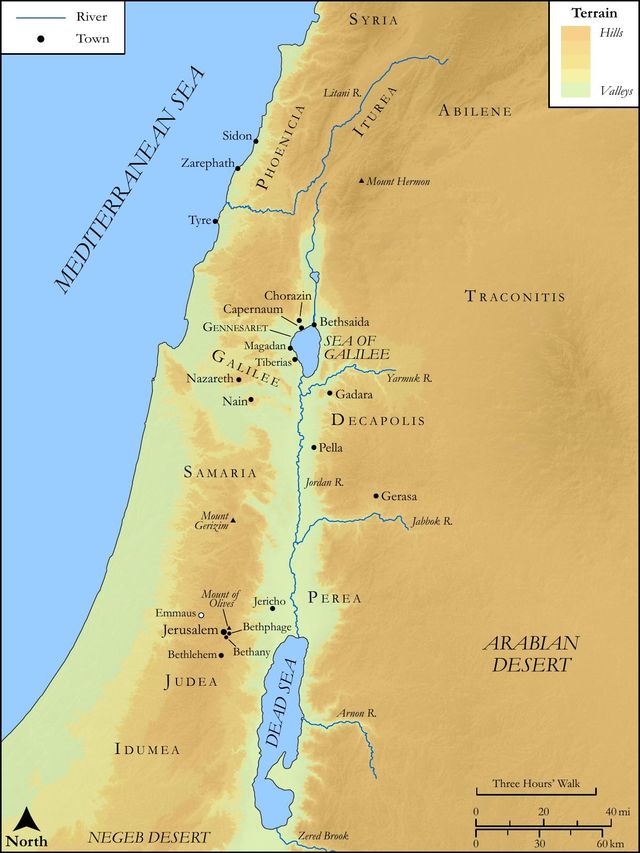
Fishing was a primary industry on the Sea of Galilee, a freshwater lake known for its abundant fish. Fishermen often worked in partnerships or family groups, sharing equipment and labor. The scene depicts a common practice of the time: multiple boats working together, especially when a large school of fish was encountered. The boats themselves were typically small, open vessels, making them susceptible to being overwhelmed by heavy loads. The urgency of "beckoning" implies a visual signal across the water, a common form of communication among fishermen working in close proximity, highlighting the immediate crisis presented by the overflowing nets.
Key Themes
ShowHideThe overwhelming catch in Luke 5:7 powerfully illustrates the theme of Divine Abundance and Provision, demonstrating Jesus' authority over creation and His capacity to bless far beyond human expectation or effort. This miracle also highlights the theme of Partnership and Collaboration, as the immediate response to the blessing is to call upon fellow laborers, foreshadowing the communal nature of the kingdom work. Furthermore, it subtly introduces the theme of The Cost and Demands of Discipleship, as such an overwhelming blessing, while glorious, also presents a practical challenge that requires immediate and strenuous effort, preparing the disciples for the vast "harvest" of souls they would later be called to gather as "fishers of men" (Luke 5:10).
Exposition and Analysis
ShowHideKey Word Analysis
ShowHideMeaning "to nod down (towards), i.e. (by analogy) to make signs to." This word conveys an urgent, non-verbal communication, likely a hand gesture or nod, indicating the immediate and critical need for assistance due to the overwhelming catch. It suggests a desperate plea across the water, emphasizing the severity of the situation.
Meaning "participant, i.e. (as noun) a sharer; by implication, an associate." This term highlights the existing professional relationship and shared enterprise among the fishermen. It underscores that the call for help was not to strangers, but to trusted colleagues already accustomed to working together, making their swift and coordinated response natural and expected within their trade.
Meaning "to sink; by implication, to drown." This word vividly describes the perilous state of the boats. The immense weight of the fish caused the vessels to take on water, threatening to submerge them. This detail amplifies the miraculous nature of the catch, emphasizing its sheer volume and the immediate danger it posed, demanding urgent intervention.
Verse Breakdown
ShowHide"And they beckoned unto their partners, which were in the other ship, that they should come and help them."
Following the miraculous and overwhelming catch, Simon Peter, James, and John, seeing their nets breaking and their boat overflowing, urgently signaled their professional associates in a nearby vessel. This action demonstrates the immediate and practical need for assistance when faced with an unprecedented blessing that exceeds one's individual capacity to manage. It highlights the existing communal and collaborative nature of their fishing enterprise.
"And they came, and filled both the ships, so that they began to sink."
In response to the urgent call, the partners arrived swiftly and joined in the effort to haul in the fish. The sheer volume of the catch was so immense that it not only filled Simon's boat but also the second boat, to such an extent that both vessels were overloaded and began to take on water, on the verge of sinking. This detail underscores the extraordinary, almost overwhelming, nature of the divine provision and the physical strain required to contain it.
Literary Devices
ShowHideLuke 5:7 employs several literary devices to convey the impact of the miraculous catch. Hyperbole is evident in the description of the boats beginning "to sink," which, while perhaps not literal submersion, strongly emphasizes the extreme abundance of fish and the immediate danger it posed. This exaggeration serves to magnify the power of Jesus' command. The scene also uses Sensory Imagery, particularly visual ("beckoned") and kinesthetic (the feeling of the boats "began to sink"), drawing the reader into the immediate, chaotic, and urgent atmosphere. Furthermore, the narrative functions as a Foreshadowing, subtly preparing the disciples for their future ministry as "fishers of men" (Luke 5:10). The overwhelming physical harvest requiring collective effort subtly prefigures the vast spiritual harvest that would demand their united and strenuous labor.
Theological and Thematic Connections
ShowHideThe overwhelming catch of fish in Luke 5:7 serves as a powerful theological statement about God's abundant provision and His capacity to bless beyond human comprehension or effort. It reveals that divine blessings can be so immense that they necessitate collaboration and mutual support, challenging individuals to move beyond self-reliance and embrace the strength found in community. This miracle also highlights the practical implications of God's power: blessings, while glorious, often come with the demand for diligent stewardship and collective effort. It underscores that the work of God, whether in physical provision or spiritual harvest, frequently requires the united labor of His people.
Reflection and Application
ShowHideLuke 5:7 offers profound insights for contemporary believers. It reminds us that God's blessings often exceed our expectations and even our capacity to manage them alone. Just as the disciples needed to call for help, we too must recognize our limitations and be willing to seek assistance from others, especially within the community of faith, when faced with overwhelming tasks or abundant opportunities. This verse calls us to embrace partnership and collaboration, understanding that the work of the Kingdom is rarely a solitary endeavor but thrives on mutual support and shared responsibility. It challenges us to consider how we respond to moments of great blessing – do we hoard, or do we share the burden and the bounty? Ultimately, it encourages us to trust in God's provision while actively engaging in the practical, often demanding, work required to steward His blessings effectively, whether they are material, spiritual, or relational.
Questions for Reflection
ShowHideFAQ
ShowHideWhy did the boats begin to sink, and what is the significance of this detail?
ShowHideThe boats began to sink because the sheer volume of fish caught was so immense that it overloaded both vessels beyond their capacity. The significance of this detail is multifaceted. First, it vividly underscores the miraculous nature of the catch, demonstrating Jesus' unparalleled power over creation. This was not merely a good day of fishing but an extraordinary, divinely orchestrated event. Second, it highlights the overwhelming abundance of God's provision, which can exceed human expectation and even infrastructure. Third, it serves as a catalyst for the disciples' response, particularly Peter's, who immediately recognized the divine power at work and was humbled by it (Luke 5:8). Finally, it foreshadows the demands of the spiritual harvest they would soon be called to gather, implying that the "fishing for men" would also be so abundant it would require immense effort and collaboration (Luke 5:10).
Christ-Centered Fulfillment
ShowHideLuke 5:7, with its depiction of an overwhelming catch threatening to sink the boats, powerfully foreshadows the abundant harvest of souls that Jesus came to gather and that His disciples would be empowered to continue. Just as the fish were gathered by Jesus' word, so too would humanity be drawn to the Son of Man by the power of the Gospel. The call for partners to help manage the overflowing bounty points to the essential collaborative nature of the Church's mission. No single individual or group can contain the vast spiritual harvest that Jesus initiates; it requires the collective effort of the entire Body of Christ, working together in unity, as described in Ephesians 4:16. This miraculous provision also speaks to Jesus' identity as the Lord of all creation, capable of providing not just physical sustenance but also the spiritual nourishment and salvation that overflows to all who believe. The "sinking" boats, though a moment of crisis, ultimately lead to the disciples abandoning everything to follow Christ (Luke 5:11), demonstrating that true fulfillment is found not in managing earthly abundance, but in committing entirely to the One who offers life abundant and eternal purpose.