


John 6:22
- ΤῇTēaOn theG3588T-DSFDefinite article Dative Singular Feminine
- ἐπαύριονepaurionnext dayG1887ADVAdverb
- ὁhotheG3588T-NSMDefinite article Nominative Singular Masculine
- ὄχλοςochloscrowdG3793N-NSMNoun Nominative Singular Masculine
- ὁhowhichG3588T-NSMDefinite article Nominative Singular Masculine
- ἑστηκὼςhestēkōsalready standingG2476V-RAP-NSMVerb Perfect Active Participle Nominative Singular Masculine
- πέρανperanon the other sideG4008PREPPreposition
- τῆςtēsof theG3588T-GSFDefinite article Genitive Singular Feminine
- θαλάσσηςthalassēsseaG2281N-GSFNoun Genitive Singular Feminine
- εἶδονeidonhaving seenG1492V-2AAI-3PVerb 2nd Aorist Active Indicative 3rd Plural
- ὅτιhotithatG3754CONJConjunction
- πλοιάριονploiarionboatG4142N-NSNNoun Nominative Singular Neuter
- ἄλλοallootherG243A-NSNAdjective Nominative Singular Neuter
- οὐκouknoG3756PRT-NNegative Particle Negative
- ἦνēnwasG1510V-IAI-3SVerb Imperfect Active Indicative 3rd Singular
- ἐκεῖekeithereG1563ADVAdverb
- εἰeionlyG1487CONDConjunction
- μὴmēexceptG3361PRT-NNegative Particle Negative
- ἓνhenoneG1520A-NSNAdjective Nominative Singular Neuter
- ἐκεῖνοekeinothatG1565D-NSNDemonstrative pronoun Nominative Singular Neuter
- εἰςeisintoG1519PREPPreposition
- ὃhowhichG3739R-ASNRelative pronoun Accusative Singular Neuter
- ἐνέβησανenebēsanclimbedG1684V-2AAI-3PVerb 2nd Aorist Active Indicative 3rd Plural
- οἱhoitheG3588T-NPMDefinite article Nominative Plural Masculine
- μαθηταὶmathētaidisciplesG3101N-NPMNoun Nominative Plural Masculine
- αὐτοῦautouof himG846P-GSMPersonal pronoun Genitive Singular Masculine
- καὶkaiandG2532CONJConjunction
- ὅτιhotiforG3754CONJConjunction
- οὐounotG3756PRT-NNegative Particle Negative
- συνεισῆλθενsuneisēlthenwent withG4897V-2AAI-3SVerb 2nd Aorist Active Indicative 3rd Singular
- τοῖςtoistheG3588T-DPMDefinite article Dative Plural Masculine
- μαθηταῖςmathētaisdisciplesG3101N-DPMNoun Dative Plural Masculine
- αὐτοῦautouof HimG846P-GSMPersonal pronoun Genitive Singular Masculine
- ὁho<the>G3588T-NSMDefinite article Nominative Singular Masculine
- ἸησοῦςIēsousJesusG2424N-NSM-PNoun Nominative Singular Masculine Individual
- εἰςeisintoG1519PREPPreposition
- τὸtotheG3588T-ASNDefinite article Accusative Singular Neuter
- πλοῖονploionboatG4143N-ASNNoun Accusative Singular Neuter
- ἀλλὰallabutG235CONJConjunction
- μόνοιmonoialoneG3441A-NPMAdjective Nominative Plural Masculine
- οἱhoitheG3588T-NPMDefinite article Nominative Plural Masculine
- μαθηταὶmathētaidisciplesG3101N-NPMNoun Nominative Plural Masculine
- αὐτοῦautouof HimG846P-GSMPersonal pronoun Genitive Singular Masculine
- ἀπῆλθον·apēlthonwent awayG565V-2AAI-3PVerb 2nd Aorist Active Indicative 3rd Plural
English is a literal word-by-word gloss of the Greek, not the KJV's wording. Why?
This is the original text the KJV's translators worked from — each Greek word with its own literal English meaning in this verse, prepared by scholars at Tyndale House, Cambridge. The KJV translates whole sentences, not word by word, so its wording differs: one Greek word can become several English words, and the KJV may choose “charity” where the gloss reads “love”. Both are faithful — they answer different questions. For the KJV's own rendering, switch to the KJV text.
Details
See on the biblical-era map
Study this verse
Public-domain commentary
Matthew Henry
From his Commentary on the Whole Bible. Henry comments on passages, not single verses — this entry covers John 6:22–27. His four-level outline is real structure in the source text, so it is rendered as structure.
In these verses we have,
I.The careful enquiry which the people made after Christ, Joh 6:23, Joh 6:24.
They saw the disciples go to sea; they saw Christ retire to the mountain, probably with an intimation that he desired to be private for some time; but, their hearts being set upon making him a king, they way-laid his return, and the day following, the hot fit of their zeal still continuing,
1.They were much at a loss for him. He was gone, and they knew not what was become of him. They saw there was no boat there but that in which the disciples went off, Providence so ordering it for the confirming of the miracle of his walking on the sea, for there was no boat for him to go in. They observed also that Jesus did not go with his disciples, but that they went off alone, and left him among them on their side of the water. Note, Those that would find Christ must diligently observe all his motions, and learn to understand the tokens of his presence and absence, that they may steer accordingly.
2.They were very industrious in seeking him. They searched the places thereabouts, and when they saw that Jesus was not there, nor his disciples (neither he nor any one that could give tidings of him), they resolved to search elsewhere. Note, Those that would find Christ must accomplish a diligent search, must seek till they find, must go from sea to sea, to seek the word of God, rather than live without it; and those whom Christ has feasted with the bread of life should have their souls carried out in earnest desires towards him. Much would have more, in communion with Christ. Now,
(1.)They resolved to go to Capernaum in quest of him. There were his head-quarters, where he usually resided. Thither his disciples were gone; and they knew he would not be long absent from them. Those that would find Christ must go forth by the footsteps of the flock.
(2.)Providence favoured them with an opportunity of going thither by sea, which was the speediest way; for there came other boats from Tiberias, which lay further off upon the same shore, nigh, though not so nigh to the place where they did eat bread, in which they might soon make a trip to Capernaum, and probably the boats were bound for that port. Note, Those that in sincerity seek Christ, and seek opportunities of converse with him, are commonly owned and assisted by Providence in those pursuits. The evangelist, having occasion to mention their eating the multiplied bread, adds, After that the Lord had given thanks, Joh 6:11. So much were the disciples affected with their Master's giving thanks that they could never forget the impressions made upon them by it, but took a pleasure in remembering the gracious words that then proceeded out of his mouth. This was the grace and beauty of that meal, and made it remarkable; their hearts burned within them.
3.They laid hold of the opportunity that offered itself, and they also took shipping, and came to Capernaum, seeking for Jesus. They did not defer, in hopes to see him again on this side the water; but their convictions being strong, and their desires warm, they followed him presently. Good motions are often crushed, and come to nothing, for want of being prosecuted in time. They came to Capernaum, and, for aught that appears, these unsound hypocritical followers of Christ had a calm and pleasant passage, while his sincere disciples had a rough and stormy one. It is not strange if it fare worst with the best men in this evil world. They came, seeking Jesus. Note, Those that would find Christ, and find comfort in him, must be willing to take pains, and, as here, to compass sea and land to seek and serve him who came from heaven to earth to seek and save us.
II.The success of this enquiry:
They found him on the other side of the sea, Joh 6:25. Note, Christ will be found of those that seek him, first or last; and it is worth while to cross a sea, nay, to go from sea to sea, and from the river to the ends of the earth, to seek Christ, if we may but find him at last. These people appeared afterwards to be unsound, and not actuated by any good principle, and yet were thus zealous. Note, Hypocrites may be very forward in their attendance on God's ordinances. If men have no more to show for their love to Christ than their running after sermons and prayers, and their pangs of affection to good preaching, they have reason to suspect themselves no better than this eager crowd. But though these people were no better principled, and Christ knew it, yet he was willing to be found of them, and admitted them into fellowship with him. If we could know the hearts of hypocrites, yet, while their profession is plausible, we must not exclude them from our communion, much less when we do not know their hearts.
III.The question they put to him when they found him:
Rabbi, when camest thou hither? It should seem by Joh 6:59 that they found him in the synagogue. They knew this was the likeliest place to seek Christ in, for it was his custom to attend public assemblies for religious worship, Luk 4:16. Note, Christ must be sought, and will be found, in the congregations of his people and in the administration of his ordinances; public worship is what Christ chooses to own and grace with his presence and the manifestations of himself. There they found him, and all they had to say to him was, Rabbi, when camest thou hither? They saw he would not be made a king, and therefore say no more of this, but call him Rabbi, their teacher. Their enquiry refers not only to the time, but to the manner, of his conveying himself thither; not only When, but, "How, camest thou thither?" for there was no boat for him to come in. They were curious in asking concerning Christ's motions, but not solicitous to observe their own.
IV.The answer Christ gave them, not direct to their question (what was it to them when and how he came thither?) but such an answer as their case required.
1.He discovers the corrupt principle they acted from in following him (Joh 6:26): "Verily, verily, I say unto you, I that search the heart, and know what is in man, I the Amen, the faithful witness, Rev 3:14, Rev 3:15. You seek me; that is well, but it is not from a good principle." Christ knows not only what we do, but why we do it. These followed Christ,
(1.)Not for his doctrine's sake: Not because you saw the miracles. The miracles were the great confirmation of his doctrine; Nicodemus sought for him for the sake of them (Joh 3:2), and argued from the power of his works to the truth of his word; but these were so stupid and mindless that they never considered this. But,
(2.)It was for their own bellies' sake: Because you did eat of the loaves, and were filled; not because he taught them, but because he fed them. He had given them,
[1.]A full meal's meat: They did eat, and were filled; and some of them perhaps were so poor that they had not known of a long time before now what it was to have enough, to eat and leave.
[2.]A dainty meal's meat; it is probable that, as the miraculous wine was the best wine, so was the miraculous food more than usually pleasant.
[3.]A cheap meal's meat, that cost them nothing; no reckoning was brought in. Note, Many follow Christ for loaves, and not for love. Thus those do who aim at secular advantage in their profession of religion, and follow it because by this craft they get their preferments. Quantis profuit nobis haec fabula de Christo - This fable respecting Christ, what a gainful concern we have made of it! said one of the popes. These people complimented Christ with Rabbi, and showed him great respect, yet he told them thus faithfully of their hypocrisy; his ministers must hence learn not to flatter those that flatter them, nor to be bribed by fair words to cry peace to all that cry rabbi to them, but to give faithful reproofs where there is cause for them.
2.He directs them to better principles (Joh 6:27): Labour for that meat which endures to everlasting life. With the woman of Samaria he had discoursed of spiritual things under the similitude of water; here he speaks of them under the similitude of meat, taking occasion from the loaves they had eaten. His design is,
(1.)To moderate our worldly pursuits: Labour not for the meat that perishes. This does not forbid honest labour for food convenient, Th2 3:12. But we must not make the things of this world our chief care and concern. Note,
[1.]The things of the world are meat that perishes. Worldly wealth, honour, and pleasure, are meat; they feed the fancy (and many times this is all) and fill the belly. These are things which mean hunger after as meat, and glut themselves with, and which a carnal heart, as long as they last, may make a shift to live upon; but they perish, are of a perishing nature, wither of themselves, and are exposed to a thousand accidents; those that have the largest share of them are not sure to have them while they live, but are sure to leave them and lose them when they die.
[2.]It is therefore folly for us inordinately to labour after them. First, We must not labour in religion, nor work the works thereof, for this perishing meat, with an eye to this; we must not make our religion subservient to a worldly interest, nor aim at secular advantages in sacred exercises. Secondly, We must not at all labour for this meat; that is, we must not make these perishing things our chief good, nor make our care and pains about them our chief business; not seek those things first and most, Pro 23:4, Pro 23:5.
(2.)To quicken and excite our gracious pursuits: "Bestow your pains to better purpose, and labour for that meat which belongs to the soul," of which he shows,
[1.]That it is unspeakably desirable: It is meat which endures to everlasting life; it is a happiness which will last as long as we must, which not only itself endures eternally, but will nourish us up to everlasting life. The blessings of the new covenant are our preparative for eternal life, our preservative to it, and the pledge and earnest of it.
[2.]It is undoubtedly attainable. Shall all the treasures of the world be ransacked, and all the fruits of the earth gathered together, to furnish us with provisions that will last to eternity? No, The sea saith, It is not in me, among all the treasures hidden in the sand. It cannot be gotten for gold; but it is that which the Son of man shall give; hēn dōsei, either which meat, or which life, the Son of man shall give. Observe here, First, Who gives this meat: the Son of man, the great householder and master of the stores, who is entrusted with the administration of the kingdom of God among men, and the dispensation of the gifts, graces, and comforts of that kingdom, and has power to give eternal life, with all the means of it and preparatives for it. We are told to labour for it, as if it were to be got by our own industry, and sold upon that valuable consideration, as the heathen said, Dii laboribus omnia vendunt - The gods sell all advantages to the industrious. But when we have laboured ever so much for it, we have not merited it as our hire, but the Son of man gives it. And what more free than gift? It is an encouragement that he who has the giving of it is the Son of man, for then we may hope the sons of men that seek it, and labour for it, shall not fail to have it. Secondly, What authority he has to give it; for him has God the Father sealed, touton gar ho Patēr esphragisen̂ ho Theos - for him the Father has sealed (proved and evidenced) to be God; so some read it; he has declared him to be the Son of God with power. He has sealed him, that is, has given him full authority to deal between God and man, as God's ambassador to man and man's intercessor with God, and has proved his commission by miracles. Having given him authority, he has given us assurance of it; having entrusted him with unlimited powers, he has satisfied us with undoubted proofs of them; so that as he might go on with confidence in his undertaking for us, so may we in our resignations to him. God the Father scaled him with the Spirit that rested on him, by the voice from heaven, by the testimony he bore to him in signs and wonders. Divine revelation is perfected in him, in him the vision and prophecy is sealed up (Dan 9:24), to him all believers seal that he is true (Joh 3:33), and in him they are all sealed, Co2 1:22.
Historical interpretation
Four Centuries of Reception
8 surviving comments on this verse. Each one is dated, so this reads as a timeline rather than a list.
Select a marker to jump to its quote. Markers stagger vertically where authors wrote within a few decades of each other.
A seal throws out a perfect impression of the stamp, at the same time that it takes in that impression. This is not a perfect illustration of the Divine nativity: for sealing supposes matter, different kinds of matter, the impression of harder upon softer. Yet He who was God Only-Begotten, and the Son of man only by the Sacrament of our salvation, makes use of it to express the Father’s fullness as stamped upon Himself. He wishes to show the Jews He has the power of giving the eternal meat, because He contained in Himself the fullness of God.
(viii. de Trin. c. 44) A seal throws out a perfect impression of the stamp, at the same time that it takes in that impression. This is not a perfect illustration of the Divine nativity: for sealing supposes matter, different kinds of matter, the impression of harder upon softer. Yet He who was God Only-Begotten, and the Son of man only by the Sacrament of our salvation, makes use of it to express the Father's fulness as stamped upon Himself. He wishes to show the Jews He has the power of giving the eternal meat, because He contained in Himself the fulness of God.
What else then could they suspect, save that He had arrived there crossing the sea on foot? for it was not possible to say that He had passed over in another ship. For "there was one," saith the Evangelist, "into which His disciples entered." Still when they came to Him after so great a wonder, they asked Him not how He crossed over, how He arrived there, nor sought to understand so great a sign. But what say they? "Master, when camest Thou hither?"
(Hom. xliii. 2) Our Lord, though He did not actually show Himself to the multitude walking on the sea, yet gave them the opportunity of inferring what had taken place; The day following, the people which stood on the other side of the sea saw that there was none other boat there, save that one whereinto His disciples were entered, and that Jesus went not with His disciples into the boat, but that His disciples were gone away alone. What was this but to suspect that He had walked across the sea, on His going away? For He could not have gone over in a ship, as there was only one there, that in which His disciples had entered; and He had not gone in with them.
(Hom. xliii. 1) Yet after so great a miracle, they did not ask Him how He had passed over, or show any concern about it: as appears from what follows; And when they had found Him on the other side of the sea, they said unto Him, Rabbi, when earnest Thou hither? Except we say that this when meant how. And observe their lightness of mind. After saying, This is that Prophet, and wishing to take Him by force to make Him king, when they find Him, nothing of the kind is thought of.
And why is John so exact? Why said he not that the multitudes having passed over on the next day departed? He desires to teach us something else, namely, that Jesus allowed the multitudes if not openly, at least in a secret manner, to suspect what had taken place. For, "They saw," saith he, "that there was none other boat there but one, and that Jesus went not into it with His disciples."
Unless any one affirm that the "when" is here used by them in the sense of "how." But it is worth while also to notice here the fickleness of their impulses. For they who said, "This is that Prophet"; they who were anxious to "take Him and make Him a king," now when they have found Him take no such counsel, but having cast out their astonishment, they no longer admire Him for His former deeds. They sought Him, desiring again to enjoy a table like the first.
The miracle does not escape notice, I mean Jesus walking on. the very sea, although it took place by night and in the dark, and was ordered in secret. But the crowd of those who were wont to follow Him perceives, assured (as is probable) by much watching, that He had neither sailed with His disciples, nor had crossed in any other ship. For there was there the Apostles' ship alone, which they took and went away before Him. Nought then is hidden of what is good even though it be performed in secret by any, and here we see that that is true, Nothing is secret that shall not be made manifest, neither hid that shall not be known and come abroad. I say then that he who desireth to track the footsteps of Christ, and, as far as man can, to be moulded after His Pattern, ought not to be eager to live in much boasting, nor when he practises virtue to be led away in pursuit of praise, nor if he enter upon an extraordinary and exceeding disciplined life, should he desire to glory immoderately thereat, but should desire to be seen alone by the Eyes of the Deity, Who revealeth hidden things, and that which is performed in secret bringeth He into clearest apprehension.
To take the passage mystically: on the day following, i. e. after the ascension of Christ, the multitude standing in good works, not lying in worldly pleasures, expects Jesus to come to them. The one ship is the one Church: the other ships which come besides, are the conventicles of heretics, who seek their own, not the things of Jesus Christ. Wherefore He well says, Ye seek Me, because ye did eat of the loaves. (Phil. 2:21)
Continue studying John 6:22 across the web’s major study libraries — every link below opens this exact verse, chapter, or book on the destination site.
Read & Compare
 BibleGatewayThis verse in more than 200 translations and 70 languages.
 Bible.comThe YouVersion reader — hundreds of translations, reading plans, and highlights.
 ESV.orgCrossway's official English Standard Version reader.
 NET BibleThe NET translation with 60,000+ translators' notes on every rendering decision.
 STEP BibleTyndale House's free study tool — original text, vocabulary, and scholarly resources.
 BibliaLogos Bible Software's free web reader.
 USCCBThe New American Bible (Revised Edition) with the U.S. bishops' study notes.
Commentaries
 BibleHub CommentariesDozens of classic commentaries on this verse, gathered on one page.
 StudyLightMore than 100 commentary sets — the largest collection on the web.
 BibleRefPlain-English commentary on what this verse means, verse by verse.
 Enduring WordDavid Guzik's free commentary on this chapter, widely used by Bible teachers.
 Bible Study ToolsVerse commentary alongside Greek and Hebrew study aids.
Original Language & Research
- BibleHub InterlinearThe verse word by word — original language, transliteration, and English.
- BibleHub LexiconEvery word's original-language definition and Strong's entry.
 Blue Letter BibleDeep-study tools — Strong's numbers, concordance, and word studies.
 CNTR CollationThe earliest Greek manuscripts of this verse, collated letter by letter.
Sermons, Hymns & Audio


TrulyRandomVerse is not affiliated with these sites and doesn’t control their content. They’re linked because they’re genuinely useful.
Summary
John 6:22 serves as a critical transitional verse, detailing the crowd's observations on the day following the miraculous feeding of the five thousand. The people, still gathered on the eastern side of the Sea of Galilee, noticed a significant detail: only one boat had departed the previous evening, the one carrying Jesus's disciples, and Jesus himself had not boarded it with them. This realization creates a narrative mystery regarding Jesus's whereabouts, setting the stage for their subsequent search for Him and the profound "Bread of Life" discourse that follows.
Context
ShowHideLiterary Context
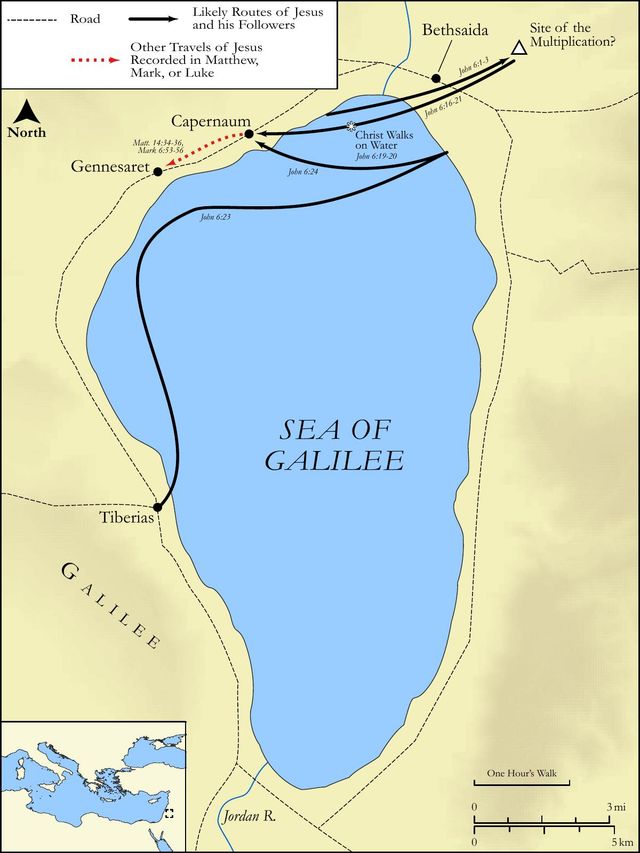
This verse immediately follows the miraculous feeding of the five thousand and Jesus's subsequent withdrawal from the crowd. In John 6:15, Jesus perceives the crowd's intention to make Him king by force and withdraws to a mountain alone to pray. Meanwhile, His disciples embark on a boat to cross the Sea of Galilee. Unbeknownst to the crowd, Jesus later performs another miracle by walking on the water to join His disciples in the boat, arriving safely at their destination. John 6:22 bridges the gap between these events and the crowd's pursuit of Jesus, explaining their confusion and motivation to cross the sea themselves in search of Him, ultimately leading to the significant "Bread of Life" discourse.
Historical & Cultural Context
The events of John 6 take place around the Sea of Galilee, a freshwater lake in northern Israel, which was a hub of fishing and trade. Boats were the primary mode of transport across the lake. The crowd's presence on the "other side of the sea" (likely the eastern shore, near Bethsaida or the Decapolis region) indicates their continued expectation of Jesus after the miraculous meal. Their desire to make Jesus king (as seen in John 6:15) reflects a common Jewish expectation for a messianic figure who would deliver them from Roman rule and provide physical sustenance, echoing the manna in the wilderness. Their diligent observation of the boats underscores their practical understanding of travel and their keen interest in Jesus's movements.
Key Themes
ShowHideJohn 6 is rich with theological themes that John 6:22 subtly introduces. A primary theme is Divine Sovereignty versus Human Perception. The crowd's inability to comprehend Jesus's movement without a boat highlights the limitations of human understanding when confronted with divine power, foreshadowing the greater spiritual truths they will struggle to grasp later in the chapter. Another key theme is Seeking Jesus for the Wrong Reasons. The crowd's diligent search for Jesus is initially motivated by their desire for more miraculous bread (John 6:26), rather than for His true identity as the Son of God and the source of eternal life. This verse sets up the dramatic contrast between their physical pursuit and Jesus's subsequent call to spiritual understanding.
Exposition and Analysis
ShowHideKey Word Analysis
ShowHideThis adverb, derived from "upon" and "tomorrow," precisely marks the temporal setting of the crowd's observation. It signifies the immediate aftermath of the feeding miracle and Jesus's withdrawal, establishing a direct chronological link between the previous day's events and the crowd's current perplexity. This temporal marker is crucial for understanding the crowd's continued presence and their subsequent actions.
This primary verb means "to see" literally or figuratively, and in its perfect tense, "to know." Here, it refers to the crowd's direct visual perception. Their "seeing" that only one boat departed and that Jesus was not in it forms the basis of their logical deduction and subsequent confusion. It underscores their reliance on empirical evidence, which contrasts sharply with the unseen, supernatural reality of Jesus's actions (walking on water).
This adjective signifies being "sole or single; by implication, mere." When applied to the disciples, it emphasizes their solitary departure in the boat, without Jesus. This detail is pivotal because it creates the narrative mystery: if the disciples left alone in the only boat, and Jesus did not accompany them, how did He cross the sea? This "alone" status of the disciples is the critical piece of information that fuels the crowd's subsequent search and sets the stage for Jesus's revelation of His supernatural power.
Verse Breakdown
ShowHide"The day following, when the people which stood on the other side of the sea saw"
This opening clause establishes the time frame as the morning after the feeding miracle, identifying the observers as the "people" (Greek: ochlos, a throng or multitude) who had remained on the eastern shore of the Sea of Galilee. Their act of "seeing" initiates the narrative's central dilemma.
"that there was none other boat there, save that one whereinto his disciples were entered"
This part specifies the crucial observation: the crowd noted the absence of any other boats, with the single exception of the vessel that had carried Jesus's disciples away the previous evening. This detail highlights the limited means of transport available and the crowd's careful attention to the movements on the sea.
"and that Jesus went not with his disciples into the boat"
This clause directly states the second key observation: Jesus did not board the boat with His disciples. This fact, combined with the previous point, creates the logical conundrum for the crowd, as they are left to wonder how Jesus could have crossed the water if He didn't use the only available vessel.
"but [that] his disciples were gone away alone;"
This final clause reinforces the disciples' solitary departure, emphasizing that Jesus was not with them. The word "alone" (Greek: mónos) is critical, solidifying the crowd's bewilderment and setting the stage for their search for Jesus, who seemingly vanished without a conventional means of transport.
Literary Devices
ShowHideJohn 6:22 masterfully employs Foreshadowing and Narrative Gap to build suspense and prepare the reader for subsequent events. The crowd's meticulous observation of the boats and the conspicuous absence of Jesus creates a deliberate Narrative Gap in their understanding. They know Jesus did not leave by boat, but they do not know how He did cross the sea. This gap in their knowledge, shared initially with the reader, serves as a Foreshadowing of Jesus's supernatural ability to walk on water (John 6:16-21), a miracle that occurred unseen by the crowd. The verse also subtly uses Irony, as the crowd, having just witnessed a massive miracle of provision, still relies on conventional logic regarding transportation, highlighting their limited perception of Jesus's divine power.
Theological and Thematic Connections
ShowHideJohn 6:22 underscores the theme of divine mystery and the limitations of human understanding. The crowd's logical deduction, based on their observation of the boats, leads them to a dead end concerning Jesus's whereabouts. This mirrors humanity's frequent inability to grasp God's ways, which often transcend our rational frameworks. Just as Jesus moved supernaturally without a boat, God often works in ways that are beyond our comprehension or expectation, calling us to trust in His unseen hand and sovereign plan. This verse sets the stage for Jesus to reveal deeper truths about Himself, moving the crowd from a pursuit based on physical needs and logical assumptions to a call for spiritual discernment and faith in Him as the true "Bread of Life."
Reflection and Application
ShowHideJohn 6:22 invites us to reflect on the nature of our pursuit of Jesus. The crowd, having just been miraculously fed, was keenly interested in Jesus, but their interest was rooted in physical provision and logical deduction. They sought Him because they couldn't explain His disappearance, and likely hoped for more bread. This challenges us to examine our own motivations for seeking Christ. Are we pursuing Him primarily for what He can do for us – for comfort, provision, or answers to our problems – or for who He truly is as the Lord of all, the source of eternal life? The verse also subtly teaches us about divine providence. Just as Jesus had a supernatural way of crossing the sea that was hidden from the crowd, God often works behind the scenes in our lives, orchestrating events in ways we cannot immediately perceive or understand. Our call is to trust His sovereignty, even when the path forward is unclear or defies our logical expectations.
Questions for Reflection
ShowHideFAQ
ShowHideWhy were the people surprised by Jesus's apparent disappearance?
ShowHideThe people were surprised because they had observed two key facts: first, only one boat had departed the previous evening from their side of the sea, and second, Jesus had not entered that boat with His disciples. Given that boats were the only conventional means of crossing the Sea of Galilee, Jesus's absence from that boat, combined with no other boats being available, created a logical conundrum for them. They couldn't fathom how He could have crossed to the other side without a vessel, leading to their perplexity and subsequent search for Him, as described in John 6:24.
What happened to Jesus between John 6:21 and 6:22?
ShowHideBetween the disciples' departure in the boat (implied in John 6:17) and the crowd's observation in John 6:22, Jesus performed the miracle of walking on water. After sending His disciples ahead, Jesus went to a mountain to pray (John 6:15). Later, as the disciples struggled against a strong wind while crossing the sea, Jesus came to them, walking on the water, and entered their boat (John 6:16-21). This supernatural journey was unseen by the crowd, explaining their confusion the following day.
What is the significance of the "other side of the sea" in this context?
ShowHideThe "other side of the sea" refers to the eastern shore of the Sea of Galilee, likely near Bethsaida or the Decapolis region, where the feeding of the five thousand had occurred. Its significance lies in establishing the crowd's location relative to the disciples' destination (Capernaum, on the western shore). The fact that the crowd remained on the eastern side, observing the boat traffic, underscores their continued interest in Jesus. Their subsequent decision to cross the sea themselves to Capernaum (John 6:24) highlights their determination to find Him, setting the stage for the pivotal "Bread of Life" discourse that takes place there.
Christ-Centered Fulfillment
ShowHideJohn 6:22, by highlighting the crowd's inability to comprehend Jesus's supernatural movement, subtly points to the profound mystery of Christ's person and work. The crowd's logical conclusion—that Jesus could not have crossed the sea without a boat—is shattered by the reality of His divine power, exemplified by His walking on water (John 6:19). This foreshadows the greater spiritual truths about Jesus that humanity, relying solely on human reason, struggles to grasp. Just as they sought a physical explanation for His disappearance, many seek Christ for tangible benefits, failing to see Him as the ultimate spiritual sustenance. This verse sets the stage for Jesus to reveal Himself not merely as a miracle worker, but as the "Bread of Life" who descended from heaven (John 6:35), offering eternal life to those who believe, a truth far surpassing any physical provision or human logic. He is the one who transcends all natural limitations, demonstrating His divine nature and foreshadowing His ultimate triumph over death and the grave, providing a way of salvation that no human effort or understanding could ever achieve (John 11:25-26).