


Hosea 13:7
Bible text: King James Version (1769 Blayney text) · Public domain
Bible text: Berean Standard Bible · Public domain
Bible text: American Standard Version (1901) · Public domain
Bible text: World English Bible, Messianic edition · Public domain
Bible text: Geneva Bible (1599) · Public domain
Bible text: Young's Literal Translation · Public domain
- וָאֱהִיva·'e·Hiand I becameH1961Conj-w ¦ V-Qal-ConsecImperf-1csVerb Qal Consecutive Imperfect 1st Singular common genderוָandאֱהִיI became
- לָהֶםla·Hemto themPrep-l ¦ 3mpSuffix Personal 3rd Plural Masculineלָtoהֶםthem
- כְּמוֹke·movlikeH3644PrepPreposition
- שָׁחַלSha·chala lionH7826N-msNoun Singular Masculine Absolute
- כְּנָמֵרke·na·Merlike a leopardH5246Prep-k ¦ N-msNoun Singular Masculine Absoluteכְּlikeנָמֵרa leopard
- עַל'alonH5921PrepPreposition
- דֶּרֶךְDe·rekha roadH1870N-csNoun Singular common gender Absolute
- אָשׁוּר'a·ShurI will watchH7789V-Qal-Imperf-1csVerb Qal Imperfect 1st Singular common gender
English is a literal word-by-word gloss of the Hebrew, not the KJV's wording. Why?
This is the original text the KJV's translators worked from — each Hebrew word with its own literal English meaning in this verse, prepared by scholars at Tyndale House, Cambridge. The KJV translates whole sentences, not word by word, so its wording differs: one Hebrew word can become several English words, and the KJV may choose “the LORD” where the gloss reads “Yahweh”. Both are faithful — they answer different questions. For the KJV's own rendering, switch to the KJV text.
Details
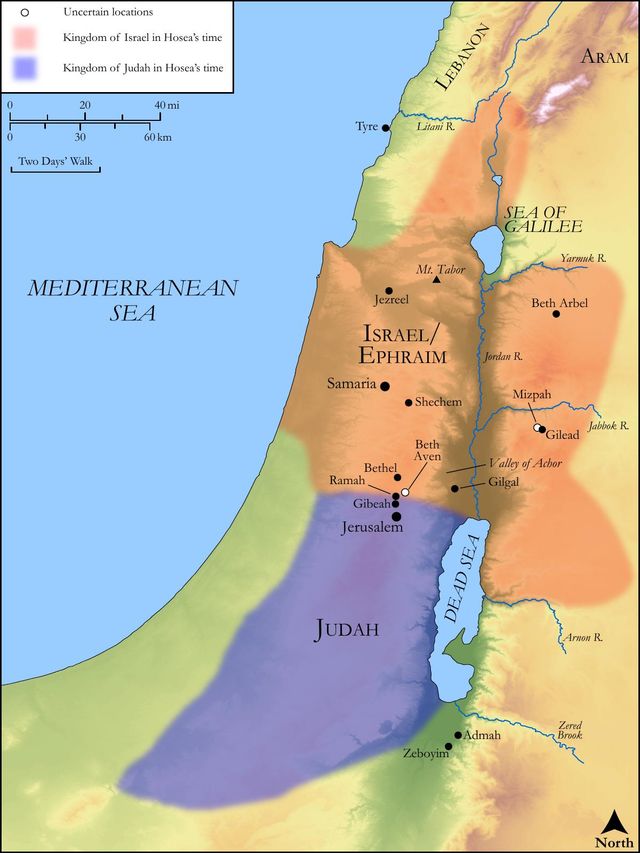
See on the biblical-era map
Study this verse
Public-domain commentary
Matthew Henry
From his Commentary on the Whole Bible. Henry comments on passages, not single verses — this entry covers Hosea 13:5–8.
We may observe here, 1. The plentiful provision God had made for Israel and the seasonable supplies he had blessed them with (Hos 13:5): "I did know thee in the wilderness, took cognizance of thy case and made provision for thee, even in a land of great drought, when thou wast in extreme distress, and when no relief was to be had in an ordinary way." See a description of this wilderness, Deu 8:15, Jer 2:6, and say, The God that knew them, and owned them, and fed them there, was a friend indeed, for he was a friend at need and an all-sufficient friend, that could victual so vast an army when all ordinary ways of provision were cut off, and where, if miracles had not been their daily bread, they must all have perished. Note, Help at an exigency lays under peculiar obligations and must never be forgotten. 2. Their unworthy ungrateful abuse of God's favour to them. God not only took care of them in the wilderness, but put them in possession of Canaan, a good land, a large and fat pasture. And (Hos 13:6) according to their pasture so were they filled. God gave them both plenty and dainties, and they did not spare it, but, having been long confined to manna, when they came into Canaan they fed themselves to the full. And this was no hopeful presage; it would have looked better, and promised better, if they had been more modest and moderate in the use of their plenty, and had learned to deny themselves; but what was the effect of it? They were filled, and their heart was exalted. Their luxury and sensuality made them proud, insolent, and secure. The best comment upon this is that of Moses, Deu 32:13-15. But Jeshurun waxed fat and kicked. When the body was stuffed up with plenty the soul was puffed up with pride. Then they began to think their religion a thing below them, and they could not persuade themselves to stoop to the services of it. The wicked, through the pride of his countenance, will not seek after God. When they were poor and lame in the wilderness they thought it was necessary for them to keep in with God; but when they were replenished and established in Canaan they began to think they had no further need of him: Their heart was exalted, therefore have they forgotten me. Note, Worldly prosperity, when it feeds men's pride, makes them forgetful of God; for they remember him only when they want him. When Israel was filled, what more could the Almighty do for them? And therefore they said to him, Depart from us, Job 22:17. It is sad that those favours which ought to make us mindful of God, and studious what we shall render to him, should make us unmindful of him, and regardless what we do against him. We ought to know that we live upon God when we live upon common providence, though we do not, as Israel in the wilderness, live upon miracles. 3. God's just resentment of their base ingratitude, Hos 13:7, Hos 13:8. The judgments threatened (Hos 13:3) intimated the departure of all good from them. The threatenings here go further, and intimate the breaking in of all evils upon them; for God, who had so much befriended them, now turns to be their enemy and fights against them, which is expressed here very terribly: I will be unto them as a lion and as a leopard. The lion is strong, and there is no resisting him. The leopard is here taken notice of to be crafty and vigilant: As a leopard by the way will I observe them. As that beast of prey lies in wait by the road-side to catch travellers, and devour them, so will God by his judgments watch over them to do them hurt, as he had watched over them to do them good, Jer 44:27. No opportunity shall be let slip that may accelerate or aggravate their ruin (Jer 5:6): A leopard shall watch over their cities. A lynx, or spotted beast (and such the leopard is), is noted for quicksightedness above any creature (lynx visu - the eyes of a lynx), and so it intimates that not only the power, but the wisdom of God is engaged against those whom he has a controversy with. Some read it (and the original will bear it), I will be as a leopard in the way of Assyria. The judgments of God shall surprise them just when they are going to the Assyrians to seek for protection and help from them. It is added, I will meet them as a bear that is bereaved, and thereby exasperated and made more cruel (Sa2 17:8, Pro 28:15), which intimates how highly God was provoked, and he would make them feel it: He will rend the caul of their heart. The lion is observed to aim at the heart of the beasts he preys upon, and thus will God devour them like a lion. He will send such judgments upon them as shall prey upon their spirits and consume their vitals. Their heart was exalted (Hos 13:6), but God will take an effectual course to bring it down: The wild beast shall tear them; not only God will be as a lion and leopard to them, but the metaphor shall be fulfilled in the letter, for noisome beasts are one of the four sore judgments with which God will destroy a provoking people, Eze 14:15.
Now all this teaches us, 1. That abused goodness turns into the greater severity. Those who despise God and affront him, when he is to them as a careful tender shepherd, shall find he will be even to his own flock as the beasts of prey are. Those whom God has in vain endured with much long-suffering, and invited with much affection, in them he will show his wrath and make them vessels of it, Rom 9:22. Patientia laesa fit furor - Despised patience will turn into fury. 2. That the judgments of God, when they come with commission against impenitent sinners, will be irresistible and very terrible. They will rend the caul of the heart, will fill the soul with confusion, and tear that in pieces; and we are as unable to grapple with them as a lamb is to make his part good against a roaring lion, for who knows the power of God's anger? Knowing therefore the terror of the Lord, let us be persuaded to make peace with him; for are we stronger then he?
Historical interpretation
Historical reception
1 surviving comment on this verse from the historical church.
"And I will be to them like a lioness, like a leopard on the road to Assyria; I will confront them like a bear that has lost its cubs, and I will tear open their chests; there I will devour them like a lion - the wild animals will tear them apart." They were filled and satisfied; they lifted up their hearts and forgot me. But I, he said, will be to them like a lioness, or a panther, of which we have spoken more fully above: and like a leopard on the way of the Assyrians, when they are led captive by the Assyrians: and I will meet them like a bear robbed of its cubs, or an animal in need of food: and I will tear apart all their vital organs. Those who have written about the nature of wild beasts say that among all animals there is nothing more savage than a bear when it has lost its cubs or needs food; and he not only threatens the ferocity of panthers, leopards, bears, lions, and all wild beasts that are born in the forests, but he says that he will direct all of this towards them when they go to the Assyrians: lest they attribute their miseries not to the power and indignation of the Lord, but to the strength of their enemies, when they have suffered hard things there. And at the same time, let us consider what he who speakes in the Gospel to those who believe: "Come to me all you who labor and are burdened, and I will refresh you; for my yoke is sweet and my burden light" (Matt. XI, 28, 29), now through the prophet he becomes a panther, pardus, bear and lion to the unbelievers and those who refuse to do penance: not only to the Israelites, because they were set up for idolatry in the cities or mountains of the Medes; but also to heretics because, due to the pride of their minds and the vanity of their false teachings, they have forgotten their God, have fashioned idols and have followed strange gods.
Continue studying Hosea 13:7 across the web’s major study libraries — every link below opens this exact verse, chapter, or book on the destination site.
Read & Compare
 BibleGatewayThis verse in more than 200 translations and 70 languages.
 Bible.comThe YouVersion reader — hundreds of translations, reading plans, and highlights.
 ESV.orgCrossway's official English Standard Version reader.
 NET BibleThe NET translation with 60,000+ translators' notes on every rendering decision.
 STEP BibleTyndale House's free study tool — original text, vocabulary, and scholarly resources.
 BibliaLogos Bible Software's free web reader.
 USCCBThe New American Bible (Revised Edition) with the U.S. bishops' study notes.
Commentaries
 BibleHub CommentariesDozens of classic commentaries on this verse, gathered on one page.
 StudyLightMore than 100 commentary sets — the largest collection on the web.
 BibleRefPlain-English commentary on what this verse means, verse by verse.
 Enduring WordDavid Guzik's free commentary on this chapter, widely used by Bible teachers.
 Bible Study ToolsVerse commentary alongside Greek and Hebrew study aids.
Original Language & Research
- BibleHub InterlinearThe verse word by word — original language, transliteration, and English.
- BibleHub LexiconEvery word's original-language definition and Strong's entry.
 Blue Letter BibleDeep-study tools — Strong's numbers, concordance, and word studies.
 SefariaThe Hebrew text with Rashi and centuries of Jewish commentary.
Sermons, Hymns & Audio


TrulyRandomVerse is not affiliated with these sites and doesn’t control their content. They’re linked because they’re genuinely useful.
Summary
Hosea 13:7 delivers a stark prophetic declaration of God's impending and inescapable judgment against unfaithful Israel, particularly Ephraim. Employing powerful zoomorphic metaphors, the Lord reveals His transformation from a protective shepherd into a formidable predator, signifying the swift, fierce, and deliberate nature of the divine retribution that will be unleashed upon a nation persistently steeped in idolatry and rebellion.
Context
ShowHideLiterary Context
Hosea 13 is a chapter of intense judgment, following a trajectory of Israel's increasing apostasy. The preceding verses lament Ephraim's spiritual decline, highlighting how their prosperity led to forgetting God and embracing Baal worship, as detailed in Hosea 13:6. God, who was their only Savior and Redeemer (Hosea 13:4), now declares His intention to become their adversary. This sets the stage for the terrifying imagery of judgment in Hosea 13:7, where the Lord's character shifts from loving provider to relentless punisher. The chapter continues to describe the utter devastation and lack of mercy that will befall them due to their unfaithfulness, culminating in a lament over their destruction.
Historical & Cultural Context
Hosea prophesied during the tumultuous final decades of the Northern Kingdom of Israel (Ephraim), roughly 750-715 BC, leading up to its destruction by Assyria in 722 BC. This period was marked by profound political instability, frequent assassinations of kings, and widespread idolatry, particularly the worship of Baal and Asherah, often blended syncretistically with Yahwism. The people had abandoned the Mosaic covenant, engaging in abominable practices and relying on foreign alliances rather than God. Lions and leopards were common and feared predators in the land of Israel, known for their ferocity, stealth, and hunting prowess. Their imagery would have been immediately understood by the Israelite audience as potent symbols for overwhelming, inescapable, and destructive power, making them fitting metaphors for divine judgment.
Key Themes
ShowHideThis verse powerfully contributes to several overarching themes in Hosea. It underscores the theme of Divine Judgment, portraying God's righteous wrath against persistent sin and covenant unfaithfulness. It also highlights the Consequences of Rebellion, demonstrating that Israel's rejection of their covenant Lord inevitably leads to severe retribution rather than continued blessing. Furthermore, it emphasizes God's Sovereignty and Power, illustrating His absolute control and ability to execute His will with precision and overwhelming force. The transformation of God from a loving husband and father (as seen in Hosea 11:1-4) into a terrifying judge when His covenant is utterly forsaken is a central and tragic theme woven throughout the book, particularly evident in the pronouncements of judgment found in Hosea 4 through Hosea 13.
Exposition and Analysis
ShowHideKey Word Analysis
ShowHideFrom an unused root probably meaning to roar, this term refers to a lion, specifically highlighting its characteristic roar and ferocious nature. In this context, it emphasizes the terrifying, powerful, and destructive aspect of God's impending judgment, signifying an overwhelming and irresistible force.
From an unused root meaning properly, to filtrate, i.e., be limpid, and thus to spot or stain, this word describes a leopard, known for its distinctive stripes. It symbolizes stealth, speed, and the ability to ambush prey, conveying the sudden, inescapable, and strategic nature of God's observation and attack.
From דָּרַךְ, meaning to trod, this word signifies a road or path. In the phrase "by the way," it suggests that God is strategically positioned along Israel's customary path or course of life, ready to intercept them, reinforcing the inescapable and unavoidable nature of the impending divine encounter.
A primitive root (identical with through the idea of going round for inspection), meaning to spy out, survey, or lurk for. Here, it implies a deliberate and watchful waiting. It suggests God's precise and strategic positioning, patiently waiting for the opportune moment to execute judgment, indicating the inevitability and calculated nature of His justice.
Verse Breakdown
ShowHide"Therefore I will be unto them as a lion:"
This opening clause declares God's decisive shift from a protective covenant partner to a formidable adversary. The "therefore" directly links this pronouncement to Israel's preceding and persistent unfaithfulness, idolatry, and forgetfulness of God. The imagery of a lion, a creature universally recognized for its immense strength, ferocity, and destructive power, conveys the overwhelming and inescapable force of God's impending judgment. It signifies that His wrath will be unleashed with a terrifying intensity, leaving no room for escape.
"as a leopard by the way will I observe [them]:"
This second metaphor intensifies and refines the imagery of judgment. The leopard, known for its stealth, speed, and ambush tactics, signifies that God's judgment will be sudden, precise, and unavoidable. The phrase "by the way" implies that God is strategically positioned along Israel's path, actively watching and waiting for the opportune moment to strike. This conveys a sense of calculated inevitability, indicating that divine retribution is not random but a deliberate, inescapable consequence that will intercept them in their daily lives.
Literary Devices
ShowHideHosea 13:7 is rich in Metaphor and Simile, comparing God's actions to those of a lion and a leopard. These powerful animalistic comparisons are not merely decorative but serve to vividly portray the terrifying nature of divine judgment: the lion symbolizes raw power, ferocity, and destructive force, while the leopard represents stealth, speed, and the inevitability of an ambush. The use of Zoomorphism attributes animal characteristics to God, emphasizing His unyielding resolve and the terrifying aspect of His righteous wrath. The phrase "by the way will I observe [them]" employs Foreshadowing and Dramatic Irony, as God, who once walked with Israel in the way of covenant, now waits for them as a predator along their path, highlighting the tragic reversal of their relationship due to their profound sin. The overall tone is one of Divine Wrath and Imminent Judgment, creating a palpable sense of dread and inescapable doom.
Theological and Thematic Connections
ShowHideHosea 13:7 is a stark reminder of God's unwavering justice and the severe consequences of persistent rebellion against His covenant. While the Old Testament frequently portrays God as merciful and gracious, it also unequivocally declares His righteous wrath against sin. This verse illustrates that divine patience has limits, and when a people continually rejects His love and embraces idolatry, God, who is just, will execute judgment. This judgment is not arbitrary but a deliberate, inescapable response to unfaithfulness, demonstrating His sovereignty over all creation and His commitment to upholding His holiness. It serves as a theological counterpoint to the abundant expressions of God's steadfast love and mercy found elsewhere in Hosea, emphasizing the dual nature of God's character as both loving Father and righteous Judge.
Reflection and Application
ShowHideHosea 13:7 stands as a profound and sobering warning for all generations, revealing a facet of God's character that is often overlooked in contemporary discourse: His unwavering commitment to justice and His righteous wrath against sin. For those who may presume upon God's patience or take His grace for granted, this verse underscores that persistent rebellion and unrepentant idolatry will ultimately lead to dire consequences. It challenges us to examine our own lives for areas of spiritual complacency, idolatry (whether overt or subtle, such as prioritizing possessions, careers, or relationships over God), or a casual disregard for God's commands. This passage calls us to a deeper understanding of God's holiness and prompts genuine repentance, fostering a renewed commitment to faithful obedience. It reminds us that true reverence for God encompasses both awe of His mercy and a healthy fear of His justice, motivating us to walk in humility and trust, knowing that He is both a loving Father and a righteous Judge who will not tolerate unrepentant sin indefinitely.
Questions for Reflection
ShowHideFAQ
ShowHideWhy does God use such violent animal imagery to describe Himself?
ShowHideGod uses violent animal imagery like the lion and leopard in Hosea 13:7 to convey the severity, ferocity, and inescapability of His judgment against Israel's persistent unfaithfulness and idolatry. These animals were common predators in that land, known for their power, stealth, and destructive capabilities. The imagery serves to shock the audience into recognizing the gravity of their sin and the certainty of divine retribution. It illustrates that God, who had been their protector and provider, would, due to their rebellion, become their adversary, executing justice with the same relentless force that a predator pursues its prey. This is a dramatic shift from earlier portrayals of God's tender love, such as in Hosea 11:1-4, highlighting the tragic consequences of a broken covenant relationship and the necessity of divine intervention to uphold righteousness.
Christ-Centered Fulfillment
ShowHideWhile Hosea 13:7 vividly portrays God's terrifying judgment against unrepentant sin, its ultimate fulfillment and resolution are found in the person and work of Jesus Christ. The fierceness of divine wrath depicted here was fully poured out upon Christ on the cross, as He became the substitute for humanity's sin, bearing the judgment we deserved. He is the one who "suffered once for sins, the righteous for the unrighteous, that he might bring us to God" (1 Peter 3:18). The "way" where God observes and strikes is transformed through Christ; He is the "way, the truth, and the life" (John 14:6), offering the only escape from the very judgment described in Hosea. Those who are "in Christ" are no longer subject to this terrifying wrath, for "there is therefore now no condemnation for those who are in Christ Jesus" (Romans 8:1). Instead of facing God as a lion or leopard in judgment, believers encounter Him as a loving Father, whose justice was satisfied through the ultimate sacrifice of the Lamb of God who takes away the sin of the world. Thus, Hosea 13:7, while a terrifying warning of God's justice, ultimately points to the profound need for a Savior and the glorious provision of salvation found only in Christ, who absorbed the full force of divine judgment so that we might receive mercy, forgiveness, and eternal life.