


Jeremiah 7:16
- וְאַתָּהve·'a·Tahand youH859Conj-w ¦ Pro-2msPronoun Personal 2nd Singular Masculineוְandאַתָּהyou
- אַל'almay notH408NegParticle Negative
- תִּתְפַּלֵּלtit·pa·Lelyou prayH6419V-Hithpael-Imperf-2msVerb Hithpael Imperfect 2nd Singular Masculine
- בְּעַדbe·'adforH1157Adj-cscAdjective Numerical Singular common gender Construct
- הָעָםha·'Amthe peopleH5971Art ¦ N-msNoun Singular Masculine Absoluteהָtheעָםpeople
- הַזֶּהha·Zeh<the> thisH2088Art ¦ PrtParticle Demonstrativeהַ<the>זֶּהthis
- וְאַלve·'aland may notH408Conj-w ¦ NegParticle Negativeוְandאַלmay not
- תִּשָּׂאti·Sa'you lift upH5375V-Qal-Imperf-2msVerb Qal Imperfect 2nd Singular Masculine
- בַעֲדָםva·'a·Damfor themH1157Adj-csc ¦ 3mpAdjective Numerical Singular common gender Constructבַעֲדָforםthem
- רִנָּהri·Naha cry of entreatyH7440N-fsNoun Singular Feminine Absolute
- וּתְפִלָּהu·te·fi·Lahand a prayerH8605Conj-w ¦ N-fsNoun Singular Feminine Absoluteוּandתְפִלָּהa prayer
- וְאַלve·'aland may notH408Conj-w ¦ NegParticle Negativeוְandאַלmay not
- תִּפְגַּעtif·ga'you entreatH6293V-Qal-Imperf-2msVerb Qal Imperfect 2nd Singular Masculine
- בִּיBi<in> <the> mePrep-b ¦ 1csSuffix Personal 1st Singular common genderבִּ<in> <the>יme
- כִּיkiforH3588PrtParticle Conditional
- אֵינֶנִּי'ei·Ne·ninot IH369N-msc ¦ 1csNoun Singular Masculine ConstructאֵינֶnotנִּיI
- שֹׁמֵעַsho·Me·a'[will be] hearingH8085V-Qal-Prtcpl-msVerb Qal Participle Singular Masculine Absolute
- אֹתָךְ'o·Takh<obj.> youH853DirObjM ¦ 2msParticle Object Indicatorאֹתָ<obj.>ךְyou
English is a literal word-by-word gloss of the Hebrew, not the KJV's wording. Why?
This is the original text the KJV's translators worked from — each Hebrew word with its own literal English meaning in this verse, prepared by scholars at Tyndale House, Cambridge. The KJV translates whole sentences, not word by word, so its wording differs: one Hebrew word can become several English words, and the KJV may choose “the LORD” where the gloss reads “Yahweh”. Both are faithful — they answer different questions. For the KJV's own rendering, switch to the KJV text.
Details
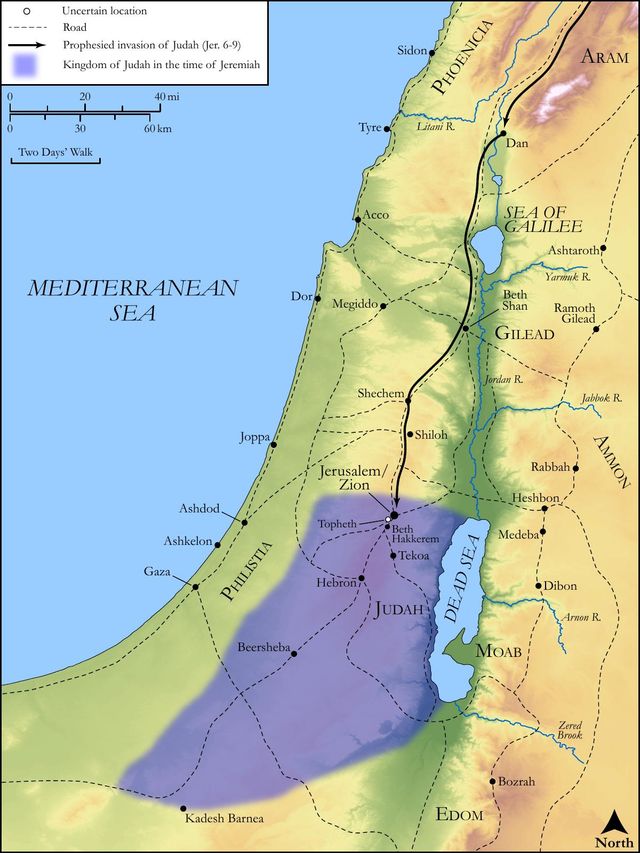
See on the biblical-era map
Study this verse
Public-domain commentary
Matthew Henry
From his Commentary on the Whole Bible. Henry comments on passages, not single verses — this entry covers Jeremiah 7:16–20. His four-level outline is real structure in the source text, so it is rendered as structure.
God had shown them, in the foregoing verses, that the temple and the service of it, of which they boasted and in which they trusted, should not avail to prevent the judgment threatened. But there was another thing which might stand them in some stead, and which yet they had no value for, and that was the prophet's intercession for them; his prayers would do them more good than their own pleas: now here that support is taken from them; and their case is said indeed who have lost their interest in the prayers of God's ministers and people.
I.God here forbids the prophet to pray for them (Jer 7:16):
"The decree has gone forth, their ruin is resolved on, therefore pray not thou for this people, that is, pray not for the preventing of this judgment threatened; they have sinned unto death, and therefore pray not for their life, but for the life of their souls," Jo1 5:16. See here,
1.That God's prophets are praying men; Jeremiah foretold the destruction of Judah and Jerusalem, and yet prayed for their preservation, not knowing that the decree was absolute; and it is the will of God that we pray for the peace of Jerusalem. Even when we threaten sinners with damnation we must pray for their salvation, that they may turn and live. Jeremiah was hated, and persecuted, and reproached, by the children of his people, and yet he prayed for them; for it becomes us to render good for evil.
2.That God's praying prophets have a great interest in heaven, how little soever they have on earth. When God has determined to destroy this people, he bespeaks the prophet not to pray for them, because he would not have his prayers to lie (as prophets' prayers seldom did) unanswered. God said to Moses, Let me alone, Exo 22:10.
3.It is an ill omen to a people when God restrains the spirits of his ministers and people from praying for them, and gives them to see their case so desperate that they have no heart to speak a good word for them.
4.Those that will not regard good ministers' preaching cannot expect any benefit by their praying. If you will not hear us when we speak from God to you, God will not hear us when we speak to him for you.
II.He gives him a reason for this prohibition.
Praying breath is too precious a thing to be lost and thrown away upon a people hardened in sin and marked for ruin.
1.They are resolved to persist in their rebellion against God, and will not be turned back by the prophet's preaching. For this he appeals to the prophet himself, and his own inspection and observation (Jer 7:17): Seest thou not what they do openly and publicly, without either shame or fear, in the cities of Judah and in the streets of Jerusalem? This intimates both that the sin was evident and could not be denied and that the sinners were impudent and would not be reclaimed; they committed their wickedness even in the prophet's presence and under his eye; he saw what they did, and yet they did it, which was an affront to his office, and to him whose officer he was, and bade defiance to both. Now observe,
(1.)What the sin is with which they are here charged - it is idolatry, Jer 7:18. Their idolatrous respects are paid to the queen of heaven, the moon, either in an image or in the original, or both. They worshipped it probably under the name of Ashtaroth, or some other of their goddesses, being in love with the brightness in which they saw the moon walk, and thinking themselves indebted to her for her benign influences or fearing her malignant ones, Job 31:26. The worshipping of the moon was much in use among the heathen nations, Jer 44:17, Jer 44:19. Some read it the frame or workmanship of heaven. The whole celestial globe with all its ornaments and powers was the object of their adoration. They worshipped the host of heaven, Act 7:42. The homage they should have paid to their Prince they paid to the statues that beautified the frontispiece of his palace; they worshipped the creatures instead of him that made them, the servants instead of him that commands them, and the gifts instead of him that gave them. With the queen of heaven they worshipped other gods, images of things not only in heaven above, but in earth beneath, and in the waters under the earth; for those that forsake the true God wander endlessly after false ones. To these deities of their own making they offer cakes for meat-offerings, and pour out drink-offerings, as if they had their meat and drink from them and were obliged to make to them their acknowledgments: and see how busy they are, and how every hand is employed in the service of these idols, according as they used to be employed in their domestic services. The children were sent to gather wood; the fathers kindled the fire to heat the oven, being of the poorer sort that could not afford to keep servants to do it, yet they would rather do it themselves than it should be undone; the women kneaded the dough with their own hands, for perhaps, though they had servants to do it, they took a pride in showing their zeal for their idols by doing it themselves. Let us be instructed, even by this bad example, in the service of our God.
[1.]Let us honour him with our substance, as those that have our subsistence from him, and eat and drink to the glory of him from whom we have our meat and drink.
[2.]Let us not decline the hardest services, nor disdain to stoop to the meanest, by which God may be honoured; for none shall kindle a fire on God's altar for nought. Let us think it an honour to be employed in any work for God.
[3.]Let us bring up our children in the acts of devotion; let them, as they are capable, be employed in doing something towards the keeping up of religious exercises.
(2.)What is the direct tendency of this sin: "It is that they may provoke me to anger; they cannot design any thing else in it. But (Jer 7:19) do they provoke me to anger? Is it because I am hard to be pleased, or easily provoked? Or am I to bear the blame of the resentment? No; it is their own doing; they may thank themselves, and they alone shall bear it." Is it against God that they provoke him to wrath? Is he the worse for it? Does it do him any real damage? No; is it not against themselves, to the confusion of their own faces? It is malice against God, but it is impotent malice; it cannot hurt him: nay, it is foolish malice; it will hurt themselves. They show their spite against God, but they do the spite to themselves. Canst thou think any other than that a people, thus desperately set upon their own ruin, should be abandoned?
2.God is resolved to proceed in his judgments against them, and will not be turned back by the prophet's prayers (Jer 7:20): Thus saith the Lord God, and what he saith he will not unsay, nor can all the world gainsay it; hear it therefore, and tremble. "Behold, my anger and my fury shall be poured out upon this place, as the flood of waters was upon the old world or the shower of fire and brimstone upon Sodom; since they will anger me, let them see what will come of it." They shall soon find,
(1.)That there is no escaping this deluge of fire, either by flying from it or fencing against it; it shall be poured out on this place, though it be a holy place, the Lord's house. It shall reach both man and beast, like the plagues of Egypt, and, like some of them, shall destroy the trees of the field and the fruit of the ground, which they had designed and prepared for Baal, and of which they had made cakes to the queen of heaven.
(2.)There is no extinguishing it: It shall burn and shall not be quenched; prayers and tears shall then avail nothing. When his wrath is kindled but a little, much more when it is kindled to such a degree, there shall be no quenching it. God's wrath is that fire unquenchable which eternity itself will not see the period of. Depart, you cursed, into everlasting fire.
Historical interpretation
Two Centuries of Reception
5 surviving comments on this verse. Each one is dated, so this reads as a timeline rather than a list.
Select a marker to jump to its quote. Markers stagger vertically where authors wrote within a few decades of each other.
Just as God knows how to heal, so does he furthermore know how to smite. He knows how to make peace but likewise permits evils. He prefers repentance but moreover commands Jeremiah not to pray for the reversal of ills on behalf of the sinful people. He says, “If they will fast, I still will not listen to their plea.” And again: “Do not pray to me on behalf of the people, and do not request on their behalf in prayer and supplication, since I will not listen to them in the time when they shall have invoked me, in the time of their affliction.” And further he, the same One who prefers mercy above sacrifice, says, “And do not pray to me on behalf of this people, and do not request that they may obtain mercy, and do not approach me on their behalf, since I will not listen to them in the time wherein they shall have invoked me, in the time of their affliction.”
Rightly, then, is it said, “Who shall entreat for him?” It implies that it must be such a one as Moses to offer himself for those who sin. Or such as Jeremiah, who, though the Lord said to him, “Pray not for this people,” yet prayed and obtained their forgiveness. For at the intercession of the prophet and the entreaty of so great a seer, the Lord was moved. And Jerusalem, which had meanwhile repented for its sins, had said, “O Almighty Lord God of Israel, the soul in anguish and the troubled spirit cries to you. Hear, O Lord, and have mercy.”
He did the same thing in explaining himself to Noah about the flood that he did to Ezekiel when while living in Babylon he caused him to see the people’s evil deeds in Jerusalem. And when he told Jeremiah not to pray, there too he explained himself adding, “Do you not see what they do?” And he does the same thing everywhere as he does here [in Matthew]. For what does he say? “The people of Nineveh shall rise up and shall condemn this generation, because they repented at the preaching of Jonah, and, behold, a greater one than Jonah is here.”
(Verse 16.) Therefore, do not pray for this people, nor take on their praise and prayer (or do not ask to obtain mercy for them). And do not resist me, for I will not listen to you. So that it may not seem that the Prophet does not obtain what he asks for, God commands that he not pray for the sinful people who do not repent. And when he says, 'And do not resist me,' he shows that the prayers of the saints can resist God's wrath. And the Lord spoke to Moses: Let me alone, that I may destroy this people: and I will make thee into a great nation (Exod. XXXII, 10). And in the psalms it is written: And Phinehas stood up and appeased him, and the shaking ceased, and it was counted to him for justice (Psal. CV, 30). And Aaron, having taken the censer, stood in the midst between the living and the dead, and the wrath of God ceased. And lest we think that God is cruel, who does not even allow himself to be asked, he gives reasons why he does not listen (Num. XVI), saying:
[Daniel 9:2] "I, Daniel, understood by the books the number of the years concerning which the word of the Lord had come to the prophet Jeremiah, that seventy years would be accomplished for the desolation of Jerusalem." Jeremiah had predicted seventy years for the desolation of the Temple (Jeremiah 29:1-10), at the end of which the people would again return to Judaea and build the Temple and the city of Jerusalem. But this fact did not render Daniel careless, but rather encouraged him to pray that God might through his supplications fulfil that which He had graciously promised. Thus he avoided the danger that carelessness might result in pride, and pride cause offense to the Lord. Accordingly we read in Genesis that prior to the Deluge one hundred and twenty years were appointed for men to come to repentance (Genesis 6:3); and inasmuch as they refused to repent even within so long an interval of time as a hundred years, God did not wait for the remaining twenty years to be fulfilled, but brought on the punishment earlier which He had threatened for a later time. So also Jeremiah is told, on account of the hardness of the heart of the Jewish people: "Pray not for this people, for I will not hearken unto thee" (Jeremiah 7:16). Samuel also was told: "How long wilt thou mourn over Saul? I also have rejected him" (1 Samuel 16:1). And so it was with sackcloth and ashes that Daniel besought the Lord to fulfil what He had promised, not that Daniel lacked faith concerning the future, but rather he would avoid the danger that a feeling of security might produce carelessness, and carelessness produce an offense to God.
Continue studying Jeremiah 7:16 across the web’s major study libraries — every link below opens this exact verse, chapter, or book on the destination site.
Read & Compare
 BibleGatewayThis verse in more than 200 translations and 70 languages.
 Bible.comThe YouVersion reader — hundreds of translations, reading plans, and highlights.
 ESV.orgCrossway's official English Standard Version reader.
 NET BibleThe NET translation with 60,000+ translators' notes on every rendering decision.
 STEP BibleTyndale House's free study tool — original text, vocabulary, and scholarly resources.
 BibliaLogos Bible Software's free web reader.
 USCCBThe New American Bible (Revised Edition) with the U.S. bishops' study notes.
Commentaries
 BibleHub CommentariesDozens of classic commentaries on this verse, gathered on one page.
 StudyLightMore than 100 commentary sets — the largest collection on the web.
 BibleRefPlain-English commentary on what this verse means, verse by verse.
 Enduring WordDavid Guzik's free commentary on this chapter, widely used by Bible teachers.
 Bible Study ToolsVerse commentary alongside Greek and Hebrew study aids.
Original Language & Research
- BibleHub InterlinearThe verse word by word — original language, transliteration, and English.
- BibleHub LexiconEvery word's original-language definition and Strong's entry.
 Blue Letter BibleDeep-study tools — Strong's numbers, concordance, and word studies.
 SefariaThe Hebrew text with Rashi and centuries of Jewish commentary.
Sermons, Hymns & Audio


TrulyRandomVerse is not affiliated with these sites and doesn’t control their content. They’re linked because they’re genuinely useful.
Summary
Jeremiah 7:16 presents a formidable divine injunction to the prophet Jeremiah, explicitly prohibiting him from offering any form of intercession on behalf of the people of Judah. This stark command underscores the profound depth of Judah's spiritual apostasy and the irreversible nature of the impending judgment. It signifies that the nation's persistent rebellion, idolatry, and covenant unfaithfulness had exhausted God's patience, rendering His righteous decree of judgment unalterable, even by the fervent prayers of His devoted prophet.
Context
ShowHideLiterary Context
Jeremiah 7:16 is a critical utterance within Jeremiah's renowned "Temple Sermon," delivered at the very gate of the Lord's house, as recorded in Jeremiah 7:1-2. This sermon directly challenges the people's misguided and dangerous reliance on the physical presence of the Jerusalem Temple, a false security they believed would safeguard them despite their rampant idolatry, oppression, and moral corruption, as detailed in Jeremiah 7:5-7. The preceding verses meticulously outline God's covenant lawsuit against Judah, itemizing their egregious violations of the covenant through sins such as theft, murder, adultery, perjury, and the worship of foreign gods, as condemned in Jeremiah 7:9. God's severe command to Jeremiah to cease intercession for the people, a prohibition echoed in Jeremiah 11:14 and Jeremiah 14:11, marks an irreversible turning point, signaling that the window for national repentance and the averting of judgment had definitively closed, setting the nation on an unalterable trajectory toward exile and destruction.
Historical & Cultural Context
The historical backdrop for Jeremiah 7:16 is late 7th to early 6th century BCE Judah, a period characterized by profound political instability and precipitous spiritual decline. Following the brief but significant spiritual revival under King Josiah, Judah rapidly reverted to widespread apostasy after his untimely death, particularly under the reign of King Jehoiakim. The people of Judah had embraced syncretistic religious practices, blending the worship of Yahweh with the veneration of pagan deities like Baal and Molech, even descending into the horrific practice of child sacrifice, as explicitly condemned in Jeremiah 7:30-31. Culturally, there was a deeply ingrained, yet profoundly misplaced, confidence in the Jerusalem Temple, viewing it as an inviolable charm or talisman that guaranteed divine protection, irrespective of their moral and spiritual conduct. This pervasive false sense of security, coupled with rampant oppression and profound religious hypocrisy, cultivated a spiritual climate that was ripe for the execution of divine judgment. Geographically, Jerusalem served as the spiritual and political epicenter of Judah, and the Temple, its most sacred edifice, paradoxically became the focal point of both their deluded hope and God's unwavering pronouncements of judgment.
Key Themes
ShowHideThis verse powerfully contributes to several overarching themes prevalent in the book of Jeremiah and the broader corpus of prophetic literature. A paramount theme is Irreversible Judgment, which underscores that there exists a critical threshold where persistent sin and unrepentance culminate in a final, unalterable divine decree. This highlights the severe Consequences of Persistent Disobedience, demonstrating unequivocally that God, though boundless in His mercy and long-suffering, is also perfectly just and will unfailingly execute judgment when His patience is exhausted and His covenant is continually and flagrantly violated. Furthermore, the passage profoundly explores the Limits of Intercession, revealing the sobering truth that even the most fervent and righteous prayers of a devoted prophet like Jeremiah could not overturn God's unyielding decree against a people whose hearts had become hardened beyond the point of true repentance. This reality was particularly agonizing for Jeremiah, who harbored a deep love for his people and profoundly lamented their impending fate, as poignantly expressed in Jeremiah 9:1.
Exposition and Analysis
ShowHideKey Word Analysis
ShowHideThis primitive root (H6419) signifies "to judge (officially or mentally); by extension, to intercede, pray." In the context of Jeremiah 7:16, it refers to the general act of prayer or supplication, specifically intercessory prayer offered on behalf of another. God's emphatic command to Jeremiah to "pray not" indicates a complete and absolute cessation of any form of appeal for the people's deliverance from the impending judgment. It encompasses any and all forms of communication with God seeking a reversal of their fate.
This primitive root (H6293) means "to impinge, by accident or violence, or (figuratively) by importunity; to come (betwixt), cause to entreat, fall (upon), meet (together), pray, reach, run." The use of this word in the verse emphasizes a direct, forceful, or persistent plea on behalf of someone, often implying a mediator "falling upon" God in earnest petition. By forbidding Jeremiah to "make intercession," God is shutting down even the most earnest, direct, and persistent appeals, thereby reinforcing the finality and irrevocability of His decision.
This primitive root (H8085) means "to hear intelligently (often with implication of attention, obedience, etc.; causatively, to tell, etc.)." When God declares, "I will not hear thee," it signifies far more than a mere physical inability to perceive sound. It implies a deliberate and resolute refusal to acknowledge, respond favorably to, or act upon Jeremiah's prayers. It is a profound declaration of divine resolve, indicating that the people's persistent and unrepentant actions have severed the possibility of a favorable divine response to any intercession made on their behalf.
Verse Breakdown
ShowHide"Therefore pray not thou for this people,"
This opening clause serves as a direct, emphatic, and absolute command from God to His prophet Jeremiah. The conjunction "Therefore" explicitly links this prohibition to the preceding verses, which meticulously detail Judah's pervasive, persistent, and unrepentant sin. God is unequivocally forbidding Jeremiah from engaging in any form of general prayer or supplication aimed at securing the nation's welfare or a reversal of the decreed judgment.
"neither lift up cry nor prayer for them,"
This phrase expands upon and intensifies the initial prohibition, employing two distinct Hebrew terms to encompass the full spectrum of supplication. "Cry" (H7440, rinnâh) suggests a loud, perhaps emotional, lament or desperate plea, indicative of profound distress. "Prayer" (H8605, tᵉphillâh) refers to a more formal or structured act of prayer, a deliberate petition. The inclusion of both terms underscores the comprehensive and exhaustive nature of God's ban – no form of appeal, whether spontaneous or formal, impassioned or reasoned, will be effective or acknowledged.
"neither make intercession to me:"
This final prohibitive clause utilizes a specific and potent term for intercession (H6293, pâgaʻ) that implies a direct, often forceful, and importunate pleading on behalf of another, suggesting a mediator's active intervention. It emphasizes that even Jeremiah's most direct and earnest appeals to God as a mediator would be utterly futile. God is definitively closing off all potential avenues of appeal for this people, leaving no room for negotiation or change of mind.
"for I will not hear thee."
This concluding statement provides the divine rationale and irrefutable justification for the absolute prohibition. It is not that God is literally deaf or incapable of hearing, but rather that He has sovereignly and justly determined not to respond favorably to any prayers offered for Judah. This signifies a profound divine hardening, a judicial decision rooted in the nation's persistent sin, indicating that the point has been reached where mercy will no longer be extended in the face of impending judgment. God's resolute refusal to "hear" means He will not act to avert the decreed consequences, sealing their fate.
Literary Devices
ShowHideJeremiah 7:16 employs several potent literary devices to convey its grave and unyielding message. Repetition is strikingly evident in the multiple synonymous phrases used to forbid prayer ("pray not," "neither lift up cry nor prayer," "neither make intercession"), which serves to underscore the absolute, comprehensive, and undeniable nature of God's command. This deliberate Emphasis highlights the finality of God's decision and the extreme severity of Judah's spiritual state. The declaration "I will not hear thee" functions as a form of Divine Fiat, a sovereign and unchallengeable decree that emanates directly from God's will and is irreversible. It also carries a powerful element of Anthropomorphism, attributing a human-like refusal to "hear" to God. This literary choice effectively communicates His deliberate and decisive withdrawal of favor and responsiveness to intercession for Judah, making the divine resolve clear and profoundly impactful.
Theological and Thematic Connections
ShowHideJeremiah 7:16 stands as a profound theological statement on the nature of divine justice, the inexorable consequences of unrepentant sin, and the absolute sovereignty of God. It reveals that while God is infinitely merciful and long-suffering, there exists a critical point where His patience gives way to His righteous and inevitable judgment. This is not an arbitrary act, but a just and necessary response to persistent rebellion and the hardening of hearts against repeated divine warnings and calls to repentance. The verse forcefully challenges any presumption that divine grace is limitless in the face of deliberate and continued defiance, underscoring the profound seriousness of covenant breaking. It also highlights the weighty responsibility of a people to respond obediently to God's calls for repentance, demonstrating that even the most righteous and fervent intercession cannot override a divine decree against a nation determined in its sin and unwilling to turn back.
Reflection and Application
ShowHideJeremiah 7:16, though deeply rooted in a specific historical context of national judgment against ancient Judah, carries timeless and profound implications for individuals and communities in every age. It serves as a solemn and urgent warning against the perilous dangers of prolonged, unrepentant sin and the grave error of presuming upon God's boundless grace. While God's mercy is indeed vast and His ultimate desire is always for genuine repentance and reconciliation, this verse powerfully reminds us that there can be a critical point where persistent rejection of His truth and the hardening of the heart lead to a divine withdrawal of favor, rendering future intercession for a specific outcome utterly futile. This passage calls us to profound introspection, urging us to meticulously examine our own lives and ensure that we are not living in a state of defiance, complacency, or spiritual apathy, but rather walking in humble obedience and responsiveness to God's living Word. Ultimately, this passage encourages us to diligently seek the Lord while He may be found, recognizing the preciousness and urgency of the present moment for repentance, genuine transformation, and unwavering reconciliation with our Creator.
Questions for Reflection
ShowHideFAQ
ShowHideDoes God ever refuse to hear prayers today, or is Jeremiah 7:16 an isolated historical event?
ShowHideWhile Jeremiah 7:16 describes a unique and extraordinarily severe instance of God forbidding a prophet from interceding for an entire nation facing irreversible judgment due to prolonged and corporate apostasy, the underlying principle that God may not "hear" certain prayers is indeed found elsewhere in Scripture and holds relevance today. God does not hear the prayers of those who intentionally cling to sin and refuse to repent, as explicitly stated in Psalm 66:18 and Isaiah 59:2. He may also refuse prayers offered with wrong motives or selfish desires, as warned in James 4:3. Furthermore, prayers that are not aligned with His divine will may not be granted, as taught in 1 John 5:14. However, for believers living under the New Covenant, the overwhelming emphasis is on the profound accessibility of God through Jesus Christ and the transformative power of prayer offered in faith, according to His will, and with a repentant heart. Believers are encouraged to approach God's throne of grace with confidence (Hebrews 4:16) and to ask, seek, and knock, knowing they will receive (Matthew 7:7). The Jeremiah passage is a specific, judicial judgment against a covenant-breaking nation that had crossed a point of no return, not a general rule about individual prayer for faithful believers today.
Christ-Centered Fulfillment
ShowHideJeremiah 7:16, with its somber declaration of God's refusal to hear intercession for a hardened and unrepentant people, finds its ultimate fulfillment and profound contrast in the person and redemptive work of Jesus Christ. Under the Old Covenant, the people of Israel, despite their unique covenant relationship with Yahweh, could reach a point of such profound and persistent rebellion that divine judgment became irreversible, and even the fervent intercession of a righteous prophet like Jeremiah was explicitly forbidden. This dire situation foreshadows the ultimate and inescapable consequence of definitively rejecting God's final and complete revelation in His Son, Jesus Christ. While Jeremiah was tragically forbidden to pray for his people, Jesus Christ stands eternally as our great High Priest who "always lives to intercede" for His redeemed people (Hebrews 7:25). His intercession is not futile or limited by human sin, but is eternally effective and perfectly righteous because it is founded upon His perfect, once-for-all sacrifice and His unblemished obedience to the Father (Hebrews 9:11-14). The finality of judgment observed in Jeremiah 7:16 powerfully points to the ultimate and inescapable judgment awaiting those who definitively and willfully reject the abundant grace and salvation offered exclusively in Christ, for whom there remains "no longer any sacrifice for sins" (Hebrews 10:26-27). However, for all who turn to Him in genuine faith and repentance, Christ's atoning work and His ongoing, ceaseless intercession ensure that God always hears the prayers of His children, providing a path to repentance, forgiveness, and eternal life that was tragically closed off to unrepentant Judah.