


Job 34:17
- הַאַףha·'Af¿ alsoH637Interrog ¦ PrtParticle Interjectionהַ¿אַףalso
- שׂוֹנֵאso·Ne'[one who] hatesH8130V-Qal-Prtcpl-msVerb Qal Participle Singular Masculine Construct
- מִשְׁפָּטmish·Pat<of> justiceH4941N-msNoun Singular Masculine Absolute
- יַחֲבוֹשׁya·cha·Vo·oshwill he governH2280V-Qal-Imperf-3msVerb Qal Imperfect 3rd Singular Masculine
- וְאִםve·'imand or?H518Conj-w ¦ PrtParticle Conditionalוְandאִםor?
- צַדִּיקtza·Dik[the] righteous [one]H6662Adj-msAdjective Singular Masculine Absolute
- כַּבִּירka·Bir[the] mighty [one]H3524Adj-msAdjective Singular Masculine Absolute
- תַּרְשִׁיעַtar·Shi·a'will you condemn as guiltyH7561V-Hiphil-Imperf-2msVerb Hiphil Imperfect 2nd Singular Masculine
English is a literal word-by-word gloss of the Hebrew, not the KJV's wording. Why?
This is the original text the KJV's translators worked from — each Hebrew word with its own literal English meaning in this verse, prepared by scholars at Tyndale House, Cambridge. The KJV translates whole sentences, not word by word, so its wording differs: one Hebrew word can become several English words, and the KJV may choose “the LORD” where the gloss reads “Yahweh”. Both are faithful — they answer different questions. For the KJV's own rendering, switch to the KJV text.
Details
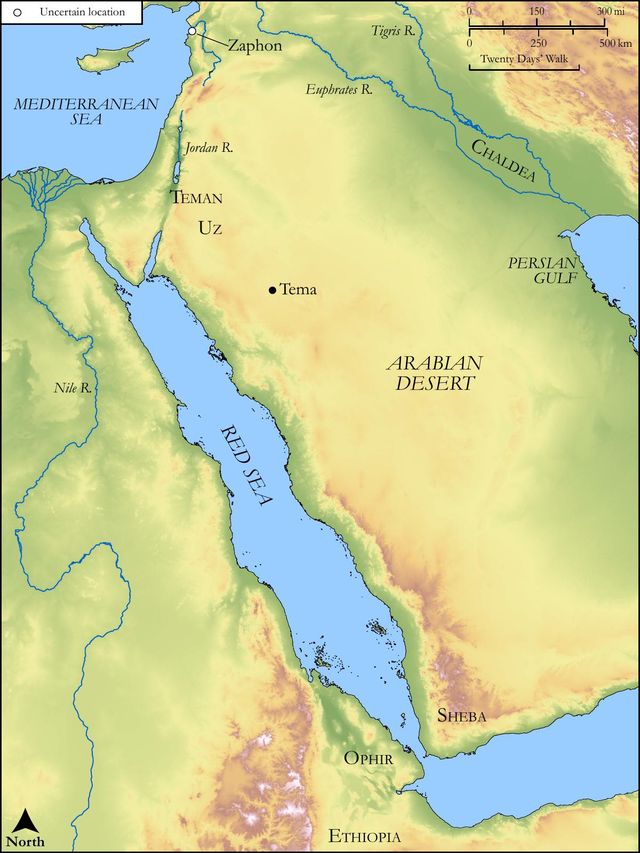
See on the biblical-era map
Study this verse
Public-domain commentary
Matthew Henry
From his Commentary on the Whole Bible. Henry comments on passages, not single verses — this entry covers Job 34:16–30. His four-level outline is real structure in the source text, so it is rendered as structure.
Elihu here addresses himself more directly to Job. He had spoken to the rest (Job 34:10) as men of understanding; now, speaking to Job; he puts an if upon his understanding: If thou hast understanding, hear this and observe it, Job 34:16.
I.Hear this, That God is not to be quarrelled with for any thing that he does.
It is daring presumption to arraign and condemn God's proceedings, as Job had done by his discontents. It was,
1.As absurd as it would be to advance one to power that is a professed enemy to justice: Shall even he that hates right govern? Job 34:17. The righteous Lord so loves righteousness that, in comparison with him, even Job himself, though a perfect and upright man, might be said to hate right; and shall he govern? Shall he pretend to direct God or correct what he does? Shall such unrighteous creatures as we are give law to the righteous God? or must he take his measures from us? When we consider the corruption of our nature, and the contrariety there is in us to the eternal rule of equity, we cannot but see it to be an impudent impious thing for us to prescribe to God.
2.It was as absurd as it would be to call a most righteous innocent person to the bar, and to give judgment against him, though it appeared ever so plainly, upon the trial, that he was most just: Wilt thou condemn him that is righteous in all his ways, and cannot but be so?
3.It is more absurd and unbecoming than it would be to say to a sovereign prince, Thou art wicked, and to judges upon the bench, You are ungodly, Job 34:18. This would be looked upon as an insufferable affront to majesty and to magistracy; no king, no prince, would bear it. In favour of government, we presume it is a right sentence that is passed, unless the contrary be very evident; but, whatever we think, it is not fit to tell a king to his face that he is wicked. Nathan reproved David by a parable. But, whatever a high priest or a prophet might do, it is not for an ordinary subject to make so bold with the powers that are. How absurd is then to say so to God - to impute iniquity to him, who, having no respect of persons, is in no temptation to do an unjust thing! He regardeth not the rich more than the poor, and therefore it is fit he should rule, and it is not fit we should find fault with him, Job 34:19. Note, Rich and poor stand upon the same level before God. A great man shall fare never the better, nor find any favour, for his wealth and greatness; nor shall a poor man fare ever the worse for his poverty, nor an honest cause be starved. Job, now that he was poor, should have as much favour with God, and be as much regarded by him, as when he was rich; for they are all the work of his hands. Their persons are so: the poor are made by the same hand, and of the same mould, as the rich. Their conditions are so: the poor were made poor by the divine providence, as well as the rich made rich; and therefore the poor shall fare never the worse for that which is their lot, not their fault.
II.Hear this, That God is to be acknowledged and submitted to in all that he does.
Divers considerations Elihu here suggests to Job, to beget in him great and high thoughts of God, and so to persuade him to submit and proceed no further in his quarrel with him.
1.God is almighty, and able to deal with the strongest of men when he enters into judgment with them (Job 34:20); even the people, the body of a nation, though ever so numerous, shall be troubled, unhinged, and put into disorder, when God pleases; even the mighty man, the prince, though ever so honourable, ever so formidable among men, shall, if God speak the word, be taken away out of his throne, nay, out of the land of the living; they shall die; they shall pass away. What cannot he do that has all the powers of death at his command? Observe the suddenness of this destruction: In a moment shall they die. It is not a work of time, with God, to bring down his proud enemies, but, when he pleases, it is soon done; nor is he bound to give them warning, no, not an hour's warning. This night thy soul shall be required. Observe the season of it: They shall be troubled at midnight, when they are secure and careless, and unable to help themselves; as the Egyptians when their first-born were slain. This is the immediate work of God: they are taken away, without hand, insensibly, by secret judgments. God can himself humble the greatest tyrant, without the assistance or agency of any man. Whatever hand he sometimes uses in the accomplishing of his purposes, he needs none, but can do it without hand. Nor is it one single mighty man only that he can thus overpower, but even hosts of them (Job 34:24): He shall break in pieces mighty men without number; for no combined power can stand it out against Omnipotence. Yet, when God destroys tyranny, he does not design anarchy; if those are brought down that ruled ill, it does not therefore follow that people must have no rulers; for, when he breaks mighty men, he sets others in their stead, that will rule better, or, if they do not, he overturns them also in the night, or in a night, so that they are destroyed, Job 34:25. Witness Belshazzar. Or, if he designs them space to repent, he does not presently destroy them, but he strikes them as wicked men, Job 34:26. Some humbling mortifying judgments are brought upon them; these wicked rulers are stricken as other wicked men, as surely, as sorely, stricken in their bodies, estates, or families, and this for warning to their neighbours; the stroke is given in terrorem - as an alarm to others, and therefore is given in the open sight of others, that they also may see and fear, and tremble before the justice of God. If kings stand not before him, how shall we stand!
2.God is omniscient, and can discover that which is most secret. As the strongest cannot oppose his arm, so the most subtle cannot escape his eye; and therefore, if some are punished either more or less than we think they should be, instead of quarrelling with God, it becomes us to ascribe it to some secret cause known to God only. For,
(1.)Every thing is open before him (Job 34:21): His eyes are upon the ways of man; not only they are within reach of his eye, so that he can see them, but his eye is upon them, so that he actually observes and inspects them. He sees us all, and sees all our goings; go where we will, we are under his eye; all our actions, good and evil, are regarded and recorded and reserved to be brought into judgment when the books shall be opened.
(2.)Nothing is or can be concealed from him (Job 34:22): There is no darkness nor shadow of death so close, so thick, so solitary, so remote from light or sight as that in it the workers of iniquity may hide themselves from the discovering eye and avenging hand of the righteous God. Observe here,
[1.]The workers of iniquity would hide themselves if they could from the eye of the world for shame (and that perhaps they may do), and from the eye of God for fear, as Adam among the trees of the garden. The day is coming when mighty men, and chief captains, will call to the rocks and mountains to hide them.
[2.]They would gladly be hid even by the shadow of death, be hid in the grave, and lie for ever there, rather than appear before the judgment-seat of Christ.
(3.)It is in vain to think of flying from God's justice, or absconding when his wrath is in pursuit of us. The workers of iniquity may find ways and means to hide themselves from men, but not from God: He knows their works (Job 34:25), both what they do and what they design.
3.God is righteous, and, in all his proceedings, goes according to the rules of equity. Even when he is overturning mighty men, and breaking them in pieces, yet he will not lay upon man more than right, Job 34:23. As he will not punish the innocent, so he will not exact of those that are guilty more than their iniquities deserve; and of the proportion between the sin and the punishment Infinite Wisdom shall be the judge. He will not give any man cause to complain that he deals hardly with him, nor shall any man enter into judgment with God, or bring an action against him. If he do, God will be justified when he speaks and clear when he judges. Therefore Job was very much to be blamed for his complaints of God, and is here well-advised to let fall his action, for he would certainly be cast or non-suited. It is not for man ever to purpose to enter into judgment with the Omnipotent; so some read the whole verse. Job had often wished to plead his cause before God. Elihu asks, "To what purpose? The judgment already given concerning thee will certainly be affirmed; no errors can be found in it, nor any exceptions taken to it, but, after all, it must rest as it is." All is well that God does, and will be found so. To prove that when God destroys the mighty men, and strikes them as wicked men, he does not lay upon them more than right, he shows what their wickedness was (v. 27, 28); and let any compare that with their punishment, and then judge whether they did not deserve it. In short, these unjust judges, whom God will justly judge, neither feared God nor regarded man, Luk 18:2.
(1.)They were rebels to God: They turned back from him, cast off the fear of him, and abandoned the very thoughts of him; for they would not consider any of his ways, took no heed either to his precepts or to his providences, but lived without God in the world. This is at the bottom of all the wickedness of the wicked, they turn back from God; and it is because they do not consider, not because they cannot, but because they will not. From inconsideration comes impiety, and thence all immorality.
(2.)They were tyrants to all mankind, Job 34:28. They will not call upon God for themselves; but they cause the cry of the poor to come to him, and that cry is against them. They are injurious and oppressive to the poor, wrong them, crush them, impoverish them yet more, and add affliction to the afflicted, who cry unto God, make their complaint to him, and he hears them and pleads their cause. Their case is bad who have the prayers and tears of the poor against them; for the cry of the oppressed will, sooner or later, draw down vengeance on the heads of the oppressors, and no one can say that this is more than right, Exo 22:23.
4.God has an uncontrollable dominion in all the affairs of the children of men, and so guides and governs whatever concerns both communities and particular persons, that, as what he designs cannot be defeated, so what he does cannot be changed, Job 34:29. Observe,
(1.)The frowns of all the world cannot trouble those whom God quiets with his smiles. When he gives quietness who then can make trouble? Job 34:29. This is a challenge to all the powers of hell and earth to disquiet those to whom God speaks peace, and for whom he creates it. If God give outward peace to a nation, he can secure what he gives, and disable the enemies of it to give it any disturbance. If God give inward peace to a man only, the quietness and everlasting assurance which are the effect of righteousness, neither the accusations of Satan nor the afflictions of this present time, no, nor the arrests of death itself, can give trouble. What can make those uneasy whose souls dwell at ease in God? See Phi 4:7.
(2.)The smiles of all the world cannot quiet those whom God troubles with his frowns; for if he, in displeasure, hide his face, and withhold the comfort of his favour, who then can behold him? that is, Who can behold a displeased God, so as to bear up under his wrath or turn it away? Who can make him show his face when he resolves to hide it, or see through the clouds and darkness which are round about him? Or, Who can behold a disquieted sinner, so as to give him effectual relief? Who can stand a friend to him to whom God is an enemy? None can relieve the distresses of the outward condition without God. If the Lord do not help thee, whence shall I? Kg2 6:27. Nor can any relieve the distresses of the mind against God and his terrors. If he impress the sense of his wrath upon a guilty conscience, all the comforts the creature can administer are ineffectual. As vinegar upon nitre, so are songs to a heavy heart. The irresistibleness of God's operations must be acknowledged in his dealings both with communities and with particular persons: what he does cannot be controlled, whether it be done against a nation in its public capacity or against a man only in his private affairs. The same Providence that governs mighty kingdoms presides in the concerns of the meanest individual; and neither the strength of a whole nation can resist his power nor the smallness of a single person evade his cognizance; but what he does shall be done effectually and victoriously.
5.God is wise, and careful of the public welfare, and therefore provides that the hypocrite reign not, lest the people be ensnared, Job 34:30. See here,
(1.)The pride of hypocrites. They aim to reign; the praise of men, and power in the world, are their reward, what they aim at.
(2.)The policy of tyrants. When they aim to set up themselves they sometimes make use of religion as a cloak and cover for their ambition and by their hypocrisy come to the throne.
(3.)The danger the people are in when hypocrites reign. They are likely to be ensnared in sin, or trouble, or both. Power, in the hands of dissemblers, is often destructive to the rights and liberties of a people, which they are more easily wheedled out of than forced out of. Much mischief has been done likewise to the power of godliness under the pretence of a form of godliness.
(4.)The care which divine Providence takes of the people, to prevent this danger, that the hypocrite reign not, either that he do not reign at all or that he do not reign long. If God has mercy in store for a people, he will either prevent the rise or hasten the ruin of hypocritical rulers.
Historical interpretation
Two Centuries of Reception
2 surviving comments on this verse. Each one is dated, so this reads as a timeline rather than a list.
Select a marker to jump to its quote. Markers stagger vertically where authors wrote within a few decades of each other.
Did you see? He did not dare come to the conclusion that he is [just]; with great discretion he avoided asserting it plainly. Not only by participating in the universe, or in the creation or in his power, we must realize his justice, but also by participating in his own nature and acts. He hates the wicked and loves human beings. He is not like us, who keep away from sin not because of our aversion to vice but because of the fear of punishment. Where does [this fear] come from? From the fact that he “hates injustice and makes the wicked perish.” “He, who is eternal,” he adds. Elihu is right in introducing the concept of eternity because God is not required every day and for every action to give explanations about what happened; it is usual that God manages a matter whose fulfillment must extend over a long period. Therefore, do not anticipate the conclusion of a fact, and do not try to understand the judgment of God before everything has been completed, because you will get no profit from your hurriedness. That is why he says, eternal and just. All past testifies to him. Is it possible that he has changed now?
51. He uttered a proper sentiment, but it ought not to have been uttered to blessed Job. For in every thing which is said we must by all means consider, what is said, to whom it is said, where it is said, how it is said. But Eliu considered only what he was saying, but did not consider to whom he was saying it. For blessed Job loved judgment, since he knew how to weigh his causes carefully with the Lord. Nor had he condemned Him that is just: but humbly enquired, when involved in grief, why he had been smitten when without sin. He loves judgment, whoever examines his own ways minutely, and enters into the secret chambers of his heart, and there considers what the Lord bestows on him, and what he owes to the Lord. But how had blessed Job not acted thus, who used to offer such frequent sacrifices in expiation for his sons, even on account of their thoughts? Because then Eliu said, that he that loveth not judgment cannot be healed, accusing blessed Job of not loving judgment, and of having condemned Him who is just, he immediately subjoins the righteousness of that same righteous One, that is, the Lord.
Continue studying Job 34:17 across the web’s major study libraries — every link below opens this exact verse, chapter, or book on the destination site.
Read & Compare
 BibleGatewayThis verse in more than 200 translations and 70 languages.
 Bible.comThe YouVersion reader — hundreds of translations, reading plans, and highlights.
 ESV.orgCrossway's official English Standard Version reader.
 NET BibleThe NET translation with 60,000+ translators' notes on every rendering decision.
 STEP BibleTyndale House's free study tool — original text, vocabulary, and scholarly resources.
 BibliaLogos Bible Software's free web reader.
 USCCBThe New American Bible (Revised Edition) with the U.S. bishops' study notes.
Commentaries
 BibleHub CommentariesDozens of classic commentaries on this verse, gathered on one page.
 StudyLightMore than 100 commentary sets — the largest collection on the web.
 BibleRefPlain-English commentary on what this verse means, verse by verse.
 Enduring WordDavid Guzik's free commentary on this chapter, widely used by Bible teachers.
 Bible Study ToolsVerse commentary alongside Greek and Hebrew study aids.
Original Language & Research
- BibleHub InterlinearThe verse word by word — original language, transliteration, and English.
- BibleHub LexiconEvery word's original-language definition and Strong's entry.
 Blue Letter BibleDeep-study tools — Strong's numbers, concordance, and word studies.
 SefariaThe Hebrew text with Rashi and centuries of Jewish commentary.
Sermons, Hymns & Audio


TrulyRandomVerse is not affiliated with these sites and doesn’t control their content. They’re linked because they’re genuinely useful.
Summary
Job 34:17 presents a profound rhetorical challenge from Elihu, forcefully asserting God's absolute and unblemished justice in His governance of the universe. Elihu interjects into the theological impasse between Job and his friends, directly confronting Job's perceived accusations that God acts arbitrarily or unjustly in allowing his suffering. Through these penetrating questions, Elihu passionately defends the divine character, positing that it is utterly inconceivable for the Almighty to be anything other than perfectly righteous, thereby refuting any notion that God could despise what is right or be subjected to human condemnation.
Context
ShowHideLiterary Context
Job 34:17 is embedded within Elihu's extensive and climactic discourse, which commences in Job 32 and concludes in Job 37. Having patiently (or impatiently) waited for Job and his three older friends to exhaust their arguments, Elihu, a younger man, steps forward, claiming divine inspiration to offer a more accurate perspective on God's justice and Job's suffering. In Job 34, Elihu specifically targets Job's complaints, which he interprets as an implicit accusation against God's righteousness. He meticulously builds a case for God's omnipotence and moral perfection, arguing that God's actions, even when inscrutable to human understanding, are always rooted in His just character. This particular verse serves as a powerful rhetorical climax, challenging the very premise that God could be unjust or subject to human judgment.
Historical & Cultural Context
The Book of Job is set in the land of Uz, a location outside of Israel, which lends a universal dimension to its exploration of suffering and divine justice, transcending specific national or covenantal boundaries. The cultural backdrop is that of ancient Near Eastern (ANE) wisdom literature, where the prevailing understanding of suffering was often tied to the concept of retributive justice—that suffering was a direct consequence of sin. While Job's experience profoundly challenges this simplistic paradigm, Elihu, like the other friends, operates within this framework but attempts to refine it. He introduces the idea that suffering can also serve as a means of discipline, instruction, or purification, rather than solely punishment. The concept of a just and righteous ruler was paramount in ANE societies, where kings were often expected to embody justice. Elihu applies this ideal, in its most perfect form, to God, emphasizing that His governance is inherently tied to His flawless moral character, contrasting sharply with the often-corrupt and fallible human rulers of the era.
Key Themes
ShowHideThis verse significantly contributes to several core themes within the Book of Job and broader biblical theology. Central to its message is the theme of God's Impeccable Justice and Righteousness, asserting that God's character is fundamentally just, making it impossible for Him to "hate right" or be "condemned" by any human standard. This undergirds the theme of Divine Sovereignty and Governance, emphasizing that the universe is ruled by a perfectly righteous being, ensuring cosmic order rather than chaos. Elihu's rhetorical questions also powerfully highlight the Limits of Human Understanding and Judgment, implicitly rebuking Job for presuming to question or "condemn" God's actions. This theme resonates deeply with the book's ultimate resolution, where God Himself speaks from the whirlwind in Job 38, majestically displaying His power and wisdom, thereby humbling Job and illustrating the vast chasm between divine and human knowledge, ultimately leading Job to repent in Job 42:6.
Exposition and Analysis
ShowHideKey Word Analysis
ShowHideA primitive root meaning "to hate (personally)"; enemy, foe, (be) hate(-ful, -r), odious, [idiom] utterly. Elihu uses this term to describe an abhorrence of what is right, presenting an unthinkable attribute for God. The rhetorical question implies that if God were capable of such hatred, His governance would be chaotic and tyrannical, which is contrary to His nature.
Properly, a verdict (favorable or unfavorable) pronounced judicially, especially a sentence or formal decree; abstractly, justice, including a participant's right or privilege (statutory or customary), or even a style. To "hate mishpâṭ" would mean to despise order, fairness, and moral rectitude. Elihu's premise highlights the absurdity of such a concept when applied to God, who is the very source and embodiment of justice and order.
Meaning "just; just, lawful, righteous (man)." This term describes one who conforms to a moral standard, acting in accordance with what is right. When combined with "most" (H3524, kabbîyr, meaning vast, mighty, much), it forms a superlative, emphasizing God's absolute, unparalleled, and supreme righteousness. Elihu uses this to underscore the utter impossibility and theological error of any human attempt to "condemn" such a perfectly righteous being.
Verse Breakdown
ShowHide"Shall even he that hateth right govern?"
This is a powerful rhetorical question designed to elicit an emphatic "No." Elihu presents an absurd hypothetical: a ruler of the cosmos who despises justice. The very notion is presented as an impossibility, intended to highlight the intrinsic and inseparable connection between God's character and His governance. Since God is inherently and perfectly just, it is inconceivable that He would rule in a manner that is unjust, arbitrary, or contrary to righteousness. This clause serves to affirm God's moral perfection as the unshakeable foundation of His cosmic authority and administration.
"and wilt thou condemn him that is most just?"
This second rhetorical question directly confronts Job's posture and implied accusations. Elihu suggests that Job, in his fervent lamentations and demands for vindication, has effectively put God on trial and found Him wanting. By asking if Job would "condemn" (Hebrew: râshaʻ, H7561, meaning "to declare wicked" or "find guilty") the One who is supremely righteous, Elihu underscores the profound arrogance and theological error inherent in any human attempt to question or pass judgment on God's actions from a limited, finite perspective. It is a forceful call for humility and a recognition of God's unassailable moral authority and perfect character.
Literary Devices
ShowHideElihu's discourse in Job 34:17 masterfully employs Rhetorical Questions. These are questions posed not to elicit an answer, but to make a point more forcefully, implying that the answer is self-evident and overwhelmingly obvious. By asking "Shall even he that hateth right govern?" and "wilt thou condemn him that is most just?", Elihu compels his listeners (and Job) to acknowledge the undeniable truth: God is perfectly just and cannot be condemned by any human standard. The verse also utilizes Antithesis, presenting a stark contrast between the hypothetical "he that hateth right" and the reality of "him that is most just." This opposition highlights the absurdity of the first premise when applied to God, thereby reinforcing the absolute truth of the second. Furthermore, Elihu employs an Argument from Impossibility or Absurdity, where he presents a premise so unthinkable (God hating justice) that its conclusion (God governing unjustly) is rendered impossible, thereby affirming God's inherent and unwavering righteousness and the impossibility of human judgment against Him.
Theological and Thematic Connections
ShowHideJob 34:17 establishes a foundational theological truth: God's governance is inextricably linked to His perfect justice. His rule is not arbitrary, capricious, or driven by malice, but is an outflow of His holy and righteous character. This verse confronts the human tendency to judge God based on limited understanding or painful circumstances, reminding us that His ways are higher than ours and His justice is beyond reproach. It calls for a posture of humility and trust, even when faced with the inexplicable, affirming that the very One who governs the universe is "most just."
Reflection and Application
ShowHideIn a world often riddled with injustice, suffering, and seemingly inexplicable events, Job 34:17 offers profound reassurance and a necessary corrective to our human perspective. It reminds us that while we may struggle to comprehend the reasons for our trials or the apparent disparities in life, the ultimate authority governing all things is perfectly righteous. This verse calls us to resist the temptation to "condemn" God or to question His character based on our limited understanding. Instead, it invites us to cultivate a deep trust in His unwavering justice, knowing that His plans, though often mysterious, are always rooted in His perfect nature. Our peace and security ultimately rest not in our ability to understand everything, but in the unshakeable truth that the One who governs is indeed "most just."
Questions for Reflection
ShowHideFAQ
ShowHideWhy does Elihu speak so confidently about God's justice, especially given Job's suffering?
ShowHideElihu's unwavering confidence stems from a deeply ingrained theological conviction regarding God's intrinsic character and absolute sovereignty, which he believes Job has implicitly challenged. While sharing some common ground with Job's three friends concerning divine justice, Elihu introduces a nuanced perspective: that suffering can also be disciplinary, instructional, or a means of refining faith, rather than solely punitive. He argues that God is too great, too pure, and too righteous to act unjustly, and therefore, Job's suffering must serve a righteous purpose, even if Job himself doesn't comprehend it. Elihu perceives Job's lamentations as bordering on self-righteousness and an implicit accusation against the Almighty, which he feels divinely compelled to correct. He firmly believes that God's actions are always consistent with His perfect nature, and it is human beings who lack the comprehensive perspective to fully grasp divine wisdom and justice, as later demonstrated by God's own words in Job 38-41.
How does this verse relate to the broader problem of evil and suffering?
ShowHideJob 34:17 addresses the problem of evil and suffering by unequivocally asserting God's inherent justice and righteous governance, even in the face of profound human suffering. It does not offer a comprehensive explanation for why evil and suffering exist, but it emphatically refutes the notion that they are a result of God's injustice, His hatred of right, or His arbitrary rule. Elihu's argument is that God is fundamentally good and just, and therefore, any suffering permitted by Him must ultimately align with His righteous character, even if the specific reasons are hidden from human view. This verse serves as a crucial theological anchor, ensuring that all discussions about suffering begin with the non-negotiable premise of God's unwavering righteousness, preventing the conclusion that God is either evil or unjust. It redirects the focus from questioning God's character to acknowledging His supreme and unassailable justice, even amidst the mystery of pain.
Christ-Centered Fulfillment
ShowHideJob 34:17, with its emphatic declaration of God as "most just" and the righteous governor, finds its ultimate fulfillment and clearest demonstration in the person and work of Jesus Christ. While Elihu passionately defends God's justice against Job's complaints, it is in Christ that divine justice is not only proclaimed but perfectly embodied and executed. Jesus is the righteous judge to whom all authority in heaven and on earth has been given, the one whom God has appointed to judge the world in righteousness. He is the "most just" one who, unlike Job, suffered not for his own sin, but as the just for the unjust, bearing the condemnation that humanity deserved. The cross, seemingly the ultimate injustice, is paradoxically the supreme demonstration of God's perfect justice and boundless love, where He both condemns sin and justifies the sinner who believes in Jesus, as highlighted in Romans 3:25-26. Ultimately, Christ is the King of kings and Lord of lords, the one who truly governs, and His reign is founded upon righteousness and justice, ensuring that His kingdom will never be shaken and that all things will ultimately be set right under His perfectly just and eternal rule, as promised in Isaiah 9:7.