


Romans 9:14
- ΤίTiWhatG5101I-ASNInterrogative pronoun Accusative Singular Neuter
- οὖνounthenG3767CONJConjunction
- ἐροῦμεν;eroumenwill we say?G4483V-FAI-1PVerb Future Active Indicative 1st Plural
- μὴmēNotG3361PRT-NNegative Particle Negative
- ἀδικίαadikiainjusticeG93N-NSFNoun Nominative Singular Feminine
- παρὰparawithG3844PREPPreposition
- τῷtō<the>G3588T-DSMDefinite article Dative Singular Masculine
- θεῷ;theōGod [is there]?G2316N-DSM-TNoun Dative Singular Masculine Title
- μὴmēNeverG3361PRT-NNegative Particle Negative
- γένοιτοgenoitowould it be!G1096V-2ADO-3SVerb 2nd Aorist Middle Deponent Optative 3rd Singular
English is a literal word-by-word gloss of the Greek, not the KJV's wording. Why?
This is the original text the KJV's translators worked from — each Greek word with its own literal English meaning in this verse, prepared by scholars at Tyndale House, Cambridge. The KJV translates whole sentences, not word by word, so its wording differs: one Greek word can become several English words, and the KJV may choose “charity” where the gloss reads “love”. Both are faithful — they answer different questions. For the KJV's own rendering, switch to the KJV text.
Details
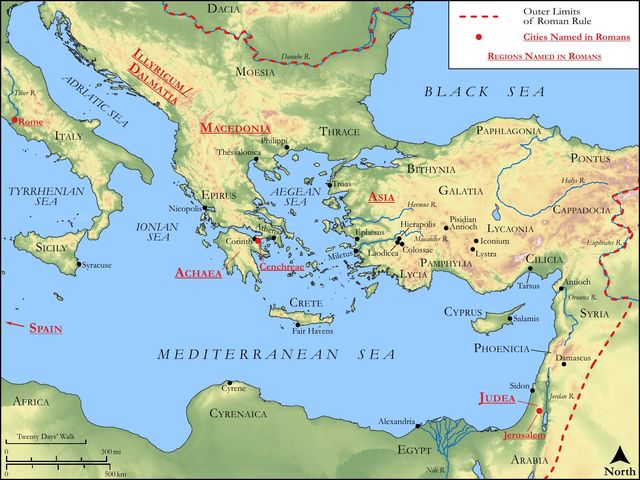
See on the biblical-era map

Study this verse
Public-domain commentary
Matthew Henry
From his Commentary on the Whole Bible. Henry comments on passages, not single verses — this entry covers Romans 9:14–24. His three-level outline is real structure in the source text, so it is rendered as structure.
The apostle, having asserted the true meaning of the promise, comes here to maintain and prove the absolute sovereignty of God, in disposing of the children of men, with reference to their eternal state. And herein God is to be considered, not as a rector and governor, distributing rewards and punishments according to his revealed laws and covenants, but as an owner and benefactor, giving to the children of men such grace and favour as he has determined in and by his secret and eternal will and counsel: both the favour of visible church-membership and privileges, which is given to some people and denied to others, and the favour of effectual grace, which is given to some particular persons and denied to others.
Now this part of his discourse is in answer to two objections.
I.It might be objected, Is there unrighteousness with God? If God, in dealing with the children of men, do thus, in an arbitrary manner, choose some and refuse others, may it not be suspected that there is unrighteousness with him? This the apostle startles at the thought of: God forbid! Far be it from us to think such a thing; shall not the judge of all the earth do right? Gen 18:25; Rom 3:5, Rom 3:6. He denies the consequences, and proves the denial.
1.In respect of those to whom he shows mercy, Rom 9:15, Rom 9:16. He quotes that scripture to show God's sovereignty in dispensing his favours (Exo 33:19): I will be gracious to whom I will be gracious. All God's reasons of mercy are taken from within himself. All the children of men being plunged alike into a state of sin and misery, equally under guilt and wrath, God, in a way of sovereignty, picks out some from this fallen apostatized race, to be vessels of grace and glory. He dispenses his gifts to whom he will, without giving us any reason: according to his own good pleasure he pitches upon some to be monuments of mercy and grace, preventing grace, effectual grace, while he passes by others. The expression is very emphatic, and the repetition makes it more so: I will have mercy on whom I will have mercy. It imports a perfect absoluteness in God's will; he will do what he will, and giveth not account of any of his matters, nor is it fit he should. As these great words, I am that I am (Exo 3:14) do abundantly express the absolute independency of his being, so these words, I will have mercy on whom I will have mercy, do as fully express the absolute prerogative and sovereignty of his will. To vindicate the righteousness of God, in showing mercy to whom he will, the apostle appeals to that which God himself had spoken, wherein he claims this sovereign power and liberty. God is a competent judge, even in his own case. Whatsoever God does, or is resolved to do, is both by the one and the other proved to be just. Eleēsō on han heleō - I will have mercy on whom I will have mercy. When I begin, I will make an end. Therefore God's mercy endures for ever, because the reason of it is fetched from within himself; therefore his gifts and callings are without repentance. Hence he infers (Rom 9:16), It is not of him that willeth. Whatever good comes from God to man, the glory of it is not to be ascribed to the most generous desire, nor to the most industrious endeavour, of man, but only and purely to the free grace and mercy of God. In Jacob's case it was not of him that willeth, nor of him that runneth; it was not the earnest will and desire of Rebecca that Jacob might have the blessing; it was not Jacob's haste to get it (for he was compelled to run for it) that procured him the blessing, but only the mercy and grace of God. Wherein the holy happy people of God differ from other people, it is God and his grace that make them differ. Applying this general rule to the particular case that Paul has before him, the reason why the unworthy, undeserving, ill-deserving Gentiles are called, and grafted into the church, while the greatest part of the Jews are left to perish in unbelief, is not because those Gentiles were better deserving or better disposed for such a favour, but because of God's free grace that made that difference. The Gentiles did neither will it, nor run for it, for they sat in darkness, Mat 4:16. In darkness, therefore not willing what they knew not; sitting in darkness, a contented posture, therefore not running to meet it, but anticipated with these invaluable blessings of goodness. Such is the method of God's grace towards all that partake of it, for he is found of those that sought him not (Isa 65:1); in this preventing, effectual, distinguishing grace, he acts as a benefactor, whose grace is his own. Our eye therefore must not be evil because his is good; but, of all the grace that we or others have, he must have the glory: Not unto us, Psa 115:1.
2.In respect of those who perish, Rom 9:17. God's sovereignty, manifested in the ruin of sinners, is here discovered in the instance of Pharaoh; it is quoted from Exo 9:16. Observe,
(1.)What God did with Pharaoh. He raised him up, brought him into the world, made him famous, gave him the kingdom and power, - set him up as a beacon upon a hill, as the mark of all his plagues (compare Exo 9:14) - hardened his heart, as he had said he would (Exo 4:21): I will harden his heart, that is, withdraw softening grace, leave him to himself, let Satan loose against him, and lay hardening providences before him. Or, by raising him up may be meant the intermission of the plagues which gave Pharaoh respite, and the reprieve of Pharaoh in those plagues. In the Hebrew, I have made thee stand, continued thee yet in the land of the living. Thus doth God raise up sinners, make them for himself, even for the day of evil (Pro 16:4), raise them up in outward prosperity, external privileges (Mat 11:23), sparing mercies.
(2.)What he designed in it: That I might show my power in thee. God would, by all this, serve the honour of his name, and manifest his power in baffling the pride and insolence of that great and daring tyrant, who bade defiance to Heaven itself, and trampled upon all that was just and sacred. If Pharaoh had not been so high and might, so bold and hardy, the power of God had not been so illustrious in the ruining of him; but the taking off of the spirit of such a prince, who hectored at that rate, did indeed proclaim God glorious in holiness, fearful in praises, doing wonders, Exo 15:11. This is Pharaoh, and all his multitude.
(3.)His conclusion concerning both these we have, Rom 9:18. He hath mercy on whom he will have mercy, and whom he will he hardeneth. The various dealings of God, by which he makes some to differ from others, must be resolved into his absolute sovereignty. He is debtor to no man, his grace is his own, and he may give it or withhold it as it pleaseth him; we have none of us deserved it, nay, we have all justly forfeited it a thousand times, so that herein the work of our salvation is admirably well ordered that those who are saved must thank God only, and those who perish must thank themselves only, Hos 13:9. We are bound, as God hath bound us, to do our utmost for the salvation of all we have to do with; but God is bound no further than he has been pleased to bind himself by his own covenant and promise, which is his revealed will; and that is that he will receive, and not cast out, those that come to Christ; but the drawing of souls in order to that coming is a preventing distinguishing favour to whom he will. Had he mercy on the Gentiles? It was because he would have mercy on them. Were the Jews hardened? It was because it was his own pleasure to deny them softening grace, and to give them up to their chosen affected unbelief. Even so, Father, because it seemed good unto thee. That scripture excellently explains this, Luk 10:21, and, as this, shows the sovereign will of God in giving or withholding both the means of grace and the effectual blessing upon those means.
II.It might be objected, Why doth he yet find fault? For who hath resisted his will? Rom 9:19.
Had the apostle been arguing only for God's sovereignty in appointing and ordering the terms and conditions of acceptance and salvation, there had not been the least colour for this objection; for he might well find fault if people refused to come up to the terms on which such a salvation is offered; the salvation being so great, the terms could not be hard. But there might be colour for the objection against his arguing for the sovereignty of God in giving and withholding differencing and preventing grace; and the objection is commonly and readily advanced against the doctrine of distinguishing grace. If God, while he gives effectual grace to some, denies it to others, why doth he find fault with those to whom he denies it? If he hath rejected the Jews, and hid from their eyes the things that belong to their peace, why doth he find fault with them for their blindness? If it be his pleasure to discard them as not a people, and not obtaining mercy, their knocking off themselves was no resistance of his will. This objection he answers at large,
1.By reproving the objector (Rom 9:20): Nay but, O man. This is not an objection fit to be made by the creature against his Creator, by man against God. The truth, as it is in Jesus, is that which abases man as nothing, less than nothing, and advances God as sovereign Lord of all. Observe how contemptibly he speaks of man, when he comes to argue with God his Maker: "Who art thou, thou that art so foolish, so feeble, so short-sighted, so incompetent a judge of the divine counsels? Art thou able to fathom such a depth, dispute such a case, to trace that way of God which is in the sea, his path in the great waters?" That repliest against God. It becomes us to submit to him, not to reply against him; to lie down under his hand, not to fly in his face, nor to charge him with folly. Ho antapokrinomenos - That answerest again. God is our master, and we are his servants; and it does not become servants to answer again, Tit 2:9.
2.By resolving all into the divine sovereignty. We are the thing formed, and he is the former; and it does not become us to challenge or arraign his wisdom in ordering and disposing of us into this or that shape of figure. The rude and unformed mass of matter hath no right to this or that form, but is shaped at the pleasure of him that formeth it. God's sovereignty over us is fitly illustrated by the power that the potter hath over the clay; compare Jer 18:6, where, by a like comparison, God asserts his dominion over the nation of the Jews, when he was about to magnify his justice in their destruction by Nebuchadnezzar.
(1.)He gives us the comparison, Rom 9:21. The potter, out of the same lump, may make either a fashionable vessel, and a vessel fit for creditable and honourable uses, or a contemptible vessel, and a vessel in which is no pleasure; and herein he acts arbitrarily, as he might have chosen whether he would make any vessel of it at all, or whether he would leave it in the hole of the pit, out of which it was dug.
(2.)The application of the comparison, Rom 9:22-24. Two sorts of vessels God forms out of the great lump of fallen mankind: - [1.] Vessels of wrath - vessels filled with wrath, as a vessel of wine is a vessel filled with wine; full of the fury of the Lord, Isa 51:20. In these God is willing to show his wrath, that is, his punishing justice, and his enmity to sin. This must be shown to all the world, God will make it appear that he hates sin. He will likewise make his power known, to dumaton autou. It is a power of strength and energy, an inflicting power, which works and effects the destruction of those that perish; it is a destruction that proceeds from the glory of his power, Th2 1:9. The eternal damnation of sinners will be an abundant demonstration of the power of God; for he will act in it himself immediately, his wrath preying as it were upon guilty consciences, and his arm stretched out totally to destroy their well-being, and yet at the same instant wonderfully to preserve the being of the creature. In order to this, God endured them with much long-suffering - exercised a great deal of patience towards them, let them alone to fill up the measure of sin, to grow till they were ripe for ruin, and so they became fitted for destruction, fitted by their own sin and self-hardening. The reigning corruptions and wickedness of the soul are its preparedness and disposedness for hell: a soul is hereby made combustible matter, fit for the flames of hell. When Christ said to the Jews (Mat 23:32), Fill you up then the measure of your father, that upon you may come all the righteous blood (Mat 23:35), he did, as it were, endure them with much long-suffering, that they might, by their own obstinacy and wilfulness in sin, fit themselves for destruction. [2.] Vessels of mercy - filled with mercy. The happiness bestowed upon the saved remnant is the fruit, not of their merit, but of God's mercy. The spring of all the joy and glory of heaven is that mercy of God which endures for ever. Vessels of honour must to eternity own themselves vessels of mercy. Observe, First, What he designs in them: To make known the riches of his glory, that is, of his goodness; for God's goodness is his greatest glory, especially when it is communicated with the greatest sovereignty. I beseech thee show me thy glory, says Moses, Exo 33:18. I will make all my goodness to pass before thee, says God (Exo 33:19), and that given out freely: I will be gracious to whom I will be gracious. God makes known his glory, this goodness of his, in the preservation and supply of all the creatures: the earth is full of his goodness, and the year crowned with it; but when he would demonstrate the riches of his goodness, unsearchable riches, he does it in the salvation of the saints, that will be to eternity glorious monuments of divine grace. Secondly, What he does for them he does before prepare them to glory. Sanctification is the preparation of the soul for glory, making it meet to partake of the inheritance of the saints in light. This is God's work. We can destroy ourselves fast enough, but we cannot save ourselves. Sinners fit themselves for hell, but it is God that prepares saints for heaven; and all those that God designs for heaven hereafter he prepares and fits for heaven now: he works them to the self-same thing, Co2 5:5. And would you know who these vessels of mercy are? Those whom he hath called (Rom 9:24); for whom he did predestinate those he also called with an effectual call: and these not of the Jews only, but of the Gentiles; for, the partition-wall being taken down, the world was laid in common, and not (as it had been) God's favour appropriated to the Jews, and they put a degree nearer his acceptance than the rest of the world. They now stood upon the same level with the Gentiles; and the question is not now whether of the seed of Abraham or no, that is neither here nor there, but whether or no called according to his purpose.
Historical interpretation
Eleven Centuries of Reception
6 surviving comments on this verse. Each one is dated, so this reads as a timeline rather than a list.
Select a marker to jump to its quote. Markers stagger vertically where authors wrote within a few decades of each other.
All having been therefore called, those who are willing to obey have been named "called." For there is no unrighteousness with God. Those of either race who have believed, are "a peculiar people." And in the Acts of the Apostles you will find this, word for word, "Those then who received his word were baptized;" but those who would not obey kept themselves aloof. To these prophecy says, "If ye be willing and hear me, ye shall eat the good things of the land;" proving that choice or refusal depends on ourselves.
"What shall we say then? Is there unrighteousness with God? God forbid." Hence there is no such thing in the case of us and the Jews. And then he goes on with another thing, a more clear than this. And of what sort is it?
Paul was afraid that because he had argued that racial privilege is of no consequence in God’s sight, or in case the Jews understood him to be saying that already at that time it was indicated that later people would be better people, they might think that he meant that God makes some people good and others evil, because, in the judgment of the Jews, it was unjust to punish those who had not voluntarily sinned, Paul also calls to mind the contrary texts which they usually used to support this view, and after replying to these examples with brief objections he shows that they should not be understood as they understand them.
What is to be said of infants who receive the sacrament of Christian grace, as is usual at that age, and thus undoubtedly have a claim to eternal life and the kingdom of heaven if they die at once, whereas if they are allowed to grow up, some become even apostates? Why is this, except that they are not included in that predestination and calling according to his purpose which is without repentance? Why some are included and others are not can be for a hidden reason but not for an unjust one.
Why does God not scourge all men mercifully in such a way so as not to allow anyone to be hardened against him? Either this is to be ascribed to the wickedness of those who have deserved to become hardened, or it is to be referred to the inscrutable judgments of God, which are often hidden but are never unjust.
After showing that by God's choice one is preferred to the other not from works but from the grace of the one calling [n. 748], the Apostle now inquires into the justice of this choice. First, he raises a question; secondly, he answers it [v. 14b; n. 768]; thirdly, he objects against the solution [v. 19; n. 786]. 766. First, therefore, he says: It has been stated that God chose one and rejected the other without any preceding merit. What shall we say then? Does this enable us to prove that there is injustice on God's part? It seems so. For it pertains to justice that things be dispensed equally to equals. But when differences arising from merit are removed, men are equal. Therefore, if without consideration of merits God dispensed unequally by choosing one and rejecting the other, it seems that there is injustice to Him; contrary to what is said in Dt (32:4) 378 "God is faithful and without any iniquity"; "Righteous art thou, O Lord, and right are thy judgments" (Ps 119:137). 767. It should be noted that Origen fell into error trying to solve this objection. For he says in his Periarchon that from the beginning God made only spiritual creatures and all were equal, lest he be charged with injustice for any inequality; later, differences among these creatures arose from differences of merit. For some of those spiritual creatures were turned to God by love, some more and some less; on this basis the various orders of angels were distinguished. Others turned from God, some more and some less; on this basis they were bound to bodies, either noble or lowly; some to heavenly bodies, some to bodies of demons, some to bodies of men. Accordingly, the reason or making and distinguishing bodily creatures is the sin of spiritual creatures. But this is against what is said in Gen (1:31): "God saw everything which he had made, and it was very good," which gives us to understand that goodness was the cause of producing bodily creatures, as Augustine says in The City of God (c.11). 768. Therefore, we must set aside this opinion and see how the Apostle solves the problem when he says: Let it not be! In regard to this he does two things: first, he solves the problem with respect to choosing the saints; secondly, with respect to hating and rejecting the wicked [v. 17; n. 799]. In regard to the first he does two things: first, he proposes the scriptural text from which the solution comes; secondly, he draws the conclusion from it [v. 16; n. 775]. 379 769. The text he adduces is from Ex (33:19) where the Lord said to Moses: "I will be gracious to whom I will and I will be merciful to whom it shall please me." But the Apostle quotes it according to the Septuagint version saying: For the Lord says to Moses: 'I will have mercy on whom I have mercy, and I will have compassion on whom I have compassion. The meaning is that all our blessings are ascribed to God's mercy, as it says in Is (63:7): "I will remember the tender mercies of the Lord, the praise of the Lord for all the things the Lord has bestowed upon us"; and in Lam (3:22): "The mercies of the Lord that we are not consumed; because his commiserations have not failed. 770. The text Paul cites is explained in two ways in a Goss, so that it solves the question and the objection in two ways. First, I will have mercy on whom I have mercy, i.e., on him who is worthy of mercy. To amplify this he repeats: I will have compassion on whom I have compassion, i.e., on whom I judge worthy of compassion, as it says in Ps 103 (v.13): "The Lord has compassion on them that fear him." It follows from this that although he imparts his blessings from mercy, he is nevertheless excused from injustice; for he gives to those who should be given and does not give to one who should not be given, according to the correctness of His judgment. 771. But having mercy on one who is worthy can be understood in two ways: in one way so that one is counted worthy of mercy on account of preexisting works in this life, though not in another life, as Origen supposed. This belongs to the Pelagian heresy which taught that God's grace is given to men according to their merits. But this cannot stand, because, as has been stated, the good merits themselves are from God and are the effects of predestination. 380 772. But there is another way in which one is considered worthy of mercy, not on account of merits preceding grace, but on account of merits subsequent to grace; for example, if God gives a person grace and He planned from eternity to give him that grace which He foresaw would be used well. According to this the Gloss is saying that He has mercy on him who should be given mercy. Hence he says: I will have mercy on whom I have mercy, i.e., by calling and bestowing grace, I will have mercy on him to whom I know beforehand that I will show mercy, knowing that he will be converted and abide with me. But it seems that not even this is a suitable explanation. For it is clear that nothing which is an effect of predestination can be taken as a reason for a predestination, even if it be taken as existing in God's foreknowledge, because the reason for a predestination is presupposed to the predestination, whereas the effect is included in it. But every benefit God bestows on a man for his salvation is an effect of predestination. Furthermore, God's benefits extend not only to the infusion of grace, by which a man is made righteous, but also to its use, just as in natural things God not only causes their forms but all the movements and activities of those forms, inasmuch as God is the source of all movement in such a way that when He ceases to act, no movement or activity proceeds from those forms. But sanctifying grace and the accompanying virtues in the soul are related to their use as a natural form is related to its activity. Hence, it is states in Is (26:12): "O Lord, thou hast wrought for us all our works." 773. Aristotle proves this in a particular way when he discusses the works of the human will. 381 For since man is open to opposites, say to sitting or not sitting, it must be resolved by something else. But this is done by deliberation, which is followed by choosing one over the other. But again, since man has the power to deliberate or not to deliberate, it will be necessary that something move him to deliberate. But since this does not proceed ad infinitum, there must be some external principal superior to man which moves him to deliberate—and this principle is none other than God. In this way, then, the very use of grace is from God. But this does not mean that sanctifying grace is superfluous, any more than natural forms are superfluous, even though God works in all, as it says in Wis (8:1): "Wisdom orders all things sweetly," because through their forms all things are inclined spontaneously, as it were, to that to which they are planned by God. Consequently, it is impossible that the merits which follow grace are the reason for showing mercy or for predestination; the only reason is God's will, according to which he mercifully delivers certain ones. For it is clear that distributive justice has its field in things given as due; for example, if some persons have earned wage, more should be given to those who have done more work. But it has no place in things given spontaneously and out of mercy; for example, if a person meets two beggars and gives one an alms, he is not unjust but merciful. Similarly, if a person has been offended equally by two people and he forgives one but not the other, he is merciful to the one, just to the other, but unjust to neither. For since all men are born subject to damnation on account of the sin of the first parent, those whom God delivers by His grace He delivers by His mercy alone; and so He is merciful to those whom He delivers, just to those whom He does not deliver, but unjust to none. 382 Thus, the Apostle solves the question with a text which ascribes all to divine mercy. 774. Yet it should be noted that God's mercy is viewed according to three aspects: first, according to predestination by which He proposed from all eternity to deliver certain ones: "The mercy of the Lord is from everlasting to everlasting" (Ps 103:17); secondly, according to His calling and justifying, by which He saves men in time: "He saved us in his mercy" (*** 3:5); thirdly, according to the bestowal of glory, when He frees from all misery: "Who crowns you with steadfast love and mercy" (Ps 103:4). Therefore, he says: I will have mercy, namely, by calling and justifying, on whom I have mercy by predestining and having compassion and finally by crowning with glory him on whom I have mercy by calling and justifying. This interpretation is more in keeping with the version before me: "I will be gracious to whom I will, and I will be merciful to whom it shall please me" where divine mercy is clearly ascribed not to merits but solely to the divine will. 775. Then (v. 16) he draws his conclusion from the authority he cited. This conclusion can be understood in a number of ways; in one say thus: So a man's salvation depends not on man's will or exertion, i.e., it is not owing to anyone through any willing of his own or any outward action; but on God's mercy, i.e., it proceeds from the sole mercy of God. What follows from the authority cited is found in Dr (9:4): "Do not say in your heart, 'It is because of my righteousness that the Lord has brought me into this land.'" 776. But it can be understood in another sense: all things proceed form God's mercy; so it depends not on man's will to will or exertion to exert oneself, but each 383 depends on God's mercy, as it says in 1 Cor (15:10): "it was not I but the grace of God which is with me," and in Jn (15:5): "Without me you can do nothing." 777. But if this is all that is understood in this word, since even grace without man's free judgment does not will or strive, he could have said the converse, namely, it does not depends on God's mercy but on man's will or exertion, which is offensive to pious ears. Consequently, something more must be understood from these words, if first place is to be given to God's grace. For an action is attributed more to the principal agent than to the secondary, as when we say that the hammer does not make the box but the carpenter by using the hammer. But man's will is moved to good by God, as it says above: "All who are led by the Spirit of God are sons of God" (Rom 8:14); therefore, an inward action of man is not to be attributed principally to man but to God: "It is God who of his good pleasure works in you both the will and the performance" (Phil 2:13). But if willing does not depend on the man willing or exertion on the man exerting himself, but on God moving man to this, it seems that man is not master of his own action, which pertains to freedom of will. But the answer is that God moves all things, but in diverse ways, inasmuch as each is moved in a manner befitting its nature. And so man is moved by God to will and to perform outwardly in a manner consistent with free will. Therefore, willing and performing depends on man as freely acting; but on God and not on man, as initial mover. 384 779. Then (v. 17) he solves the above problem as it refers to rejection of the wicked. First, he quotes an authority; secondly, he draws the conclusion (v. 18). 780. He says, therefore: It has been shown that there is no injustice, when God loves the just from all eternity. But neither is there injustice in rejecting the wicked from all eternity. For out of God's mouth the Scripture says, I have raised you up, or according to another rendition: "Have preserved you" for the very purpose of showing my power in you, so that my name may be proclaimed in all the earth. 781. The first point to notice here is what God does in regard to the rejected. He shows this when he says: For this purpose have I preserved you, i.e. you had deserved to die for the evils you had done: Those who do such things deserve to die" (Rom 1:32), but I did not call you to die at once; rather I preserved you in life for this purpose, namely, of showing my power in you. This interpretation can also be obtained from the version which reads: I have raised you up, i.e., although before me you deserved to be dead, I granted you life, as if I had raised you up. From this it appears that God works no injustice against the rejected, sine they deserved to be destroyed at once for their crimes; rather, the fact that He preserves their life proceeds from His exceeding goodness: "Correct me, O Lord, but yet with judgment; and not in thy fury, lest thou bring me to nothing" (Jer 10:24). Another interpretation is this, I have raised you up for sin, that you might become worse. This should not be understood as though God causes sin in man; rather, it should be understood in a permissive sense, namely, that from His just judgment he permits 385 some to fall into sin on account of previous sins, as it says above (1:28): "God gave them up to a base mind." But it seems to me that still more must be understood here, namely, that men are moved to good and to evil y God through an inward prompting. Hence, Augustine says in his book On Grace and Free Will that God works in men's hearts to incline their wills whithersoever He wills, either to good through His mercy or to evil according to their deserts. Thus, God is aid very often to tire p men to do good, as it says in Dan (13:45): "The Lord raised up the holy spirit of a young boy." He is also said to raise up others to do evil, as in Is (13:1): "I will stir up the Medes against them and with their arrows they shall kill the children." However, He stirs them to good and to evil in different ways: for he inclines men's wills to good directly as the author of these good deeds; but he is said to incline or stir up men to evil as an occasional cause, namely, inasmuch as God puts before a person, either in him or outside of him something which of itself is conducive to good but which through his own malice he uses for evil: "Do you not know that God's kindness is meant to lead you to repentance? But by your hard and impenitent heart you are storing up wrath for yourself on the day of wrath" (Rom 2:4-5) and "God gave his place for penance: and he abused it unto pride" (Jb 24:23). Similarly, as far as in him lies, God enlightens a man inwardly to good, say a king to defend the rights of his kingdom or to punish rebels. But he abuses this good impulse according to the malice of his heart. This is plain in Is (10:6) where it is said of Assyria: "Against a godless nation I send him and against the people of my wrath I command him to take spoil and seize plunder..." and further on: "But he does not so intend, and his mind 386 does not so think, but it is in his mind to destroy." That is the way it happened with Pharaoh, who, when he was prompted by God to defend his kingdom, abused this suggestion and practiced cruelty. 782. Secondly, there is need to consider the purpose behind God's doing certain things and permitting certain things. For one must remember that God works in creatures to manifest Himself, as it says in Rom (1:20): "His invisible nature has been clearly perceived in the things that have been made"; hence these promptings are ordained to this manifestation both for those present, for the very purpose of showing my power in you, "and Israel saw the great work which the Lord did against the Egyptians Ex (14:3), and for those absent, so that my name may be proclaimed in all the earth. Thus, it is clear that in this matter there in no injustice in God, because he uses his creature according to its merits for his glory. And it can be interpreted in the same sense if it be said I have raised you up, i.e., I have ordered your malice to my glory; for God orders the malice, but does not cause it. 783. Then (v. 18) he draws a conclusion from the two texts cited: from the text, I will have mercy on whom I have mercy, he concludes: Therefore he has mercy upon whomever he wills: "The Lord has mercy on them that fear him" (Ps 103:11); from the text, I have raised you up, he concludes, and he hardens the heart of whomever he wills: "You have hardened our heart, so that we fear thee not: (Is 3:17); "Some of them he blessed and exalted, and some of them hath he cursed and brought low" (Sir 33:12). There seems to be no difficulty about God's mercy, once we grant what has been said above. 387 784. But two difficulties seem to exist in regard to hardening: first, hardening of heart seems allied to sin, as it says in Sir (3:27): "A hard heart shall fear evil at the last." Consequently, if God hardens the heart, He is the author of a sin—contrary to what is said in Jas (1:13): "God is no tempter to evil." The answer is that God is not said to harden anyone directly, as though He causes their malice, but indirectly, inasmuch as man makes an occasion of sin out of things God does within or outside the man; and this God Himself permits. Hence, he is not said to harden as though by inserting malice, but by not affording grace. The second difficulty is that this hardening does not seem ascribable to the divine will, since it is written: "This is the will of God, your sanctification" (I Th 4:3) and "He desires all men to be saved" (1 Tim 2:4). The answer is that both mercy and justice imply a disposition of the will. Hence, just as mercy is attributed to the divine will, so also that which is just. Therefore, the interpretation is that he has mercy upon whomever he wills through His mercy and he hardens whomever he wills through His justice, because those whom He hardens deserve to be hardened by Him, as was stated above in chapter 1.
Continue studying Romans 9:14 across the web’s major study libraries — every link below opens this exact verse, chapter, or book on the destination site.
Read & Compare
 BibleGatewayThis verse in more than 200 translations and 70 languages.
 Bible.comThe YouVersion reader — hundreds of translations, reading plans, and highlights.
 ESV.orgCrossway's official English Standard Version reader.
 NET BibleThe NET translation with 60,000+ translators' notes on every rendering decision.
 STEP BibleTyndale House's free study tool — original text, vocabulary, and scholarly resources.
 BibliaLogos Bible Software's free web reader.
 USCCBThe New American Bible (Revised Edition) with the U.S. bishops' study notes.
Commentaries
 BibleHub CommentariesDozens of classic commentaries on this verse, gathered on one page.
 StudyLightMore than 100 commentary sets — the largest collection on the web.
 BibleRefPlain-English commentary on what this verse means, verse by verse.
 Enduring WordDavid Guzik's free commentary on this chapter, widely used by Bible teachers.
 Bible Study ToolsVerse commentary alongside Greek and Hebrew study aids.
Original Language & Research
- BibleHub InterlinearThe verse word by word — original language, transliteration, and English.
- BibleHub LexiconEvery word's original-language definition and Strong's entry.
 Blue Letter BibleDeep-study tools — Strong's numbers, concordance, and word studies.
 CNTR CollationThe earliest Greek manuscripts of this verse, collated letter by letter.
Sermons, Hymns & Audio


TrulyRandomVerse is not affiliated with these sites and doesn’t control their content. They’re linked because they’re genuinely useful.
Summary
Romans 9:14 presents Paul's direct and emphatic response to a critical theological objection arising from his discourse on God's sovereign election. Having just declared God's preferential choice of Jacob over Esau, Paul anticipates the human tendency to accuse God of injustice or partiality. With a powerful rhetorical question, "What shall we say then? Is there unrighteousness with God?", he immediately and unequivocally denies any such possibility, asserting God's absolute righteousness and demonstrating his commitment to defending the divine character against human misinterpretations of His sovereign will.
Context
ShowHideLiterary Context
This verse is a pivotal moment in Paul's intricate argument in Romans 9. Immediately preceding it, Paul has articulated God's sovereign choice of Jacob over Esau, even before their birth, stating, "Jacob I loved, but Esau I hated" (Romans 9:13). This declaration, rooted in God's pre-temporal decision and not in human works, naturally provokes a profound question about divine fairness. Paul, a master rhetorician, anticipates this very human objection and poses it himself, only to deliver a resounding, unequivocal denial. This verse serves as a transition, allowing Paul to delve deeper into the nature of God's mercy and hardening, as seen in the subsequent verses regarding Pharaoh (Romans 9:15-18).
Historical & Cultural Context
Paul's audience, particularly Jewish believers and God-fearing Gentiles in Rome, would have been deeply familiar with the Old Testament narratives and the concept of God's covenant faithfulness to Israel. The idea of God choosing one nation or individual over another was not new (e.g., Abraham, Israel as a chosen people). However, the implications of such a choice for individual salvation and God's justice were intensely debated, especially in the context of Israel's current rejection of the Messiah. The Greco-Roman world also had its own pantheon of gods, often depicted with human-like flaws and partiality. Paul's assertion of God's absolute righteousness stands in stark contrast to such pagan conceptions, affirming the unique moral perfection of the God of Israel.
Key Themes
ShowHideRomans 9:14 contributes significantly to several overarching themes in Romans. Firstly, it underscores God's Unquestionable Righteousness and Justice. Paul's emphatic denial serves as an absolute affirmation that God's character is impeccable, even when His actions appear inscrutable to human reason. Secondly, it highlights Divine Sovereignty, emphasizing that God's choices are not subject to human judgment or contingent upon human merit. His freedom to elect is inherent to His nature as the Creator, and His justice is defined by His own perfect being, not by human standards. Thirdly, this verse is a crucial part of Paul's Defense of God's Character in light of the doctrine of election and Israel's unbelief. He systematically dismantles potential accusations against God, ensuring that the profound truth of divine sovereignty is never misconstrued as arbitrary or unjust. This defense continues throughout Romans 9-11.
Exposition and Analysis
ShowHideKey Word Analysis
ShowHideThis term (G93) denotes injustice, wrongfulness, or iniquity. It refers to a state of being or an act that is contrary to what is right, just, or lawful. In the context of God, it would imply a failure to act according to His perfect moral standard, a charge Paul vehemently rejects.
This word (G2316) refers to the supreme Divinity. When used with the definite article (as implied here), it specifically points to the one true God, the Creator and Sovereign of the universe. Paul's question directly challenges the very nature and character of this supreme Being, making his subsequent denial all the more powerful.
This translates the powerful Greek idiom mḗ genoito. Mḗ (G3361) is a particle of qualified negation, indicating a strong prohibition or denial, often implying "lest" or "not." Gínomai (G1096) means "to become" or "to come into being." Together, mḗ genoito literally means "may it not come to pass" or "may it never be!" It is Paul's strongest possible expression of repudiation, used to dismiss a false conclusion with absolute finality.
Verse Breakdown
ShowHide"What shall we say then?"
This is a common rhetorical device used by Paul throughout Romans (e.g., Romans 3:5, Romans 6:1) to anticipate and engage with potential objections or logical conclusions that might be drawn from his preceding arguments. It signals a shift to address a critical implication.
"[Is there] unrighteousness with God?"
This is the core rhetorical question, directly challenging God's character. Paul is asking if God's actions, specifically His sovereign election, could be construed as unjust, unfair, or morally flawed according to human standards. The question is designed to provoke a strong negative response.
"God forbid."
This is Paul's immediate, emphatic, and unequivocal denial. Translating the Greek mḗ genoito, it expresses the strongest possible rejection of the preceding proposition. It means "By no means!", "Absolutely not!", "May it never be!" Paul leaves no room for doubt: the idea of God being unrighteous is utterly abhorrent and impossible.
Literary Devices
ShowHidePaul masterfully employs several literary devices in this concise verse. The most prominent is the Rhetorical Question, "What shall we say then? Is there unrighteousness with God?" This device is not meant to elicit an answer from the audience but to introduce a potential objection that Paul himself will immediately and forcefully refute. It engages the reader directly, drawing them into the theological debate. Following this, Paul uses a powerful Idiom and Exclamation, "God forbid" (μὴ γένοιτο). This is a highly emphatic expression of denial, serving as a definitive and absolute repudiation of the implied accusation. Its abruptness and strength convey Paul's unshakeable conviction in God's perfect righteousness. Furthermore, the verse demonstrates Anticipation, as Paul foresees and preemptively addresses the logical human objection to God's sovereign election, thereby strengthening his argument by demonstrating its robustness against scrutiny.
Theological and Thematic Connections
ShowHideRomans 9:14 is a foundational statement about the very nature of God, asserting His absolute and unquestionable righteousness. It teaches that God's justice is not subject to human definitions or expectations, but is inherent to His perfect character. His sovereignty, including His freedom to elect, is never arbitrary or unjust, but always flows from His holy and righteous being. To suggest unrighteousness with God is to fundamentally misunderstand who He is. This verse serves as a bulwark against any attempt to accuse God of wrongdoing, even when His ways are beyond human comprehension or seem to contradict our limited sense of fairness. It calls believers to trust in His perfect wisdom and goodness, even when faced with the mysteries of His divine decrees.
Reflection and Application
ShowHideRomans 9:14 challenges us to examine our own understanding of God's character, particularly when His actions or decrees seem to conflict with our human sense of fairness or justice. In a world where we often demand accountability and transparency from earthly authorities, it can be tempting to project these expectations onto God. However, this verse firmly reminds us that God's righteousness is not contingent upon our comprehension or approval; it is an intrinsic aspect of His divine nature. When we encounter difficult doctrines like election or face circumstances in life that seem unfair, our call is not to question God's justice, but to humble ourselves and trust in His perfect wisdom and goodness. This verse encourages a profound posture of faith, resting in the assurance that the Almighty is always just, always right, and always true to His holy character, even when His ways are mysterious. It compels us to worship Him for who He is, rather than demanding that He conform to our limited understanding.
Questions for Reflection
ShowHideFAQ
ShowHideWhy does Paul use such a strong phrase as "God forbid"?
ShowHidePaul uses "God forbid" (Greek: mḗ genoito) because he is addressing a profound and potentially blasphemous accusation: that God could be unrighteous. This phrase is one of Paul's most emphatic expressions of denial, appearing frequently in his letters (e.g., Romans 3:4, Romans 6:2). It signifies an absolute and utter rejection of the premise, leaving no room for doubt or compromise. He wants to ensure that no one could possibly conclude from his teaching on divine sovereignty that God is anything less than perfectly just.
How does God's sovereignty, particularly His election, not lead to unrighteousness?
ShowHidePaul's argument in Romans 9 is that God's sovereignty does not imply unrighteousness because God's justice is not measured by human standards of fairness, but by His own perfect and holy nature. God is sovereign over all creation, and His choices are based on His own righteous will, not on any merit or demerit in humanity. The very concept of "righteousness" is defined by God's character. If God chooses to extend mercy to some and allow others to harden their hearts, it is not because He is unjust, but because He is God, acting according to His perfect attributes. The subsequent verses in Romans 9:15-18 elaborate on this, showing that God's power and will are demonstrated both in His mercy and His hardening, all within His righteous framework.
Christ-Centered Fulfillment
ShowHideWhile Romans 9:14 directly addresses the righteousness of God the Father in His sovereign election, its ultimate fulfillment and most profound demonstration are found in the person and work of Jesus Christ. If there were any unrighteousness with God, the entire plan of salvation would collapse. But because God is perfectly righteous, He could not simply overlook sin; justice demanded a penalty. This is precisely what Jesus accomplished: He, "who knew no sin, was made to be sin for us, so that in him we might become the righteousness of God" (2 Corinthians 5:21). The cross is the ultimate vindication of God's righteousness, demonstrating that He is both "just and the justifier of the one who has faith in Jesus" (Romans 3:26). In Christ, God's sovereign choice to save is perfectly aligned with His unblemished justice, as the Lamb of God bore the unrighteousness of the world, satisfying divine wrath and providing a path to righteousness for all who believe (John 1:29). Thus, Jesus is the living embodiment and ultimate proof that there is, indeed, no unrighteousness with God.