


Romans 9:19
- ἘρεῖςEreisYou will sayG4483V-FAI-2SVerb Future Active Indicative 2nd Singular
- μοιmoito meG3165P-1DSPersonal pronoun Dative 1st Singular
- οὖν·ounthenG3767CONJConjunction
- τίtiWhyG5101I-ASNInterrogative pronoun Accusative Singular Neuter
- ἔτιetistillG2089ADVAdverb
- μέμφεται;memphetaidoes He find fault?G3201V-PNI-3SVerb Present Middle Or Passive Deponent Indicative 3rd Singular
- τῷtōTheG3588T-DSNDefinite article Dative Singular Neuter
- γὰρgarforG1063CONJConjunction
- βουλήματιboulēmatipurposeG1013N-DSNNoun Dative Singular Neuter
- αὐτοῦautouof HimG846P-GSMPersonal pronoun Genitive Singular Masculine
- τίςtiswhoG5101I-NSMInterrogative pronoun Nominative Singular Masculine
- ἀνθέστηκεν;anthestēkenhas been resisting?G436V-RAI-3SVerb Perfect Active Indicative 3rd Singular
English is a literal word-by-word gloss of the Greek, not the KJV's wording. Why?
This is the original text the KJV's translators worked from — each Greek word with its own literal English meaning in this verse, prepared by scholars at Tyndale House, Cambridge. The KJV translates whole sentences, not word by word, so its wording differs: one Greek word can become several English words, and the KJV may choose “charity” where the gloss reads “love”. Both are faithful — they answer different questions. For the KJV's own rendering, switch to the KJV text.
Details
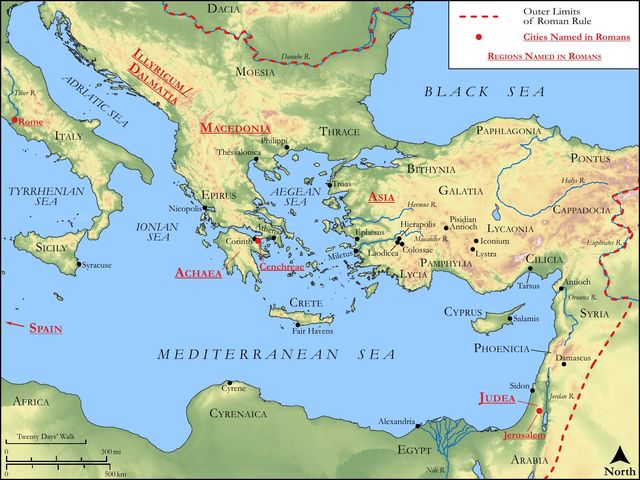
See on the biblical-era map

Study this verse
Public-domain commentary
Matthew Henry
From his Commentary on the Whole Bible. Henry comments on passages, not single verses — this entry covers Romans 9:14–24. His three-level outline is real structure in the source text, so it is rendered as structure.
The apostle, having asserted the true meaning of the promise, comes here to maintain and prove the absolute sovereignty of God, in disposing of the children of men, with reference to their eternal state. And herein God is to be considered, not as a rector and governor, distributing rewards and punishments according to his revealed laws and covenants, but as an owner and benefactor, giving to the children of men such grace and favour as he has determined in and by his secret and eternal will and counsel: both the favour of visible church-membership and privileges, which is given to some people and denied to others, and the favour of effectual grace, which is given to some particular persons and denied to others.
Now this part of his discourse is in answer to two objections.
I.It might be objected, Is there unrighteousness with God? If God, in dealing with the children of men, do thus, in an arbitrary manner, choose some and refuse others, may it not be suspected that there is unrighteousness with him? This the apostle startles at the thought of: God forbid! Far be it from us to think such a thing; shall not the judge of all the earth do right? Gen 18:25; Rom 3:5, Rom 3:6. He denies the consequences, and proves the denial.
1.In respect of those to whom he shows mercy, Rom 9:15, Rom 9:16. He quotes that scripture to show God's sovereignty in dispensing his favours (Exo 33:19): I will be gracious to whom I will be gracious. All God's reasons of mercy are taken from within himself. All the children of men being plunged alike into a state of sin and misery, equally under guilt and wrath, God, in a way of sovereignty, picks out some from this fallen apostatized race, to be vessels of grace and glory. He dispenses his gifts to whom he will, without giving us any reason: according to his own good pleasure he pitches upon some to be monuments of mercy and grace, preventing grace, effectual grace, while he passes by others. The expression is very emphatic, and the repetition makes it more so: I will have mercy on whom I will have mercy. It imports a perfect absoluteness in God's will; he will do what he will, and giveth not account of any of his matters, nor is it fit he should. As these great words, I am that I am (Exo 3:14) do abundantly express the absolute independency of his being, so these words, I will have mercy on whom I will have mercy, do as fully express the absolute prerogative and sovereignty of his will. To vindicate the righteousness of God, in showing mercy to whom he will, the apostle appeals to that which God himself had spoken, wherein he claims this sovereign power and liberty. God is a competent judge, even in his own case. Whatsoever God does, or is resolved to do, is both by the one and the other proved to be just. Eleēsō on han heleō - I will have mercy on whom I will have mercy. When I begin, I will make an end. Therefore God's mercy endures for ever, because the reason of it is fetched from within himself; therefore his gifts and callings are without repentance. Hence he infers (Rom 9:16), It is not of him that willeth. Whatever good comes from God to man, the glory of it is not to be ascribed to the most generous desire, nor to the most industrious endeavour, of man, but only and purely to the free grace and mercy of God. In Jacob's case it was not of him that willeth, nor of him that runneth; it was not the earnest will and desire of Rebecca that Jacob might have the blessing; it was not Jacob's haste to get it (for he was compelled to run for it) that procured him the blessing, but only the mercy and grace of God. Wherein the holy happy people of God differ from other people, it is God and his grace that make them differ. Applying this general rule to the particular case that Paul has before him, the reason why the unworthy, undeserving, ill-deserving Gentiles are called, and grafted into the church, while the greatest part of the Jews are left to perish in unbelief, is not because those Gentiles were better deserving or better disposed for such a favour, but because of God's free grace that made that difference. The Gentiles did neither will it, nor run for it, for they sat in darkness, Mat 4:16. In darkness, therefore not willing what they knew not; sitting in darkness, a contented posture, therefore not running to meet it, but anticipated with these invaluable blessings of goodness. Such is the method of God's grace towards all that partake of it, for he is found of those that sought him not (Isa 65:1); in this preventing, effectual, distinguishing grace, he acts as a benefactor, whose grace is his own. Our eye therefore must not be evil because his is good; but, of all the grace that we or others have, he must have the glory: Not unto us, Psa 115:1.
2.In respect of those who perish, Rom 9:17. God's sovereignty, manifested in the ruin of sinners, is here discovered in the instance of Pharaoh; it is quoted from Exo 9:16. Observe,
(1.)What God did with Pharaoh. He raised him up, brought him into the world, made him famous, gave him the kingdom and power, - set him up as a beacon upon a hill, as the mark of all his plagues (compare Exo 9:14) - hardened his heart, as he had said he would (Exo 4:21): I will harden his heart, that is, withdraw softening grace, leave him to himself, let Satan loose against him, and lay hardening providences before him. Or, by raising him up may be meant the intermission of the plagues which gave Pharaoh respite, and the reprieve of Pharaoh in those plagues. In the Hebrew, I have made thee stand, continued thee yet in the land of the living. Thus doth God raise up sinners, make them for himself, even for the day of evil (Pro 16:4), raise them up in outward prosperity, external privileges (Mat 11:23), sparing mercies.
(2.)What he designed in it: That I might show my power in thee. God would, by all this, serve the honour of his name, and manifest his power in baffling the pride and insolence of that great and daring tyrant, who bade defiance to Heaven itself, and trampled upon all that was just and sacred. If Pharaoh had not been so high and might, so bold and hardy, the power of God had not been so illustrious in the ruining of him; but the taking off of the spirit of such a prince, who hectored at that rate, did indeed proclaim God glorious in holiness, fearful in praises, doing wonders, Exo 15:11. This is Pharaoh, and all his multitude.
(3.)His conclusion concerning both these we have, Rom 9:18. He hath mercy on whom he will have mercy, and whom he will he hardeneth. The various dealings of God, by which he makes some to differ from others, must be resolved into his absolute sovereignty. He is debtor to no man, his grace is his own, and he may give it or withhold it as it pleaseth him; we have none of us deserved it, nay, we have all justly forfeited it a thousand times, so that herein the work of our salvation is admirably well ordered that those who are saved must thank God only, and those who perish must thank themselves only, Hos 13:9. We are bound, as God hath bound us, to do our utmost for the salvation of all we have to do with; but God is bound no further than he has been pleased to bind himself by his own covenant and promise, which is his revealed will; and that is that he will receive, and not cast out, those that come to Christ; but the drawing of souls in order to that coming is a preventing distinguishing favour to whom he will. Had he mercy on the Gentiles? It was because he would have mercy on them. Were the Jews hardened? It was because it was his own pleasure to deny them softening grace, and to give them up to their chosen affected unbelief. Even so, Father, because it seemed good unto thee. That scripture excellently explains this, Luk 10:21, and, as this, shows the sovereign will of God in giving or withholding both the means of grace and the effectual blessing upon those means.
II.It might be objected, Why doth he yet find fault? For who hath resisted his will? Rom 9:19.
Had the apostle been arguing only for God's sovereignty in appointing and ordering the terms and conditions of acceptance and salvation, there had not been the least colour for this objection; for he might well find fault if people refused to come up to the terms on which such a salvation is offered; the salvation being so great, the terms could not be hard. But there might be colour for the objection against his arguing for the sovereignty of God in giving and withholding differencing and preventing grace; and the objection is commonly and readily advanced against the doctrine of distinguishing grace. If God, while he gives effectual grace to some, denies it to others, why doth he find fault with those to whom he denies it? If he hath rejected the Jews, and hid from their eyes the things that belong to their peace, why doth he find fault with them for their blindness? If it be his pleasure to discard them as not a people, and not obtaining mercy, their knocking off themselves was no resistance of his will. This objection he answers at large,
1.By reproving the objector (Rom 9:20): Nay but, O man. This is not an objection fit to be made by the creature against his Creator, by man against God. The truth, as it is in Jesus, is that which abases man as nothing, less than nothing, and advances God as sovereign Lord of all. Observe how contemptibly he speaks of man, when he comes to argue with God his Maker: "Who art thou, thou that art so foolish, so feeble, so short-sighted, so incompetent a judge of the divine counsels? Art thou able to fathom such a depth, dispute such a case, to trace that way of God which is in the sea, his path in the great waters?" That repliest against God. It becomes us to submit to him, not to reply against him; to lie down under his hand, not to fly in his face, nor to charge him with folly. Ho antapokrinomenos - That answerest again. God is our master, and we are his servants; and it does not become servants to answer again, Tit 2:9.
2.By resolving all into the divine sovereignty. We are the thing formed, and he is the former; and it does not become us to challenge or arraign his wisdom in ordering and disposing of us into this or that shape of figure. The rude and unformed mass of matter hath no right to this or that form, but is shaped at the pleasure of him that formeth it. God's sovereignty over us is fitly illustrated by the power that the potter hath over the clay; compare Jer 18:6, where, by a like comparison, God asserts his dominion over the nation of the Jews, when he was about to magnify his justice in their destruction by Nebuchadnezzar.
(1.)He gives us the comparison, Rom 9:21. The potter, out of the same lump, may make either a fashionable vessel, and a vessel fit for creditable and honourable uses, or a contemptible vessel, and a vessel in which is no pleasure; and herein he acts arbitrarily, as he might have chosen whether he would make any vessel of it at all, or whether he would leave it in the hole of the pit, out of which it was dug.
(2.)The application of the comparison, Rom 9:22-24. Two sorts of vessels God forms out of the great lump of fallen mankind: - [1.] Vessels of wrath - vessels filled with wrath, as a vessel of wine is a vessel filled with wine; full of the fury of the Lord, Isa 51:20. In these God is willing to show his wrath, that is, his punishing justice, and his enmity to sin. This must be shown to all the world, God will make it appear that he hates sin. He will likewise make his power known, to dumaton autou. It is a power of strength and energy, an inflicting power, which works and effects the destruction of those that perish; it is a destruction that proceeds from the glory of his power, Th2 1:9. The eternal damnation of sinners will be an abundant demonstration of the power of God; for he will act in it himself immediately, his wrath preying as it were upon guilty consciences, and his arm stretched out totally to destroy their well-being, and yet at the same instant wonderfully to preserve the being of the creature. In order to this, God endured them with much long-suffering - exercised a great deal of patience towards them, let them alone to fill up the measure of sin, to grow till they were ripe for ruin, and so they became fitted for destruction, fitted by their own sin and self-hardening. The reigning corruptions and wickedness of the soul are its preparedness and disposedness for hell: a soul is hereby made combustible matter, fit for the flames of hell. When Christ said to the Jews (Mat 23:32), Fill you up then the measure of your father, that upon you may come all the righteous blood (Mat 23:35), he did, as it were, endure them with much long-suffering, that they might, by their own obstinacy and wilfulness in sin, fit themselves for destruction. [2.] Vessels of mercy - filled with mercy. The happiness bestowed upon the saved remnant is the fruit, not of their merit, but of God's mercy. The spring of all the joy and glory of heaven is that mercy of God which endures for ever. Vessels of honour must to eternity own themselves vessels of mercy. Observe, First, What he designs in them: To make known the riches of his glory, that is, of his goodness; for God's goodness is his greatest glory, especially when it is communicated with the greatest sovereignty. I beseech thee show me thy glory, says Moses, Exo 33:18. I will make all my goodness to pass before thee, says God (Exo 33:19), and that given out freely: I will be gracious to whom I will be gracious. God makes known his glory, this goodness of his, in the preservation and supply of all the creatures: the earth is full of his goodness, and the year crowned with it; but when he would demonstrate the riches of his goodness, unsearchable riches, he does it in the salvation of the saints, that will be to eternity glorious monuments of divine grace. Secondly, What he does for them he does before prepare them to glory. Sanctification is the preparation of the soul for glory, making it meet to partake of the inheritance of the saints in light. This is God's work. We can destroy ourselves fast enough, but we cannot save ourselves. Sinners fit themselves for hell, but it is God that prepares saints for heaven; and all those that God designs for heaven hereafter he prepares and fits for heaven now: he works them to the self-same thing, Co2 5:5. And would you know who these vessels of mercy are? Those whom he hath called (Rom 9:24); for whom he did predestinate those he also called with an effectual call: and these not of the Jews only, but of the Gentiles; for, the partition-wall being taken down, the world was laid in common, and not (as it had been) God's favour appropriated to the Jews, and they put a degree nearer his acceptance than the rest of the world. They now stood upon the same level with the Gentiles; and the question is not now whether of the seed of Abraham or no, that is neither here nor there, but whether or no called according to his purpose.
Historical interpretation
Ten Centuries of Reception
5 surviving comments on this verse. Each one is dated, so this reads as a timeline rather than a list.
Select a marker to jump to its quote. Markers stagger vertically where authors wrote within a few decades of each other.
It is certain that no one can resist God’s will, but it is good for us to remember that his will is just and right. Whether we are good or bad depends on our will, but it is God’s will that the bad person is destined to punishment and the good person is destined to glory.
Paul teaches us first that nobody can resist God’s will because he is more powerful than anyone else. Next he teaches us that God is the Father of all and therefore does not want anyone to suffer evil. What God has made he wants to remain unharmed.
"Therefore He hath mercy on whom He will have mercy, and whom He will He hardeneth. Thou wilt say then unto me, Why doth he then find fault? For who hath resisted His will?" See what pains he takes to embarrass the subject in every way. And the answer he does not produce forthwith, it being a useful thing not to do so, but he first stops the disputant's mouth, saying as follows.
Having given his conclusion [in the last verse] Paul plays devil’s advocate by asking a rhetorical question.… He responds to this question in a sensible way so that we might understand that the basic rewards of faith and of unbelief are made plain only to spiritual people and not to those who live according to the earthly man. Likewise with the way God in his foreknowledge elects those who will believe and condemns unbelievers. He neither elects the ones because of their works nor condemns the others because of theirs, but he grants to the faith of the ones the ability to do good works and hardens the unbelief of the others by deserting them, so that they do evil. This understanding, as I have said, is given only to spiritual people and is very different from the wisdom of the flesh. Thus Paul counters his inquirer so that he may understand that he first must put away the man of clay in order to be worthy to investigate these things by the Spirit.
Having solved the question proposed [n. 765], the Apostle objects to the solution, particularly to the last part, which states that God has mercy on whomever He wills and hardens whomever He wills. First, he places the objection; secondly, the solution [v. 20; n. 788]. 787. First, therefore, he says: We have said that God has mercy on whomever He wills and hardens whomever He wills. You will say to me then: Why does he still find fault? i.e., what need is there to inquire any further into the cause of the good and evil done here, since all things are attributed to the divine will, which is a sufficient cause, since no one can resist Him? Hence he continues: For who can resist his will?" I applied my mind to seek and to search out by wisdom all that is done under heaven" (Ec 1:13). Or in another way: Why does he still find fault? i.e., why does God complain about men when they sin, as in Is (1:2): "some have I reared and brought up, but they have rebelled against me." Therefore, He does not seem to have a just complaint, because it all proceeds from His will, which no one can resist. Hence he adds: Who can resist his will? 389 Or still another way: Why does he still find fault, i.e., why is man still required to do good and avoid evil: "He has showed you , O man, what is good and what does the Lord require of you but o do justice, and love mercy and walk with your God?" (Mic 6:8). For it is useless to require of someone that which is not in his power. But nothing seems to lie in man’s power, according to the above, in which all things seem ascribed to the divine will, which cannot be resisted. He adds: For who can resist his will? As if to say: no one. "There is none that can resist they majesty" (Est 13:11). And this seems to be the Apostle's meaning. 788. Then (v. 20) he answers the question. To understand his answer it should be noted that with regard to the election of the good and the rejection of the wicked two questions can arise. One is general, namely, why does God will to harden some and be merciful to some; the other is particular, namely, why does He will to be merciful to this one and harden this or that one? Although a reason other God's will can be assigned, in the first question the only reason that can be assigned in the second question is God's absolute will. An example is found among humans. For if a builder has at hand many similar and equal stones, the reason why he puts certain ones at the top an others at the bottom can be gathered from his purpose, because the perfection of the house he intends to build requires both a foundation with stones at the bottom and walls of a certain height with stones at the top. But the reason why he put these stones on the to and those others at the bottom seems to be merely that the builder so willed. First, therefore, the Apostle answers the problem involved in the second question, namely why He has mercy on this one and hardens that one; 390 secondly, the problem involved in the first question, namely, why He is merciful to some and hardens others [v. 22; n. 792]. In regard to the first he does three things: first, he censures the questioner's presumption; secondly, he cites an authority which solves the question [v. 21; n. 790]; thirdly, he explains the authority [v. 21b; n. 791]. 789. First, therefore, he says: But who are you, O man, fragile and unknowing, to answer back to God" How would you answer Him, if He were to contend with you in judgment? "If one wished to contend with him, one could not answer him once in a thousand times" (Jb 9:3). Again, as it says in Jb (39:30): "He who argues with God let him answer him." In this we are given to understand that man should not examine the reason for God's judgments with the intention of comprehending them, for they exceed human reason: "Seek not the things that are too high for thee" (Sir 3:22); "He that is a searcher of majesty shall be overwhelmed by glory" (Pr 25:27). 790. Then (v. 20b) he cites the authority of Is (29:16): "Shall the thing made say of its maker, He did not make me?" Here it should be noted that if an artisan uses base matter to make a beautiful vessel for noble uses, it is all ascribed to the goodness of the artisan; for example, if from clay he fashions pitchers and serving-dishes suited to a banquet table. If, on the other hand, from such base matter, say clay, he produced a vessel adapted to meaner uses, for example, for cooking or such, the vessel, if it could think, would have no complaint. But 391 it could complain, if from precious metals, such as gold and precious stones, the artisan were to make a vessel reserved for base uses. But human nature has baseness about it from its matter, because as Gen (2:7) says: "God formed man of dust from the ground," and more baseness after being spoiled by sin, which entered this world through one man. That is why man is compared to dirt, in Jb (30:19) "I am compared to dirt and I am likened to dust and ashes." Hence, any good that man possesses is due to God's goodness as its basic source: "O Lord, thou art our Father, we are the clay, and thou art the potter, we are all the work of they hand" (Is 64:8). Furthermore, if God does not advance man to better things but leaves him in his weakness and reserves him for the lowliest use, He does him no injury such that he could justly complain about God. 791. Then (v. 21) the Apostle explains the words of the prophet. As if to say What is molded, i.e., the vessel., should not say to the potter: Why have you made me thus?, because the potter is free to make anything he wishes out of the clay. Hence he says: Has the potter no right over the clay, to make without any injury to it out of the same lump of base matter one vessel for honor, i.e., for honorable use and another for dishonor, i.e., for meaner uses: "In a great house there are not only vessels of gold and silver but also of wood and earthenware, and some for noble use, some for ignoble." (2 Tim. 2:20). In the same way God has free power to make from the same spoiled matter of the human race, as from a clay, and without any injustice some men prepared for glory and some abandoned in wretchedness: "Behold, like the clay in the potter's hand, so are you in my hand, O house of Israel" (Is 18:6). 392 792. Then (v. 22) he answers the first question, namely, why God wills to be merciful to some and leave others in wretchedness, i.e., to choose some and reject others. Here it should be noted that the end of all divine works ins the manifestation of divine goodness: "The Lord has made all things for himself" (Pr 16:4). Hence, it was stated above that the invisible things of God have been clearly perceived in the things that have been made (1:20). But the excellence of the divine goodness is so great that it cannot be manifested in one way or in one creature. Consequently, he created diverse creatures in which He is manifested in diverse ways. This is particularly true in rational creatures in whom is justice is manifested with regard to those he benefits according to their deserts and His mercy in those He delivers by His grace. Therefore, to manifest both of these in man He mercifully delivers some, but not all. First, therefore, he gives an account of the rejections of the wicked; secondly, of the election of the good [v. 23; n. 794]. 793. In both cases three differences should be considered. First, with respect to the end; secondly, with respect to use; thirdly, with respect to the divine act. Now the end of the rejection or hardening of the wicked is the manifestation of divine justice and power. Referring to this he says: What, i.e., But if God, desiring to show him wrath, i.e., retaliatory justice. For wrath is said of God not as an emotion but as the effect of retaliation: "The wrath of God is revealed from heaven" (Rom 1:18). Then he adds: and to make known his power, because God not only uses wrath, i.e., retribution, by punishing those subject to him, but also by subjecting them to himself by his power: 393 "According to his work by which he can subject all things to himself" (Phil 3:21); "And they saw the Egyptians dead upon the sea shore, and the mighty hand that the Lord had used against them" (Ex 14:31). The use which God makes of the wicked is wrath, i.e., punishment. And this is why he calls them vessels of wrath, i.e., instruments of justice that God uses to show wrath, i.e., retributive justice: "We were by nature children of wrath" (Eph 2:3). But God’s action toward them is not that he disposes them to evil, since they of themselves have a disposition to evil from the corruption of the first sin. Hence he says fit for destruction, i.e., having in themselves an disposition towards eternal condemnation: "God saw that the wickedness of men was great on the earth, and that all the thought of their heart was bent upon evil at all times" (Gen 6:5). The only thing God does concerning them is that he lets them do what they want. Hence not without meaning does he say has endured. And the fact that he does not exact retribution immediately shows his patience; so he adds with much patience: "The most high is a patient rewarder" (Sir 5:4). 794. Then on the part of the good he likewise sets out three things. First the end, when he says in order to make known the riches of his glory. For the end of the election and mercy shown the good is that he might manifest in them the abundance of his goodness by calling them back from evil, drawing them to justice, and finally leading them into glory. And this is the meaning of that he might show the riches of his glory, the riches concerning which he said above (2:4), "Or do you despise the riches of his goodness?" "God who is rich in mercy" (Eph 2:4). 394 And it is significant that he says in order to make known the riches of his glory, because the very condemnation and reprobation of the wicked, carried out in accord with God’s justice, makes known and highlights the glory of the saints, who were freed from such misery as this. Second he describes their use, when he says for the vessels of mercy. He names them vessels of mercy because God uses them as instruments to show his mercy: "These were men of mercy" (Sir 44:10). Thirdly he sets out God’s action in their regard. For God does not merely endure them, as though they were of themselves disposed to the good, but rather he prepares and disposes them by calling them to glory. Hence he says which he has prepared beforehand for glory: "Preparing the mountains by your power." 795. Even to this point the Apostle uses an incomplete and suspensive construction, so that the meaning is: If God wants to do this, to have mercy on some and harden others, what can justly be said against it? As though to imply: Nothing. For he does not will to harden them in such a way that he compels them to sin, but rather he endures them so that they may tend to evil by their own inclination.
Continue studying Romans 9:19 across the web’s major study libraries — every link below opens this exact verse, chapter, or book on the destination site.
Read & Compare
 BibleGatewayThis verse in more than 200 translations and 70 languages.
 Bible.comThe YouVersion reader — hundreds of translations, reading plans, and highlights.
 ESV.orgCrossway's official English Standard Version reader.
 NET BibleThe NET translation with 60,000+ translators' notes on every rendering decision.
 STEP BibleTyndale House's free study tool — original text, vocabulary, and scholarly resources.
 BibliaLogos Bible Software's free web reader.
 USCCBThe New American Bible (Revised Edition) with the U.S. bishops' study notes.
Commentaries
 BibleHub CommentariesDozens of classic commentaries on this verse, gathered on one page.
 StudyLightMore than 100 commentary sets — the largest collection on the web.
 BibleRefPlain-English commentary on what this verse means, verse by verse.
 Enduring WordDavid Guzik's free commentary on this chapter, widely used by Bible teachers.
 Bible Study ToolsVerse commentary alongside Greek and Hebrew study aids.
Original Language & Research
- BibleHub InterlinearThe verse word by word — original language, transliteration, and English.
- BibleHub LexiconEvery word's original-language definition and Strong's entry.
 Blue Letter BibleDeep-study tools — Strong's numbers, concordance, and word studies.
 CNTR CollationThe earliest Greek manuscripts of this verse, collated letter by letter.
Sermons, Hymns & Audio


TrulyRandomVerse is not affiliated with these sites and doesn’t control their content. They’re linked because they’re genuinely useful.
Summary
Romans 9:19 captures a profound human objection to God's absolute sovereignty, a question arising from the tension between divine determination and human accountability. The verse articulates a hypothetical challenge: if God's will is irresistible and He orchestrates all events, including the hardening of hearts, then how can He justly hold individuals responsible for their actions or "find fault" with them? This rhetorical question sets the stage for Paul's subsequent defense of God's unquestionable authority and righteous prerogative as Creator.
Context
ShowHideLiterary Context
Romans 9:19 is nestled within a pivotal section of Paul's letter to the Romans (chapters 9-11) where he addresses the perplexing issue of Israel's rejection of the Messiah and God's faithfulness to His covenant promises. Immediately preceding this verse, Paul has used the examples of God's sovereign choice of Jacob over Esau (Romans 9:10-13) and His raising up of Pharaoh to demonstrate His power (Romans 9:17). The preceding verse, Romans 9:18, explicitly states, "Therefore hath he mercy on whom he will have mercy, and whom he will he hardeneth." This declaration directly provokes the objection raised in verse 19, serving as a logical, albeit human-centric, response to Paul's assertions of God's unfettered prerogative in salvation and judgment. The question posed in Romans 9:19 is then answered by Paul in Romans 9:20-21, where he silences the objector by appealing to the Creator-creature distinction, using the analogy of a potter and his clay.
Historical & Cultural Context
Paul's audience, primarily in Rome, included both Jewish and Gentile believers. The Jewish Christians would have wrestled with the implications of God's apparent "rejection" of Israel (as a nation) in favor of Gentiles, while Gentile believers might have struggled with understanding God's continued plan for Israel. The concept of divine sovereignty was deeply ingrained in Jewish thought, stemming from the Old Testament narratives of God's control over nations and individuals (e.g., Exodus 9:16, Isaiah 45:9). However, the specific tension between God's absolute will and human moral responsibility was a perennial philosophical and theological challenge, not unique to Paul's time but certainly accentuated by his radical presentation of God's free grace. The Greco-Roman world, with its various philosophical schools (e.g., Stoicism, which emphasized fate), also grappled with questions of determinism versus free will, making Paul's argument both relevant and challenging to the broader cultural intellectual landscape.
Key Themes
ShowHideThis verse powerfully contributes to several overarching themes in Romans 9. Firstly, it highlights the theme of Divine Sovereignty, emphasizing God's ultimate control and unchallengeable authority over all creation and human destiny, as seen in His choice of individuals and nations. Secondly, it brings to the forefront the Tension Between Divine Sovereignty and Human Responsibility, a central theological paradox that Paul addresses not by resolving it philosophically but by asserting God's unquestionable right as Creator. The objector's question directly challenges God's justice in light of His absolute will, forcing Paul to defend God's righteousness. Thirdly, it underscores the theme of God's Righteousness and Justice, particularly in the face of human questioning. Paul's subsequent response in Romans 9:20-21 reaffirms that God is just in all His dealings, even when His ways are inscrutable to human reason. Finally, the verse introduces the theme of Human Impotence and God's Omnipotence, demonstrating that no human will can ultimately resist or thwart God's divine purpose.
Exposition and Analysis
ShowHideKey Word Analysis
ShowHideThis word means "to blame." In the context of the verse, the hypothetical objector is asking how God can justly "blame" or "find fault" with individuals for their actions if their resistance to His will is, by definition, impossible. It implies a sense of moral culpability and judgment.
Meaning "to stand against" or "oppose." The rhetorical question "For who hath resisted his will?" implies that no one has the power or ability to successfully oppose or thwart God's ultimate purpose and decree. This highlights the absolute nature of God's sovereignty.
Meaning "a resolve" or "purpose." This refers to God's deliberate intention, His fixed and unchangeable determination. The question posits that if God's "will" or "purpose" is irresistible, then the concept of human responsibility for disobedience becomes logically problematic from a human perspective.
Verse Breakdown
ShowHide"Thou wilt say then unto me, Why doth he yet find fault?"
This opening clause presents a direct, anticipated human objection to Paul's preceding theological assertions about God's sovereign choice and hardening. The "thou" refers to a hypothetical interlocutor, representing a common, logical human query. The core of the question is "Why doth he yet find fault?" – if God is ultimately in control and His will is absolute, how can He still hold people accountable or blame them for their actions? This highlights the perceived tension between divine sovereignty and human moral responsibility.
"For who hath resisted his will?"
This second clause provides the logical premise for the objection. It is a rhetorical question, implying the answer: "No one." The objector's reasoning is that if God's will is completely irresistible, then any human action, including disobedience, must ultimately be part of or unable to deviate from God's predetermined plan. Therefore, if no one can resist God's will, how can God then justly assign blame or fault? This clause underscores the objector's perception of a logical inconsistency in God's dealings.
Literary Devices
ShowHideRomans 9:19 primarily employs a Rhetorical Question. The entire verse is framed as a question posed by a hypothetical objector, not expecting a literal answer from Paul, but rather serving to articulate a common theological dilemma. This device effectively introduces the tension between divine sovereignty and human responsibility, allowing Paul to address a significant challenge to his doctrine. Furthermore, the verse uses Anticipation, as Paul anticipates and directly addresses the logical objection that might arise in the minds of his readers given his previous statements about God's hardening of hearts. The phrase "Thou wilt say then unto me" clearly indicates this foresight. The use of Personification is also present in the "thou" (the objector), giving voice to a human perspective that questions divine justice.
Theological and Thematic Connections
ShowHideThis verse encapsulates a perennial theological tension between God's absolute sovereignty and human moral responsibility, a paradox that theologians have grappled with for centuries. Paul does not attempt to philosophically reconcile these two truths but rather asserts God's unquestionable right as Creator, reminding humanity of its place before the divine Potter. The objection raised in Romans 9:19 highlights the human tendency to apply human standards of justice to God, failing to grasp His transcendent nature and His righteous purposes that operate on a different plane. Ultimately, the passage calls for humility before the divine mystery, acknowledging that God's ways are higher than our ways, and His justice is perfect, even when beyond our full comprehension.
Reflection and Application
ShowHideRomans 9:19, while presenting a challenging theological paradox, offers profound opportunities for reflection on our relationship with God. It compels us to confront the limits of human reason when attempting to fully comprehend the divine. Rather than striving to perfectly reconcile God's sovereignty with human responsibility, we are called to embrace a posture of humble trust in His perfect wisdom and justice. This verse reminds us that God is not accountable to our human logic or standards; rather, we are accountable to Him. Our inability to fully grasp the mechanics of His will does not negate our moral obligation or His right to judge. True faith acknowledges God's absolute authority and goodness, even when His ways seem inscrutable. It encourages us to live responsibly, knowing that our choices matter, while simultaneously resting in the assurance that God is working all things according to His good and sovereign purpose.
Questions for Reflection
ShowHideFAQ
ShowHideDoes God's sovereignty negate human free will or responsibility?
ShowHideRomans 9:19 raises this very question, but Paul's response in the subsequent verses (Romans 9:20-21) does not negate human responsibility. Instead, he asserts God's right as the Creator to deal with humanity as He sees fit. The Bible consistently affirms both God's absolute sovereignty (e.g., Ephesians 1:11) and human accountability for choices (e.g., Romans 2:6-8). While the precise philosophical reconciliation remains a mystery, Scripture presents them as co-existing truths. Our responsibility is to respond in faith and obedience to God's revealed will, trusting His perfect justice.
Christ-Centered Fulfillment
ShowHideRomans 9:19, with its stark question about God's unresisted will and human fault, finds its ultimate resolution and profoundest meaning in the person and work of Jesus Christ. If anyone perfectly embodied a will utterly submitted to God's, it was Christ, who declared, "I have come down from heaven, not to do my own will but the will of him who sent me" (John 6:38). His perfect obedience, even unto death on the cross (Philippians 2:8), demonstrates that God's sovereign will is not arbitrary but perfectly righteous and ultimately redemptive. Furthermore, the "fault" that God finds in humanity is not a result of His irresistible will forcing sin upon us, but rather our inherent rebellion and inability to perfectly obey His law (Romans 3:23). Christ, as the Lamb of God, takes away the sin of the world (John 1:29), bearing the fault and condemnation that humanity justly deserves. Thus, God's sovereign will, which cannot be resisted, is ultimately revealed as a will of salvation and mercy, accomplished through Christ, offering reconciliation to those who believe, thereby justly addressing both human culpability and divine prerogative.