


Genesis 13:1
Bible text: King James Version (1769 Blayney text) · Public domain
Bible text: Berean Standard Bible · Public domain
Bible text: American Standard Version (1901) · Public domain
Bible text: World English Bible, Messianic edition · Public domain
Bible text: Geneva Bible (1599) · Public domain
Bible text: Young's Literal Translation · Public domain
- וַיַּעַלvai·ya·'Aland he went upH5927Conj-w ¦ V-Qal-ConsecImperf-3msVerb Qal Consecutive Imperfect 3rd Singular Masculineוַandיַּעַלhe went up
- אַבְרָם'av·RamAbramH87N-proper-mNoun Proper Masculine
- מִמִּצְרַיִםmi·mitz·Ra·yimfrom EgyptH4714Prep-m ¦ N-properNoun Proper LocationמִfromמִּצְרַיִםEgypt
- הוּאhu'heH1931Pro-3msPronoun Personal 3rd Singular Masculine
- וְאִשְׁתּוֹve·'ish·Toand his wifeH802Conj-w ¦ N-fsc ¦ 3msNoun Singular Feminine Constructוְandאִשְׁתּwifeוֹhis
- וְכָלve·kholand allH3605Conj-w ¦ N-msNoun Singular Masculine Absoluteוְandכָלall
- אֲשֶׁר'a·SherthatH834RelParticle Relative
- לוֹlo[belonged] to <the> himPrep-l ¦ 3msSuffix Personal 3rd Singular Masculineל[belonged] to <the>וֹhim
- וְלוֹטve·Lotand LotH3876Conj-w ¦ N-proper-mNoun Proper MasculineוְandלוֹטLot
- עִמּוֹi·Mowith himH5973Prep ¦ 3msPreposition Definiteעִמּwithוֹhim
- הַנֶּגְבָּהha·Neg·bahthe Negev towardsH5045Art ¦ N-proper ¦ SfxNoun Proper LocationהַtheנֶּגְבָּNegevהtowards
English is a literal word-by-word gloss of the Hebrew, not the KJV's wording. Why?
This is the original text the KJV's translators worked from — each Hebrew word with its own literal English meaning in this verse, prepared by scholars at Tyndale House, Cambridge. The KJV translates whole sentences, not word by word, so its wording differs: one Hebrew word can become several English words, and the KJV may choose “the LORD” where the gloss reads “Yahweh”. Both are faithful — they answer different questions. For the KJV's own rendering, switch to the KJV text.
Details
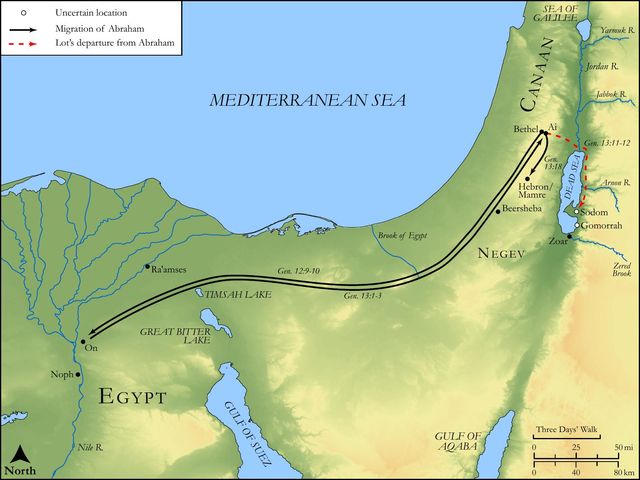
See on the biblical-era maps


Study this verse
Public-domain commentary
Matthew Henry
From his Commentary on the Whole Bible. Henry comments on passages, not single verses — this entry covers Genesis 13:1–4. His two-level outline is real structure in the source text, so it is rendered as structure.
I.Here is Abram's return out of Egypt, Gen 13:1.
He came himself and brought all his with him back again to Canaan. Note, Though there may be occasion to go sometimes into places of temptation, yet we must hasten out of them as soon as possible. See Rut 1:6.
II.His wealth:
He was very rich, Rut 1:2. He was very heavy, so the Hebrew word signifies; for riches are a burden, and those that will be rich do but load themselves with thick clay, Hab 2:6. There is a burden of care in getting them, fear in keeping them, temptation in using them, guilt in abusing them, sorrow in losing them, and a burden of account, at last, to be given up concerning them. Great possessions do but make men heavy and unwieldy. Abram was not only rich in faith and good works, and in the promises, but he was rich in cattle, and in silver and gold. Note,
1.God, in his providence, sometimes makes good men rich men, and teaches them how to abound, as well as how to suffer want.
2.The riches of good men are the fruits of God's blessing. God has said to Abram, I will bless thee; and that blessing made him rich without sorrow, Pro 10:22.
3.True piety will very well consist with great prosperity. Though it is hard for a rich man to get to heaven, yet it is not impossible, Mar 10:23, Mar 10:24. Abram was very rich and yet very religious. Nay, as piety is a friend to outward prosperity (Ti1 4:8), so outward prosperity, if well-managed, is an ornament to piety, and furnishes an opportunity of doing so much the more good.
III.His removal to Beth-el, Gen 13:3, Gen 13:4.
Thither he went, not only because there he had formerly had his tent, and he was willing to go among his old acquaintance, but because there he had formerly had his altar: and, though the altar was gone (probably he himself having taken it down, when he left the place, lest it should be polluted by the idolatrous Canaanites), yet he came to the place of the altar, either to revive the remembrance of the sweet communion he had had with God in that place, or perhaps to pay the vows he had there made to God when he undertook his journey into Egypt. Long afterwards God sent Jacob to this same place on that errand (Gen 35:1), Go up to Bethel, where thou vowedst the vow. We have need to be reminded, and should take all occasions to remind ourselves, of our solemn vows; and perhaps the place where they were made may help to bring them afresh to mind, and it may therefore do us good to visit it.
IV.His devotion there.
His altar was gone, so that he could not offer sacrifice; but he called on the name of the Lord, as he had done, Gen 12:8. Note,
1.All God's people are praying people. You may as soon find a living man without breath as a living Christian without prayer.
2.Those that would approve themselves upright with their God must be constant and persevering in the services of religion. Abram did not leave his religion behind him in Egypt, as many do in their travels.
3.When we cannot do what we would we must make conscience of doing what we can in the acts of devotion. When we want an altar, let us not be wanting in prayer, but, wherever we are, call on the name of the Lord.
Historical interpretation
Three Centuries of Reception
2 surviving comments on this verse. Each one is dated, so this reads as a timeline rather than a list.
Select a marker to jump to its quote. Markers stagger vertically where authors wrote within a few decades of each other.
So Abraham left, taking with him his wife Sarah, which means “sovereign,” not “servant.” Therefore it was said to Abraham, “Listen to your wife Sarah.” In fact, she who is liberated from the slavery of sin obtains sovereignty, not servitude. Therefore a sound mind possesses sovereign virtue, which has dominion over the bodily senses, which is not subject, which has brought back everything from Egypt, which has not left there any of the norms that regulate her life. Such a mind is not clothed with intemperance or insolence or shameful immodesty. Nor is it lacking the veil of prudent wisdom, and it is clothed with modesty.
Abram went up therefore from Egypt, he and his wife, and all that he had, and Lot with him, to the southern region. He does not mean the southern region of Egypt, but of the promised land: for indeed he did not travel southward from Egypt, which whoever does, goes farther from the promised land: but leaving all of Egypt, part of which he had visited, he first ascended to the southern region of the promised land, which was nearest. It should also be noted according to the letter that Abraham is remembered as having previously descended into Egypt, and now ascending from Egypt, because certainly the land of Egypt is considered inferior not only to the land of Canaan but also to other regions of the world, just as conversely the region of the Scythians is said to be elevated higher than other parts of the earth: which can be easily inferred from the courses of the rivers flowing into it from elsewhere and flowing out from it. It fits however most aptly with the typical senses that the land of Canaan should be higher than Egypt, because this indeed represents the promise of the heavenly homeland, while that signifies the oppressions and labors of present life. For this the Lord both promised and gave as an inheritance to his people Israel: but in that land both Abraham encountered peril, though protected immediately by the Lord, and his progeny were for a long time oppressed by a severe servitude, although they themselves were at last miraculously redeemed and led out from there. Therefore the land of promise is higher than the boundaries of Egypt, although situated nearby, because even if the just and the reprobate appear to live a common life outwardly in this age, yet with the great sublimity of a devoted mind, the citizens of heaven surpass all the lovers of this world. Therefore what is said about Abraham that he went up from Egypt, and came with all his own to the southern region, signifies typically that he himself while living in the flesh, and all the elect, that is the children of the same promise, thus for a time turn their thoughts to caring for bodily necessities in the lowest things, so that soon, having fulfilled the same care of the body, they may recall the whole intention of the mind to contemplate the things that are above, and seek to be renewed by the fervor of love and the light of heavenly grace from the Sun of righteousness: for this is mystically to go up from Egypt to the southern region, after fulfilling the necessities of the flesh, to ask diligently from the Lord for progress in the light of the heavenly and of charity. For with such a desire and purpose of mind it is no doubt that we make our journey to the heavenly homeland: whence it is aptly added.
Continue studying Genesis 13:1 across the web’s major study libraries — every link below opens this exact verse, chapter, or book on the destination site.
Read & Compare
 BibleGatewayThis verse in more than 200 translations and 70 languages.
 Bible.comThe YouVersion reader — hundreds of translations, reading plans, and highlights.
 ESV.orgCrossway's official English Standard Version reader.
 NET BibleThe NET translation with 60,000+ translators' notes on every rendering decision.
 STEP BibleTyndale House's free study tool — original text, vocabulary, and scholarly resources.
 BibliaLogos Bible Software's free web reader.
 USCCBThe New American Bible (Revised Edition) with the U.S. bishops' study notes.
Commentaries
 BibleHub CommentariesDozens of classic commentaries on this verse, gathered on one page.
 StudyLightMore than 100 commentary sets — the largest collection on the web.
 BibleRefPlain-English commentary on what this verse means, verse by verse.
 Enduring WordDavid Guzik's free commentary on this chapter, widely used by Bible teachers.
 Bible Study ToolsVerse commentary alongside Greek and Hebrew study aids.
Original Language & Research
- BibleHub InterlinearThe verse word by word — original language, transliteration, and English.
- BibleHub LexiconEvery word's original-language definition and Strong's entry.
 Blue Letter BibleDeep-study tools — Strong's numbers, concordance, and word studies.
 SefariaThe Hebrew text with Rashi and centuries of Jewish commentary.
Sermons, Hymns & Audio


TrulyRandomVerse is not affiliated with these sites and doesn’t control their content. They’re linked because they’re genuinely useful.
Summary
Genesis 13:1 marks Abram's significant return from Egypt to the southern region of Canaan, accompanied by his wife Sarai, his nephew Lot, and all his accumulated possessions. This pivotal verse signals a re-entry into the land promised by God, following a period of moral compromise in Egypt, and implicitly underscores God's unwavering faithfulness and the ongoing trajectory of His covenant purposes for Abram.
Context
ShowHideLiterary Context
This verse immediately follows the challenging and morally fraught narrative of Abram's sojourn in Egypt, detailed in Genesis 12:10-20. Driven by a severe famine in Canaan, Abram sought refuge in Egypt, where, out of fear for his life, he instructed his wife, Sarai, to pose as his sister. This deception led to Sarai being taken into Pharaoh's household. However, God sovereignly intervened, afflicting Pharaoh and his house, which ultimately exposed Abram's lie and led to his expulsion from Egypt. Genesis 13:1 thus serves as a narrative pivot, signifying Abram's departure from a place of spiritual and moral compromise and his return to the land of promise, re-establishing the geographical and spiritual locus of God's covenant with him, first articulated in Genesis 12:1-3.
Historical & Cultural Context
The journey from Canaan to Egypt was a common response to famine in Canaan, as the Nile River provided a stable agricultural base. However, Egypt was also a powerful, pagan civilization, often viewed in biblical narratives as a place of temptation or bondage (e.g., the later Israelite exodus). The "south" (Hebrew: negeb) refers to the semi-arid Negev region, a transitional zone between the fertile crescent and the desert. For nomadic pastoralists like Abram, movement between these regions was dictated by the availability of water and pasture. Abram's return "up" from Egypt is geographically accurate, as the Nile Delta is at a lower elevation than the highlands of Canaan. Culturally, the concept of a patriarch traveling with his extended family and possessions was typical of nomadic life, and the mention of his wife and Lot highlights the familial and tribal units central to their existence.
Key Themes
ShowHideGenesis 13:1 contributes to several overarching themes within the book of Genesis and the broader biblical narrative. It highlights God's unwavering faithfulness to His covenant promises, even in the face of human failure and moral compromise, as Abram returns safely and prosperously despite his deception in Egypt (Genesis 13:2). The verse also underscores the theme of divine guidance and providence, demonstrating that God's purposes for Abram and his descendants will prevail, leading him back to the promised land despite detours. Furthermore, the inclusion of Lot subtly introduces the theme of familial relationships and their complexities, foreshadowing the impending conflict and separation that will further define Abram's journey and the unfolding of God's plan for his lineage (as seen in Genesis 13:5-12).
Exposition and Analysis
ShowHideKey Word Analysis
ShowHideThis name, meaning "high father," is the original name of Abraham. Its inclusion here underscores the continuity of God's dealings with the individual He has chosen, even after a period of moral lapse. The narrative consistently traces the journey and development of this foundational figure in salvation history.
This verb signifies to "ascend," "go up," or "arise." Geographically, it accurately describes the movement from the lower elevation of the Nile Delta to the higher terrain of the Negev in Canaan. Theologically and symbolically, this "ascent" from Egypt, a place of spiritual danger and compromise, can be interpreted as a movement towards spiritual elevation, a return to the path of obedience and alignment with God's will.
This refers to the land of Egypt, often depicted in the Bible as a place of worldly power, idolatry, and later, oppression. Abram's departure from Egypt symbolizes a turning away from a place of potential entanglement and a return to the land where God's promises are to be realized. His exit, prompted by divine intervention, sets a precedent for future "exoduses" from places of bondage.
This term refers to the southern region of Canaan, a semi-arid area known as the Negev. It was a familiar territory to Abram, as he had previously journeyed through it (Genesis 12:9). His return to this specific part of the promised land marks a re-establishment of his presence in the territory God had designated for him and his descendants.
Verse Breakdown
ShowHide"And Abram went up out of Egypt"
This clause establishes the primary action and direction of the narrative. Abram's movement "up" from Egypt is both a literal geographical ascent and a symbolic departure from a place of spiritual and moral compromise. It signifies God's sovereign hand in directing Abram back to the land of promise, despite his recent failings.
"he, and his wife, and all that he had"
This detail emphasizes the completeness of Abram's return. He is not alone; his immediate family unit (Sarai) and his considerable wealth (livestock, silver, gold, as mentioned in Genesis 13:2) are with him. This underscores God's protection and blessing, demonstrating that His covenant promises remained active and effective, even in the aftermath of Abram's deceptive actions.
"and Lot with him"
The explicit mention of Lot, Abram's nephew, highlights their continued close association. Lot's presence is significant not only as a member of Abram's extended household but also as a subtle foreshadowing of the impending conflict over resources and the subsequent separation that will occur later in this chapter, which will further define Abram's lineage and the scope of God's promises.
"into the south."
This specifies Abram's destination: the Negev region of Canaan. This return to a familiar part of the promised land marks a re-engagement with the divine purpose and a re-establishment of his presence in the territory that God had called him to inherit. It is a return to the sphere of God's direct covenantal activity.
Literary Devices
ShowHideGenesis 13:1 employs several literary devices to convey its meaning and significance. Symbolism is prominent in the phrase "went up out of Egypt." Geographically, it's a literal ascent, but spiritually, "Egypt" often symbolizes a place of worldly entanglement, fear, and moral compromise in the biblical narrative. Thus, Abram's "ascent" represents a movement away from spiritual danger and a return towards God's intended path and the land of promise. The verse also uses Foreshadowing with the explicit mention of Lot. While seemingly a simple detail, Lot's continued presence subtly hints at the future conflict and separation between him and Abram, which will serve as a crucial turning point in Abram's journey and the unfolding of the covenant. Furthermore, the narrative employs Contrast by implicitly setting Abram's return to the promised land against his previous descent into Egypt, highlighting the difference between a place of divine blessing and a place of human fear and deception.
Theological and Thematic Connections
ShowHideAbram's journey "up out of Egypt" is a profound theological statement. It demonstrates God's persistent grace and unwavering commitment to His covenant, even when His chosen servant falters. Abram's safe and prosperous return, despite his moral failings in Egypt, underscores that God's promises are not contingent on human perfection but on divine faithfulness. This act of divine restoration sets a pattern for God's redemptive work throughout history, emphasizing His ability to bring His people back to Himself and His purposes, even from places of spiritual wandering or compromise. It highlights the unconditional nature of God's grace and His sovereign control over circumstances to fulfill His will.
Reflection and Application
ShowHideGenesis 13:1 offers a powerful message of hope and restoration for believers today. Abram's journey reminds us that our spiritual walk is often marked by detours, mistakes, and moments of fear that lead us away from God's perfect will. Yet, just as God sovereignly intervened to bring Abram out of Egypt and back to the land of promise, He is faithful to guide us back to His path when we stray. This verse encourages us to trust in God's persistent grace, knowing that His purposes for us are not thwarted by our imperfections. It calls us to reflect on areas in our lives where we might have "descended" into compromise or fear, and to embrace the opportunity for "ascent" – a return to obedience, trust, and renewed focus on God's calling. Our journey of faith is not about flawless performance, but about God's unwavering faithfulness and our willingness to respond to His call for repentance and restoration.
Questions for Reflection
ShowHideFAQ
ShowHideDid Abram's deception in Egypt nullify God's promises to him?
ShowHideNo, Abram's deception in Egypt did not nullify God's promises. While Abram acted out of fear and misrepresented Sarai as his sister, God's covenant with him was unconditional and based on divine grace, not human merit. God intervened directly to protect Sarai and afflicted Pharaoh's household, demonstrating His unwavering commitment to His word despite Abram's moral lapse. Abram's subsequent safe return to Canaan with increased wealth (as noted in Genesis 13:2) further underscores God's enduring faithfulness, showing that His purposes prevail even through human imperfection. This episode highlights that God's covenant is secured by His character, not by the flawless obedience of His people.
Christ-Centered Fulfillment
ShowHideAbram's journey "up out of Egypt" serves as a profound type and shadow of the greater spiritual exodus and ultimate restoration found in Jesus Christ. Just as Abram was divinely led out of a place of compromise and worldly entanglement back to the land of promise, Christ delivers humanity from the bondage of sin and death, leading us into the true spiritual promised land of eternal life and communion with God. Abram's imperfect obedience and God's persistent grace find their ultimate fulfillment in Christ's perfect obedience and His atoning work on the cross, which secures a new and lasting covenant (Hebrews 8:6). Through Christ, we are called "out of darkness into his marvelous light" (1 Peter 2:9), experiencing a spiritual "ascent" from the dominion of sin to the freedom of God's children. He is the true Seed of Abraham, through whom all nations are blessed (Galatians 3:16), and the ultimate heir of the promises given to Abram, making possible our own inheritance of spiritual blessings in the heavenly Canaan (Ephesians 1:3).