


Mark 10:23
Bible text: King James Version (1769 Blayney text) · Public domain
Bible text: King James Version with Strong's numbers · Public domain
Bible text: Berean Standard Bible · Public domain
Bible text: American Standard Version (1901) · Public domain
Bible text: World English Bible, Messianic edition · Public domain
Bible text: Geneva Bible (1599) · Public domain
Bible text: Young's Literal Translation · Public domain
- καὶkaiAndG2532CONJConjunction
- περιβλεψάμενοςperiblepsamenoshaving looked aroundG4017V-AMP-NSMVerb Aorist Middle Participle Nominative Singular Masculine
- ὁho<the>G3588T-NSMDefinite article Nominative Singular Masculine
- ἸησοῦςIēsousJesusG2424N-NSM-PNoun Nominative Singular Masculine Individual
- λέγειlegeisaysG3004V-PAI-3SVerb Present Active Indicative 3rd Singular
- τοῖςtoisto theG3588T-DPMDefinite article Dative Plural Masculine
- μαθηταῖςmathētaisdisciplesG3101N-DPMNoun Dative Plural Masculine
- αὐτοῦ·autouof HimG846P-GSMPersonal pronoun Genitive Singular Masculine
- πῶςpōsHowG4459PRT-IInterrogative Particle Interrogative
- δυσκόλωςduskolōsdifficultlyG1423ADVAdverb
- οἱhoithoseG3588T-NPMDefinite article Nominative Plural Masculine
- τὰta<the>G3588T-APNDefinite article Accusative Plural Neuter
- χρήματαchrēmatarichesG5536N-APNNoun Accusative Plural Neuter
- ἔχοντεςechonteshavingG2192V-PAP-NPMVerb Present Active Participle Nominative Plural Masculine
- εἰςeisintoG1519PREPPreposition
- τὴνtēntheG3588T-ASFDefinite article Accusative Singular Feminine
- βασιλείανbasileiankingdomG932N-ASFNoun Accusative Singular Feminine
- τοῦtou<the>G3588T-GSMDefinite article Genitive Singular Masculine
- θεοῦtheouof GodG2316N-GSM-TNoun Genitive Singular Masculine Title
- εἰσελεύσονταιeiseleusontaiwill enter!G1525V-FDI-3PVerb Future Middle Deponent Indicative 3rd Plural
English is a literal word-by-word gloss of the Greek, not the KJV's wording. Why?
This is the original text the KJV's translators worked from — each Greek word with its own literal English meaning in this verse, prepared by scholars at Tyndale House, Cambridge. The KJV translates whole sentences, not word by word, so its wording differs: one Greek word can become several English words, and the KJV may choose “charity” where the gloss reads “love”. Both are faithful — they answer different questions. For the KJV's own rendering, switch to the KJV text.
Details
See on the biblical-era maps
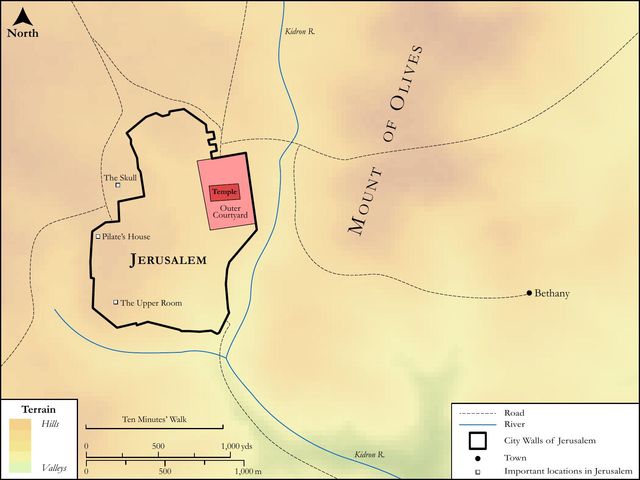
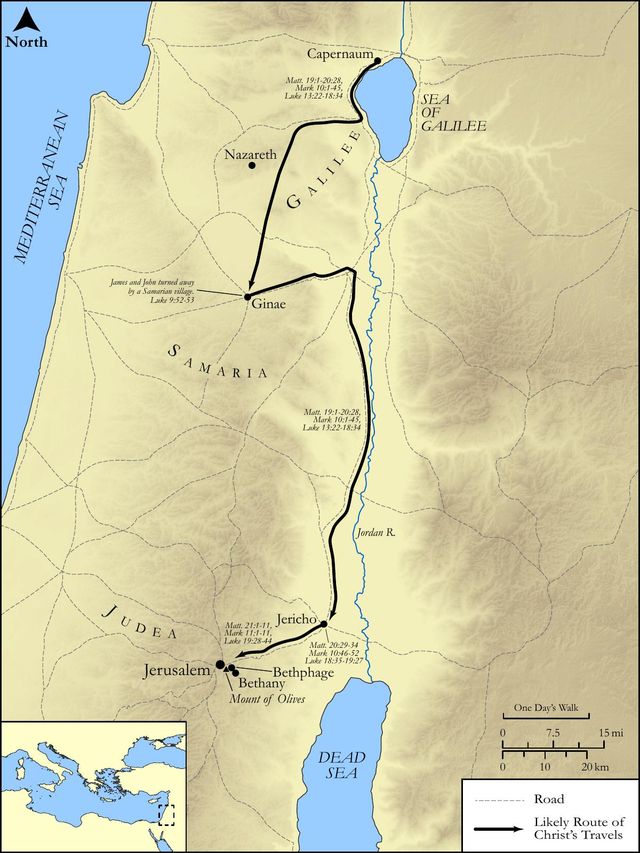
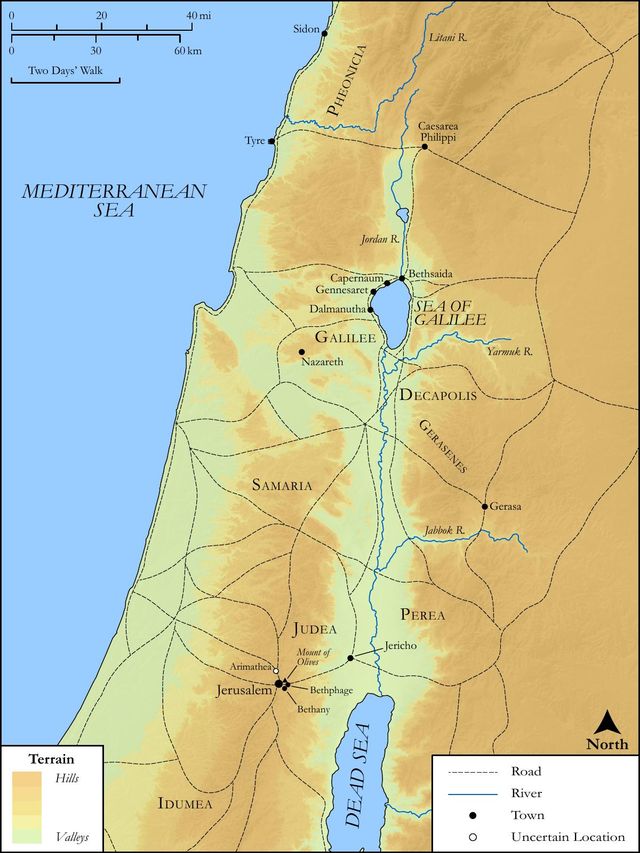
Study this verse
Public-domain commentary
Matthew Henry
From his Commentary on the Whole Bible. Henry comments on passages, not single verses — this entry covers Mark 10:17–31. His four-level outline is real structure in the source text, so it is rendered as structure.
I.Here is a hopeful meeting between Christ and a young man; such he is said to be (Mat 19:20, Mat 19:22), and a ruler (Luk 18:18), a person of quality. Some circumstances here are, which we had not in Matthew, which makes his address to Christ very promising.
1.He came running to Christ, which was an indication of his humility; he laid aside the gravity and grandeur of a ruler, when he came to Christ: thus too he manifested his earnestness and importunity; he ran as one in haste, and longing to be in conversation with Christ. He had now an opportunity of consulting this great Prophet, in the things that belonged to his peace, and he would not let slip the opportunity.
2.He came to him when he was in the way, in the midst of company: he did not insist upon a private conference with him by night, as Nicodemus did, though like him he was a ruler, but when he shall find him without, will embrace that opportunity of advising with him, and not be ashamed, Sol 8:1.
3.He kneeled to him, in token of the great value and veneration he had for him, as a teacher come from God, and his earnest desire to be taught by him. He bowed the knee to the Lord Jesus, as one that would not only do obeisance to him now, but would yield obedience to him always; he bowed the knee, as one that meant to bow the soul to him.
4.His address to him was serious and weighty; Good Master, what shall I do, that I may inherit eternal life? Eternal life was an article of his creed, though then denied by the Sadducees, a prevailing party: he asks, What shall he do now that he may be happy for ever. Most men enquire for good to be had in this world (Psa 4:6), any good; he asks for good to be done in this world, in order to the enjoyment of the greatest good in the other world; not, Who will make us to see good? But, "Who will make us to do good?" He enquires for happiness in the way of duty; the summum bonum - chief good which Solomon was in quest of, was that good for the sons of men which they do should do, Ecc 2:3. Now this was,
(1.)A very serious question in itself; it was about eternal things, and his own concern in those things. Note, Then there begins to be some hope of people, when they begin to enquire solicitously, what they shall do to get to heaven.
(2.)It was proposed to a right person, one that was every way fit to answer it, being himself the Way, the Truth, and the Life, the true way to life, to eternal life; who came from heaven on purpose, first to lay open for us, and then to lay open to us; first to make, and then to make known, the way to heaven. Note, Those who would know what they shall do to be saved, must apply themselves to Christ, and enquire of him; it is peculiar to the Christian religion, both to show eternal life, and to show the way to it.
(3.)It was proposed with a good design - to be instructed. We find this same question put by a lawyer, not kneeling, but standing up (Luk 10:25), with a bad design, to pick quarrels with him; he tempted him, saying, Master, what shall I do? It is not so much the good words as the good intention of them that Christ looks at.
5.Christ encouraged this address,
(1.)By assisting his faith, Mar 10:18. He called him good Master; Christ would have him mean thereby, that he looked upon him to be God, since there is none good but one, that is God, who is one, and his name one, Zac 14:9. Our English word God doubtless hath affinity with good; as the Hebrews name God by his power, Elohim, the strong God; so we by his goodness, the good God.
(2.)By directing his practice (Mar 10:19); Keep the commandments; and thou knowest what they are. He mentions the six commandments of the second table, which prescribe our duty to our neighbour; he inverts the order, putting the seventh commandment before the sixth, to intimate that adultery is a sin no less heinous than murder itself. The fifth commandment is here put last, as that which should especially be remembered and observed, to keep us to all the rest. Instead of the tenth commandment, Thou shalt not covet, our Saviour here puts, Defraud not. Mē aposterēsēs - that is, saith Dr. Hammond, "Thou shalt not rest contented with thy own, and not seek to increase it by the diminution of other men's." It is a rule of justice not to advance or enrich ourselves by doing wrong or injury to any other.
6.The young man bid fair for heaven, having been free from any open gross violations of the divine commands. Thus far he was able to same in some measure (Mar 10:20), Master, all these have I observed from my youth. He thought he had, and his neighbours thought so too. Note, Ignorance of the extent and spiritual nature of the divine law, makes people think themselves in a better condition than they really are. Paul was alive without the law. But when he saw that to be spiritual, he saw himself to be carnal, Rom 7:9, Rom 7:14. However, he that could say he was free from scandalous sin, went further than many in the way to eternal life. But though we know nothing by ourselves, yet are we not thereby justified. Co1 4:4.
7.Christ had a kindness for him; Jesus, beholding him, loved him, Mar 10:21. He was pleased to find that he had lived inoffensively, and pleased to see that he was inquisitive how to live better than so. Christ particularly loves to see young people, and rich people, asking the way to heaven, with their faces thitherward.
II.Here is a sorrowful parting between Christ and this young man.
1.Christ gave him a command of trial, by which it would appear whether he did in sincerity aim at eternal life, and press towards it: he seemed to have his heart much upon it, and if so, he is what he should be; but has he indeed his heart upon it? Bring him to the touchstone.
(1.)Can he find in his heart to part with his riches for the service of Christ? He hath a good estate, and now, shortly, at the first founding of the Christian church, the necessity of the case will require that those who have lands, sell them, and lay the money at the apostles' feet; and how will he dispense with that? Act 4:34, Act 4:35. After awhile, tribulation and persecution will arise, because of the word; and he must be forced to sell his estate, or have it taken from him, and how will he like that? Let him know the worst now; if he will not come up to these terms, let him quit his pretensions; as good as the first as at last. "Sell whatsoever thou hast over and above what is necessary for thy support;" probably, he had no family to provide for; let him therefore be a father to the poor, and make them his heirs. Every man, according to his ability, must relieve the poor, and be content, when there is occasion, to straiten himself to do it. Worldly wealth is given us, not only as maintenance to bear our charges through this world, according to our place in it, but as talent, to be used and employed for the glory of our great Master in the world, who hath so ordered it, that the poor we should have always with us as his receivers.
(2.)Can he find it in his heart to go through the hardest costliest services he may be called to as a disciple of Christ, and depend upon him for a recompence in heaven? He asks Christ what he should do more than he has done to obtain eternal life, and Christ puts it to him, whether he has indeed that firm belief of, and that high value for, eternal life that he seems to have. Doth he really believe there is a true treasure in heaven sufficient to make up all he can leave, or lose, or lay out, for Christ? Is he willing to deal with Christ upon trust? Can he give him credit for all he is worth; and be willing to bear a present cross, in expectation of a future crown?
2.Upon this he flew off (Mar 10:22); He was sad at that saying; was sorry that he could not be a follower of Christ upon any easier terms than leaving all to follow him; that he could not lay hold on eternal life, and keep hold of his temporal possessions too. But since he could not come up to the terms of discipleship, he was so fair as not to pretend to it; He went away grieved. Here appeared the truth of that (Mat 6:24), Ye cannot serve God and mammon; while he held to mammon he did in effect despise Christ, as all those do who prefer the world before him. He bids for what he has a mind for in the market, yet goes away grieved, and leaves it, because he cannot have it at his own price. Two words to a bargain. Motions are not marriages. That which ruined this young man was, he had great possessions; thus the prosperity of fools destroys them, and those who spend their days in wealth are tempted to say to God, Depart from us; or to their hearts, Depart from God.
III.Here is Christ's discourse with his disciples.
We are tempted to wish that Christ had mollified that saying which frightened this young gentleman from following him, and by an explanation taken off the harshness of it: but he knew all men's hearts; he would not court him to be his follower, because he was a rich man and a ruler; but, if he will go, let him go. Christ will keep no man against his will; and therefore we do not find that Christ called him back, but took this occasion to instruct his disciples in two things.
1.The difficulty of the salvation of those who have an abundance of this world; because there are few who have a deal to leave, that can be persuaded to leave it for Christ, or to lay it out in doing good.
(1.)Christ asserts this here; He looked about upon his disciples, because he would have them all take notice of what he said, that by it they might have their judgments rightly informed, and their mistakes rectified, concerning worldly wealth, which they were apt to over-rate; How hardly shall they who have riches enter into the kingdom of God! Mar 10:23. They have many temptations to grapple with, and many difficulties to get over, which lie not in the way of poor people. But he explains himself, Mar 10:24, where he calls the disciples children, because as such they should be taught by him, and portioned by him with better things than this young man left Christ to cleave to; and whereas he had said, How hardly will those who have riches get to heaven; here he tells them, that the danger arose not so much from their having riches as from their trusting to them, and placing their confidence in them, expecting protection, provision, and a portion from them; saying that to their gold, which they should say only to their God, Thou art my hope, Job 31:24. They have such a value as this for the wealth of the world, will never be brought to put a right value upon Christ and his grace. They that have ever so much riches, but do not trust in them, that see the vanity of them, and their utter insufficiency to make a soul happy, have got over the difficulty, and can easily part with them for Christ: but they have ever so little, if they set their hearts upon that little, and place their happiness in it, it will keep them from Christ. He enforces this assertion with, Mar 10:25, It is easier for a camel to go through the eye of a needle, than for a rich man, that trusts in riches, or inclines to do so, to enter into the kingdom of God. The disproportion here seems so great (though the more it is so the more it answers the intention), that some have laboured to bring the camel and the eye of the needle a little nearer together.
[1.]Some imagine there might be some wicket-gate, or door, to Jerusalem, commonly known by the name of the needle's eye, for its straitness, through which a camel could not be got, unless he were unloaded, and made to kneel, as those camel, Gen 24:11. So a rich man cannot get to heaven unless he is willing to part with the burthen of his worldly wealth, and stoop to the duties of a humble religion, and so enter at the strait gate.
[2.]Others suggest that the word we translate a camel, sometimes signifies a cable-rope, which, though not to be got through a needle's eye, yet is of great affinity to it. A rich man, compared with the poor, is as a cable to a single thread, stronger, but not so pliable, and it will not go through the needle's eye, unless it be untwisted. So the rich man must be loosed and disentangled from his riches, and then there is some hope of him, that thread by thread he may be got through the eye of the needle, otherwise he is good for nothing but to cast anchor in the earth.
(2.)This truth was very surprising to the disciples; They were astonished at his words, Mar 10:24. They were astonished out of measure, and said among themselves, Who then can be saved? They knew what were generally the sentiments of the Jewish teachers, who affirmed that the Spirit of God chooses to reside in rich men; nay, they knew what abundance of promises there were, in the Old Testament, of temporal good things; they knew likewise that all either are rich, or fain would be so, and that they who are rich, have so much the larger opportunities of doing good, and therefore were amazed to hear that it should be so hard for rich people to go to heaven.
(3.)Christ reconciled them to it, by referring it to the almighty power of God, to help even rich people over the difficulties that lie in the way of their salvation (Mar 10:27); He looked upon them, to engage their attention, and said, "With men it is impossible; rich people cannot by their own skill or resolution get over these difficulties, but the grace of God can do it, for with him all things are possible." If the righteous scarcely are saved, much more may we say so of the rich; and therefore when any get to heaven, they must give all the glory to God, who worketh in them both to will and to do.
2.The greatness of the salvation of those that have but a little of this world, and leave it for Christ. This he speaks of, upon occasion of Peter's mentioning what he and the rest of the disciples had left to follow him; Behold, (saith he), we have left all to follow thee, Mar 10:28. "You have done well," saith Christ, "and it will prove in the end that you have done well for yourselves; you shall be abundantly recompensed, and not only you shall be reimbursed, who have left but a little, but those that have ever so much, though it were so much as this young man had, that could not persuade himself to quit it for Christ; yet they shall have much more than an equivalent for it." (1.) The loss is supposed to be very great; he specifies, [1.] Worldly wealth; houses are here put first, and lands last: if a man quit his house, which should be for his habitation, and his land, which should be for his maintenance, and so make himself a beggar and an outcast. This has been the choice of suffering saints; farewell houses and lands, though ever so convenient and desirable, through the inheritance of fathers, for the house which is from heaven, and the inheritance of the saints in light, where are many mansions. [2.] Dear relations. Father and mother, wife and children, brethren and sisters. In these, as much as in any temporal blessing, the comfort of life is bound up; without these the world would be a wilderness; yet, when we must either forsake these or Christ, we must remember that we stand in nearer relation to Christ than we do to any creature; and therefore to keep in with him, we must be content to break with all the world, and to say to father and mother, as Levi did, I have not known you. The greatest trial of a good man's constancy is, when his love to Christ comes to stand in competition with a love that is lawful, nay, that is his duty. It is easy to such a one to forsake a lust for Christ, for he hath that within him, that rises against it; but to forsake a father, a brother, a wife, for Christ, that is, to forsake those whom he knows he must love, is hard. And yet he must do so, rather than deny or disown Christ. Thus great is the loss supposed to be; but it is for Christ's sake, that he may be honoured, and the gospel's, that it may be promoted and propagated. It is not the suffering, but the cause, that makes the martyr. And therefore, (2.) The advantage will be great. [1.] They shall receive a hundred-fold in this time, houses, and brethren, and sisters; not in specie, but that which is equivalent. He shall have abundance of comfort while he lives, sufficient to make up for all his losses; his relation to Christ, his communion with the saints, and his title to eternal life, shall be to him brethren, and sisters, and houses, and all. God's providence gave Job double to what he had had, but suffering Christians shall have a hundred-fold in the comforts of the Spirit sweetening their creature comforts. But observe, It is added here in Mark, with persecutions. Even when they are gainers by Christ, let them still expect to be sufferers for him; and not be out of the reach of persecution, till they come to heaven. Nay, The persecutions seem to come in here among the receivings in this present time; for unto you it is given, not only to believe in Christ, but also to suffer for his name; yet this is not all, [2.] They shall have eternal life in the world to come. If they receive a hundred-fold in this world, one would think they should not be encouraged to expect any more. Yet, as if that were a small matter, they shall have life eternal into the bargain; which is more than ten thousand-fold, ten thousand times told, for all their losses. But because they talked so much, and really more than became them, of leaving all for Christ, he tells them, though they were first called, that there should be disciples called after them, that should be preferred before them; as St. Paul, who was one born out of due time, and yet laboured more abundantly than all the rest of the apostles, Co1 15:10. Then the first were last, and the last first.
Historical interpretation
Eighteen Centuries of Reception
13 surviving comments on this verse. Each one is dated, so this reads as a timeline rather than a list.
Select a marker to jump to its quote. Markers stagger vertically where authors wrote within a few decades of each other.
For as it is disagreeable to walk among thistles with naked feet, so also it is hard for such to enter the kingdom of God. But by all these the repentance of the rich is rendered difficult.
Let this teach the prosperous that they are not to neglect their own salvation, as if they had been already foredoomed, nor, on the other hand, to cast wealth into the sea, or condemn it as a traitor and an enemy to life, but learn in what way and how to use wealth and obtain life.
Again, "Don't sail on land" is a Pythagorean saw, and shows that taxes and similar contracts, being troublesome and fluctuating, ought to be declined. Wherefore also the Word says that the tax-gatherers shall be saved with difficulty.
What am I to fasten on as the cause of this madness, except the weakness of faith, ever prone, to the concupiscences of worldly joys?-which, indeed, is chiefly found among the wealthier; for the more any is rich, and inflated with the name of "matron," the more capacious house does she require for her burdens, as it were a field wherein ambition may run its course. To such the churches look paltry. A rich man is a difficult thing (to find) in the house of God; and if such an one is (found there), difficult (is it to find such) unmarried.
(Hom. in Matt. 63) Because however he had come to Christ as he would to a man, and to one of the Jewish doctors, Christ answered him as Man. Wherefore it goes on: And Jesus said unto him, Why callest thou me good? there is none good but the One God. In saying which He does not exclude men from goodness, but from a comparison with the goodness of God.
(ubi sup.) Well too did He say, not eternal life, but treasure, saying, And thou shalt have treasure in heaven; for since the question was concerning wealth, and the renouncing of all things, He shows that He returns more things than He has bidden us leave, in proportion as heaven is greater than earth.
(ubi sup.) And the Evangelist adds the cause of his grief, saying, For he had great possessions. The feelings of those who have little and those who have much are not the same, for the increase of acquired wealth lights up a greater flame of covetousness. There follows: And Jesus looked round about, and said unto his disciples, How hardly shall they that have riches enter into the kingdom of God.
(ubi sup.) But the Lord said this to His disciples, who were poor and possessed nothing, in order to teach them not to blush at their poverty, and as it were to make an excuse to them, and give them a reason, why He had not allowed them to possess any thing. It goes on: And the disciples were astonished at his words; for it is plain, since they themselves were poor, that they were anxious for the salvation of others.
(ubi sup.) Or else, after saying difficult, He then shows that it is impossible, and that not simply, but with a certain vehemence; and he shows this by an example, saying, It is easier for a camel to pass through the eye of a needle, than for a rich man to enter the kingdom of heaven.
(ubi sup.) And the reason why He says that this is the work of God is, that He may show that he who is put into this path by God, has much need of grace; from which it is proved, that great is the reward of those rich men, who are willing to follow the 1discipline of Christ.
Such, O my soul, are the miseries that attend on riches. They are gained with toil and kept with fear. They are enjoyed with danger and lost with grief. It is hard to be saved if we have them; and impossible if we love them; and scarcely can we have them, but we shall love them inordinately. Teach us, O Lord, this difficult lesson: to manage conscientiously the goods we possess, and not covetously desire more than you give to us.
(Cat. in Marc. Oxon.) It is worthy of enquiry, however, how He loved a man, who, He knew, would not follow Him? But this is so much as to say, that since he was worthy of love in the first instance, because he observed the things of the law from his youth, so in the end, though he did not take upon himself perfection, he did not suffer a lessening of his former love. For although he did not pass the bounds of humanity, nor follow the perfection of Christ, still he was not guilty of any sin, since he kept the law according to the capability of a man, and in this mode of keeping it, Christ loved himq.
Note what kind of riches it is that God loves. Note what wealth does he demand that we should store up for children. Note what possessions he especially orders us to guard: faith, fear of God, modesty, holiness, and discipline. Nothing earthly, nothing base, nothing perishable or transitory.
The rich man “went away sad,” as you have heard, and the Lord says: “With what difficulty will they who have riches enter the kingdom of God!” At length the disciples became very sad when they heard this and they said: “If this is so, who then can be saved?” Rich and poor, listen to Christ: I am speaking to God’s people. Most of you are poor, but you too must listen carefully to understand. And you had best listen even more intently if you glory in your poverty. Beware of pride, lest the humble rich surpass you. Beware of wickedness, lest the pious rich confound you. Beware of drunkenness, lest the sober excel you.
And looking around, Jesus said to His disciples: How difficult it is for those who have riches to enter the kingdom, etc. It is clear indeed that those who strive here to multiply riches neglect to seek the joys of another life: but there is much difference between having and loving riches. Many indeed, having them, do not love; many, not having them, love. Similarly, others both have and love. Others rejoice neither to have nor to love the riches of the world, whose state is safer, because they can say with the Apostle: For to us the world is crucified, and we to the world (Gal. V). Hence Solomon does not say, he who has, but he who loves riches will not enjoy their fruits (Eccl. V). And the Lord Himself, explaining to the disciples who were amazed at the words of this sentence, added saying:
(ubi sup.) A certain man had heard from the Lord that only they who are willing to be like little children are worthy to enter into the kingdom of heaven, and therefore he desires to have explained to him, not in parables, but openly, by the merits of what works a man may attain everlasting life. Wherefore it is said: And when he was gone forth into the way, there came one running, and kneeled to him, and asked him, Good Master, what shall I do that I may inherit eternal life?
(ubi sup.) But by this one God, who is good, we must not only understand the Father, but also the Son, who says, I am the good Shepherd; (John 10:11) and also the Holy Ghost, because it is said, The Father which is in heaven will give the good Spirit to them that ask him. (Luke 2:15. Vulg.) For the One and Undivided Trinity itself, Father, Son, and Holy Ghost, is the Only and One good God. The Lord, therefore, does not deny Himself to be good, but implies that He is God; He does not deny that He is good Master, but He declares that no master is good but God.
(ubi sup.) But observe that the righteousness of the law, when kept in its own time, conferred not only earthly goods, but also eternal life on those who chose it. Wherefore the Lord's answer to one who enquires concerning everlasting life is, Thou knowest the commandments, Do not commit adultery, Do not kill; for this is the childlike blamelessness which is proposed to us, if we would enter the kingdom of heaven. On which there follows, And he answered and said unto him, Master, all these have I observed from my youth. We must not suppose that this man either asked the Lord, with a wish to tempt him, as some have fancied, or lied in his account of his life; but we must believe that he confessed with simplicity how he had lived; which is evident, from what is subjoined, Then Jesus beholding him loved him, and said unto him. If however he had been guilty of lying or of dissimulation, by no means would Jesus, after looking on the secrets of his heart, have been said to love him.
(ubi sup.) For God loves those who keep the commandments of the law, though they be inferior; nevertheless, He shows to those who would be perfect the deficiency of the law, for He came not to destroy the law, but to fulfil it. Wherefore there follows: And said unto him, One thing thou lackest; go thy way, sell whatsoever thou hast, and give to the poor, and thou shalt have treasure in heaven: and come, follow me; (Matt. 5:17) for whosoever would be perfect ought to sell all that he has, not a part, like Ananias and Sapphira, but the whole.
(ubi sup) For he follows the Lord, who imitates Him, and walks in His footsteps. It goes on: And he was sad at that saying, and went away grieved.
But there is a great difference between having riches, and loving them; wherefore also Solomon says not, He that hath silver, but, He that loveth silver shall not be satisfied, with silver. (Eccl. 5:10) Therefore the Lord unfolds the words of His former saying to His astonished disciples, as follows: But Jesus answereth again, and saith unto them, Children, how hard it is for them that trust in their riches to enter the kingdom of God. Where we must observe that He says not, how impossible, but how hard; for what is impossible cannot in any way come to pass, what is difficult can be compassed, though with labour.
(ubi sup.) How then could either in the Gospel, Matthew and Joseph, or in the Old Testament, very many rich persons, enter into the kingdom of God, unless it be that they learned through the inspiration of God either to count their riches as nothing, or to quit them altogether. Or in a higher sense, it is easier for Christ to suffer for those who love Him, than for the lovers of this world to turn to Christ; for under the name of camel, He wished Himself to be understood, because He bore the burden of our weakness; and by the needle, He understands the prickings, that is, the pains of His Passion. By the eye of a needle, therefore, He means the straits of His Passion, by which He, as it were, deigned to mend the torn garments of our nature. It goes on; And they were astonished above measure, saying among themselves, Who then can be saved? Since the number of poor people is immeasurably the greater, and these might be saved, though the rich perished, they must have understood Him to mean that all who love riches, although they cannot obtain them, are reckoned in the number of the rich. It goes on; And Jesus looking upon them saith, With men it is impossible, but not with God; which we must not take to mean, that covetous and proud persons can enter into the kingdom of Heaven with their covetousness and pride, but that it is possible with God that they should be converted from covetousness and pride to charity and lowliness.
I wonder at this young man, who when all others come to Christ to be healed of their infirmities, begs of Him the possession of everlasting life, notwithstanding his love of money, the malignant passion which afterwards caused his sorrow.
Therefore the Lord intended by these words to raise the mind of the young man, so that he might know Him to be God. But He also implies another thing by these words, that when you have to converse with a man, you should not flatter him in your conversation, but look back upon God, the root and fount of goodness, and do honour to Him.
And when he has sold it, to give it to the poor, not to stage-players and luxurious persons.
But because there are many poor who are not humble, but are drunkards or have some other vice, for this reason He says, And come, follow me.
He says not here, that riches are bad, but that those are bad who only have them to watch them carefully; for He teaches us not to have them, that is, not to keep or preserve them, but to use them in necessary things.
It may be that by camel, we should understand the animal itself, or else that thick cable, which is used for large vessels.
Or we must understand that by, with man it is impossible, but not with God, He means, that when we listen to God, it becomes possible, but as long as we keep our human notions, it is impossible. There follows, For all things are possible with God; when He says all things, you must understand, that have a being; which sin has not, for it is a thing without being and substance.r. Or else: sin does not come under the notion of strength, but of weakness, therefore sin, like weakness, is impossible with God. But can God cause that not to have been done which has been done? To which we answer, that God is Truth, but to cause that what has been done should not have been done, is falsehood. How then can truth do what is false? He must first therefore quit His own nature, so that they who speak thus really say, Can God cease to be God? which is absurd.
The Christian view is that men were created to be in a certain relationship to God (if we are in that relation to Him, the right relation to one another will follow inevitably). Christ said it was difficult for "the rich" to enter the Kingdom of Heaven,1 referring, no doubt, to "riches" in the ordinary sense. But I think it really covers riches in every sense—good fortune, health, popularity, and all the things one wants to have. All these things tend—just as money tends—to make you feel independent of God, because if you have^them you are happy already and contented in this life. You don't want to turn away to anything more, and so you try to rest in a shadowy happiness as if it could last forever. But God wants to give you a real and eternal happiness. Consequently He may have to take all these "riches" away from you: if He doesn't, you will go on relying on them. It sounds cruel, doesn't it? But I am beginning to find out that what people call the cruel doctrines are really the kindest ones in the long run. I used to think it was a "cruel" doctrine to say that troubles and sorrows were "punishments." But I find in practice that when you are in trouble, the moment you regard it as a "punishment," it becomes easier to bear. If you think of this world as a place intended simply for our happiness, you find it quite intolerable: think of it as a place of training and correction and it's not so bad.
Imagine a set of people all living in the same building. Half of them think it is a hotel, the other half think it is a prison. Those who think it a hotel might regard it as quite intolerable, and those who thought it was a prison might decide that it was really surprisingly comfortable. So that what seems the ugly doctrine is one that comforts and strengthens you in the end. The people who try to hold an optimistic view of this world would become pessimists: the people who hold a pretty stern view of it become optimistic.
Continue studying Mark 10:23 across the web’s major study libraries — every link below opens this exact verse, chapter, or book on the destination site.
Read & Compare
 BibleGatewayThis verse in more than 200 translations and 70 languages.
 Bible.comThe YouVersion reader — hundreds of translations, reading plans, and highlights.
 ESV.orgCrossway's official English Standard Version reader.
 NET BibleThe NET translation with 60,000+ translators' notes on every rendering decision.
 STEP BibleTyndale House's free study tool — original text, vocabulary, and scholarly resources.
 BibliaLogos Bible Software's free web reader.
 USCCBThe New American Bible (Revised Edition) with the U.S. bishops' study notes.
Commentaries
 BibleHub CommentariesDozens of classic commentaries on this verse, gathered on one page.
 StudyLightMore than 100 commentary sets — the largest collection on the web.
 BibleRefPlain-English commentary on what this verse means, verse by verse.
 Enduring WordDavid Guzik's free commentary on this chapter, widely used by Bible teachers.
 Bible Study ToolsVerse commentary alongside Greek and Hebrew study aids.
Original Language & Research
- BibleHub InterlinearThe verse word by word — original language, transliteration, and English.
- BibleHub LexiconEvery word's original-language definition and Strong's entry.
 Blue Letter BibleDeep-study tools — Strong's numbers, concordance, and word studies.
 CNTR CollationThe earliest Greek manuscripts of this verse, collated letter by letter.
Sermons, Hymns & Audio


TrulyRandomVerse is not affiliated with these sites and doesn’t control their content. They’re linked because they’re genuinely useful.
Summary
Following the departure of the rich young ruler who could not forsake his wealth to follow Christ, Jesus turns to His disciples and delivers a profound and challenging statement: it is exceedingly difficult for those who possess riches to enter into the kingdom of God. This declaration upends conventional wisdom, which often equated material prosperity with divine favor, and sets the stage for a deeper exploration of true discipleship and God's sovereign power in salvation.
Context
ShowHideLiterary Context
This verse is immediately preceded by the poignant encounter between Jesus and a rich young man who sought to inherit eternal life (Mark 10:17-22). Jesus challenged the man to sell all his possessions, give to the poor, and follow Him. The man, deeply saddened by this command, departed because he had great wealth. Jesus' statement in Mark 10:23 is a direct, somber reflection on this event, not just a casual observation. It serves as a pivotal moment, shifting the focus from the individual's failure to a universal principle regarding the spiritual dangers of wealth. The disciples' astonished reaction in Mark 10:24 and Jesus' subsequent, even stronger, illustration of a camel passing through the eye of a needle further underscore the gravity and counter-cultural nature of His teaching.
Historical & Cultural Context
In ancient Jewish society, wealth was often perceived as a sign of God's blessing and favor, a reward for righteousness and obedience to the Law. Poverty, conversely, could be seen as a sign of divine disfavor or even sin. This prevailing worldview made Jesus' statement in Mark 10:23 particularly shocking to His disciples. They, like many of their contemporaries, would have assumed that the wealthy, being blessed by God, would find it easier to enter the kingdom, not harder. This cultural backdrop highlights the radical nature of Jesus' teaching, which consistently subverted human expectations and called for a re-evaluation of what truly constitutes blessing and spiritual prosperity. The concept of "the kingdom of God" was deeply ingrained in Jewish eschatological hopes, referring to God's sovereign rule, both present and future, culminating in a new age of righteousness and peace.
Key Themes
ShowHideThe primary theme emerging from Mark 10:23 is the spiritual peril of riches. Jesus is not condemning wealth itself, but the inherent tendency for wealth to become an idol, fostering self-sufficiency and a false sense of security that hinders absolute dependence on God. This challenges the common assumption that material prosperity is inherently good or a direct indicator of spiritual standing. Another key theme is the nature of entry into the Kingdom of God. Jesus emphasizes that entry is not based on human merit, status, or material possessions, but requires a radical reorientation of priorities and a complete surrender to God. This sets the stage for the later clarification that what is impossible with man is possible with God, highlighting divine grace as the sole means of entry. The verse also underscores God's counter-cultural values, where worldly advantages can become spiritual disadvantages, demanding a radical re-evaluation of what truly matters for eternal life.
Exposition and Analysis
ShowHideKey Word Analysis
ShowHideThis adverb, derived from dyskólos (difficult), conveys a strong sense of extreme difficulty, arduousness, or near impossibility. It emphasizes that entering the kingdom of God for those who possess riches is not merely challenging but a profoundly arduous task, implying a significant obstacle that is rarely overcome by human effort alone.
While a common verb meaning "to hold" or "to possess," in this context, échō refers specifically to the state of possessing great wealth. The emphasis is not merely on having money, but on the reliance upon or attachment to these riches, which can become a competing loyalty to God. It speaks to the heart's disposition towards material possessions.
This verb means "to come in" or "to go into," indicating the act of gaining admission or participation. In the context of the "kingdom of God," it signifies becoming a part of God's reign, experiencing its blessings, and living under His sovereign rule, both in the present spiritual reality and the future eschatological fulfillment. The difficulty lies in the act of entering for those whose hearts are bound by wealth.
Verse Breakdown
ShowHide"And Jesus looked round about,"
This phrase indicates a deliberate, observant gaze. Jesus' action is not casual; it's a moment of profound reflection and intentionality. He surveys the scene, perhaps taking in the departing rich young ruler, the reactions of His disciples, and the broader implications of the recent encounter before making His weighty declaration. This visual cue adds solemnity and emphasis to the words that follow.
"and saith unto his disciples,"
Jesus addresses His inner circle directly, indicating that this teaching is specifically for those who are committed to following Him. It's a foundational truth for their understanding of discipleship and the nature of God's kingdom, meant to challenge their preconceptions and deepen their spiritual insight. The statement is not a private aside but a public teaching intended for their instruction.
"How hardly shall they that have riches enter into the kingdom of God!"
This is the core declaration, expressed with an exclamation of deep concern. The "How hardly" (pōs dyskólōs) emphasizes the extreme difficulty. Jesus asserts that the possession of riches, when clung to, presents a formidable barrier to entering God's sovereign rule. This is because wealth often fosters a spirit of self-reliance, creates competing loyalties, and distracts from the absolute surrender and dependence on God that the kingdom demands. It is a stark warning against the spiritual idolatry of materialism.
Literary Devices
ShowHideMark 10:23 employs several potent literary devices. Irony is prominent, as what was traditionally seen as a sign of divine blessing (wealth) is here presented as a significant spiritual impediment. This subverts the disciples' expectations and challenges the prevailing cultural wisdom. The phrase "How hardly" functions as a form of exclamation or rhetorical question, emphasizing the extraordinary difficulty and drawing the listener's attention to the profound nature of the statement. While not a direct hyperbole itself, it sets the immediate stage for the extreme hyperbole of the camel and the needle's eye in Mark 10:25, indicating that Jesus is speaking of a near-impossibility from a human perspective. The verse also uses contrast, implicitly pitting the values of the world (material security, status) against the values of the Kingdom of God (humility, dependence, radical discipleship), thereby highlighting the fundamental tension between them.
Theological and Thematic Connections
ShowHideMark 10:23 serves as a profound theological statement on the nature of salvation and the spiritual dangers of idolatry. It underscores that entry into God's kingdom is not based on human merit, status, or material possessions, but requires a radical reorientation of the heart towards God alone. The difficulty for the rich lies not in wealth itself, but in the heart's tendency to trust in riches rather than in God, fostering self-sufficiency and creating a competing loyalty that prevents full surrender. This teaching aligns with the broader biblical emphasis that God often works through the humble and the dependent, and that the "first shall be last, and the last first" in His kingdom. It challenges believers across all economic statuses to examine their hearts for any idols that might hinder their complete devotion to Christ.
Reflection and Application
ShowHideMark 10:23 presents a timeless challenge to all who seek to follow Christ, regardless of their financial standing. It compels us to honestly examine our own hearts and ask where our ultimate security and trust lie. Do we subtly depend on our savings, our investments, or our material comforts more than we depend on God? This verse is not a condemnation of wealth per se, but a sober warning against the idolatry of it, and against the self-sufficiency it can breed. True entry into the kingdom of God requires a recognition of our spiritual poverty and an absolute reliance on God's grace. For those with resources, it calls for radical stewardship, generosity, and a detachment from possessions, viewing them as tools for God's kingdom rather than ends in themselves. For all, it is a call to prioritize God's kingdom above all earthly pursuits, understanding that true riches are found in Christ alone.
Questions for Reflection
ShowHideFAQ
ShowHideDoes Jesus mean that rich people cannot be saved?
ShowHideNo, Jesus does not mean that it is absolutely impossible for rich people to be saved, but that it is exceedingly difficult from a human perspective. The difficulty lies in the human heart's tendency to trust in riches rather than in God. The following verses clarify this, as the disciples are astonished, and Jesus explains that "With men it is impossible, but not with God: for with God all things are possible" (Mark 10:27). This means salvation, for the rich and poor alike, is a work of divine grace, not human effort or merit. The challenge for the wealthy is to overcome the inherent temptation to rely on their possessions instead of surrendering fully to God.
What exactly does "the kingdom of God" refer to in this verse?
ShowHideIn this context, "the kingdom of God" refers to God's sovereign rule and reign, both in its present spiritual reality and its future eschatological fulfillment. To "enter into" it means to become a participant in God's saving work, to submit to His Lordship, and to experience the blessings of His reign. It encompasses salvation, discipleship, and eternal life. Jesus emphasizes that this entry is not granted based on worldly status or possessions, but requires a radical transformation of heart and a humble dependence on God, which is often hindered by the idol of wealth.
Christ-Centered Fulfillment
ShowHideMark 10:23 finds its profound Christ-centered fulfillment not in a condemnation of the rich, but in the revelation of God's impossible grace made possible through Jesus Christ. Jesus Himself, though "rich, yet for your sakes he became poor, that ye through his poverty might be rich" (2 Corinthians 8:9). He is the ultimate example of one who "emptied himself" (Philippians 2:7), demonstrating that true spiritual wealth is found not in accumulation, but in radical self-giving and dependence on the Father. The "hardly" of the rich entering the kingdom highlights the human inability to achieve salvation by any means, including wealth or good works. It points to the necessity of a divine intervention, which is precisely what Christ provides. Through His atoning sacrifice and resurrection, He opens the way for all—rich and poor—to enter the kingdom, not by human striving or possession, but by grace through faith (Ephesians 2:8-9). The impossible becomes possible because of God's power in Christ, enabling those who were once bound by earthly treasures to find their true and eternal treasure in Him (Matthew 6:19-21).